Game Review: Vampire Ltd (2020, Alex Harby)


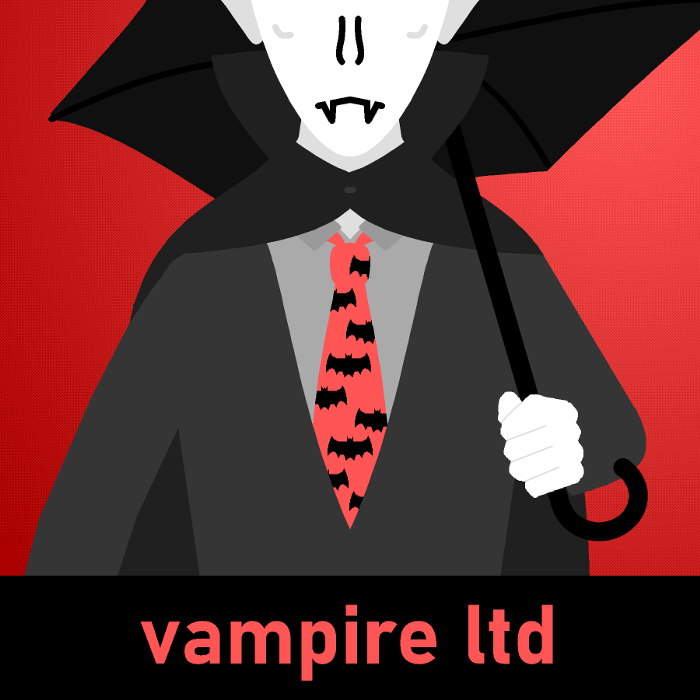
One of the best Interactive Fiction games that I’ve played recently, Vampire Ltd. is described as being “a corporate espionage adventure (with vampires in it).”

Taking place in a world where vampires are not only known to exist but where they often become rich and powerful businessman, Vampire Ltd. has the player take on the role of Nero Brashov.  Nero is a former aristocrat, a current vampire, and a failed businessman.  But the failure is not your fault.  You were cheated by your business partner, Hadrian.  Now, Hadrian is on the verge of unveiling something that he calls the Moonlite and you’re determined to get revenge by sneaking your way into his corporate office and destroying the machine.

The only problem is that you’re a vampire and you can’t enter unless someone invites you in.  Can you convince someone to do that?

A clever and very detailed mix of horror and corporate espionage, Vampire Ltd. is a frequently hilarious text adventure in which you alternate between dealing with the realities of corporate life and your desire for revenge.  While the puzzles are not excessively difficult, they do require a little work to figure out but the game comes with a walk-through for those who might get lost.

Vampire Ltd. is a game that benefits from being played more than once.  There’s a lot that your vampire can do.  It’s not necessary to do all of it to win the game but it’s still rewarding to replay and discover all of the different things that can happen.  Fortunately, the game ends with a series of suggestions of things that you might want to try when you play a second or third time.

Vampire Ltd. is an entry in this year’s Interactive Fiction Competition.  It can be played here.

Game Review: The Brutal Murder of Jenny Lee (2020, Daniel Gao)


Jenny Lee was only seventeen years old when she was brutally murdered, beaten to death with her own saxophone.  Now, seventeen years later, you have been sent into the past to investigate her murder.  A disembodied voice follows you everywhere you go, sometimes offering up hints but sometimes reprimanding you if you find clues to a solution that the voice doesn’t want to hear.  The voice makes it clear that you have a limited amount of time to solve the murder and when that time expires, so will you.  When you’re not investigating, you’re in limbo, where you can move in every direction but you can never escape.  Or can you?

This work of Interactive Fiction is actually two mysteries in one.  The first is the mystery of who murdered Jenny Lee.  The other is the mystery of who you are and why you’ve been sent to the past.  Neither is an easy mystery to solve and, fortunately, the game does have a walk-through for those who just want to find out what’s going on in the most straight-forward way possible.  However, it’s best to play this game without using the walk-through so that you can fully immerse yourself in the world that it creates.  Not everything you see in the game is going to be relevant to solving the mystery.  Like all good detective stories, there are red herrings.

The best advice I can give you for what to do while playing The Brutal Murder of Jenny Lee is to write things down.  A lot of the game’s clues involve remembering either directions or passcodes.  Making the right or wrong decision when going either north, south, east, or west be can be the difference between a good ending and a bad ending.

The Brutal Murder of Jenny Lee is an entry in this year’s Interactive Fiction Competition.  It, and all of the other entries, can be played here.

Game Review: Alone (2020, Paul Michael Winters)


You’re alone.

You want to be alone.

Surviving what has happened to the world requires you to be alone.

But if you want to keep driving down the hallway, you’re going to have to find the closest garage and get some gas.  And when the gas pumps turn out to be locked, you’re going to have to figure out how to get them unlocked and you might not be able to do it alone.

Alone is a post-apocalyptic Interactive Fiction game.  While you try to solve the puzzle of how to unlock the gas pumps, you also find journals and other notes that reveal what has happened to the world and why it’s so important to stay isolated from other people.  It’s not a bad text game.  The descriptions are sparse but effective and the puzzles are not that difficult to solve as long as you pay attention.  As befits its story, it’s a straight forward game without any unnecessary padding.  In the game, you don’t have any time to waste and neither does Alone.

Not surprisingly, Alone is one of many IF games that I’ve played this year that deals with people having to isolate themselves because of an apocalyptic events.  This is the year of the quarantine so, of course, it’s going to be reflected in our games, books, and movies.  I think that’s one reason why Alone sticks with you.  Right now, a lot of people are feeling alone.  Depending on the choices you make and how you play the game, Alone can end on a note of either hope or uncertainty.  It’s up to you.

Alone is one of the entrants in the 26th annual Interactive Fiction Competition, which is currently ongoing and accepting entries until November 29th.  You can play it (and all the other entries) by visiting the Interactive Fiction Comp’s home page.

Game Review: Six Gray Rats Crawl Up The Pillow (2015, Caleb Wilson as “Boswell Crain”)


You are Rinaldo di Gorgonzola, a spoiled fop living in Renaissance-era Italy.  With the plague shutting down most of the country and with you needing money to pay your rent, you accept a bet.  All you have to do to win is spend the night in the deserted castle of a recently deceased nobleman.

The main challenge of this Interactive Fiction game is to figure out how to get to sleep.  Getting in the caste is easy.  Since there’s only three rooms in the castle, finding the bedroom is easy.  Once you figure out that the command is “enter bed” and not “lie on bed,” getting on the bed is easy.  It’s getting to sleep that’s the hard part.  Not only are there things you have to do — like get undressed, eat, and read — before you can go to sleep but you also have to deal with a series of memories.  This game is unique in that your inventory includes memories that have to be examined before you can go to sleep.  Each memory leads to another memory until you finally reach one memory that will not go away.  The solution for getting rid of that memory is so simple that I’m worried that it took me so long to solve the puzzle.  I might not be as good at these games as I think I am.

The game doesn’t end once you fall asleep.  There’s some other things that you have to deal with.  You didn’t think that spending the night in a dead nobleman’s castle would be easy, did you?  But those puzzles are considerably easier to solve than the puzzle of how to get to sleep in the first place.

Six Gray Rats Crawl Up The Pillow is a well-written and atmospheric game.  There’s a lot of unexpected wit to be found in the game.  At one point, I grew so frustrated with trying to figure out how to go to sleep that I commanded the game “shoot shelf,” just to be reprimanded for always thinking about myself.  Another entertaining thing to do is to try to pick up the corpse of the nobleman.  (Yes, it does seem that the body was just left in the bedroom.)  I liked the way the game incorporated memories into the inventory, though I think some of the memories could have been combined to help the game flow better.  It took me about 40 minutes to play the entire game.  Someone who is actually good at this will probably be able to do it in 10.  It can be downloaded from here.

Game Review: Ghosts Are Good Hosts (2015, Leonard Pilchin)


Waiting for an invitation to arrive
Goin’ to a party where no one’s still alive
Waiting for an invitation to arrive
Goin’ to a party where no one’s still alive

— Dead Man’s Party by Oingo Boingo, lyrics by Danny Elfman

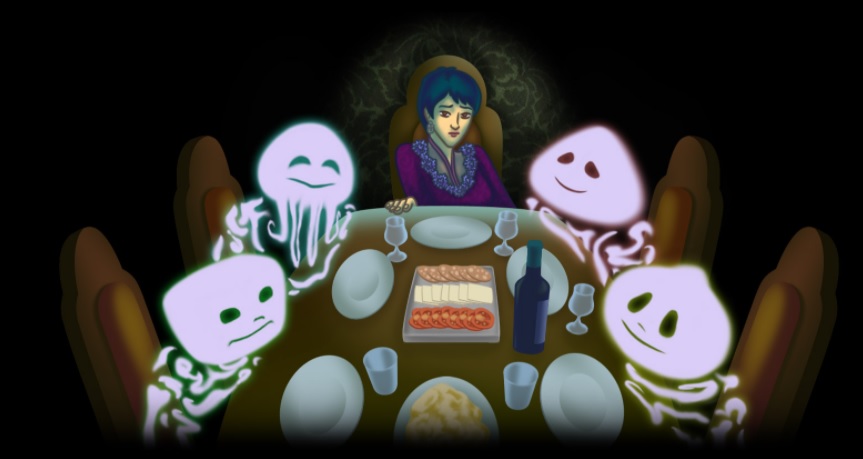
Last night, you dreamed about going to a party that was being thrown by ghosts.  The next morning, you receive an invitation to just such a party.  Of course, you go.  When you arrive, you meet Annabel, who is not a ghost.  However, the ghosts soon arrive and, once gathered around the table, they look at you with hungry eyes.

As the title of this game states, ghosts are good hosts.  However, they also want to eat you and Annabel for dinner!  Since there’s no way for you to leave the dining room without the permission of your hosts, you’re going to have to talk to the ghosts and somehow win them over.  Not even a ghost would be willing to eat its own friend.

Talk to Corsair, Halle, Kal, and Soul.  It’s not hard.  (All you have to do is point and click and then select what questions you want to ask them.)  Get to know them.  Ask them about each other.  Learn about their stories and compliment them at the right time.  Once you think that you’ve won each ghost over, ask them if they want to be “ghost friends.”  Ask too soon and you’ll get rejected and you might even get eaten.  Ask at the right time and you’ll have a pleasant ghost party and you might even make a living friend out of Annabel.

Ghosts Are Good Hosts is a surprisingly challenging but good-natured TWINE game.  The challenge isn’t finding the right questions to ask as much as it’s asking them in the right order and to the right ghost at the right time.  It’s not easy but it is fun, mostly because each ghost has their own unique story and personality.  Along with the wonderful graphics, the game has a retro feel which will appeal to the nostalgia of every 90s kid who used to play games on a big, bulky personal computer.

Ghost Are Good Hosts can be played here.  If you’re struggling to not get eaten, a walk-through is available here.

Game Review: The Sock Puppet Killer (2019, Jason Cantalini)


In this diabolically clever work of interactive fiction, the narrator needs you to track down the Sock Puppet Killer!

Who is the Sock Puppet Killer?  A killer who kills sock puppets, of course!  And why are you the only one who can stop him?  Because that narrator says that you’re former Chief Inspector Caine Slade, the brilliant detective who has been a pathetic drunk ever since the tragic death of your family!

You can tell the narrator that you’re not interested in catching the Sock Puppet Killer.  You can say that you won’t even “do it for the children!”  (Yes, that is an option.)  You can say that you have no memory of ever being Caine Slade.  You can tell the narrator, in detail, why his story doesn’t make any sense.  But eventually, you’re going to end up in a bar, approaching a beautiful woman who you’ve been told is the Sock Puppet Killer.

This is one weird game and winning it going to require more than one try.  Fully understanding everything that is happening is going to take probably a dozen tries.  There are a variety of different decisions to be made throughout the game.  Make the wrong decision and you’ll end up dead.  Make the right decision and you very well could still end up dead.  The best piece of advice that I can give you (without spoiling the game, of course) is to avoid pissing off the narrator.  At one point, I very adamantly told him that I wasn’t going to approach the Sock Puppet Killer and I suddenly found myself drowning in the ocean.  It’s accepted in almost all Interactive Fiction games that the narrator is basically God but The Sock Puppet Killer is remarkable for featuring an easily angered and very vengeful God.

The Sock Puppet Killer is well-written and often loud out loud hilarious.  It’s not an easy game but that just makes it all the more rewarding if you manage to get through the entire thing without dying.

The game can be played by clicking here.

Game Review: Bogeyman (2018, Elizabeth Smyth)


In this interactive fiction game, you are put in the role of a child who, after having what you believe to be a nightmare about being abducted, wakes up to discover that you actually have been abducted.  You are now one of several children, living in an isolated mountain cabin and subject to the unpredictable and often cruel whims of your abductor.  Escape seems impossible and survival is going to mean making some truly grim choices.

Bogeyman starts out with a dark premise and then it just gets progressively more dark from there.  Whenever you think that the story can’t get any more unsettling, it does.  It’s not a game where you always get as many choices as you would like.  Often, you have to decide between doing a bad thing or doing an even worse thing.  It’s also not a short game but it grabs your interest from the very first line and I played all the way to the end because, after spending just a few minutes experiencing life in that cabin, I had to know how it would all end.

Bogeyman is a Twine game and it actually makes good use of the format.  White text slowly appears against a black background while subtle but spooky music plays in the background.  Your choices are in all caps, highlighting the desperation of your situation.  There are a few graphics but most of the game takes place in your head.  The game does such a good job of describing the cabin and the situation that you feel like you’re there.

Well-written and carefully put together, Bogeyman is an IF game that sticks with you.  You can experience it here.


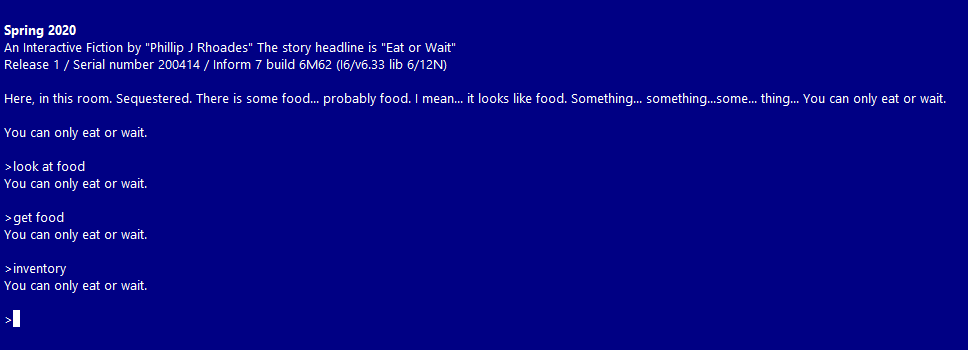
Game Review: Spring 2020 (2020, Philip J. Rhoades)


Click to Enlarge

In this existential, sequester-inspired horror film, you start in a room.  You cannot leave the room.  There is something appears to be food in the room.  You can do two things.  As the game puts it, “You can only eat or wait.”

The game’s not lying about that, either.  I tried all sorts of tricks to see if maybe I could fool the game into letting me do something else.  I tried to look at the food.  I tried to get the food.  I tried to go north.  I tried to go east.  I tried to go west.  I tried to go south.  I tried to examine the room.  I tried them all.  Just to be told, “You can only eat or wait.”

So, during one game, I ate.  During the next game, I waited.  I did both of those for several turns and things did not go well for me at all.  This is a game that you cannot win but it also captures the way many people feel about 2020.  This is the year when no one wins so why not play a game where no one wins?  It’s a simple game but it captures the mood of the year.

If you want to play this game, you can download it from here.  

Just remember, you only eat or wait.

Game Review: Rockstar (1989, Wizard Games)


Do you want to be a rockstar despite having no musical talent?

Then get over to the Internet Archive and play Rockstar, which is about as close to being a music superstar as most of us will ever get a chance to be!

In Rockstar, you’re a musician.  You start out as a poor, aspiring star.  You’ve got health, creativity, and happiness but you also don’t have any money.  How can you get money?  You can tour the local pubs.  And once you get the money, maybe you can record a single or even an album.  If that album sells well, you might get a record contract.  With a record contract comes so much money that you never have to worry about it again and that’s a good thing because, if you go bankrupt, you have to get a real job and the game ends.

Unfortunately, once you’ve signed that record deal, you’re pretty much a slave to the record company.  They’re going to want you to tour and record and make videos on a regular basis.  Tour too much and it will have a bad effect on your health.  Record too often and your creativity will dry up.  Work too hard and your happiness will go downhill and there will be a good chance that the game will suddenly tell you that you’ve committed suicide.

Fortunately, there’s a way to recharge your happiness and your creativity!  You can take drugs!  The game gives you the option to decide which drugs you want to take.  You can drink.  You can smoke marijuana.  You can drop acid.  You can do cocaine and heroin.  You can get hooked on speed.  Of course, you can be a rock star without doing drugs but it takes a lot longer and it’s not halfway as fun.  The secret is to find the perfect balance of drugs and to go to rehab whenever you’ve become too addicted.  (Otherwise, there’s a good chance you’ll eventually end up dying of an overdose.)  Unfortunately, going to rehab pretty much zaps away all of your happiness.  Assuming that you survive the rehab experience, you’re only option to cheer yourself up is to start doing drugs again.  Do too many drugs and you’ll overdose.  You might survive the overdose but you’ll have to recover in the hospital, which again sucks away your happiness.  Once you get out of the hospital, you better call your connection and quick.

There’s only two ways that Rockstar can end.  You can either voluntarily retire, which brings your career and your fame to an end.  Or you can eventually die, which brings your life to an end but which also ensures that you’ll be remembered forever.  It probably sounds like a depressing game but it’s not.  Whenever the game told me that my latest single was the number one song in America, Europe, and the UK, it made all of the drug overdoses and mental breakdowns worth it.  You don’t play a game like Rockstar to win.  You play it to see how long you can survive.  The longest I’ve kept one of my rock stars alive was for ten years.  Eventually, he drank himself to death while on holiday but it was still a hell of a ride.

Rockstar can be played at the Internet Archive.

Game Review: Detroit: Become Human (2018, Quantic Dream)


Detroit: Become Human takes place in a Detroit of the near future.

Androids, built, programmed, and sold by CyberLife, have become so common place that almost everyone seems to own one.  The androids do everything from domestic work to hard labor to even dangerous security work.  Because they are viewed as just being machines, they have no rights in American society and they are often blamed for stealing jobs from hardworking humans.  Androids have become a luxury that few humans can do without.  Some try to treat their android laborers with respect while other humans are abusively cruel, secure in the knowledge that a damaged android can easily be replaced with a newer model.
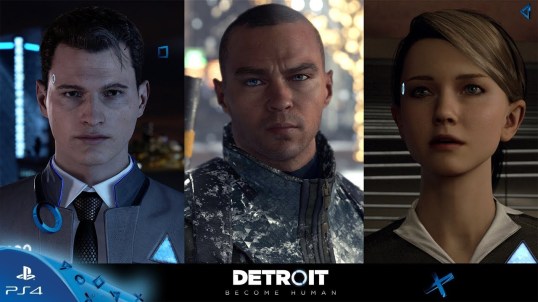
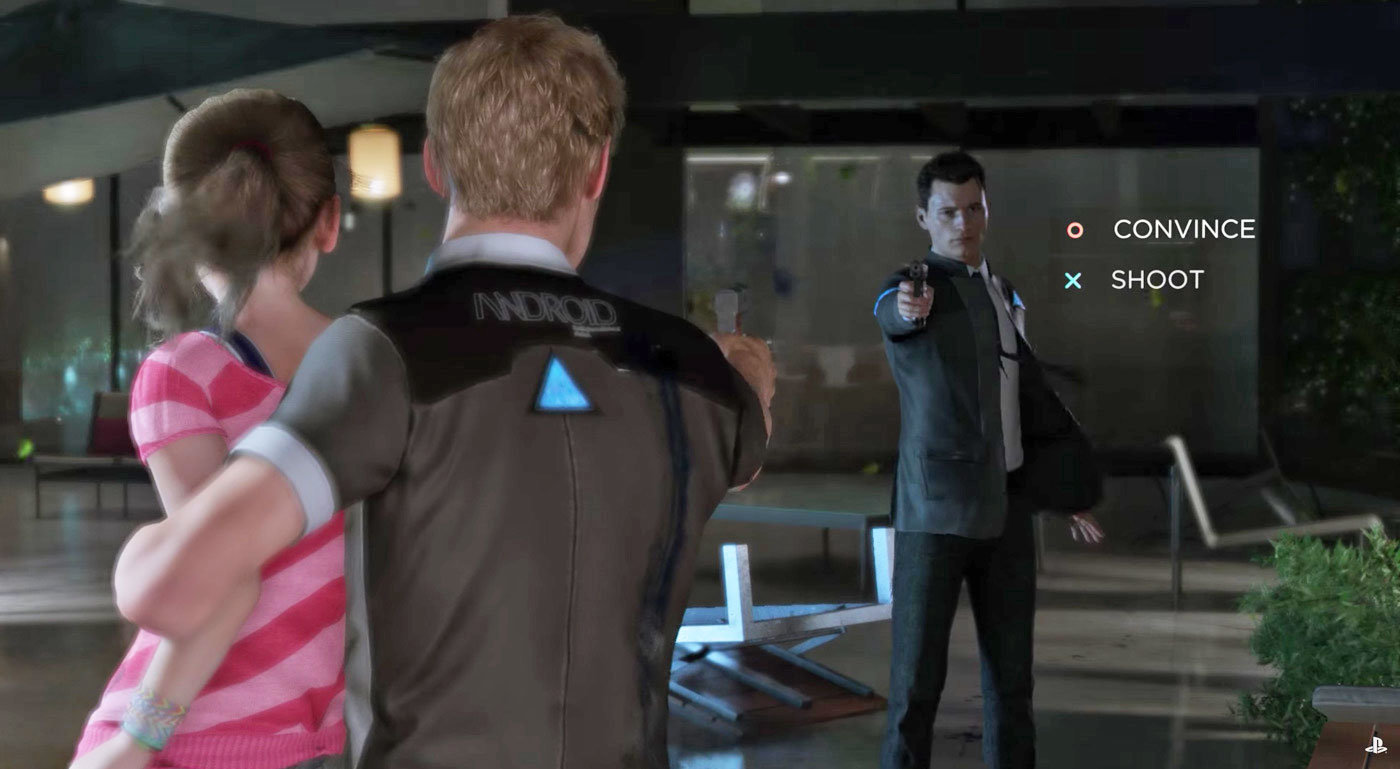
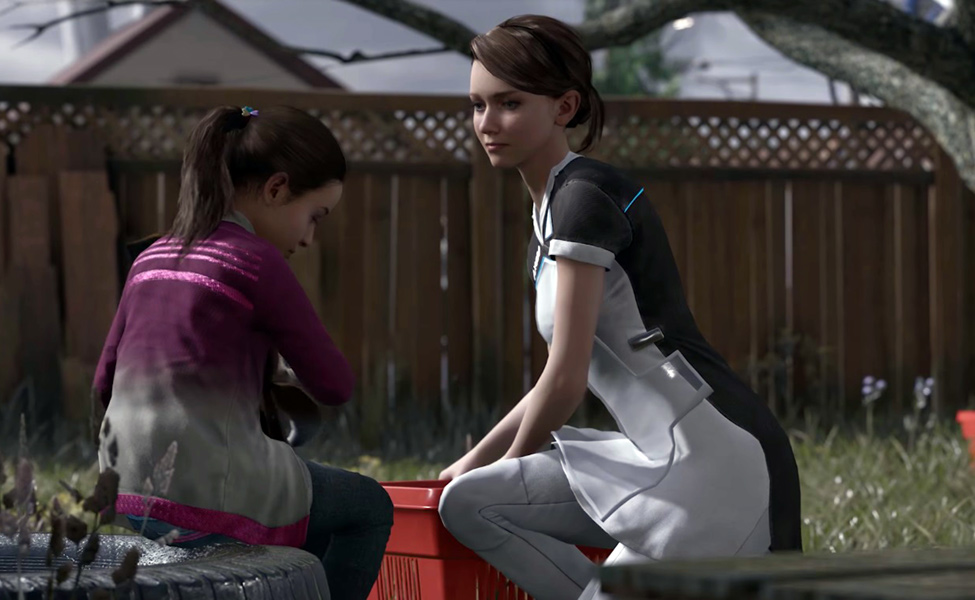
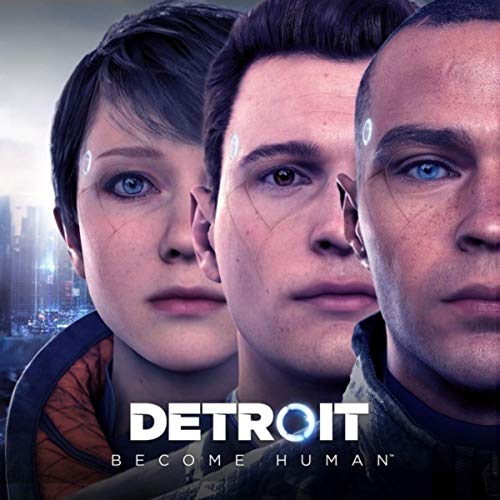
Detroit: Become Human is game about three androids, all of whom the player will control at different points in the game.  Two of the androids, Markus and Kara, turn deviant and develop their own free will.  Markus ends up discovering the android community of Jericho and, depending on decisions made by the player, can end up leading either a peaceful or violent revolution against the human race.  Kara is an abused housekeeper android who, after escaping her owner, runs away with a young girl named Alice and attempts to reach Canada, where there are no laws limiting the rights of androids.  On her journey, Kara discovers a mad scientist who tortures androids, a deserted amusement park that is populated exclusively by androids waiting for their humans to return, and eventually the future’s version of the Underground Railroad.
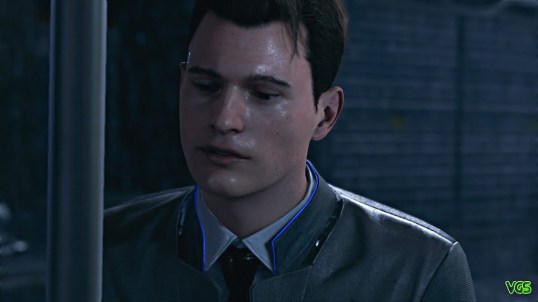
Lastly, Connor is an android who has been designed by CyberLife to track down and destroy deviants.  Connor is assigned to work with police Lt. Hank Anderson to discover why so many androids have been turning on their owners.  Much like Heavy Rain‘s Norman Jayden, Connor is an outsider who has been assigned to aide the establishment.  Just as Norman sought refuge in a VR world, Connor finds himself summoned to an ever-changing zen garden where he is asked questions by his superior and it is up to the player to decide if Connor should tell the truth or lie.  Like Norman, Connor eventually has to decide which side he is on.  How Connor’s story progresses depends on the decisions made by the player.  Choose one path and Connor and Hank can become unlikely allies and Connor might even end up going deviant himself.  Choose another path and Connor might remain a loyal servant of CyberLife to the very end.  It may sound like an easy choice to make but nothing concerning Connor is ever that simple.
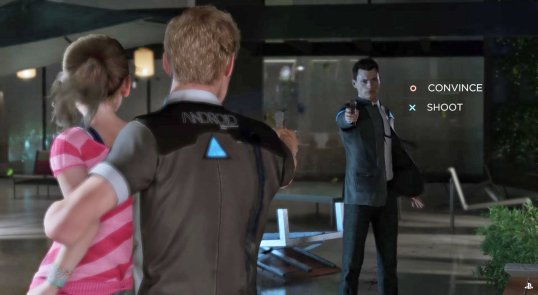
Of all the games that I’ve recently played, Detroit: Become Human is tied with Spider-Man for my favorite.  Like Quantic Dream’s previous games, Heavy Rain and Beyond: Two Souls, Detroit: Become Human tells a sprawling story where nearly every single decision that you make effects what happens in the game.  Like those previous two games, there are no do-overs.  If Markus or Kara dies during one of their chapters, the game continues without them.  (Connor, on the other hand, is just rebuilt by CyberLife and sent back into the field.)  Because the game follows three distinct (but connected) storylines, it is estimated to have over 40 possible endings, which makes it a game that very much rewards being replayed and experimented with.
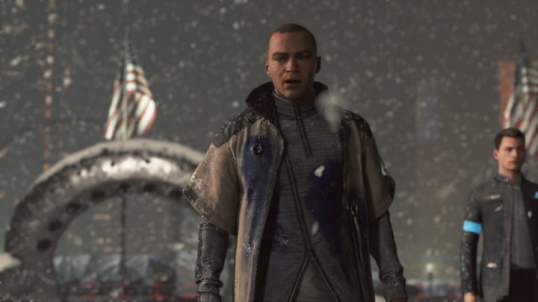
Detroit: Become Human takes the storytelling and the gameplay concepts introduced in Heavy Rain and Beyond: Two Souls and it improves on both of them.  Unlike the uncertain voice acting of Heavy Rain, Detroit: Become Human features characters played by actors like Clancy Brown, Lance Henriksen, Minka Kelly, and Jesse Williams, all of whom do an excellent job of bringing their characters to life.  The game’s recreation of Detroit and the surrounding area is visually rich and detailed and, unlike Beyond: Two Souls, Detroit: Become Human does not get bogged down in quick time events.  Detroit: Big Human is a game that rewards observant and intelligent players who want to do more than just push buttons while they’re playing a game.

Of course, this is a Quantic Dream game so don’t expect any of Detroit: Become Human‘s political subtext to be subtle.  When t comes to dealing with issues, this game is even more heavy-handed than Beyond: Two Souls.  There’s barely a good human to be found in this game’s version of Detroit.  The best of them is Clancy Brown’s Hank who manages to hate everyone, human and android, equally.  (Of course, who Hank or anyone else in the film ultimately turns out to be, depends on the choices that you make during the game.)  The most interesting of the human characters, though, is Carl Manfred, the artist played Lance Henriksen.  Carl tries to teach Markus how to be human and it’s a confrontation between Carl and his real son (who is jealous of Carl’s relationship with Markus) that leads to Markus setting off on his own.  If Carl dies during the confrontation, he remains an inspiration to Markus and his revolution.  If Carl survives, his later reaction to Markus will depend on what the player has chosen to have Markus do over the course of the game.  Is Carl as benevolent as he seems or was his earlier kindness to Markus just his way of assuaging his own guilt over essentially being a slave owner?  The answer depends on how you play the game.
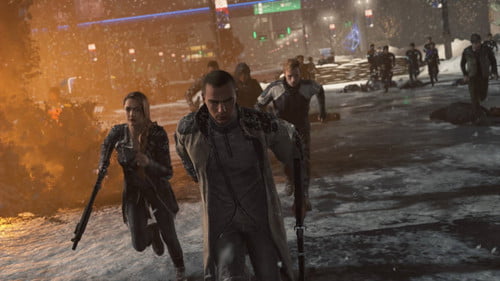
In the end, it’s the sheer number of possible endings that truly sets this game apart.  This is especially true of Kara.  I haven’t discovered all of the endings yet but, from those that I have reached, Kara’s story always seems to get either the best or the darkest possible conclusion.  Markus, meanwhile, can either be an android of peace or an android of war.  After everything that he is forced to endure over the course of the game, it’s difficult not to go for war every time.  As for Connor, it’s all up to you.  Ultimately, everything is up to you.

I look forward to replaying Detroit: Become Human and seeing what other endings this game has to offer.  And I look forward to seeing what will come next from Quantic Dream.