Horror Film Review: One Hour Photo (dir by Mark Romanek)


I guess some people might argue that the 2002 film, One Hour Photo, isn’t really a horror film.

It’s an argument that I can understand.  The film does have its scary moments, like the scene where Sy Parrish (Robin Williams) dreams that his eyes are exploding.  But there aren’t any ghosts or vampires or hockey mask-wearing slashers to be found in One Hour Photo.  Even the film’s most disturbing moment — in which we see that Sy’s apartment is nearly empty except for a giant collage of pictures that cover his living room wall — is more depressing than scary.

It’s really a very sad movie.  In fact, it’s probably even more sad today than when it was originally released.  Now, when you see Robin Williams’s sad eyes and you hear him talking about how reality can never live up to a photograph, it’s impossible not to think about the actor’s 2014 suicide.  I remember that, when One Hour Photo and Insomnia came out in the same year, there was a lot of talk about how unexpected it was to see Robin Williams playing such dark characters.  Now, of course, that darkness is a key part of Robin Williams’s persona.

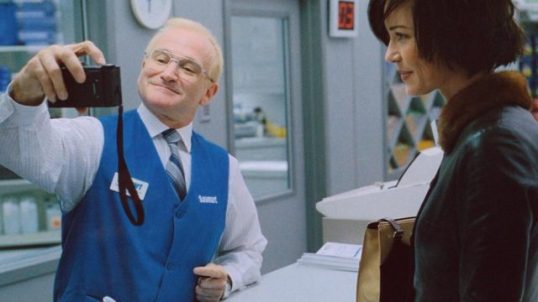
In hindsight, it’s also sad because one watches the film with the knowledge that, even if Sy hadn’t lost it at the end of One Hour Photo, he still probably be a lost soul in 2019.  When we first meet Sy, he’s working at the one-hour photo lab in SavMart.  He talks about how much he loves developing pictures.  When someone mentions that they’ve been thinking about getting a digital camera, Sy nervously chuckles and says, “Don’t do that, you’ll put us out of business.”  Of course, in 2019, people take pictures with their phones and even digital cameras are viewed as being something of a relic.  If Sy were around and free today, I doubt he’d have a job.  If he did have a job, it’s doubtful it would be one that would allow him to cover his wall with someone else’s photos.  Instead, in 2019, I imagine Sy would be one of those people following strangers on social media and printing out all their pictures and probably sending them unsolicited DMs and private messages.

Sy is obsessed with the Yorkin family, Will (Michael Vartan), Nina (Connie Nielsen), and their son, Jake (Dylan Smith).  Even though the family barely knows who Sy is, he knows them because Sy has spent years developing (and stealing) their photos.  Sy views them as being the perfect family.  They’re the family that he wants to be a part of.  “Sometimes I think of myself as being Uncle Sy,” he says at one point.  But then Maya Burson (Erin Daniels) brings in her photos to be developed and Sy learns that the reality of the Yorkins is not as perfect as the photographs.  And Sy loses it.

Actually, there’s quite a few reasons why Sy loses it and the film suggests that, if the Yorkins had never stepped into SavMart, Sy would have found another family on which to obsess.  Something is missing inside of Sy.  Incapable of dealing with reality, Sy instead deals with posed pictures of happy times.  Towards the end of the film, there’s a throw-away line that attempts to offer some sort of insight into why Sy is such a lost soul.  Personally, I think the film works better without an explanation.  Why is less important than the fact that Sy exists.

In the end, One Hour Photo qualifies as a horror film not because of any paranormal danger but because it’s a film about the horror of everyday life.  You never know who might be watching you.  That friendly clerk who waits on you at the grocery store might be following you home and imagining that he’s a part of your life.  You never know.  One Hour Photo is the film that suggests that, lurking behind every friendly smile, there’s a blank Sy Parrish.  It’s a scary thought.
Horror on the Lens: Plan 9 From Outer Space (dir by Edward D. Wood, Jr.)


Watching Ed Wood’s infamous Plan 9 From Outer Space is something of an October tradition here at the Shattered Lens!  And you know how much I love tradition!

Some people say that this film has a reputation for being the worst film ever made.  Personally, I don’t think that it deserves that reputation.  Is it bad?  By traditional standards of quality, I guess it can be argued that Plan 9 From Outer Space is a bad movie.  But it’s also a lot of fun and how can you not smile when you hear Criswell’s opening and closing statements?

Enjoy and be sure to read Gary’s review!

(And also be sure to read Jedadiah Leland’s tribute to Criswell!)

(On another note: Watch this as quickly as you can because, over the least year or so, it seems like all the films of Ed Wood get yanked off YouTube as soon as they are posted.  Copyright violations, they say.  Personally, I think that’s shameful.  First off, Ed Wood is no longer alive.  Wood had no children and his widow died in 2006, having never remarried.  Whatever money is being made off of his films is not going to support his family.  Wherever he is, I think Ed would be more concerned that people see his films than some faceless corporation make money off of them.)

(It seems like, every year, someone threatens to either remake Plan 9 or produce a sequel.  Again, the original is all that is needed.)

Monster Chiller Horror Theatre: Deadly Companion (1980, directed by George Bloomfield)


Deadly Companion starts with John Candy sitting in a mental institution and snorting cocaine while happily talking to his roommate, Michael Taylor (Michael Sarrazin).  Michael has been in the institution ever since the night that he walked in on his estranged wife being murdered.  Because of the shock, he can’t remember anything that he saw that night.  When his girlfriend Paula (Susan Clark) comes to pick Michael up, Michael leaves the institution determined to get to the truth about his wife’s murder.  Once Michael leaves, John Candy disappears from the movie.
Michael suspects that his wife was killed by her lover, Lawrence Miles (Anthony Perkins) but there is more to that night than Michael is remembering.  Deadly Companion is a typical low-budget shot-in-Toronto thriller from the early 80s, with familiar Canadian character actors like Michael Ironside, Al Waxman, Kenneth Welsh, and Maury Chaykin all playing small roles.  Michael Sarrazin is a dull lead but Anthony Perkins gets to do what he did best at the end of his career and plays a thoroughly sarcastic bastard who gets the only good lines in the film.

What’s interesting about Deadly Companion isn’t the predictable plot and it’s certainly not Michael Sarrazin.  Instead, what’s strange is that several cast members of SCTV show up in tiny supporting roles, though none of them get as much of a chance to make as big an impression as John Candy.  Deadly Companion is a serious thriller that just happens to feature Candy, Joe Flaherty, Eugene Levy, Catherine O’Hara, and Dave Thomas.  It’s strange to see Michael Sarrazin trying to figure out who killed his wife while Eugene Levy loiters in the background.  It leaves you waiting for a punchline that never comes.

The SCTV people are in the film because it was directed by George Bloomfield, who also directed several episodes of SCTV.  Since this film was made before SCTV really broke into the American marketplace, it was probably assumed that no one outside of Canada would ever find the presence of John Candy in a dramatic murder mystery distracting.  Of course, when Deadly Companion was later released on VHS in the late 80s, Candy and the SCTV crew were all given top billing.

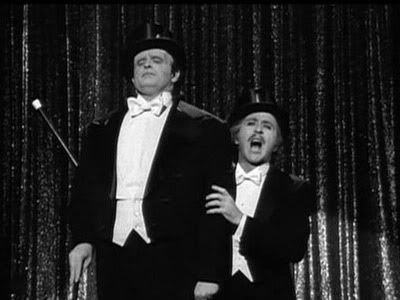
Horror Scenes That I Love: Frankenstein and his Creation Put On The Ritz From Young Frankenstein


This scene from 1974’s Young Frankenstein is not only funny but kinda poignant and sad.  I mean, you can tell that the Monster (Peter Boyle) is trying so hard to do a good job and what does it get him?  Not only does the audience turn on him but even his creator (Gene Wilder) starts yelling at him.

I mean, considering that the Monster had only been alive for a few days, I think he deserves a lot of credit for handling the performance as well as could be expected!  To me, the true monsters in this scene are the theater patrons who apparently brought cabbages and other vegetables with them to the theater.  I mean, you don’t pack a salad unless you’re planning on using it.

The performers didn’t have a chance.

Enjoy!


4 Shots From 4 Films: Evil Dead II, Near Dark, Stage Fright, The Stepfather


4 Shots From 4 Films is just what it says it is, 4 shots from 4 of our favorite films. As opposed to the reviews and recaps that we usually post, 4 Shots From 4 Films lets the visuals do the talking!

This October, we’re using 4 Shots From 4 Films to look at some of the best years that horror has to offer!

4 Shots From 4 1987 Horror Films

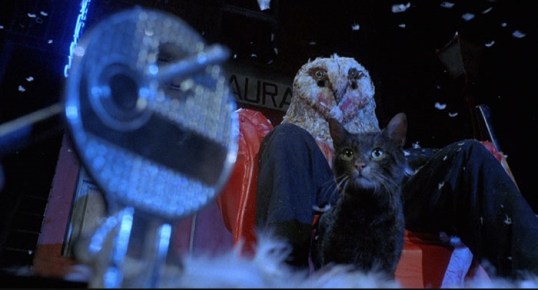
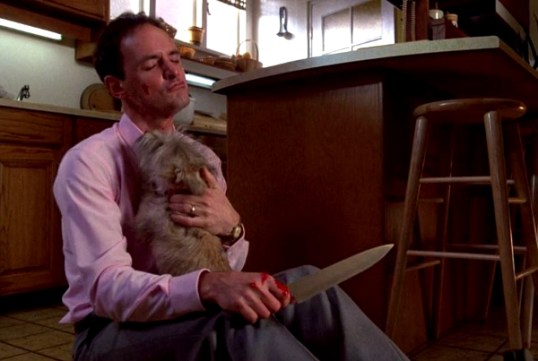
Evil Dead II (1987, dir by Sam Raimi)

Near Dark (1987, dir by Kathryn Bigelow)

Stage Fright (1987, dir by Michele Soavi)

The Stepfather (1987, dir by Joseph Ruben)

Horror On The Lens: The Giant Gila Monster (dir by Ray Kellogg)


For today’s horror on the lens, we present to you the 1959 film, The Giant Gila Monster!

As you can tell from the title, this is another one of those big lizard films, which were so popular back in the 50s and early 60s.  For reasons that aren’t quite clear, a lizard grows to giant size and it’s up to a bunch teenagers, law enforcement officers, and small town citizens to put nature back in its place!

The Giant Gila Monster was filmed outside of Dallas and it was produced by Gordon McLendon.  Now, admittedly, you might not recognize the name but he was one of the most important figures in the history of DFW.  McLendon founded KLIF, which is DFW’s top talk radio station.  He also once ran for the Senate, as a conservative Democrat.  By most accounts that I’ve read, he was a true Texas character so I guess it makes sense that, along with all of his other accomplishments, he would add film producer to the list.

Anyway, enjoy this movie about a giant lizard!  Gila monsters, I should add, are freaking scary enough when they’re normal-sized.  That said, the lizard in this film is actually a Mexican beaded lizard and not an actual Gila monster.

Enjoy!

The Things You Find On Netflix: El Camino: A Breaking Bad Movie (dir by Vince Gilligan)


As one might expect from the sequel film to Breaking Bad, the shadow of Walter White hangs over very minute of El Camino.

Physically, Bryan Cranston doesn’t have a large role in El Camino.  Like many of the characters from Breaking Bad, he appears only in a flashback.  Jesse Pinkman (Aaron Paul) spends a good deal of this movie dwelling on the past, perhaps because the only way that he can have a future is by mentally forgiving himself for all the stuff that went on while he was cooking meth with Walter White and, later, for the Nazi bikers who kept him chained up in a cage like an animal.  So, it makes sense that we would see a lot of flashbacks, the majority featuring characters who are no longer alive.  Cranston’s Walter White only appears towards the end of the film, when Jesse remembers the conversation they had at a diner about what Jesse was going to do with the money that they were making.  It’s a bit jarring to see them, largely because Walter still looks like an earnest and frail science teacher while Jesse is still young, loud, and more than a little obnoxious.  It’s quite a contrast to what we know will eventually happen to both characters.

For obvious reasons, Walter White isn’t in much of El Camino but his ghost seems to following Jesse through the entire movie. For that matter, so does the ghost of Tod Alquist (Jesse Plemons).  It’s not just that a good deal of the movie deals with Jesse trying to figure out where Tod hid all of his money.  (Jesse is planning on using the money to hopefully escape New Mexico and start a new life in Alaska.)  It’s also that Jesse has been scarred, both physically and mentally, by the Hellish time that he spent as Tod’s …. well, Tod’s pet.  Tod treated Jesse like a dog, keeping him on a leash, punishing him for being “bad,” and then offering Jesse pizza as a reward whenever Jesse did something right.  To be honest, the flashbacks with Tod take some getting used to, largely because Plemons has obviously aged quite a bit between the finale of Breaking Bad and the shooting of El Camino.  But, still, Plemons is absolutely terrifying as the unfailingly polite but definitely sociopathic Tod.  At one point, Tod casually brings Jesse over to his apartment so that Jesse can help dispose of the body of his cleaning lady.  Tod murdered her because she came across some money that he was hiding in a hollowed-out book.  Tod shrugs as he tells the story of her murder, as if his actions are as commonplace as waking up and going to bed.

Throughout Breaking Bad, Jesse spent most of the series being manipulated by evil men.  What was ironic, of course, was that Jesse was the only one of those men who must people automatically considered to be a criminal.  Everyone thought that Walter was a tragic family man.  Tod was largely anonymous and those who did notice him usually assumed he was just an eccentric weirdo.  Jesse, on the other hand, was the guy who was continually getting hauled in by the police and harassed by the DEA.  He was the one who was viewed as being a danger to society even though he eventually proved himself to be one of the few characters with anything resembling a conscience.  In El Camino, Jesse finally gets a chance to determine his own fate.  Will he embrace the lucrative but soul-destroying greed of Walter and Tod?  Or will he escape and try to make a new life for himself?

El Camino is a visually stunning tour-de-force, anchored by Aaron Paul’s empathetic performance as Jesse.  Jesse is no longer as loud as he may have been in Breaking Bad.  He’s a man haunted by the past and, watching the film, you know, regardless of whether he makes it to Alaska, the scars will never fully heal.  He has the haunted eyes of a man who is never going to be fully okay, regardless of where he ends up.  In fact, if we’re going to be realistic, he probably doesn’t have much of a future ahead of him.  Those ghosts are always going to follow him and, as Robert Forster’s Ed sagely explains it, much of what has happened is due to Jesse’s own poor decisions.

Still, whatever mistakes he’s made in the past, you can’t help but wish the best for Jesse Pinkman.

He’s earned it.

The Dirt On The Relentless: American Satan (2017, directed by Ash Avildsen)


The Relentless are the biggest band in the world, even though their music sounds like it belongs in the 80s.  Led by charismatic singer Johnny Faust (Andy Biersack), the Relentless have just released their debut album, American Satan.  Now, they’re touring the country, doing every drug they can get their hands on and every groupie that stops by their hotel.  The moral guardians say that The Relentless are a bad influence and are leading their children into Satanism.  For once, the moral guardians are right.  Back when they were just a struggling band in Los Angeles, The Relentless made a deal with Satan (Malcolm McDowell).  All they had to do was sacrifice the lead singer of a rival band (played by former teen idol Drake Bell) and all their dreams would come true.  However, if Johnny Faust had bothered to study his namesake, he’d know better than to make a deal with the devil.

The best thing about American Satan is that it was obviously made by people who know the music industry.  All of the details at the start of the film, with the Relentless struggling to get noticed and having to hit the streets and sell tickets to their own show, felt true.  It helps that most of the members of the Relentless were played by actual musicians.  What they lacked in acting talent, they made up for with authenticity.  The music industry is a tough business to break into, regardless of how good or bad your band is.  After watching Johnny and the Relentless struggle with crooked promoters and unsympathetic label owners, it was believable that they would consider signing a deal with the devil.

Much like the band, the movie lost its way after the contract with the devil was signed and official.  The rioting, the groupies, and the drugs were all too predictable and the movie just became The Dirt with Satan replacing Ozzy.  American Satan seems to be building up to an epic conclusion but it never seals the deal.  Instead, it just ends with a whimper, as if no one was sure where the story was supposed to be heading.  Still, any movie that finds roles for Malcolm McDowell, Bill Duke, Goldberg, and Denise Richards can’t be all bad.

At its worse, American Satan is an anti-climatic take on the Faust legend.  At its best, its Tipper Gore’s worst nightmare.

Horror Scenes That I Love: A Nightmare From Take Shelter


Take Shelter was one of my favorite films of 2011.  It was not only the first to introduce me to director Jeff Nichols but it was also the first time that I ever watched Michael Shannon act and thought to myself, “Hmmm….so, yeah, he’s a really good actor.”

The film was usually described as being either a “psychological thriller” or “a character study” but that’s just because critics were trying to justify how good the film was by ignoring the fact that it was totally a horror film.  Shannon plays a man who is haunted by disturbing nightmares of the end of the world.  The film perfectly integrates the nightmares into the narrative, so that you’re never quite sure when one of them is going to pop up.  It’s always raining in the nightmares but sometimes, it’s cloudy while Shannon’s awake as well and you’re just like, “Oh no….”

Anyway, this is one of the nightmares and I remember it totally freaked me out when I saw Take Shelter in the theaters.  I was like, “Uhmmm….did anyone else just notice a shadow walk by the window?”

Take Shelter‘s a really good movie so you need to see it if you haven’t already.

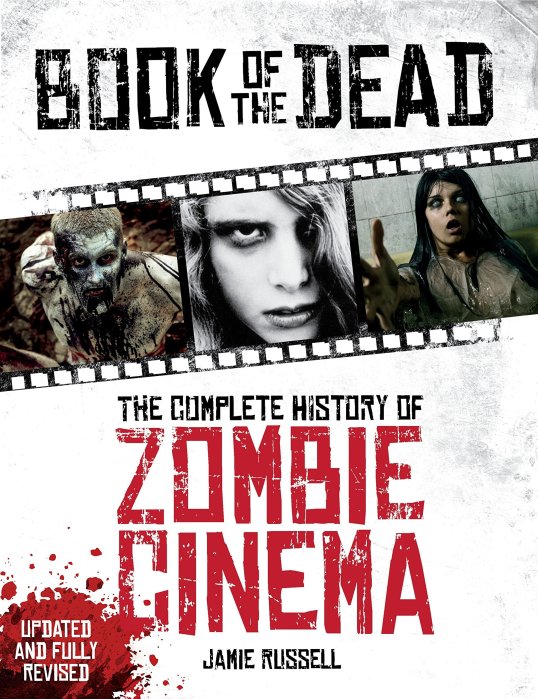
Horror Book Review: Book of the Dead by Jamie Russell


If you’re still making out your Halloween movie list, might I suggest that you pick up a copy of Jamie Russell’s Book of the Dead?  Because, seriously — what’s a Halloween movie night without a few zombies thrown into the mix?

Book of the Dead is comprehensive study of the history of zombie cinema, starting with a look at how the legend of the zombie first began and then progressing through White Zombie, the dead films of George Romero, the great Italian zombie films of Lucio Fulci, and finally moving all the way to the modern era.  Scary zombies, funny zombies, porno zombies, political zombies, underwater zombies, French zombies; they’re all here!  It’s a well-written book, one that was clearly written by somebody who not only loves the movies in general but zombie films in specific.  Russell seems to be having so much fun writing about these films that it’s impossible not to share his enthusiasm.

Even better, the book contains a comprehensive appendix that lists and reviews basically every zombie film ever made!  Seriously, there all here — from the obscure to famous.  When I first started to seriously study the history of horror cinema, Book of the Dead was one of the first resources that I purchased and I used to obsessively study that appendix.  It’s thanks to this book that I discovered films like I, Zombie: The Chronicles of Pain.  It was thanks to this book that I discovered that there was more to zombie cinema than just corpses eating brains.

This book was originally published in 2005 and, at that time, basically went up to the Resident Evil-era of zombie films.  Subsequent editions have been updated with even more zombie films and even more zombie reviews!  This is the perfect book for all of your undead needs!