4 (or more) Shots From 4 (or more) Films is just what it says it is, 4 (or more) shots from 4 (or more) of our favorite films. As opposed to the reviews and recaps that we usually post, 4 (or more) Shots From 4 (or more) Films lets the visuals do the talking.
The horror genre has been around ever since people struggled to explain their fears and horror films were a feature of cinema from the time of the earliest movies. Today, we pay tribute to some of the early entries in the horror genre with….
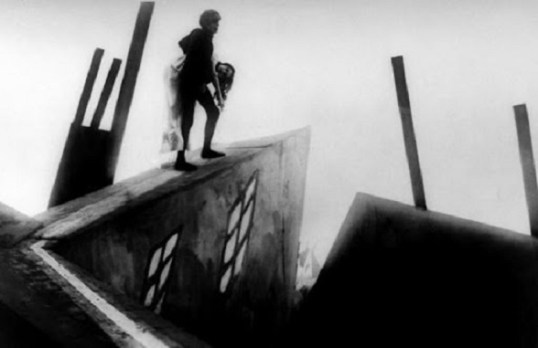
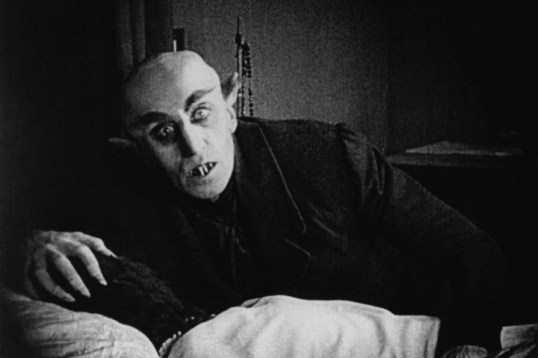
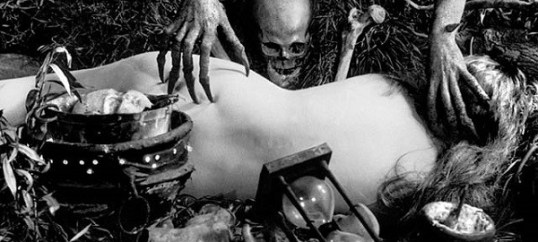
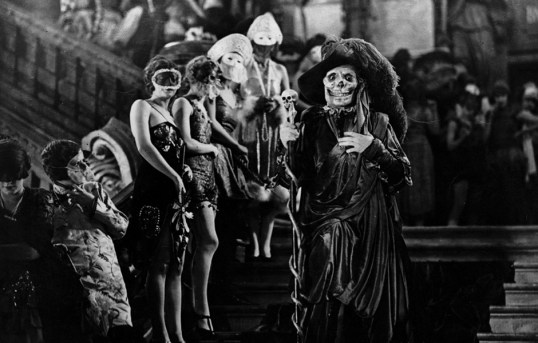
4 Shots From 4 Horror Films
The Cabinet of Dr. Caligari (1920, dir by Robert Wiene, DP: Willy Hameister)
Nosferatu (1922, dir by F.W. Murnau, DP: Fritz Arno Wagner and Günther Krampf)
Haxan (1922, dir by Benjamin Christesen, DP: Johan Ankerstjerne)
The Phantom of the Oepra (1925, dir by Rupert Julian, DP: Milton Bridenbecker, Virgil Miller, Charles Van Enger)
Today’s Horror on the Lens is a silent German film from 1926. Based on the legend of the alchemist who sold his soul to the Devil, Faust was dismissed by European critics when it was intially released but it has since been recognized as one of the great cineamtic examples of German Expressionism.
It was after directing this film that Murnau traveled to Hollywood and directed his masterpice, Sunrise: A Story of Two Humans. (Murnau was also responsible, many years earlier, for directing Nosferatu.) The role of Fasut was played by Swedish actor Gosta Ekman, who tragicaly developed an addiction to cocaine while making the film and who would die as a result in 1938. Playing the role of Mephisto is German actor Emil Jannings, who would later go to win the very first Academy Award for Best Actor. Unfortunately, with the advent of sound, Jannings — who had no interest in learning English — returned to Germany and, after making some classic films with Marlene Dietrich, spent the rest of his career appearing in Nazi propaganda films. Whether or not Jannings was a committed Nazi or just an opportunist remains a point of cotention but it’s still undoubtedly not the career path that one would hope for one of the very first Oscar winners.
Here, for the first time on the Shattered Lens, is Faust:
In what we’re told is supposed to be the 1950s (even though everybody looks and dresses as if they’re from 1989, the year this film was shot), a group of bikers murder a young waitress named Josie (Abigail Wolcott). Josie’s father hacks the biker’s to death with an axe and, years later, uses a magic blue crystal to bring Josie back to life. However, Josie is inow a succubus who wanders along the highway and waits to be picked up by random travelers. She brings them back to a ghost town called Hellgate, where her father uses the gem to turn them into zombies or ghosts or something. Jose’s latest target is a college student named Matt (Ron Palillo), who is heading up to the mountains to meet up with his girlfriend and another couple. When Matt gets distracted by Josie, will he be able to escape or will he lose his mortal soul or whatever is that supposed to be going on in the town of Hellgate?
This is a confusing film. It actually feels like a hodgepodge of outtakes from several other films which were just put together in an attempt to salvage something and hopefully make some money from the undemanding direct-to-video market. That Hellgate still has a cult following despite being an incoherent mess is proof that the film’s producers were not totally clueless. People will watch almost anything if there’s a promise of nudity. Hellgate delivers that, though much of the nudity comes from Ron Pallilo so I can only imagine how the film’s target audience of teenage horror fans reacted to that back in 1989.
This movie does indeed star Ron Palillo, better known for playing Arnold Horseshack on Welcome Back, Kotter. (In the Gabe Kaplan stand-up routine that inspired the show, Arnold’s last name was actually Horseshit but they had to clean it up for network TV.) Pailillo was in his 40s when he was cast as a college student and he looked closer to 50. Still, every woman in the film falls all over herself at the sight of Ron Palillo, even the ones who aren’t trying to steal his soul or whatever it is that Josie is actually doing in this film. Ron Palillio tries really hard to convince us that he’s a college stud but it’s impossible to look at him without thinking, “That’s Horseshack with a few extra years on him.”
If the story and the acting aren’t bad enough for you, Hellgate was also filmed in South Africa in the late 80s, at a time when Apartheid was still the law of the land and Nelson Mandela was still imprisoned. Most of the supporting actors are South African. They try and struggle to sound like they live in the American southwest. It’s hard to see what the film got out of being filmed in South Africa, other than the fact that it was cheap.
Like most really bad movies, Hellgate has got a cult following but it’s not worth the trouble. Unless you’re the world biggest Ron Pallilo fan (no judgment here!), this is one you can skip.
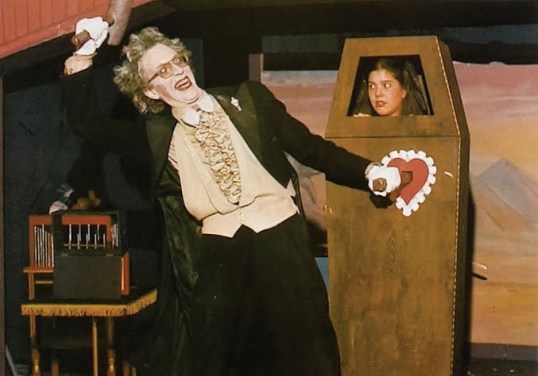
Now that it’s time to share a scene that I love, I figure why not continue to pay tribute to Tobe Hooper? The scene below is from Hooper’s unjustly neglected 1981 film, The Funhouse. It doesn’t really advance the plot in any way but it’s still a scene that I really enjoy. It shows Hooper being a bit more playful than usual and it does introduce one the film’s key themes: not everything at the carnival is what it seems. Later on in the film, the same people who made fun of this magician will discover that the magician is not the only person at the carnival who is more clever than they thought.
That’s what a friend of mine yelled a few years ago. Jack was a choreographer who had just received a call from someone in New York City, offering him the chance to come work on an off-Broadway show. He accepted, of course and then he hugged everyone who had been standing nearby, listening to the call.
“Manhattan, baby!” he shouted.
Now, the show itself didn’t really work out but Jack did get a trip to Manhattan out of it and really, I think that’s what everyone was excited about. No matter how many bad things you may hear about New York City, it’s hard not to get excited when you hear the word Manhattan. For many, Manhattan represents culture, sophistication, and wealth. For others, Manhattan represents crime, inequity, and alienation. Across the world, Manhattan stands for everything that is both good and bad about America. Just the word Manhattan carries a power to it. You would never get excited if someone announced that they had gotten a job in Minnesota, for instance. If Jack had shouted, “Minnesota, baby!,” we all would have been concerned about him. Minnesota? Who gives a fuck? But Manhattan …. Manhattan has power, baby!
Manhattan also lent its name to one of Lucio Fulci’s post-Zombi films and the title just happened to duplicate Jack’s proclomation, Manhattan Baby. Released in 1982, Manhattan Baby is often cited as being the last of Fulci’s “major” productions. While his career was reinvigorated by the success of the films he made with producer Fabrizio De Angelis (including Zombi 2 and the Beyond trilogy), Fulci and De Angelis had a falling out over Manhattan Baby. Fulci claimed that De Angelis essentially forced him to make the movie, despite the fact that Fulci himself did not have much interest in the script. Initially, the film was to be a special effects spectacluar with a large budget but, after the controversy surrounding Fulci’s The New York Ripper, the budget was drastically scaled back and the special effects were done on the cheap. Fulci later said that he felt the movie was terrible and that it set back his career.
As for what the film is actually about, Manhattan Baby deals with …. well, the plot is not easy to describe. Fulci’s films were always better known for their surreal imagery than their tight plots and, even by his standards, Manhattan Baby is all over the place. The film opens in Egypt, where archeologist George Hacker (Christopher Connelly) is struck blind when he enters a previously unexplored tomb. Meanwhile, his daughter, Susie (Brigitta Boccoli), is given an amulet by another blind woman.
Back in Manhattan, George waits for his sight to return and Susie and her little brother, Tommy (Giovanni Frezza, who played Bob In The House By The Cemetery) start to act weird. It turns out that their bedroom is now some sort of demensional gateway, from which snakes sometimes emerge. At the same time, the gateway occasionally sucks people through and they end up stranded in the Egyptian desert. Why? Who knows? Is Susie possessed or does the gateway operate independently from her? Why does she occasionally glow a weird blue color? Why do she and her brother suddenly seem to hate their nannny (played by Cinzia De Ponti, who was also in The New York Ripper)? It all has something to do with the amulet but the exact details of how it all works seems to change from scene-to-scene. Eventually, it turns out that the owner of the local antique shop knows about the amulet and its evil designs. Unfortunately, all of his stuffed birds come to life and peck his eyes out. Meanwhile, Susie’s parents and her doctors wonder why her latest x-ray seems to indicate that Susie has a cobra living inside of her and….
Like I said, it doesn’t really make any sense and, despite the power of the name, the meaning behind Manhattan Baby as a title is never really explained. In fact, more time is probably spent in Egypt than in Manhattan. It’s easy to assume that the film was called Manhattan Baby because it was felt that the title would appeal to American audiences but, when then the film was released in the U.S., it was actually retitled Eye of the Evil Dead in an attempt to disguise it as being a sequel to Sam Raimi’s classic shocker. (This was actually a common practice as far as the Italian film industry was concerned. Many films were retitled to disguise them as being a sequel. Fulci’s Zombi 2, for instance, recieved that title because, in Europe, Dawn of the Dead was released under the title Zombi.)
One can understand Fulci’s frustration with Manhattan Baby but, at the same time, is it really as bad as he often said it was? Yes, the plot is incoherent but that’s to be expected with a Fulci film. Yes, the special effects are cheap but again, that’s kind of part of the charm when it comes to Italian exploitation films. While Manhattan Baby never duplicates the ominous atmosphere of Zombi 2 or achieves the same sort of surreal grandeur as The Byond trilgoy, there are still enough memorable, if confusing, moments to make it watchable. The sequece where a shot of a man standing in a doorway cuts to a shot of him lying dead in the desert works surprisingly well. The scene where the shop owner is attacked by reanimated birds is both ludiscrous and scary, in the grand Fulci tradition. With their emphasis on foolhardy explorers ignoring curses, the Egyptian scenes feel almost as if they could have been lifted from one of the Hammer mummy films. Manhattan Baby may not be Fulci’s best but it’s hardly his worst.
In fact, with its obsession with blindness, Manhttan Baby is actually one of Fulci’s more personal films. Fulci was diabetic and reportedly lived in fear that he would someday lose his eyesight. Many critics, including me, have suggested that he dealt with this fear by having people lose their eyesight in his movies, often in the most violent ways possible. Manhattan Baby is full of people losing the ability to see. George Hacker is rendered blind in Egypt. The mysterious Egyptain woman hands out amulets to people who she cannot see. The store owner loses his eyes. One of George’s colleagues falls on a bed of spikers and, of course, one spike goes straight through an eye. Manhattan Baby is all about blindness and only be getting rid of the amulet can George hope to once again truly see the world and the people that he loves. If only illness could be tossed away as easily as an amulet.
Despite Fulci’s disdain for the final result, Manhattan Baby is hardly the disaster that it’s often made out to be. Those who aren’t familiar with Fulci’s unique aesthetic will undoubtedly confused by the film but, for those of us who know the man’s work, Manhattan Baby may be a minor Fulci film but it’s still an occasionally intriguing one.
4 (or more) Shots From 4 (or more) Films is just what it says it is, 4 (or more) shots from 4 (or more) of our favorite films. As opposed to the reviews and recaps that we usually post, 4 (or more) Shots From 4 (or more) Films lets the visuals do the talking.
Today, I am proud to pay homage to a director from my home state, a man who changed the face of horror and the movies but who was treated terribly by a jealous film industry. I am talking, of course, about Texas’s own Tobe Hooper. Hooper redefined horror with The Texas Chainsaw Massacre. Though his later films were never quite as critically or financially successful as that classic, many of them have since been rediscovered by audiences who now better appreciate Hooper’s quirky sensibility. Hollywood may not have known how to handle Tobe Hooper but horror fans like me will always appreciate him.
It’s time for….
4 Shots From 4 Tobe Hooper Films
The Texas Chainsaw Massacre (1974, dir by Tobe Hooper, DP: Daniel Pearl)
Eaten Alive (1976, dir by Tobe Hooper. DP: Robert Caramico)
Salem’s Lot (1978, dir by Tobe Hooper, DP: Jules Bremmer)
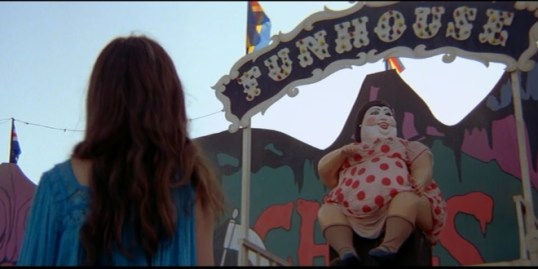
The Funhouse (1981, dir by Tobe Hooper. DP: Andrew Laszlo)
“Have you checked the children?” the stranger on the phone asks the terrified babysitter, who is unaware that the children are already dead and that the call is …. COMING FROM INSIDE THE HOUSE!
That’s the premise behind both an oft-repeated urban legend and the opening of the 1979 film, When A Stranger Calls. I’ve often seen the original When A Stranger Calls described as being one of the scariest films ever made. That’s not quite true, of course. The first 20 minutes or so are effective. The final scene has a few intense moments. The majority of what lies in-between feels like filler, albeit well-acted filler.
When A Stranger Calls opens with Carol Kane as Jill, a teenage babysitter who is terrified one night by a caller who keeps asking her if she’s checked on the children. This sequence — really, a mini-movie all of its own — is so well-executed and suspenseful that many people assume that the entire film is just Jill dealing with the mystery caller. Actually, that’s just the first few minutes and, once the location of the killer has been revealed, Kane disappears from the film for an extended period. That’s a shame since Kane’s empathetic performance is perhaps the best thing that When A Stranger Calls has going for it. She’s so convincing as the emotionally shattered babysitter that it doesn’t matter that, at the start of the film, she’s obviously not a teenager.
Instead, the middle part of the film focuses on John Clifford (Charles Durning). Clifford is a former policeman-turned-private investigator. He is obsessed with Duncan (Tony Beckley), the man who called Jill at the start of the film. Duncan has just escaped from a mental institution and Clifford has been hired to track him down. Clifford is convinced that Duncan will try to find Jill. Duncan, meanwhile, wanders through the sleaziest sections of downtown Los Angeles, briefly living with a pathetic alcoholic named Tracy (Colleen Dewhurst). Clifford, of course, is right about Duncan wanting to find Jill. And Clifford is so determined to kill Duncan that he might even be willing to use Jill as bait….
After the brilliantly horrific opening sequence, it’s impossible not to be disappointed with the drawn-out middle section of When A Stranger Calls. Durning, Dewhurst, and especially Beckley all give good performances and downtown Los Angeles is so repellent that you’ll want to take a shower afterwards but, narratively, there’s really not much happening. Clifford finds Duncan. Duncan runs away. Duncan acts like a jerk and gets in a fight. Tracy drinks. The old school cop Clifford scowls at the sleaziness of the world while Duncan continues to lose what little sanity he has left. Give the film some credit for not portraying Duncan as being some sort of charming, loquacious master criminal. He’s a total loser, as all serial killers are despite the later popularity of fictional characters like Hannibal Lecter. Duncan hates both himself and the world with equal fury. But, that said, the narrative stalls during the middle part of the film. There’s only so many time you can watch two men chase each other down a trash-strewn street before it gets dull.
Fortunately, Jill does eventually show up again and, after an hour of relentless sleaziness, you’re happy to see Carol Kane, again. Jill is now married and has children of her own. And soon, she’s again getting a phone call asking if she’s checked on the children….
And, again, the closing sequence is scary, even if it’s not quite as intense as the opening. (The opening was scary because we didn’t know what the killer looked like. By the time Duncan finds Jill a second time, we now know that Duncan is a sickly-looking alcoholic who can’t handle himself in a fair fight.) The film does have one great jump scare left in its arsenal of tricks. And yet, it’s impossible to watch When A Stranger Calls without wishing that the whole thing had just focused on Jill instead of getting sidetracked with Clifford searching Los Angeles.
When A Stranger Calls will always have a place in horror history. “Have you checked the children?” will always produce chills. It’s just unfortunate that the film spends a good deal of its running time ignoring what makes it scary in the first place.
Leonard Nimoy is a race car driver who can see into the future and who uses his powers to solve crimes!
Seriously, if that’s not enough to get you to watch the 1973 made-for-TV movie Baffled!, then I don’t know what is. In the film, Nimoy takes a break from racing so that he and a parapsychologist (played by Susan Hampshire) can solve the mystery of the visions that Nimoy is having of a woman in a mansion. This movie was meant to serve as a pilot and I guess if the series had been picked up, Nimoy would have had weekly visions. Of course, the movie didn’t lead to a series but Baffled is still fun in a 70s television sort of way. Thanks to use of what I like to call “slow mo of doom,” a few of Nimoy’s visions are creepy and the whole thing ends with the promise of future adventures that were sadly never to be.
Enjoy Baffled! Can you solve the mystery before Leonard?
I have a love/hate relationship with short films because there isn’t a middle ground. Film school is starting to look like a place to go to get in from the rain. When they’re done well, it’s so moving and amazing because in this short period of time, I cared about these characters and was sad to see them fail or overjoyed to see them win. What a lot of filmmakers fail to understand about the short is how challenging they are and really it should inform them that maybe they should try something else. Painting? Sculpting? Insurance? Mail Carrier? Many terrible short-filmmakers will evolve into terrible feature-length story tellers. They have to be stopped!
The short film becomes the proving ground for their bad habits: trading a shocking shot for narrative, trading grittiness for character likeability, trading story structure for a lazy jumbled mess masquerading as realism.
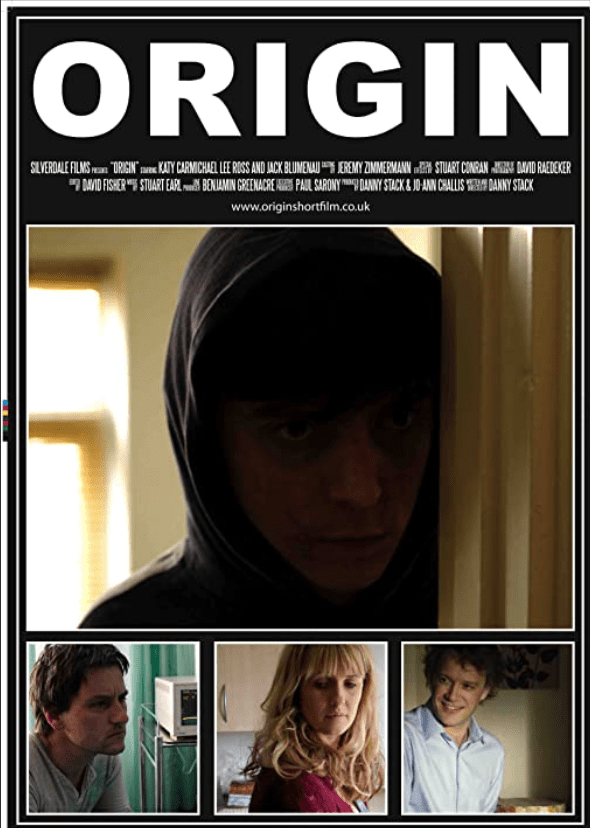
ORIGIN is the worst short that I’ve ever seen. It’s good in that it shows what NOT to do. The story is derivative and boring. The characters are unlikeable, which might trick a teacher into saying great realism, but in reality – banal unlikeable characters lower your stakes and destroy your final act. The dialogue is predictable. The emotion is stilted and unbelievable. Sadly, it was thirteen minutes too long (runtime 13 minutes).
ORIGIN depicts a banal and horrible family dealing with their son being attacked and slowly transforming into a monster. The son doesn’t speak and we learn nothing about him; so, I didn’t care when he died. The father was gross, boring, and annoying; so, I didn’t care when he had to put his monster son down. The mom was a boring/cheating whiner. Her dull and uncaring boyfriend was just sort of there sometimes like a mailbox. The mom and her boyfriend added nothing and slowed an already terrible story down.
What was really insulting was the hamfisted violins at the end that were way too loud to let me know- this is where you should feel……sad. Well, I didn’t and no one should. Don’t tell me how to feel. You have to earn concern. You have to earn stakes. Just having a bunch of unlikeable people running around is boring. We need a show on TLC called filmmaker intervention! This person must be stopped!




 Through the Shattered Lens