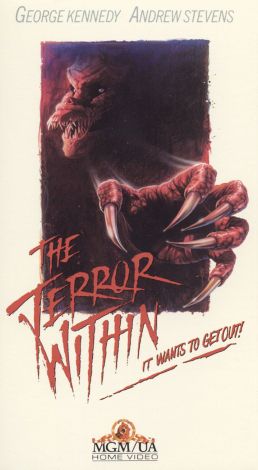
Years after “The Accident,” the Earth is a post-apocalyptic wasteland. The surface is controlled by Gargoyles, scaly monsters with big claws and a rampaging libido. The few human survivors hide out in underground bunkers, trying to find a cure for “the Plague,” which I guess came about as a result of the Accident. That still doesn’t explain the Gargoyles, though. It doesn’t matter, though. This is a Roger Corman-produced cheapie, one that what so obviously made to exploit the success of Alien, Aliens, Insemenoid, and Day of the Dead that I hope Corman at least had the decency to buy Christmas presents for Ridley Scott, James Cameron, Norman Warren, and George Romero.
The plot kicks into high gear when a group of human scientists discover a pregnant woman on the surface. They take her into their bunker, where she gives birth to a garoyle/human hybrid. The hybrid baby quickly grows into an adult gargoyle and is soon running through the air ducts, killing all the men, and attempting to mate with all the women. It’s actually pretty offensive, not that anyone complained when the movie used to show up on late night Cinemax in the 90s.
It’s up to the humans to stop the terror within. Unfortunately, the humans are interchangeable and easily killed. The only two that you’ll remember are Andrew Stevens and George Kennedy. Stevens, you’ll remember because he’s the star and has the ability to somehow survive while everyone around him is dying. You’ll remember George Kennedy because he’s George Kennedy, an Oscar-winning actor picking up some extra money by barking orders in a few scenes. I doubt Kennedy listed this film high on his list of accomplishment but, because he manages to deliver his lines with a straight face, he’s one of the best thing about the movie. The other thing that partially redeems this film is that the monster, once it reaches adulthood, looks far more convincing than I think anyone would expect it to. Corman may not have spent a lot of money on this film but he was smart enough to invest in a convincing monster.
The Terror Within has a cult following, mostly made up by people like me who saw it when we were kids and were too dumb to realize that it’s really not a very good movie. The main problem is that, though the film may be based on Alien, the director is no Ridley Scott or James Cameron. He’s not even a Fred Olen Ray or Jim Wynorski. There’s no suspense or humor or anything that would really distinguish the film. The Terror Within was still successful enough to lead to a sequel. Fortunately, Andrew Stevens took over as director for The Terror Within II.
That’s a question that I found myself discussing on Saturday night as I joined a group of friends to watch the 2019 film, Halloween Party.
“What is your greatest fear?”
It seems like a simple question but it can be so difficult to answer. I know that a lot of people, at this very moment, would probably say COVID-19. Others would probably say climate change or creeping authoritarianism or Greta Thunberg’s disapproving stare. On Saturday night, a few people identified clowns as being their greatest fear. Leonard said that he didn’t like spiders.
Myself, I struggled to come up with one. It’s not that I’m not scared of things. I hate heights. I have a fear of drowning. I’m not a fan of dogs. But when it comes to my greatest fear, that’s a difficult one to answer. The more I thought about it, the more I realized that most of my fears were more abstract as opposed to being physical. I fear being at the mercy of pitiless and chaotic universe, the type that Werner Herzog always talks about. I fear having to listen to a boring conversation. I fear discovering that I picked the wrong confirmation name. In fact, I spent a lot of time on Saturday bragging about how my fears were so much more interesting than everyone else’s fear.
Then, on Sunday, I watched the original Poltergeist and I remembered that my greatest fear is actually accidentally eating spoiled food. Which could totally happen! I mean, what if they put the wrong expiration date on the package? What if you’re refrigerator stopped working while you were away and then started working at the exact moment that you returned home? You would never know that the food had been sitting there, unrefrigerated, for hours.
Seriously, I think it’s a pretty justifiable fear.
Halloween Party is all about being forced to face your greatest fears. It’s about a cursed internet meme. When it shows up in your email, you’ve got only a few seconds to type in your greatest fear and then hit return. Tell the truth and hit return in time and you’ll get a cute little dancing ghost. Lie or don’t hit return in time and an evil witch appears and announces that you will soon meet your greatest fear. Everyone laughs the meme off but then their fears actually do start to show up, killing not only the person who received the meme but also anyone unlucky enough to get in the way.
College students Grace (Amy Groening) and Spencer (T. Thomason) attempt to investigate the meme and try to figure out how to stop it. It all has something to do with the fact that horribly disfigured children were once housed in their dorm. Apparently, the children got walled up and have been after revenge ever since. To be honest, I couldn’t really follow all of the stuff about the kids and the fact that the kids were made up to appear to be kind of grotesque made it a bit difficult for me to really watch any of the scenes involving them. I kind of wish the film had just concentrated on the meme and the fears. That’s fun part of a film like this.
(For the record, Spencer is afraid of bears. Personally, I think he just needs to watch Grizzly Man a few times and he’ll get over it. Grace is scared of “vagina spiders” and that’s actually a perfectly reasonable fear to have because spiders are almost as frightening as spoiled food and they do tend to get everywhere. I did some research and discovered that, thankfully, spiders cannot lay eggs under your skin but still, whether they’re laying eggs or not, there are certain places that a spider just has no place being.)
Halloween Party is a fairly derivative horror film, as anyone who has seen any of The Ring films will quickly notice. That said, it has a sense of humor about itself and Grace and Spencer are appealingly quirky protagonists. There are more than enough creepy scenes to make up for the familiarity of the story. Halloween Party is a film made for horror fans by horror fans. Watch it at your next party but be prepared to confess what you’re greatest fear is. Don’t say spoiled food, though. That’s already taken.
Since today is Peter Boyle’s birthday (he would have been 86), it seems only appropriate that today’s scenes that I love should come from 1974’s Young Frankenstein. Here, for your viewing and listening pleasure, are Gene Wilder and Peter Boyle….
4 Shots From 4 Films is just what it says it is, 4 shots from 4 of our favorite films. As opposed to the reviews and recaps that we usually post, 4 Shots From 4 Films lets the visuals do the talking!
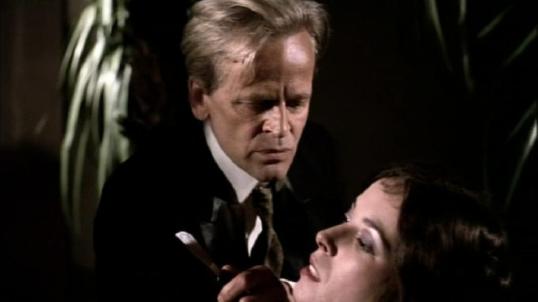
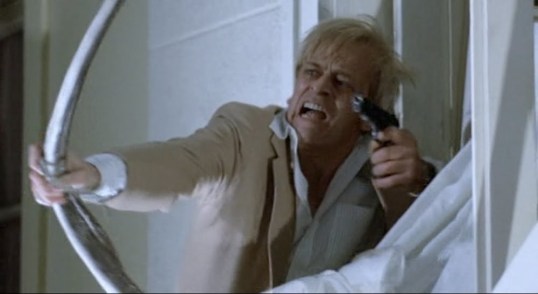
95 years ago today, Klaus Kinski was born in Poland. Kinski was a brilliant actor who, by all accounts, was an absolute monster in his private life. Werner Herzog worked with him on several films and reportedly considered murdering him on more than a few occasions. Herzog, himself, wrote about the time that he had spent in a mental asylum and the time that was diagnosed as being a psychopath. Because of his talent, he appeared in many great films. Because of his reputation for being a literal madman, he also missed out on a lot of great roles and spent much of his career appearing in low-budget exploitation flicks. Many of those films were in the horror genre.
Today, on the anniversary of Kinski’s birth, TSL presents….
4 Shots From 4 Klaus Kinski Films
Count Dracula (1970, dir by Jess Franco, DPs: Manuel Merino and Luciano Trasatti)
Jack the RIpper (1976, dir by Jess Franco, DPs: Peter Baumgartner and Peter Spoerri)
Nosferatu The Vampyre (1979, dir by Werner Herzog, DP: Jörg Schmidt-Reitwein)
Venom (1981, dir by Piers Haggard, DPs: Denys Coop and Gilbert Taylor)
The Lost Daughter, which is the directorial debut of Maggie Gyllenhaal, made quite a splash on the festival circuit and it’s being spoken of as a darkhorse Oscar contender. Olivia Colman, who is quickly becoming an Oscar favorite, could pick up another nomination. The destined-to-be-nominated someday Jessie Buckley could pick up her first.
As for the film itself, it’s about confronting dark secrets from the past, which is always an interesting subject matter. We’ll all get a chance to judge the film for ourselves when it’s released in December.
Last night, I watched Poltergeist on TCM and I found myself thinking about how much I’ve always liked James Karen’s performance in that film. Karen plays Craig T. Nelson’s boss, the guy who moved the headstones but left the bodies. Karen also appeared in Return of the Living Dead and, up until his death a few years ago, he was a busy character actor. He almost always seemed to play slightly sinister executive types. If you saw him in a film, you knew he would probably be a crooked businessman, a corrupt lawyer, or a politician on the take. And yet, even though he often played less than savory characters, he always played them not as being evil but instead, at worst, merely misguided. Anyway, as I watched him get yelled at by Craig T. Nelson in Poltergeist, I decided that our next horror on the lens would be a James Karen film.
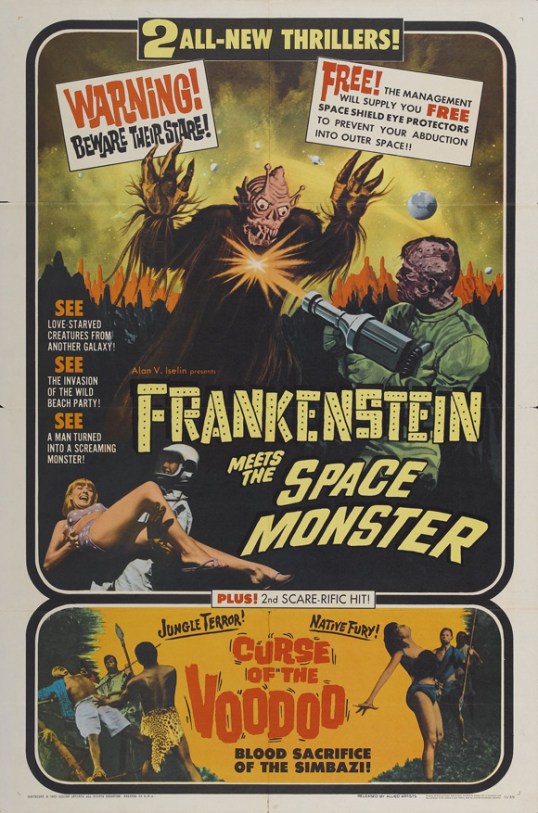
Today’s horror on the lens is the 1965 film, Frankenstein Meets The Space Monster. This film features not only the debut of James Karen but it also gave him a rare lead role. For once, james Karen gets to the hero! Though he’s much younger than he was when he appeared in films like Poltergeist and Return of the Living Dead, you’ll know James Karen as soon as you see him.
Despite the movie’s title, it’s not about Frankenstein. Instead, it’s about an astronaut named Frank who is actually an android. When his latest mission into space goes wrong, Frank ends up crashing in Puerto Rico. Now malfunctioning, Frank causes some major chaos. Can his creator, Dr. Adam Steele (James Karen), track Frank down and put an end to his reign of terror?
And what about the Martians? Android Frank isn’t the only threat in Puerto Rico. A group of Martians have landed and are determined to kidnap any girl wearing a bikini so that they can use them to repopulate their race. We’re told that every woman on Mars — with the apparent exception of Princess Marcuzan, played with evil haughtiness by Marilyn Hanold — has been killed as the result of an atomic war. Assisting Princess Marcuzan is Dr. Nadir (Lou Cutell), a short, bald Martian with pointy ears.
One of the oddest things about Frankenstein Meets The Space Monster is that, despite being a standard — if wonderfully nonsensical — low-budget B-movie, it features a great soundtrack! Just try to get “That’s The Way It’s Got To Be” out of your head.
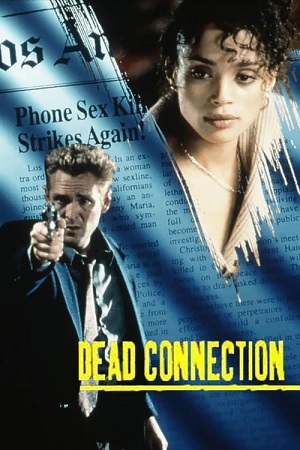
A former boxer and phone sex addict (played by real-life boxer Gary Stretch) is picking up women in Los Angeles, taking them to cheap motels, and beating them to death. Detective Matt Dickson (Michael Madsen, with blonde hair) is a burned out homicide cop who finds himself investigating the murders. It doesn’t take Dickson long to figure out that the killer is using the names of former boxing champs when he checks into the motels. He also figures out that the boxer has phone sex before and after the killing. That’s a lot but it’s not enough to solve the case. To do that, he’ll have to team up with a journalist (played by Lisa Bonet) who has personal reasons for wanting to take down the killer.
Back in the 90s, the main reason that I watched Dead Connection was because I had a hopeless crush on Parker Posey and she was listed as being one of the stars of the film. Parker does appear early on in the film and is just as funny and appealing in her small role as she was in bigger parts in other movies. Unfortunately, Parker gets killed pretty early on in the movie. That traumatized me the first time I saw the movie.
After Parker dies, the main reason to watch the movie is to see what Michael Madsen can do with his clichéd role. It turns out that Madsen can do a lot, even though there’s nothing unusual about the character on paper. Madsen just had the right look and the right style of acting for neo-noirs like this one. Even in a movie like this one, Madsen makes the whispering and the arched eyebrow seem cool and natural. Judging from her performance here, Lisa Bonet should have been a bigger star too. Just as with Madsen, there’s nothing unusual about her role but she still plays it with a lot of conviction.
The main problem with Dead Connection is that it reveals the identity of the killer in the first few minutes and it’s hard to believe that it would take the police a particularly long time to track him down. The minute it was learned that he was using the names of boxers to check into motels, that should have been the end of it for him. Instead, the movie dithers around for a good 90 minutes before finally ending on a predictable note. Despite the script’s flaws, Dead Connection is competently directed by Nigel Dick, who was also responsible for several music videos in the 80s and the 90s. Perhaps that explains why Tears for Fears’s Curt Smith has a tiny role as a desk clerk.
In the U.S., the film was released under the title Dead Connection, playing up the phone sex angle. In Europe, the focus was instead put on the killer’s boxing career and the film was called Final Combination, which made it sound like it was a movie about safecrackers. Neither title is really great but I prefer Dead Connection.
Over the course of his long and distinguished career, Harvey Keitel has only been nominated once for an Academy Award.
And, amazingly enough, he wasn’t nominated for any of the films for which he is best remembered. He wasn’t nominated for Mean Streets or Taxi Driver or any of his other collaborations with Martin Scorsese. He wasn’t nominated for playing the Wolf in Pulp Fiction or Mr. White in Reservoir Dogs. He was not nominated for The Piano. He certainly wasn’t nominated for baring his soul in Bad Lieutenant. Instead, Harvey Keitel’s only nomination was for playing real-life gangster Mickey Cohen in the 1991 Best Picture nominee Bugsy.
Bugsy was one of the many films to be made about the life of Bugy Siegel, the reputedly psychotic gangster who left New York for Hollywood and who later helped to create the wonderland of Las Vegas. In both the movie and real-life, Siegel was gunned down by his former associates, who felt that he was recklessly wasting their money out in the middle of the desert. It’s generally agreed that the order to murder Siegel was given by Lucky Luciano and Meyer Lansky, two of Siegel’s long-time friends and business partners. In Bugsy, Lansky was played by Ben Kingsley. Kingsley was also nominated for Best Supporting Actor. Unfortunately, whenever two actors from the same film are nominated for an Oscar, they usually end up canceling each other out. That’s what happened in the case of Bugsy, with both Kingsley and Keitel losing the Oscar to City Slickers‘s Jack Palance.
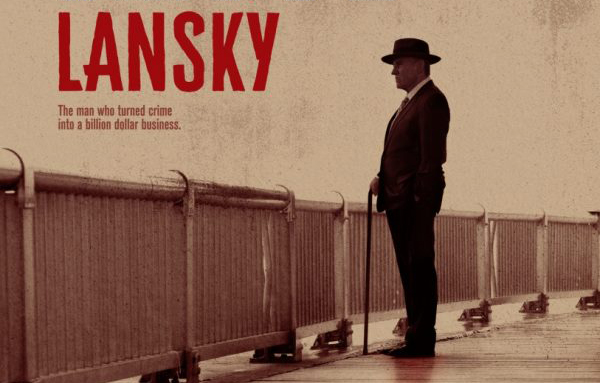
30 years after Busgy, Harvey Keitel once again acted out of the story of the death of Bugsy Siegel. Except, things time, Keitel played Meyer Lansky, Mickey Cohen was nowhere to be seen, and the film was called Lansky.
Of course, there’s more to Lansky than just the falling out with Bugsy Siegel. As you can tell from the film’s title, it attempts to deal with Lansky’s entire life. The film starts in 1979, with a friendly but terminally ill Meyer Lansky meeting with a writer named David Stone (Sam Worthington). David desperately needs the money that would come from writing the only authorized biography of Meyer Lansky. Lansky, knowing that he’s dying, wants to tell his story. Of course, Lansky has a few conditions. David can only publish the book after Lansky has died and David is not to talk to anyone about anything that Lansky tells him. David agrees.
From there, the film jumps back and forth in time. We watch the young Lansky (played by John Magaro) as he teams up with Lucky Luciano (Shane McRae) and Bugsy Siegel (David Cade) to change the face of organized crime. Along the way, he gets involved in the casino business, the CIA, and the Cuban revolution, and he fights Nazis at home and abroad. Lansky turns organized crime into a business and, as a result, becomes known as “the Mob’s accountant.” The FBI hounds him for almost his entire life, determined to discover where he’s hidden the millions of dollars that he’s rumored to have earned through his crimes.
While Lansky tells his story to David, the two of them form a slightly uneasy friendship Lansky is friendly and curteous but, as becomes clear as the film progresses, he’s still as capable of ordering a murder as ever. David, meanwhile, is being pressured by the FBI. They want him to become an informant and to press Lansky for information on where he’s hiding his money.
Lansky is a film that requires some patience. The first hour or so is a bit messy, with the film awkwardly trying to strike a balance between the flashbacks and the scenes of David talking to Lansky. At times, the film becomes a bit of an odd buddy picture, with Lansky offering David some unexpected life advice. However, once the FBI starts pressuring David, things pick up. The arrival of the FBI adds some much needed tension to the film’s storyline. As you watch the main agent (played by David James Elliott) pressure David into becoming an informant and essentially put his life at risk, it’s hard not to contrast Lansky with the men who are determined to put him away. Lansky may be a criminal but he has a code of ethics and, most importantly, he doesn’t harass innocents. The FBI, though, has no problem with bullying and manipulating informants and witnesses, all in the name of trying to figure out where a dying man is hiding his money. When the attention shifts from Lansky telling his story to Lansky outwitting the FBI, the film takes on an entirely new feel. When a smug FBI agent flies all the way to Israel in search of Lansky’s money, it’s impossible not to cheer a little when he gets outsmarted.
Due to the film’s flashback structure, Harvey Keitel is not in as much of Lasnky as you might expect. And yet he dominates the entire film. He perfectly captures both Lansky’s determination and his grim humor. Even facing death, Lansky is determined to keep control over every situation. In the film’s most powerful moments, he discusses what it’s like to be an outsider in America. Lansky knows that, as a Jew, he’ll never be fully accepted by the establishment. So, instead of begging for hand-outs, Lansky created his own establishment, one that operated in the shadows but which ultimately proved to be as successful as any corporation. When Lansky discovers that the American government is pressuring Israel to refuse to grant Lansky citizenship, Keitel perfectly captures both Lansy’s pain and his defiance. It all leads to a haunting final scene of Lansky on the beach. Appropriately enough, Meyer Lansky is alone.
Lansky is a both a portrait of a fascinating life and a tribute to the talent of Harvey Keitel. It may require some patience but that patience will be rewarded.
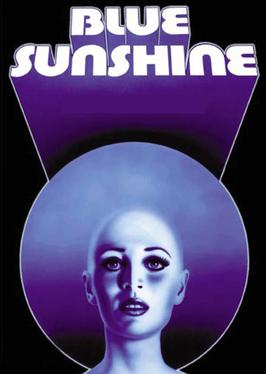
Today’s scene that I love comes from Jeff Lieberman’s 1978 film, Blue Sunshine.
If you haven’t seen the film, Blue Sunshine is the nickname for the acid that a group of characters dropped while in college during the 60s. Unfortunately, ten years later, all of them are losing their hair, suffering from extreme migraines, and turning into psycho killers. It’s the worst acid flashback of all time!
This is a pretty good film, one that uses the horror genre as a way to explore the contrast between the idealism of college and the realities of the real world. It’s also, as you can see in the scene below, quite suspenseful and more than a little frightening.
That can be a dangerous thing to admit nowadays. Clint is not a popular man on social media. The older critics have yet to forgive him for endorsing Mitt Romney over Barack Obama in 2012, despite the fact that Eastwood’s empty chair speech was quite a bit tamer than some of the other criticisms and insults that were being lobbed at both Obama and Romney at the time. The younger critics are still angry that he made Richard Jewell, a film that was seen as criticizing the press at a time when Trump was doing the same thing, this despite the fact that Eastwood never endorsed Trump in 2016 or 2020. (Beyond having a strong individualistic streak, Eastwood’s films are usually apolitical.)
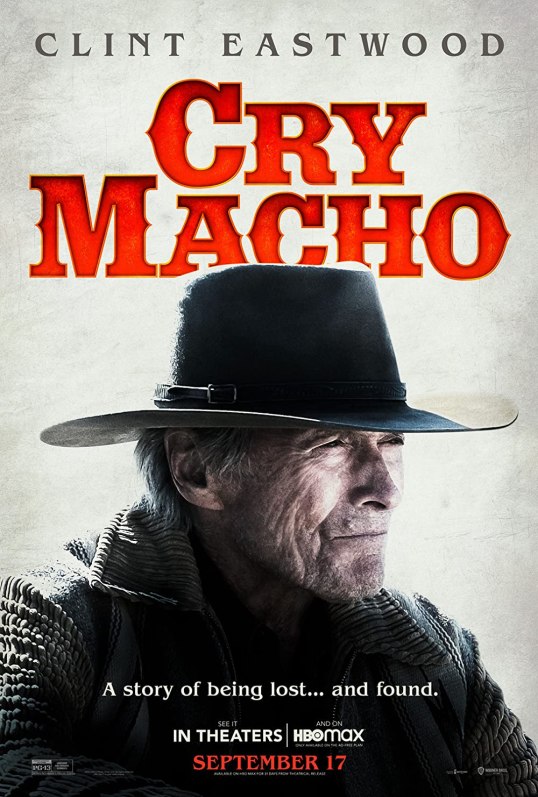
He’s one of those cultural figures that drives Twitter crazy. No one can deny that he’s a film icon and that he’s directed several good and a handful of great films. But, because he doesn’t seem to care what the online crowd thinks and probably isn’t even totally sure what Twitter is, there’s this need to try to tear him down. As such, I wasn’t surprised when his latest film, Cry Macho, received mixed reviews. At this point in the game, any film that Eastwood makes is going to be criticized.
Don’t get me wrong, of course. Sometimes, the criticism is correct, even if it is more motivated by personal animus than anything else. Some of his recent films have been a bit weaker than his earlier ones. I wasn’t a fan of Jersey Boys but I figured that Eastwood was in his 80s and he probably had always wanted to do a musical and, if anyone has earned the right to cross a few things off of his bucket list, it’s Clint Eastwood. Having the three men at the center of The 15:17 to Paris play themselves is something that worked better as an idea than in the actual execution. J. Edgar was a mess and so was Hereafter.
And yet, for every weak Eastwood film, there’s also a recent film that reminds us that he’s still a good director and that he’s still far more willing to explore new territory than some of his contemporaries. The Mule is a film that, like Cry Macho, received mixed reviews but which looks better with each subsequent viewing. Sully was a moving tribute to professionalism and grace under pressure and featured one of Tom Hanks’s best performances. American Sniper was far more nuanced that most critics were willing to admit. All of these films received mixed reviews, even the Oscar-nominated American Sniper. All of them have benefitted from reevaluation.
Will Cry Macho be another Eastwood film that will be embraced in later years? It’s too early to say but I think it will be. Now, again, don’t get me wrong. Some of the criticism that the film has received is justified. In Cry Macho, Clint plays a rodeo rider who, a year after being forced to retire due to a back injury, is hired to go down to Mexico and track down Rafo (Eduardo Minett), the teenage son of a wealthy businessman (Dwight Yoakam). Clint Eastwood is 91 years old and, let’s just be honest, he looks like he’s 91 years old as well. Thirty or even twenty years ago, Clint would have been perfect for the role of Mike Milo. Today, Clint is a bit too old for the role and it’s hard not to notice that, whenever Mike does throw a punch in the film, the scene is edited so that we see the fist and we see the results of the hit but we don’t actually see the punch itself. Clint is old in this film and, even more importantly, he comes across as being old.
But you know what? It almost doesn’t matter. He may be old but he’s still Clint Eastwood. He’s a pop cultural icon. He’s a legend. He epitomizes an era that Cry Macho acknowledges is coming to an end. It’s a bit of a meandering film. Though Rafo’s mother refuses to allow him to leave with Mike, Rafo still sneaks into Mike’s truck and travels with him to the border. Along the way, some men working for Rafo’s mother try to stop them from leaving Mexico. There are a few small action scenes but they’re not what the movie is about and it’s significant that this is a rare Eastwood film in which no one, not even the main bad guy, dies. Instead, the movie is about Mike and Rafo bonding on the road and discussing what it truly means to be macho. Mike is someone who has spent his entire life being “macho” but now he’s old and he’s broken down and he’s realizing that there’s more to life than just trying to live up to some sort of idealized version of manhood. Rafo is young and Mike is very old but, over the course of the movie, they both learn the same lesson. It’s okay to just be yourself. That may be a simple lesson but it’s one worth hearing.
As a director, Eastwood leaves room for the story to wander a bit but he still keeps the action moving at a steady pace. He gets good performances out of his cast. Despite being miscast, he still manages to gets a good performance from himself, though you may cringe a little at his insistence of still trying to present himself as being a romantic lead. (This was played for laughs in The Mule.) The film’s cinematography, courtesy of Ben Davis, is breathtaking. Even while helping Rafo leave the country, Mike falls in love with Mexico and, looking at the beautiful landscapes in this film, you can’t blame him. All in all, it’s a good film. If it had been made a few decades earlier, it would have been a great film but still, this is Eastwood at his most gentle and self-reflective. Future reviewers, free from the need to appease the online mob, will appreciate this film more than the modern ones.
 Years after “The Accident,” the Earth is a post-apocalyptic wasteland. The surface is controlled by Gargoyles, scaly monsters with big claws and a rampaging libido. The few human survivors hide out in underground bunkers, trying to find a cure for “the Plague,” which I guess came about as a result of the Accident. That still doesn’t explain the Gargoyles, though. It doesn’t matter, though. This is a Roger Corman-produced cheapie, one that what so obviously made to exploit the success of Alien, Aliens, Insemenoid, and Day of the Dead that I hope Corman at least had the decency to buy Christmas presents for Ridley Scott, James Cameron, Norman Warren, and George Romero.


 Through the Shattered Lens