Film Review: Lucy and Desi (dir by Amy Poehler)


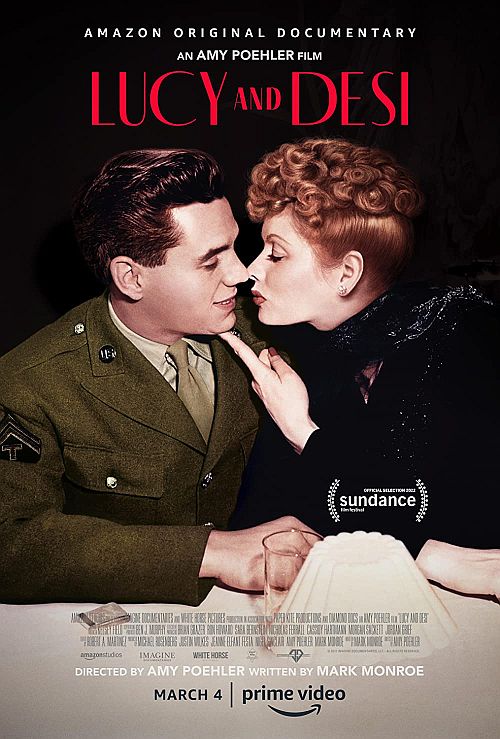
If you were as disappointed with Being the Ricardos as I was but you still want to learn something about the lives and the marriage of Lucille Ball and Desi Arnaz, might I suggest checking out Lucy and Desi?

Directed by Amy Poehler, Lucy and Desi covers much of the same material as Being the Ricardos but it does so in a far more authentic way.  This is because Lucy and Desi is a documentary, one featuring actual interviews and recordings from Lucy, Desi, and the people who worked with them through the years.  As a result, we get to hear the story in their own words as opposed to Aaron Sorkin’s words.  I’m hardly the first person to point out that Aaron Sorkin is incapable of writing dialogue that doesn’t sound like something that Aaron Sorkin himself would say.  In Being the Ricardos, Lucy and her writers all spoke in Sorkinese and it all felt rather false.  Watching Lucy and Desi, you quickly realize that both Lucy and Desi were intelligent and articulate people.  Their own words are strong enough, without needing a polish from a screenwriter who, by his own admission, never found I Love Lucy to be all that funny.

Lucy and Desi covers the early lives of both Lucy and Desi as well as detailing how they first met, how they married, and how they went on to revolutionize television with I Love Lucy.  More than just being portrayed as being a talented but somewhat volatile couple, both Lucy and Desi emerges as fascinating individuals in their own right.  Both of them survived childhood difficulties, both of them remade themselves in Hollywood, and, most importantly, both of them had an instinctive understanding of what audiences wanted to see.

They were also very much in love, even after their divorce.  That love was missing from Being the Ricardos but it’s very much present in Lucy and Desi.  It was that love that led to the marriage that led to the partnership that made them a success but it was that same success that eventually led to the end of their marriage.  And yet, even after divorcing, Lucy and Desi remained close.  Their daughter, Lucie Arnaz, talks about the last few times that Lucy saw Desi before Desi’s succumbed to lung cancer.  They watched old episodes of I Love Lucy and they laughed together.  It’s an incredibly touching moment.

And if sentimentality isn’t your thing, Lucy and Desi also explores just how important their partnership was to the development of modern television.  I Love Lucy was the first “modern” sitcom but their company, Desilu Productions, had a hand in producing several other classic shows as well.  Star Trek was a Desilu production.  So were Mission Impossible and The Untouchables.  So much of what we take for granted about pop culture started with Lucy and Desi.

Perhaps the most shocking revelation in the Lucy and Desi documentary is that the J. Edgar Hoover story was true!  You may remember that, when I reviewed Being the Ricardos, I scoffed at the scene where Hoover called the studio and personally cleared Lucy of being a communist.  But apparently, this actually did happen!  I’m as stunned as anyone.

Lucy and Desi is a good and heartfelt tribute to Lucy and Desi, their talent and their love and their lasting influence.  It can be viewed on Prime.
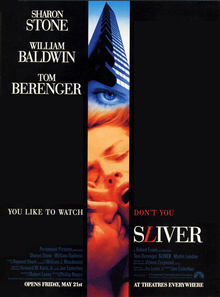
Sliver (1993, directed by Phillip Noyce)


Who here remembers Sliver?

It may be hard to believe it but Sliver was a big deal back in the day.  It was one of Robert Evans’s first producing gigs after getting out of rehab.  It was Sharon Stone’s first film after Basic Instinct.  The script was written by Basic Instinct‘s Joe Eszterhas, back when that was still something that people bragged about.  It featured Tom Berenger, back before he found himself relegated to character roles, and William Baldwin.  Remember William Baldwin?  He was Alec Baldwin’s younger brother.  He looked just like Alec but he never managed to project much of a personality whenever he was onscreen.  Even Stephen Baldwin was a more interesting actor than William.  Still, back in the day, William Baldwin was close to being a star.

William Baldwin’s lack of personality actually works for the role he plays in Sliver.  He’s Zeke, who owns an exclusive high-rise apartment building.  Zeke makes his money designing video games and he’s filled the building with secret video cameras so he can spend all day sitting in front of a wall of monitors and watching his tenants and experiencing their lives without having to get close to them.  Zeke’s a voyeur.  Back in the 90s, the surveillance thing was a big twist.  Today, we take it for granted.  We even applauded Batman for doing the same thing to all of the citizens of Gotham.

Sharon Stone plays Carly, the newest resident of the Sliver.  Carly is a recently divorced book editor snd is lonely and repressed despite being played by Sharon Stone.  She draws the attention of both Zeke and her neighbor, Jack (Tom Berenger).  Both are interested when they discover that Carly has a telescope on her balcony.  “She’s a voyeur!” Jack says.  When Carly gets involved with Zeke, Jack is obsessively jealous.  He insinuates that Zeke had something to do with the death of the previous tenant of Carly’s apartment.

After Basic Instinct, Sharon Stone made a series of films that were designed to show that she actually could act by casting her as characters who were meant to be sexually repressed.  The films never seemed to work because, at the height of Sharon Stone’s 90s stardom, there was nothing about her that suggested that she was repressed in any way.  What made her a star in the first place was that she was so uninhibited and not afraid to be as blunt about sex as any of her male co-stars.  In Sliver, she gives a performance that is somewhere between her vampish work in Basic Instinct and her terrible ice queen performance in Intersection.  At the start of the film, she feels miscast as a straight-laced book editor but her performance gets better once she starts hooking up with Zeke.  Sharon Stone tries, even if she doesn’t succeed.  That’s more than can be said for most of her co-stars.

“Get a life,” Sharon Stone says at the end of the movie and, as far as final lines go, it’s a bad one because it comes out of nowhere and her actions in the final scene don’t fit in with anything that she’s previously said or done in the film.  That’s because the ending was hastily reshot after test audiences disliked the original ending.  Test audiences often have the worst instincts.

Like many things, Sliver was big in the 90s but forgotten today.  It was a popular Blockbuster rental for a while.  VCRs were set for whenever it appeared on Cinemax.  When it first came out, it was all about Sharon Stone.  Today, it’s all about nostalgia.

A Gary Oldman Scene That I Love: The Hotel Scene From The Firm


The Firm (1989, directed by Alan Clarke)

Since today is Gary Oldman’s birthday, I decided to share a scene that I love from The Firm.

Directed by Alan Clarke, this 1989 film was originally made for the BBC and it stars Oldman as Bex Bissell.  During the week, Bex sells real estate.  During the weekend, he’s a football hooligan and the leader of his own firm.  Though The Firm is not as well-known in the States as some of his other films, I think that Gary Oldman’s performance here might very well be the best of his career.

In this scene, Bex and his firm meet with two other firms in a London hotel.  They’re arguing about who is going to be the “top boy” during the upcoming international football tournament in Holland.  Mostly, they’re just trying to out-intimidate and one-up each other.  Oldman controls the scene through pure attitude.

We leave you with the ICC motto — “we come in peace, we leave you in pieces.”

4 Shots From 4 Films: Special Russ Meyer Edition


4 Or More Shots From 4 Or More Films is just what it says it is, 4 shots from 4 of our favorite films. As opposed to the reviews and recaps that we usually post, 4 Shots From 4 Films lets the visuals do the talking!

100 years ago, on the very day, Russ Meyer was born in San Leandro, California.  Meyer would get his start filming newsreels during World War II (many of his newsreel footage were used in the 1970 Oscar winner, Patton).  When he returned to the United States, he continued to make films.  Meyer was one of the pioneers of the adult film industry, though his films seem rather quaint and innocent when compared to the industry’s later films.  Meyer’s strong visual sense and his intentionally over-the-top plots made him a favorite amongst underground critics.  In the 70s, he was briefly embraced by mainstream Hollywood but, unhappy with having to deal with studio bosses, Meyer returned to making the type of independent, grindhouse films that made him famous.

Russ Meyer was 82 years old when he died in 2004.  He was acclaimed as one of America’s first and greatest independent filmmakers.

Here are 4 Safe-For-Work Shots From 4 Russ Meyer Films.

4 Shots From 4 Films

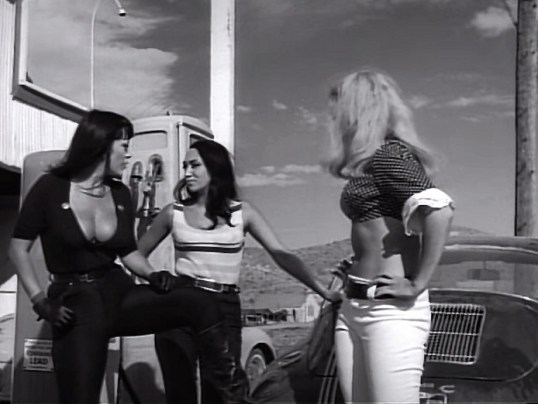
Faster, Pussycat! Kill! Kill! (1965, dir by Russ Meyer, DP: Walter Schenk)

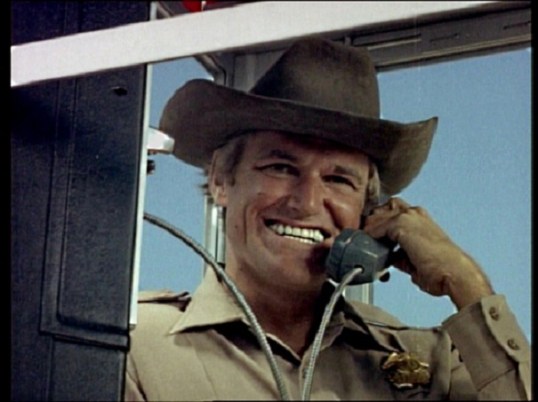
Motorpsycho (1965, dir by Russ Meyer, DP: Russ Meyer)

Cherry, Harry, & Raquel! (1970, dir by Russ Meyer, DP: Russ Meyer)

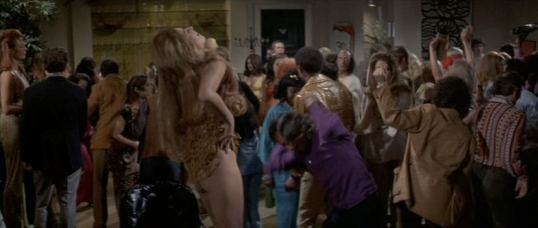
Beyond The Valley Of The Dolls (1970, dir by Russ Meyer, DP: Fred J. Koenekamp)

The PGA Names CODA The Best of 2021


I’m a little late in reporting this but last night, the Producers Guild of America announced their picks for the best of 2021 and they promptly threw the Oscar race into chaos by selecting CODA, instead of the Power of the Dog.  Today, there’s a lot of people talking about the possibility of DGA winner Jane Campion taking Best Director while CODA, which also won the SAG Ensemble Award, takes Best Picture.

It could happen.  We’ll find out for sure next Sunday!

The Award for Outstanding Producer of a Feature Theatrical Motion Picture
Being The Ricardos
Belfast
CODA
Don’t Look Up
Dune
King Richard
Licorice Pizza
The Power Of The Dog
Tick, Tick…Boom!
West Side Story

The Award for Outstanding Producer of Animated Theatrical Motion Pictures
Encanto
Luca
The Mitchells vs. The Machines
Raya And The Last Dragon
Sing 2
 
The Award for Outstanding Producer of Documentary Motion Pictures 
Ascension
The First Wave
Flee
In The Same Breath
The Rescue
Simple As Water
Summer Of Soul (…Or, When The Revolution Could Not Be Televised)
Writing With Fire

Film Review: Deep Water (dir by Adrian Lyne)


Just released on Hulu, Deep Water is the funniest film of the year so far.

Ben Affleck stars as Vic Van Allen.  (Even his name is funny!)  Vic made a fortune by inventing a computer chip that is used to help drones track people down and blow them up.  Now, Vic is retired, living in a nice and small town, and publishing a photography/poetry magazine.  He enjoys going to parties with his friends, joking about committing murder, and riding the heck out of his bike.  Seriously, the shots of Affleck riding that bike are comparable to Will Ferrell playing the flute in Anchorman.

Ana de Armas plays Vic’s wife, Melinda.  Everyone, including Vic, knows that Melinda cheats on Vic with almost every man that she meets.  Vic accepts Melina’s infidelities on the condition that she not leave him and their daughter, Trixie (Grace Jenkins).  Of course, Vic does still get upset.  When Melinda’s former lover vanishes, Vic jokes to Melinda’s current lover that he killed the previous lover.  Everyone in town gets a good laugh out of that one.  Everyone, that is, but for Melinda and local busybody Don Wilson (Tracy Letts).

Both Melinda and Don think that Vic is capable of murder.  As far as Don is concerned, Vic is responsible for the death of every single person who has ever been blown by a drone.  Meanwhile, Melinda knows that there’s something strange about the way that Vic spends all of his time taking care of the hundreds of snails that he keeps in the basement.  Vic, of course, insists that he was just making a joke when he said that he was a murderer.  But then Vic actually does murder someone and things get complicated….

From what I understand, Deep Water is supposed to be a serious thriller but I absolutely refuse to believe that it’s not actually meant to be a parody of the genre.  It’s director Adrian Lyne’s first film in 20 years.  Lyne is best know for directing movies like 9 1/2 Weeks, Fatal Attraction. Indecent Proposal, and Unfaithful and so many of the scenes in Deep Water feel as if they’ve been specifically designed as a way to poke fun at Lyne’s previous films that one can’t help but suspect that at least a few of the film’s laughs are meant to be intentional.  This is a film that features Ben Affleck, on a bicycle, chasing a car while the driver rants about how autocorrect is always ruining his text messages.  I absolutely refuse to accept that this was truly meant to be taken seriously.

That said, Affleck wanders through the film with a glum expression on his face, one that suggests that he wasn’t let in on the joke ahead of time.  Ana de Armas is ultimately defeated by a script that refuses to allow her character to behave with any consistency but she’s still smart enough to play Melinda as being a character who is at least partially aware that she’s in a movie.  As for Tracy Letts, I have never seen any reputable actor overact quite as much as Tracy Letts does towards the end of Deep Water.  It’s a sight to behold.

Adrian Lyne makes sure that the film looks good but he never manages to strike a consistent tone and the film’s plot is full of holes.  Affleck spends a lot of time gazing at snails while Ana de Armas throws a fit when her daughter keeps insisting that Alexa play Old MacDonald.  Tracy Letts, at one point, sees Affleck riding his bicycle and starts cursing like Linda Blair in The ExorcistDeep Water doesn’t really work as a thriller but, as a comedy, it’s a lot of fun.

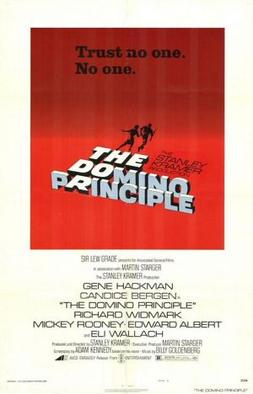
The Domino Principle (1977, directed by Stanley Kramer)


Roy Tucker (Gene Hackman) loyally served his country as a part of a “search and destroy” team in Vietnam but when he returned home, he discovered that America didn’t appreciate his sacrifice.  When he was convicted of murdering his wife’s abusive first husband, he was tossed in prison.  But now, two mysterious men (Richard Widmark and Edward Albert) have offered Tucker a chance to escape from prison and reunite with his wife (Candice Bergen) in Costa Rica.  The only catch is that they also expect Tucker to do a job for “the Organization” and assassinate an unidentified target.  As Tucker discovers, The Organization has been watching and manipulating him entire life, setting him up for this very moment.  Every small event in Tucker’s life led to another event that eventually sent him to both the war and to prison.  It’s almost like a game of dominos.  And we have a title!

The Domino Principle gets off to a good start, with a black-and-white montage of actual assassinations and then an opening credit sequence that features someone placing dominos over pictures of Roy Tucker at different ages.  (I am guessing that actual childhood photos of Gene Hackman were used because even the baby pictures feature the Hackman squint.)  However, the scene immediately following the credits features Gene Hackman and Mickey Rooney as cellmates and the film never really recovers.  Though they were both talented actors, Gene Hackman and Mickey Rooney don’t seem as if they belong on the same planet together, let alone sharing a prison cell in a grim and downbeat political thriller.  Hackman is his usual surly self, while Mickey seems like he’s going to try to get the entire prison to put on a show.  The film tries to do some unexpected things with Mickey’s character but it doesn’t change the fact that he’s Mickey Rooney and he just doesn’t belong here.

As for the rest of The Domino Principle, it’s slow and ponderous.  Best known for earnest social issue films like The Defiant Ones and Guess Whos’ Coming To Dinner, Stanley Kramer is the wrong director for a film that aspires to duplicate the conspiracy-themed atmosphere of other 70s thrillers like The Parallax View and Three Days of the Condor.  For all the time that film takes to build to its obvious conclusion, Kramer doesn’t even bother to identify who Tucker is supposed to kill or why the Organization wants him dead.  Though he seems like he should be a good choice for the lead role, Gene Hackman goes through the movie on autopilot.  Perhaps he was overwhelmed to be sharing a prison cell with Mickey Rooney or to be playing the husband of Candice Bergen, who the film unsuccessfully attempts to deglamorize.

Sadly, this would be one of Kramer’s last films.  He followed it up with The Runner Stumbles, which starred Dick Van Dyke (!) as a conflicted priest, and then went into semi-retirement.  (A few attempts to return to directing failed.)  Kramer spent his twilight years writing about movies for The Seattle Times.  Before his death in 2001, he also published a very entertaining autobiography, A Mad Mad Mad Mad World: A Life in Hollywood, which I recommend to anyone interested in the history of Hollywood.

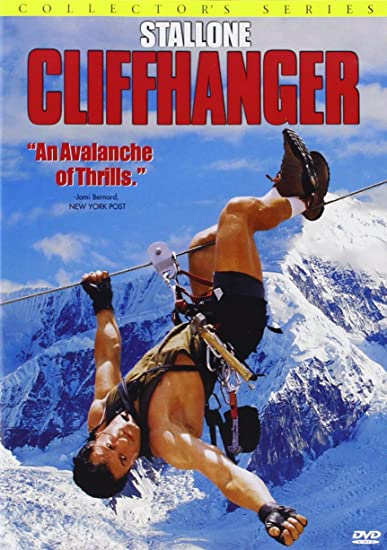
Cliffhanger (1993, directed by Renny Harlin)


Sylvester Stallone is Gabe, a mountain climber who also works as a rescue ranger.  Michael Rooker is Hal, Gabe’s colleague and former best friend.  Hal blames Gabe for the death of his girlfriend, Sarah.  Gabe also blames himself and is planning on getting out of the rescue game.  But before Gabe can quit, he’s got one last mission to perform.  Qualen (John Lithgow) is a psychotic former spy who has masterminded a multi-million dollar robbery.  A plane crash leads to the loot getting scattered in the mountains.  Qualen takes Hal and Gabe prisoner and tries to force them to help him track down the money.

Cliffhanger was made during one of the slower periods of Stallone’s career.  He had temporarily retired the roles of both Rocky Balboa and John Rambo and, as an action star, he was being overshadowed by Arnold Schwarzenegger.  Stallone had tried to reinvent himself as a comedic actor, with the result being Stop!  Or My Mom Will Shoot!  The former Oscar nominee was now only winning Razzies and he was running the risk of becoming better known for his messy divorce from Brigitte Nielsen than for his recent films.  Things weren’t looking good for Stallone but, fortunately, the box office success of Cliffhanger revived his career.

Seen today, Cliffhanger holds up well as an undemanding but enjoyable action film.  It’s a very much a film of its time, complete with John Lithgow hamming it up as a British villain and Northern Exposure’s Janine Turner playing Stallone’s loyal, helicopter-owning girlfriend.  Stallone’s best films are the ones where he is willing to surrender his ego and he does that in Cliffhanger.  It may be a Stallone film but the best lines go to Michael Rooker and the true stars of the film are the mountains and the scenes of Stallone and Rooker trying to climb them.  With Cliffhanger, Stallone was smart enough to stay out of the way and just trust that the image of him dangling above the Rockies would bring in the audience.  It was a smart decision.  Though Cliffhanger is often overshadowed by Stallone’s other 1993 hit, Demolition Man, it’s still an entertaining film in its own right.

Cliffhanger was directed by Renny Harlin, the Finnish action specialist whose promising career would subsequently take a hit and never really recover from directing Cutthroat Island.  Mountain climbing and Renny Harlin just seem to go together and Cliffhanger is one of his better films.  Here’s hope that, just as Stallone has done many times in the past, Renny Harlin will eventually his comeback as a director.

Scenes that I Love: Marlon Brando as Mark Antony in Julius Caesar


Beware the Ides of March!

The scene below is from the 1953 film, Julius Caesar.  This Oscar-nominated Shakespearean adaptation had a cast that was full of distinguished actors.  James Mason played Brutus.  The great John Gielgud played Cassius.  Louis Calhern was Caesar while other roles were filled by Deborah Kerr, Greer Garson, Edmond O’Brien, George Macready, John Hoyt, Edmund Purdom. and a host of other distinguished thespians.  And yet, the best performance in the film came from an actor who, at the time, no one considered to be a Shakespearean.  Marlon Brando brought his method intensity to the role of Mark Antony and the result was a performance that is still electrifying today.

On YouTube, someone referred to this as being “the world’s greatest speech delivered by the world’s greatest actor.”  Sounds good to me!

Here is Marlon Brando in Julius Caesar:

4 Shots From 4 Films: Special David Cronenberg Edition


4 Or More Shots From 4 Or More Films is just what it says it is, 4 shots from 4 of our favorite films. As opposed to the reviews and recaps that we usually post, 4 Shots From 4 Films lets the visuals do the talking!

Today, the Shattered Lens wishes a happy birthday to one of our favorite directors, David Cronenberg!  Cronenberg has a new film coming out later this year, one that we’re all looking forward to.  Crimes of the Future (which shares its name with one of Cronenberg’s early, experimental films) will be Cronenberg’s first film since 2014’s Map of the Stars and it will also reunite him with Viggo Mortensen.

For now, here are….

4 Shots From 4 David Cronenberg Films

The Brood (1979, dir by David Cronenberg, DP: Mark Irwin)

The Fly (1986, dir by David Cronenberg, DP: Mark Irwin)

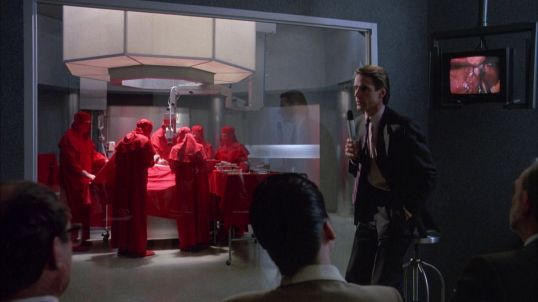
Dead Ringers (1988, dir by David Cronenberg, DP: Peter Suschitzky)

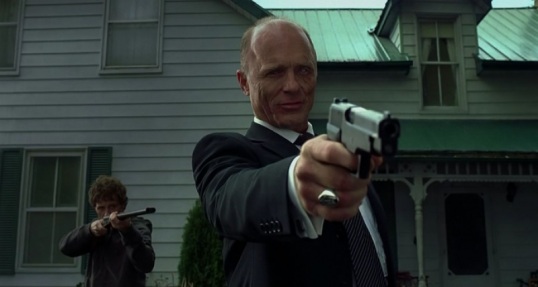
A History of Violence (2005, dir by David Cronenberg, DP: Peter Suschitzky)