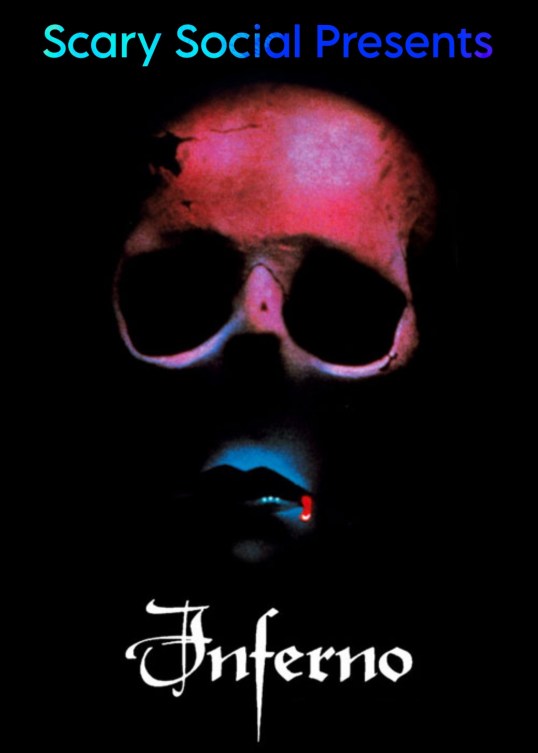
Inferno (1980, dir by Dario Argento, DP: Romana Albano)
As some of our regular readers undoubtedly know, I am involved in a few weekly live tweets on twitter. I host #FridayNightFlix every Friday, I co-host #ScarySocial on Saturday, and I am one of the five hosts of #MondayActionMovie! Every week, we get together. We watch a movie. We tweet our way through it.
Tonight, for #ScarySocial, I will be hosting 1980’s Inferno! Dario Argento’s sequel to the original Suspiria is one of his best films, a dream-like exploration of the dark and the disturbing. I can’t wait to share it with everyone!
If you want to join us on Saturday night, just hop onto twitter, start the film at 9 pm et, and use the #ScarySocial hashtag! The film is available on Prime. I’ll be there co-hosting and I imagine some other members of the TSL Crew will be there as well. It’s a friendly group and welcoming of newcomers so don’t be shy.
In the mining town of Gold Creek, an outlaw gang has been hijacking shipments of gold. Newspaper publisher Rufus Todd (Milburn Morante) has learned that the head of the gang is saloon owner Jim Rand (Harry Woods). Todd is planning on publishing a story identifying Rand as the outlaw leader on the front page of his newspaper so Rand’s secret partner, businessman John Corbett (Jack Daley) arranges for Rufus’s printing press to be blown up.
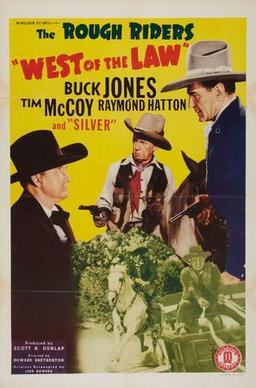
Rufus calls in his old friend, Marshal Buck Roberts (Buck Jones). Buck arrives in town with his fellow Rough Riders, Tim McCall (Tim McCoy) and Sandy Hopkins (Raymond Hatton). As usual, everyone is working undercover. Buck pretends to be an outlaw named Rocky Sanders. Tim claims to be a preacher who is not afraid to draw his gun and force everyone in the saloon to put down their drinks and listen while Rufus identifies Rand as being an outlaw. Sandy is the new undertaker and his coffins prove useful for smuggling in some much needed equipment.
The eighth Rough Riders film trods familiar ground. Once again, Buck is framed for a crime he didn’t commit and, as always, the villains are a businessman and a saloon owner. Still, I enjoyed seeing Tim to pretend to be a preacher and Sandy had some funny moments are the town’s garrulous undertaker. As always, McCoy, Roberts, and Hatton possessed an authentic western toughness that made them compelling heroes even in B-westerns like this one.
Since Tim McCoy reenlisted in the U.S. Army following Japan’s attack on Pearl Harbor, this was the last Rough Riders film to feature the original three riders and their chemistry and friendship are as strong as when the series first began. The movie ends with the promise that the Rough Riders would ride again but sadly, it was not to be. Though West of the Law doesn’t break any new ground, it’s still a decent finale for the original team.
As some of our regular readers undoubtedly know, I am involved in a few weekly live tweets on twitter. I host #FridayNightFlix every Friday, I co-host #ScarySocial on Saturday, and I am one of the five hosts of #MondayActionMovie! Every week, we get together. We watch a movie. We tweet our way through it.
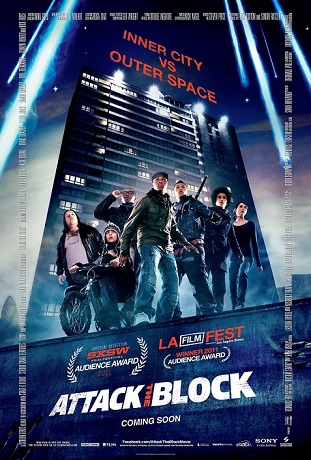
Tonight, at 10 pm et, #FridayNightFlix has got 2011’s Attack the Block!
If you want to join us this Friday, just hop onto twitter, start the movie at 10 pm et, and use the #FridayNightFlix hashtag! It’s a friendly group and welcoming of newcomers so don’t be shy.
Attack The Block is available on Prime and Tubi! See you there!
Amityville Emanuelle is the latest film about the dumbass Amityville Haunting.
In order to watch any of the many films about the supposed haunted house in Amityville, New York, you need to be aware of two real-life events.
In 1974, a 23 year-old junkie named Ronald DeFeo, Jr. gunned down his entire family in their Amityville home. DeFeo first claimed that unknown gunmen had killed his family while he was out. He then changed his story and said that he killed his family but he did it because he knew they were plotting to kill him. He then suggested that the whole thing was a mafia hit. He then moved on to claiming that his sister was the one who actually killed everyone. And, finally, he claimed that he had been possessed by demonic spirits.
One year later, the Lutz family moved into the Amityville House. After a month, the Lutzes left the house and George Lutz claimed that the house was haunted and that the family had been forced to flee for their lives. Thanks to a book and a few movies based on that book, the Lutzes made some money and eventually ended up suing a lot of other people in order to make even more money. Subsequent owners of the house have never reported anything strange happening while living in the house, other than strangers stopping by to view the supposedly haunted structure.
So, we can either believe that Ronald DeFeo was a junkie who killed his own estranged family or we can accept that the Devil took one look at Ronald DeFeo shooting up heroin and decided, “I’m tired of possessing the innocent and the naïve. I’m going to possess someone who is already so screwed up that no one will even notice that he’s been possessed. That’ll show ’em!”
And we can either believe that a bunch of demons chased George and Kathryn Lutz from their home or we can believe that the Lutzes looked at the success of books and films like The Exorcist and The Omen and they decided that they might as well cash in as well.
Amityville Emanuelle accepts, from the start, the everything was due to the paranormal, which is fine. It’s a movie and Occam’s razor goes out the window when it comes to the movies. George Lutz’s daughter, Laura (Dawn Church), moves into a new house and is soon visited by a strange woman who claims that she is delivering some of George’s belongings. Laura discovers that George owned an urn that was full of Ronald DeFeo’s ashes. Apparently, George and DeFeo had a psychic connection and George, who is insinuated to have been some sort of an occultist, knew that DeFeo was going to murder his family before he even did it.
(Wow, those are some pretty mean things to say about the late George Lutz, who was a real person and not really around to defend himself. Then again, George Lutz would be totally forgotten today if not for the fact that he made up a bunch of stuff about a haunted house so really, Lutz being portrayed as an occultist feels like karma.)
Laura soon finds herself acting in strange ways, picking up random men at bars and then barely noticing when they’re subsequently killed by someone who looks just like Ronald DeFeo.
Meanwhile, Ronald DeFeo’s son, Gordon (Shane Ryan-Reid, himself a director of transgressive films), makes the mistake of using a Ouija Board with his friends and he’s soon having visions of his father killing people.
(Now, I know that some of you are now saying, “Where does Emanuelle fit in with this?” because, after all, the symbol of sexual freedom and experimentation is namechecked in the film’s title. Well, Emanuelle really doesn’t fit into it, unless you include the scene where Laura goes to a bar and picks up two men. But those watching this film because they’re expecting it to be some sort of soft-core haunted house flick are going to be disappointed.)
Amityville Emanuelle is a low-budget and rather dumb film but it is at least partially redeemed by the fact that it doesn’t appear to be taking itself seriously at all and there’s no attempt to convince the viewer that they’re somehow watching anything that could be based on fact. There’s not much in the way of suspense and both the gore and the sex are rather tame but there is a medium (played by Saint Heart) whose generally annoyed attitude is occasionally fun to watch. The Amityville Haunting has always been a particularly stupid story and the cynicism of the majority of people who continue to try to sell it as being fact has always been more than a bit icky so, at this point, Amityville Emanuelle is kind of what the legend deserves.
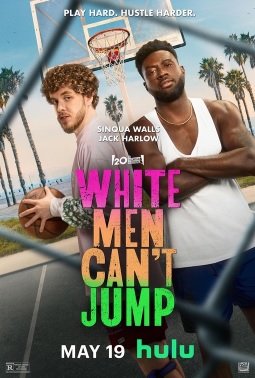
Hulu’s White Men Can’t Jump is the story of two aging basketball players who have never lived up to their potential but who have yet to totally give up on their dreams.
Even when he was in high school, Kamal Allen (Sinqua Walls) was considered to be one of the best basketball players in the country. A lot of that was due to how he was raised by his father, Benji (Lance Reddick, giving a strong performance in one of his final roles). Benji was a basketball star himself and, as we see in several flashbacks, he trained Kamal to be the best. Benji was so obsessed with turning Kamal into a great player that he even drove away Kamal’s mother. Benji taught Kamal all that he needed to know about playing basketball but not enough about how to survive once his playing days were over. Unfortunately, after Benji was diagnosed with MS, Kamal lost his concentration. When he responded to being taunted during a game by going into the stands and punching a guy out, Kamal ended up getting arrested and he also ended up losing his chance of entering the NBA.
Jeremy (Jack Harlow) was a college basketball star who blew out his knee and lost his chance to go pro. He makes his living hustling other basketball players, knowing that they’ll assume that he can’t shoot because he’s white. He also sells highly suspicious health tonics and he spends a lot of time meditating. Though he can barely walk without taking his pain pills first, Jeremy still wants to make the NBA. When he hears that stem cell treatment might help his knee, Jeremy starts to scheme to win the money to cover the cost.
Together, Jeremy and Kamal hustle other players, make some money, and become unlikely friends.
It took me three days to get through White Men Can’t Jump, largely because the film itself was so boring that I struggled to actually pay attention to it for more than a few minutes at a time. This film is a remake of a 1992 film that starred Wesley Snipes and Woody Harrelson. I have not seen the original White Men Can’t Jump but I have seen enough films featuring both Snipes and Harrelson to know that they are both talented and charismatic actors who both have strong comedic timing. In short, they don’t have much in common with the two leads of the new version of White Men Can’t Jump. In the role of Kamal, Sinqua Walls is solid but dull. Walls is convincing but he’s never particularly interesting. Making his film debut in the role of Jeremy, rapper Jack Harlow is so incredibly obnoxious that I found myself wanting to throw something at the screen whenever he popped up. The film repeatedly emphasizes that no one wants to play with Jeremy because he’s white but I think it’s equally probable that they’re just reacting to the fact that he is an incredibly annoying human being. Director Calmatic does all the usual choppy editing and slow-motion dunking that most viewers have come to expect from movies about basketball but with little chemistry between the leads and a script that tends to repeat the same jokes over and over again, this film never takes flight.
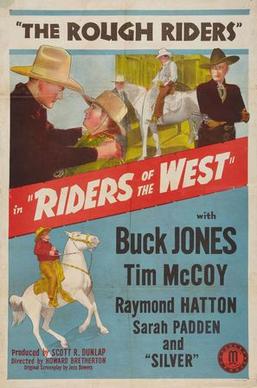
In a frontier town, a gang of rustlers are stealing cattle as a part of a plot to force cash-strapped ranchers to take out exorbitant mortgages on their ranches. Ma Turner (Sarah Padden) summons her old friend, Marshal Buck Roberts (Buck Jones), to come to town and take on the rustlers. When the town’s corrupt banker is murdered and Ma Turner’s son, Steve (Dennis Moore), is framed for the crime, Roberts calls in his fellow Rough Riders, Tim McCall (Tim McCoy) and Sandy Hopkins (Raymond Hatton), to help him take down the gang.
In many ways, this is a familiar Rough Riders film, right down to the main bad guy being the owner of the town’s saloon and Charles King showing up as a member of the gang. What sets it apart from the film that came before it is that, this time, Tim pretends to be an outlaw while Buck sets himself up as the new law in town. Tim takes on the identity of Tim Steele, a sarsaparilla-drinking ne’er do well who has just gotten out of prison. Jones and McCoy both seem to enjoy getting to switch their typical roles. As for Sandy Hopkins, he goes undercover as a peddler of snake oil and provides the comic relief. Riders of the West is a typical B-western but the chemistry between the three leads continues to shine through.
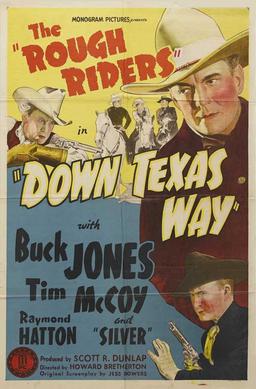
The sixth entry in the Rough Riders series finds Marshal Tim McCall (Tim McCoy) traveling from Wyoming to Texas so that he can help Sandy Hopkins (Raymond Hatton) celebrate his birthday. When he arrives, he discovers that the birthday celebration is on hold because Sandy has been accused of murdering his best friend, John Dodge (Jack Daley). Dodge was the richest man in town and the townspeople think that Sandy murdered him as a result of a disagreement over a card game. What they don’t know is that Sandy and Dodge were only pretending to be mad at each other as a practical joke.
Dodge was really murdered by Bert Logan (Harry Woods), an outlaw who has hired an actress named Stella (Lois Austin) to pretend to be Dodge’s long-lost wife. When all of Dodge’s property is given to Stella, Stella will then give it all to Dodge. While Tim tries to keep the sheriff (Glenn Strange) from prosecuting Sandy, Marshal Buck Roberts (Buck Jones) goes undercover and infiltrates Logan’s gang.
After five previous films that just featured the Rough Riders talking about what their lives were like when they weren’t chasing outlaws, Down Texas Way shows us Sandy Hopkins’s life in Texas. It’s about what you would expect. Sandy likes to spend his time playing cards and hanging out in the lobby of his hotel. It seems like an nice life, at least until Bert Logan tries to frame him for murder. Luckily, the other Rough Riders are always there to have his back. Down Texas Way is not one of the better Rough Riders films because Bert’s scheme never makes much sense but Hatton is relaxed and engaging and McCoy and Jones are their usual tough selves. As with the previous film, the appeal of this Rough Riders film is the Rough Riders themselves and the way that they always stick together and have each other’s back. That’s especially true in Down Texas Way, in which both Tim and Buck show that they’ll travel across several states if it means helping out a friend in a jam.
One final note, the town’s sheriff is named Trump, though I assume he’s no relation. Glenn Strange, who played Sheriff Trump, would later play Frankenstein’s Monster in the last of the Universal horror movies.
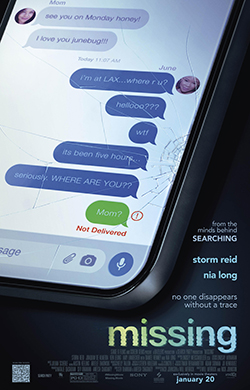
Single mother Grace Allen (Nia Long) goes on a week-long vacation to Colombia with her boyfriend, Kevin (Ken Leung). In doing so, she leaves her 18 year-old daughter, June (Storm Reid), alone at the house. She tells June to be responsible. She tells June to only use the emergency cash in case of emergencies. She tells June not to throw any wild parties. She tells June to clear out her voice mail so Grace can actually leave a message. As soon as Grace leaves, June starts spending the emergency money on beer and parties and she also fails to clear out her voice mail.
It’s hard to blame June, however. She’s 18 and she’s rebellious and it doesn’t help that her mother is extremely overprotective. June feels that there is something off about Kevin and his awkward attempts to talk to her do nothing to make her like him. June spends most of her time wishing that she could have spent more time with her father, James (Tim Griffin), a man who she can barely even remember.
At the end of the week, June drives out to the airport. She makes a sign that reads, “Welcome back from prison,” and she stands in the airport, waiting to see her mom and Kevin. However, neither one of them shows up. The plane has landed. The passengers have disembarked. But Grace and Kevin are nowhere to be seen. June realizes that they are …. MISSING!
Missing was made by the same production team behind Searchingand, like that film, it’s a screenlife thriller, one that is told via computer desktops, security cameras, smartphones, and a smartwatch. Early on, June watches an episode of a true crime show called Unfiction, which is based on the missing person case at the heart of Searching, establishing that the two films take place in the same universe. Much as with Searching, the app-heavy visual style of Missing feels a bit gimmicky but it’s also undeniably effective. Indeed, it’s interesting to think that, even as technology connects us in new ways and as cameras film our every move, people can still somehow disappear off the face of the Earth. As June goes through both Grace and Kevin’s social media and email accounts, the film’s format lets us view the world through her eyes. Like her, we read every email and search for hidden meanings and missed clues.
The mystery at the heart of Missing is an intriguing one and the film is full of twists and turns. Unfortunately, many of the film’s later twists are more improbable than clever. For all of the film’s strengths, things pretty much fall apart during the film’s final third. That’s when the film comes up with a twist that’s surprising only because of how little sense it makes. It’s one thing to fool an audience by being clever. It’s another thing to fool an audience by just pulling a plot point out of thin air. The final big twist requires a huge suspension of disbelief on the part of the audience but Missing isn’t a horror or a sci-fi or a Fast & Furious-style action film. It’s a mystery and anyone who was actually trying to look for clues and come up with the solution on their own would have every right to be annoyed by the way the film handles its finale.
That said, it’s a well-acted film and, much like John Cho in Searching, Storm Reid deserves a lot of credit for bringing some genuine emotion to the lead role. With Reid in the lead role, Missing manages to become something more than just the latest twist on the found footage genre. I also liked the performance of Joaquim de Almeida as Javi, the local Colombian who aids June in the search for her mother. (As long as we’re going to keep spinning off new Searching and Missing films, I think the next one should be about Javi.) There are some genuinely funny moments in the film. Be sure to keep an eye on the messages that June gets from Angel (Michael Segovia) over the course of the film. Despite its flaws, Missing is an enjoyable thriller and, undoubtedly, it will make a good episode of Unfiction.
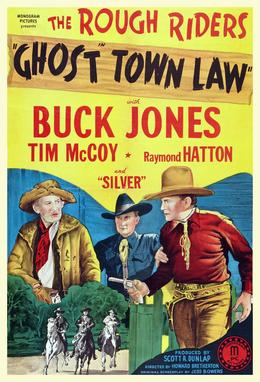
When two U.S. marshals are ambushed and killed while searching for a group of outlaws in a nearly deserted ghost town, Marshal Tim McCall (Tim McCoy) leaves his ranch in Wyoming to investigate the crime. He was friends with the two murdered men, making this case personal. Of course, McCall’s two fellow Rough Riders ride into town to help McCall out. Buck Roberts (Buck Jones) and Sandy Hopkins (Raymond Hatton) arrives separately and pretend to be prospectors. Their investigation leads to the outlaws (led, as usual, by Charles King), a corrupt member of the community, and a network of underground tunnels that might lead to a gold mine. As with all of the Rough Rider films, Ghost Town Law features a younger secondary protagonist who was there to appeal to audiences who didn’t remember Jones, McCoy, and Hatton from their silent and pre-code era heyday. Virginia Carpenter plays Josie Hall, who comes to the town to search for her grandmother and brother.
Starting with the two marshals getting gunned down in the line of duty, this is one of the more violent of the Rough Riders films. Since the Rough Riders are as interested in getting revenge as they are in getting justice, the Rough Riders themselves are quicker on the draw than usual. The identity of the main villain will not be a shock to anyone who has watched any of the other Rough Rider films but the use of the underground tunnels adds a new element of danger to the movie. For once, the outlaws and the Rough Riders seem evenly matched. The film also features the very lovely and likable Virginia Carpenter, making the last of her five film appearances.
As always, the main appeal is watching Jones, McCoy, and Hatton acting opposite each other. Due to the nature of the case, all three of them are more serious than usual in Ghost Town Law but it is still enjoyable to watch them discuss what’s been happening at their ranches since the last movie.