44 Days of Paranoia #2: Executive Action (dir by David Miller)


The Kennedy Memorial in Downtown Dallas

The Kennedy Memorial in Downtown Dallas

Even though it happened 22 years before I was born, I sometimes feel as if it was only yesterday that President John F. Kennedy was assassinated.

A lot of that is because I’m from Dallas.  When I was born, my family lived in Oak Cliff, a few blocks away from where the accused assassin Lee Harvey Oswald once lived.  I drive by the Kennedy Memorial several times a week.  I’ve gone to the Sixth Floor Museum.  I’ve made out on the Grassy Knoll.  On a daily basis, I see tourists who have come down here from up north with their preconceived prejudices, their unwieldy copies of Stephen King’s 11/22/63, and their overactive sweat glands.  (“How do you handle the heat!?” they ask when the temperature is barely above 90.)  With the 50th anniversary of the assassination approaching, the Dallas Morning News has been running daily stories examining every detail of that terrible event.

The rest of the nation, of course, will never let us forget that JFK was assassinated in Dallas.  Just last week, there was an idiotic and bitter opinion piece in The New York Times, written by James McAuley, in which he claimed that Dallas was a “city of hate” that should feel more guilt over the JFK assassination.  As McAuley (who is studying history at Oxford and is not a resident of that city that he apparently feels qualified to judge) put it, “For 50 years, Dallas has done its best to avoid coming to terms with the one event that made it famous: the assassination of John F. Kennedy on Nov. 22, 1963.”

This, of course, is bullshit.

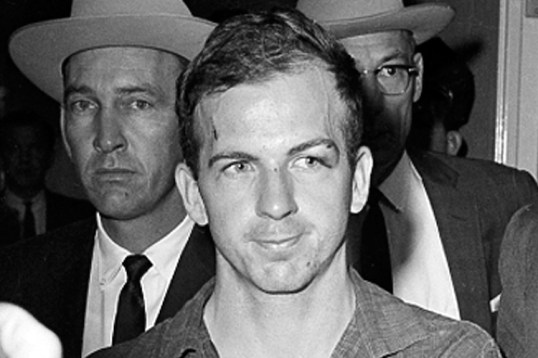
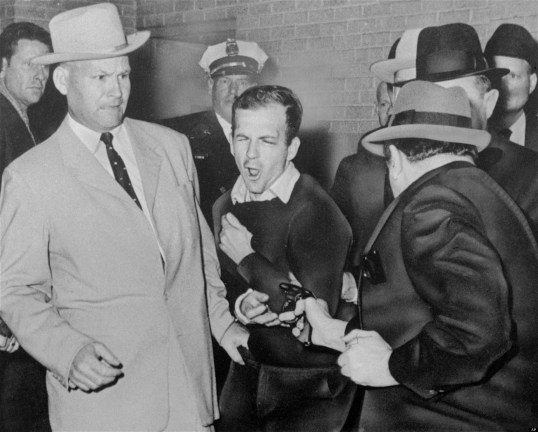
There are two competing schools of thought about the assassination of John F. Kennedy.  One says that Lee Harvey Oswald was solely responsible.  The other is that Kennedy was killed as the result of a complex conspiracy.

JFK Assassination Bullets

Let’s say, for the sake of argument, that Lee Harvey Oswald acted alone.  Well, Oswald was born in New Orleans but he was raised up north in New York City.  He was also a communist with a history of mental instability.  Hence, if you accept that Oswald was the lone assassin than you also have to be willing to accept that Oswald would have tried to kill Kennedy regardless of what city he was living in.

IMF Head-Perp Walk

Things get a bit more complicated if you believe that Kennedy was killed as the result of a conspiracy.  But let’s consider the usual suspects that come up whenever people start talking about the possibility of conspiracy.  The Mafia was based in the north.  The CIA was based in Washington, D.C.  The anti-Castroites were based in Miami.  Again, all of these conspirators would have killed Kennedy regardless of what city he went to in November.

It’s easy for the rest of the country, in a fit of jealousy, anger, and delusion, to blame Dallas and Texas for the assassination of John F. Kennedy but, regardless of whether you believe in the lone assassin or a larger conspiracy, the truth is far more complex.

Over the next few days, as part of the 44 Days of Paranoia, I’ll be taking a look at some of the many films that were inspired by this assassination.  Let’s start things off with one of the lesser known entries in the JFK genre, 1973’s Executive Action.

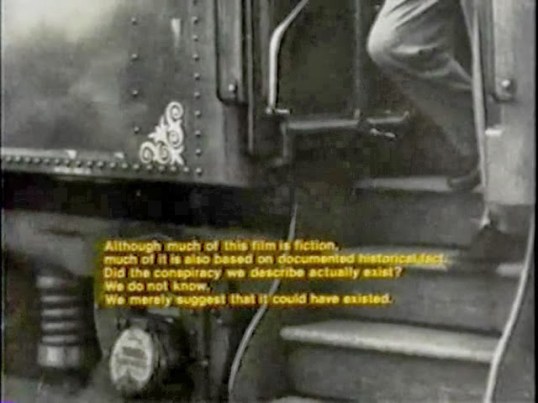
Executive Action opens with a series of grainy, black-and-white photographs of both America in the 1960s and the men who, over the course of the film, will be portrayed as having plotted and carried out the assassination of President Kennedy while a mournful piano plays in the background.  It’s a low-key but eerily effective opening and it also lets the viewers know exactly what type of film they are about to see.  As opposed to Oliver Stone’s far better known JFK, Executive Action is a low-key, almost deliberately undramatic film.   Despite the fact that there are some familiar faces in the cast (or, at the very least, familiar faces to those of us who watch TCM), Executive Action almost feels as if it could have been a documentary.

blogger-image--1805315534

As the film opens in 1963, we see a group of very rich men talking about the future of America.  Ferguson (Will Geer) and Foster (Robert Ryan) are concerned that President Kennedy’s policies are going to destroy America.  Foster is worried that Kennedy is planning on cutting back on military spending.  Ferguson is upset by Kennedy’s support of the Civil Rights movement.  (In one memorable scene, we see Martin Luther King delivering his Dream speech on TV before the camera pulls back to reveal Ferguson watching in disgust.)  Their associate, the shadowy Farrington (Burt Lancaster), argues that the only way to stop Kennedy is to assassinate him and put the blame on a lone gunman.

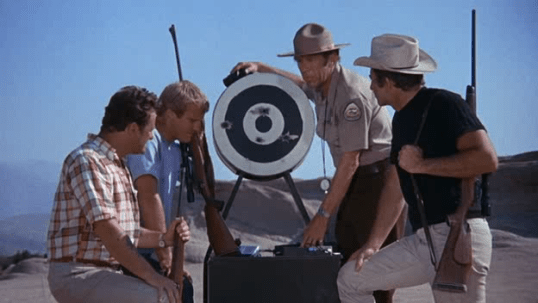
With the support of Ferguson and Foster, Farrington recruits a group of gunmen (led by Ed Lauter and including Roger Corman regular Dick Miller) and works to set up the perfect patsy.  A man (James MacColl) goes around Dallas, acting obnoxious and telling anyone who will listen that his name is Lee Oswald.  At Ferguson’s insistence, a picture is doctored to make it appear as if Lee Harvey Oswald is posing in his backyard with a rifle.  As all of this goes on, the date of November 22nd steadily approaches…

ex3

As I stated before, Executive Action is an almost obsessively low-key film.  That, however, works to the film’s advantage.  Ferguson, Foster, Farrington, and the other conspirators are chillingly believable because they are presented almost as being anonymous.  Instead of being portrayed as being super villains, they are instead men who approach assassination as just another part of doing business.  The impression one gets is that Kennedy isn’t the first leader they’ve had killed and he probably wasn’t the last.  Director David Miller seamlessly mixes historical footage with film reenactments and the end result is a disturbingly plausible film.

Unfortunately, Executive Action is less well-known than some of the other films that have argued that a conspiracy was responsible for the assassination for John F. Kennedy.  However, it may very well be the best.

executive-action-movie-poster-1020681901

44 Days of Paranioa #1: Clonus (dir by Robert S. Fiveson)


clone

We live in paranoid times.

When I first started at the University of North Texas, I lived in the Bruce Hall Dormitory and every day, I could count on the fact that there would be at least one fat and bearded resident in the lobby talking about how 9-11 was an inside job and how the only reason we were in Iraq was so Dick Cheney’s buddies could get rich.

By the time I graduated, everyone was convinced that the Republicans were going to steal the election from Barack Obama.  Some people, of course, were hoping that was exactly what would happen because they were convinced that Obama was actually a Muslim from Kenya.

With each passing year of the Obama administration, there’s been a new conspiracy theory.  Some people claimed that Obamacare was actually a Socialist plot.  Others said that the Koch Brothers were behind the Tea Party.  Meanwhile, Occupy Wall Street spoke ominously of how 1% of the population exploited the other 99%.  As I sit here typing this, there is undoubtedly a desperate Obama partisan somewhere who is writing up his 100th blog post claiming that the Republicans somehow sabotaged the Obamacare website.

And, of course, living and working in Dallas, I am constantly reminded of the biggest conspiracy theory of all time.  In just a few days, it will be the 50th anniversary of the assassination of John F. Kennedy and you better believe that my hometown is currently being invaded by wild-eyed men who are incapable of uttering a sentence without including terms like “grassy knoll,” “military-industrial complex,” and “coup d’etat.”

Yes, these are paranoid times.  Nobody trusts anyone.  All motives are suspect.  With each passing day, it seems that more and more people are convinced that their daily failures and fortunes can all be blamed on shadowy forces.  The world is a random place where a billion stories play out at once and not a single one of them is going to have a happy ending.  People cling to their paranoia for much the same reason that some people cling to their concept of God.  It gives them a false sense of security and reason in an otherwise chaotic universe.

As for me, I may not be a believer in conspiracies but, at the same time, I do find myself fascinated by both the theories and the films that they occasionally inspire.  If movies ultimately serve as a reflection of society’s secret fears, insecurities, and desires, can it be any surprise that so many movies seem to be just as a paranoid as the audiences that go to see them?

For that reason, I am proud to announce that today is Day One of the 44 Days of Paranoia!  For the next 44 days, we will be taking a look at some of the best and worst conspiracy-themed and paranoia-inducing films ever made.

Let’s start things off by taking a look at the 1979 sci-fi conspiracy film, Clonus (a.k.a. Parts, the Clonus Horror).

Clonus opens on a compound the looks a lot like a community college.   Living on the compound is a group of people who all appear to be extremely friendly and trusting.  Every single one of them has a permanent smile plastered across his or her fresh faces.  They spend their spare time jogging, working out, and — well, that’s about it.  At the same time, none of them smoke, drink, or do anything else that could possibly cause any damage to their bodies.

So, at this point, you can probably guess that they’re either Mormons or they’re clones.  (If you’re not sure, take another look at the film’s title…)

When the clones aren’t busy jogging, they’re talking about how much they hope that, one day, they will be allowed to go to “America.”  There’s actually something rather touching about how excited they all get whenever they hear that one of them is getting sent to America.  They’re a bit like the rubber aliens in Toy Story, putting all of their faith in “The Claw” and its ability to lift them up to a better life.  Of course, what the clones don’t realize is that “going to America” is just a euphemism for being put under sedation and having their organs forcibly removed.

Eventually, one clone (played to awkward blank-faced perfection by Tim Donnelly) starts to question just why exactly he and his friends are being kept on the compound.  He eventually escapes and discovers that not only has he been in America all along but that he only exists so that the rich and powerful can harvest his organs.  Donnelly meets an idealistic journalist (Keenan Wynn) who happens to be acquainted with the family of a sinister presidential candidate (played by Peter Graves).  When Wynn and Donnelly threaten to expose the truth, they find themselves targeted by the U.S. government which, in typical conspiracy-film style, is more than willing to kill to protect its secrets.

If the plot of Clonus sounds familiar, that’s because Michael Bay pretty much remade the film in 2005.  In fact, Clonus director Robert Fiveson felt Bay’s The Island was so similar to his film, that he filed a lawsuit for copyright infringement.  But whereas The Island was the epitome of a film that was more expensive than memorable, Clonus is an effectively creepy little film that, though dated, is still occasionally even thought-provoking.  Though it may have been the result of the film’s budgetary limitations, Clonus eschews flashy effects for atmosphere and even the blandness of some of the locations adds to the film’s sense of low-key but palpable menace.  If ever one needed proof that a low budget can occasionally be the best thing to ever happen to a film, Clonus is that proof.  The film is generally well-acted and, best of all, it all builds up to one of those wonderfully downbeat endings that appear to have been so popular in the 70s.

Much like another recent and similar film — the excellent Never Let Me Go — Clonus works because it’s disturbingly plausible.  It’s a bit of a cliché to say that a film makes science fiction feel like science fact but Clonus is one of those films that accomplishes just that.

title

Defending the Counselor


The_Counselor_Poster

(Spoilers Below)

The Counselor was one of the most anticipated films of 2013.  After all, it was based on a screenplay by the Pulitzer-prize winning novelist Cormac McCarthy and it was directed by Ridley Scott.  Its cast included such stars as Michael Fassbender, Javier Bardem, and Brad Pitt.  The film’s two trailers promised a return to the thematic territory that the Coen Brothers explored in their Oscar-winning adaptation of McCarthy’s No Country For Old Men.

And yet, when The Counselor was released in October, the reviews were scathing and audience response was reportedly terrible.  Writing for Salon, film “critic” Andrew O’Hehir suggested that The Counselor was not only the worst film of 2013 but the worst film of all time.

And you know what?

For not the first time, Andrew O’Hehir was wrong.  The Counselor is not the worst film of 2013.  Instead, it’s one of the best.  It’s a film that will be studied long after more acclaimed films have been forgotten.

Why is The Counselor so hated?

It’s not an easy film to love.  In fact, the film is rather brave about alienating its audience and refusing to allow for the crowd-pleasing moments that viewers have come to expect from even the most prestigious of films.

In order to truly defend the Counselor, it’s necessary to know the plot of The Counselor.  Needless to say, everything that follows constitutes a huge spoiler so, if you’re one of those types, feel free to stop reading now.
Brad-Pitt-Michael-Fassbender-Counselor

Okay, still here?  Here’s a condensed version of what happens in The Counselor:

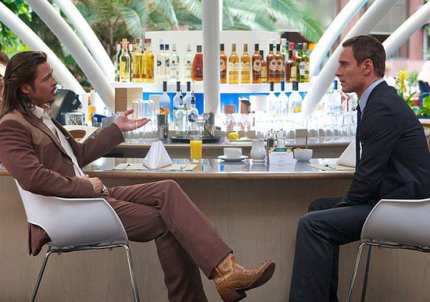
The Counselor (Michael Fassbender) is an honest lawyer in El Paso who has never broken the law and is engaged to marry the beautiful and saintly Laura (Penelope Cruz).  For reasons that are never explicitly stated (but, as I’ll explain below, are obvious to anyone who is willing to look for the clues), The Counselor agrees to help his clients Westray (Brad Pitt) and Reiner (Javier Bardem) smuggle a huge shipment of cocaine into the U.S. from Mexico.  However, Reiner’s girlfriend Malkina (Cameron Diaz) steals the drugs and frames the Counselor for the theft.  As a result, Reiner ends up getting executed by the Mexican cartel, Westray is beheaded on the streets of London, and the Counselor ends up hiding out in Juarez, Mexico, sobbing as he looks at a DVD copy of a cartel-produced snuff film that features Laura being murdered.  The end.

Yeah, it’s not exactly a happy film.  And yet, it’s a film that sticks with you, a portrait of a shadowy underworld that is fueled solely by greed, paranoia, and masculine posturing.  Ridley Scott makes good use of the South Texas landscape and the talented cast creates a memorable gallery of rouges.

And yet, The Counselor is getting some of the worst reviews of the year.  What’s especially interesting is that the things that so many critic cite as flaws are actually the film’s greatest strengths.

The Counselor

Consider the following common criticisms:

1) The film features some of the most overly articulate drug deals of all time.

This is the most frequent complaint that I’ve come across concerning The Counselor and there is some validity to it.  The Counselor is a very talky film.  The film’s first hour is pretty much made up of The Counselor having three conversations, all about the same thing and all reaching the same conclusion.  Cormac McCarthy’s dialogue is, perhaps not surprisingly, rather portentous and florid.  The Counselor does ask the audience to accept a world where even the head of Mexico’s most powerful cartel is given to going off on long philosophical digressions.  The Counselor is one of those films where nearly every line seems to have a double meaning.

That said, I think that those who attacking the film’s dialogue are missing the point.  This is not meant to be a naturalistic film.  Instead, it’s a heavily stylized B-film that uses its sordid story as a metaphor for dealing with deeper issues of greed, masculinity, and the changing mores of American culture.  Much as every line of dialogue has a deeper meaning, so does every pulpy plot twist.  It takes a while to adjust to McCarthy’s dialogue but, ultimately, that dialogue serves to remind us that the film has a lot more on its mind than just telling the story about a drug deal gone bad.  The combination of overly articulate dialogue with primitive violence and desires encourages us to look under the film’s surface.

2) The film’s plot is predictable.

This may be true but I think that’s actually McCarthy’s point.  From the start of the film, the Counselor is continually warned that things could potentially go very wrong.  Despite these warnings, the Counselor still gets involved in Reiner’s drug and, through a combination of hubris and fate, he loses everything that he loved.

The Counselor’s downfall is not meant to be a surprise.  Instead, McCarthy’s point is that the consequences of our actions are usually obvious but we, as human beings, chose to live in denial about just how little control we actually have over our own fate.

TheCounselor-Diaz-Cheetah-Tat

3) Ridley Scott’s direction is stylish but ultimately empty.

This argument goes that, while Scott manages to capture some gorgeous images of the Texas/Mexico border, those images ultimately don’t add up to much.  The idea goes back to a charge that is frequently leveled against Ridley Scott as a director, that he’s all style and technique with little substance.  (Interestingly enough, this is the same charge that is often made against the Coen Brothers.)

In the past, I’ve been critical of Ridley Scott.  (For proof, check out my reviews of Robin Hood and Gladiator.)  However, that being said, I think that, with The Counselor, Scott does a good job of visually interpreting the concepts at the heart of McCarthy’s script.  My mom was from South Texas and I’ve spent enough time down there to understand just how perfectly Ridley Scott manages to capture the combination of beauty and harshness that one finds along the border between Texas and Mexico.  In Scott’s hands, the emptiness of the Texas landscape serves as a perfect parallel for the emptiness of the lives of the majority of the film’s characters.

Speaking of which…

4) The motivations of the Counselor remain a mystery.

Why does the Counselor get involved in the drug deal in the first place?  Many of the film’s critics have complained that the Counselor’s motivations remains a mystery and therefore make it impossible for audiences to sympathize with the character.

Nothing could be further from the truth.

What these critics are failing to realize is that the Counselor’s motives are obvious every time that he appears on-screen.  The audience has to be willing to look for them.  The audience has to be willing to think and that, of course, is asking quite a bit of some viewers.
The-Counselor

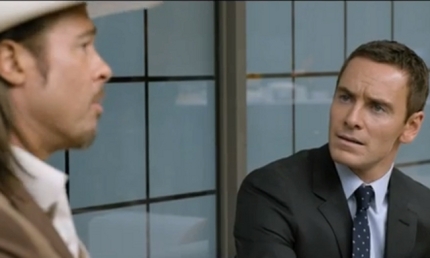
While the Counselor hints that his reason for getting involved with the drug deal is so that he can make enough money to provide a good life for Laura, his actual motivations are far more selfish.  One need only see the Counselor in his perfectly pressed suits or in his sleek but sterile home to understand exactly who the Counselor is.  He is a character who has made his living by defending those who break the law but who has never had the courage to actually flaunt the rules himself.   He is a man who lives in a self-constructed prison of ennui and associating with Reiner and Westray gives him a chance to escape from his conventional existence.   He is a character who spends his day profiting from the crimes of others but, because he can go home to his beautiful home and his beautiful fiancee, assumes that he’s somehow detached from the consequences of the actions of his associates.

The Counselor starts the film as an unemotional, blank-faced cipher, a man whose entire identity is based on his job title.  (Indeed, we never learn once learn or hear the character’s actual name.)  The only time that he shows even a hint of human depth or emotion is when he’s with Laura.  He’s a man who, in many ways, is dead on the inside.  It’s only after he gets involved with Reiner and Westray that the Counselor starts to show any signs of life until, by the end of the film, he literally cannot control his emotions.   The Counselor frees himself from his stifling and conventional existence at the cost of everything and everybody that he loves.  In his pursuit of freedom, he simply moves from one self-imposed prison to another.

5) Particularly in its portrayal of Malkina, there is a strong streak of misogyny running through the film.

This is a point that I’ve seen made by several critics and it’s one that bothers me as both a feminist and as a female who happens to love genre films.  Just because a film features a misogynistic character does that therefore make the film itself misogynistic?

The majority of those who claim that The Counselor is anti-female often point to the character of Malkina.  As played by Cameron Diaz, Malkina is a hyper sexual sociopath who manipulates and destroys everyone else in the film.  Even though he’s obsessed with her, Reiner also claims to fear her and he has several conversations with the Counselor in which he cites her as proof that women cannot be trusted.

However, just because Reiner says this, that doesn’t necessarily mean that the film agrees.  In fact, as should be obvious to anyone who is actually willing to pay attention to the film, Reiner is portrayed as being a fool who, ultimately, is just as delusional as the Counselor.  Reiner, Wainstray, and the Counselor all exist in a hyper masculine environment.  For all of their posturing and macho talk, it’s also obvious that none of them are capable of truly dealing with women.  Wainstray can only bring himself to acknowledge them as potential sexual partners while the Counselor both idealizes Laura and uses her happiness as an excuse to pursue his own criminal enterprises.  Reiner, meanwhile, is both attracted to and terrified of Malkina.

the-counselor-ferrari-diaz

In perhaps the film’s most infamous scene, Malkina removes her panties and then grinds against the windshield of a Ferrari while Reiner watches from inside the car.  Some have argued that, with this scene, the filmmakers are equating Malkina’s sexuality with evil.  I, however, would argue that this scene shows that Malkina — alone of all the film’s major characters — understands the fact that all of the men in her life are essentially boys who are either incapable of or unwilling to grow up.  Malkina uses her sexuality not because she’s evil but because she’s intelligent enough to use every weapon at her disposal to make sure that she will be one of the few characters to survive to the movie’s conclusion.  By the end of the film, it’s obvious that Malkina is both the strongest and the most intelligent character in the film.

There’s an interesting scene towards the end of the film in which the Counselor, who is hiding out in Juarez, stumbles across a group of protesters who are holding pictures of young women who have either been killed on or vanished from the streets of Juarez.  Since 1993, over 4000 women have been murdered in Juarez.  The majority of those murders are still unsolved, with many blaming the Spanish tradition of machismo.  The feeling of many is that “good” girls stay home while “bad” girls get jobs in the city and are often  murdered as a result.  And, since the victims shouldn’t have been pursuing a life outside of domestic servitude in the first place, why waste the time trying to win them any sort of justice?  For the past decade, brave activists have put themselves in danger by daring to demand justice for the dead of Juarez.  When the Counselor stumbles across their rally, it’s a brief moment in which the real world and the cinematic landscape come together.

It’s also a scene that serves to remind us that the film’s characters are living in a hyper masculine world, one that embraces the concept of machismo without understanding or caring about the consequences of that destructive  culture.  The Counselor’s horrified reaction to the rally is the reaction of a man who has finally been forced to confront the evil of which he is now a permanent part.

6) The film’s ending is depressing.

Complaining about Cormac McCarthy writing a depressing ending is a bit like getting upset at a cat for purring.  It’s what McCarthy does and anyone with any knowledge of his work has no right to be shocked that the film ends on a note of hopelessness.  Much as with No Country For Old Men, The Counselor ends the only way that it can.  It may not be a happy ending but it is, at least, an honest ending.

The Counselor may not be an easy film to like but it’s definitely a film that deserves better than to be dismissed as the worst of 2013.


Counselor-Bardem2

Film Review: Gangster Squad (dir by Ruben Fleischer)


Gangster Squad

Do you remember Gangster Squad?

This film, which tells the story of hard-boiled cops and psychotic gangsters in 1940s Los Angeles, was originally meant to be released in September of 2012 but the release date was moved back because the film originally featured a gun battle in a movie theater.  After the real-life movie theater shooting in Aurora, Colorado, that scene was reshot and the release of Gangster Squad was delayed until January of this year.  The critics absolutely hated it, audiences stayed away, and Gangster Squad was the first high-profile flop of 2013.

I was among those who ignored the film when it was first playing at theaters.  After all, it was January and I was more interested in following the Oscar race than going to see a film that, by all accounts, was somewhat terrible.  However, now that Gangster Squad is showing up on a nearly nightly basis on Cinemax, I recently got a chance to see the movie and you know what?

The critics were wrong.

Gangster Squad tells a familiar story.  In fact, the film features not a single character or plot twist that hasn’t shown up in another movie.  The setting is Los Angeles in the 1940s.  Ruthless gangster Mickey Cohen (a totally over-the-top Sean Penn) is the king of the city’s underworld.  How crazy is Mickey Cohen?  He’s so crazy that, when we first see him, he’s watching as another gangster is literally ripped in half.  He’s so crazy that, in the middle of a gun battle, he yells, “Here comes Santy Claus!” as he fires his machine gun.  That’s how crazy Mickey Cohen is.

Sean Penn in Gangster Squad

Seriously crazy.

Fortunately, righteous police chief William H. Parker (Nick Nolte) refuses to allow a little thing like due process to keep him from pursuing Mickey.  Parker calls Sgt. John O’Mara (Josh Brolin) to his office and, after delivering a long and flowery monologue that verges on incoherence, he finally explains that O’Mara’s mission is to put together an elite squad of cops and to take Mickey out by any means necessary!  (Usually, I try to exercise some restraint when it comes to punctuation but Gangster Squad is one of those films that demands exclamation points.)

This is followed by a series of properly colorful scenes in which O’Mara recruits his gangster squad.

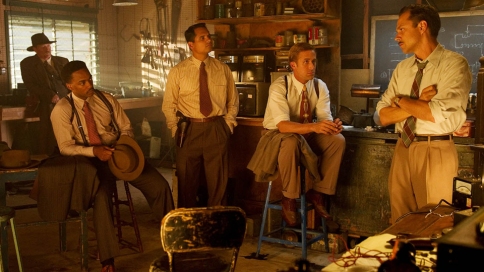
Jerry Wooters (Ryan Gosling) is a cynical World War II veteran who is, at first, skeptical of O’Mara and his squad.  Wooters, however, changes his mind after a saintly shoeshine boy is gunned down in front of him.  Wooters is also having an affair with Grace Faraday (Emma Stone), who happens to also be Cohen’s girlfriend.

Coleman Harris (Anthony Mackie) is a black cop who is good with a knife and who lost his cousin to the heroin distributed by Cohen’s mob.  Watching the friendly and playful interaction between Harris and all of the film’s white characters provides us with one of our first clues that Gangster Squad is not necessarily aiming to be a historically accurate portrait of America in the 1940s.

Conway Keeler (Giovanni Ribisi) is a wiretapper and a family man.  Keeler’s fate is pretty much sealed the minute that he tells O’Mara that he’s willing to risk death just to make the world a better place for his son.

Max Kennard (Robert Patrick) is a former old west gunslinger who now spends his time killing gangsters.  Max, we’re told, may be old but he’s also personally shot over a 100 gangsters.  Max also has a younger partner, an honest cop named Navidad Ramirez (Michael Pena).

GANGSTER SQUAD

The Gangster Squad

As you can probably guess at this point, there’s not a single cliché that is not employed by Gangster Squad.  However, and this is what I think several critics missed, the film deliberately takes its clichés to such an extreme that they go from being flaws to being strengths.  By so enthusiastically going overboard in its embrace of the conventions of the gangster film genre and, at the same time, acknowledging the fact that the audience is also familiar with those clichés, Gangster Squad creates its own vibrant and compulsively watchable fantasy world.  The world of Gangster Squad has little to do with any sort of historical reality.  Instead, it’s a  world constructed solely out of other gangster movies.

Taking all of this (and the fact that the film is directed by Ruben Fleischer of Zomieland and 30 Minutes or Less fame) into consideration, it’s pretty obvious that Gangster Squad is not a film that’s meant to be taken seriously.  And yet, that’s what so many critics did when the film was first released in January.  Instead of appreciating the film for paying over-the-top homage to the gangster films of the past, critics attacked it for being an example of style over substance.

And, to give the critics their due, they were exactly right.  There is no substance to Gangster Squad.  Instead, the film is a total celebration of style.

And what style!  In Fleischer’s hands, 1940s Los Angeles is a colorful wonderland of pure excess, a vibrant landscape of dark alleys and swanky nightclubs that literally glow on-screen and are populated by tough men and sultry women in clothing that might not have been found hanging in every closet in the 40s but should have been.  (Seriously, when Emma Stone first appears on-screen, she’s wearing a red gown that is simply to die for.)

This Christmas, I want both Ryan Gosling and the dress.

This Christmas, I want both Ryan Gosling and the dress.

For the viewer who is willing to give themselves over to the film’s over-the-top aesthetic and are willing to appreciate it for what it is (as opposed to condemning it for what it isn’t), Gangster Squad is a watchable, entertaining, and fun movie.  And what’s so bad about that?

I’m glad that I finally got a chance to see Gangster Squad.  Is it one of the great gangster films?  No.  The great gangster films have both style and substance but, quite frankly, if I can only have one than I would prefer something stylish and fun like Gangster Squad to something like Killing Them Softly.

(Then again, I would prefer just about anything to sitting through Killing Them Softly for a second time.)

So, enjoy Gangster Squad.  Watch it for the style.  Have fun.  And most importantly, remember that critics are as often wrong as they are right.

Emma Stone in Gangster Squad

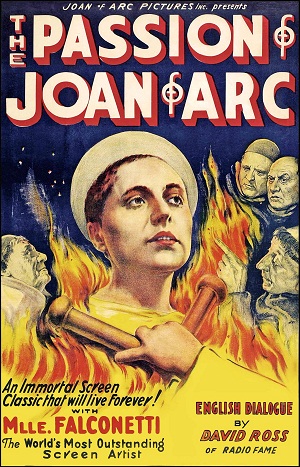
Celebrate Lisa’s Birthday With The Passion of Joan Of Arc


Passionarc

As some of you may know, I celebrated my birthday on Saturday.  I’m still getting used to the idea of being 28.  (I can still remember when I thought that 21 was so old!)  And, I have to admit, that I think I always figured that I would have all the questions of existence answered by the time I turned 28.

Don’t get me wrong, I’m hardly a lost soul.  They say that 30 is the new 20 and, by that logic, I’m only 18 years old, which means that not only am I barely legal but I’m actually doing amazingly well for someone my age.

Still, as I start the 28th year of my often quirky life, it’s hard for me not to think about one of my personal heroines.  St. Jeanne D’Arc never lived to be 28.  She was burned at the stake for heresy when she was 19 years old.  But, in her short life, she inspired and led a nation.  When I was 17, I was busy dating and shoplifting.  When she was 17, Jeanne was defeating the English at the Siege of Orleans.

So, you can see why, despite whatever else I may have accomplished so far in my life, it’s still difficult for me to feel that I haven’t quite lived up to Jeanne’s example.

With all this in mind, what better time, than my birthday, to share with you my favorite silent film, the 1928 masterpiece The Passion of Joan of Arc?

Directed by Carl Theodor Dreyer, the film tells the story of the capture, torture, and eventual execution of Jeanne D’Arc.  Dreyer adapted the film directly from the original transcripts of Jeanne’s trial and he brings a truly surprising amount of intimacy to a story that is so famous that it often runs the risk of also feeling remote and detached from modern reality.  As opposed to many silent films in which camera movement seems to be almost an afterthought, Dreyer skillfully used jarring angles and sweeping movement as a way to put us directly into Jeanne’s head.  As we watch the film, we feel both her courage as she refuses to surrender to her tormentors and her fear as her story reaches its inevitable conclusion.  This film  transforms an iconic saint into a vulnerable but strong human being and, as a result, 85 years after it was first released, The Passion of Joan of Arc remains one of the most powerful films of all time.

Before one watches The Passion of Joan of Arc, there are three things worth noting:

1) One of Jeanne’s tormentors is played by the playwright Antonin Artaud.  Artaud would later found the Theater of Cruelty, a theatrical movement that would later be cited as an influence by Italian director Lucio Fulci.

2) Dreyer specifically barred his cast from wearing makeup, which serves to emphasize both the natural beauty and the vulnerability of Jeanne.  It also serves to emphasize the ugliness of those persecuting her.  As a result, even as the film serves to transform Jeanne into an individual, it also establishes her as a symbol for all oppressed people while her memorably ugly persecutors perfectly symbolize the excess and corrupting influence of absolute power.

3) It has been said by that, in the title role, Maria Falconetti gives one of the best performances in the history of film.  I certainly don’t disagree.  Facing her persecutors with a mixture of fear and defiance, Falconetti gives an intensely emotional performance.  You look at Falconetti’s Jeanne and you believe that yes, at the age of 19, she could have led a nation to victory.  (Though, it should be noted, that Falconetti was actually 35 years old when she played Jeanne).  Making Falconetti’s performance all the more poignant is the fact that she only made one other film and she would eventually end up committing suicide in 1948.

Without further ado, here is Carl Theodor Dreyer’s The Passion of Joan Of Arc.

A Steaming Pile Of Norseshit — “Thor : The Dark World”


thor-the-dark-world-poster1

The way I work, I generally try to avoid giving up too much by way of “spoilers” when it comes to reviewing movies that are still playing simply because I’m never sure how much anybody out there who might be reading this stuff wants to know about any given flick before they’ve actually seen it. Call it common courtesy, I guess, if you’re feeling generous, or weak-kneed fear of the always-on-the-alert hordes of internet “spoiler police” if you’re not, but nevertheless, it’s something I try to adhere to, however tough the going may get.

And Thor : The Dark World makes it very tough indeed. The simple fact is, you just can’t heap all the criticism on this film that it so richly deserves without giving away numerous  key plot points, so here’s what I’m gonna do instead : for those of you who want a meticulously-detailed, blow-by-blow analysis of how and why this big-budget boondoggle fails every single logic test known to humankind, I humbly suggest you follow this link to a lengthy review  by the ever-reliable Julian Darius over at  the Sequart website : http://sequart.org/magazine/32555/id-need-a-lobotomy-to-enjoy-thor-the-dark-world/ .  Julian’s one of the more articulate and intelligent writers the web has to offer on all things comic-related, and while his grammar and syntax are occasionally a bit uncharacteristically all over the map in this particular piece, I get it : he had a lot to vent about, and sometimes ya just gotta let off steam. In any case, his analysis is absolutely spot-on here and, if anything, he’s being too kind to this putrid mess of a movie.

For those of you who want a short, “spoiler”- free summation of why this film sucks so badly though, , here’s the bare essentials  — Thor : The Dark World is built on so many glaringly obvious logical inconsistencies, ten-trillion-to-one coincidences, rehashed story elements that worked much better in the first film, plot holes that are big enough for an  entire army of Asgardian warriors to charge though,  and problems brought on by the idiotic actions of the title character himself that it well and truly boggles the imagination. This is, in short, a complete and utter celluloid train wreck that requires such a heaping dose of suspension of disbelief that even people who can accept the most outlandish premises imaginable will have a hard time coming to grips with this one. It also doesn’t help that the characterization of most of the leading players seems to have taken a leap back toward the dark ages, the dialogue is hopelessly inane from start to finish, and that director Alan Taylor (a seasoned TV veteran, and it shows) brings exactly none of the Shakespearean-rooted vision of Kenneth Branagh to the proceedings and opts, instead, to film things in the rapidly-evolving (and hopelessly uniform) Marvel “house style” best exemplified by the likes of Jon Favreau and Joss Whedon. Sure, their Iron Man and Avengers films, respectively, have earned tons of fan accolades (not to mention box office dollars),  but let’s be honest — the directorial work on either of those properties is virtually (okay, who are we kidding, completely) indistinguishable from the other. So, hey, welcome to the lowest-common-denominator club, I guess, Alan.

thor-the-dark-world-releases-a-pair-of-new-images-132862-a-1366629848-470-75

On the plus side, the CGI is pretty cool here throughout, though, and since that’s probably what half the audience (at least) for these things is there for, said half (again, at least) of the audience should walk away feeling quite satisfied.

For those of us who like a movie that at least tries to make sense, though (or fails to so earnestly that watching it becomes a kind of sublime pleasure in its own right), there just ain’t much of offer here. Natalie Portman goes from intelligent astrophysicist to love-struck schoolgirl the minute Thor hits the scene (we later learn she’s only continued with her career at all in hopes of running into him again — there goes a few decades’ worth of tepid progress for female characters in genre cinema in about one second flat) and spends the rest of the film making puppy-dog eyes but not doing much else; Chris Hemsworth plays up the dull nobility  of his character with none of the  reckless humanity we saw in the first film (even though he organizes mass treason here — again); Tom Hiddleston wildly accentuates the effeminate qualities of Loki in a way that pretty much screams “you can’t trust this guy, he’s obviously queer“; Anthony Hopkins mails in his performance from behind a shining suit of armor; Rene Russo fulfills her one character requirement by d— whoops, that’s right, “spoliers”! ;  Kat Dennings essentially plays the same character she does on TV’s Two Broke Girls ; and Stellan Skarsgard does his best to make sure we all know nervous breakdowns are nothin’ but harmless fun, his character having gone mad due to the purportedly “traumatic” events he endured in The Avengers (a bit of a reach given that even its most fervent partisans would admit that’s essentially a big-budget “popcorn movie” with little to no actual thematic depth whatsoever — they just think it’s a particularly well done “popcorn movie”). In short, if you’re getting the idea that Thor : The Dark World is risible,  superficial nonsense with some deeply offensive takes on gender roles, (alluded to) homosexuality, and mental illness, then congratulations! You’re exactly correct.

Christopher Eccleston stars as Malekith in Marvel's Thor: The Dark World

Christopher Eccleston does his best, I suppose, considering the mountain of makeup he’s buried beneath, as chief villain Malekith, but given the preposterous nature of the character he’s asked to portray (head of the evil “Dark Elves,” who alone has the power  to track down a mystical force powerful enough to unmake all of creation called the Aether — except for, ya know, that time  he lost sight of it for literally eons when it was purportedly “shielded”  from him  in a wide-open cave — and even if you buy that, you’d have a tough time explaining why he couldn’t trace it while it was being taken right there), I guess there’s only so much the poor guy can do. Still, I give him credit for at least appearing to want to do more than simply go through the motions here. It’s more than I can say for anybody else, apart from Idris Elba, who does inanimate stoicism better than anyone in his role as Heimdall. Not that he’s really got that much to do, mind you, but he stands around with a hell of a lot of conviction.

At the end of the day, though, I dunno — Thor : The Dark World is still a Marvel studios product, which means that it won’t get nearly the critical scrutiny it should and that legions of loyal followers will proclaim their undying love for it even though it is, by any standard of bias-free critical measure, an absolute clusterfuck of a movie. They, like the Asgardians in the film, will still see Thor himself as a heroic figure even though his decision to bring Portman’s Jane Foster character to his mythic home ensures its invasion by enemy hordes, and they’ll no doubtpraise the film for its forced moments of flat, shoehorned-in “humor” (although even I have to admit the cameo-of-sorts by Chris Evans as Captain America is fun) and equally-forced “dark and somber” tone. This will probably be proclaimed as a “mature” and  even “sophisticated” film in many quarters, and needless to say, those of us willing to call bullshit on it will be vilified  by Dinsey’s unpaid internet army.

Thor: The Dark World film still

No matter.  The simple truth is that Thor : The Dark World is a movie that insults it’s audience’s intelligence in ways that even Roger Corman would never dream of, and goes about its dull and tepid business with less interest and heart than Roger and his barely-compensated filmmakers, actors, and crew ever brought to the proceedings. It’s easily and unquestionably one of the absolute worst films of the year — hell, of the last several years —even if only a few of us have the guts to say so in public. Dis/Mar thinks you’e a sucker with no taste or intelligence who will blindly queue up for anything they churn out. They hold their audience in contempt and at this point are openly daring you to keep forking over your cash for their garbage. How long are you willing to prove them right, and keep playing along?

Scenes I Love: “Tomorrow Belongs To Me” from Cabaret


cabaret_old_man

Tuesday night was election night so, of course, everyone on twitter was talking about politics.  People were making fun of Chris Christie’s weight, accusing Barack Obama of being a communist, and going on and on about the Tea Party.  Some of them were very liberal and some of them were very conservative and quite a few of them made a big deal about being in the middle.  However, the one thing that many of them had in common was that, regardless of what they believed, they were convinced that they had the best plan for America and that anyone who disagreed with them had to be idiotic, evil, or both.

That, by the way, is why I tend to stay off of twitter whenever there’s something political going on.  It’s far too stressful having to deal with so many people convinced that tomorrow belongs exclusively to them.

Myself, I believe in freedom of choice and the importance of the individual.  That’s one reason why twitter bothers me when it comes to politics.  Everyone has something to say but nobody says it as an individual.  Instead, there’s a mob mentality that I find difficult to take.

Today’s scene that I love is all about that political mob mentality.

Bob Fosse’s 1972 film Cabaret takes place in pre-World War II Nazi Germany.  In this scene, writer Brian (Michael York) and the decadent aristocrat Max (Helmut Griem) visit a Berlin beer garden.  As they discuss their own personal concerns, they are interrupted by a boy who singing a patriotic song called “Tomorrow Belongs To Me.”

Fosse begins the song with a close-up of the boy’s angelic face, only gradually moving the camera to reveal that the boy is dressed in the uniform of the Hitler youth.  As the boy’s singing steadily grows more and more strident, the other Germans at the beer garden join in.  As more and more voices join in, the song goes from being hopeful and optimistic to being ominous and threatening.

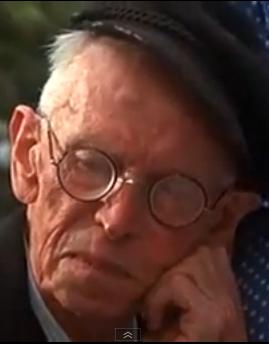
Most significantly, only one old man declines to join in.  Instead, that man can only watch the scene with a weary sadness that indicates that he’s survived enough to know better.

It’s a powerful and disturbing scene and one that serves as a powerful warning against the political mob mentality.

Horror On The Lens: The Little Shop of Horrors (dir by Roger Corman)


little_shop_of_horrors_2

So, guess what?

Originally, we were going to feature an Italian film called Dawn of the Mummy today.  It’s the world’s only zombie/mummy hybrid and you guys would have loved it!  Or maybe not.  I have to admit that I don’t really love it.  It’s actually a pretty bad movie but, at the same time, how many times do you get to see a movie that features both a mummy and zombies?

However, last night, the YouTube account that was hosting Dawn of the Mummy was deleted.

AGCK!

So, instead of showing you Dawn of the Mummy, we’re going to show you the original Little Shop of Horrors.  It’s true that we featured Little Shop last Halloween but, oh well.  It’s a fun little movie, especially when you consider that Roger Corman filmed it in 3 days.  Jack Nicholson gets all the attention for playing a masochistic dental patient but I think the best performance is given by flower-eating Dick Miller.

From 1960, enjoy the original (non-musical) Little Shop of Horrors!

(However, speaking of the musical, I was in a community theater production of Little Shop of Horrors when I was 19.  I so should have been cast as Audrey but instead, I was just a member of the “ensemble.”  Bleh!  Anyway, our director showed us the original Little Shop of Horrors and I was the only member of the cast to understand that Corman’s film was superior to the musical version.  That said, I still tear up whenever I hear “Somewhere that’s green.”)

Horror On The Lens: House on Haunted Hill (dir by William Castle)


House on Haunted Hill

With only two days left to go until we reach Halloween, now seems like the perfect time to watch a classic Vincent Price haunted house film.  I’m talking, of course, about the original House On Haunted Hill.

Released in 1959, House On Haunted Hill tells the story of how an eccentric millionaire (played by Vincent Price, of course) rented out a “haunted” mansion for a party. invited over five guests, and offered each of them $10,000 on the condition that they manage to spend the entire night in the house.  Along for the ride is Price’s unhappy wife (Carol Ohmart) and the house’s wonderfully neurotic caretaker (played by Elisha Cook, Jr, who played a lot of neurotic caretakers over the course of his long career).

House on Haunted Hill remains one of the classic B-movies.  This is largely because of Price’s wonderfully over-the-top lead performance and William Castle’s equally over-the-top direction.

Back in 1959, theaters were equipped so that a plastic skeleton would appear to fly over the heads of the audience during some of the film’s more shocking moments.  So, grab yourself a skeleton, take a seat, and enjoy House on Haunted Hill!

Halloween Horrors 2013 : “Self Storage”


self-storage-movie

Sometimes even a movie with very little to recommend for it still has — well, something to recommend for it. Such is the case with this year’s direct-to-video, shot-on-HD indie horror effort Self Storage,  a largely pathetic, unmemorable, boringly amoral (more on that before we’re through) piece of — uhhmm, work —- written and directed by, and starring, the supremely untalented Tom DeNucci.

Shot in Rhode Island, this is one of those flicks that’s pretty hard to see having much of an audience beyond the friends and immediate family of anyone involved in its production, being that every single character in it’s a complete douchebag, the blood n’ guts are both fairly tame and poorly realized, and its somewhat inventive premise is buried under layer upon layer of incompetent execution.

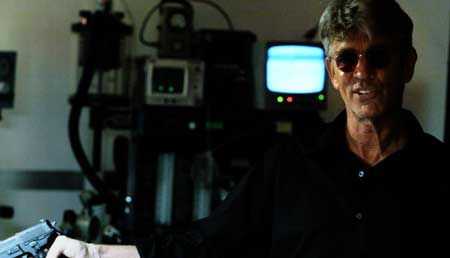
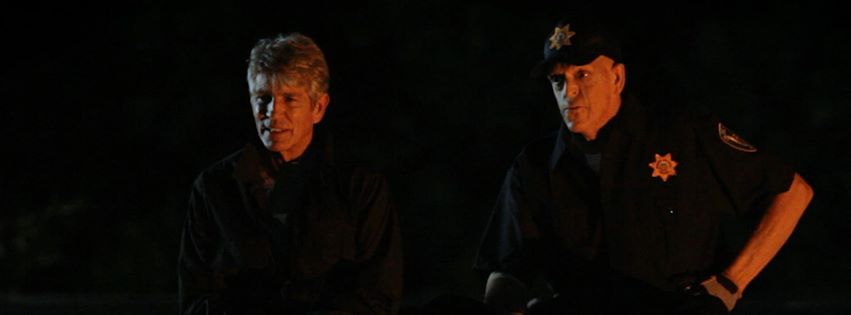
First, the particulars of the plot : go-nowhere pothead Jake (the aforementioned DeNucci) works as a security guard at a mini-storage facility. His friends, a half-assed assemblage of walking caricatures (the slut, the hot chick, the good girl, the horn-dog guy who gets a lot of pussy, the two other horn dog guys who get no pussy and are hopeless porn addicts) want to party at his workplace one night and figure it should be no sweat because Jake actually lives on the premises, as well. He says no at first, then says yes when he learns that his asshole boss (Eric Roberts) and flunky right-hand man (Micheal Berryman, whose name might not ring a bell to anyone but die-hard horror fans, but who even most casual viewers will recognize instantly thanks to The Hills Have Eyes, The Devil’s Rejects, and too many other flicks to mention — in short, he’s the tall, bald, weird-lookin’ dude) have cut some kind of shady deal with a local black marketeer (Jonathan Silverman — -speaking of supremely untalented), and intend to shut the place down the next day when they’re good and rich and fire their deadbeat part-timer’s ass in a heartbeat.

So — the party’s on, but everyone but Jake and his sweetheart get killed because the “big deal” that’s going down is a massive sale of kidnapped coeds for the purportedly thriving underground body parts and organs trade. Jake accidentally melts the folks who have already been kidnapped in an acid shower — long story — and finds that he and his dickhead friends have been tapped as replacements.

Self-Storage-2013-Movie-Tom-DeNucci-1

Yeah, I know — it sounds kinda creepy/interesting yet hopelessly stupid at the same time. Rest assured, dear reader, that the “hopelessly stupid” part of the equation wins the day in a hurry and you’ll be hoping against hope for everyone — even (and maybe especially) our purported “hero ” —  to get killed both gruesomely and quickly. Unfortunately, things take a long time to get going, and aren’t very interesting once they do. DeNucci’s film is that rarest of things, then — a story about people you’re aching to see get murdered that bores you so fucking much that you don’t even end up caring how, when, or even if they die — you want ’em too, sure, but actively giving a damn is just too much effort.

So what about that whole “dully amoral” thing, then? Well, Jake ends up pocketing the take for his dead pals’ organs in the end, and rides off into the sunset with his ladyfriend, and I guess the two live happily ever after on the gruesome loot they’ve procured on the deceased bodies of their friends. Could be shocking, I suppose, if handled correctly, but it’s such a garbled mess that you honestly wonder if DeNucci even considered the ethical implications of his tasteless finale or if he just wrapped things up quickly because he didn’t know what the hell else to do at that point. The end result? It all falls pretty flat — just like the preceding 90-or-so minutes.

Self-Storage-2013-Movie-Tom-DeNucci-4

Still, as I mentioned at the outset, Self Storage has at least one thing going for it — Eric Roberts, who’s clearly in the “anything for a buck” phase of his career at this point. I don’t know about you, but if my script called for a psychotic cheeseball Viet Nam vet who owns a mini-storage business and trades in impromptu homemade (and fatal) surgery on the side, he’d be the first guy I’d call. And he certainly doesn’t disappoint here, hamming it up with the kind of overstated, fourth-wall-busting relish that makes his turn as the villainous Master in 1996’s Doctor Who TV movie look subtle by comparison. He’s a lot of fun to watch, and is clearly pushing the envelope of what he can get away with simply because he knows his chickenshit kid director doesn’t have the balls to step in and tell him to at least try to play it straight. I have a weird kind of respect for anyone willing to piss in his boss’s face so brazenly, and so I tip my hat to Mr. Roberts for  clearly communicating with his outrageous performance exactly what he thinks of this steaming pile of dogshit he’s working on. Thanks for the money, ya snot-nosed little punk, now shut up, get the fuck out of my way, and let me do what I do best.

1077595_404045043049202_1907699543_o

Beyond that, though, this is a movie with less than nothing going for it. Don’t waste your time and/or money picking it up on Blu-Ray or DVD, to be sure — and if you absolutely must watch it in spite of my dire warnings, then catch it on Netflix’s instant streaming queue, like I did. But honestly — you’re just better off leaving the whole thing alone and just trusting me when I say that Roberts is a blast to watch, but Self Storage is in no way worth sitting through just to see him ooze sleaze and disrespect for his (temporary) employers unless you’re really bored, stoned, or both.