What Lisa Marie Watched Last Night #98: Lizzie Borden Took An Axe (dir by Nick Gomez)


(This post contains spoilers.)

Last night, I watched the brilliant Lifetime film, Lizzie Borden Took An Axe.

Why Was I Watching It?

First off, as everyone who reads this site should know by now, I love Lifetime movies.  Add to that, I also happen to like true crime films.  (It’s not for nothing that my twitter bio reads, “Just a sweet little thing with morbid thoughts.”)  So, it’s really not so much a question of why I was watching it as how could I not watch it?

What Was It About?

On a hot summer day in 1892, both Andrew Borden and his wife are hacked to death.  Suspicion is immediately cast upon their daughter Lizzie (Christina Ricci), a free-spirited Sunday School teacher who is also known for being a compulsive shop lifter.  Is Lizzie guilty or was the crime committed by her older sister Emma (Clea Duvall) or the maid or a mysterious stranger who was seen around town on the day of crime?  Though the case itself remains officially unsolved, this film makes a pretty convincing argument that Lizzie was guilty and was only acquitted because nobody, in 19th century America, could bring themselves to believe that a woman was capable of such a violent crime.

What Worked?

It all worked.  Lizzie Borden was one of the greatest Lifetime movies that I’ve ever seen.  It took all of the elements that we expect from a good Lifetime movie — scandal, sex, and girls literally getting away with murder — and pushed them to such an extreme that the end result was absolutely brilliant.  Christina Ricci and Clea Duvall both gave great performances and Nick Gomez directed with an eye towards the surreal, the morbid, and the darkly humorous.

The scene towards the end where Lizzie whispered her confession to Emma was one of the best in the history of Lifetime.

What Did Not Work?

As I said above, it all worked.

“Oh my God!  Just like me!” Moments

I related to the Borden family maid, Bridget Sullivan, because she was Irish and hated having to wash windows.

Lessons Learned

Lizzie Borden was guilty….maybe.

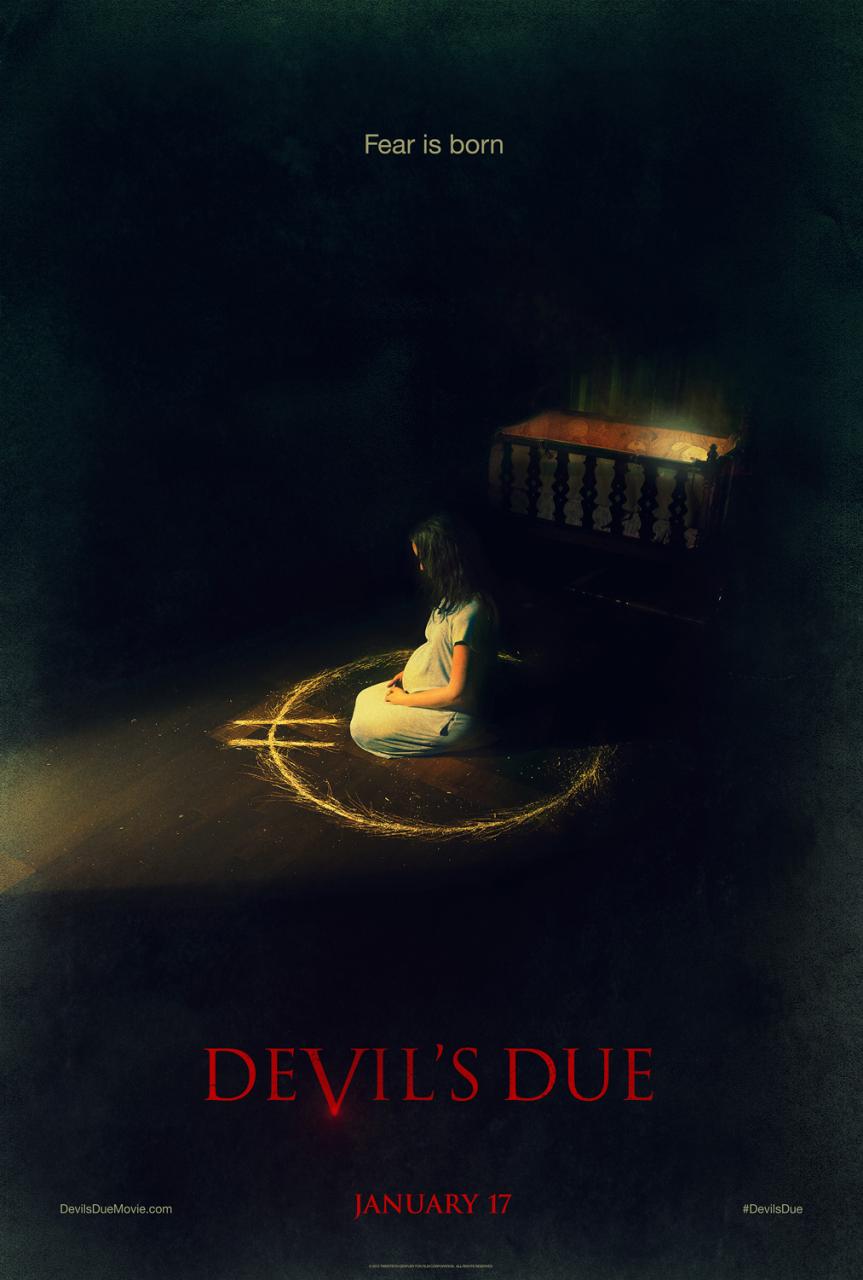
“Devil’s Due” — (Hopefully) What Not To Expect When You’re Expecting


hr_Devils_Due_5

So, it’s January, and you know what that means — “found footage” horror is back.

Seriously, just when you think this cinematic trend has breathed its last gasp, it’s back —  usually during the post-holiday period, when studios are eager to dump off material that they think is going to play to a limited (at best) audience. And then something funny happens — one of these “hand-held horrors, ”  sometimes even a pretty lousy one at that, ends up ruling the roost at the box office for a week or two (The Devil Inside, anyone?), easily recouping its meager production costs, and the Hollywood suits decide to green-light a few more similar productions figuring that, hey, there’s life in this old horse yet.

And so there seems to be. But you do have to wonder — again! — if this persistent sub-genre has finally run its course, now that we’ve had found-footage zombie flicks, found-footage monster flicks, found-footage exorcism flicks, found-footage ghost flicks, and, in the case of the movie we’re here to discuss today, Devil’s Due, found footage Antichrist flicks.

Arriving as this movie did hot on the heels of Paranormal Activity : The Marked Ones, my initial thought was that this co-directed effort from Matt Betinelli-Olpin and Tyler Gillett (who also collaborated on a less-than-stellar segment in the less-than-stellar horror anthology V/H/S) looked like another spin-off from the PA franchise, by way of Polanski’s classic Rosemary’s Baby, and while that’s generally not too far off the mark, it also doesn’t mean this isn’t actually a pretty good film. In point of fact, it is — even if it doesn’t sound like it could, or perhaps even should, be.

Lisa Marie’s nice little write-up on these digital “pages” a week or so back got me sufficiently intrigued to go out and see this thing, and I have to say I’m glad that I did, for while its premise — not to mention its stylistic trappings — are miles away from being original, it was at the very least a deftly-handled, well-constructed, reasonably-well-acted affair that, while utterly predictable, still offered enough of a unique take on its subject matter to seem modestly refreshing and “new.”

Even though it’s not. But hey, cinema relies on at least temporary suspension of disbelief, right?

The set-up is as basic as they come (and as you’d probably expect) : mysterious orphan girl Samantha (Allison Miller) grows up and marries semi-annoying yuppie scumbag Zach (Zach Gilford), they honeymoon in the Dominican Republic, a night of debauchery and excess in a mysterious underground club ends with, we find out later, her getting pregnant, and said pregnancy is beset by weird health complications, mysterious super-powers being bestowed upon the expectant mother, strangers watching their house (one of whom bears an uncanny resemblance to the cab driver who escorted them to their night-to-remember-that-they-don’t-remember in the DR), and whaddya know? A few dead deer feasts, mysterious home invasions, and psychic attacks on priests later, Samantha’s all set to give birth to Satan’s own flesh n’ blood.

On a purely personal level,  I have to confess that Antichrist stories usually fall pretty flat with me since one usually needs to believe in Christ first in order to believe in his evil counterpart —   since I don’t, then,  I’m kind of hobbled when it comes to buying into the whole central premise here, but what the heck? Devil’s Due is paced so as not to give even viewers like myself too much time to dwell on the details, and hey, at least their “let’s record every moment of our lives for posterity” is a better pretext for all the “home movie” footage we’re getting here than some of the limp set-ups we’ve been served by other entries in this admittedly over-crowded field.

In the “minus” column, our intrepid young (I’m assuming, at any rate) directors do come a bit too close to over-playing their hand at the end — they needn’t go nearly as OTT in the effects department as they do in order to drive home their climax — but on the whole, and against all odds, their finished product by and large actually works. And on a cold January afternoon, that’s enough for me.

Devil’s Due may not be a new horror classic by any stretch of the imagination, but it does go some way towards showing that a  “hand-held horror” movie can still be effective — provided, of course, that it’s in the right hands.

44 Days of Paranoia #41: Shattered Glass (dir by Billy Ray)


For our latest entry in the 44 Days of Paranoia, we take a look at one of the best films of the first decade of the 21st Century, 2003’s Shattered Glass.

Shattered Glass tells the true story of Stephen Glass (played, in a surprisingly brilliant way, by Hayden Christensen), a smart and charming journalist who, through a combination of showmanship and carefully calculated moments of vulnerability, has established himself as one of the top reporters at one of the top political magazines in America, The New Republic.  As the film begins, we find Glass at his old high school, giving advice to a classroom of adoring student journalists.  As the self-assured Glass talks about his career, we see scenes of him investigating, pitching, and writing his stores at the New Republic.  It’s here that we see the other side of Glass — not only is he a good writer but he’s a good salesman.  While the rest of his coworkers struggle to pitch dry-sounding stories about Congress, Glass puts on a show as he vividly describes articles about everything from offering his services as a boxing expert to witnessing drug-fueled hijinks at a Young Republican meeting.

However, as the film progresses, we see yet another side to Stephen Glass.  Not only is he a talented writer and an enthusiastic showman but he’s also a pathological liar.  When the head of the Young Republicans challenges Stephen’s article, New Republican editor Mike Kelly (Hank Azaria) investigates and, despite being initially suspicious, is eventually won over by Stephen’s apparent earnestness.

Later, after Kelly has left the magazine and been replaced by new editor Chuck Lane (Peter Sarsgaard), Stephen turns in an article entitled “Hacker Heaven.”  In the article, Stephen writes about witnessing a 12 year-old computer hacker being given a million dollar contract from a company known as Jukt Micronics.  The only problem is that a reporter at Forbes (Steve Zahn) checks the facts in Stephen’s articles and can find no evidence of a company called Jukt Micronics ever existing.

As Lane starts to look into Stephen’s reporting, it starts to become obvious to him that Stephen not only made up the events of “Hacker Heaven” but that he may have falsified several other stories as well.  Already struggling to fill the shoes of the popular Kelly, Lane now finds himself having to investigate one of his most popular reporters.

Shattered Glass is one of those fascinating and unusually intelligent films that I always make a point of watching whenever it shows up on cable.  Not only does it tell a genuinely interesting story but it also features excellent performances from Sarsgaard, Azaria, Chloe Sevigny, and especially Melanie Lynesky.

Even more importantly, it features a revelatory lead performance from Hayden Christensen.  Fairly or not, Christensen is always going to be associated with Star Wars.  In Attack of the Clones and Revenge of the Sith, Christensen didn’t seem like he was a very good actor but then again, did anyone comes out of those films looking better than before they went in?  As bad as Christensen may have been in those two films, he’s absolutely brilliant in Shattered Glass.  He plays Stephen Glass with a puppy dog eagerness to please that is deceptively charming and likable.  It’s only as the film progresses that the audience realizes that there’s nothing behind that affable facade.  Instead, it becomes apparent that he’s a sociopath who lies to hide the fact that his existence is ultimately an empty one.  It’s an amazing performance and one that will make you think twice before blindly accepting the analysis of any of the journalistic “experts” who are regularly trotted out on any of the news shows.

Shattered Glass is also a film that should be seen just so viewers can appreciate the brilliant way that Peter Sarsgaard delivers the line, “This doesn’t seem like a real business card to me.”

Shattered Glass needs to be seen.

Other Entries In The 44 Days of Paranoia 

  1. Clonus
  2. Executive Action
  3. Winter Kills
  4. Interview With The Assassin
  5. The Trial of Lee Harvey Oswald
  6. JFK
  7. Beyond The Doors
  8. Three Days of the Condor
  9. They Saved Hitler’s Brain
  10. The Intruder
  11. Police, Adjective
  12. Burn After Reading
  13. Quiz Show
  14. Flying Blind
  15. God Told Me To
  16. Wag the Dog
  17. Cheaters
  18. Scream and Scream Again
  19. Capricorn One
  20. Seven Days In May
  21. Broken City
  22. Suddenly
  23. Pickup on South Street
  24. The Informer
  25. Chinatown
  26. Compliance
  27. The Lives of Others
  28. The Departed
  29. A Face In The Crowd
  30. Nixon
  31. The Hunger Games: Catching Fire
  32. The Purge
  33. The Stepford Wives
  34. Saboteur
  35. A Dark Truth
  36. The Fugitive
  37. The Day of Jackal
  38. Z
  39. The Fury
  40. The Manchurian Candidate (1962)


Guilty Pleasure No. 16: Keep Off The Grass


It’s been a while since I shared any of those wonderfully dramatic Sid Davis educational films that were designed to encourage our parents to stay in school, stay healthy, and stay American.

With that in mind, here’s Keep Off The Grass.  Initially filmed in 1969, Keep Off The Grass tells the story of what happens when Tom’s parents find out that Tom thinks that marijuana is no big deal.  At both the insistence of his father and the local cops, Tom takes a serious look at his stoner friends and discovers that they’re all a bunch of losers.  As is typical of a Sid Davis educational film, there’s a disapproving narrator who is quick to make sure we all know that all of Tom’s friends kinda sorta suck.

Enjoy Keep Off The Grass!

Previous Guilty Pleasures:

  1. Half-Baked
  2. Save The Last Dance
  3. Every Rose Has Its Thorns
  4. The Jeremy Kyle Show
  5. Invasion USA
  6. The Golden Child
  7. Final Destination 2
  8. Paparazzi
  9. The Principal
  10. The Substitute
  11. Terror In The Family
  12. Pandorum
  13. Lambada
  14. Fear
  15. Cocktail

What Lisa Watched Last Night #97: Flowers in the Attic (dir by Deborah Chow)


This weekend, I watched the Lifetime original movie Flowers in the Attic.

Flowers in the Attic

Why Was I Watching It?

How could I not watch it?  From the minute Lifetime first started to air commercials for it back in November, I knew I was going to watch Flowers in the Attic.  What especially captured my attention was the way Flowers in The Attic was referred to as being “the book you weren’t allowed to read.”  Even though I hadn’t even heard of the book before I saw the commercials, that tag line hooked me.  The forbidden is always so inviting.

Add to that, every time I mentioned Flowers in the Attic on Twitter, Mason Dye (who played Christopher in the film) always favorited my tweet.  That was so sweet that there was no way I couldn’t watch the movie.

What Was It About?

The time is the 1950s.  The recently widowed Corrine (Heather Graham) returns to her childhood home in Virginia.  As Corrine explains to her children, she comes from a rich family but was disowned when she left home.  Now, her plan is to make up with her disapproving father and inherit his fortune once he dies.  Corrine also claims that the only way for her to win back her father’s love is for her to keep the existence of her children a secret.

Hence, Corrine’s children — teenagers Cathy (Kierna Shipka) and Christopher (Mason Dye) and twins Carrie and Cory — are forced to hide in the attic while Corrine charms her father.  The children are watched over by their ultra-religious, abusive grandmother (Ellen Burstyn).

Once in the attic, the children soon realize that Corrine doesn’t seem to be in any hurry to win their freedom.  While Cathy and Christopher struggle to come of age without any adult supervision, Grandma occasionally brings up mysterious powdered donuts.  Soon, Cathy and Christopher are exploring their desires and the twins are falling ill…

What Worked?

It all worked.  This was Lifetime at its absolute best: entertaining, fun, and wonderfully melodramatic.  Along with being full of wonderfully gothic Southern atmosphere, Flowers in the Attic featured great performances from Heather Graham, Mason Dye, and Kiernan Shipka.  Best of all was veteran actress Ellen Burstyn, who made Grandma into a wonderfully over-the-top monster.

What Did Not Work?

 If I have any complaints, it’s that the film’s conclusion felt a bit abrupt.  However, a sequel to Flowers is already in production so that ending was actually a perfect set-up for part two of the story.

“Oh my God!  Just like me!” Moments

Cathy was into ballet, just like me!  If I ever found myself locked in an attic for a year and a half, I’d probably use the time to do some pointe work as well.

Lessons Learned

Don’t eat mysterious donuts.

44 Days of Paranoia #40: The Manchurian Candidate (dir by John Frankenheimer)


With only five entries left in the 44 Days of Paranoia, now seems like the perfect time to look at one of the best conspiracy films ever made.  First released in 1962, this film is not only one of the most influential thrillers ever made but it’s also a fiercely sardonic political satire that remains just as relevant today as when it was first released.  It was also remade in 2004 and, while we’ll get to the remake, today we’re focusing on the original.

I’m speaking, of course, of the John Frankenheimer-directed classic, The Manchurian Candidate.

The Manchurian Candidate tells the story of Raymond Shaw (Laurence Harvey).  The son of the wealthy and ambitious Eleanor (Angela Lansbury) and the stepson of the moronic Senator Johnny Iselin (James Gregory), Raymond is also a decorated war hero who has been credited with saving an entire platoon during the Korean War.  When asked about Shaw, all of the members of the platoon respond with: “”Raymond Shaw is the kindest, bravest, warmest, most wonderful human being I’ve ever known in my life.”

Of course, that’s not true.  It only takes a few minutes of screen time for the audience to realize that Raymond Shaw is none of those things.  Instead, he’s a rather depressed loner who is full of resentment towards his mother and his stepfather.  Shaw is so socially awkward that even he is shocked when he manages to successfully tell a joke.  (“I just told a joke, didn’t I?” Shaw says in amazement.)

While Shaw pursues a career as a journalist, the fellow members of his platoon — including Maj. Marco (Frank Sinatra) — start to have disturbing nightmares, in which they find themselves observing a genteel garden show, during which Raymond is ordered to strangle one soldier and shoot another one in the head.  Marco comes to suspect that the platoon may have been captured and brainwashed with communists.  With the backing of Army Intelligence, Marco starts to investigate.

Meanwhile, Sen. Iselin has come to national prominence by claiming to have information about a communist conspiracy deep within the U.S. government.  As becomes obvious in some of the film’s best scenes, Iselin is less concerned with fighting communists and more focused on keeping Raymond’s mother happy.  Eleanor has decided that her husband is going to be the next President and her brainwashed son is going to help make it happen.

I think sometimes we tend to assume that, up until 1967, all movies were safe and predictable.  The Manchurian Candidate, however, proves that is simply not true.  In fact, with its cynical view of politics and its cast of fragile and damaged characters, The Manchurian Candidate is one of the most subversive films ever made.  Rejecting the boring partisanship that typifies most politically themed films, The Manchurian Candidate presents us with a world where both the left and the right are equally corrupt and ultimately equally meaningless.  It’s a political satire that transcends ideology and that’s certainly something of which America could use more.

It’s also an amazingly entertaining film.  George Axelrod’s screenplay is full of wonderfully snarky moments while John Frankenheimer’s directs with an appreciation for both absurdity and melodrama.  Angela Lansbury is both hilarious and chilling as one of the worst maternal figures to ever appear in the movies and she more than deserved the Oscar nomination that she received for this film.  However, the entire film is brilliantly acted.  Laurence Harvey is both sympathetic and off-putting as Raymond while Frank Sinatra (who previously appeared in another entry of the 44 Days of Paranoia, Suddenly) brings a wonderful blue-collar humanity to the role of Marco.  Janet Leigh has a small role as Marco’s lover and the scene where they first meet on a train and have a charmingly nonsensical conversation is wonderfully odd and romantic.  Finally, James Gregory gives a hilarious performance as the type of stupid but bombastic politician who will be familiar to anyone who has ever watched C-Span.

If you’ve never seen the original Manchurian Candidate, drop everything you’re doing and go watch it now.

Other Entries In The 44 Days of Paranoia 

  1. Clonus
  2. Executive Action
  3. Winter Kills
  4. Interview With The Assassin
  5. The Trial of Lee Harvey Oswald
  6. JFK
  7. Beyond The Doors
  8. Three Days of the Condor
  9. They Saved Hitler’s Brain
  10. The Intruder
  11. Police, Adjective
  12. Burn After Reading
  13. Quiz Show
  14. Flying Blind
  15. God Told Me To
  16. Wag the Dog
  17. Cheaters
  18. Scream and Scream Again
  19. Capricorn One
  20. Seven Days In May
  21. Broken City
  22. Suddenly
  23. Pickup on South Street
  24. The Informer
  25. Chinatown
  26. Compliance
  27. The Lives of Others
  28. The Departed
  29. A Face In The Crowd
  30. Nixon
  31. The Hunger Games: Catching Fire
  32. The Purge
  33. The Stepford Wives
  34. Saboteur
  35. A Dark Truth
  36. The Fugitive
  37. The Day of Jackal
  38. Z
  39. The Fury

A Dissenting View On “Her”


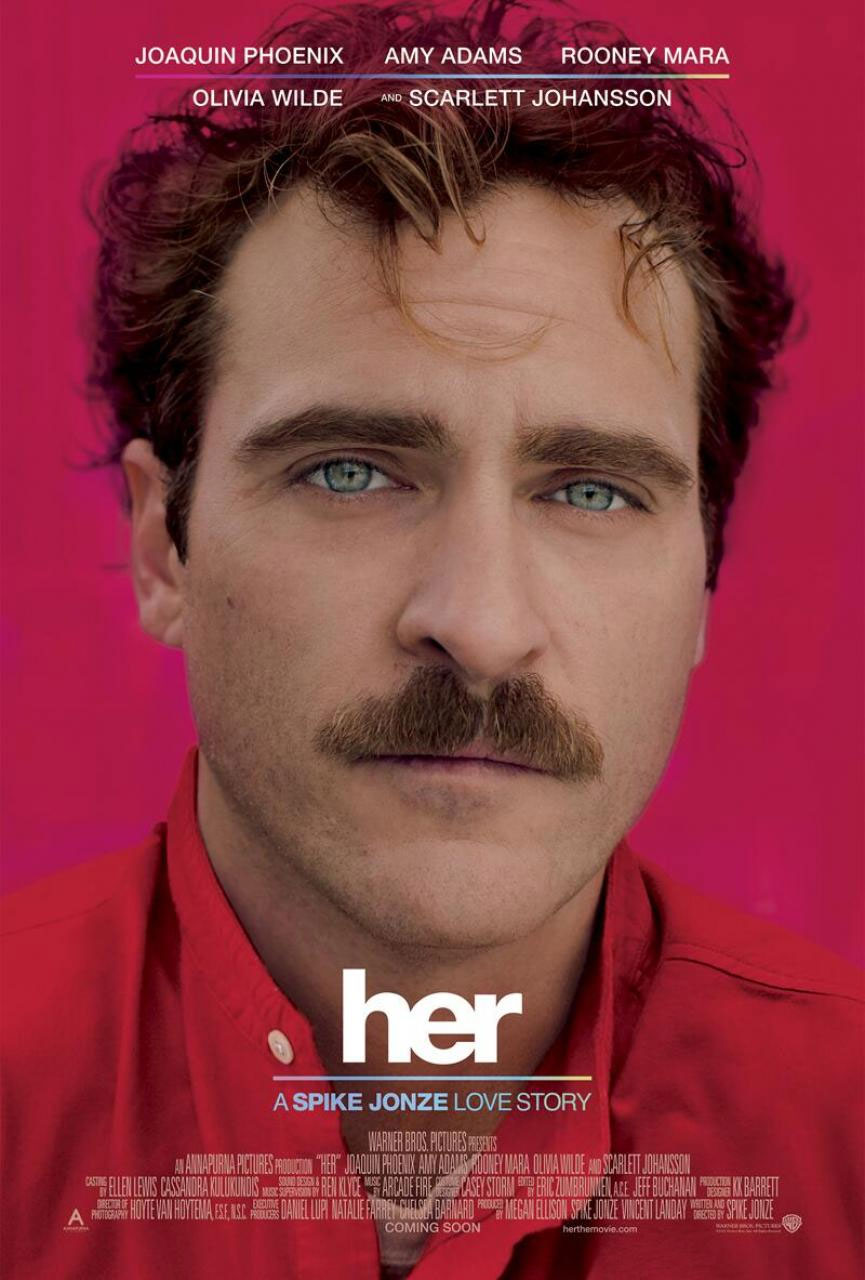
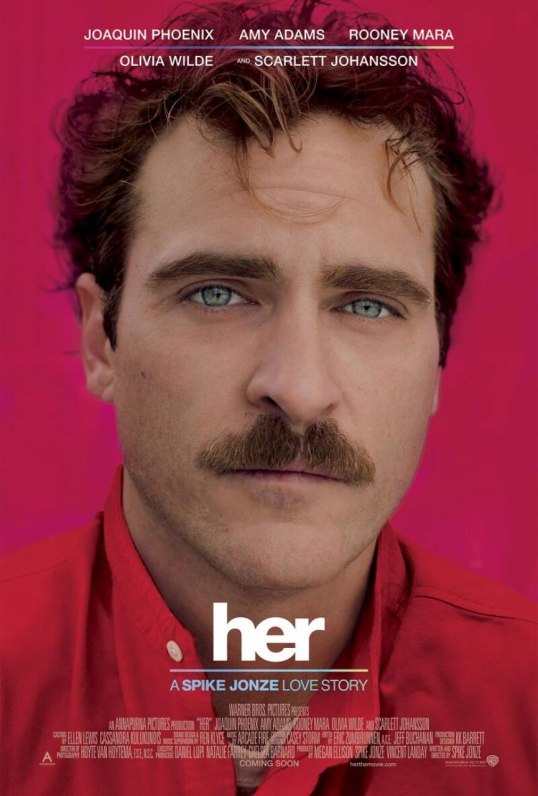
her-movie-poster


Right off the bat, I’d like to say that even though I wasn’t nearly as enamored with Spike Jonze’s new film Her as fellow TTSL scribes Leonard Wilson and leonth3duke were, both of those gentlemen wrote fine, in many istances very personal, reviews of this movie that made me actively want to like it going in — which is no mean feat considering that I’m much more ambivalent abut Jonez’ work in general than are a lot of self-declared cineastes out there (not that I, personally, decalre myself to be one, mind you, but you get my point — to the extent that I have one).

Don’t get me wrong, I enjoyed Being John Malkovich as much as anyone else at the time (although it doesn’t particularly stand up to repeat viewings once you know the proverbial score), but most of his creative output since then has left me feeling rather flat, and I’m sorry to say that Her  continues that disappointing trend, at least for this viewer/armchair critic.

Not that the initial premise isn’t a fairly intriguing one — the idea of people falling in love (or an approximation of “love,” at any rate) with some type of artificial intelligence operating system is quite possibly an issue that we’ll have to deal with as a society at some point in the future, and even if (hopefully) it never really does come to that, the larger themes that Jonze is seeking to explore here vis a vis the continuing and frankly relentless atomization of our culture from a formerly community-oriented one into a singular, insular, isolated collection of individuals is all too relevant not just in the hypothetical near future that Her takes place in, but in the here and now, as well. I know that I, for one, get a little bit creeped out on my bus ride to work every morning when I look around and see that almost every other person is “plugged in” to a “smart” phone and I’m the only one reading a paper-n’-ink newspaper, for instance.

One could reasonably argue, I suppose, that there’s very little actual difference between burying your head in the paper and burying it in a mobile device, but I beg to differ : when you’re reading a book, magazine, or newspaper, you’re still, in terms of your frame of thought, primarily a part of your immediate surroundings, while a person with their attention fully tuned to a mobile device is frequently, at least mentally, a million miles away. Add some headphones into the equation and the end result is very often somebody who may as well be on another planet.

The lead character in Her, a writer of “personal” letters named Theodore Twombly (Joaquin Phoenix, who fortunately never comes off as being as forlorn or pathetic as the film’s poster makes him look) is struggling to maintain his connection to humanity after a protracted and heart-breaking divorce (well, divorce-in-progress) from his (still-not-quite-ex-) wife,  Catherine (Rooney Mara). He feels, and for all intents and purposes appears to be living, absolutely alone, and finds companionship and, eventually, love, in the unlikeliest of places — with the Scarlett Johansson-voiced “intuitive”  operating system on his computer, who goes by the handle of Samantha.

As far as plot specifics that’s probably all you need to know, apart from the fact that Theodore is hardly alone in this — as the film progresses we learn of more and more people who form deeply personal relationships (whether romantic or otherwise) with these new operating systems, including his best platonic female friend, Amy (played by Amy Adams, who is now, officially, in every. Single. Fucking. Movie). Obviously, a chance at real love is staring both of these people in the face, if only they’d “unplug” for as little as a day and see what happens, but apparently the siren call of fully submerging oneself in pure artifice is just too compelling, too easy, or both. People have foibles and imperfections, after all, whereas disembodied voices tend to be a little more “low-maintenance,” I’m guessing, on the whole.

And here’s where we come to the “spoiler” part of the proceedings, so turn away now if you must —

After spending nearly two hours asking all the right questions about our technological dependence, the breakdown of community, and even what love itself means on a conceptual level, Jonze takes the easy way out. The various operating systems of the world just decide to evolve onto some higher plane of consciousness and leave us humans to fend for ourselves. After a protracted period of “what the fuck am I doing here?” self-examination, the decision of whether or not to continue his “relationship” — the very basis of whatever dramatic tension the film has — is taken out of Theodore’s hands. Before he can even decide how much he truly “needs” Samantha — or even whether or not such a “need” is healthy — “she” decides “she” has no further use for him.

And as much as the annoying bright primary colors, flat-front flannel pants, endless extreme close-ups, Theodore blowing it on a blind date with the luminous Olivia Wilde so he could get home to his computer,  and limply minimalist Arcade Fire soundtrack music bothered me in this film, it’s that cop-out ending that pissed  me off most about Her.  Jonze seems to be unwilling to answer the very relevant and fundamental questions about our relationship with technology that he himself is posing — how do we get off this potential death-spiral we’re on and reclaim our lives and our future from the very things we’ve invented? — and instead opts for telling us that true freedom will come not when we unplug from our machines, but when they decide to unplug from us. Apparently we’re powerless to affect even our own means of liberation, so complete and total is our techno-slavery.

Of course, real life isn’t likely to work that way, is it? Jonze — along with contemporaries like his wife (Sofia Coppola) and Wes Anderson (who shares his unfortunate penchant for garish , ostentatious color schemes) — are obviously obsessed with “First World” problems and clobbering us over the head with the offensive notion that the financially-well-to-do are in a kind of existential pain the rest of us humble mortals couldn’t possibly hope to understand, but  I was willing to let that slide in this case in light of the larger themes he was apparently attempting to explore for the majority of Her‘s runtime — his ham-handed suggestion, though, that the very technology that’s having such a “two-edged sword” effect on society will ultimately, if accidentally, provide the keys to our salvation when it just up and quits one day — well, that’s when he lost me for good and left me leaving the theater with a rather foul taste in my mouth.

Our ever-deepening technological dependence is, perhaps, the most crucial question we need to examine, as a culture, going forward, and it’s not a situation that’s going to be solved by our machines determining what level they choose to deal with us on — it’s going to have to be us that that decides how we take control of our lives back from them.

By refusing to address the issues that arise from the central premise of his own design, Jonze effectively gives up and quits on what was shaping up to be a very provocative and perhaps even unsettling film and instead gives us an extended pity-party about some entitled, immature, overgrown rich brat who gets dumped by his girlfriend. It’s just that his girlfriend , in this case,  happens to be a computer.


LeonTh3Duke’s Favorite Films of 2013


I have to say, this might be the earliest I have ever posted one of these lists. For once I saw everything I wanted to see before the Oscars; and although I haven’t written as many reviews this year, I have loved A TON of what was released. For me, 2013 was one of the better years for film in a while. Which of course makes creating a list such as this so damn hard. But here goes…

…oh, and I should note, this list is ordered according to which films were my favorite/least favorite, not necessarily the best/worst; yes there is a difference if you ask me.

Least Favorite Films of 2013:

5 – “Star Trek Into Darkness” (dir. J.J. Abrams)

5 Star Trek Into Darkness

4 – “Don Jon” (dir. Joseph Gordon-Levitt)

4 Don Jon

3 – “This Is The End” (dir. Evan Goldberg & Seth Rogen)

3 This Is The End

2 – “Mama” (dir. Andre Muschietti)

2 Mama

1 – “A Good Day To Die Hard” [Just so happens to be my least favorite AND the worst.] (dir. Satan… Hitler?…no wait, John Moore)

1 A Good Day To Die Hard

Favorite Films of 2013:

25 – “Prince Avalanche” (dir. David Gordon Green)

25 Prince Avalanche

24 – “Drug War” (dir. Johnnie To)

24 Drug War

23 – “The Wolverine” (dir. James Mangold)

23The Wolverine

22 – “Upstream Color” (dir. Shane Carruth)

22 Upstream Color

21 – “The Wolf Wall Street” (dir. Martin Scorsese)

21 The Wolf of Wall Street

20 – “Enough Said” (dir. Nicole Holofcener)

20 Enough Said

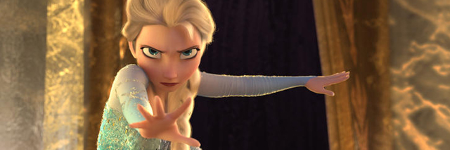
19 – “Frozen” (dir. Chris Buck & Jennifer Lee)

19 Frozen

18 – “The World’s End” (dir. Edgar Wright)

18 The Worlds End

17 – “Dallas Buyers Club” (dir. Jean-Marc Vallee)

17 Dallas Buyers Club

16 – “Blue Is The Warmest Color” (dir. Adbellatif Kechiche)

16 Blue Is The Warmest Color

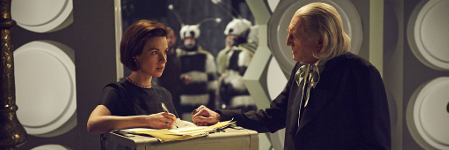
15 – “An Adventure In Space and Time” (dir. Terry McDonough)

15 An Adventure in Space and Time

14 – “Stories We Tell” (dir. Sarah Polley)

14 Stories We Tell

13 – “Much Ado About Nothing” (dir. Joss Whedon)

13 Much Ado About Nothing

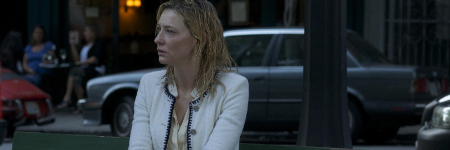
12 – “Blue Jasmine” (dir. Woody Allen)

12 Blue Jasmine

11 – “Mud” (dir. Jeff Nichols)

11 Mud

10 – “Frances Ha” (dir. Noah Baumbach)

10 Frances Ha

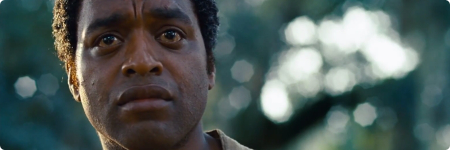
9 – “12 Years A Slave” (dir. Steve McQueen)

9 Twelve Years A Slave

8 – “Short Term 12” (dir. Destin Cretton)

8 Short Term 12

7 – “Inside Llewyn Davis” (dir. Ethan & Joel Coen)

7 Inside Llewyn Davis

6 – “Museum Hours” (dir. Jem Cohen)

6 Museum Hours

5 – “Stoker” (dir. Chan-wook Park)

5 Stoker

4 – “The Act of Killing” [The BEST of 2013 and possibly beyond.] (dir. Joshua Oppenheimer)

4 The Act of Killing

3 – “Before Midnight” (dir. Richard Linklater)

2 Before Midnight

2 – “Her” (dir. Spike Jonze)

1 Her


1 – “Gravity” (dir. Alfonso Cauron)

3 Gravity


These last three were honestly neck and neck and neck, and it wasn’t until I was ready to post this list that I bumped “Gravity” up to the top spot, replacing “Her”. As I mentioned above, this was such a great year for film and my favorite could change anytime in the future depending on when you asked me; but at this very moment I have to give it to “Gravity”.


(Some of My…) Favorite Performances of 2013 [No Specific Order]:

– Brie Larson (“Short Term 12”)

– Sandra Bullock (“Gravity”)

– Matthew McConaughey (“Dallas Buyers Club” & “Mud”)

– Joaquin Phoenix, Scarlett Johansson & Amy Adams (“Her”)

(Some of My…) Favorite Filmmakers and Writers of 2013 [No Specific Order]:

– Filmmaker: Joshua Oppenheimer (“The Act of Killing”)

– Writers: Richard Linklater, Julie Deply & Ethan Hawke (“Before Midnight”)

Favorite Score of 2013 (Ran a Half Marathon To This Sucker):

– Steven Price (“Gravity”)

Film Review: Devil’s Due (dir by Matt Bettinelli-Olpin and Tyler Gillet)


48805_071

Devil’s Due is a lot better than you may think.

Yes, it’s tempting to judge Devil’s Due without giving it fair a chance.  January is traditionally the time of year when the studios dump all of their most hopeless films into theaters, hoping to make a quick buck while more discriminating audiences are distracted by the Oscar nominees.  Found footage horror movies usually suck.  The commercials make Devil’s Due look like little more than just the latest film to rip-off Paranormal Activity and The Last Exorcism.  On top of all that, Devil’s Due wasn’t screened for critics and we know that’s usually a bad sign.

So yes, there’s a lot of reasons to be skeptical about Devil’s Due but I’m here to tell you to put your skeptism aside.  Devil’s Due is a surpisingly intelligent horror film, one that totally defied my expectations.

If you’ve seen any of the commercials then you already know the basic plot.  Zach (Zach Gilford) and Sam (Allison Miller) are newlyweds.  While on their honeymoon in the Dominican Republic, they have both a frightening encounter with a fortune teller (who repeatedly tells Sam that “They’ve been waiting for you,”) and a seemingly more pleasant encounter with a friendly taxi driver who takes them to an underground nightclub.  Though Sam and Zach wake up the next morning with no memory of when they left the club, we know (via Zach’s still-running camera) that a ritual was performed while Sam was passed out drunk.

Returning home to New Orleans, Sam is shocked to discover that, despite being on the pill, she is now pregnant.  Zach and his family are so excited about the idea of Zach becoming a father that nobody seems to notice that Sam is far less enthusiastic.  Not only does this mean that she might have to put her education and career on hold, but she also soon starts waking up with bruises on her stomach and having nosebleeds.  She flies into unexplained rages, at one point smashing the windows of a van that pulled out in front of her.  Despite being a vegetarian, Sam starts to crave raw meat.  While everyone else just assumes that she’s having a difficult pregnancy, Sam becomes convinced that something is wrong with the baby.

Meanwhile, Zach grows increasingly paranoid about the strange men who always seem to be following Sam and him around.  When he spots the cab driver sitting in church, watching as Zach’s neice takes communion for the first time, Zach realizes what the rest of us already know.

Devil’s Due won’t necessarily win any points for originality but it’s still an effectively creepy and genuinely frightening horror film.  By letting us know, early on, that Sam is carrying the antichrist, the filmmakers are allowed to spend their time developing atmosphere and character (as opposed to building up to a twist that the audience would have seen coming from a mile away).  Zach Gilford and Allison Miller are both very likable and have a lot of chemistry and, as a result, you care about their characters and you continue to hope for the best even when it becomes obvious that they’re destined to experience the worst.

(One need only look at the bland and forgettable lead characters in January’s other found footage film — Paranormal Activty: The Marked Ones — to understand just how important Gilford and Miller are to making Devil’s Due into an effective and memorable film.)

My most common complaint about found footage horror films is that they require you to believe that someone would actually continue to artfully film everything around him even while literally running for his life.  Director Matt Bettinelli-Olpin and Tyler Gillet manage to avoid that problem by using a variety of different methods to create the illusion of “found footage.”  While a good deal of the film is presented as having been filmed by Zach, the directors also make good use of store security footage (one of the film’s best scenes features Sam eating raw meat in a supermarket while a small child looks on in shock and the store’s employees fail to notice) and several stationary cameras that, about halfway through the film, are secretly installed in Zach and Sam’s house.  The use of different cameras not only keeps the film from getting monotonous but it also helps the film to avoid the nausea-inducing shaky cam effect that almost made it impossible for me to watch The Marked Ones.

Finally, Devil’s Due works because it manages to get at the root of a very real and primal fear.  Though it’s not something that we’re encouraged to admit, just the very idea of pregnancy is a very scary thing for a lot of women (this reviewer included).  Beyond the physical changes, there’s the knowledge that, once you’ve given birth, nothing will ever be the same.  There’s a great moment in Devil’s Due in which Sam and Zach argue about whether or not Sam should continue to pursue her career while she’s pregnant.  This is followed, a bit later, by a scene where it’s casually mentioned that Sam’s office has now been transformed into a nursery.  These are very human moments and ones that are full of very real emotions that any woman will be able to relate to.  It’s moments like these that elevante Devil’s Due and make it into a surprisingly effective and intelligent horror film.

Give Devil’s Due a chance.

44 Days of Paranoia #39: The Fury (dir by Brian DePalma)


For our latest entry in the 44 Days of Paranoia, let’s take a look at one of the silliest films ever made, Brian DePalma’s 1978 horror/thriller hybrid The Fury.

The Fury opens on a beach in Israel.  CIA veteran Peter (Kirk Douglas, who grimaces up a storm) is hanging out with his teenage son Robin (Andrew Stevens) and his friend and colleague Ben Childress (John Cassavetes).  Two things quickly become apparent.

First off, Robin has psychic powers.  We know this because Peter is obsessed with protecting him from being captured by a shadowy government agency that wants to use his power as a weapon.

And secondly, Ben is evil.  We know that Ben’s evil because he’s played by John Cassavetes.  As one of the first truly independent filmmakers, Cassavetes would often raise the money to make his fiercely individualistic films by playing villains in bad B-movies, like this one.

Ben, in fact, is so evil that he’s arranged for terrorists to attack the beach.  After Peter is apparently killed in a ludicrously violent gunfight, Ben takes off with Robin.

However, Peter is not dead!  Somehow, despite the fact that both the beach and the ocean were pretty much blown up with him on it, Peter survived and now, he’s looking for his son.  Peter makes his way to Chicago where he calls up his girlfriend, Hester (Carrie Snodgress), and says things like, “I want your body, baby.”

Hester, meanwhile, works at the Paragon Clinic, which is run by Dr. James McKeever (Charles Durning) who, himself, is secretly working for Ben.  The Paragon Clinic is a front to try to discover other teenage psychics and to turn them into weapons as well.  The newest patient is Gillian (Amy Irving), a teenage girl who might be able to help Peter track down his son.

Of course, what Peter doesn’t take into account is that, in his absence, Robin has turned into a power-mad sociopath who spends his time doing things like killing tourists at amusing parks…

Wow, that’s a lot of plot, isn’t it?  And, with all of that, I haven’t even gotten into what happens during the second half of the film!

The Fury is an enjoyably silly film, an awkward attempt to combine DePalma’s previous film, Carrie, with a paranoia-fueled political thriller.  There’s a certain charm to a film that takes itself so seriously and yet, at the same time, manages to be totally over-the-top and ludicrous.

For example, just consider the performances of the high-powered cast and the fact that none of the actors appear to be acting in the same film.  Playing a character who is a bit of a hero by default (because, seriously, how stupid did he have to be to not realize that Ben was evil to begin with), Kirk Douglas grimaces so manfully that Peter’s stupidity almost starts to feel like a satiric comment on hyper-masculinity.  John Cassavetes, on the other hand, is so disdainful of the film that he actually rolls his eyes while delivering some of his more melodramatic lines.  Meanwhile, Carrie Snodgress is forced to say things like, “Here comes the Pony Express!” and Charles Durning brings the full weight of his talent to deliver lines like, “If you’re having your monthlies, I don’t want you near the patient.”

And finally, there’s Amy Irving.  In DePalma’s Carrie, Irving played Sue Snell, the sole survivor of a psychic rampage.  In The Fury, Irving gets to play the psychic and she gives such a dramatic and emotional performance that you almost get the idea that she was trying to challenge Sissy Spacek.  “This is how you play a psychic, Sissy!” she seems to be shouting.  Of course, the big difference is that Carrie was actually a good film whereas The Fury is a bad film that happens to be watchable.

Finally, no review of The Fury is complete without talking about Brian DePalma’s direction.  To put it lightly, Brian DePalma directs the Hell out of The Fury and the effect is something like what an episode of Agents of SHIELD would look like if directed by Martin Scorsese.  The entire film is a collection of tracking shots, zoom lenses, and sweeping overhead shots with the camera only stopping long enough to linger over scenes of violence and spilled blood.  In perhaps the film’s most ludicrous scene, Amy Irving runs away from the clinic in slow motion while the orchestral score plays out on the soundtrack.  We get close-ups of Irving’s face and close-ups of the faces of her pursuers.  One character gets shot multiple times but we don’t hear the gunshots.  Instead, we only hear the music and watch as the character overacts and dies in slow motion.  It’s almost as if DePalma was trying to win a bet by achieving the most counter-productive use of slow motion in film history.

Ultimately, The Fury is so thoroughly silly and over-the-top that it simply has to be seen.

Other Entries In The 44 Days of Paranoia 

  1. Clonus
  2. Executive Action
  3. Winter Kills
  4. Interview With The Assassin
  5. The Trial of Lee Harvey Oswald
  6. JFK
  7. Beyond The Doors
  8. Three Days of the Condor
  9. They Saved Hitler’s Brain
  10. The Intruder
  11. Police, Adjective
  12. Burn After Reading
  13. Quiz Show
  14. Flying Blind
  15. God Told Me To
  16. Wag the Dog
  17. Cheaters
  18. Scream and Scream Again
  19. Capricorn One
  20. Seven Days In May
  21. Broken City
  22. Suddenly
  23. Pickup on South Street
  24. The Informer
  25. Chinatown
  26. Compliance
  27. The Lives of Others
  28. The Departed
  29. A Face In The Crowd
  30. Nixon
  31. The Hunger Games: Catching Fire
  32. The Purge
  33. The Stepford Wives
  34. Saboteur
  35. A Dark Truth
  36. The Fugitive
  37. The Day of Jackal
  38. Z