Cleaning Out the DVR Pt 13: ALL-STAR WESTERN ROUNDUP!


gary loggins's avatarcracked rear viewer

Major League Baseball’s All-Star Game is tomorrow night, and in honor of that All-American pastime I’ve corralled an All-Star lineup of (mostly) All-American Westerns filled of blazing six-guns, galloping horses, barroom brawls, sexy saloon gals, and wide-open spaces. Hot damn, that DVR sure enough gets filled up mighty fast! Saddle up and enjoy these capsule looks at one of my favorite genres, the Western:

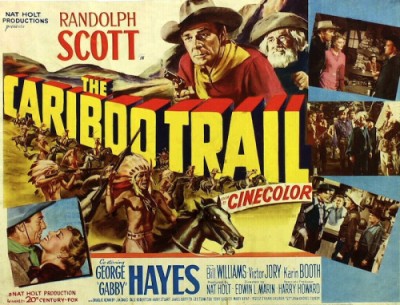
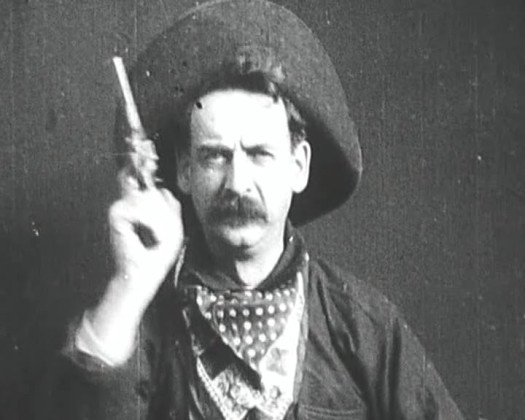
THE CARIBOO TRAIL (20th Century-Fox, 1950; D: Edwin L. Marin) – Randolph Scott   rides tall in the saddle driving his cattle to Vancouver gold rush country in this exciting oater filled with stampedes, Indian attacks, bad hombres, shoot outs, and fisticuffs. There’s a pretty saloon keeper (Karin Booth), a mean town boss (Victor Jory), and Scott’s bitter ex-pardner (Bill Williams), who had to have his arm amputated along the trail. Scenic Colorado stands in for Canada’s Great Northwest, shot in gorgeous Cinecolor by DP Fred Jackman Jr. Look for young…

View original post 944 more words

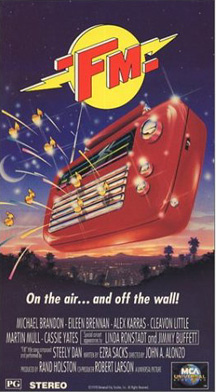
A Movie A Day #182: FM (1978, directed by John A. Alonzo)


Hey, California!  Are you ready to soft rock!?

That is the question asked by FM, a movie about rock that tries to stick it to the man with some of the safest, least revolutionary music ever recorded.

FM is centered around Q-Sky, an FM radio station in Los Angeles.  Because the laid back station manager (Michael Brandon) allows his DJs to program their own music with little commercial interruption, Q-Sky has become one of the most popular radio stations in California.  The corporate suits, though, demand that Q-Sky play less music and air more commercials, especially one that is specifically designed to get mellow Californians to join the Army.  When Brandon refuses, he is fired.  Outraged, Q-Sky’s motley crew of DJs (who include Martin Mull, Cleavon Little, Eileen Brennan, and even former football great Alex Karras) barricade themselves in the station and lead a protest by playing their music without commercials.

That would all be well and good except that the DJs spend most of their time playing songs by such noted rockers as Jimmy Buffett, Billy Joel, and REO Speedwagon.  A major set piece of the film is Q-Sky’s attempt to secretly broadcast a Linda Ronstadt concert that is being sponsored by a rival station.  At a time when Johnny Rotten was still singing Anarchy in the UK,  Q-Sky’s idea of rebellion was to go from Bob Seger to James Taylor with limited commercial interruption.

The always reliable Martin Mull is always good for some laughs and this was the only movie directed by award-winning cinematographer John A. Alonzo so, if nothing else, FM always looks good.  With its ensemble cast and episodic narrative, FM tries hard to be an Altmanesque satire but, ultimately, it fails because the revolution is not going to sound like The Doobie Brothers.

(Even though The Doobie Brothers clearly rock.)
“Who likes The Doobie Brothers?”

Because Michael Brandon looked like Gary Sandy and Martin Mull possessed a passing resemblance to Howard Hesseman, some reference books state that FM was the inspiration for WKRP in Cincinatti.  However, the first season of WKRP was already in production before FM was released to theaters and FM was such a financial flop that it is doubtful it inspired anything.

Add to that, while Venus Flytrap probably could have made it work, Dr. Johnny Fever would never have fit in at Q-Sky.  Johnny’s frequent acid flashbacks would have unnerved the mellow Q-Sky vibes.  Herb Tarlek, on the other hand…

“It must be a struggle to match the belt with the shoes.”
“Sometimes, I can’t do it.”

 

A Movie A Day #181: Guilty As Sin (1993, directed by Sidney Lumet)


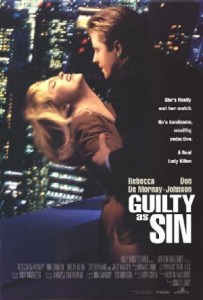
When wealthy playboy David Greenhill (Don Johnson, doing a one-note Michael Douglas impersonation) is accused of throwing his wife out of a window, there’s only one lawyer who he wants to defend him.  Jennifer Haines (Rebecca De Mornay) may have just won a huge case but it is obvious that the only reason that David wants her on his team is because she’s sexy as Hell and David has an obsessive streak.  Still, despite the misgivings of her boyfriend (Stephen Lang) and her mentor (Jack Warden), she takes the case, convinced that she is the only attorney smart enough to be able to get David acquitted.
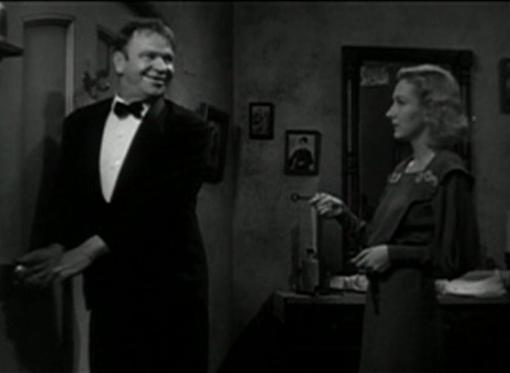
It becomes very obvious that David is not only probably guilty but that he might be a serial killer as well.  Not only does he start to turn up everywhere that Jennifer goes but, protected by attorney/client privilege, he starts to tell her all of his dark secrets.  Jennifer finds herself trapped into defending an obviously guilty client, one who appears to be setting her up to be his next victim.  Even when he fails to pay her for her services, the trial judge refuses to allow Jennifer to quit the case.

Back in the 90s, Guilty As Sin used to frequently show up on late night HBO and Cinemax.  I always watched because I had a crush on Rebecca De Mornay and I bet I was not alone as far as that’s concerned.  Late night cable is where Guilty As Sin belongs, which makes it strange that this weak and implausible movie was directed by Sidney Lumet.  One of the legitimately great American directors, Lumet directed several classic courtroom thrillers over the course of his career.  Guilty As Sin is not one of them.  This is probably the most impersonal film that Lumet ever made.  Other than the presence of Lumet favorite Jack Warden, there is nothing about Guilty As Sin that would lead anyone to think that it had been directed by the same man responsible for 12 Angry Men, Dog Day Afternoon, Network, or Prince of the City.

Fortunately, though Guilty As Sin was one of his Lumet’s last films as a director, it was not his final film.  Released in 2007, Lumet’s final film was a crafty thriller called Before The Devil Knows Your Dead, which showed that, at the age of 83, Lumet was still one of the greats and that Guilty As Sin was just a minor bump in an otherwise brilliant career.

Pre-Code Confidential #13: Wallace Beery in John Ford’s FLESH (MGM 1932)


gary loggins's avatarcracked rear viewer

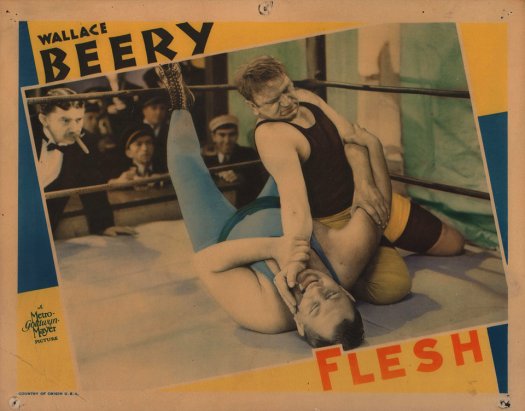
Long before his John Wayne collaborations, John Ford had worked to perfect his own style as a filmmaker. Even though the cranky, idiosyncratic Ford, who directed his first film way back in 1917,  had his directing credit removed from 1932’s FLESH, it is credited as “A John Ford Production”, and one can tell this is definitely a “John Ford Picture”.  The man himself thought the film was lousy, and most critics agreed, but I’m in the minority opinion. I think it’s worthy of reappraisal for film lovers to get a glimpse of some vintage Ford, with solid performances by Wallace Beery, Karen Morley, and Ricardo Cortez. Plus, as a long-time pro wrestling buff, the grappling game setting appeals to me, as do the many Pre-Code themes and moments.

Beery once again is a good-natured lug, a German wrestler named Polakai who doubles as a waiter in a rowdy beer garden, toting a keg on his massive…

View original post 915 more words

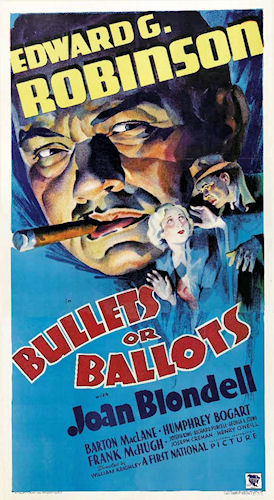
A Movie A Day #180: Bullets or Ballots (1936, directed by William Keighley)


Johnny Blake (Edward G. Robinson) was one of the toughest cops in New York City, until he punched out his new captain (Joe King) and was kicked off the force.  That punch was witnessed by racketeer Al Kruger (Barton McLane).  Kruger has long wanted to get Blake to join his organization and, with Blake now out of work, Kruger makes an offer.  Blake goes to work for Kruger, much to the consternation of Kruger’s second-in-command, Bugs Fenner (Humphrey Bogart).  Bugs says that anyone who was once a cop will always be a cop.  Bugs is right.  Blake is working undercover, trying to expose and take down the mob from the inside.

Bullets or Ballots is an entertaining if predictable gangster film from the 1930s.  After making his career playing bad guys, Robinson makes the transition to the side of law and order without losing any of his trademark attitude.  Bogart plays one of the many remorseless killers that he played before Casablanca reinvented him as a hero.  Bullets or Ballots may be predictable but it’s impossible not to enjoy watching Robinson and Bogart snarl hard-boiled insults at each other.

Second-billed Joan Blondell does not have much screen time but her role is still an interesting one, as a tough businesswoman who runs a numbers racket with her former maid (played by Louise Beavers).  I would have enjoyed seeing a full movie just about Blondell’s character but she mostly takes a back seat to Robinson and Bogart.

Unfortunately, unlike Little Caesar, The Public Enemy, and Scarface, Bullets or Ballots was made after Hollywood started to enforce the infamous Production Code and, as a result, Bullets or Ballots never reaches the gritty, violent heights of those earlier films.  Still, fans of Robinson, Bogart, and Blondell will find much to enjoy here.

A Movie A Day #179: Heavy Metal Parking Lot (1986, directed by Jeff Krulik and John Heyn)


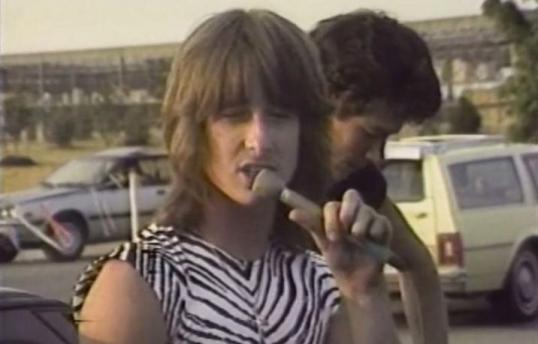
Everyone remembers the Zebraman.

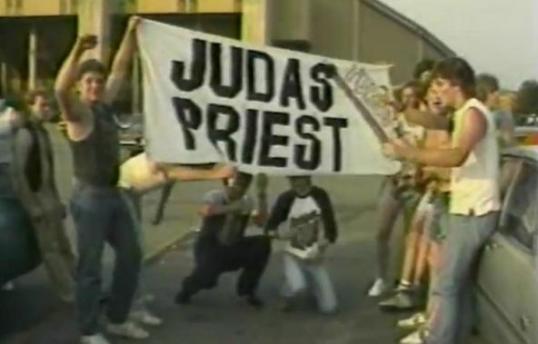
In 1986, two aspiring filmmakers, Jeff Krulik and John Heyn drove down to the Capital Center in Landover, Maryland and interviewed several Judas Priest fans (and, to be fair, a few lost souls who were there for Dokken) who were tailgating in the parking lot, before a concert.  Some of them were drunk.  Some of them were stoned.  Some of them were posers and some of them were genuine metalheads.  The end result was a 17-minute documentary called Heavy Metal Parking Lot.  In the days before YouTube, bootlegged VHS copies of this film made Heavy Metal Parking Lot into an underground classic.

In 17 minutes, Krulik and Heyn introduced viewers to several different fans.

There was this guy, who said his name was Graham, “as in gram of dope!,” and who had strong feelings about the legalization of drugs:

There was Michelle, who said she came from Mayberry, USA:

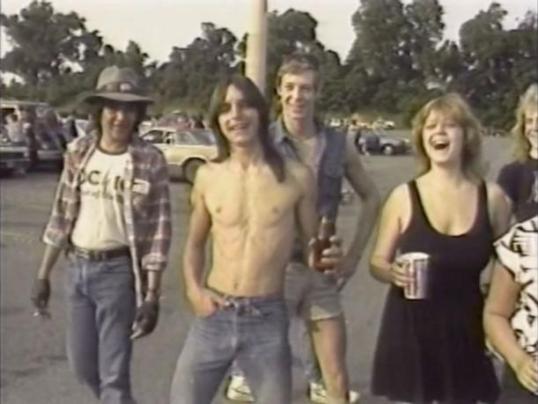
There were these people, who looked like the cast of every 80s teen comedy ever made:

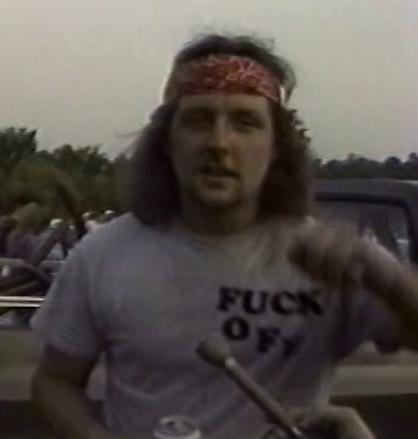
There’s the Fuck Off Guy who says he plans to “get fucked up, drink a few beers, you know.”

There’s even this loser:

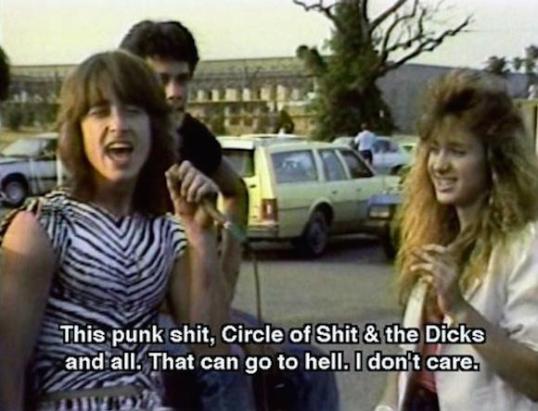
But the one that everyone remembers is Zebraman, a young man wearing a zebra-print jumpsuit who, fueled by alcohol, shares some thoughts on punk rock:

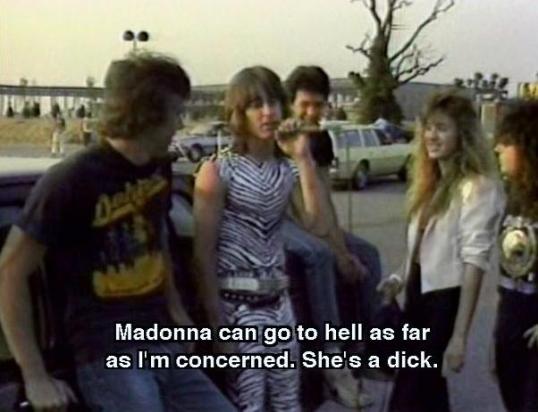
He followed up with some thoughts on Madonna:

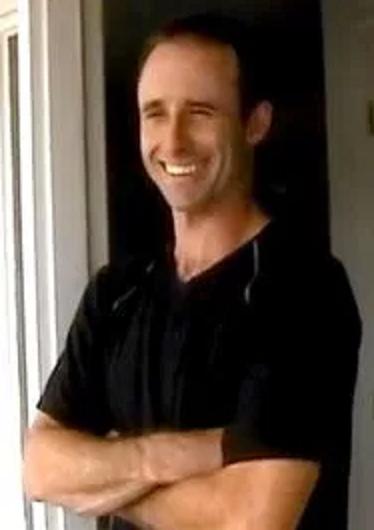
13 years later, in 1999, Krulik and Heyn tracked down the famous Zebraman for a “Where Are They Now” update.  When they found him, living in a nice house in the suburbs, they discovered that not only did he not know that he had become an underground cult star but that he also no longer listened to heavy metal.  Zebraman described himself as being a country music fan:

Zebraman, grown up.

Both Heavy Metal Parking Lot and Heavy Metal Parking Lot Alumni: Where Are They Now? can be viewed on YouTube.

Movie A Day #178: Kinjite: Forbidden Subjects (1989, directed by J. Lee Thompson)


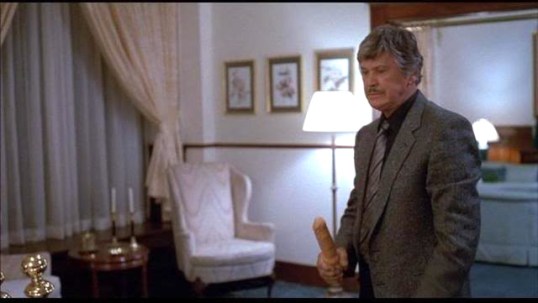
This is the one where Charles Bronson sodomizes a guy with a dildo.

Don’t worry, though.  Bronson does it off-screen and the guy was abusing Nicole Eggert so he had it coming.

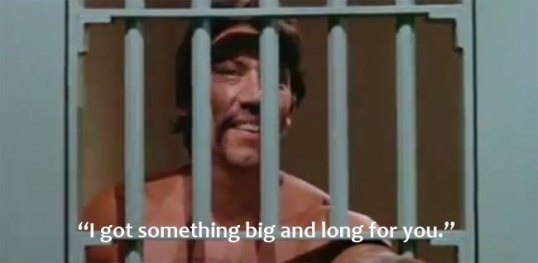
In Kinjite, Bronson plays Lt. Crowe, a tough LAPD vice cop who hates two groups of people: pedophiles (which is cool, who doesn’t hate them?) and the Japanese (which is not cool).  Not only does Crowe sodomize a pervert but he also forces a pimp to eat a gold watch and later, with the help of his partner, he holds another man over the edge of a balcony, just to have that man accidentally slip out of his shoes and plunge to his death.  Finally, Crowe tosses a convict into a prison cell, where another prisoner (played by Danny Trejo, in what may have been his film debut) announces that he’s “got something big and long for you.”  Crowe chuckles, “That’s justice” and then walks away.

Danny Trejo in Kinjite

Of the many strange films that Bronson made for Cannon Films, Kinjite may be the strangest.  The main plot involves Crowe searching for and rescuing the kidnapped daughter of a Japanese businessman (James Pax).  Before his daughter was kidnapped, the businessman groped Crowe’s fifteen year-old daughter on a city bus.  The entire movie seems to be building up to the moment that Crowe, who is portrayed as being overprotective of his daughter, discovers what the businessman did but that moment never comes.  There are numerous scenes of the businessman in Japan but they do not have anything to do with the rest of the plot.  Strangely, neither Crowe’s daughter nor his wife (played by Peggy Lipton) are ever menaced by the bad guys.  What type of Charles Bronson movie is this?

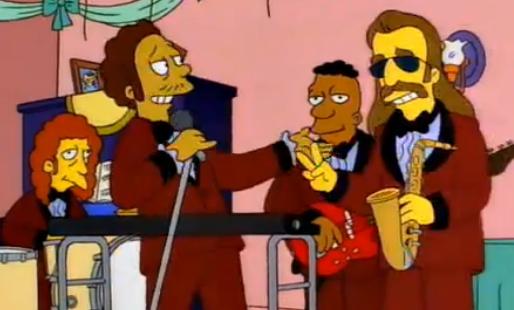
In Bronson’s defense, he was 71 year-old when he made this movie and, off screen, his wife Jill Ireland was battling the cancer that would eventually take her life.  Bronson can be excused for not appearing to be overly invested in Kinjite: Forbidden Subjects.  (Since Kinjite means Forbidden Subjects in Japanese, the actual title of this movie is Forbidden Subjects: Forbidden Subjects.)  No one appears to have made much of an effort on Kinjite, though Bronson’s stunt double gets a good work out.  Kinjite is full of scenes where Bronson throws a punch in close-up but his first in never actually shown connecting with anyone.  Most of the action scenes are clumsily filmed so that Crowe keeps his back to the camera.   All Kinjite needs is a supporting turn from Troy McClure and a cameo from McGarnagle and it would be perfect viewing for The Simpsons.

Kinjite would be the final film that Bronson made for Cannon Films.  It would also be the last Bronson film to be directed by J. Lee Thompson.  After Kinjite, Bronson appeared in two more feature films: Sean Penn’s The Indian Runner (which, if not for Penn’s pretentious direction, could have launched Bronson on a second career as a first-rate character actor) and a final Death Wish film.  Bronson returned to television, appearing in three made-for-TV movies before retiring in 1999.  Bronson died in 2003 but, as long as there are people who enjoy a good action movie, he will never be forgotten.

This scene is not from Kinjite but it’s still pretty fucking cool.

Hot in Argentina: Rita Hayworth in GILDA (Columbia 1946)


gary loggins's avatarcracked rear viewer

If COVER GIRL made Rita Hayworth a star, then GILDA propelled her into the stratosphere. This 1946 film noir cast Rita at her smoking hot best as the femme fatale to end ’em all. Surrounded by a Grade A cast and sumptuous sets, GILDA gives us the dark side of CASABLANCA , moved to Buenos Aires and featuring star-crossed lovers who are at lot less noble than Rick and Ilsa ever were.

“Every man I knew went to bed with Gilda… and woke up with me”, Hayworth is famously quoted as saying. Who could blame them, as Rita is absolutely stunning in this film. From our first glimpse of her, popping into view with that iconic hair flip…

…to her sultry faux striptease singing “Put the Blame on Mame”, Rita burns up the screen with her smoldering sexuality. Lines like “If I’d been a ranch,  they’d’ve named me the Bar Nothing” leave no doubt…

View original post 565 more words

A Movie A Day #177: Murphy’s Law (1986, directed by J. Lee Thompson)


What is Murphy’s Law?

Let’s ask LAPD Detective Jack Murphy.

“Don’t fuck with Jack Murphy.”

Normally, having a law named after you would be pretty cool but it appears that this is just a law that Jack came up with himself.  Having to come up with your own law is kind of like having to come up with your own nickname.  Dude, it’s just lame.  Since Jack Murphy is played Charles Bronson, we can cut him some slack.

Murphy’s Law was one of the many film that, towards the end of his career, Bronson made for Cannon Films.  He played a detective in almost all of them.  Jack Murphy is Dirty Harry without the fashion sense.  He is also an alcoholic who cannot get over his ex-wife (Angel Tompkins) and her decision to become a stripper.  Not only has Murphy managed to piss off his superiors with his bad attitude but the mob is out to get him.  Everyone has forgotten Murphy’s Law.  Everyone is fucking with Jack Murphy.

Jack’s main problem, though, is Joan Freeman (Carrie Snodgress).  Years ago, Murphy sent Joan to prison for murder but, because it’s California and Jerry Brown appointed all of the judges, Joan gets out after just a few years.  Joan starts to systematically murder everyone that Murphy knows, framing Murphy for the murders.  Murphy’s arrested by his fellow cops, all of whom need a refresher on Murphy’s Law.  Though handcuffed to a young thief (Kathleen Wilhoite), Murphy escapes from jail and set off to remind everyone why you don’t fuck with Jack Murphy.

Murphy’s Law is a typical Cannon Bronson film: low-budget, ludicrously violent, borderline incoherent, so reactionary than it makes the Dirty Harry films look liberal, and, if you’re a fan of Charles Bronson, wildly entertaining.  Bronson was 65 years old when he played Jack Murphy so he cannot be blamed for letting his stunt double do most of the work in this movie.  What’s interesting is that, for once, Bronson is not the one doing most of the killing.  Instead, it is Carrie Snodgress, in the role of Joan Freeman, who gets to murder nearly the entire cast.  There is nothing subtle about Snodgress’s demonic performance, which makes it perfect for a Cannon-era Bronson film.  In fact, Carrie Snodgress gives one of the best villainous performances in the entire Bronson filmography.  There is never any doubt that Snodgress is capable of killing even the mighty Charles Bronson, which makes Murphy’s Law a little more suspenseful than most of the movies that Bronson made in the 80s.

Whatever else can be said about Murphy’s Law, it does feature one of Bronson’s best one liners.  When Joan threatens to send him to Hell, Murphy replies, without missing a beat, “Ladies first.”  Only Bronson could make a line like that sound cool.  That’s Bronson’s Law.

A Movie A Day #176: Honor Among Thieves (1968, directed by Jean Herman)


It’s Bronson and Delon, trapped in an airless vault!

While serving in the French Foreign Legion during the Algerian War, Dino Barran (Alain Delon) and Franz Propp (Charles Bronson) became unlikely friends.  Dino is a doctor while Franz is both a pimp and a mercenary.  When the war ends, both return to Paris.  Dino is ready to get on with his life but then he’s approached by Isabelle (Olga Georges-Picot), the lover of a man who Dino got killed in Algeria.  Isabelle has a job for Dino.  She has some files that she needs to return to a safe in an office building.  All Dino has to do is arrange a medical screening in the building and, when no one is looking, open the safe and drop off the documents.  Feeling guilty, Dino agrees.

The problem is that Franz has been following Dino and he has found out that Dino will be opening the safe.  While Dino just wants to put something in, Franz plans to take much more out.  After a fist fight, the two of them find themselves accidentally tapped inside the vault.  Working together, they have to both crack the safe and find a way out of the vault before they run out of the air.

Charles Bronson nearly did not make Honor Among Thieves.  Alain Delon wanted an American actor to co-star with him in the film and he specifically requested that Bronson be offered the part.  Up until this point, with the exception of a few B-movies like Machine Gun Kelly, Bronson had been a supporting player in Hollywood and had always resisted the temptation to follow the lead of Clint Eastwood and go to Europe in search of stardom.  When the film’s producer approached Bronson, he argued that only in Europe would an unconventional actor like Bronson be appreciated.  Though still skeptical, Bronson eventually accepted the offer.

It is a good thing that he did because Honor Among Thieves proved to be a huge hit and it made Bronson a star in Europe.  As a result of his tough and charismatic performance in Honor Among Thieves, Bronson went on star in films like Once Upon A Time In The West and other European hits.  It would be another 5 years before Death Wish made Bronson a star in America but, if not for Honor Among Thieves, Death Wish could very well have ended up starring Jack Lemmon (who was the choice of Death Wish‘s author, Brian Garfield).

As for Honor Among Thieves, it is an overlong and overly complicated heist film, the type that was very common in the 60s and which made a comeback with Steven Soderbergh’s remake of Ocean’s 11.  Ultimately, Honor Among Thieves does not work because the plot has too much padding (the subplot about Franz’s career as a pimp goes nowhere) and unanswered questions (it’s never explained what’s in the documents that need to be returned to the safe) but it is easy to see why Bronson became a star.  Bronson was already in his fifties by the time he made his best-known American films so Honor Among Thieves is a chance to see a younger and more energetic Bronson.  For once, Bronson actually seems to be enjoying himself, even smiling a few times.  For those of us who best know Bronson as the grim-faced avenger who gunned down criminals in countless film for Cannon, it is interesting to see Bronson playing someone who is actually having fun.

Honor Among Thieves was finally given an American release in 1973, following the success of Death Wish.  The original French title was Adieu l’ami.