Cleaning Out The DVR: O (dir by Tim Blake Nelson)


(Lisa is currently in the process of cleaning out her DVR!  This could take a while.  She recorded the 2001 high school film O off of Cinemax on July 6th.)

Tell me if this sounds familiar.

O (Mekhi Phifer) is one of the only black students attending an exclusive high school in South Carolina.  Despite a past that involves petty crime and drugs, O appears to have his life on the right track.  As the captain of school’s basketball team, O is the most popular student at his school.  Everyone looks up to him.  Everyone wants to be him.  He’s even dating Desi (Julia Stiles), the very white daughter of the school’s very white headmaster (John Heard).  At a school assembly, Coach Duke Goulding (Martin Sheen) describes O as being like a son to him.  When O is awarded the MVP trophy, he shares it with his teammate, Michael Cassio (Andrew Keegan).

Watching all of this with seething jealousy is Hugo Gaumont (Josh Hartnett).  Hugo is a teammate of O’s.  In fact, he even thought that he was O’s best friend.  That was before O shared his award with Michael.  Making Hugo even more jealous is that he happens to be the son of the coach.  For every kind word that Duke has for O, he has a hundred petty criticisms for Hugo.  Whereas O has overcome drug addiction and is proclaimed as a hero for doing so, Hugo is secretly doing steroids, trying to do anything to improve himself as a player and hopefully win everyone’s love.

So, Hugo decides to get revenge.  Working with a nerdy outcast named Roger Calhoun (Elden Hansen), he manipulates O into thinking that Desi is cheating on him with Cassio.  He also tricks Cassio into getting into a fight with Roger, leading to Cassio getting suspended from the team.  To top it all off, Hugo gets O hooked on drugs, once again.  Finding himself consumed by a violent rage that he thought he had under control, O starts to obsess on determining whether or not Desi has been faithful to him…

If that sounds familiar, that’s because O is basically Othello, transported to modern times and involving privileged teenagers.  Even though the whole modernized Shakespeare thing has become a bit of a cliché, it actually works pretty well in O.  Hugo’s obsessive jealousy of the “cool kids” feels right at home in a high school setting and director Tim Blake Nelson and writer Brad Kaaya do a fairly good job of transporting Shakespeare’s Elizabethan melodrama to the early aughts.

(Actually, O was filmed in 1999 but it sat on the shelf for two years.  After a spate of school shootings, distributors were weary about releasing a film about high school students trying to destroy each other.)

Admittedly, O has its share of uneven moments.  Martin Sheen, playing the type of role that always seems to bring out his worst instincts as an actor, goes so overboard as the coach that he threatens to sink almost every scene in which he appears and Rain Phoenix is miscast as Hugo’s girlfriend.  Even Julia Stiles struggles a bit in the role of Desi.  However, both Mekhi Phifer and Josh Hartnett are perfectly cast as O and Hugo.  Phifer brings just the right amount of arrogant swagger to the role while Hartnett is a sociopathic marvel as Hugo.  Tim Blake Nelson’s direction is occasionally overwrought, relying a bit too heavily on a groan-inducing metaphor about taking flight and claiming the spotlight.  However, both Nelson and the film deserve some credit for not shying away from directly confronting and portraying the source material’s cultural and racial subtext.

O is hardly perfect but it is always watchable and, at its best, thought-provoking.

Cleaning out the DVR: Burn Motherf**ker, Burn! (dir by Sacha Jenkins)


(Lisa is currently in the process of cleaning out her DVR!  She has got over 170 movies to watch and she is determined to get it all done by the end of the year!  She recorded the 2017 documentary Burn Motherfucker, Burn! off of Showtime on April 22nd!)

I should note that the title of this film actually doesn’t contain any asterisks.  Burn, Motherf**ker Burn! may be how it was listed in the guide but the opening credits proudly and loudly proclaim: BURN MOTHERFUCKER, BURN!

It’s an appropriate title because there’s actually not a subtle moment to be found in Burn, Motherfucker, Burn!  Burn, Motherfucker Burn probably will not change anyone’s opinion about anything but that doesn’t really seem to be the film’s goal.  This is an angry and outspoken documentary, one that deals with the long history of conflict between the LAPD and the black community of Los Angeles.  Starting with cell phone footage of the 2015 killing of Charley Keunang before flashing back to the 1965 Watts riot and ending with the 1992 Los Angeles uprising, Burn, Motherfucker, Burn! is pure agitprop.

How you react to the documentary will largely depend on how you view race in America.  If you go into this film thinking that issues of police brutality and systemic racism are overstated, you’ll probably think Burn, Motherfucker Burn is one-sided propaganda.  If you go into the film thinking that America is still struggling to overcome the effects of systemic racism and that the police unfairly target minorities, Burn, Motherfucker Burn will confirm your every suspicion and might even inspire you to take a stand.  If the viewer doesn’t already agree with Burn, Motherfucker Burn‘s outlook, then Burn, Motherfucker Burn doesn’t have much use for that viewer.

I have to admit that I probably would have had a stronger reaction to Burn, Motherfucker Burn! if I hadn’t finally watched O.J.: Made In America a few weeks ago.  Quite a bit of the more infuriating footage used in Burn, Motherfucker Burn! — such as Bill Parker, the chief of the LAPD in the 60s, casually dismissing the concerns of the black community on a talk show — also appeared in O.J.: Made in America.  In fact, there’s very little in Burn, Motherfucker Burn! that wasn’t previously dealt with in the first two parts of the O.J. documentary.

That said, speaking as a self-confessed history nerd, there are a few interesting things to be learned from Burn, Motherfucker Burn.  For instance, before watching this documentary, I didn’t know that the infamous gangs of Los Angeles — which have been the subject of so many movies and tv shows — were started largely to provide neighborhoods with protection from the police.  The film shows how a vibrant artistic and cultural movement came about as a result of people rebelling against endless oppression.  For me, those were the most interesting parts of the film.

Charlie Beck, the current LAPD chief, is also interviewed.  He suggests that, as long as everyone does what they’re told to do, no one should worry about a thing.  He doesn’t bother to mention what Charley Keunang did to get gunned down at the start of the documentary.

Lisa Cleans Out Her DVR: The Carey Treatment (dir by Blake Edwards)


(Lisa is currently in the process of cleaning out her DVR!  She has got over 170 movies on the DVR to watch and she’s trying to get it done before the start of the new year!  Can she get it done?  Probably not, but she’s going to try!  1972’s The Carey Treatment was recorded off of TCM on July 23rd.)

Dr. Peter Carey (James Coburn) is the epitome of 1970s cool.  He’s got hair long enough to cover the top half of ears.  He’s got a fast car.  He’s got a rebellious attitude and a girlfriend (Jennifer O’Neill) who rarely questions his decisions.  Though you don’t see it in the movie, Dr. Carey probably smokes weed when he’s back at his fashionably decorated apartment.  How do I know this?  Well, he’s played by James Coburn.  Even if some of them are nearly 50 years old, you can still get a contact high from watching any movie featuring James Coburn.

Anyway, what the Hell is The Carey Treatment about?  Dr. Carey has just recently moved to Boston, where he’s taken a job at a stodgy old hospital.  The hospital’s chief doctor, J.D. Randall (Dan O’Herlihy, of Halloween III: Season of The Witch fame), might want Dr. Carey to tone down his free-livin’, free-lovin’ California ways but no one tells Peter Carey what to do.  In fact, the entire city of Boston might be too stodgy and conventional for Dr. Carey.  You see, Dr. Carey not only heals people.  He also beats up people who try to stand in his way.  Peter Carey is a doctor who cares but he’s also a doctor who can kick ass.

And he’s going to have to kick a lot of ass because Dr. Randall’s daughter has just turned up dead.  The police say that she died as the result of a botched abortion and they’ve arrested Carey’s best friend, Dr. David Tao (James Hong).  (The Carey Treatment, it should be noted, was filmed before Roe v. Wade legalized abortion.)  The Boston establishment is determined to use Dr. Tao as a scapegoat but Dr. Carey is convinced that his friend is innocent.  In fact, he doesn’t think that the death was the result of an abortion at all.  Carey sets out to solve the case … HIS WAY!

If it seems like I’m going a little bit overboard with my emphasis on the Dr. Peter Carey character, that’s because this entire movie feels more like a pilot for a weekly Dr. Carey television series as opposed to an actual feature film.  It’s easy to image that each week, James Coburn would drive from hospital to hospital, solving medical mysteries and debating social issues with stuffy members of the Boston establishment.  Henry Mancini would provide the theme music and Don Murray would guest star as Dr. Carey’s brother, a priest who encourages the young men in his parish to burn their draft cards.

It might have eventually become an interesting TV show but it falls pretty flat as a movie.  James Coburn is in nearly every scene, which would usually be a good thing.  But in The Carey Treatment, he gives an incredibly indifferent performance.  He seems to be bored by the whole thing and, as a result, Dr. Peter Carey is less a cool rebel and more of a narcissistic jerk.  The mystery itself is handled rather haphazardly.  On the positive side, Michael Blodgett gives a wonderfully creepy performance as a duplicitous masseur but otherwise, The Carey Treatment is nothing special.

If you want to see a great James Coburn film, track down The President’s Analyst.

Cleaning Out The DVR: Crime + Punishment in Suburbia (dir by Rob Schmidt)


(Lisa is once again trying to clean out her DVR!  She’s got about 182 films on her DVR and she needs to get them all watched by the end of this year!  Will she make it?  Not if she’s too busy writing cutesy introductions for her reviews to actually watch the movies!  She recorded Crime + Punishment in Suburbia off of Flix on February 25th!)

Oh, dammit.

I have seen some really pretentious movies before but Crime + Punishment in Suburbia is really something else.  As you might be able to guess from the title, the film is supposedly based on the Dosteyevsky novel but it takes place not only in modern times but in suburbia as well.  Oh, and it actually has next to nothing in common with Doteyevsky novel, beyond a murder and occasional religious symbolism.  And by occasional, I mean that there’s a scene where Vincent Kartheiser wears a Jesus t-shirt.

Kartheiser plays Vincent, a teenager who I think we’re supposed to think is dark and disturbed but instead he just comes across like a weird little poser.  I mean, honestly, it takes more than just wearing black clothes to be weird.  I had a closet full of black clothes when I was eighteen and it still never brought me any closer to enlightenment.  Anyway, Vincent is a classmate of Roseanne (Monica Keena) and Roseanne is dating a handsome but dumb jock named Jimmy (James DeBello).  Roseanne’s mother is named Maggie (Ellen Barkin) and Maggie has recently married an abusive drunk named Fred (Michael Ironside).

Fred is a total jerk so Maggie goes out with her best friend, Bella (Conchata Ferrell), to a bar.  It’s at the bar that she meets Chris (Jeffrey Wright), a handsome and charming bartender.  Soon, Chris and Maggie are having an affair and when Fred finds out, he rapes his stepdaughter.  Roseanne convinces Jimmy to help her murder Fred but, after the deed is done, Roseanne finds herself struggling with her conscience.

Now, of course, in Crime & Punishment, the whole point is that the murder itself was largely random and motiveless.  The rest of the book deals with the protagonist’s attempt to come to terms with not only his crime but also with the meaninglessness of it all.  In Crime + Punishment in Suburbia, Roseanne has a good reason for killing Fred.  Fred is such a monster that there’s no real confusion as to why Roseanne did what she did.  One could argue, quite convincingly, that if she didn’t kill Fred, he would have ended up killing her.  That makes the film’s later attempt at moral ambiguity feel rather hollow and empty.

The other problem with Crime + Punishment in Suburbia is that we don’t see the story through Roseanne’s eyes.  Instead, the entire movie is narrated by Vincent.  Now, Vincent Kartheiser is not a bad actor.  Anyone who has seen Mad Men knows that.  And, in this film, he occasionally gets to flash a cute smile that makes the character a little bit bearable.  But the character he plays, Vincent, is so weird and off-putting that you have no desire to spend 100 minutes listening to him portentously talk about his existence.  Considering that Monica Keena actually gives a pretty good performance as Roseanne, the decision to tell her story through Vincent’s eyes feels all the more mistaken.

The only thing more overwrought than Vincent’s narration is Rob Schmidt’s direction.  This is one of those films that uses every narrative trick in the book to tell its story.  Look at the wild camera angles!  Look at the sudden slow motion!  Look at the freeze frame!  This is one of those movies that you watch and you just want to shout, “Calm down!” at the director.

Crime + Punishment in Suburbia is one to avoid.

Cleaning out the DVR: Night Nurse (dir by William A. Wellman)


(Lisa is once again cleaning out her DVR!  She recorded the 1931 film Night Nurse off of TCM on May 3rd.)

Night Nurse follows the sordid nights and quiet days of Lora Hart (Barbara Stanwyck), a high school dropout who dreams of becoming a nurse.  Fortunately, she manages to get hired on as a trainee nurse at a big city hospital.  Along the way, she gets a new BFF (Joan Blondell), a potential new boyfriend named Mortie (Ben Lyon), who is not only handsome and nice but a bootlegger too, and valuable life lessons on how to defend herself against smirky male doctors.  Yay!

Unfortunately, even if you manage to survive the rigorous training program, the life of a night nurse is never easy.  For instance, Lora gets hired to help look after the Ritchie children.  The Ritchies may be rich but they’ve got so much drama going on that maybe it would be better if they were poor.  The kids, for instance, are always sick and their doctor (Ralf Harolde) is apparently hooked on morphine.  The mother (Charlotte Merriam) is always passed out drunk.  Meanwhile, the family’s chauffeur, Nick (Clark Gable!), is a total brute who appears to have dangerous plans of his own.

Made in 1931, Night Nurse is a pre-code film, which is to say that it was made before the production code mandated what was and was not acceptable in the movies.  Occasionally, among film fans like myself, there’s a tendency to assume that any pre-code film is actually going to be some sort of subversive, over-the-top masterpiece.  We always think about the epic orgies that Cecil B. DeMille would slip into his silent films or maybe Douglas Fairbanks playing a constantly sniffing detective named Coke Ennyday in The Mystery of the Leaping Fish or the old stories about anonymous stagehands accidentally getting gunned down during the filming of Little Caesar or The Public Enemy.  However, just as often, the pre-code label just means that a film is going to feature a few winky double entendres, a bootlegger hero, and at last one scene of the film’s heroine getting undressed.  If you want to become an expert on 1930s lingerie, just spend a weekend watching pre-code films.

That’s certainly the case with Night Nurse, which only takes 7 minute to reach its first scene of nurses changing out of street clothes and into uniform.  As for the bootlegger hero, that’s taken care of as soon as Mortie shows up and flashes his charming smile despite having a bullet in his hand.  As played by Ben Lyon, Mortie is not exactly the most convincing gangster to ever show up in a pre-code film but no matter!  He’s got charm and not every gangster can be Edward G. Robinson…

If it sound like I’m being critical of Night Nurse, I’m not.  I watch Night Nurse every time that it shows up on TCM and I actually love the film.  It’s a cheerfully silly melodrama, the type of innocently risqué film that could only be made during the pre-code era.  Stanwyck and Blondell are a perfect team and whenever I listened to them trade sarcastic quips or watched them as they try to get away with breaking curfew, I couldn’t help but think of my own friends.  Seriously, everyone should be as lucky as to have a BFF like Joan Blondell.  And finally, you get Clark Gable as the bad guy.  Gable is really mean and hateful in this movie and it takes a while to get used to seeing him without his mustache.  To be honest, he’s not as handsome without the facial hair.  But still — he’s Clark freaking Gable and, even in this early role, he had so much charisma and screen presence that it’s impossible not to watch him.

I was going to start this review by saying that Night Nurse sounded like a good title for an MCU film.  However, my boyfriend informed me that apparently, there actually was a Marvel comic book called Night Nurse.  Apparently, it had nothing to do with this movie.  That’s a shame but hopefully, someone at Lifetime will read this review and decide to remake Night Nurse with an all Canadian cast.  I’m keeping my fingers crossed on this one!

Anyway, Night Nurse shows up on TCM constantly.  Keep an eye out for it!

Cleaning Out the DVR: Lady In The Lake (dir by Robert Montgomery)


(Lisa is once again in the process of cleaning out her DVR!  She recorded the 1947 film noir Lady In The Lake off of TCM on June 17th!)

You are Raymond Chandler’s world-famous private detective, Phillip Marlowe!

Well, no.  Actually, you aren’t.  Lady in the Lake is best-known for being one of the first (if not the first) film to be shot from the viewpoint of the main character but actually, the film goes out of its way to remind you that you’re seeing the story through Marlowe’s eyes but you’re not Marlowe yourself.  There are three scenes in which Marlowe (played by Robert Montgomery, who also directed the film) is seen sitting behind a desk and directly addressing the audience.  He shows up to fill in a few plot details and to assure the audience that, while the film they’re watching may be experimental, it’s not too experimental.  For his part, Montgomery looks and sounds absolutely miserable whenever he has to speak directly to the audience.  One gets the feeling that these scenes were forced on him by nervous studio execs, who were probably worried that the film would be too weird for mainstream audiences.

However, the rest of the film is seen totally through Marlowe’s eyes.  When Marlowe gets punched, we see the fist flying at him.  When Marlowe smokes a cigarette, we see the smoke float away from him.  When Marlowe leers at every single woman that he meets, the camera leers as well.  When Marlowe looks at himself in a mirror, we see his reflection.  When Marlowe passes out after a beating or a car accident, the image grows blurry before fading to black.  There’s even a rather clever scene when Marlowe leans in for a kiss, just to suddenly change his mind and pull back.

Today, of course, the film’s technique doesn’t seem quite as revolutionary.  We’re used to point of view shots and moving cameras.  Last year, Hardcore Henry told its entire stupid story through a point of view shot and the shaky cam effect actually made me physically ill.  In Lady in the Lake, there is no shaky, hand-held camera work and I was happy about that.  Marlowe may turn his head left and right and he may walk forward but he apparently has nerves of steel because the image stays steady and only shakes when Marlowe’s getting beat up.

As for the film’s plot, it opens with Marlowe explaining that, since he’s not making enough money as a P.I., he’s decided to try his hand at writing for a pulp magazine.  While his stories are not accepted, publishing executive Adrienne Fromsett (Audrey Totter) does hire him to track down the missing wife of her boss, Derace Kingbury (Leon Ames).  As Marlowe quickly figures out, nobody’s motives are exactly pure.  Adrienne wants to marry her boss and get her hands on his money.  The wife’s lover (Richard Simmons) claims that he hasn’t seen her in weeks but still lets slip that she may no longer be alive.  The police (represented by Lloyd Nolan and Tom Tully) are corrupt, rather rude, and may know more than they are letting on.  Even a seemingly innocent landlady (Jayne Meadows) might have a secret or two.

And, of course, there’s the dead woman who is discovered in a nearby lake.  Her identity holds the key to many mysteries…

It’s an intriguing puzzle and it actually helps to see everything through Marlowe’s eyes.  If nothing else, it cuts down on the red herrings.  If Marlowe stops to stare at something, you know exactly what he’s staring at and you can be sure that it will prove to be important at some point in the story.

By the way, did I mention that Lady In The Lake is not just an experimental film noir but a Christmas movie?  Seriously, it opens with holiday music playing in the background and the opening credits are printed on cheery Christmas cards.  It’s only after the credits are over that we see that there’s a gun underneath the cards.  As a director, Montgomery does a great job juxtaposing the cheeriness of Christmas with the sordidness of the people who Marlowe has to associate with on a daily basis.  He may be dealing with a bunch of murderers and greedy con artists but almost everyone has a Christmas tree in their apartment.

In fact, it’s so easy to get so wrapped up in the film’s technique that the viewer runs the risk of not noticing just how dark and cynical Lady in The Lake truly is.  Everyone that Marlowe meets is sleazy.  Marlowe, himself, does not come across as being particularly likable.  Every room that Marlowe enters is underlit.  Interestingly, with the exception of the opening credits and a driving montage, there’s not much music to be heard in the film, a reminder that we’re only hearing what Marlowe hears.  And, in Marlowe’s world, there’s no music playing in the background to provide relief from the tension.  There’s just a mix of lies and threats.

Lady in the Lake is an intriguing film and it shows up on TCM fairly frequently.  Keep an eye out for it.

A Movie A Day #256: Thrashin’ (1986, directed by David Winters)


Cory Webster (a young Josh Brolin, who looks identical to older Josh Brolin) is an amateur skateboarder from the Valley who hopes to win a downhill competition and score some sweet corporate sponsorship.  Chrissy (Pamela Gidley) is an innocent blonde from Indiana who is staying with her brother in Venice Beach.  Cory and Chrissy are in love but there is only one problem.  Chrissy’s brother is Tommy Hook (Robert Rusler), leader of The Daggers, a punk skateboard gang.  There’s no way Hook is going to let his sister go out with someone from the Valley.

Thrashin’ has a plot but it’s just an excuse for almost nonstop, kinetic skateboarding action.  The film is justly famous for the jousting scene, where Cory and Hook battle in Bronson Canyon, seeing who can knock who off his board.  Attentive viewers will be able to spot skateboard greats Tony Alva, Tony Hawk, Christian Hosoi, and Steve Caballero in the cast.  Fortunately, Gator Rogowski is nowhere to be found.

Best of all, Thrashin‘ features an early performance from Sherilyn Fenn!  She plays Hook’s girlfriend and, though her role may be small, it is easy to see the spark that would make her the breakout star of Twin Peaks.  At the time that she made Thrashin’, Fenn was dating a young actor named Johnny Depp.  The film’s director, David Winters, hoped to cast Depp in the lead role but the producers insisted on Brolin, who does a good job even if he never looks completely comfortable on a board.

With its minimal plot and threadbare character development, Thrashin‘ is dumb but legendary, a film that embodies an era.  It also has a killer soundtrack.  Keep an eye out for an early version of Red Hot Chili Peppers, performing Black-Eyed Blonde in a club scene.

A Movie A Day #255: Her Alibi (1989, directed by Bruce Beresford)


Tom Selleck is Phil Blackwood, a best-selling mystery author who is suffering from writer’s block.  Paulina Porizkova in Nina, a beautiful Romanian who has been accused of murder.  When Phil sees Nina being arraigned in court, it is love at first sight.  He provides her with a false alibi and invites her to stay with him while he writes a book based on her case.  At first, Phil thinks that she is innocent but he soon has his doubts, especially after Nina shows off her skills as a knife thrower.
1989 was a strange year for Australian director Bruce Beresford.  On the one hand, he directed Driving Miss Daisy, which went on to win the Oscar for the best picture.  On the other hand, he also directed Her Alibi, a disjointed comedy that feels like an extended episode of Magnum P.I.  (Even Sellecks’ narration feels like a throwback to his star-making role.  But if Phil is a best-selling writer, why does his narration sound so clunky and clichéd?)  Her Alibi is a predictable film, not really bad but just very bland.  It tries to duplicate the style of a classic screwball comedy but it lacks the bite necessary to make much of an impression.  On the plus side, the great William Daniels was given a few good lines as Phil’s caustic agent and Paulina Porizkova was absolutely beautiful.  The scene where Nina gives Phil a haircut almost makes the movie worth it.

One final note: When watching Her Alibi, be sure to pay attention to the scene where Phil holds up his latest novel.  The book is so thin that it looks like it is only 20 pages long, at the most.

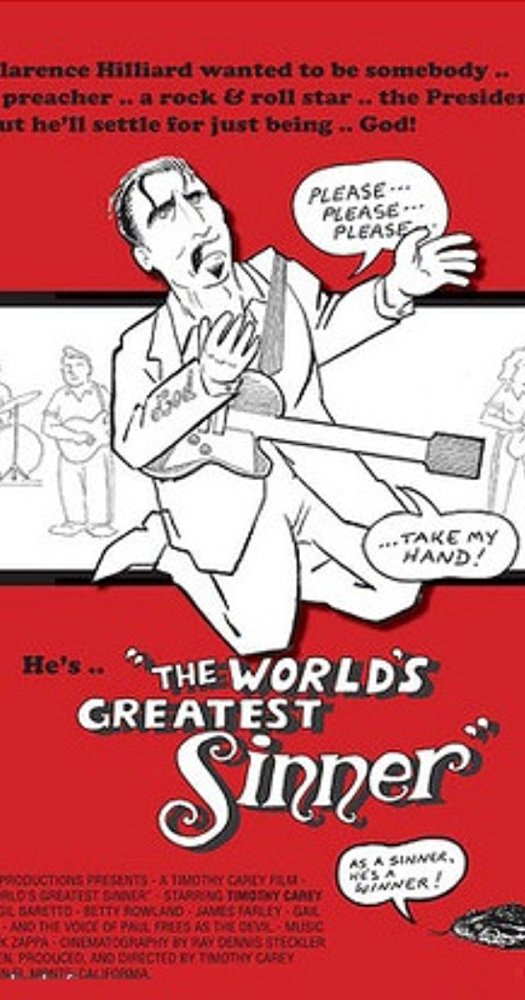
Prophet Without Honor: Timothy Carey’s THE WORLD’S GREATEST SINNER (Timothy Carey 1962)


gary loggins's avatarcracked rear viewer

Timothy Agoglia Carey (1929-1994) was an eccentric, oddball actor who played in everything from early Stanley Kubrick films (THE KILLING, PATHS OF GLORY) to AIP Beach Party romps (BIKINI BEACH, BEACH BLANKET BINGO ). He had the look of an overfed vampire, and was noted for his off-the-wall characterizations. Carey didn’t play the Hollywood game, considering himself an artist, and you’ve got to admire that. In 1962, he made a film called THE WORLD’S GREATEST SINNER, which he produced, directed, wrote, starred in, and released himself. Top THAT, Orson Welles!.

This ultra-low-budget film is totally bizarre right off the rip. Insurance man Clarence Hilliard (Carey) gets himself fired from his job after telling people they don’t need insurance. He wants more out of life, believing man is a superbeing, and begins to set himself up as a God. After watching a rock’n’roll teen idol, Clarence becomes a charismatic, guitar-toting, fiery…

View original post 373 more words

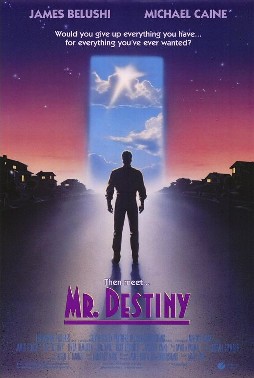
A Movie A Day #254: Mr. Destiny (1990, directed by James Orr)


When did your life first start to go downhill?

Larry Burrows (James Beluhsi) is convinced that, if he had not struck out while playing in the state high school baseball championship when he was 15, his life would have turned out so much differently.  He would be a success, instead of a mid-level executive with money problems, a dissatisfied wife, Ellen (Linda Hamilton), and a weird best friend (Jon Lovitz, of course).  On Larry’s 35th birthday, Michael Caine shows up as Larry’s guardian angel and, before you can say “George Bailey,” Larry is transported to an alternate timeline where he won that baseball game and got everything that he wanted.  Now, Larry has a big home, a sexy wife (Rene Russo), and a sexy mistress (Courtney Cox).  But he doesn’t have Ellen and Larry realizes that this all he ever wanted in the first place.

1990 was a busy year for Jim Belushi, starring in both this and Taking Care of Business.  Of the two films, Mr. Destiny is marginally better.   The story itself is predictable and the film makes a big mistake by trying to get dramatic during the final act.  (Everyone knows that Larry’s rival at the compamy is sleazy because he is played by Hart Bochner and everyone remembers Die Hard.  There was no need to turn him into a murderer, even if it was in a parallel universe.)   However, Michael Caine has the ability to make even the worst dialogue sound good.  Belushi is relatively restrained and any film that features Rene Russo, Courtney Cox, and Linda Hamilton can’t be all bad.   Mr. Destiny is forgettable but inoffensively entertaining.