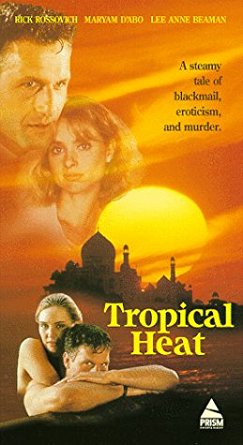
In India, a maharaja is killed when an elephant steps on him. His widow, an American named Beverly (Maryam d’Abo) stands to receive five million dollars but the life insurance company wants to make sure that the maharajah is actually dead before paying. Luckily, insurance exec Carolyn (Lee Anne Beaman) knows the world’s stupidest private investigator, a man named Gravis (Rick Rossovich). Gravis is busy house sitting a friend’s mansion and says he does not want to go to India but, after having sex with Carolyn in the pool, he changes his mind. Once he arrives, he casually investigates the maharaja’s death whenever he is not busy having sex with Beverly. During the course of his “investigation,” Gravis meets a young Indian woman (Asha Siewkumar), who thinks that there is more to the maharjah’s death than just a rogue elephant. Gravis has sex with her, too. Eventually, the movie runs out of people for Gravis to have sex with and it ends.
Though it often seems like it should be, Tropical Heat is not a comedy. An American-Indian co-production, Tropical Heat is a softcore neo-noir, the type that used to dominate late night Cinemax. By the standards of Skinemax, Tropical Heat is still pretty bad, with both Rossovich and d’Abo looking like they would have rather been anywhere other than this movie. Filmed on location, Tropical Heat highlights all of the ugliest, most crowded urban areas of India and then, for some reason, has Gravis telling everyone that he meets that he cannot believe how beautiful the country is. All of the hilariously bad dialogue sounds as if it was written by someone who learned how to speak English from watching someone else play Leisure Suit Larry.
If you want to see a good show about self-centered Americans in India, stick with that episode of Seinfeld where everyone goes to India for Sue Ellen Mischke’s wedding.
Dr. Judd Stevens (Roger Moore) is a mild-mannered Chicago psychologist who has never been in any trouble, so why has one of his patients and his receptionist been murdered? Lt. McGreavy (Rod Steiger), who has a personal grudge against Stevens, thinks that the doctor himself might be responsible. Dr. Stevens thinks that the first murder was a case of mistaken identity and that he is being targeted for assassination. Detective Angeli (Elliott Gould) says that he is willing to consider Stevens’s theory but can Stevens trust him? Or should Dr. Stevens put his trust in a veteran P.I. (Art Carney) or maybe even his newest patient (Anne Archer)?
An example of one of the “prestige” pictures that Cannon Films would produce in between Chuck Norris movies, The Naked Face has the potential be intriguing but both the direction and the script are too formulaic to be effective. Even though the movie does not work, it is always interesting to see the non-Bond films that Roger Moore made while he was playing the world’s most famous secret agent. In The Naked Face, a lot of time is spent on establishing Judd Stevens as being the exact opposite as James Bond. Stevens doesn’t drink or smoke and he is devotedly loyal to the memory of his dead wife. When someone offers him a gun, Stevens replies, “I don’t believe in them.” Unlike Bond, Dr. Stevens does not have the ability to come up with one liners. He barely ever cracks a smile. Moore is miscast in the role but he still does a better job than Rod Steiger, who bellows all of his lines, and Elliott Gould, who spends the movie with his head down. I don’t blame him.
One final note: As much as The Naked Face tries to distance itself from the Bond films, it does feature one other connection beyond the casting of Moore. David Hedison, who plays Dr. Stevens’s friend and colleague, also played Felix Leiter in Live and Let Die and Licence to Kill.
We last left the wacky world of Wheeler & Woolsey with a look at the looney HOLD ‘EM JAIL . Today we delve deeper into comedy’s film vault with their 1930 effort THE CUCKOOS, based on the hit Broadway musical by Guy Bolton, Bert Kalmar, and Harry Ruby. The play featured the team of Clark & McCullough, who are even more obscure than W&W to most film fans (they appeared in a series of shorts from 1928-35), but RKO (after the success of 1929’s RIO RITA) put W&W into the film version, hoping the team’s antics would click with Depression Era audiences.
And click they did, leading to an RKO contract and nineteen more features! THE CUCKOOS’ plot concerns romantic entaglements at a plush hotel, with heiress Ruth (June Clyde) in love with pilot Billy (Hugh Trevor), but pushed toward the oily Baron de Camp (Ivan Lebedeff ) by her…
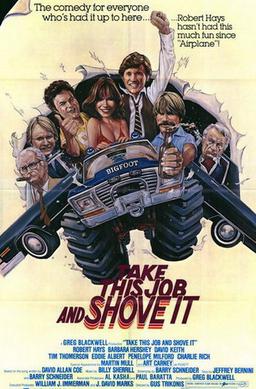
Originally from a small town in Iowa, Frank Macklin (Robert Hays) is a hotshot young executive with The Ellison Group. When Frank is assigned to manage and revitalize a failing brewery in his hometown, it is a chance for Frank to rediscover his roots. His childhood friends (played by actors like David Keith, Tim Thomerson, and Art Carney) may no longer trust him now that Frank wears a tie but it only takes a few monster truck rallies and a football game in a bar for Frank to show that he is still one of them. However, Frank discovers that the only reason that he was sent to make the brewery profitable was so that his bosses could sell it to a buffoonish millionaire who doesn’t know the first thing about how to run a business. Will Frank stand by while his bosses screw over the hardworking men and women of the heartland? Or will he say, “You can take this job and shove it?”
Named after a country music song and taking place almost entirely in places stocked with beer, Take This Job And Shove It is a celebration of all things redneck. This movie is so redneck in nature that a major subplot involves monster trucks. Bigfoot, one of the first monster trucks, gets plenty of screen time and, in some advertisements, was given higher billing than Art Carney.
A mix of low comedy and sentimental drama, Take This Job And Shove It is better than it sounds. In some ways, it is a prescient movie: the working class frustrations and the anger at being forgotten in a “booming economy” is the same anger that, 35 years later, would be on display during the election of 2016. Take This Job And Shove It also has an interesting and talented cast, most of whom rise above the thinly written dialogue. Along with Hays, Keith, Thomerson, Bigfoot, and Carney, keep an eye out for: Eddie Albert, Royal Dano, James Karen, Penelope Milford, Virgil Frye, George “Goober” Lindsey, and Barbara Hershey (who, as usual, is a hundred times better than the material she has to work with).
One final note: Martin Mull plays Hays’s corporate rival. His character is named Dick Ebersol. Was that meant to be an inside joke at the expense of the real Dick Ebersol, who has the executive producer of Saturday Night Live when Take This Job and Shove It was filmed and who later became the president of NBC Sports?
Old west outlaw Frank Calder (Oliver Reed) wants to learn how to read so he and his gang ride into the nearby town and kidnap Melissa Ruger (Candice Bergen). Because he saw her reading to a group of children, Calder assumed that Melissa was a school teacher. Instead, Melissa is the wife of a brutal cattle baron and hunter named Brandt Ruger (Gene Hackman). Even after Calder learns the truth about Melissa’s identity, he keeps it a secret from his gang because he knows that they would kill her and then kill him as punishment for kidnapping the wife of a man as powerful as Brandt. Stockholm Syndrome kicks in and Melissa starts to fall in love with Calder. Meanwhile, Brandt learns that his wife has been kidnapped and, with a group of equally brutal friends, he sets out to get her back. In Brandt’s opinion, Calder has stolen his personal property. Using a powerful and newly designed rifle, Brandt kills Calder’s men one-by-one until there is a final, bloody confrontation in the desert.
Coming out two years after Sam Peckinpah redefined the rules of the western genre with The Wild Bunch, The Hunting Party owes a clear debt to Peckinpah. Much as in The Wild Bunch, the violence is sudden, brutal, and violent. What The Hunting Party lacks is Peckinpah’s attention to detail and his appreciation for the absurd. Instead, The Hunting Party is just one shooting after another and, devoid of subtext or any hint of a larger context, it quickly gets boring.
Fans of Oliver Reed, however, will want to watch The Hunting Party because it features one of his best performance. For once, Reed is actually playing the nice guy. He may be an outlaw but he still cries when a mortally wounded member of his gang begs Calder to put him out of his misery. Gene Hackman is also good, even though he’s playing one of his standard villain roles. (The less said about Candice Bergen’s performance, the better.) The Hunting Party may be dully nihilistic but Oliver Reed shines.
Groundbreaking 60’s films like BONNIE & CLYDE, THE GRADUATE, THE WILD BUNCH, and MIDNIGHT COWBOY led to the complete obliteration of the Production Code, and by the sizzling 70’s it was anything goes! Low budget exploitation filmmakers benefitted most by this loosening of standards as the following quintet of movies illustrates, filled with bouncing boobs, bloody action, pot smoking, beer drinking, and hell raising:
THE MUTHERS (Dimension 1976; D; Cirio H. Santiago) – A Filipino-made “Women in Prison” Blaxploitation actioner? Yes, please! Former Playboy Playmates Jeanne Bell and Rosanne Katon, future NFL TODAY commentator Jayne Kennedy, and ex-Bond girl Trina Parks are all trapped on a coffee plantation run by the sadistic Monteiro with no chance of escape… until there is! Loaded with gore, torture, kung-fu fighting, bare breasts, a funky score, pirates (that’s right, pirates!), and a slam-bang run through the jungle – what more could you ask for?…
(Lisa is currently in the process of cleaning out her DVR! She’s got over 170 films to watch before the end of 2017! Will she make it? Who knows? She recorded 1983’s Women of San Quentin off of Retroplex on January 25th.)
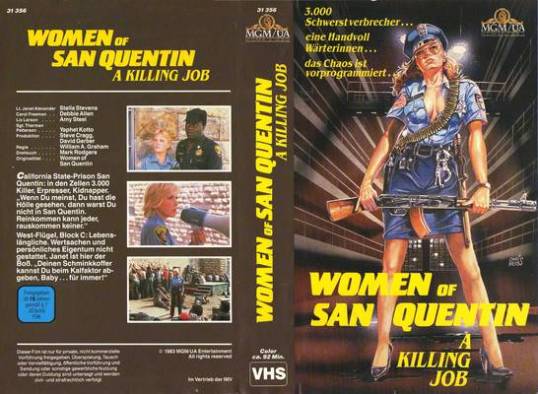
For some reason, back in January, I felt the need to record several prison movies off of cable. I’m not sure where my mind was at that I would see a title like Women of San Quentin listed in the guide and think to myself, “That’s something I definitely need to record.” Maybe I was thinking of pursuing a career as a prison guard. That seems to be the easiest way to get a show on A&E nowadays.
Anyway, I imagine that anyone reading this review is looking that title and considering the VHS cover art and they’re probably assuming that Women of San Quentin is some sort of Cirio Santiago-directed women in prison film. And then consider the film’s cast: Amy Steel is best known for Friday the 13th Part II and April Fool’s Day. Stella Stevens is an exploitation film vet. One of the prisoners is played by Rockne Tarkington, who starred in a handful of blaxploitation films. William Sanderson, star of the infamous Fight For Your Life, has a small role. Yaphet Kotto plays a prison guard here but he’s best known for playing the villain in Live and Let Die. Gregg Henry plays a sociopath. Hector Elizondo and Debbie Allen play sympathetic guards. Even Ernie Hudson, a now-respectable actor with several less-than-savory films on his resume, shows up. Finally, consider this: Women of San Quentin was written by Larry Cohen, the man who directed both Black Caesar and It’s Alive.
However, despite all of that, Women of San Quentin is not an exploitation film. Instead, it’s a made-for-TV movie. (Director William A. Graham has over a hundred TV shows and made-for-TV movies to his credit.) It follows several storylines. Lt. Janet Alexander (Stella Stevens) is the tough-but-fair captain who is in charge of one of San Quentin’s most intimidating cell blocks. She’s great at her job and she has a vaguely romantic relationship with Hector Elizondo but she’s also tempted to find a new career. Charles Wilson (Ernie Hudson) steps up to lead the prison’s black inmates after another activist is assassinated. Meanwhile, the leader of the Mexican Mafia plots a prison riot and Yaphet Kotto and Debbie Allen use any means necessary to discover what’s going to happen.
And then there’s Liz Larson (Amy Steel), the newest prison guard who struggles to prove that she belongs in San Quentin. Sexist colleagues play cruel pranks on her. The prisoners shout at her whenever she walks past their cells. When she has to use a gun to break up a fight, she hesitates just a second too long. Will she be able to step up when real trouble breaks out? Among horror fans, Amy Steel is remembered for “surviving” several slasher films. (Her performance as Ginny in Friday the 13th Part 2 largely set the standard for which all final girls are judged.) Steel does a pretty good job as Liz but, actually, the entire movie is well-acted. The script is frequently rudimentary but the cast is full of unique talent and it’s always fun to watch so many good actors playing opposite each other.
I assume that the Women of San Quentin was meant to be a pilot for a TV show or something. It just has that feel to it. If just for the cast alone, I would recommend watching Women of San Quentin if you get a chance. I’m as surprised as anyone but, after all, where else are going to get a chance to watch Hector Elizondo, Yaphet Kotto, Stella Stevens, and Amy Steel all hanging out in a bar together? There are certain opportunities that you just don’t miss.
(Lisa is currently in the process of cleaning out her DVR! She’s got over 170 movies recorded and she’s hoping to have them all watched by the new year! Wish her luck! She recorded the 2017 documentary, Disgraced, off of Showtime on July 10th.)
To be honest, Disgraced is not the type of documentary that I would usually watch.
After all, it’s a documentary about basketball and a college athletics program, two things about which I have next to no interest. I will admit that, like everyone in Dallas, I watched the Marvericks when they were playing for the NBA championship but, even then, I spent most of the games with my hands over my ears. Seriously, all those squeaky shoes! I just couldn’t take it.
However, with all that in mind, there was no way that I was going to miss Disgraced. As soon as I found out what the documentary was specifically about, I set the DVR to record it. Disgraced is about more than just basketball. It tells the story of Patrick Dennehy, a Baylor basketball player who, in 2003, vanished. I can still remember when Dennehy disappeared. It was big news down here in Texas and, for a few days, it was all anyone was talking about. Even back then, I was fascinated by missing person cases and I wondered if Dennehy had been kidnapped, developed amnesia, or perhaps voluntarily gone into hiding. Who knows? Maybe he didn’t want to be a big basketball star.
I can also remember the day when it was announced that Dennehy’s teammate and friend, Carlton Dotson, had confessed to shooting and killing Dennehy. At the time, it was reported that Dotson had said that he heard a voice telling him to kill Patrick. That was pretty scary stuff and everyone was shocked. In retrospect, I think a lot of the surprise had to do with the fact that Dotson killed his own teammate. We’re big on team sports down here in Texas. For many, being a teammate is almost as sacred a relationship as being someone’s cousin.
Topping it all off, of course, was the fact that this all happened at Baylor University. Baylor may be the world’s biggest Baptist University but it’s also a Texas institution. Down here, we all know the Baylor stereotype. Baylor students are both religious and wild. For those who like to think of Baylor as being full of hypocrites, the murder of Patrick Dennehy was viewed as vindication. For me, as a high school student, the murder made me wonder if all colleges were as messed up as Baylor apparently was.
(When I was a later a student at the University of North Texas, I ran into some Baylor students who were visiting a friend. They were drunk off their asses and begged me and my BFF to come back to their place with them. “You can trust us,” one of them said, “we’re good Baptist boys from Baylor…” I informed them that I was a “bad Catholic girl from Dallas,” which just seemed to make them like me more. Fortunately, I not only had another party to go to but I also had a BFF who had no fear about telling drunk dudes to fuck off.)
What I did not know, at the time, is that the investigation into Dennehy’s death also led to the discovery that the Baylor basketball program was apparently violating all sorts of regulations when it came to recruiting players. Baylor’s respected coach, Dave Bliss, lost his job as a result of the violations that were discovered and, in the opinion of many, his attempts to cover up all of his actions actually impeded the police investigation into Dennehy’s disappearance.
All of this is detailed in Disgraced, though I have to admit that the details of Dave Bliss’s downfall were of far less interest to me than the details of what led to Carlton Dotson murdering Patrick Dennehy. Featuring extensive interviews with the people who were there — including an occasionally contrite Dave Bliss — Disgraced traces the steps that eventually led to Dennehy’s murder. It was fascinating and rather distressing to hear about the days leading up to Dennehy and Dotson going off together to shoot guns. Dotson’s motives remains as unknowable in the documentary as they are in real life but Patrick Dennehy comes across as being a good guy who deserved better than to be reduced to a sordid headline. For fans of true crime, Disgraced is a must see and I imagine basketball lovers will get something out of it too.
(Lisa is currently in the process of trying to clean out her DVR. She has over 170 movies recorded and she’s trying to get them all watched before the beginning of the new year! Will she make it? Keep checking the Shattered Lens to find out! She recorded the 1992 dramedy This Is My Life off of Indieplex on March 20th.)
This Is My Life tells the story of Dottie Ingels (Julie Kavner). Dottie may be stuck working in a dead end job at a cosmetics counter but she dreams of becoming a successful comedienne. She even entertains her customers, who all seem to be delighted to put off making their purchases so that they can listen to an aspiring star tell corny jokes that were probably considered to be dated even at the height of vaudeville. Most of Dottie’s jokes deal with raising her daughters — Erica (Samantha Mathis) and Opal (Gabby Hoffman) — on her own. Times may not be easy but … well, actually, as portrayed in this movie, times are remarkably easy for a single mom with a job in retail. It’s certainly easier for Dottie than it ever was for my mom.
Anyway, Dottie’s aunt dies and leaves her some money, so Dottie moves herself and her daughters to New York City so that she can pursue her comedy career. With the help of an eccentric agent (Dan Aykroyd) and his assistant (Carrie Fisher), Dottie starts to find success as a performer but her daughters also start to resent the fact that their mother is no longer around as much as she used to be. While Dottie is getting invitations to appear on late night talk shows, Erica and Opal are feeling neglected. Finally, they decide to run away from home and head upstate to see their father, little realizing that he may not have room for them in his new life.
This Is My Life is one of those films that could only have been made by someone totally in love with the concept (as opposed to the reality) of show business. While Dottie does have to sacrifice to find success, the film has no doubt that the sacrifices are worth it. As played by Dan Aykroyd, Dottie’s agent is a big lovable eccentric who just wants the best for all of his clients. In fact, everyone in this movie just wants the best for Dottie. As a result, the film is so good-natured that you kind of feel guilty if you don’t force yourself to love it. At the same time, it’s such an unabashedly sentimental movie that it’s difficult to take any of its conflicts seriously. It’s like a fantasy of what it’s like to be an aspiring star in New York. Making her directorial debut, the famous writer Nora Ephron laid on the schmaltz so thick that, for the majority of the film, there’s not even a hint of a rough edge or a ragged corner. This is a film that really could have used a little more profanity. And while Julie Kavner is undoubtedly a funny actress, she’s never believable as a stand-up comedienne. (At least not a successful one…)
That said, there were a few things that I did like about This Is My Life. Mathis and Hoffman are believable as sisters and there’s a natural poignancy to the scenes where they manage to track down their father. I related to those scenes and they brought tears to my mismatched eyes, not that it’s particularly hard to do that. Otherwise, This Is My Life felt like a typical directorial debut: heartfelt, uneven, well-intentioned, and just a little too heavy-handed.
(Lisa is currently in the process of cleaning out her DVR! This could take a while. She recorded the 2001 high school film O off of Cinemax on July 6th.)
Tell me if this sounds familiar.
O (Mekhi Phifer) is one of the only black students attending an exclusive high school in South Carolina. Despite a past that involves petty crime and drugs, O appears to have his life on the right track. As the captain of school’s basketball team, O is the most popular student at his school. Everyone looks up to him. Everyone wants to be him. He’s even dating Desi (Julia Stiles), the very white daughter of the school’s very white headmaster (John Heard). At a school assembly, Coach Duke Goulding (Martin Sheen) describes O as being like a son to him. When O is awarded the MVP trophy, he shares it with his teammate, Michael Cassio (Andrew Keegan).
Watching all of this with seething jealousy is Hugo Gaumont (Josh Hartnett). Hugo is a teammate of O’s. In fact, he even thought that he was O’s best friend. That was before O shared his award with Michael. Making Hugo even more jealous is that he happens to be the son of the coach. For every kind word that Duke has for O, he has a hundred petty criticisms for Hugo. Whereas O has overcome drug addiction and is proclaimed as a hero for doing so, Hugo is secretly doing steroids, trying to do anything to improve himself as a player and hopefully win everyone’s love.
So, Hugo decides to get revenge. Working with a nerdy outcast named Roger Calhoun (Elden Hansen), he manipulates O into thinking that Desi is cheating on him with Cassio. He also tricks Cassio into getting into a fight with Roger, leading to Cassio getting suspended from the team. To top it all off, Hugo gets O hooked on drugs, once again. Finding himself consumed by a violent rage that he thought he had under control, O starts to obsess on determining whether or not Desi has been faithful to him…
If that sounds familiar, that’s because O is basically Othello, transported to modern times and involving privileged teenagers. Even though the whole modernized Shakespeare thing has become a bit of a cliché, it actually works pretty well in O. Hugo’s obsessive jealousy of the “cool kids” feels right at home in a high school setting and director Tim Blake Nelson and writer Brad Kaaya do a fairly good job of transporting Shakespeare’s Elizabethan melodrama to the early aughts.
(Actually, O was filmed in 1999 but it sat on the shelf for two years. After a spate of school shootings, distributors were weary about releasing a film about high school students trying to destroy each other.)
Admittedly, O has its share of uneven moments. Martin Sheen, playing the type of role that always seems to bring out his worst instincts as an actor, goes so overboard as the coach that he threatens to sink almost every scene in which he appears and Rain Phoenix is miscast as Hugo’s girlfriend. Even Julia Stiles struggles a bit in the role of Desi. However, both Mekhi Phifer and Josh Hartnett are perfectly cast as O and Hugo. Phifer brings just the right amount of arrogant swagger to the role while Hartnett is a sociopathic marvel as Hugo. Tim Blake Nelson’s direction is occasionally overwrought, relying a bit too heavily on a groan-inducing metaphor about taking flight and claiming the spotlight. However, both Nelson and the film deserve some credit for not shying away from directly confronting and portraying the source material’s cultural and racial subtext.
O is hardly perfect but it is always watchable and, at its best, thought-provoking.
 In India, a maharaja is killed when an elephant steps on him. His widow, an American named Beverly (Maryam d’Abo) stands to receive five million dollars but the life insurance company wants to make sure that the maharajah is actually dead before paying. Luckily, insurance exec Carolyn (Lee Anne Beaman) knows the world’s stupidest private investigator, a man named Gravis (Rick Rossovich). Gravis is busy house sitting a friend’s mansion and says he does not want to go to India but, after having sex with Carolyn in the pool, he changes his mind. Once he arrives, he casually investigates the maharaja’s death whenever he is not busy having sex with Beverly. During the course of his “investigation,” Gravis meets a young Indian woman (Asha Siewkumar), who thinks that there is more to the maharjah’s death than just a rogue elephant. Gravis has sex with her, too. Eventually, the movie runs out of people for Gravis to have sex with and it ends.
 Dr. Judd Stevens (Roger Moore) is a mild-mannered Chicago psychologist who has never been in any trouble, so why has one of his patients and his receptionist been murdered? Lt. McGreavy (Rod Steiger), who has a personal grudge against Stevens, thinks that the doctor himself might be responsible. Dr. Stevens thinks that the first murder was a case of mistaken identity and that he is being targeted for assassination. Detective Angeli (Elliott Gould) says that he is willing to consider Stevens’s theory but can Stevens trust him? Or should Dr. Stevens put his trust in a veteran P.I. (Art Carney) or maybe even his newest patient (Anne Archer)?


 Originally from a small town in Iowa, Frank Macklin (Robert Hays) is a hotshot young executive with The Ellison Group. When Frank is assigned to manage and revitalize a failing brewery in his hometown, it is a chance for Frank to rediscover his roots. His childhood friends (played by actors like David Keith, Tim Thomerson, and Art Carney) may no longer trust him now that Frank wears a tie but it only takes a few monster truck rallies and a football game in a bar for Frank to show that he is still one of them. However, Frank discovers that the only reason that he was sent to make the brewery profitable was so that his bosses could sell it to a buffoonish millionaire who doesn’t know the first thing about how to run a business. Will Frank stand by while his bosses screw over the hardworking men and women of the heartland? Or will he say, “You can take this job and shove it?”
 Old west outlaw Frank Calder (Oliver Reed) wants to learn how to read so he and his gang ride into the nearby town and kidnap Melissa Ruger (Candice Bergen). Because he saw her reading to a group of children, Calder assumed that Melissa was a school teacher. Instead, Melissa is the wife of a brutal cattle baron and hunter named Brandt Ruger (Gene Hackman). Even after Calder learns the truth about Melissa’s identity, he keeps it a secret from his gang because he knows that they would kill her and then kill him as punishment for kidnapping the wife of a man as powerful as Brandt. Stockholm Syndrome kicks in and Melissa starts to fall in love with Calder. Meanwhile, Brandt learns that his wife has been kidnapped and, with a group of equally brutal friends, he sets out to get her back. In Brandt’s opinion, Calder has stolen his personal property. Using a powerful and newly designed rifle, Brandt kills Calder’s men one-by-one until there is a final, bloody confrontation in the desert.

 Through the Shattered Lens