Special Veteran’s Day Edition: THE STORY OF G.I. JOE (United Artists 1945)


gary loggins's avatarcracked rear viewer

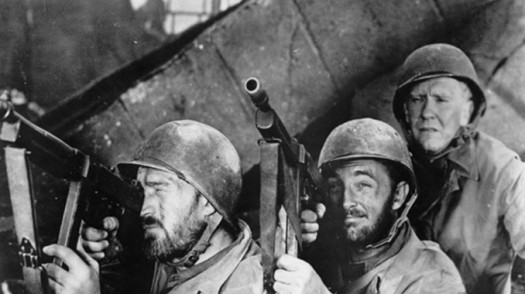
William Wellman’s THE STORY OF G.I. JOE tells the tale of boots-on-the-ground combat soldiers through the eyes of war correspondent Ernie Pyle, Pulitzer Prize winning syndicated columnist for Scripps-Howard newspapers. The film was one of the most realistic depictions of the brutality of war up to that time, and made a star out of a young actor by the name of Robert Mitchum . In fact, this was the one and only time Mitchum ever received an Oscar nomination – a shocking fact given the caliber of his future screen work.

Burgess Meredith  plays Pyle, who embeds with the 18th Infantry’s ‘C’ Company in order to give his stateside readers the grim realities of war from the soldier’s point of view. The men accept him, affectionately calling him ‘Pop’, as he shares their hardships, heartbreaks, and victories. Meredith’s voice over narrations are taken directly from Pyle’s columns, detailing the cold nights, dusty…

View original post 497 more words

Cleaning Out The DVR: Off The Rails (dir by David Jackson)


(Hi there!  So, as you may know because I’ve been talking about it on this site all year, I have got way too much stuff on my DVR.  Seriously, I currently have 205 things recorded!  I’ve decided that, on January 15th, I am going to erase everything on the DVR, regardless of whether I’ve watched it or not.  So, that means that I’ve now have only two months to clean out the DVR!  Will I make it?  Keep checking this site to find out!  I recorded Off The Rails off of the Lifetime Movie Network on March 26th!)

Oh, poor Nicole (Hannah Barefoot)!

When we first meet her, Nicole is recovering from amnesia.  She knows that she was injured in a catastrophic train derailment.  She knows that she’s married to Mark (Thomas Beaudoin), who seems like the perfect husband.  She knows that her therapist is Dr. Teres (Andrea Cirie).  She knows that she’s oddly obsessed with maps and that she teaches at the local college.  However, she is still not totally sure what her life was like before the accident.  And sometimes, she wonders if she can actually trust Mark.  For instance, she suspects that, while she was in her coma, Mark added onto the deck in the back yard.  Mark swears that it was her idea but why would she want to do that?

Nicole is also convinced that she has never had a Facebook account.  She swears that she’s never been on Twitter.  She doesn’t even know what Instagram is!  “You call me a Luddite!” she says to one of her friends, “I do remember that!”  But, if that’s true, why do all of her friends swear that they’ve talked to her on Facebook?  And why are all sorts of sleazy men approaching her, all claiming that they met her online?

That’s not all Nicole has to worry about.  There’s also the weird visions that she’s having, many of them involving being watched by a menacing-looking raven.  And then there’s the French Canadian photographer (Andreas Damm).  Nicole is not sure who he is but she sure did take a lot of happy pictures with him.  Could it be that she wasn’t as happy in her marriage as both Mark and her therapist insist?

There were some parts of Off The Rails that I really liked.  The story was, at times, genuinely intriguing and I always appreciate it whenever Lifetime films mix a little surrealism in with the melodrama.  The first part of the film does a very good of creating a properly ominous atmosphere and Hannah Barefoot does a good job portraying Nicole’s confusion and paranoia.  Obviously, it demanded a considerable suspension of disbelief to buy into the idea that Nicole could possibly be so ignorant of social media in 2017 but then again, that’s Lifetime for you.  Social media is always the source of all evil in the world of Lifetime.

Unfortunately, there’s a twist at the end of Off The Rails that simply does not work and it actually cheapens the film a bit.  I understand that it’s a Lifetime film and that, therefore, things can never end on too dark of a note but, in this case, the movie’s story demanded and deserved an ending that was just a bit more bittersweet.

Still, I’d recommend Off the Rails.  Up until that final shot, it’s a nicely done Lifetime mystery.  You’ll probably figure out the solution early but it’s still entertainingly melodramatic and just weird enough to be worthwhile.


Cleaning Out The DVR: Secrets In Suburbia (dir by Damian Romay)


(Hi there!  So, as you may know because I’ve been talking about it on this site all year, I have got way too much stuff on my DVR.  Seriously, I currently have 205 things recorded!  I’ve decided that, on January 15th, I am going to erase everything on the DVR, regardless of whether I’ve watched it or not.  So, that means that I’ve now have only two months to clean out the DVR!  Will I make it?  Keep checking this site to find out!  I recorded Secrets in Suburbia off of Lifetime on April 15th!)

Welcome to the Hell that is Lifetime suburbia!

Seriously, whenever you come across a Lifetime movie that has the word “suburbia” in the title, you know exactly what you’re getting: nice houses, nice clothes, beautiful people, adulterous affairs, and usually a little bit of murder.  Secrets in Suburbia features all of that and it’s an enjoyably over the top little movie.

We open with a nice house in a nice neighborhood on a nice night.  A party’s being thrown.  It’s a divorce party!  (Divorce parties, by the way, are super fun!  I’ve been encouraging all of my married friends to get divorced, just so we can all get together for the party afterward.)  The recently divorced wife gives a long and sarcastic speech.  Suddenly, her ex-husband shows up.  He’s waving a gun and rambling incoherently.  Then he shoots himself, which totally ruins the party.

(Choice dialogue: “I don’t need a dead body in my house!”)

We return to the party four more times over the course of the film, each time from the perspective of a different character and each time, we learn a little bit more about what happened on that night.  It’s a nicely done technique, one that forces us to pay close attention to the action unfolding on screen.  It certainly adds a layer of narrative complexity that one might not usually expect to find in a Lifetime film.

The majority of the film deals with Gloria (Brianna Brown) and her husband, Phil (Joe Williamson).  Gloria has a nice house, nice children, and a nice dog.  Phil has a lot of charm and a massive chip on his shoulder about the fact that, unlike most of his friends and neighbors, he wasn’t born rich.  Phil, it quickly turns out, has more than a little trouble being a faithful husband.  No need to be shocked by that.  It’s Lifetime and it’s suburbia.

One day, Gloria comes home to discover that her dog has been poisoned.  While she rushes the dog to the vet, she gets into a serious car accident.  It’s hard not to notice that, underneath all of his charm, Phil doesn’t seem to be that concerned about his wife.  Maybe it’s the fact that he keeps ignoring the doctor’s advice.  Maybe it’s the fact that he doesn’t seem to care about the dead dog.  Or maybe it has something to do with the antifreeze that he keeps putting in her drinks…

This is a movie that’s all about revenge, especially after Gloria learns that Phil has been cheating with her friends.  To be honest, the plot doesn’t make a whole lot of sense.  Things get pretty crazy towards the end of the film.  That’s not a complaint, of course.  In general, the more melodramatic and crazy a movie like this gets, the better.  Secrets in Suburbia goes totally batshit crazy, which is exactly what it needed to do.  It’s all terrifically entertaining and in the end, that’s all that really matters.

A Movie A Day #305: Go Tell The Spartans (1978, directed by Ted Post)


One of the best films ever made about Vietnam is also one of the least known.

Go Tell The Spartans takes place in 1964, during the early days of the Vietnam War.  Though the Americans at home may not know just how hopeless the situation is in South Vietnam, Major Barker (Burt Lancaster, in one of his best performances) does.  Barker is a career military man.  He served in World War II and Korea and now he’s ending his career in Vietnam, taking orders from younger superiors who have no idea what they are talking about.  Barker has been ordered to occupy a deserted village, Muc Wa.  Barker knows that occupying Muc Wa will not make any difference but he is in the army and he follows orders.

Barker sends a small group to Muc Wa.  Led by the incompetent Lt. Hamilton (Joe Unger), the group also includes a drug-addicted medic (Dennis Howard), a sadistic South Vietnamese interrogator (Evan C. Kim) who claims that every civilian that the men meet is actually VC, a sergeant (Jonathan Goldsmith) who is so burned out that he would rather commit suicide than take command, and Cpl. Courcey (Craig Wasson).  Courcey is a college-educated idealist, who joined the army to do the right thing and is now about to discover how complicated that can be in South Vietnam.  At Muc Wa, the soldiers find a cemetery containing the graves of French soldiers who died defending the hamlet during the First Indochina War.  The inscription as the cemetery reads, “Go tell the Spartans, stranger passing by, that here, obedient to their laws, we lie.”  

Because the film strives for realism over easy drama, Go Tell The Spartans has never gotten the same attention as some other Vietnam films.  Unlike The Deer Hunter, Platoon, Coming Home, and Born on the 4th of July, Go Tell The Spartans received no Oscar nominations.  It is still a brilliantly acted and powerful anti-war (but never anti-soldier) film.  It starts out as deceptively low-key but the tension quickly builds as the soldier arrive at Muc Wa and discover that their orders are both futile and impossible to carry out.  Vastly outnumbered, the Americans also find themselves dealing with a land and a culture that is so unlike their own that they are often not even sure who they are fighting.  Military discipline, as represented by Lt. Hamilton, is no match for the guerilla tactics of the VC.  By the film’s end, Vietnam is revealed to be a war that not even Burt Lancaster can win.

A Movie A Day #304: Code of Silence (1985, directed by Andrew Davis)


It’s life and death in the Windy City.  It’s got Chuck Norris, Henry Silva, Dens Farina, and a robot, too.  It’s Code of Silence.

Chuck plays Eddie Cusack, a tough Chicago policeman who is abandoned by his fellow officers when he refuses to cover for an alcoholic cop who accidentally gunned down a Hispanic teenager and then tried to place a gun on the body.  This the worst time for Cusack to have no backup because a full-scale gang war has just broken out between the Mafia and the Comachos, a Mexican drug gang led by Luis Comacho (Henry Silva).  When a cowardly mobster goes into hiding, Luis targets his daughter, Diana (Molly Hagan).  Determined to end the drug war and protect Diana, Eddie discovers that he may not be able to rely on his brothers in blue but he can always borrow a crime-fighting robot named PROWLER.

Despite the presence of a crime-fighting robot, Code of Silence is a tough, gritty, and realistic crime story.  Though Chuck only gets to show off his martial arts skills in two scenes (and one of those scenes is just Eddie working out in the gym), Code of Silence is still Norris’s best film and his best performance.  The film draws some interesting comparisons between the police’s code of silence and the Mafia’s omerta and director Andrew Davis shows the same flair for action that he showed in The Fugitive and Above the LawCode of Silence‘s highlight is a fight between Chuck and an assassin that takes place on top of a moving train.  Norris did his own stunts so that really is him trying not to fall off that train.

Davis surrounds Norris with familiar Chicago character actors, all of whom contribute to Code of Silence‘s authenticity and make even the smallest roles memorable.  (Keep an eye out for the great John Mahoney, playing the salesman who first introduces the PROWLER.)  Norris’s partner is played by Dennis Farina, who actually was a Chicago cop at the time of filming.  After Code of Silence, Farina quit the force to pursue acting full time and had a busy career as a character actor, playing cops and mobsters in everything from Manhunter to Get Shorty.  As always, Henry Silva is a great villain but the movie is stolen by Molly Hagan, who is feisty and sympathetic as Diana.  To the film’s credit, it doesn’t try to force Eddie and Diana into any sort of contrived romance.

Unfortunately, none of Chuck Norris’s other films never came close to matching the quality of this one.  Code of Silence is a hint of what could have been.

Hoods vs Huns: ALL THROUGH THE NIGHT (Warner Brothers 1942)


gary loggins's avatarcracked rear viewer

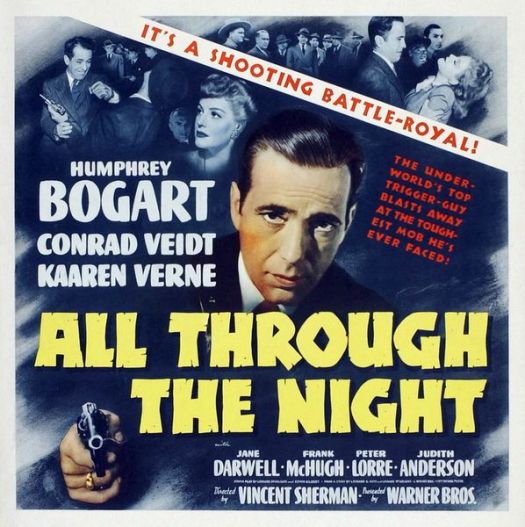
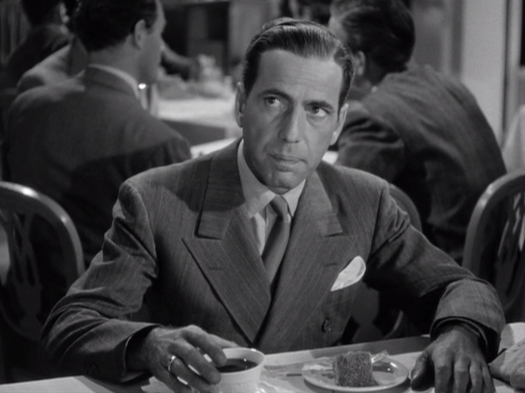
A gang of Runyonesque gamblers led by Humphrey Bogart take on Nazi spies in ALL THROUGH THE NIGHT, Bogie’s follow-up to his breakthrough role as Sam Spade in THE MALTESE FALCON. Here he plays ‘Gloves’ Donovan, surrounded by a top-notch cast of character actors in a grand mixture of suspense and laughs, with both the action and the wisecracks coming fast and furious in that old familiar Warner Brother style. Studio workhorse Vincent Sherman, whose directorial debut THE RETURN OF DOCTOR X also featured Bogart, keeps things moving briskly along and even adds some innovative flourishes that lift the film above its meager budget.

Bogie’s gangster image from all those 1930’s flicks come to a humorous head in the part of ‘Gloves’. He’s a tough guy for sure, but here the toughness is humanized by giving him a warm, loving mother (Jane Darwell ) and a fondness for cheesecake…

View original post 562 more words

A Movie A Day #303: The Evil That Men Do (1984, directed by J. Lee Thompson)


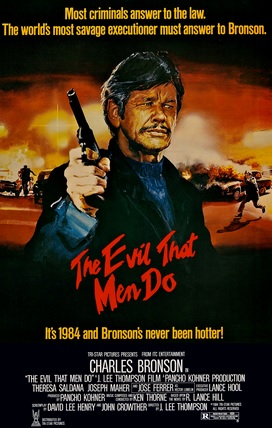
Clement Molloch (Joseph Maher) is a doctor who uses his medical training to torture journalists and dissidents in an unnamed South American country.  Holland (Charles Bronson) is a former  CIA assassin, who is content with being retired.  But when Molloch kills a journalist who was also an old friend of Holland’s, it all becomes about revenge.  No one’s more dangerous than Charles Bronson seeking revenge.  Working with the dead journalist’s widow (Theresa Saldana), Holland heads down to South America.  Since Molloch is always surrounded by bodyguards, it is not going to be easy to get him.  But who can stop Charles Bronson?

Bronson was 62 years old when he made The Evil The Men Do and he was still the toughest, coolest killer in the movies.  The Evil That Men Do is a rarity, an 80s Bronson film that was not produced by Cannon.  It still feels like a Cannon production, even if it is a little more interesting than some of the other films that Bronson was making at that time.  Dr. Molloch was clearly based on the notorious Nazi Klaus Barbie and Joseph Maher plays Molloch as being a dignified sadist.  Molloch also has a strange relationship with his equally cruel sister (Antoinette Bower).  That Molloch is so extremely evil makes the film’s final scenes all the more satisfying.

The Evil That Men Do is one of the best of Bronson’s later films.  Charles Bronson, man.  No one got revenge better than Bronson.

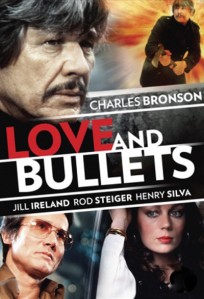
A Movie A Day #302: Love and Bullets (1979, directed by Stuart Rosenberg)


Joe Bomposa (Rod Steiger) may wear oversized glasses, speak with a stutter, and spend his time watching old romantic movies but don’t mistake him for being one of the good guys.  Bomposa is a ruthless mobster who has destroyed communities by pumping them full of drugs.  Charlie Congers (Charles Bronson) is a tough cop who is determined to take Bomposa down.  When the FBI learns that Bomposa has sent his girlfriend, Jackie Pruit (Jill Ireland), to Switzerland, they assume that Jackie must have information that Bomposa doesn’t want them to discover.  They send Congers over to Europe to bring her back.  Congers discovers that Jackie does not have any useful information but Bomposa decides that he wants her dead anyway.

Love and Bullets is an uneasy mix of action and comedy, with Bronson supplying the former and Ireland trying to help out with the latter.  Not surprisingly, the action works better than the comedy.  Because Charlie is an American in Switzerland, he is not allowed to carry a gun and he is forced to resort to some creative ways to take out Bomposa’s assassins.  Unfortunately, the scenes where Charlie and Jackie fall in love are less interesting, despite Bronson and Ireland being a real-life couple.  Ireland occasionally did good work when she was cast opposite of Bronson but here, she’s insufferable as a ditzy gangster moll with a strange accent.  While everyone else is trying to make an action movie, she’s trying too hard to be Judy Holliday.  Steiger’s peformance starts out as interesting but soon devolves into the usual bellowing and tics.

Love and Bullets does have a good supporting cast, though.  Bradford Dillman, Michael V. Gazzo, Val Avery, Albert Salmi, and Strother Martin all pop up.  The two main hit men are played by Paul Koslo and Henry Silva.  Silva’s almost as dangerous here as he was in Sharky’s Machine.

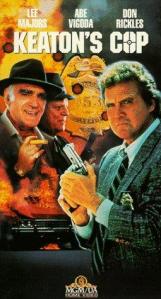
A Movie a Day #301: Keaton’s Cop (1990, directed by Bob Burge)


Mike Gable (Lee Majors) is the angriest cop in Galveston, famous for tossing people out of windows.  Jake (Don Rickles!) is Gable’s partner, who seems to be too old to still be on the force.  Gable’s best friend is Keaton (Abe Vigoda), a retired mobster who now lives in a nursery home.  When it becomes apparent that someone has put a hit out on Keaton, Gable and Jake are sent to investigate.  A shoot out at the nursery home leads to Jake’s death.  Another shoot out at a hotel leads to the death of several other cops.  Gable can either toss Keaton out a window or he can team up with him to solve the murders.  Imagine 48 Hours with Lee Majors replacing Nick Nolte and Eddie Murphy stepping aside for Abe Vigoda.

In the style of both 48 Hours and Midnight Run, Keaton’s Cop tries to combine comedy with action but the comedy is too lame to be funny and the action is too brutal to be light-hearted.  For some reason, Don Rickles plays his role completely straight while Abe Vigoda mostly just looks happy to have the chance to play a leading role for once.  Lee Majors is believable as an angry cop, mostly because he appears to be pissed off about having to appear in Keaton’s Cop.  It can’t be easy to go from being the Six Million Dollar Man to a movie like this.

What would have improved Keaton’s Cop?  How about an appearance from the stars of Shattered If Your Kid’s On Drugs:

Right, Burt?

Cleaning Out The DVR: Consenting Adults (dir by Alan J. Pakula)


(Lisa is currently in the process of cleaning out her DVR!  It’s going to take a while because Lisa has over 200 things recorded.  However, one thing is for sure: it’s all getting erased on January 15th.  Will Lisa be able to watch everything before doomsday?  Keep checking here to find out!  She recorded the 1992 thriller, Consenting Adults, off of Cinemax on February 22nd!)

Consenting Adults is a rather silly film from 1992, one which starts out as a typical sex-and-sin-in-suburbia type of film and then turns into something else.  It was directed by the distinguished director, Alan J. Pakula and the cast features people who have been nominated for (and, in some cases, won) multiple Oscars, Tonys, and Emmys.  It also features the daughter of somewhat overrated playwright, Arthur Miller.

“Wow!,” you’re saying, “who exactly is in this film?”

Well, there’s Kevin Kline and Mary Elizabeth Mastrantonio.  They play a seemingly happy married couple.  They have a nice house in the suburbs.  Kevin Kline has a good job as a composer.  Mary Elizabeth Mastrantonio has really pretty hair.  It should be a perfect life but they’re both secretly bored with their safe marriage.

And then there’s Rebecca Miller.  She’s the wife of the new neighbor.  She does thing like sing and bathe in front of an open window, allowing Kline to peek in at her.  She’s also apparently murdered about halfway through the film.  As the result of a wife-swapping scheme that was suggested by his neighbor, Kevin Kline’s semen is found in her body.  Kline goes to jail for murder.  His wife divorces him and marries the neighbor.  Hmmm….does it sound like maybe someone set Kline up?

That’s what Forest Whitaker thinks!  Whitaker plays an insurance agent who is investigating Kline’s neighbor.  It seems that the neighbor has made most of his money through insurance fraud.  Whitaker looks incredibly young in Consenting Adults.  He’s probably the most likable person in the film.  He seems to be amused by it all.

“Hey,” you’re saying, “you keep mentioning this neighbor but you have yet to tell us who played him.  You just keep saying, ‘the neighbor,’ which seems kinda awkward…”

I’m getting to the neighbor!  The neighbor is the evil genius behind all of Kevin Kline’s misfortune.  He’s a totally and thoroughly evil suburbanite and, even when he’s pretending to be a good guy, he doesn’t make much of an effort to hide the fact that he’s not to be trusted.  In fact, you could argue that Kline and Mastrantonio both had to be complete idiots to trust this guy in the first place.  That’s kind of one of the problems with this movie.   Not only is the neighbor’s scheme ludicrously complicated but, in order for it to work, he had to find two of the stupidest people ever…

“We get it, Lisa,” you’re saying, “Just tell us who plays this super villain neighbor!”

Uhmmm… *whispers* Kevin Spacey.

When I saw Consenting Adults on my DVR and I also saw that it starred Kevin Spacey, I figured that I would watch it as a test.  After everything that’s come out about Kevin Spacey, is it still possible to watch him in a movie and forget about the fact that you’re watching Kevin Spacey?  Or does Spacey’s very presence now make it impossible to watch any of his previous films?  In the grand scheme of things, of course, that should be the least of our concerns when it comes to Kevin Spacey but still, regardless of who he may be as a human being, he has appeared in some very good movies.

Of course, I quickly learned that Consenting Adults is not one of those very good movies.  That was obvious from the very first scene, which featured Kevin Kline looking like a madman while composing some of the most maudlin and less interesting music that I’ve ever heard.  In fact, Consenting Adults turned out to one the silliest movies that I’ve ever seen.

As for Kevin Spacey, he is cast as a cold-hearted narcissist who hides his true self underneath a charming and witty facade.  I think a lot of people would watch this film and assume that Spacey is basically playing himself.  (I have to admit that was pretty much my reaction, despite the fact that I usually try to separate the art from the artist.)  Since Spacey’s playing a loathsome villain, his presence doesn’t make Consenting Adults any more or any less difficult to sit through.  If anything, you really can’t wait to see him get his comeuppance.

(So, I guess the real Spacey test will be whether or not I can still watch L.A. Confidential and Baby Driver.)

Anyway, Consenting Adults is occasionally entertaining in an over-the-top, WTF is going on sort of way.  Spacey’s scheme is just so out there and makes so little sense that you can’t help but be impressed that everyone making the film kept a straight face.  Otherwise, this is a truly forgettable movie.