Annihilation, Movie Review with some spoilers


Annihilation-Movie

Annihilation, a movie adaptation from the novel of the same name, is a confusing story.  The book is part of a trilogy and has no relation to the film except that both are fairly convoluted.

The movie has two storylines: a dying marriage that was based more on lust and youth than common interest and a comet that hits a lighthouse and forces mutations on everything around it.  The comet creates a “shimmer”, which may or may not be made of bubble mixture goop because that’s what it looks like and inside the shimmer a whole lot of mutations are goin’ on and scientists want to know why.

Lena (Natalie Portman) is having an affair so her husband decides to go into the shimmer because he’s self-destructive and Jimmy Fallon’s been kind of dull lately.  He’s gone for 12 months and returns ….. different.  The government, an organization run by a tranquilized Jennifer Jason Leigh, kinda wants Lena to go into the shimmer with her to investigate the entity further.  I write kinda because everyone in the film just meanders and moseys through their own story.

Lena and Jennifer don’t go in alone; they go into the bubble mixture goop with Jane the Virgin whose only special skill appears to be staring and whining, but to be fair she might be picking up on her malaise from being on a shitty CW show.  There’s also Explainer Woman who explains everything all….the….time and I mean Morgan Freeman voiceover levels of explaining.  There’s a lady who cuts herself (off camera) and whose special skill is to Explain Science with a voice that can only be described as sedated, interesting choice to prepare for every scene by eating a turkey sandwich and gravy.

They proceed to run into some weird predators and creepy deer; yep, creepy deer.  As they get closer to the origin of the comet impact, the mutations are more and more pronounced.  We are also treated to her husband via found video footage that the shimmer area is mutating him and his comrades that were all lost in the previous mission.  There does not appear to be a motive to the mutations or any form of a goal on the part of the invasive comet.  In many ways, the movie is a lot like the flora and fauna in the film; it is, it exists, and it will cost about 14.00 bucks to see it.

The movie did succeed in creating a mysterious vibe and playing up the unreliable narrator component.  It failed in pacing.  This movie is s l o w.  I mean it’s possible that I went back in time and re-watched it again.  I thought it was actually an hour longer than it was.  I have to really think as to whether I would recommend the film to a fellow human being.  If you go to see a Western because you like to watch people mosey, this is the film for you.


Moanin’ Low: On Claire Trevor and KEY LARGO (Warner Brothers 1948)


gary loggins's avatarcracked rear viewer

John Huston’s filmnoir KEY LARGO is a personal favorite, and a bona fide classic in its own right that works on many different levels. Much of its success can be credited to the brilliant, Oscar-winning performance of Claire Trevor as Gaye Dawn, the alcoholic ex-nightclub singer and moll of gangster Johnny Rocco (played with equal brilliance by Edward G. Robinson ). The woman dubbed by many “Queen of Noir” gives the part a heartbreaking quality that makes her stand out among the likes of scene stealers Robinson, Humphrey Bogart , Lauren Bacall , and Lionel Barrymore .

Claire Trevor (1910-2000) arrived in Hollywood in 1933, and almost immediately became a star. Her early credits include playing Shirley Temple’s mom in BABY TAKE A BOW (1934), the title role in the Pre-Code drama ELINOR NORTON (also ’34), Spencer Tracy’s wife in the bizarre DANTE’S INFERNO (1935), and the reporter out…

View original post 685 more words

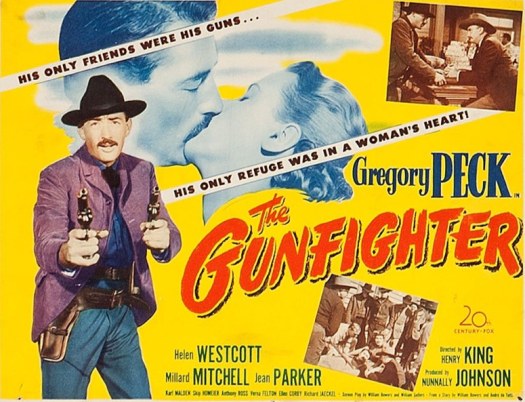
Celebrity Hound: Gregory Peck in THE GUNFIGHTER (20th Century-Fox 1950)


gary loggins's avatarcracked rear viewer

By the late 1940’s, the Western was beginning to grow up. Films like Robert Wise’s BLOOD ON THE MOON (1948), Mark Robson’s ROUGHSHOD (1949), and William Wellman’s YELLOW SKY (9149) incorporated darker, more adult themes than the run-of-the-mill shoot ’em up. Henry King’s THE GUNFIGHTER tackles the still-relevant issues of celebrity culture and the price of fame, personified by Gregory Peck as Jimmy Ringo, a notorious fast gun whose reputation brings him the adulation of the masses but little peace.

Jimmy Ringo is weary of being challenged everywhere he goes by young punks eager to make a name for themselves. When one such punk (played by a young Richard Jaeckel) draws on him at in a saloon, he quickly learns how Jimmy earned his fast-draw rep. Problem is the punk has three brothers who “ain’t gonna care who drew first”. Ringo once again hits the trail, heading for the town…

View original post 487 more words

Lisa Reviews An Oscar Nominee: Atlantic City (dir by Louis Malle)


(With the Oscars scheduled to be awarded on March 4th, I have decided to review at least one Oscar-nominated film a day.  These films could be nominees or they could be winners.  They could be from this year’s Oscars or they could be a previous year’s nominee!  We’ll see how things play out.  Today, I take a look at the 1981 best picture nominee, Atlantic City!)

Welcome to Atlantic City, New Jersey!

It’s a city with a storied past and an uncertain future.  It’s a place where old men on street corners can tell you stories about meeting Bugsy Siegel in the lobby of an old hotel that’s just been demolished.  The decrepit remains of old Atlantic City co-exists next to half-completed luxury casinos and hotels.  It’s a place where business deals are celebrated in the Frank Sinatra Suite and where a woman trying to make a very important phone call might find herself being serenaded by Robert Goulet.

It’s also the home of Lou (Burt Lancaster).  From the minute we first see Lou, it’s obvious that he’s a man past his time.  He walks up and down the worst streets of Atlantic City, dressed in a gray suit and trench coat.  With his white mustache and his coolly professional manner, he looks like he belongs in an old movie and not hanging out in his shabby apartment or drinking in the local bar.  When Lou was younger, he was acquainted with all of the big names: Siegel, Luciano, Costello, Lansky.  Of course, he wasn’t ever much of a mobster.  He used to run numbers.  If pressed, he’ll tell some interesting stories but it’s not difficult to tell that he’s lying.  (At one point, it’s mentioned that Lou’s Mafia nickname was Numbnut.)  Now, Lou is an old man.  Much like a condemned Atlantic City hotel, he’ll soon be due for demolition.  He spends most of his time taking care of Grace (Kate Reid), the widow of a mobster.  When he’s not responding to Grace’s demands, he watches his neighbor, Sally (Susan Sarandon).

Sally is originally from Canada.  She came to America looking for a better life and ended up working as a waitress.  Under the strict tutelage of Joseph (Michel Piccoli), Sally is learning how to be a blackjack dealer.  Someday, she hopes that she’ll be able to move out of her apartment and into a communal house on the beach.  Until then, she works hard every day and then returns to her apartment, little realizing that she’s being watched by Lou.

And then David shows up.

David (played by Canadian character actor Robert Joy) is Sally’s estranged husband.  Sally knows that David can’t be trusted but she reluctantly allows him and his pregnant girlfriend (Hollis McLaren) to stay with her for a few days.  David has stolen a large amount of cocaine from the Philadelphia mob.  David wants to sell it but he quickly discovers that no one in Atlantic City is willing to deal with someone who they don’t know.  Fortunately, for David, he runs into Lou.  Lou, looking for a chance to be a real gangster and also wanting a chance to get closer to Sally, agrees to help David sell the cocaine.  Unfortunately, for David, two hit men from Philadelphia have traced him to Atlantic City and are determined to not only get their cocaine back but to also kill David as well.

It may sound like the set up for a standard crime thriller but Atlantic City is actually a thoughtful meditation on getting older, falling in love, and dealing with the fact that things change.  Lou is a relic of the past, looking for one last chance to make his mark before, like the older buildings on the boardwalk, he’s demolished and forgotten about.  Sally and David are the dreamers, hoping to build a future in America.

Louis Malle directs at a leisurely pace.  Those looking for a hyperkinetic gangster film will be disappointed.  There’s only two acts of violence in Atlantic City and Malle presents both of them in a low-key, matter-of-fact fashion.  Instead, Malle focuses on exploring the lives and dreams of the film’s characters and Burt Lancaster rewards that attention with an absolutely outstanding performance as a dignified man who knows his best days are behind him but who still refuses to give in to defeat.  It’s one of Lancaster’s best performances and he was rewarded with an Oscar nomination for best actor.

Atlantic City was nominated for best picture but lost to Chariots of Fire.

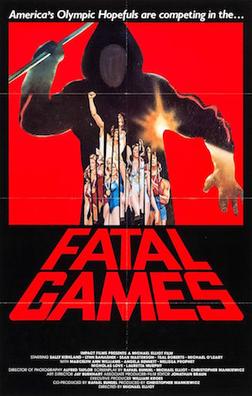
An Olympic Horror Film Review: Fatal Games (dir by Michael Elliot)


Like all good people, I am currently obsessed with the Winter Olympics!  As a result, over the past two weeks, I’ve been watching and reviewing a lot of Olympic-themed films.  Today, I watched the 1984 slasher film, Fatal Games!

If you look at the poster above, you’ll see that Fatal Games was advertised as being a film about “America’s Olympic hopefuls … competing in the Fatal Games!”  That’s kind of true.  The Olympics are frequently mentioned throughout Fatal Games but technically, no one in the movie is actually a member of the Olympic team.  At least not yet.  Instead, they’re all students at a special athletic academy.  Apparently, it’s supposed to be a high school, though we don’t ever see anyone taking a math test or attending English class or anything like that.  Instead, it appears that everyone at the school spends all day practicing gymnastics, swimming, or running.  In fact, it appears that there’s only 20 students at the school and, at most, 5 members of the faculty.  Maybe it’s meant to be like that school that all of the clones attended in Never Let Me Go.  Either that or it’s just an indication that Fatal Games was an extremely low-budget film.

Anyway, seven of the students have just won some sort of regional competition and now they’re getting ready for nationals!  And, if they win at nationals, they’ll get to go to the Olympics.  However, they might not even make it to nationals.  Someone is stalking the blandly likable athletes and using a javelin to pick them off, one-by-one.

Interestingly, it takes people a while to notice that the number of potential Olympians is steadily dwindling.  Instead, people say stuff like, “Hey, have you seen Nancy?”  “Not for a few days.”  “Hey, have you seen Sue Ellen?”  “Didn’t she got to San Francisco to see her boyfriend?”

Well, I guess it’s understandable.  It’s not like anyone in the film is going to school to develop their critical thinking skills.  They’re athletes.  Who cares about all of the people mysteriously disappearing?  They have athletic stuff to worry about!

Fatal Games is pretty much a typical mid-80s slasher.  Interestingly enough, it’s structured like a giallo.  The murderer dresses in black and we get all of the required close-ups of the killer’s gloved hands.  The film introduces several potential suspects but doesn’t reveal the killer’s identity until the final ten minutes.

Is it the overly critical track coach?

Is it the creepy doctor?

Is it the nurse who is worried that the athletes are being injected with too many hormones?  (Obviously, she’s seen Goldengirl.)

Is it the swim coach?

Or is it her girlfriend, the swimmer who didn’t qualify for nationals?

Is it the gymnast whose grades are slipping?

Could it be the other gymnast who is always telling jokes?

Or the runner who has father issues?

Or is it Joe, the token weird guy?

They’re all given a scene or two to establish that they have a potential motive for wanting the seven aspiring Olympians dead.  When the killer and the killer’s motive is finally revealed, it’s so over-the-top and stupid that you can’t help but admire the film for actually going there.  The filmmakers obviously said, “Forget trying to make sense.  WE’RE GOING FOR IT!”

Anyway, the main problem with Fatal Games is that the murderer uses a javelin and, as a result, there’s a lot of scenes of the killer running through narrow school hallways, carrying this goofy-looking javelin.  Don’t get me wrong.  Javelins are sharp and scary and I wouldn’t want one thrown at me.  But still, when someone spends more than five minutes running down a narrow hallway while carrying a javelin, it just looks silly.  Let’s not even think about the logistics of using a javelin to kill someone in broad daylight without anyone else noticing.

That said, as silly and predictable as Fatal Games may have been, there were a few moments of inspired lunacy.  I already mentioned the ending, which is so over-the-top and silly that you can’t help but admire it.  But there’s also a few shots that are genuinely effective.  A scene where the killer suddenly appears in a doorway was handled well.  There’s also an oddly dream-like sequence in which a swimmer practices in the pool, little realizing that the killer is floating underneath her.  How did the killer get in the pool, with the javelin, without anyone noticing?  Who knows?  It’s still an effective scene.

Finally, I have to mention that Fatal Games opens with a song called “Take It All The Way,” which is so generically 80s that it’s oddly brilliant.  It’s almost as good as Graduation Day‘s “The Winner.”

Fatal Games is currently available for viewing on YouTube.

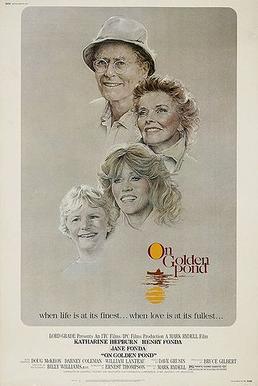
Lisa Reviews An Oscar Nominee: On Golden Pond (dir by Mark Rydell)


(With the Oscars scheduled to be awarded on March 4th, I have decided to review at least one Oscar-nominated film a day.  These films could be nominees or they could be winners.  They could be from this year’s Oscars or they could be a previous year’s nominee!  We’ll see how things play out.  Today, I take a look at the 1981 best picture nominee, On Golden Pond!)

On Golden Pond takes place in a cottage that’s located on a lake called Golden Pond.  Hence, the title.  As far as title’s go, it’s not a bad one.  It’s a film about an elderly couple who spends every summer in that cottage.  They’re in their golden years so I guess it makes sense that they would feel an affinity for Golden Pond.

That said, I think that an even better title for the film would be Everything Annoys Norman.

Norman Thayer, Jr. (Henry Fonda) is a cantankerous old man.  He’s 79 and not particularly looking forward to celebrating his 80th birthday.  He’s a retired college professor.  His wife claims that the last time Norma was really happy was when Franklin Roosevelt was elected president.  Norman likes to fish and still brags about the time he caught a legendary trout named Walter.

What Norman doesn’t like is having to deal with the world.  When he stops to get gas, he loudly complains that, “in his day,” gas only cost eighty-five cents.  When he’s told that there’s another “middle-aged” couple on the lake, he says that, unless he’s going to live to be 150, he’s not middle-aged.  He gets frustrated because his memory isn’t as good as it used to be.  When he goes out for a walk in the woods, he forgets where the path is and he has to return to the house.  Sometimes, he calls people by the wrong name.  At one point, he struggles to use a landline phone.  (I can only imagine how annoyed Norman would be if he was alive today.)  Norman doesn’t like to deal with anyone other than his wife.

Ethel (Katharine Hepburn) is Norman’s wife.  She loves him.  When she hears Norman referred to as being “a son of a bitch,” she replies, “That son of a bitch is my husband.”  Ethel is used to Norman and his ways.  As she puts it, she understands that he’s like a “lion” who has to roar just to remind himself that he still can.  Ethel is … well, basically, she’s Katharine Hepburn.

Ethel has invited their daughter, Chelsea (Jane Fonda), to celebrate Norman’s birthday with them.  Norman and Chelsea have a strained relationship.  It’s implied that Norman was an emotionally distant and overly critical father and that Chelsea has never been able to forgive him.  When she shows up with her new boyfriend, Bill Ray (Dabney Coleman) and his 13 year-old son, Billy Ray (Doug McKeon), Norman barely bothers to acknowledge her.  With Bill and Chelsea planning on vacation in Europe, they ask if Billy can stay at the cottage with Norman and Ethel.  Ethel agrees.  Norman acquiesces.

On Golden Pond is a film that I wanted to like more than I actually did.  After all, the film features two classic actors, Henry Fonda and Katharine Hepburn, appearing in their only film together.  (Both Henry Fonda and Hepburn won Oscars for their work here.)  Henry Fonda gives a good performance as a strong-willed man who is struggling to deal with his own mortality.  As for Hepburn, it’s not a great performance, largely because Ethel is a thinly written role, but she’s Katharine Hepburn so it doesn’t matter.  But almost everything about the film — from the tasteful music to the pretty but not overwhelming cinematography — feels more like something you’d expect to find in a television production instead of a feature film.  On Golden Pond was based on a play and, with almost all of the action set in that cottage, it really doesn’t escape its theatrical origins.  That said, it’s a sweet movie.  The love between Norman and Ethel feels real.  If nothing else, the film gave the great Henry Fonda his only Oscar.

On Golden Pond was nominated for Best Picture but lost to Chariots of Fire.

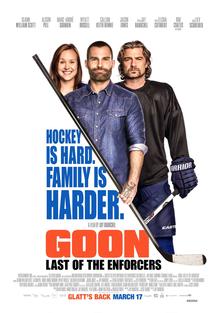
A Winter Game Film Review: Goon: Last of the Enforcers (dir by Jay Baruchel)


Here at the Shattered Lens, Leonard Wilson is our resident hockey expert.  He can tell you all about the in and outs of the game in general and the New York Rangers in specific.

Myself, I know very little about hockey.  Here’s what I do know:

  1. It’s played on the ice and with a puck.
  2. There are a lot of fights.
  3. All of my Canadian friends love it.
  4. It’s a sport that is mentioned many times on Degrassi.
  5. Two hockey players won the 22nd season of The Amazing Race.
  6. Back in 2011, I followed Arleigh’s suggestion and watched a hockey movie called Goon.  Surprisingly, I really, really liked it.

Six years ago, I started my review of Goon by admitting that I didn’t know anything hockey so not much has changed.  However, while I still may not know much about hockey, I am currently obsessed with the Winter Olympics.  And, of course, hockey is a big part of the Winter Games.  Since I’m currently watching movies about winter sports, today seemed like the perfect time to watch 2016’s Goon: The Last of The Enforcers and get caught up on the story of Doug Glatt.

Who is Doug Glatt?  As played by Seann William Scott, Doug Glatt is probably one of the nicest guys that you could ever hope to meet.  He’s not particularly smart.  He’s the type who responds to almost comment with a slightly confused smile.  He tend to take things literally.  But he’s a genuinely sweet guy and it’s impossible not to like him.

Except, of course, when he’s on the ice.  Doug is a semi-pro hockey player, playing for the Halifax Highlanders.  Even his biggest fans will admit that Doug isn’t the best hockey player of all time.  However, no one can throw a punch like he can.  Doug’s an enforcer.  His specialty is beating up the opposing team.  When his coach (Kim Coates) needs to intimidate the other team, he sends Doug out with orders to beat someone up.  Doug has no problem breaking someone’s nose but he usually apologizes afterward.  He’s known as The Thug.

Doug is married to Eva (Allison Pill), who loves hockey but, now that she’s pregnant, she worries about Doug getting seriously injured.  These worries come true when Doug gets into a fight with Anders Cain (Wyatt Russell), a fearsome enforcer on another team.  (Anders just happens to be the son of the owner of the Highlanders.)  Cain not only leaves Doug crumpled up on the ice but he also injures Doug’s right shoulder, making it difficult for Doug to throw a punch with his right hand.  It appears that Doug’s playing days are over.  Doug ends up working in the storage room of an insurance company while the Highlanders continue on without him.  Adding insult to injury, Anders is soon signed by the Highlanders and given Doug’s old position as team captain.

As much as Doug tries to move on, he keeps finding himself drawn back to hockey.  When he runs into a former rival, Ross Rhea (Liev Schreiber), who is now making a living as a glorified gladiator, Doug realizes that he can learn how to fight with his left fist.  But with Eva not wanting him to fight anymore, Doug is forced to decide which team he’s going to play for, the Highlanders or his family?

Especially when compared to the first Goon, Goon: Last of the Enforcers is an extremely busy film.  Beyond Doug trying to adjust to life off the ice, the film also deals with Anders Cain’s relationship with his father, the locker room shenanigans of the Highlanders, Ross Rhea’s attempt to make a comeback, and the antics of obnoxious sports reporter Chad Bailey (T.J. Miller).  That’s a lot for one film to deal with and it’s not surprising that the end result is an uneven mishmash of raunchy comedy and sports-themed melodrama.  Whereas the first Goon worked because it kept things simple and sincere, Goon: Last of the Enforcers is way too complicated for its own good.

That said, as played by Seann William Scott, Doug is just as likable as he was in the first film and Scott and Allison Pill still make for an adorable couple.  In fact, the entire cast does a pretty good job, especially Wyatt Russell and Liev Schreiber.  The film doesn’t really work but, for fans of the first film, it’s still enjoyable enough.  If nothing else, it’s nice to see how things work out for Doug Glatt.

Spy in the House of Love: Alfred Hitchcock’s NOTORIOUS (RKO 1946) — cracked rear viewer


You won’t find a more glamorous pair of spies than Cary Grant and Ingrid Bergman in Alfred Hitchcock’s NOTORIOUS… except maybe in other films that feature Cary Grant as a spy! The Master of Suspense once again goes full speed ahead in bringing this exciting espionage caper to the screen loaded with the usual “Hitchcock Touches”, and […]

via Spy in the House of Love: Alfred Hitchcock’s NOTORIOUS (RKO 1946) — cracked rear viewer

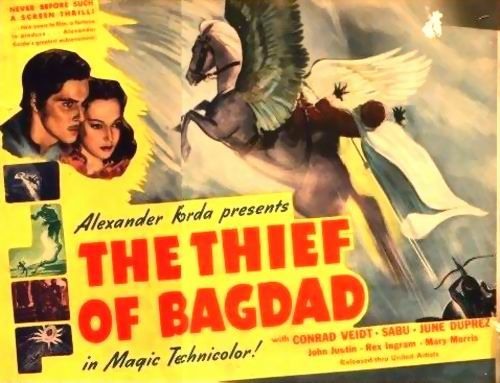
Adventure of a Lifetime: THE THIEF OF BAGDAD (United Artists 1940) — cracked rear viewer


Alexander Korda’s Arabian Nights fantasy THE THIEF OF BAGDAD has stood the test of time as one of filmdom’s most beloved classics. A remake of Douglas Fairbanks Sr.’s 1924 silent classic, Korda and company added some elements of their own, including Indian teen star Sabu as the title character, and some innovative Special Effects. In […]

via Adventure of a Lifetime: THE THIEF OF BAGDAD (United Artists 1940) — cracked rear viewer

“Black Panther” : Hail To The King


Let’s be honest — as was the case with last year’s Wonder Woman (in fact probably to an even greater degree), Black Panther was a cultural phenomenon before it was even released, and in future it will be examined as such. As something more than a movie. As something that resonated within, and reverberated throughout, the zeitgeist. Its trajectory in that regard is largely unwritten to this point, but can be predicted with a fair amount of certainty : near-universal praise will come first, followed by the inevitable backlash, followed by an almost apologetic, “ya know, maybe we were too hard on this thing that we loved at first” sort of acceptance. If we could just skip all that, and take it as a given, it would save us all a lot of time and effort — but it’s on the way, so tune in or out of all that as you see fit. My concerns here are considerably more prosaic : to talk about the movie as what it began “life” as, to wit — “just” a movie.

For what it’s worth (which may not be much), I’m tempted to agree, to an extent, with those who are pointing out that simply seeing this flick is in no way an act of “resistance” in and of itself : after all, if the fact that the first thing that runs in theaters before the film starts is a commercial for Lexus cars featuring Chadwick Boseman in full Panther gear isn’t enough to clue you in to the reality that, at the end of the day, this is much more about profits than it is about politics, then the product placement within the film itself should do the job — and at the end of the day, one of the largest corporations in the world, founded by noted racist Walt Disney, is still the one making all the money off it. If, then, shelling out ten or fifteen bucks to watch Black Panther is an inherently defiant or dissident act (and I’m not saying it is), then it’s a highly commodified and co-opted one.

All that being said, when a film is released out into the world, particularly a film with as much fanfare attached to it as this one, there are gonna be ripples that emanate out from it — and among the millions of kids, in particular, who watch this flick, the seeds of an interest in African culture are sure to be sown, and the more they follow the metaphorical stalks that grow and flower from those seeds, the more they’ll discover things like historical resistance to colonialism, exploitation, capitalism, and the like. So while Black Panther may not be a radical (or even a particularly political) work in and of itself, it may inspire some radicalism in the future — one can only hope, at any rate.

But that’s pure speculation at this point, so let’s talk about what we know for certain.

One thing anyone who follows this site, or my work anywhere else, absolutely knows is that I’m no fan of Marvel Studios product in general. Unlike, apparently, most people, I find the overwhelming majority of Marvel flicks to be hopelessly redundant, formulaic, lowest-common denominator fare directed in a flat and lifeless “house style” with no particular visual flair, no particularly standout performances, no particular vision to do anything but get audiences keyed up for the next one. They exist as a self-perpetuating celluloid organism, one with no distinct personality but a lot of business sense and promotional muscle. This has been going on for so long, and with so much box office success, that I went into flick essentially expecting more of the same — sure, I knew it had a predominantly-black cast, and was set in Africa (albeit in a fictitious country), but that doesn’t mean that director Ryan Coogler was going to break the mold in any appreciable way. Hell, it doesn’t even mean that he would be allowed to do so. Happily, my pessimism was turned on its ear almost from word the word “go” here.

Black Panther looks different, feels different, because it is different. Coogler and co-screenwriter Joe Robert Cole certainly capture the dynamism, the energy, the Afro-futurism that has been a part of King T’Challa’s backstory since Jack Kirby created the character and his world (nope, we don’t lay any credit at Stan Lee’s feet around these parts, but I’m not getting into the “whys and wherefores” of that right now because, shit, I don’t have all night), but advance it all considerably, absorbing the extra layers added onto the mythos by the likes of Don McGrregor, Billy Graham, Christopher Priest, Reginald Hudlin, and Ta-Nehisi Coates over the years, and coming out with something uniquely suited to cinema and very much of the “now.” There’s a hard-driving and kinetic sense of energy to this film that the so-called “MCU” has been missing since it inception, and if you’re among the small number of those who agree with my assessment that most of these flicks play out more like two-hour TV episodes than proper movies, you can relax : this is as bold, brash, and big as it gets. This is blockbuster fare not only in name, but in execution, with visual effects that amaze, sets that inspire awe, cinematography that commands attention, action that sizzles, a script that charges forward, and music that slicks that trajectory along. This is arresting cinema that doesn’t even give you the option to leave your seat.

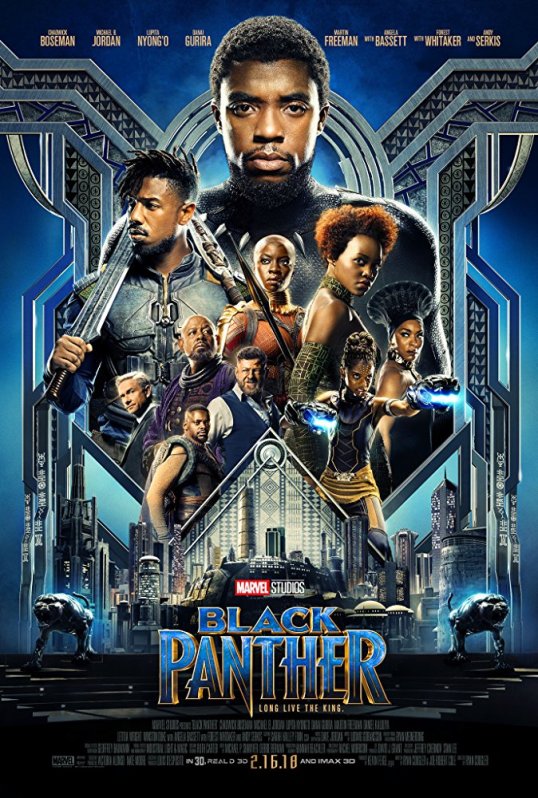
But what of the acting, you ask? It ranges from good to great, and thankfully the great includes the key players : Chadwick Boseman is regal yet human, fallible, relatable in the film’s central role: Forest Whitaker embodies aged wisdom tinged with regret as high priest Zuri; Michael B. Jordan is the first truly formidable villain, crucially one with a compelling backstory and some entirely valid philosophical viewpoints, as Killmonger; Martin Freeman not only reprises, but considerably expands, his already-extant “MCU” role of CIA agent Everett K. Ross with heart, humor, and brains; Sterling K. Brown makes the most of limited but significant screen time as T’Challa’s late uncle, N’Jobu; Andy Serkis — as a human this time! — chews up the screen with dangerous charm as Ulysses Klaue (or “Klaw,” as the comics would have it). These guys are all tops, really. And yet —

It is the women that carry this film. Whether we’re talking about Lupita Nyong’o as T’Challa’s love interest Nakia, a determined, fiercely independent, and soulful force that isn’t just her partner’s “equal,” but his conscience; Danai Gurira as General Okoye, head warrioress of the Dora Milaje, who embodies martial discipline and loyalty with the controlled fury of a hurricane ready to strike at any moment; Angela Basset as Queen Mother Ramonda, a living embodiment of grace, stature, and tradition; or Letitia Wright as younger sister Shuri, part “Q” to T’Challa’s “Bond,” part grounding and humanizing influence, part Moon Girl-style intellectual prodigy — as in life, it is the women that both make this movie’s men what they are, while also being complete and fully-realized in and of themselves. African history is far less patriarchal than is commonly believed, and in Wakanda that proud matriarchal lineage is exemplified, modernized, magnified — and honored.

Most films reflect the moment. Others define the moment. Black Panther goes one further by creating the moment. It’s as near to flawless as big-budget blockbusters get and eschews the too-common-flaw that movies made on this scale have of dumbing things down to appeal to the masses. Coogler and company instead trust those same masses to be intelligent enough to meet them on their level, and to respond to being talked “up,” rather than “down,” to. By believing that the world was not just ready, but eager, for something that goes far beyond mere spectacle — something that challenges the intellect while speaking to the heart — they have woken what could very well be a sleeping giant.

Now, let’s just keep our fingers crossed they’ve spurred that giant to do something more than simply go out and buy luxury cars.