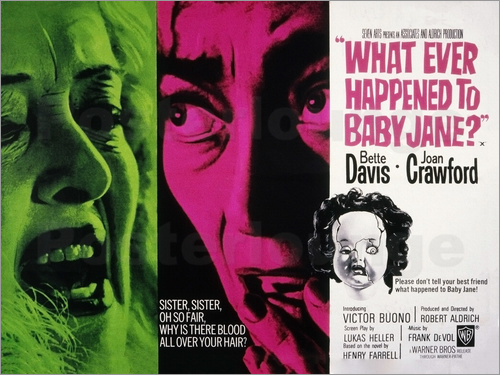
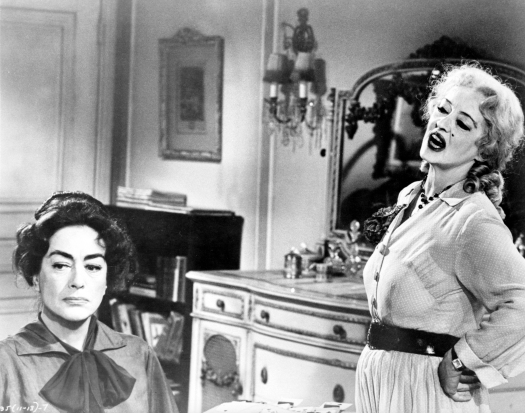
Joan Crawford and Bette Davis had been Hollywood stars forever by the time they filmed WHATEVER HAPPENED TO BABY JANE?. Davis was now 54 years old, Crawford 58, and both stars were definitely on the wane when they teamed for this bizarre Robert Aldrich movie, the first (and arguably best) of what has become know as the “Grand Dame Guignol” (or “psycho-biddy”) genre.
Bette is Baby Jane Hudson, a washed-up former vaudeville child star with a fondness for booze, while Joan plays her sister Blanche, a movie star of the 30’s permanently paralyzed in a car accident allegedly caused by Jane. The two live together in a run-down old house, both virtual prisoners trapped in time and their own minds. Blanche wants to sell the old homestead and send Jane away for treatment, but Jane, jealous of her sister’s new-found popularity via her televised old films, descends further into alcoholism…
Released in December of 2016, Live By Night was one of those highly anticipated films that ended up bombing at the box office and leaving critics cold. The anticipation was due to the fact that Live By Night was the first film that Ben Affleck had directed since Argo won best picture. It was seen as Affleck’s next prestige picture, the one that would remind everyone that he was more than just the latest actor to be cast as Batman. Live By Night was expected to be a huge Oscar contender. As for why it bombed at the box office, that may have had something to do with the fact that Live By Night is not a very good film.
It’s a gangster film, one that takes place during prohibition. Joe Coughlin (Ben Affleck) is the most boring gangster in Boston. Or, at least, he is until he falls for the wrong woman and he ends up having to flee down to Tampa. Once down there, Joe sets himself up as the most boring gangster in Florida. There’s all sorts of themes running through Live By Night — racial themes, economic themes, even some heavy-handed religious themes — but ultimately, the main impression that one gets from the film’s story is that Joe Coughlin was a very boring gangster.
Anyway, Joe gets involved in all sorts of corruption and violence. He brings down his friend, Dion (Chris Messina), to help him out. Whereas Joe is rational and dull, Dion is violent and dull. You spend the entire movie waiting for the moment when Dion will turn on Joe but it never happens. I guess that’s a good thing since Joe and Dion are busy battling the Klan. Joe may be a 1920s gangster but he’s got the political and cultural outlook of a 21st century movie star.
Joe knows that prohibition is going to end someday, so he hopes to make money through opening up a casino. Standing in the way of the casino is a prostitute-turned-evangelist named Loretta (Elle Fanning). Loretta is the daughter of the local police chief (Chris Cooper), with whom Joe has an uneasy friendship. You keep expecting this plot to go somewhere but it really doesn’t. Loretta’s just kinda there. That said, we do get a hilarious shot of a tearful Chris Cooper repeating the word repent over and over again so there is that.
Zoe Saldana is also just kind of there, playing Joe’s Cuban wife. Again, you expect a lot to happen with Saldana’s character but, for the most part, she’s mostly just a plot device who exists solely so that Joe can have some sort of motivation beyond simply wanting to get rich.
It’s a big, sprawling film that never quite feels like an epic. A huge part of the problem is that Ben Affleck the director is let down by Ben Affleck the actor. Regardless of what’s happening in the scene, Affleck always has the same grim look on his face. At times, it seems as if he’s literally been chiseled out of a marble and you find yourself wondering if he’s actually capable of any facial expression beyond glum annoyance. A gangster film like this need a bigger-than-life protagonist but, as played by Affleck, Joe always seems to be in danger of vanishing into the scenery.
I think part of the problem is that Affleck’s previous films all dealt with places and subjects that Affleck felt comfortable with, perhaps because he could relate their stories to his own personal experiences. Gone, Baby, Gone and The Townboth took place exclusively in Boston. Argo dealt with the film industry. Live By Night is a period piece set in the South and Affleck is obviously lost from the minute Joe arrives in Florida.
Live By Night, I think, could have been a good movie if it had been directed by someone like Paul Thomas Anderson and maybe if an actor like Colin Farrell played the role of Joe. But, as it is, it’s just a rather stolid and uninspiring gangster film.
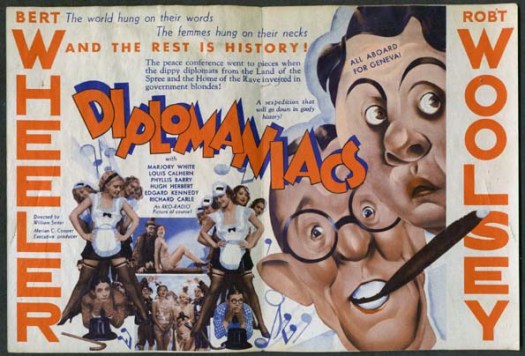
Political satire in film ran rampant during the Pre-Code Era. Somewhere between W.C. Fields’s MILLION DOLLAR LEGS and the Marx Brothers’ DUCK SOUP sits DIPLOMANIACS, Wheeler & Woolsey’s madcap take on war and peace, 1930’s style. It’s purely preposterous, unadulterated farce, and is guaranteed to offend someone, if not everyone.
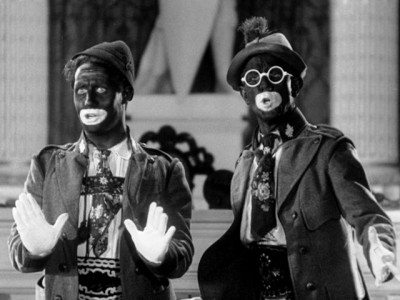
Let’s get it out of the way right now: DIPLOMANIACS is not politically correct in any way, shape, or form. It’s loaded with racist stereotypes, casting Hugh Herbert as a not-so-wise Chinaman (“It is written that it is written that it is written that it is written”), lambastes Jews, Native Americans, and homosexuals, and portrays women as sex objects (spy Marjorie White is delivered in plastic wrap). A bomb tossed into the peace talks causes everyone to turn blackface, leading to a prolonged minstrel number! If you’re already offended, stop reading… but if you can take the heat, by all…
Okay, so here’s the deal. I know that this 1984 film has a strong cult following. A few months ago, I was at the Alamo Drafthouse when they played the trailer and announced a one-night showing and the people sitting in front of me got so excited that it was kind of creepy. I mean, I understand that there are people who absolutely love Streets of Fire but I just watched it and it didn’t really do much for me.
Now, that may not sound like a big deal because, obviously, not everyone is going to love the same movies as everyone else. I love Black Swan but I have friends who absolutely hate it. Arleigh and I still argue about Avatar. Leonard and I still yell at each other about Aaron Sorkin. Erin makes fun of me for watching The Bachelorette. Jedadiah Leland doesn’t share my appreciation for Big Brother and the Trashfilm Guru and I may agree about Twin Peaks but we don’t necessarily agree about whether or not socialism is a good idea. And that’s okay. There’s nothing wrong with healthy and respectful disagreement!
But the thing is — Streets of Fire seems like the sort of film that I should love.
It’s a musical. I love musicals!
It’s highly stylized! I love stylish movies!
It’s from the 80s! I love the 80s films! (Well, most 80s films… if the opening credits are in pink neon, chances are I’ll end up liking the film…)
It takes place in a city where it never seems to stop raining. Even though the neon-decorated sets give the location a futuristic feel, everyone in the city seems to have escaped from the 50s. It’s the type of city where people drive vintage cars and you can tell that one guy is supposed to be a badass because he owns a convertible. All of the bad guys ride motorcycles, wear leather jackets, and look like they should be appearing in a community theater production of Grease.
Singer Ellen Aim (Diane Lane) has been kidnapped by the Bombers, a biker gang led by Raven (Willem DaFoe). Ellen’s manager and lover, Billy Fish (Rick Moranis), hires Tom Cody (Michael Pare) to rescue Ellen. Little does Billy know that Cody and Ellen used to be lovers. Cody is apparently a legendary figure in the city. As soon as he drives into town, people starting talking about how “he’s back.” The police see Cody and automatically tell him not to start any trouble. Raven says that he’s not scared of Cody and everyone rolls their eyes!
It’s up to Cody to track Ellen down and rescue her from Raven and … well, that’s pretty much what he does. I think that was part of the problem. After all of the build-up, it’s all a bit anti-climatic. It doesn’t take much effort for Cody to find Ellen. After Cody escapes with Ellen, it doesn’t take Raven much effort to track down Cody. It all leads to a fist fight but who cares? As a viewer, you spend the entire film waiting for some sort of big scene or exciting action sequence and it never arrives. The film was so busy being stylish that it forgot to actually come up with a compelling story.
I think it also would have helped if Tom Cody had been played by an actor who had a bit more charisma than Michael Pare. Pare is too young and too stiff for the role. It doesn’t help to have everyone talking about what a badass Tom Cody is when the actor playing him doesn’t seem to be quite sure what the movie’s about. Also miscast is Diane Lane, who tries to be headstrong but just comes across as being petulant. When Cody and Ellen get together, they all the chemistry of laundry drying on a clothesline.
On the positive side, Willem DaFoe is believably dangerous as Raven and Amy Madigan gets to play an ass-kicking mercenary named McCoy. In fact, if McCoy had been the main character, Streets of Fire probably would have been a lot more interesting.
I guess Streets of Fire is just going to have to be one of those cult films that I just don’t get.
I recorded this 1961 Italian film off of TCM on June 14th!
From 280 BC to 226 BC, a 108 feet high statue of the sun-god Helios stood in the Greek city of Rhodes. It was reportedly built to celebrate a major military victory and it overlooked the harbor, serving to both welcome friends and intimidate enemies. No one’s quite sure what it actually looked like but we do know that it was considered, by its contemporaries, to be one of the Seven Wonders of the World. No trip to Greece was complete without a stopover in Rhodes so that the curious could feast their eyes upon the Colossus. Eventually, the statue was destroyed in an earthquake and it was never rebuilt.
The statue serves as the centerpiece for the aptly named 1961 film, The Colossus of Rhodes. The film opens with its dedication and ends with the earthquake that toppled it. (Of course, in the film, the earthquake occurs just a week or two after the dedication.) The film imagines that the Colossus was not just a monument to a God. No, instead, this film suggests that the Colossus was an elaborate torture chamber, one that could pour fire down on anyone trying to sail underneath it. Inside the Colossus is an elaborate labyrinth of dungeons, where anyone who has displeased the king is punished.
And, indeed, quite a few people have displeased the king. King Serse (Roberto Camardiel), it turns out, is a mad tyrant who spends all of his days eating grapes and having people executed in the coliseum. (He’s like Nero but without the artistic temperament.) Not only do the rebels want him dead but so does his evil second-in-command, Thar (Conrado San Martin). With the people angry that they’ve been forced to build a giant statue for no reason other than their king’s vanity, it seems like a perfect time for a revolution!
Caught in the middle of it all is Darios (Rory Calhoun). Darios is from Athens and the only reason he came to Rhodes was to visit his uncle and see the statue. At first, Darios is more interested in trying to get laid than the revolution. When that doesn’t quite work out, Darios tries to leave the island, just to discover that, thanks to the Colossus, escape is impossible. When Darios is accused of being a supporter of the revolution, he has no choice but to take up arms against Serse, which is exactly what Thar wants him to do…
The plot’s is more than a little convoluted and Darios is never the most sympathetic of heroes but The Colossus of Rhodes is still an enjoyable example of the peplum genre. Though the acting is frequently stiff, the film is visually impressive, with both the Colossus and ancient Rhodes brought to wonderfully decadent life. The idea that the Colossus was actually just an elaborate torture chamber is handled well and the frequent battle scenes are well-choreographed. (I was particularly impressed with a scene of Darios fighting off an army while also trying to maintain his balance on the Colossus’s arm.) And, of course, the climatic earthquake is as grandly operatic as you would hope. Say what you will about the Italian film industry, it always delivered what audiences wanted.
That said, the main reason that The Colossus of Rhodes is known today is because it was the Sergio Leone’s first directorial credit. (It was, however, the second film that he actually directed. Though uncredited, he previously replaced Mario Bonnard as the director of 1959’s The Last Days of Pompeii.) While The Colossus of Rhodes was obviously very different from the spaghetti westerns for which Leone is best known, there are some thematic similarities between the film and Leone’s future work:
For instance, much like Clint Eastwood in the Dollars Trilogy, Charles Bronson in Once Upon A Time In The West, and the gangsters in Once Upon A Time In America, Darios starts out as an amoral hero. When Darios does join the revolution, it’s reminiscent of James Coburn aiding Rod Steiger in Duck, You Sucker.
The corrupt and greedy Serse has much in common with the crooked land barons and businessmen who lurked behind-the-scenes in Once Upon A Time In The West.
Even the torture chamber in the Colossus brought to mind the grisly torments that both Clint Eastwood and Eli Wallach had to endure in The Good, The Bad, and The Ugly.
(Unfortunately, unlike other Leone films, Ennio Morricone did not provide the score for The Colossus of Rhodes. Instead, Angelo Francesco Lavagnino provided a rather standard “epic” orchestration.)
The Colossus of Rhodes may not be a great film but, as an early work of a great filmmaker, it’s definitely worth watching.
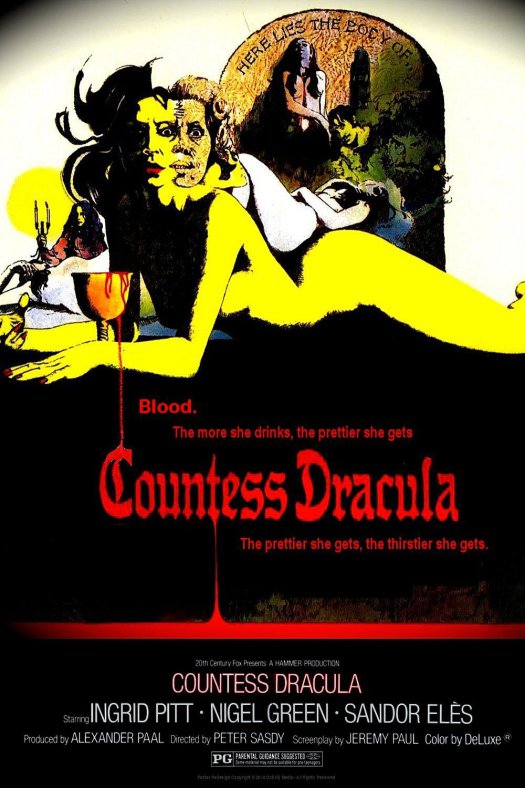
Iconic Ingrid Pitt became a horror fan favorite for her vampire roles in the early 1970’s. The Polish-born actress, who survived the horrors of a Nazi concentration camp as a child during WWII, played bloodsucking lesbian Carmilla in Hammer’s THE VAMPIRE LOVERS, based on the classic story by J. Sheridan LeFanu, and was a participant in the Amicus anthology THE HOUSE THAT DRIPPED BLOOD opposite Jon Pertwee in that film’s best segment. Finally, Ingrid sunk her teeth into the title role of COUNTESS DRACULA, a juicy part where she’s not really a vampire, but a noblewoman who gets off on bathing in blood, loosely based on the real life events of Hungarian Countess Elizabeth Bathory.
Portrait of the real Elizabeth Bathory
Bathory (1560-1614) was the most infamous female serial killer in history, officially found guilty of 80 murders, yet a diary allegedly found puts the count as high as 650!…
The 2017 film, My Friend Dahmer, opens in a suburban high school in the 1970s. It’s a school like any other, with the usual collection of jocks, nerds, geeks, and outcasts. Jeff (Ross Lynch) is the token weird kid. Every school has one. He’s obviously intelligent but there’s something off about him. He shuffles around the school with his eyes down. When he speaks, he rarely shows any emotion, leaving you to wonder if he’s just shy or if he’s lost in a world of his own. There are rumors, of course, about all the strange things that Jeff has done. Some people say that they’ve seen him collecting dead animals. Jeff has told people that he has a shack where he uses acid to dissolve carcasses. Jeff frequently comes to school drunk, reeking of alcohol. And then there’s his parents! His father (Dallas Roberts) tries to be strict but usually just comes across as befuddled. Meanwhile, his mother (Anne Heche) alternates between doting on her oldest son and making paranoid accusations.
His father demands that Jeffrey make some friends. That’s why Jeff ends up in such unlikely places as both the school band and the school’s tennis team. Still feeling out-of-place, Jeff starts to act out in school. Walking through the hallway, he’ll suddenly start shouting and twitching. Jeff becomes known as the kid who will do anything. One his classmates, an artist named John “Derf” Backderf (Alex Wolff), even starts to draw pictures based on Jeffrey’s antics. Derf and his friends describe themselves as being Jeffrey’s fan club. For the rest of the school year, they encourage Jeff to act stranger and stranger. It would be incorrect to say that Derf and Jeff are really friends. In fact, towards the end of the school year, Derf starts to realize that he’s basically been exploiting Jeff for his own amusement. And yet, Derf and his friends provide perhaps the closest thing to “normal” human interaction that Jeff will ever experience.
As you’ve probably already guessed from the film’s title, Jeff is Jeffrey Dahmer, the infamous Milwaukee-based serial killer and cannibal who is estimated to have killed 17 young men before he was arrested in 1991. (In 1994, Dahmer was murdered in prison by an inmate who claimed to have been motivated by Dahmer’s lack of remorse.) Dahmer committed his first murder when he was 18, a fact alluded to towards the end of the film when we see Dahmer picking up a hitchhiker. (Disturbingly, the only time in the film in which Dahmer smiles and sounds like a “normal” person is when he’s trying to convince that hitchhiker to get in his car.) With the exception of that one scene, My Friend Dahmer deals with the year before Dahmer started his killing spree, when Dahmer was just the token weird kid.
The fact that we know what Jeffrey Dahmer is ultimately going to becomes add an ominous subtext to every scene in the film. Throughout, there are signs that something is wrong with Dahmer and yet neither his classmates nor his teachers ever seem to take those signs seriously. When Dahmer brutally cuts open a fish because he wants to see what’s inside of it, his friends are disgusted but they assume that’s just Dahmer being weird again. When he shows up drunk for class and his grades start to go downhill, his teachers just ignore him. No matter what he says (and he does say some truly disturbing things), everyone just shrugs it off. Their attitude is that Jeff’s the weird kid so, of course, he’s going to say weird things.
To its credit, My Friend Dahmer resists the temptation to sensationalize or make excuses for the monster that Jeffrey Dahmer became. Ross Lynch plays Dahmer as a hulking, inarticulate time bomb. It’s not so much that Dahmer can’t control his dark thoughts as he really has no desire to do so. The film contrasts Dahmer’s darkness with the light-hearted and, quite frankly, dorky guys who briefly became his clique. (Again, despite the film’s title, it would probably be a bit of a stretch to say that Dahmer had any real friends.) One practical joke, in which Derf sneaks Dahmer into every club’s yearbook picture, is so likable in its dorkiness that you almost forget that Derf’s scheme centers around a guy who will grow up to murder 17 people. In the end, both Dahmer’s crimes and his fate feels as inevitable as the fact that Derf will ultimately write and draw graphic novel about their relationship.
By any stretch of the imagination, it’s not a happy or pleasant film. I watched the film last night and I doubt I’ll ever watch it again. And yet, it’s an effective film, one that left me wondering what happened to some of the “weird kids” that I went to school with. Do we ever really know what’s going on inside someone’s head? Ross Lynch turns Dahmer into a disturbingly familiar monster while Alex Wolff is sympathetic in the role of Derf. Anne Heche goes a bit overboard as Dahmer’s unstable mother but Dallas Roberts has a few good scenes as the father who can only watch helplessly as his son grows more and more disturbed. The film is a disturbing trip into the heart of darkness, one that will haunt you after it ends.
Frank Zappa is definitely an acquired taste, one I acquired as a young kid listening to albums like “Absolutely Free”, “Weasels Ripped My Flesh”, and “Apostrophe”, which goes a long way in helping to explain my warped world view. Zappa’s avant garde rock’n’roll, a mélange of jazz, classical, doo-wop, psychedelica, and anything else he could think of, combined with his nonsensical, sexual, and scatological lyrics, skewered convention, the plastic world of suburban America, and hippie culture as well (Zappa was an equal opportunity offender). 200 MOTELS was his first attempt at making a movie, co-directing and co-writing with British documentarian Tony Palmer, and to call it bizarre would be a gross understatement.
Visually, the film is as close to Zappa’s avant garde compositions as you can get. 200 MOTELS was shot on videotape and transferred to 35mm film, using techniques like double and triple exposure, color filters, flash-cut editing, and…
Red Sparrow is a spy thriller that features a lot of spies but not many thrills. Jennifer Lawrence plays Dominika Ergova, a Russian ballerina whose career with the Bolshoi is ended when another dancer drops her on stage. Fortunately, Dominka’s sleazy uncle Ivan (Matthias Schoenaerts) has a new career in mind! Maybe Dominka could be a sparrow, a spy who seduces the enemy! Just in case Dominka doesn’t want to spend the rest of her life seducing westerners, Ivan arranges for her to witness a murder and then informs her that she’ll be eliminated as a witness unless she does what he tells her. This, of course, leads to Dominkia attending State School 4, where she is schooled in the arts of seduction by Matron (Charlotte Rampling). Upon graduation, Dominka is sent to Budapest, where she falls in love with a CIA agent named Nash (Joel Edgerton) and a lot of predictable spy stuff happens. Despite all of the sex and violence, it’s just not much fun.
Red Sparrow has all the ingredients to be an enjoyably trashy 90-minute spy flick but instead, it’s a slowly paced, 140-minute slog that just seems to go on forever. Throughout the film, director Francis Lawrence (no relation to the film’s star) struggles to maintain a steady pace. Too much time is spent on Dominka’s life before she suffers the injury that should have opened the film. Meanwhile, the only interesting part of the film — Dominka’s education at State School 4 — goes by far too quickly and, despite the fact that she was giving one of the few interesting performances in Red Sparrow, Charlotte Rampling vanishes from the film early on. Once Dominkia gets to Budapest, the film really slow down to a crawl. Joel Edgerton’s a good actor and an even better director but he gives an overly grim and serious performance in Red Sparrow and he and Jennifer Lawrence have next to no romantic chemistry.
(That lack of romantic chemistry petty much dooms the final forty minutes of the film. It’s easy to imagine a much better version of Red Sparrow in which Bradley Cooper played the role of Nash. True, that would have been like the 100th time that Cooper and Jennifer Lawrence starred opposite each other but why not? It worked for William Powell and Myrna Loy.)
As for Jennifer Lawrence, her performance is okay. It’s not one of her best and there’s a few moments where it seems as if she’s more concerned with maintaining her Russian accent than with what’s actually going on in the scene but, for the most part, it’s a good enough performance. That said, you do have to wonder how long she can go without having another hit film. Despite being heavily hyped, Passengers, Mother!, and Red Sparrow all underperformed at the box office. (In defense of Mother!, it was never going to be a box office hit, regardless of who starred in it.) As talented as she is, it’s sometimes hard not to feel that, as an actress, Jennifer Lawrence has lost some of the natural spark that took viewers by surprise in Winter’s Bone, launched a whole new genre of dystopian YA adaptations with The Hunger Games, and which previously elevated unlikely films like The House At The End Of The Street. She was a far more interesting actress before she became J Law.
Here’s hoping that she finally gets another role worthy of her talent!
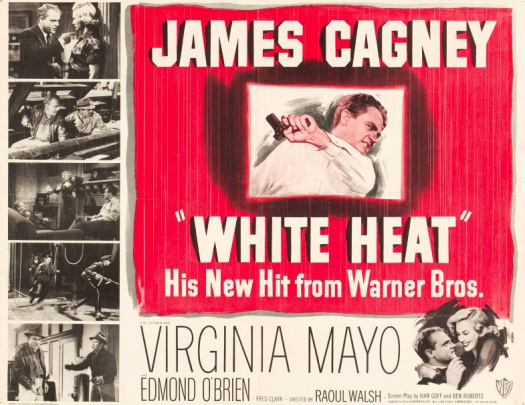
When James Cagney burst onto the screen in THE PUBLIC ENEMY, a star was born. Cagney’s machine gun delivery of dialog, commanding screen presence, and take-no-shit attitude made him wildly popular among the Depression Era masses, if not with studio boss Jack Warner, with whom Cagney frequently battled over salary and scripts that weren’t up to par. Films like LADY KILLER , THE MAYOR OF HELL , and ANGELS WITH DIRTY FACES made Cagney the quintessential movie gangster, but after 1939’s THE ROARING TWENTIES he hung up his spats and concentrated on changing his image. Ten years later, Cagney returned to the gangster film in WHITE HEAT, turning in one of his most memorable performances as the psychotic Cody Jarrett.
Cagney is older and meaner than ever as Jarrett, a remorseless mad-dog killer with a severe mother complex and more than a touch of insanity. Jarrett has frequent debilitating headaches…









 Through the Shattered Lens