Italian Horror Spotlight: Hatchet for the Honeymoon (dir by Mario Bava)


“My name is John Harrington. I’m 30 years old. I am a paranoiac.”

So declares John Harrington (Stephen Forsyth) at the start of the 1969’s Hatchet for The Honeymoon.  Along with being a paranoiac, John Harrington is also handsome, charming, and apparently quite successful.  He owns a bridal dress factory in France, a business that he inherited from his mother after her untimely death.  On the outside, everything looks perfect but appearances can often be deceiving.

John’s wife, Mildred (Laura Betti), knows that John is hiding secrets.  She regularly taunts John, reminding him that he’s not only impotent but that he’s also has an unhealthy obsession with his memories of his mother.  John’s mother died when he was very young.  He witnessed her death but he’s repressed the memory of who actually killed her.  John is determined to recover those memories.

So, what does John do?

Does he go to a hypnotist?  Does he dig through old police files and search for clues?  Does he ask someone to analyze his dreams?  That’s what you or I might do but John, you must remember, is a paranoiac.  Somehow, John has realized that, whenever he commits a murder, he remembers just a little bit more about the night his mother died.  So, in order to learn the truth about his mother’s death, John is murdering the models who work at his bridal salon.  Apparently, it’s very important that his victims be wearing a wedding dress when they die….

Okay, now you’re probably already thinking that this sounds like a somewhat bizarre movie.  Well, believe it or not, things are about to get a lot stranger.

After John meets a new model named Helen (Dagmar Lassander), he decided that he doesn’t need Mildred yelling at him anymore.  So, he puts on a wedding veil and murders Mildred.  However, even in death, Mildred won’t leave John alone.  Mildred’s ghost shows up and announces that everyone will be able to see her but John.

So now, John is having to deal with everyone assuming that his wife is with him, even though he can’t see her.  As you might guess, this makes it a bit difficult for John to convince potential victims to come back to the salon with him.

And, from there, it just keeps getting stranger and stranger….

Hatchet For The Honeymoon was written and directed by one of the most important figures in the history of Italian cinema, Mario Bava.  A master technician with a wry and occasionally self-mocking sense of humor, Bava worked in every genre, from peplums to spaghetti westerns to poliziotteschis, but he’s best remembered for his work in the horror genre.  Bava is often credited with having directed the first giallo film and his often-violent thrillers are still influential to this day.

Hatchet For The Honeymoon is often described as being one of Bava’s lesser films but I don’t agree with that judgment.  If nothing else, Hatchet For The Honeymoon is probably one of Bava’s more playful movies.  From the increasingly bizarre twists and turns of the film’s plot to John Harrington’s wonderfully overwrought narration, the entire film has an almost improvisational feel to it.  One gets the feeling that Bava is poking fun at the conventions of the giallo genre.  The usual omnipresent, black glove-wearing killer has been replaced by an impotent wedding dress designer who can’t even escape the ghost of his dead wife.

(Reportedly, Mildred wasn’t originally in the script and was only added because Bava wanted to work with actress Laura Betti.  Perhaps that explains why Mildred often seems to be standing outside of the story, mocking not only John but also the mechanics of the thriller plot.)

As one would expect from a Bava film, Hatchet for the Honeymoon is frequently a visual marvel, a pop art-inspired mix of dark shadows and red blood.  The wedding dresses are to die for and so is the cinematography.  I especially liked the darkly ominous shots of John surrounded by the lifeless mannequins in his salon.  Early on, when we get a shot from John’s point of view, the image is slightly blurred and the angle seem just a bit off, a reminder of John’s twisted impression of the world around him.  When John walks up stairs to the kill his wife, the sound of his movement seems to echo through his ornate but sterile home.

If Stephen Forsyth sometimes seems to be a bit stiff in the role of John, it’s an appropriate reminder that John is an empty shell and all of his feelings and emotions are manufactured.  Laura Betti does a wonderful job nagging him in life and her palpable joy about getting revenge in death is one of the best things about the movie.

Hatchet For The Honeymoon is an exuberantly weird film and definitely one that needs to be seen by anyone seeking to fall in love with Italian horror.

Horror Film Review: Mom and Dad (dir by Brian Taylor)


Mom and Dad, which was released earlier this year, is the story of many things.

It’s a story of the suburbs, the perfect place to buy a home and raise your family.  Nice lawns, big houses, friendly people, and plenty of buried resentment.  It’s a place that can either represent a new beginning or the death of all of your childhood dreams.  It all depends on how you look at it.  Mom and Dad opens with a suburban mom leaving her newborn in a car that has been strategically parked on the railroad tracks.

Mom and Dad is also the story of a family.  The Ryans may seem like they have it all but one only needs to look at their morning routine to see that things aren’t as perfect as they may appear.  Teenager daughter Carly (Anne Winters) is dating a guy who she knows her parents dislike.  Her younger brother, Josh (Zackary Arthur), is something of a brat.  Carly’s father, Brent (Nicolas Cage), is stuck in a monotonous job while her mother, Kendall (Selma Blair), had to give up her career to raise two children who don’t seem to appreciate her at all.  On top of all that, the grandparents (one of whom is Lance Henriksen) are coming over later for dinner.  The Ryans are a family who spend more time looking at their phones that actually talking to each other.

Mom and Dad is also the story of static.  It’s not just the metaphorical static that makes it difficult for the Carly to understand her parents.  It’s also a very real static, a hissing and popping noise that suddenly comes over radios, pa systems, and televisions and which, for reasons that are never really made clear, fills parents with rage.  When a parent hear the static, they suddenly become obsessed with killing their children.  Kendall’s sister attempts to smother her newborn while a group of new fathers gather in the hospital, shaking with rage as they stare at their babies.  Elsewhere, parents gather outside the high school, waiting for their kids to get out of school so that they can kill them.

As for Carly and Josh, they find themselves locked in their basement while, outside, Brent and Kendall plot their demise.  What makes all of this particularly disturbing (and, at times, darkly humorous) is that it’s not like the parents turn into glass-eyed zombies.  Instead, their personalities remain largely the same, except for the fact that they’re now obsessed with killing their children.  When Brent and Kendall discuss wanting to murder their children, they speak about everyday frustrations.  Brent wants to murder Carly because he caught her hanging out with her boyfriend.  Kendall wants to kill her son and her daughter because she feels like she’s had to give up her entire life just to be their mother.  The static didn’t drive Mom and Dad crazy.  Instead, it just really reminded them that sometimes, children can be a real pain in the ass to deal with.

When it was initially released, the film got a lot of attention for a scene in which an enraged Brent sledgehammers a pool table while singing The Hokey Pokey and yes, it is a classic Nicolas Cage scene.  That Cage goes totally and gloriously over-the-top as Brent shouldn’t come as a shock to anyone.  (For the record, I always enjoy a good Nicolas Cage freakout.)  Even better though is Selma Blair, who is as subtle as Cage is wild.  When Kendall talks about everything that she’s sacrificed to be a stay-at-home mom, it’s a poignant moment.  She may be trying to kill her children but you still feel for her.  Cage is, as usual, entertainingly bizarre but Blair actually gives the film some unexpected depth.

It’s a wild and deeply subversive film and definitely not for everyone.  It also features a wonderful third act twist and one of my favorite endings of the year.  Mom and Dad has its flaws but, for those who like a little satire with their horror, it’s definitely worth seeing.

Horror on the Lens: Equinox (dir by Jack Woods and Dennis Muren)


Today’s horror on the lens is a film that Gary reviewed a few years ago.  

First released in 1970, Equinox is a low-budget film about a bunch of kind of dumb teenagers who find a book and end up getting chased around the woods by a bunch of angry monsters.

Equinox is a fun little movie.  The acting may not be the greatest and this is one of those films where everyone always seems to do the stupidest possible thing at the worst possible time but there’s a lot of charm to be found in the monsters.  This film is thought, by many, to have inspired the Evil Dead and there are some definite similarities.

Enjoy!

“All The Boys Love Mandy Lane” AKA All the Bland Love Blandy Lane, Review By Case Wright


ATHBLML6

IT’S OCTOBER!!!! WOOHOO!!!! The Most Wonderful Time of The Year!!!!

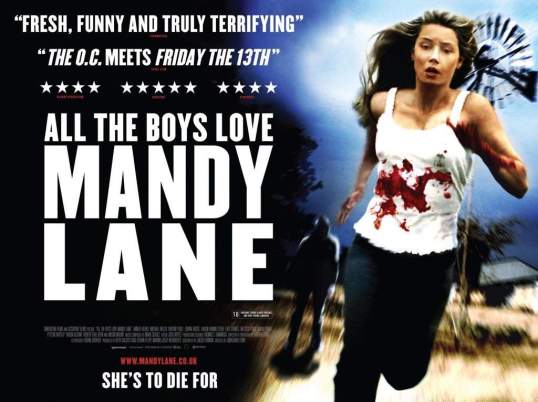
All The Boys Love Mandy Lane….for some reason.  Let’s begin by admitting Amber Heard is pretty, but …. love at first sight obsession?! Word?! Word?!  This film was written by Jacob Forman who went on to …. not much.  Jacob Forman does have a few recent credits as a special thanks over the last few years, which means he let someone sleep on his couch or something who was making a movie.  I wonder if the film deserved to make enough money to afford the futon that he used to get those special thanks.  But it’s on Netflix; so, if you’re on an elliptical and have already caught up on your YouTube subscriptions…. I guess this would be a choice that you could make … on purpose.

Jonathan Levine (director 50/50) directed this mess and he’s a very talented director for … Dramatic Comedy and Drama… Horror…not so much.  It was one of his first films (2006) and didn’t get a US release until 2013 … for good reason.  He’s very good at filming true to life couch conversations, which was certainly evident in 50/50, but in a Horror/Thriller the camera work/direction has to act as another character to pull us into suspense and punch us with payoffs.  This piece uses a lot of shaky cam in a 1980s style with artsy cuts that never allow us to feel worried about anyone on-screen.  The direction is like someone constantly spilling water on your charcoal as your trying to get the barbecue going.

The exploitation premise is simple enough: A bunch of boys try to corrupt a naive virginal archetype – Mandy Lane (Amber Heard).  Mandy is kind of bland and has a friend Emmet who everyone picks on and gets even by somehow convincing a guy to jump off his roof into a pool and he dies.  It’s weird.

After the pool incident, Emmet is a pariah. Mandy, on the other hand, is apparently the paragon of the feminine ideal because every man within 100 miles will give up his eternal soul for a tryst with her.  She agrees to go to a ranch in the middle of nowhere with a bunch of dudes and girls who are equally boring.  They arrive at the ranch and there’s a ranch hand on the property who is supposedly a Gulf War veteran even though he’s 27 and not in his later 40s.  Sigh.  Mandy Lane and all the other girls are obviously smitten with the ranch hand and why not….the ranch hand defies time and math itself!!!  As the song goes, every girl crazy for a …. man who defies the space-time-continuum! [Sung as ZZ Top]  The ranch hand is bored with the teens and returns to his home sweet shed.

Later, the teens start doing a ton of drugs and booze and Emmet or someone (dun dun dun) arrives and starts murdering everyone.  They are pretty gruesome deaths and it does border on torture porn at one point, which makes sense because it was written around 2004/2005 when Hostel was all the rage.  Even though people aren’t returning, all of the guys continue to try to make out with Mandy in the creepiest ways possible.  Mandy Lane has 20 lines of very bland dialogue total in the film and there is a slight twist at the end that fails to thrill.

What bugged me about this film is that horror is always treated as the Red-Headed Stepchild of film.  Everybody seems to think the genre is easy to write and do and this film is proof that both of those assumptions are false.  First, you need to at least have some sympathy for the people getting killed.  Second, you need to explain in someway at the halfway why they don’t just leave.  In this film, it’s not clear why the dudes want Mandy to stay at the halfway point of the film when it’s clear that she’s not interested in any of them.  Third, the camera work and direction to pull you into the house and into the story to ratchet up tension; otherwise, it’s just boring.

I’m glad that Jonathan Levine found his voice soon after this. Amber Heard did a fair enough performance for what she had to work with.  There was good performance by Melissa Price, but from IMDB, it appears that this film probably tanked her career.  In any case, I’m crazy excited that October is here!!!


The TSL’s Horror Grindhouse: Hellmaster (dir by Douglas Schulze)


Welcome to the end of the world.

Or something like that.

To be honest, it’s a bit of a struggle to say what exactly the 1992 film Hellmaster was actually about but I think it definitely had something to do with the end of the world.  John Saxon plays Prof. Jones, a sadistic eugenicist who, in the late 60s, developed a drug that he claimed would — I kid you not — “cure homelessness.”  Apparently, the drug would make the homeless so strong that they would be able to build a house or something.  Anyway, a reporter (David Emge, best known as the helicopter pilot in the original Dawn of the Dead) discovered what Jones was doing and that the drugs were actually turning the homeless into mind-controlled zombies.  Jones responded by murdering the reporter’s wife and then vanishing.

Are you following the story so far?

20 years later, the reporter is having nightmares about the homeless so he decides to start hanging out around the Kant Institute for the Gifted.  We’re told that the Kant Institute is a college.  There only appears to be one professor and a handful of students, the majority of whom appear to be in their early 30s.  I’m not really sure what’s being taught at the school.  (The only class we see features two white people debating whether or not Malcolm X hated the homeless.)  One of the students, Shelley (Amy Raasch), is apparently clairvoyant and she keeps having visions of the school’s chapel bursting into flames.

Meanwhile, there are shots of an old church bus driving down various deserted roads.  “Have a nice day” is written across the cross that hangs on the front of the bus.  On top of the bus, someone’s painted a smiley face.  The bus itself is occupied by four deformed followers of Prof. Jones.  Apparently, they’ve spent the last 20 years driving around the country and killing people.  One of them is dressed like a nun and carries several hypodermic needles.  They come across a stalled motorist and promptly kill him.  The man’s daughter (Sarah Barkoff) escapes and flees to the nearby Kant Institute.

It turns out that the bus is also heading to the Kant Institute!  Eventually, Prof. Jones pops up and explains that it took God six days to create the world but Jones believes that it will only take him one night to transform the world into Hell.  Why does Jones want to do this?  That’s not really clear.  Actually, it’s not even clear how showing up at the Kant Institute will even help Jones accomplish that goal.

Anyway, the rest of the movie is basically Shelley and the reporter and a handful of friends attempting to not get transformed into zombies by Prof. Jones.  This is easier said than done because, as we quickly discover, everyone in this movie is an idiot.

Hellmaster is one of those low-budget horror films that shouldn’t work and yet somehow, it does.  Yes, the plot makes absolutely no sense and, with the exception of genre vets Saxon and Emge, the performances are almost all terrible.  But no matter!  At its best, the film — which is full of dark hallways and deserted roads and twisty camera angles — achieves a dream-like intensity.  The zombies, with their hypodermic needles and their joyful savagery, are genuinely creepy and John Saxon is properly menacing as Prof. Jones.  It’s a relentless film, one that leaves you feeling as if anyone can die at any time and, when they do die, it’s often in the most macabre ways possible.  A crippled student is beaten to death with his own crutch.  Another is doused with acid.  And you may be asking yourself, “But why was there a big vat of acid just sitting around?” but oddly, it works within the surreal dream logic of the film.  It makes no sense and yet, it happens.  If anything, the lack of a coherent plot and the low-budget aesthetic help this film create and maintain its nightmarish atmosphere.

For all of its flaws, Hellmaster is a thousand times more effective than you might expect.

Elwes Unbound: American Crime (2004, directed by Dan Mintz)


Smalltown reporter Jessie St. Clair (Rachael Leigh Cook) has stumbled across the story of her career.  A stripper and a prostitute have been murdered.  Before committing the murders, the killer sent each victim a video tape of him stalking her.  With the help of her producer, Jane (Annabella Sciorra), and her cameraman, Rob (Kip Pardue), Jessie sets out to try to solve the case but when she receives a videotape that indicates that she might be the next victim, she quits her job and vanishes.

Then, Albert Bodine (Cary Elwes) shows up in town.  Albert says that he’s the anchor of the UK’s top true crime show, American Crime, and that he wants to investigate not only the two murders but also Jessie’s disappearance.  When both Rob and Jane are suddenly fired by their station, they reluctantly agree to work with Albert.  Albert soon proves himself to be so incompetent that his new colleagues start to wonder if he’s actually who he says he is.  Meanwhile, another videotape turns up, this one starring Jane.

The tone of American Crime is all over the place and it never seems to be sure if it wants to scare us or if it wants to make us laugh but there are some tense scenes and a good twist ending.  American Crime tries to strike a balance between being a horror/thriller and a satire of media sensationalism.  It doesn’t always succeed but you really haven’t lived until you’ve seen Cary Elwes play a sleazy tabloid reporter.  Imagine an even more hyperactive version of Robert Downey, Jr’s performance in Natural Born Killers and you’ll have some idea of what Cary Elwes does in this movie.  Elwes sweats profusely, bulges his eyes, speaks with an extremely affected English accent, and plays with his hair every time he passes a mirror.  Everything sets him off, from his camera falling off of its tripod to people questioning his journalistic credibility.  Though the movie does feature good roles for underappreciated actresses like Rachael Leigh Cooke and Annabella Sciorra, Elwes is definitely the best thing about and the main reason to watch American Crime.

Halloween Havoc!: FRANKENSTEIN (Universal 1931)


gary loggins's avatarcracked rear viewer

Two hundred years ago, Mary Wollstonecraft Shelley unleashed her novel FRANKENSTEIN upon an unsuspecting world. The ghastly story of a “Modern Prometheus” who dared to play God and his unholy creation shocked readers in 1818, and over the past two centuries has been adapted into stage plays, radio dramas, television programs, comic books, and the movies, most notably James Whale’s seminal 1931 FRANKENSTEIN, featuring not only a star-making  performance by Boris Karloff as the Creature, but ahead of its time filmmaking from Whale.

Director James Whale and his star

James Whale had directed only two films before FRANKENSTEIN (JOURNEY’S END and WATERLOO BRIDGE), but the former stage director certainly adapted quickly to the new medium of talking pictures. The story had been made three times for the silent screen, but the new sound technology adds so much to the overall eeriness of the film’s atmosphere. Whale was obviously influenced by…

View original post 580 more words

Italian Horror Spotlight: Ratman (dir by Giuliano Carnimeo)


This October, along with with everything else, I want to highlight Italian horror!  Today, we start things off with a look at 1988’s Ratman!

Terry (Janet Agren) has come to a Caribbean island, not for a vacation but instead to collect the remains of her sister, Marlis (Eva Grimaldi).  Marlis was an up-and-coming model who came to the island with a photographer named Mark (Werner Pochath) and another model named Peggy (Luisa Menon).  Marlis had her entire life ahead of her but apparently, someone murdered her on the island and then left her body in an abandoned building where it was eaten by a rat.

Obviously, identifying a dead sibling would be a difficult task for anyone.  Fortunately, no sooner has Terry arrived on the island than she runs into Fred (David Warbeck).  Fred is a true crime writer, a man who knows the island and who is always ready with a quip or a joke.  For reasons that are never quite clear, Fred invites himself to accompany Terry down to the morgue.  Why does Terry allow a complete stranger to go with her to identify her sister’s body?  Who knows?  Maybe it’s because Fred is played by David Warbeck, who was one of the more likable actors to regularly appear in Italian horror films.

It turns out to be a good thing that Fred came along because, when they arrive at the morgue, it turns out that the police don’t actually have Marlis’s body!  Instead, they have Peggy’s body.  Peggy was murdered while wearing Marlis’s dress, which led to a case of mistaken identity.  But, if Marlis isn’t dead, where is she?

Could she and Mark have gone deeper into the jungles of the island, hoping to find the perfect place to take the pictures that will turn Marlis into a superstar?  Of course, they have!  Unfortunately, what they did not take into account is that the island is also the home of the Ratman!

Who is the Ratman?  Well, his name is actually Mousey (Nelson de la Rosa), despite the fact that he doesn’t really act like a mouse.  Mousey was created a mad scientist who wanted to see what would happen if he crossed the genes of a monkey and a rat.  The end result was a 2’4 sociopath with really sharp teeth and an insatiable urge to kill.  The scientist thinks that he’ll win the Nobel Prize for this creation but Mousey seems to be more concerned with killing people.  As soon as he gets out of his cage, he goes on a killing spree….

Mostly because of the presence of Nelson de la Rosa (who, until his death in 2016, was the world’s shortest man), Ratman has a cult following.  And it must be admitted that de la Rosa makes for a memorable ratman.  Unfortunately, he’s not really in the film that much.  The majority of the film is made up of filler.  For instance, we spend a lot of time watching Mark take pictures.  A lot of time is also devoted to Fred and Terry having to deal with the incompetent island police.  (The police are convinced that Marlis is dead and are apparently willing to force Terry to look at every dead body on the island to prove it.)

Fortunately, this film also features David Warbeck and, as any fan of Italian horror can tell you, Warbeck was one of those actors who improved any film in which he appeared.  Warbeck always approached his roles with a sense of humor and a likable joie de vivre and he’s probably as convincing as anyone could hope to be when appearing in a film like Ratman.  Warbeck delivers his lines with just enough of a smile to not only let you know that he’s in on the joke but to also invite you to play along with him.

Reportedly, Ratman was a troubled production and the film’s producer stepped in to take over from the credited director.  That perhaps explains why the film itself sometimes feels rather disjointed.  There is one undeniably effective sequence, in which a model is stalked by a knife-wielding maniac just to then be attacked by Mousey instead.  Otherwise, by the standards of most Italian horror films, it’s a visually bland movie.  I would have liked to have seen what someone like Lamberto Bava and Lucio Fulci could have done with Ratman.

Ratman exists in several different version.  The version I saw was dubbed into French and it was obvious that a good deal of gore had been cut from the film.  (The “official” Italian version has a running time of 82 minutes.  The version I saw only ran 76 minutes.)  Still, even in an edited form, this film has an undeniable “What did I just see” appeal to it and it’s always worth watching anything that features David Warbeck.

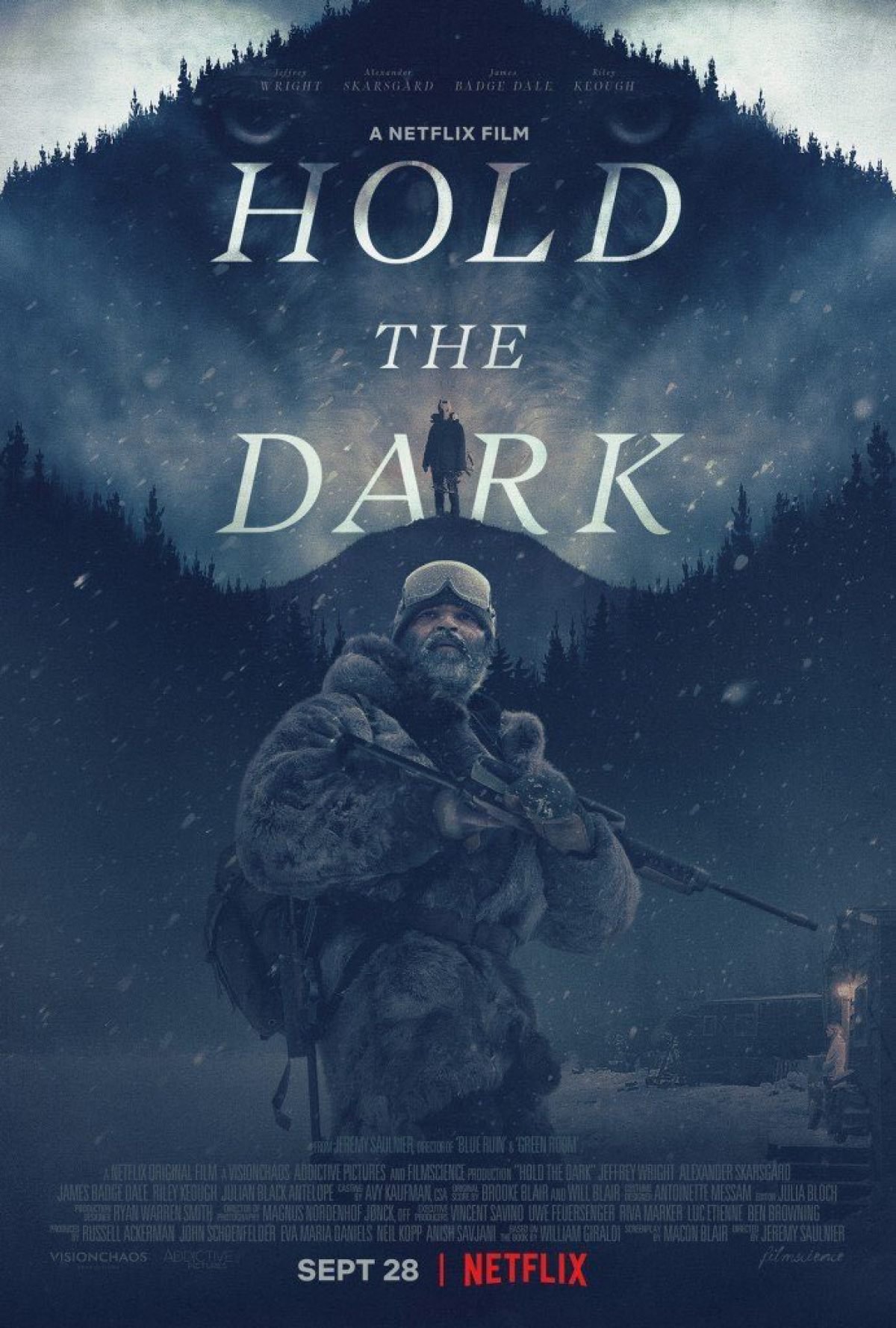
Horror Review: Hold the Dark (dir. by Jeremy Saulnier)


Hold the Dark

“The dead don’t haunt the living. The living haunt themselves.” — Russell Core

Jeremy Saulnier, writer-director of Blue Ruin and Green Room, invites the brave and the curious into his latest creation, steeped in the dark, foreboding Alaskan wilderness and tinged with supernatural folklore.

No one could accuse Saulnier of timidity when it comes to on-screen violence. While many filmmakers stage more elaborate or explosive sequences, Saulnier aligns more with Sam Peckinpah than Michael Bay. His films present violence at its most unglamorous. The brutality he depicts is neither titillating nor exploitative; instead, it’s stark, sudden, and deeply unsettling.

Saulnier views humanity’s capacity for violence as primal—an inherent trait held in check only by the thin veneer of civilization. In his films, man is not truly civilized, but rather a creature pretending to be, always closer to savagery than he’d like to admit. Whether it’s a drifter caught in a blood feud or a punk band fighting for survival against backwoods neo-Nazis, his characters are pushed to rediscover that inner, violent core—even as they try to cling to the fragile rules of civilized behavior.

With Hold the Dark, Saulnier veers away from the straightforward narratives of his previous films and ventures into something more ambiguous—closer to a haunting campfire tale than a conventional thriller. Its deliberately opaque storytelling may frustrate viewers who prefer clear protagonists, antagonists, and linear progression. Yet, like his earlier work, the film continues his fascination with moral ambiguity and the blurred line between good and evil.

The story begins with retired naturalist Russell Core (Jeffrey Wright), who is summoned by Medora Slone, a grieving mother living in the remote Alaskan village of Keelut. She believes wolves have taken her young son, along with two other children before him. Knowing Core’s experience as a wolf expert and hunter, she asks him to track and kill the animals responsible—both for justice and to provide closure for her husband, who is deployed in Iraq.

From the moment Core arrives in Keelut, the film slowly shifts from a man-versus-nature premise into something far more mythic and unsettling—a dark fairytale with no promise of a happy ending. This tonal shift will either draw viewers in, asking them to surrender to its grim, disorienting atmosphere, or leave them detached and confused, searching for concrete answers the film refuses to provide.

Like Saulnier’s previous films, Hold the Dark does not shy away from brutality. Violence erupts suddenly and with horrifying efficiency, emphasizing how fragile the human body—and psyche—really is.

The screenplay, written by frequent collaborator Macon Blair, raises compelling questions: Is violence an inherent darkness within humanity, merely suppressed by the “light” of civilization? Or is it something learned, passed down like a contagion through generations? Is it an inescapable cycle, or something that can be broken? These are questions without easy answers, and the film’s ambiguity—while potentially frustrating—is also what gives it lingering power. It invites viewers to sit with these ideas rather than resolve them.

Where the narrative may divide audiences, the performances are consistently strong. Jeffrey Wright anchors the film as Russell Core, serving as both participant and observer—mirroring the audience’s own confusion and unease. Riley Keough and Alexander Skarsgård, as Medora and Vernon Slone, add further layers of tension. Keough’s eerie stillness contrasts sharply with Skarsgård’s explosive response to his son’s death—a turn that propels the film from mystery into outright horror, complete with imagery that borders on slasher territory.

Hold the Dark may not be a direct evolution of Blue Ruin or Green Room, but it carries forward Saulnier’s thematic obsessions. It allows him to explore more esoteric territory while maintaining his signature style—raw, unflinching, and deeply primal. There’s nothing comforting or hopeful in this dark fairytale, but then again, fairytales were never meant to be. They exist to confront the darkness, to give it shape, and, perhaps, to help us endure it.

Horror Film Review: Don’t Look Now (dir by Nicolas Roeg)


Donald Sutherland and Julie Christie in Don’t Look Now (1973)

I have to admit that I’m actually a bit embarrassed to say that Venice is my favorite city in Italy.

I mean, it’s such a cliché, isn’t it?  Tourists always fall in love with Venice, even though the majority of us really don’t know much about the city beyond the canals and the gondolas.  I spent a summer in Italy and Venice was definitely the city that had the most American visitors.  Sadly, the majority of them didn’t do a very good job representing the U.S. in Europe.  I’ll never forget the drunk frat boys who approached me one night, all wearing University of Texas t-shirts.  One of them asked, “Are you from Texas?”

“No,” I lied.

“You sound like you’re from Texas!” his friend said.

“No, ah’m not from Texas,” I said, “Sorry, y’all.”

I mean, that’s not something that would have happened in Florence or even Naples!  In Rome, handsome men on motor scooters gave me flowers.  In Venice, on the other hand, I had to deal with the same assholes that I dealt with back home!

That said, I still fell in love with Venice.  And yes, it did happen while riding in a gondola.  At that moment, I felt like I was living in a work of art.  I can still remember looking over the side of the gondola and watching as a small crab ran across someone’s front porch.  That’s when I realize that, by its very existence, Venice proved that anything was possible.

I’ve often heard that Venice is slowly sinking.  That Venice has a reputation as being a dying city would probably have come to a surprise to the drunk Americans who were just looking for a girl from Texas that summer.  And yet, Venice has always been associated with death.  Just consider Thomas Mann’s Death in Venice and the subsequent film adaptation from Luchino Visconti.  Consider the controversial Giallo in Venice.  And, of course, you can’t forget about the 1973 film, Don’t Look Now.

Oh my God, Don’t Look Now is a creepy movie.  It’s probably best known for two things: the lengthy sex scene between Julie Christie and Donald Sutherland (which was apparently quite controversial back in 1973 but which seems rather tame when viewed today) and the film’s shock ending.  It’s one of the best and most disturbing endings in the history of horror and I’m not going to spoil it in this review.  The first time I saw the movie, the ending caught me totally off guard and gave me nightmares.  Admittedly, it’s not hard to give me nightmares but what’s remarkable is that, upon subsequent viewings, the ending is still just as frightening and disturbing.  In fact, knowing what’s going to happen makes the film even more chilling.

The film’s story is actually a rather simple one.  After their daughter, Christine, accidentally drowns, John (Donald Sutherland) and Laura Baxter (Julie Christie) take a trip to Venice.  Though they’re in Venice so that John can restore an ancient church, both John and Laura are mostly trying to escape their grief.  Laura meets a blind woman, Heather (Hilary Mason), who claims to not only be a psychic but who also says that she can see Christine in the afterlife.  Laura believes Heather and is concerned when Heather says that Christine wants them to leave Venice.  John, on the other hand, believes that Heather is a fake.

When the Baxters get a phone call informing them that their son has taken ill, Laura flies back to the UK.  Or does she?  One day, John spots his wife riding on a boat with Heather and her sister.  Has Heather abducted or brainwashed his wife?  When John goes to the police, they are as skeptical of him as he was of Heather.  In fact, they start to suspect that John may have something to do with a recent rash of murders.

Confused, John searches Venice for his wife but, instead of finding her, he spots a figure in the distance.  It appears to be a young child, one who is wearing the same red coat that Christine was wearing when she drowned….

It’s a simple story but it’s told in a very complex fashion.  Director Nicolas Roeg is best known for his fragmented narrative style.  Roeg often mashes together scenes from the past, present, and future and leaves it up to the viewer to put it all together.  (For instance, in Don’t Look Now, scenes of John and Laura making love are intercut with scenes of them getting dressed afterward.)  Roeg’s style that can often come across as being pretentious but, in Don’t Look Now, it works perfectly.  The audience is kept off-balance and is always aware that that’s more than one possible interpretation for everything that is seen.  Is Laura in the UK or is she on a boat in Venice?  Is Heather seeing Christine or is she just trying to con a grieving mother?  Is John chasing the figure in the red coat or is she actually the one pursuing him?  Is John chasing the figure because he believes that she’s his daughter or because he wants to prove, once and for all, that Christine is gone and never coming back?  Roeg keeps you guessing.

Death seems to permeate every frame of Don’t Look Now, whether it’s Heather’s cheery descriptions of the afterlife or the sight of a bloated corpse being pulled out of the canal.  Even when John is working in the church, he still nearly slips off a scaffolding.  While John restores ancient buildings to the vibrant glories of the past, the present seems to grow more and more ominous and menacing.  John and Laura may have traveled to Venice to escape their grief but their grief follows them.  How they deal with that grief — both as a couple and as individuals — is what determines their fate.  For a film that is full of mysteries, none is as enigmatic as Julie Christie’s smile when she’s on the boat.

I’m probably making Don’t Look Now sound like an incredibly grim film and, to a certain extent, it is.  After all, early 70s cinema is not known for its happy endings.  And yet, as dark and disturbing as this film may be, it’s impossible to look away from.  Roeg does a fantastic job capturing both the beauty and the decay of Venice while Donald Sutherland and Julie Christie are so sympathetic as John and Laura that you find yourself rewatching and hoping that somehow, they don’t end up making the same mistakes that they made the last time that you watched.

Don’t Look Now is an essential horror film and one that’s as timeless as the sight of a crab running across someone’s front porch.