This is our favorite time of the year here at the Shattered Lens because October is horror month. For the past five years, we have celebrated every October by reviewing and sharing some of our favorite horror movies, shows, books, and music!
A part of the tradition of Horrorthon is that we begin every day in October by sharing a free movie. Now, I should warn you that most of these movies will come from YouTube and you know how YouTube is about yanking down videos. So, if you’re reading this in 2024 and wondering where the promised movie disappeared to … well, you should have watched it in 2018!
Let’s start things off with the 1993 made-for-television movie, The Tower!
Have you ever asked yourself what Die Hard would have been like if it had starred Paul Reiser and the Alan Rickman role had been played by an overzealous automated security system? Well, watch The Tower to find out! This is one of those movies where the hero, played by Paul Reiser of all people, manages to get almost everyone in the movie killed and yet we’re not supposed to hold it against him.
By the end of the movie, you’ll totally be on The Tower’s side!
In 1984, Lisa McVey was seventeen years old and working at a doughnut shop in Florida. When she wasn’t working, she was having to deal with her dysfunctional home life, including regular sexual abuse at the hands of a relative. One night, after ending her shift at work, Lisa hopped on her bicycle and rode off. At the time, she was fully intending to kill herself. Instead, she found herself being chased and eventually abducted by a man in a car. That man was Bobby Joe Long and, though Lisa didn’t know it at the time, he has already killed at least ten other women in the Tampa Bay area.
After kidnapping her, Long held Lisa prisoner for 26 hours. Keeping her bound and blindfolded, Long raped her repeatedly and planned to kill her. Lisa, however, managed to talk him out of it. By her own admission, she used the same techniques that she had previously used to survive the years of abuse that she suffered when she was a child. She promised him that she wouldn’t tell anyone what had happened. She told him that she understood that he wasn’t a bad guy and that she would even be his friend if he just let her go.
And that’s just what Bobby Joe Long did. He set her free. Lisa ran for home, not realizing that her family had reported her missing and that the police were looking for her. However, once Lisa reached her house, she discovered that neither her family nor the cops believed her. They assumed that she had run off with a boy and, when things didn’t work out, she came home and made up the kidnapping story to get out of trouble. The more Lisa tried to explain, the more the police doubted her….
That’s the story that was told in tonight’s Lifetime premiere, Believe Me: The Abduction of Lisa McVey. Usually, I tend to take a humorous (some would say “snarky”) approach when reviewing Lifetime films but that really wouldn’t be appropriate with this film. My friend, the writer Trevor Wells, compared this film to Cleveland Abduction and he’s absolutely right. Much like Cleveland Abduction, Believe Me tells the true story of one strong and underestimated woman who survived the worst experience possible and who, against all odds, managed to create light in the darkness. It’s not a pleasant film to watch but it is an inspiring one, one that offers up strength to any woman who has ever had to fight to be believed.
Katie Douglas gives a strong and empathetic performance as Lisa McVey. While the film doesn’t shy away from showing both what she experienced and her struggle with PTSD afterward, it also showcases the strength that helped her to survive both her Hellish childhood and Bobby Joe Long. It’s that same strength that caused her to never stop demanding that both the police and her family believe her.
Thanks to Lisa McVey, Bobby Joe Long was eventually captured. He’s currently sitting on Florida’s death row. As for Lisa, she is now a school resource officer and a motivational speaker.
I recorded Conrad & Michelle off of Lifetime on September 23rd.
In 2014, 18 year-old Conrad Roy committed suicide in Massachusetts, poisoning himself with carbon monoxide fumes while sitting in his truck.
Conrad was an outstanding athlete and a good student but he has also struggled with social anxiety and depression and had reportedly often insisted to various therapists that he wanted to die. Some reports stated that Conrad had attempted suicide at least once before, with an attempted drug overdose when he was 17. Any suicide, regardless of the circumstances, is a tragedy but making Conrad’s story all the more disturbing was that, minutes before his death, he was texting with an acquaintance named Michelle Carter. Supposedly, a few years earlier, Michelle had talked Conrad out of a suicide attempt. This time, however, she insisted that he grow through with it. Even when he texted her that he was scared and that he had gotten out of his truck, Michelle texted back that he needed to get back in truck and go through with what he was planning.
After Conrad’s death, Michelle reportedly used the tragedy to generate as much attention for herself as possible. She described herself as being Conrad’s girlfriend and his soulmate. At the same time, Conrad’s friends and family said that Conrad had only met Michelle face-to-face a handful of times and that their relationship was almost entirely conducted online. Some friends went as far as to say that they had never even heard Conrad mention Michelle’s name and that Conrad had actually been doing better before Michelle started sending him text messages in which she goaded him into committing suicide.
When Michelle was arrested and put on trial, it made national headlines. Attorneys for the defense argued that Conrad had a history of suicidal behavior and that he was ultimately responsible for his own actions. The prosecution, on the other hand, argued that Michelle was a narcissist who heartlessly manipulated a vulnerable acquaintance. In the end, Michelle’s was convicted of involuntary manslaughter. Specifically, she was convicted because of the text in which she told Conrad to get back in the truck. In August of 2017, she was sentenced to serve 30 months in prison.
Given the sensational nature of the case and the fact that the trial made national headlines, it’s not particularly shocking that Lifetime would make a movie about it. Starring Bella Thorne as Michelle and Austin P. McKenzie as Conrad, Conrad & Michelle does a good job of presenting the basic facts of the case. We watch as Michelle and Conrad first meet while on vacation on Florida and then we follow along as both of them spend the next few years texting each other, taking different psychiatric medications, and attending various therapy groups. Conrad struggles with his depression while Michelle deals with, among other things, an eating disorder. After Conrad’s death, we watch as Michelle awkwardly forces herself into the lives of his friends and family.
Some people will probably complain that the film never solidly takes a side as to whether or not Michelle was truly responsible for Conrad’s suicide. Though we see Michelle texting Conrad to get back in the truck, the film leaves it ambiguous as to whether it was specifically Michelle’s text that caused Conrad to follow through with his suicide. Still, after Conrad’s suicide, the film leaves no doubt that Michelle relished her new-found fame and her status as a self-declared tragic heroine. (After learning that Conrad’s suicide note was addressed to her, Michelle brags to her friends that Conrad didn’t write a note to anyone else. Later, when Michelle sets up a charity softball game in Conrad’s memory, she breathlessly reminds everyone that it was her idea and worries that someone else might try to take credit.) Bella Thorne does an excellent job in these scenes, playing Michelle as an unstable narcissist who is incapable of understanding why no one else is as excited for her as she is. In these scenes, Michelle’s monstrous selfishness is revealed and Thorne gives a chilling performance.
Like the story that inspired it, Conrad & Michelle is a sad and disturbing movie and one that I would recommend catching the next time that it’s on.
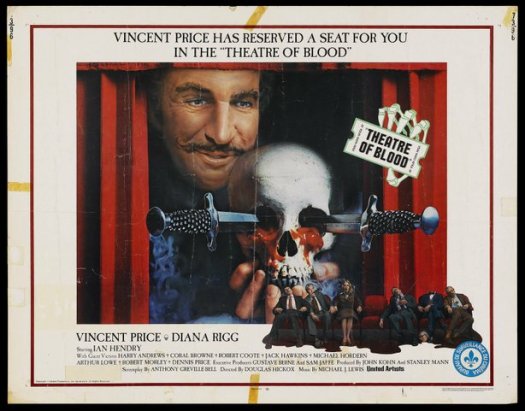
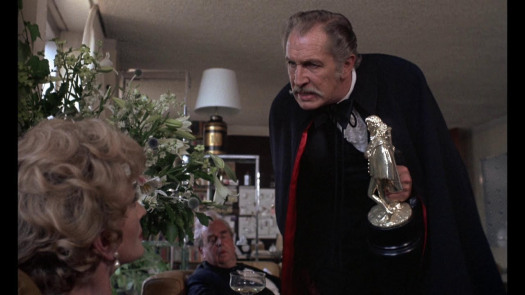
Vincent Price traded in Edgar Allan Poe for William Shakespeare (and American-International for United Artists) in THEATER OF BLOOD, playing an actor’s dream role: Price not only gets to perform the Bard of Avon’s works onscreen, he gets to kill off all his critics! As you would imagine, Price has a field day with the part, serving up deliciously thick slices of ham with relish as he murders an all-star cast of British thespians in this fiendishly ingenious screenplay concocted by Anthony Greville-Bell and directed with style by Douglas Hickox.
Edward Lionheart felt so slighted by both scathing criticism and once again being stiffed at the prestigious Critics’ Circle award, he broke up their little soiree by doing a swan dive into London’s mighty Thames. His body was never found, and everyone assumed they had seen Lionheart’s final performance, but unbeknownst to all he was fished out of the river…
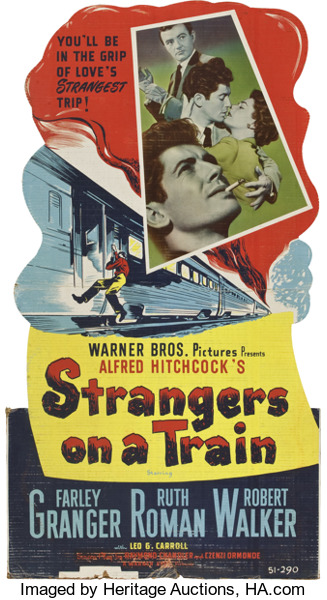
Alfred Hitchcock , like many great artists before and since, was in a bit of a career slump. The Master of Suspense’s previous four films (THE PARADINE CASE, ROPE, UNDER CAPRICORN, STAGE FRIGHT) were not hits with either critics or audiences, and did poorly at the box office. Then came 1951’s STRANGERS ON A TRAIN and Hitch was back on top with this devilish mélange of murder, suspense, romance, and humor, featuring a stunning star turn by Robert Walker, cast against type as a charming sociopath.
Our story opens with two pairs of shoes (one two-toned, one staid brown loafers) emerging from two separate cabs, walking separately to catch a train and their date with destiny, as we cut to two separate train tracks merging together. Hitchcock’s playing with one of his classic themes: “the double”, or more importantly, duality. Even Dimitri Tiomkin’s score highlights the differences, as a jaunty…
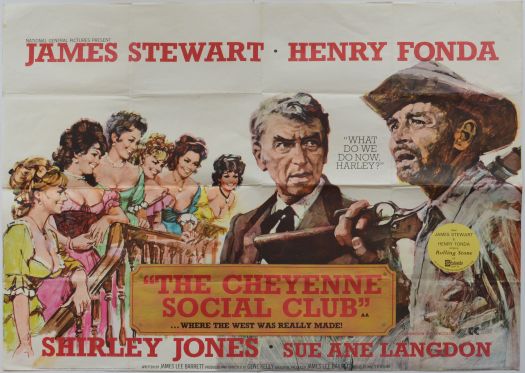
THE CHEYENNE SOCIAL CLUB isn’t a great movie, but it’s not a bad one, either. It couldn’t be; not with all that talent in front of and behind the cameras. You’ve got two legendary leads, James Stewart and Henry Fonda , Oscar winner Shirley Jones, Gene Kelly in the director’s chair, and John Wayne’s favorite cinematographer William Clothier . Still, the film, while amusing, should’ve been so much better.
The story’s fairy simple: two old Texas cowhands, John O’Hanlon (Stewart) and Harley Sullivan (Fonda) are plying their trade when John receives a letter. Seems John’s brother has died and left him an inheritance – The Cheyenne Social Club in Cheyenne, Wyoming. John and his old pal head north, and it turns out The Cheyenne Social Club is a cathouse, run by Madame Jenny (Jones), and she and the girls warmly greet the perplexed duo. Uptight John, who’s always wanted to…
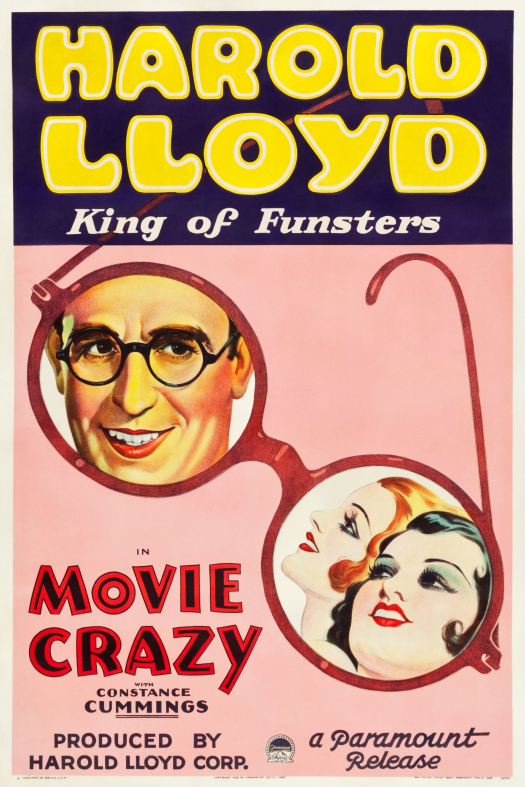
Harold Lloyd made a smooth transition from silent films to talkies beginning with 1929’s WELCOME DANGER. Unlike Charlie Chaplin (who stubbornly clung to making silents until 1940), and Buster Keaton (whose MGM contract took away much of his artistic freedom), Lloyd retained both his comic visual style while integrating verbal gags in the new medium and kept control of the pictures he made. And while his popularity had begun to wane by the 1930’s, Harold Lloyd’s early talkies are definitely worth watching – because they’re flat-out funny! Case in point: 1932’s MOVIE CRAZY.
MOVIE CRAZY is one of those “Hollywood-behind-the-scenes” stories you know I love so much, so it automatically scored cool points with me! Kansas farm boy Harold Hall lives with his parents and daydreams of being a movie star. One day, he sends his picture and a letter to Planet Films exec O’Brien – only the inept Harold…
On Friday night, I watched the latest Lifetime premiere, Long Lost Daughter!
Why Was I Watching It?
First off, let me just say that, considering what the folks on the East Coast have had to deal with over the past two weeks, I feel really guilty about complaining about getting a little bit of rain in Texas. (And it’s not really a complaint because, to be honest, I love stormy weather!)
That said, it rained all day Friday and it’s supposed to continue to rain through the weekend. When I was driving home from work, the rain was so bad that I actually had to limit myself to 30 mph. We’re under flash flood warning right now. What better way to pass the time when you’re trapped inside by a storm than be watching a Lifetime movie?
What Was It About?
Cathy Rhodes (Molly Hagan) is a successful and acclaimed author of children’s books. She’s written hundreds of stories about Mr. Poppins, a rabbit who can’t find his way home. It’s made her a beloved figure in her small town but there are some who find Cathy and her husband (Bates Wilder) to be a little bit strange. They whisper about how, 20 years earlier, Cathy’s 7 year-old daughter, Michelle, vanished.
Meanwhile, two new arrivals have come to town. Jonathan (Richard Brancatisano) is an aspiring science fiction writer. And his wife (Sofia Mattson) is going to help run the education center that Cathy has helped to fund. It turns out that Jonathan’s wife is 27 years old and has no memory of her mother or her childhood. And her name is …. Michelle!
Could Michelle be Cathy’s daughter? That’s certainly what Cathy thinks and she’s willing to do anything to make sure that both her daughter and Mr. Poppins find their way home…
What Worked?
Molly Hagan may not be a household name but I can guarantee you that you would recognize her if you saw her. She’s been in a countless number of films over the years and she is a truly great character actress. She’s played so many different characters and she’s been totally convincing every time. (I think her best-known recent film might be Sully, where she played one of the flight attendants who chanted, “Brace! Brace! Head down! Stay down!”) Anyway, Hagan does a great job as the Cathy Rhodes, making her both frightening and sympathetic.
Also giving a good performance was Bates Wilder, who played Cathy’s somewhat creepy husband. Both he and Hagan keep you guessing.
Speaking of keeping you guessing, this film had an ambiguous ending that I absolutely loved. I won’t spoil it but it was handled very well. It’s the type of ending that I wish Lifetime would try more often. Sometime, it’s not necessary to spell everything out.
What Did Not Work?
Could Michelle and Jonathan have been anymore unlikable? Michelle acted like moving from the city to a small town was the equivalent of moving to a different country. When Cathy mentioned she was making a casserole, Michelle’s smug response of, “Casserole!” was enough to make me decided that I wouldn’t ever want to know someone like Michelle in real life.
As for Jonathan … well, I lost all sympathy for him when he announced that, for him, being a writer was about business and not art. “No one ever reads Proust anymore,” he said, at one point. What a jerk! Michelle, at least, kinda redeemed herself as the film progressed. But Jonathan …. well, once a jerk, always a jerk.
“Oh my God! Just like me!” Moments
Whenever Michelle got annoyed with Jonathan, I was like, “Oh my God! I feel the exact same way!”
Watching Life Itself is like getting a Hallmark card from a serial killer. Even if you appreciate the sentiment, you still don’t feel good about it.
Written and directed by This Is Us creator Dan Fogelman, Life Itself attempts to juggle several different themes, so much so that it can sometimes be difficult to understand just what exactly the film is attempting to say. That said, I think the main lesson of the film is that you should always look both ways before stepping out into the middle of the street. It doesn’t matter if you’ve got a horrific backstory, involving a decapitated father, a pervy uncle, and a gun. It doesn’t matter if you love Pulp Fiction or if you think Bob Dylan’s more recent work is underrated. It doesn’t matter if you’ve got a dog and husband who is so in love with you that he’s practically a stalker. It doesn’t even matter that your pregnant and looking forward to naming your firstborn after your favorite musician. If you don’t look both ways before stepping out into the middle of the street, you’re going to get hit by a big damn bus.
That’s the lesson that Abby (Olivia Wilde) does not learn and, as a result, she not only gets run over by a bus but we, the viewers, are subjected to seeing her repeatedly getting run over by that bus. As temtping as it is to feel bad for Abby, my sympathy was limited by the fact that she and her husband (Oscar Isaac) named their dog Fuckface. I mean, seriously, who does that? Not only is it cruel to the dog but it’s also inconsiderate to the people who have to listen to you shouting, “Fuckface!” whenever the dog gets loose. For whatever reason, the movie doesn’t seem to get how annoying this is. That’s because Life Itself is another one of those movies that mistakes quirkiness for humanity.
The other annoying thing about Abby is that she’s an English major who somehow thinks that the use of the unreliable narrator is an understudied literary phenonema. In fact, she’s writing her thesis on unreliable narrators. Her argument is that life itself is the ultimate unreliable narrator because life is tricky and surprising, which doesn’t make one bit of sense.
Speaking of narrators, Life Itself has three, which is three too many. Two of the narrators are unreliable but I get the feeling that the third one is meant to be taken literally, which is a shame because the film would have made a lot more sense if it had ended with a Life of Pi-style revelation that none of what we just watched actually happened.
Anyway, Abby getting hit by a bus has repercussions that reverberate across the globe and across time. Not only does it lead to her husband writing a bad screenplay but it also leads to him committing suicide in a psychiatrist’s office. Abby’s daughter, Dylan (Olivia Cooke), grows up to be what this film believes to be a punk rocker, which means that she angrily covers Bob Dylan songs and stuffs a peanut butter and jelly sandwich down another girl’s throat. Meanwhile, in Spain….
What? Oh yeah, this film jumps from New York to Spain. In fact, it’s almost like another film suddenly starts after an hour of the first one. You go from Olivia Cooke sobbing on a park bench to Antonio Banderas talking about his childhood. Banderas is playing a landowner named Vincent Saccione. Saccione wants to be best friends with his foreman, Javier (Sergio Peris-Mencheta) but Javier suspects that Saccione just wants to steal away his saintly wife, Isabel (Laia Costa) and maybe Javier’s right!
Javier has a son named Rodrigo (who is played by five different actors over the course of the film before eventually growing up to be Alex Monner). When Saccione gives Rodrigo a globe, Javier decides to one-up him by taking his wife and child on a vacation to New York City. Rodrigo has a great time in New York, or at least he does until he distracts a bus driver, which leads to a bus running down a pregnant woman…
…and the movie’s not over yet! It just keeps on going and believe it or not, there’s stuff that I haven’t even mentioned. Life Itself has a running time of only two hours. (For comparison, it’s shorter than almost every comic book film that’s come out over the past few years.) This is one of the rare cases where the film might have been improved with a longer running time because Fogelman crams so much tragedy and melodrama into that running time that it literally leaves you feeling as if you’re being bludgeoned. This is one of those films that gets in your face and screams, “You will cry! You will cry!” Even if you are inclined to cry at movies (and I certainly am), it’s impossible not to resent just how manipulative the film gets. You get the feeling that if you spend too much time wondering about the plot holes or the on-the-nose dialogue, the third narrator might start yelling at you for not getting with the program.
Life Itself is full of twists that are designed to leave you considering how everything in life is connected but, for something like this to work, the twists have to be surprising. They have to catch you off-guard. They have to make you want to see the movie again so that you can look for clues. The twists in Life Itself are not surprising. Anyone who has ever seen a movie before will be able to guess what’s going to happen. For that matter, anyone who has ever sat through an episode of This is Us should be able to figure it all out. Life Itself is not as a clever as it thinks it is.
Also, for a film like this work, you have to actually care about the characters. You have to be invested in who they are. But nobody in the film ever seems to be real and neither do any of their stories. (To the film’s credit, it actually does point out that one narrator is idealizing the past but that’s an intriguing idea that’s abandoned.) Everyone is just a collection of quirks. We know what type of music they like but we never understand why. Background info, like Abby being molested by her uncle or Isabel being the fourth prettiest of six sisters, is randomly dropped and then quickly forgotten about. Almost ever woman has a tragic backstory and, for the most part, a tragic destiny. (Except, of course, for Rodrigo’s first American girlfriend, who is dismissed as being “loud.”) Every man is soulful and passionate. But who are they? The film’s narrators say a lot but they never get around to answering that question. This is a film that insists it has something to say about life itself but it never quite comes alive.
Some critics are saying that Life Itself is the worst film of 2018. Maybe. I don’t know for sure. The Happytime Murders left me feeling so icky that I haven’t even been able to bring myself to review it yet. Life Itself, on the other hand, is such a huge misfire that I couldn’t wait to tell everyone about it. There’s something to be said for that.
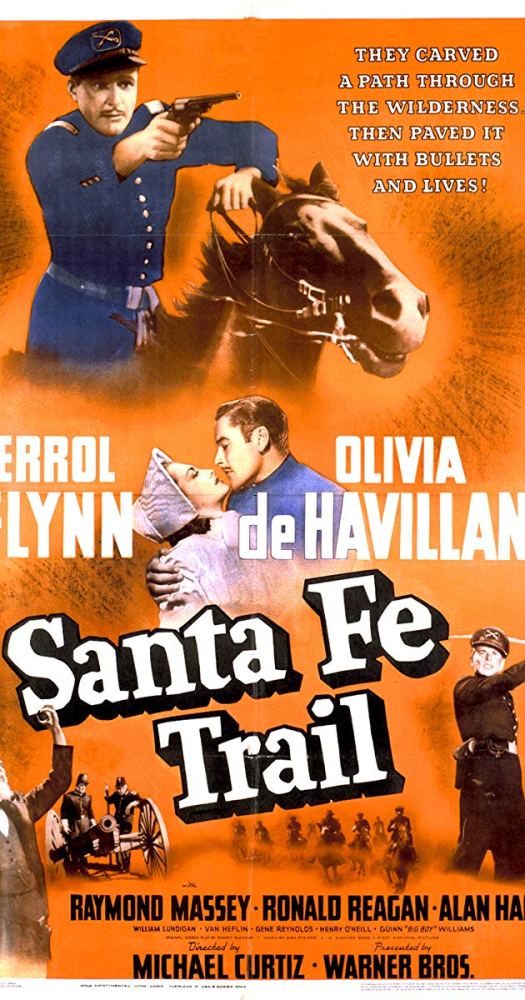
A movie lover could get pretty spoiled living on a steady diet of Errol Flynn/Warner Brothers epics from the 30’s and 40’s. You’ve got Flynn, the personification of the classic “movie star”, performing heroic feats and romancing his leading lady (usually Olivia de Havilland ). A historical setting serving as the backdrop to move the story along, expertly directed by Michael Curtiz or Raoul Walsh, a cast full of Hollywood’s greatest character actors, a majestic music score (mainly Max Steiner , but there were others equally as talented), action, drama, humor, conflict… what more could a film fan ask for?
SANTA FE TRAIL has all this and more, an energetic pre-Civil War tale guaranteed to hold your interest for its 110 minutes no matter which side of the Mason-Dixon Line you live on. It’s characters are drawn from history, but historic accuracy be damned… these films were all about…







 Through the Shattered Lens