30 Days of Noir #7: The Sniper (dir by Edward Dmytryk)


Halfway through the chilling 1952 film, The Sniper, there’s a scene in which a woman is seen standing on the rooftop of a San Francisco apartment building.  She’s nonchalantly hanging laundry.  When she steps to the side, we suddenly see that there’s a man standing on the next rooftop over.  And he’s holding a rifle.

Fortunately, in this case, the man is a policeman.  He’s one of several cops who have been ordered to stand on rooftops with their weapons drawn and to keep an eye on the city below.  There’s a killer on the loose and the city is demanding that the police capture him.  And yet, even with a city that’s caught in the grip of fear and even with heavily armed men watching everything going on in the streets, life goes on.  People go to bars.  People go to work. Couples stroll in the park.  And one woman hangs her laundry to dry on the rooftop of an apartment building.

Suddenly, the policeman spots someone on another rooftop, a man who isn’t supposed to be there.  He’s a young guy, carrying what looks like a rifle.  The police quickly rush to the rooftop where they arrest the young man.  Have they caught the sniper who has been terrorizing San Francisco?

The police think that they have their man but we know that they don’t.  We know that the sniper is a guy named Eddie Miller (Arthur Franz).  Eddie is a delivery man.  He’s handsome but, from the minute we first see him, we can tell that there’s something off about him.  He stumbles through life, keeping his head down and rarely speaking to anyone.  The few times he does attempt to smile, it’s painfully awkward.  He’s someone who is struggling to convince the people of San Francisco that he’s one of them but the more he tries, the more of an outsider he seems to be.  In fact, the only time that we see Eddie truly happy is when he goes to a carnival and comes across a dunk tank.  Over and over again, he throws a baseball and cause the woman inside to be submerged in cold water.

At first, Eddie tries to deal with his bad thoughts by deliberately burning his hand on an electric stove.  When he goes to the emergency room, he asks the attending doctor why he would do something like that but the doctor is soon distracted by another patient.  With his hand bandaged, Eddie goes on a shooting spree, targeting brunette women.

This dark film is fairly evenly divided, between Eddie, the cops that are trying to catch him, and the psychiatrist who tries to explain him.  Not surprisingly, the cops, led by the appropriately named Lt. Kafka (Adolphe Menjou), aren’t particularly interested in what makes the sniper tick.  They just want to get him off the street.  However, Dr. James Kent (Richard Kiley) is convinced that the only way to stop not only this killer but others is to understand what’s going on inside of his mind.  The differences between Kafka and Kent’s approaches are most obvious in a scene in which every registered sex offender in San Francisco is paraded into a squad room full of jeering cops.  While the detectives taunt the offenders that they know, the offender that they don’t know prepares to kill yet again.

The Sniper was directed by Edward Dmytryk, who previously directed the Oscar-nominated (and superficially similar) Crossfire.  This was Dmytryk’s first film after his career was temporarily derailed by his refusal to testify before the House Unamerican Activities Committee.  (He later changed his mind and named names while testifying about his time as a member of the Community Party.)  Interestingly enough, top-billed Adolphe Menjou was one of the leaders of the anti-communist Motion Picture Alliance for the Preservation of American Ideals, a prominent supporter of the blacklist that Dmytryk had narrowly escaped.

Filmed in a black-and-white, documentary style, The Sniper is a chilling and disturbing film.  When Eddie stalks through the city at night, the dark shadows that he casts against the walls of empty alleyways and closed storefronts serve to remind us that men like Eddie could be lurking anywhere, unseen and unknown.  During the day scenes, the harshly bright lighting reminds us of just how vulnerable we are.  If the night provides too many places to hide, the day provides too few.  Arthur Franz gives a disturbingly credible performance as Eddie.  While he plays Eddie as being obviously troubled, he also suggests how someone like Eddie has managed to survive without getting exposed.  Menjou is properly cynical as the world weary Kafka while Richard Kiley brings some needed passion and anger to the film’s most talky scenes.  The film ends on a note of melancholy ambiguity, leaving it to us to make up our own mind about how to deal with the Eddie Millers of the world.

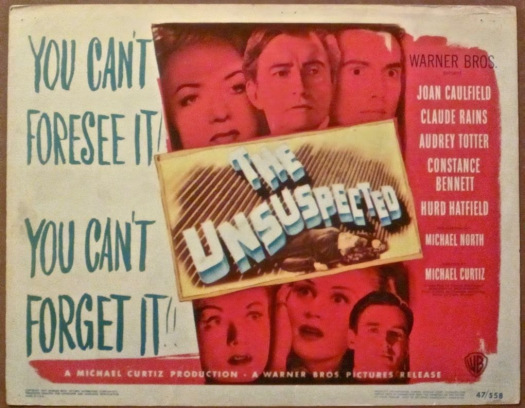
Claude Reigns Supreme: THE UNSUSPECTED (Warner Brothers 1947)


gary loggins's avatarcracked rear viewer

As a classic film blogger, I’m contractually obligated to cover film noir during the month of “Noirvember”, so every Tuesday this month I’ll be shining the spotlight on movies of this dark genre!


Claude Rains  received second billing in 1947’s THE UNSUSPECTED, but there’s no doubt who’s the star of this show. Nobody could steal a picture like Rains, as I’ve stated several times before – his sheer talent commands your attention! Here, he gives a chilling portrayal of a cold, calculating murderer in a Michael Curtiz noir based on a novel by Edgar Award-winning mystery writer Charlotte Armstrong, and runs away with the film. Joan Caulfield gets top billing, but let’s be honest – it’s Claude’s movie all the way!

The film begins with a frightening scene played mostly in shadow, as a figure creeps into the office of Victor Grandison (Rains) and murders his secretary Robyn Wright while…

View original post 608 more words

30 Days of Noir #6: Walk The Dark Street (dir by Wyott Ordung)


The 1956 film noir, Walk The Dark Street, opens with a platoon of soldiers fighting in the Korean War.

Dan Lawton (Don Ross) has been promoted to lieutenant and Sgt. Tommy Garrick (Eddie Kafafian) isn’t happy about it.  Despite the fact that he and Dan were once good friends, Tommy now is openly insubordinate.  Dan claims that Tommy is just jealous that Dan got promoted while Tommy didn’t.  Tommy, however, claims that Dan is too incompetent to lead the men.  He writes a letter to his older brother, Frank (Chuck Conners).  In the letter, Tommy says that, if he dies, Dan is to blame.  Shortly after sending the letter, Tommy is killed in battle.

After the war, Dan returns to the United States.  When he enlisted in the army, he left behind a small hardware store and now he’s returned to discover that the store’s insurance has lapsed and that he’ll need several thousand dollars to renew it.

While Dan tries to come up with a way to save his store, he also decides to pay a visit to Tommy’s brother.  Why does Dan drop by Frank’s apartment?  It’s difficult to say.  When Dan first shows up in Frank’s doorway, you assume that he’s going to praise Tommy or maybe seek some sort of forgiveness for Tommy’s death.  Instead, Dan just tells Frank that Tommy wouldn’t have gotten killed if he had followed orders (!) and then mentions that he and Tommy didn’t always get along (!!).  Like, seriously, what’s the point of telling Frank any of this?  What does Dan think that he’s accomplishing?

Frank doesn’t seem to be too upset over Tommy’s death.  In fact, Frank is actually a lot more interested in talking about his love of hunting.  Frank even shows Dan some film that he shot during his last safari, which means that those of us in the audience get to spend four minutes watching nature documentary stock footage that has little to do with the rest of the movie.  Frank explains that he has a heart condition so he can’t go abroad to hunt anymore.  Poor Frank!  But, hey, Dan’s going to be in Los Angeles for the next two days and Frank does still own a gun so maybe Frank could just hunt him!

At first, Dan’s not too enthusiastic about the idea of being hunted by Frank.  Frank, however, assures him that they won’t be using real bullets.  Instead, they’ll hunt each other with “camera guns.”  Apparently, you pull the trigger and, instead of firing a bullet, the gun fires a cartridge that takes a picture.  Dan’s still reluctant but then Frank offers to pay him $10,000.  You can renew a lot of insurance for $10,000!

Quicker than you can say “Most Dangerous Game!,” Frank is stalking Dan through Los Angeles.  What Dan doesn’t realize is that Frank was lying about using a camera gun.  He wants revenge for his brother’s death so he’s hunting Dan with live ammunition!

This is one of those films that probably sounds more interesting than it actually is.  After setting up an intriguing premise, Walk The Dark Street doesn’t really do much with it.  It turns out that neither Dan nor Frank is particularly clever so nearly the entire movie is just footage of them walking down various streets in Los Angeles.  If you’re a history nerd like me, you might get a kick out of seeing what the streets of Los Angeles looked like in the mid-50s but otherwise, there’s not much excitement to be found in this movie.

The film stretched its credibility to the breaking point when Dan, while trying to hide from Frank, just happens to randomly run into Tommy’s ex-girlfriend, Helen (Regina Gleason).  Whereas Frank is stoic to a fault and Dan is just an incredible dumbass, Helen at least gets to tell everyone off.  She’s not impressed with either Frank or Dan, which makes her the default audience surrogate.  Helen figures out what Frank is planning but Dan refuses to believe her because, again, Dan’s not very smart.  While it may not have been the film’s intention, it’s hard not to feel that Tommy had a point about Dan being incredibly incompetent.

Aside from offering a chance to see what Los Angeles looked like back in the 50s, Walk The Dark Street is largely forgettable.

30 Days of Noir #5: The Hoodlum (dir by Max Nosseck)


He’s a bad seed, that Vincent Lubeck!

At the start of the 1951 film, The Hoodlum, Vincent (played by the legendary Lawrence Tierney) is rotting away in prison.  Even though the parole board is considering whether or not to release him, things aren’t looking good for Vincent.  The warden (Gene Roth) has taken it upon himself to attend the parole hearing and remind them of Vincent’s long criminal record.  Vincent’s been in trouble for as long as he’s been alive.  The warden says that allowing Vincent to walk the streets will just make the streets even more unsafe.

However, Vincent’s mother (Lisa Golm) swears that she’ll keep an eye on Vincent.  She will give Vincent a place to live and she’s even arranged for Vincent to get a job at the family gas station, where he’ll be working under his brother, Johnny (played Lawrence’s younger brother, Edward Tienery).  Moved by a mother’s tears, the board grants Vincent parole.

Big mistake.  As soon as Vincent’s out of prison, he starts making plans to return to his old life.  He has no interest in working in a gas station and he resents Johnny’s success.  Vincent is the type of bum that steals his brother’s girlfriend, gets her pregnant, and doesn’t feel the least bit guilty when she jumps off a roof to her death.

Vincent’s also the type who always has a scheme going.  For instance, it turns out that his brother’s gas station is right across the street from both the town mortuary and the bank!  Soon, Vincent is hanging out with his old gang and plotting to rob an armored car.  Vincent’s not going to let anyone stand in his way.  Not the police.  Not his lover.  Not even his own brother.  The only person that Vincent seems to care about is his sickly mother and, even then, Vincent doesn’t actually care enough to stay out of trouble.

The Hoodlum is a low-budget gangster noir.  It’s only an hour long so it doesn’t waste any time.  Instead, it jumps straight into its often sordid story.  From the minute that Vincent gets out of prison, he’s greedily watching that bank and telling off anyone who looks at him funny.  What makes Vincent an especially despicable character is that he’s not even good at what he does.  If Vincent was some sort of criminal mastermind, you could at least get some sort of guilty pleasure out of watching him rob that armored car.  Instead, Vincent’s an idiot who not only messes up everything that he does but who isn’t even smart enough to understand that he’s screwed up.

Fortunately, Vincent is played by Lawrence Tierney.  Tierney was a veteran tough guy, an actor who played killers onscreen and who spent a good deal of his offscreen time sitting in jail.  (Tierney had a bad habit of getting into bar brawls.)  In the role of Vincent, Tierney is a force of pure, uninhibited destructive energy.  When he glares at his brother, you feel the resentment.  When he rushes at a security guard while holding a gun, you never doubt that he’s capable of using it.  Tierney gives such a raw and angry performance that you can’t stop watching him.  Vincent quickly overstays his welcome but Tierney remains a fascinating actor.

The Hoodlum is a short and brutal little movie, one that works best as a showcase for the intimidating talent of Lawrence Tierney.

Catching Up With The Films of 2018: Fifty Shades Freed (dir by James Foley)


“Mrs. Grey will see you now.”  (Insert your own eye roll GIF here.)

Occasionally, you see a film and, even though you know you should, you just never get around to reviewing it.  For instance, I saw Fifty Shades Freed when it was originally released in February and then I watched it again when it was released on DVD.  Both times, I thought to myself that I should write down my thoughts on the film, if for no other reason than the fact that I previously reviewed both Fifty Shades of Grey and Fifty Shades Darker for this site.  And yet, I never did.  To be honest, it was difficult to really think of anything to say about this movie that I hadn’t said about the previous two films.

Fifty Shades Freed opens with Christian (Jamie Dornan) and Ana (Dakota Johnson) getting married and going on their honeymoon.  It’s fun!  It’s sexy!  And it’s kinda creepy because, as always, Christian has control issues and he has to have his security team following them all over the place.  Christian freaks out with Ana removes her top on the beach.  Ana gasps at the sights of handcuffs.  There’s one hot sex scene that will temporarily make you forget about the fact that Jamie Dornan doesn’t seem to be that good of an actor.  It’s everything that you’d expect from a Fifty Shades honeymoon.

Unfortunately, the honeymoon ends way too quickly and then we have to deal with the marriage.  On the plus side, marrying Christian Grey means that you get to live in a really nice house and fly around in a private jet.  On the negative side, Christian is still basically an immature douchebag and, now that’s she rich, Ana has become a lot less likable.

Christian freaks out when he discovers that Ana is still using the name “Ana Steele” in her email address.  Ana explains that she’s Ana Steele at work but then, when she meets an architect named Gia Matteo (Arielle Kebbell), Ana tells her to stop flirting with her husband and announces, “You can call me Mrs. Grey!” with all the intensity of Kelly Kapowski announcing that she’s going to prom with Zach Morris on Saved By The Bell.

The marriage continues to play out like a perfume commercial written by Sartre’s bastard child.  Fortunately, there’s a few more sex scenes that are designed to again remind us that a good body can make up for a lack of everything else.  Unfortunately, Ana gets upset when Christian tries to humiliate her for real and a pouty Christian walks out of a shower as soon as Ana steps into it.  Ana is told that she’s pregnant and Christian totally freaks out because he still has all sorts of things that he wants to do with his money.  Christian’s a douchebag but he’s got a good body and he’s like super rich.  Have I already mentioned that?

Anyway, it turns out that Ana is being stalked by her former boss, Jack Hyde (Eric Johnson).  Fortunately, all of the stalking allows Ana and Christian to rediscover their love for each other.  There’s a kidnapping.  There’s a car chase.  There’s a lot of music and a lot of scenes of Dakota Johnson looking confused and Jamie Dornan looking blank.  It’s a Fifty Shades movie.  What else were you expecting?

The usual argument that critics tend to make with the Fifty Shades trilogy is that the movies are terrible but Dakota Johnson does the best that she can with the material.  Actually, both Dakota Johnson and Jamie Dornan are pretty lousy in all three of these films but Ana was at least kind of a sympathetic character in the previous two films.  Unfortunately, Fifty Shades Freed sees Ana and Christian becoming a boring married couple and what little chemistry Dornan and Johnson had in the previous films completely vanishes.  As a result, Ana doesn’t seem like someone lucky enough to have fallen in love with a man who just happens to be super wealthy.  Instead, she just comes across like someone who sold her soul for a private jet.

Fifty Shades Freed is the weakest of the trilogy, done in by the fact that there’s really not much of a story to tell.  Ana and Christian get to live blissfully ever after and it’s always good to see happy mannequins.  I saw this movie with my best friend and we talked through the entire movie and I imagine that’s what we’ll do every time we rewatch it.

30 Days of Noir #4: Lady in the Death House (dir by Steve Sekely)


The 1944 film, Lady in the Death House, tells the tragic and faintly ridiculous story of Mary Kirk Logan (Jean Parker).

The daughter of a small-time criminal, Mary has spent most of her life trying to escape from her family’s legacy of crime.  She’s even got a job, working at the same bank that her father once tried to rip off.  Of course, at work, everyone knows her as Mary Kirk and they have no idea that her father was the infamous Tom Logan.  If that information got out, Mary would lose her job and no longer be able to take care of herself or her younger sister, Suzy (Marcia Mae Jones).

One night, Mary is out on a date with a clumsy man who takes her out to a nightclub and manages to accidentally set Mary’s dress on fire.  Luckily, Dr. Brad Braford (Douglas Fowley) is there, having a drink with his friend, the famous criminologist, Charles Finch (Lionel Atwill).  Brad jumps into action, extinguishing the fire and saving Mary’s dress.  It’s love at first sight.

There’s just one problem.  Dr. Bradford is studying ways to bring the dead back to life and, in order to raise money for his research, he’s been working as the state’s executioner.  When someone goes to the electric chair, Brad is the one who pulls the lever.  Mary says that she can only marry Brad if he gives up his electrifying night job.

However, before Brad can turn in his letter of resignation, Mary is arrested for the murder of Willis Millen (Dick Curtis), a crook who once knew her father.  Mary swears that she’s innocent but there are two eye witnesses who testify that they not only heard Mary and Willis fighting but that they also saw the shadow of someone hitting Willis over the head with a lamp.  It doesn’t take long for the jury to reach a verdict:

I have to admit that, when this newspaper appeared on-screen, I was actually more curious about the “youth” who was arrested for stealing glitter off of campaign signs.  However, for whatever reason, the film declines to follow up on that story.  Instead, we watch as Mary goes to death row, with the knowledge that she is to die “at the hand of the man I love.”

However, there may still be hope!  Charles thinks that Mary is innocent.  Though there’s only 24 hours left before Brad is scheduled to execute Mary, Charles launches an investigation of his own.  But even if Charles is able to find the evidence that exonerates Mary, will he be able to contact the governor in time?  Or will Mary go to the chair?

Well, regardless of what happens, rest assured that this World War II-era film will end with an appeal for all movie goers to do the right thing and buy war bonds.

Lady in the Death House is an entertaining but fairly ludicrous little movie.  I mean, realistically, having the executioner execute his own fiancée is a huge conflict of interest.  It seems like they could have gotten a substitute executioner, if just for one night.  But, if they did that, we wouldn’t get the melodramatic highlight of Mary announcing that she’s scheduled to be killed “by the hand of the man I love.”

Lady in the Death House provides a rare chance to see Lionel Atwill in a heroic role.  The British actor played a countless number of mad scientists, killers, and Nazis before his premature death in 1946.  (Atwill’s promising career was derailed in 1943, when he accused of hosting orgies at home and was subsequently convicted of perjury.  That’s one reason why Atwill turned up in a “poverty row” feature like this one.)  Atwill is convincing as Charles Finch.  The same superior attitude that made him a good villain also makes him believable as the only person capable of figuring out who murdered Willis Millen.

Taking on its own terms, Lady in the Death House is a fun movie.  If nothing else, it provides a lesson on how to get a message to the governor, even if no one’s quite sure where he is for the evening.  That’s an important lesson to learn!

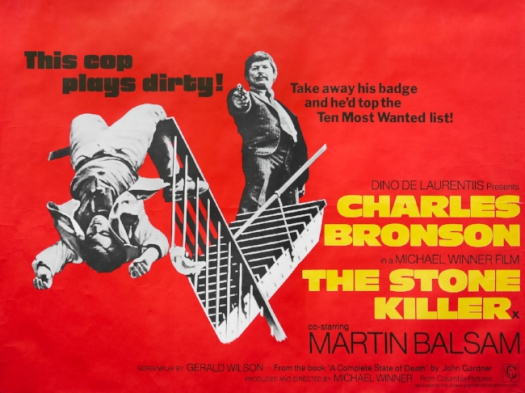
Happy Birthday Charles Bronson!: THE STONE KILLER (Columbia 1973)


gary loggins's avatarcracked rear viewer

Charles Buchinsky was born November 3, 1921 in the coal-country town of Ehrenfield, PA to a Lithuanian immigrant father and second-generation mother. He didn’t learn to speak English until he was a teen, and joined the Air Force at age 23, serving honorably in WWII. Returning home, young Charles was bitten by the acting bug and made his way to Hollywood, changing his last name to ‘Bronson’ in the early fifties. Charles Bronson spent decades toiling in supporting parts before becoming a name-above-the-title star in Europe.

By the 1970’s, Bronson had begun his long run as an action star. THE STONE KILLER capitalizes on the popularity of Cop and Mafia movies of the era, with Our Man Bronson as Lou Torrey, a Dirty Harry-type who shoots first and asks questions later. After he kills a 17-year-old gunman in the pre-credits opening, Torrey is raked over the coals by the New…

View original post 398 more words

30 Days of Noir #3: Footsteps in the Night (dir by Jean Yarbough)


The 1957 film Footsteps in the Night opens in a small motel apartment in Los Angeles.

Jazz blares from a record player.  Playing cards are spread across a table.  A cigarette burns in an ashtray while a stack of poker chips sits undisturbed nearby.  When the apartment’s resident, Henry Johnson (Douglas Dick) steps into the room, he nearly stumbles over the dead body that’s lying in the middle of the floor.

Henry looks down at the body.  Is he shocked?  Is he scared?  Is he regretful?  Is he guilty?  It’s impossible to tell from his somewhat perturbed but mostly blank facial expression.  He takes in the scene and then promptly turns out the lights.

The dead man is Henry’s neighbor, Fred Horner (Robert Shaye).  When the police arrive, Detectives Andy Doyle (Bill Elliott) and Mike Duncan (Don Haggerty) immediately deduce that someone murdered Fred in the middle of a poker game.  Since everyone says that Henry was not only a degenerate gambler but that he also frequently got into arguments with Fred, Henry becomes the number one suspect.  Not helping Henry’s case is the fact that he’s disappeared and his girlfriend, Mary Raiken (Eleanore Train), won’t reveal where he’s hiding.

It seems like an open-and-shut case but Doyle has his doubts.  The case against Henry is almost too perfect and Doyle wonders if maybe they’re overlooking something.  As Doyle and Duncan continue to investigate, they discover that Fred Horner was an angry and misanthropic man.  They also discover that there’s a salesman named Bradbury (James Flavin) who is staying at an adjacent hotel and who bears a strong resemblance to the dead man….

Clocking in at just 62 minutes, Footsteps in the Night is a fast-paced police procedural with elements of film noir tossed in for good measure.  While I was doing some research for this review, I discovered that Footsteps in the Night was actually the fifth and final film in which Bill Elliott played Detective Andy Doyle.  Before taking on the role of Doyle, Elliott appeared in several westerns and he plays Doyle much like an ideal frontier sheriff.  He’s a no-nonsense lawman who solves cases with common sense and doesn’t have much time for wild speculation.  Dan Haggerty backs him up as the equally no-nonsense Mike Duncan.  As opposed to the modern tendency to celebrate cops who “break the rules,” Footsteps in the Night emphasizes the professional, by-the-book attitude of Doyle and Duncan.  If you were ever murdered, Duncan and Doyle are the type of cops that you would want assigned to the case.

As for their number one suspect, Henry may claim to have just been an innocent bystander but his gambling addiction makes him less than trustworthy in the eyes of many cops.  It’s only when Doyle and Duncan start to dig into the case that they discover just how cruelly Fred manipulated Henry’s addiction.  In the best tradition of many murder mysteries, Footsteps in the Night not only leaves you wondering who the murderer may have been but also whether or not the victim may have gotten what he deserved.

Footsteps in the Night is a good police procedural.  I look forward to watching and reviewing the other four films in which Bill Elliott played Detective Doyle as well.

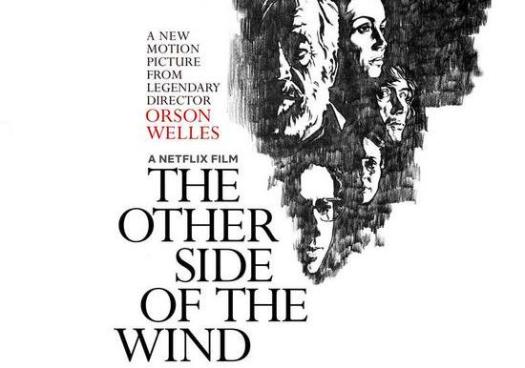
What A Long, Strange Trip It’s Been: Orson Welles’ THE OTHER SIDE OF THE WIND (Netflix 2018)


gary loggins's avatarcracked rear viewer

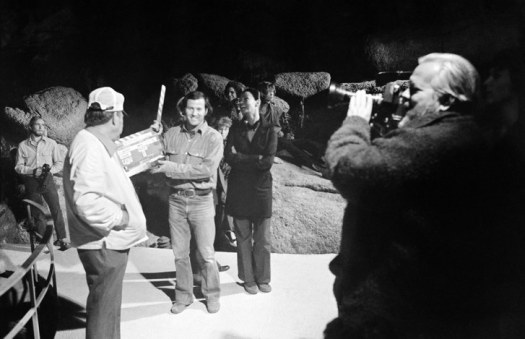
The day has finally arrived. November 2, 2018. I ordered a free trial of Netflix specifically so I could watch the completed version of Orson Welles’ final film, THE OTHER SIDE OF THE WIND . Welles worked on this project for over a decade, and the footage sat for decades more before finally being restored and re-edited. A film buff’s dream come true – perhaps. There were questions I needed answered. Was there enough salvageable material to make a coherent movie? Does it follow Welles’ vision? Would it live up to the hype? Was it worth the wait?

The answer: OH, HELL YEAH!!

Welles shot over ten hours of film, utilizing different film stocks (Super 8, 16mm, 35mm), switching back and forth from color to classic black and white, to create his movie, which is a documentary about the movie-within-the-movie’s director – a movie-within-a-movie-within-a-movie. It took six years (from 1970-76)…

View original post 719 more words

Film Review: Billionaire Boys Club (dir by James Cox)


Have patience.  This is kind of a long story.

Billionaire Boys Club, a fact-based film about two murders that occurred back in the greed and cocaine-filled 80s, was first announced in 2010.  After five years of pre-production, the film started shooting in 2015.  It featured up-and-coming stars Ansel Elgort and Taron Egerton in the lead roles and Emma Roberts in a key supporting role.  It also featured a certain two-time Oscar-winning actor, who we will talk about shortly.  There was speculation that Billionaire Boys Club could be an Oscar contender.  At the very least, that two-time Oscar-winning actor might pick up another supporting nomination.  Shooting started in December of 2015 and wrapped in January of 2016.

And then …. nothing.

What happened?

Kevin Spacey happened.  On October 29th, 2017, Anthony Rapp told how, when he was 14, an intoxicated Kevin Spacey made a sexual advance towards him.  Subsequently, 15 other people came forward with stories about Spacey making similar advances towards them.  At the time, the Oscar-wining actor had key supporting roles in two upcoming films: All The Money In The World and Billionaire Boys Club.  The producers of All The Money In The World replaced Spacey with Christopher Plummer and hastily refilmed all of his scenes.

Unfortunately, that really wasn’t an option for the producers of Billionaire Boys Club.  Whereas Spacey’s role in All The Money In The World was basically an extended cameo, he was a key part of Billionare Boys Club.  Spacey had been cast as Ron Levin, a flamboyant con man whose murder led to the collapse of an 80s investment firm.  There was really no feasible way to replace Spacey without reshooting the majority of the film.  As a result, Billionaire Boys Club sat a while in limbo before finally getting an extremely limited release back in July.  On opening day, the film made a total of $126.  (The final weekend gross was $618.)

As for the film itself, the behind the scenes drama is far more interesting than anything that actually happens on screen.  Elgort and Egerton play Joe Hunt and Dean Karny, two middle-class guys who want to be rich in the 80s.  They do this by starting an investment firm called Billionaire Boys Club and, for a few months, everything seems to be perfect.  They appear to be making money.  They drive nice cars and live in big mansions and throw big parties.  There’s all the usual stuff that you expect to see in films about rich twentysomethings: cocaine, swimming pools, black lingerie, and fast cars.  In fact, that’s kind of the problem with the film.  There’s nothing surprising about what happens to Joe and Dean.  If you’ve seen Wolf of Wall Street, you’ve seen it all before.  In fact, if anything, the film’s recreation of greed-fueled decadence is almost too tame.  I mean, sure — we get the shot of the lines of cocaine getting snorted off a counter top but it’s hardly the mountain of coke that usually shows up in a movie like this.  If anything, this movie needed more cocaine.

Of course, everything eventually falls apart.  It turns out that Ron Levin, their main financial backer, was actually a con man who had managed to trick everyone into thinking that he was a millionaire.  In the end, it all leads to two murders, one prison sentence, and one new life in the witness protection program.

The film tries to critique the culture of greed but it fails because it never seems to understand why that culture would be so attractive to two guys like Joe and Dean in the first place.  Despite the efforts of Elgort and Egerton, Joe and Dean just come across as being two ciphers who maybe watched Wall Street one too many times.  It’s never clear what made these two click or why they were able to trick so many people into believing in them.  Unlike something like The Wolf of Wall Street, Billionaire Boys Club is so busy scolding everyone for being greedy that it never acknowledges that being rich can also be a lot of fun.  (It doesn’t help that Billionaire Boys Club features first person narration, which often leads to the film telling us what it should be showing us.)

As for Kevin Spacey, he gave the same performance that he gave in any number of similar films.  He’s arch and sarcastic and sometimes ambiguously flamboyant.  He gets upset whenever anyone says anything against his dog.  When he announces that he’s a “hustler” and brags about how he can get away with anything because he’s convinced people that he’s something that he’s not, it’s hard not to cringe.  It’s not really a bad performance, as much as it just kind of a predictable one.  It feels destined to be remembered only for being Spacey’s final appearance in a feature film.

Billionaire Boys Club will be making its Showtime premiere later tonight.  It’s not a terrible film but it’s not a particularly memorable one either.