Ranking The Films of Quentin Tarantino


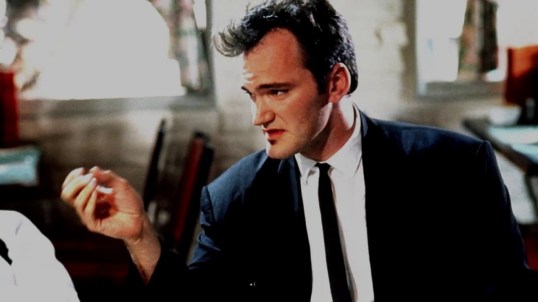
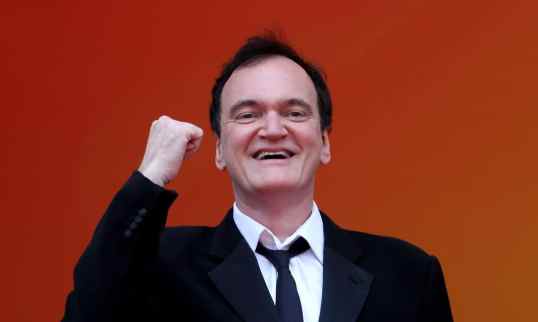
Since Today is Quentin Tarantino’s 57th birthday, I figured this would be a good time to rank the ten films that he’s directed so far!

Please note that I have not included things like Natural Born Killers, True Romance, Four Rooms, Sin City, or those episodes of CSI and ER on the list below.  These are just the feature films that Tarantino has directed.

So, without further ado, for worst to best, here are the ten film of Quentin Tarantino:
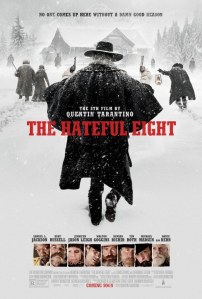
10) The Hateful Eight (2015)

The Hateful Eight is one of those films that people either seem to love or hate.  I personally think that it’s the one Tarantino film in which QT truly stepped over the line and became a parody of himself.  From the punishing run time to the lengthy “chapters” that went nowhere to the overwritten dialogue that read more like someone trying to write like Tarantino than Tarantino himself, The Hateful Eight is my least favorite of his films.  For me, the final straw was when — after already having forced audiences to endure two and half hours of this film — Tarantino stopped the action completely for a totally unnecessary flashback that apparently only existed so Tarantino could work in a Zoe Bell cameo.
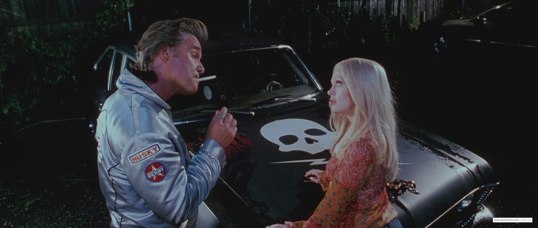
9) Death Proof (2007)

Oh, Death Proof.  I really liked Death Proof the first time that I saw it but whenever I’ve tried to rewatch it, it’s been a struggle to get through it.  Yes, Kurt Russell is great as Stuntman Mike and, unlike her previously mentioned cameo in The Hateful Eight, Zoe Bell is a welcome addition to Death Proof‘s ensemble.  But oh my God, why doesn’t the film just start in Tennessee?  Why do we have to suffer through all of that crap in Austin?
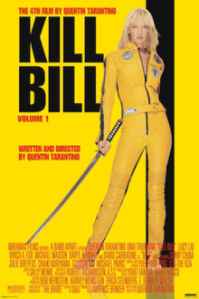
8) Kill Bill: Volume One (2003)

Now, it may seem like I’m ranking the first volume of Kill Bill fairly low on the list but you have to understand that, as far as I’m concerned, Tarantino has only made two bad films.  Kill Bill: Volume One is an exciting thriller and it not only features Uma Thurman at her best but it also has some of the best and most energetic fight scenes of all time.  If Kill Bill: Volume One seems ranked low, it’s just because it has some truly tough competition to deal with.
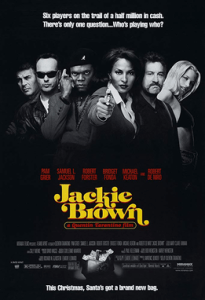
 

7) Jackie Brown (1997)

The first time I saw Jackie Brown, I thought it was a bit too slow and I guess I didn’t really “get” it.  As I’ve gotten older, I’ve come to better appreciate this surprisingly low-key and rather sad film.  Jackie Brown features Tarantino in the type of contemplative mood that he wouldn’t really return to until making Once Upon A Time In Hollywood.
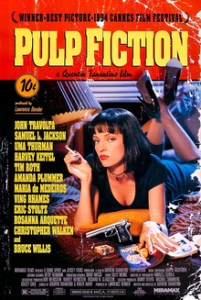
6) Pulp Fiction (1994)

One of the most influential films ever made, Pulp Fiction was not only the first of Tarantino’s first film to be nominated for an Oscar but it was also his first film to truly establish that his filmography takes place in its own separate, pop culture-centered universe.  If there’s anything that’s keeping Pulp Fiction from being listed higher, it’s the painfully self-indulgent taxi cab conversation between Bruce Willis and Angela Jones and Quentin Tarantino’s own terrible cameo as Jimmy, the casually racist homeowner.  That said, this is still one of the most — if not the most — essential film for the 90s.  If you want to understand that decade, you have to watch Pulp Fiction.
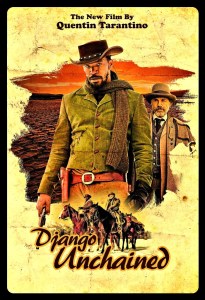
5) Django Unchained (2012)

Despite the fact that it features one of Leonardo Di Caprio’s worst performances (I know I’m the only one who thinks that), Django Unchained is still Tarantino at his most provocative and angry.  After decades of Hollywood films that attempts to explain away the history and legacy of slavery or that suggested that racism could easily be overcome, Tarantino and Django stepped up to say, “Fuck that.”  While the film received a lot of attention for its violence, I think it revealed that Tarantino is an artist with a conscience.  When Christoph Waltz speaks against the evils of slavery, it’s obvious that he’s speaking for Tarantino as well.  In much the same fashion of 12 Years A Slave (which would come out a year later), Django Unchained doesn’t flinch away from showing the horrors of slavery.
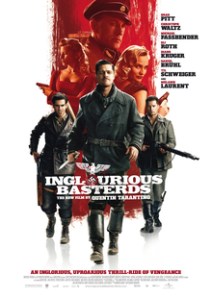
4) Inglourious Basterds (2009)

With Inglourious Basterds, Tarantino showed how art could be used to fix history’s mistakes.  In reality, many of the leaders of Nazi Germany escaped justice by committing suicide.  In Inglourious Basterds, they get blown away by a group of Jewish soldiers.  The film itself features some of Tarantino’s best set pieces and one of his best casts.  Despite the film’s length, this is also one of the few Tarantino films where there’s not a single scene that you can look at and say, “Well, that could have been cut.”  For once, every minute of the run time is needed to tell the film’s story.  Christoph Waltz became the first actor to win an Oscar for appearing in a Tarantino film.

3) Kill Bill: Volume Two (2004)

The Kill Bill saga concludes in grand fashion in Kill Bill: Volume Two.  For all of the fights and the violence, this film is more about accepting the consequences of your actions.  Uma Thurman and David Carradine give great performances but the heart of the film belongs to poor Michael Madsen, sitting in his trailer and waiting for justice to come and get him.  The scene where Thurman digs herself out of her grave is a justifiable classic and the final confrontation between Carradine and Thurman is Tarantino at his best.
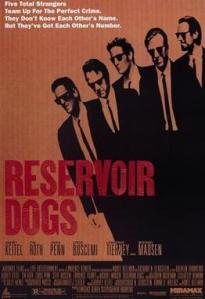
2) Reservoir Dogs (1992)

Tarantino’s debut film is still one of the most exciting and, in it’s way, funniest crime films ever made.  Every line is quotable.  Every performance is perfect.  Every song on the soundtrack is perfectly selected.  Who can forget Harvey Keitel’s incoherent scream of pain as he realizes that he’s been betrayed?  Personally, I just hope Mr. Pink escaped with the diamonds.


1) Once Upon A Time In Hollywood (2019)

Tarantino’s latest film is also his best, a love letter to the movies and the actors whose legacies live on in his own films.  For all the criticism that the film took for Margot Robbie’s lack of dialogue, her performance as Sharon Tate is the perfect epitome of everyone’s fantasy of what Hollywood was like in the years before the Manson murders made everyone lock their doors.  Leonardo Di Caprio and Brad Pitt are perfectly cast as Rick and Cliff and the film’s finale may be bloody but, at the same time, it corrected history in much the same way that Inglorious Basterds did.  By the end of the film, Rick Dalton knows that he’ll probably never be as big of a star as he could have been but at least he’s made some new friends.  He’s been accepted, in much the same way that a somewhat dorky former Hollywood video store clerk was eventually accepted by a film industry that, at first, wasn’t sure what to make of him.

Happy birthday, Quentin Tarantino!
18 Days of Paranoia #14: The Organization (dir by Don Medford)


Sidney Poitier played Detective Virgil Tibbs for the third and final time in the 1970 film, The Organization.

This time, Virgil is investigating a murder at an office building in San Francisco.  It’s a very odd murder, in that an executive was shot, a security guard was bludgeoned, and even though it looks like there was a robbery taking place, nothing appears to have actually been stolen.  Since neither the company nor the executive were believed to be involved in anything shady, Virgil finds himself perplexed as to why any of this has happened at all.

Fortunately, the local urban revolutionaries are here to help!  They contact Virgil and Virgil reluctantly agrees to meet with the group, which is made up of the usual collection of angry 1970s activists — i.e., a dissident preacher, a reformed drug dealer, a guy who won’t stop yelling, and a woman who is obviously going to be killed before the movie is over.  The revolutionaries explain that they were the ones who broke into the office but they also say that they didn’t kill anyone.  Instead, they broke into the office because they wanted the police to investigate the break-in and discover that the company was a front for a bunch of drug dealers.  “The Organization” is flooding poor and minority neighborhoods with heroin and the revolutionaries want to stop them.  In fact, the revolutionaries have stolen four million dollars worth of heroin.  Now, they want Virgil to help them.

Even though Virgil is sympathetic to the revolutionaries, he’s still a cop and he can’t get directly involved with illegal activities.  Instead, he agrees to not arrest the revolutionaries and to continue his investigation, in the hope of bringing down the Organization.  It’s not going to be easy, of course.  There’s evidence that the Organization may even have agents inside the San Francisco police department.

As far as the Virgil Tibbs movies are concerned, The Organization is slightly better than They Call Me Mister Tibbs! but it’s nowhere near as good as the one that started it all, In The Heat of the Night.  Probably the biggest flaw with The Organization is that Virgil has to share the spotlight with the revolutionaries.  With the exception of Raul Julia (who plays a former drug dealer named Juan), none of the revolutionaries are particularly memorable characters and their plan for taking down The Organization is so unnecessarily convoluted that it’s hard to believe that Virgil would go along with it.

On the plus side, The Organization works fairly well as a conspiracy thriller.  It does manage to create a consistent atmosphere of unease and mistrust.  This is one of those films where people are constantly getting shot by unseen gunmen mere minutes after getting arrested and the fact that even cool and in-control Virgil Tibbs can’t save them does a lot towards creating a nice sense of paranoia.  The films end on perhaps the most downbeat note of all of the Virgil Tibbs movies, suggesting that, in the end, everything we’ve just watched was for nothing.


Other Entries In The 18 Days Of Paranoia:

  1. The Flight That Disappeared
  2. The Humanity Bureau
  3. The Private Files of J. Edgar Hoover
  4. The Falcon and the Snowman
  5. New World Order
  6. Scandal Sheet
  7. Cuban Rebel Girls
  8. The French Connection II
  9. Blunt: The Fourth Man 
  10. The Quiller Memorandum
  11. Betrayed
  12. Best Seller
  13. They Call Me Mister Tibbs


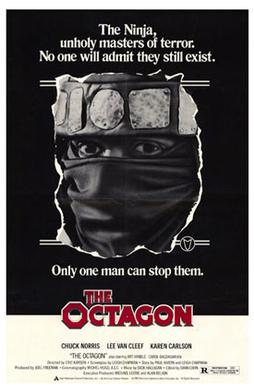
The Octagon (1980, directed by Eric Karson)


A ninja named Seikura (Tadashi Yamashita) is running a training camp where he shows mercenaries and terrorists how they can use martial arts to assassinate their enemies and disrupt the political system.  Someone has to stop him.

This looks like a job for CHUCK NORRIS!

In this one, Chuck plays Scott James, a retired karate champion who, though a massive series of apparently unrelated coincidences, is drawn into the fight against Seikura’s terrorists.  (Speaking of coincidences, Seikura just happens to be Scott’s half-brother.)  One of the fun things about The Octagon is that there’s no real rhyme-or-reason as to how Scott gets involved.  He just keeps running into people who want him to fight terrorists.  His former mentor (played by Lee Van Cleef) tries to recruit him.  Immediately after turning him down, Scott just happens to run into a woman (Karen Carlson) who is having car trouble and the woman tries to recruit him.  Scott’s old friend, A.J. (Art Hindle) tries to recruit him.  Even a dancer (Kim Lankford) who goes out on a date with Scott is more interested in talking about the terrorists than anything else.  Even when the terrorists decide to go after Scott, it’s mostly just because he keeps talking to their enemies.

Scott does eventually get involved.  He goes undercover, which means that he gives everyone a fake last name while asking them if they know where he can sign up for the terrorist training camp.  (But he doesn’t shave his mustache or anything else so he’s still obviously Chuck Norris.)  Eventually, Aura (Carol Bagdasarian) defects from the terrorists over to Scott’s side and the two of them launch an assault on the terrorist camp.  While this is all going on, Scott has doubts about whether or not he can really defeat his half-brother and we hear them in voice over.  It’s an interesting attempt to show what’s going on in an action hero’s head but, because Chuck was such an inexpressive actor early in his career, the contrast between his worries and his stone face creates a strange effect.

It doesn’t matter, though, that Chuck wasn’t an expressive actor or that the film’s plot is needlessly convoluted.  The fight scenes are frequent and they all rock and that’s what really matters.  Chuck throws a lot of punches and kicks in this film and, as opposed to some of his other early films, the director of The Octagon made sure that we could see every single one of them.  Whether he’s fighting in a small hotel room and fighting off a dozen enemies in the terrorist camp, Chuck’s exciting to watch.  Also exciting to watch is Carol Bagdasarian, who makes her role more than the typical action movie love interest.  At times, she seems like she might even be a deadlier opponent than Chuck himself!

Finally, Lee Van Cleef!  In this one, he drives a truck with a “Have You Hugged Your Gun Today?” bumper sticker.  No film featuring Lee Van Cleef can be that bad.  In fact, most, like The Octagon, are pretty damn entertaining.

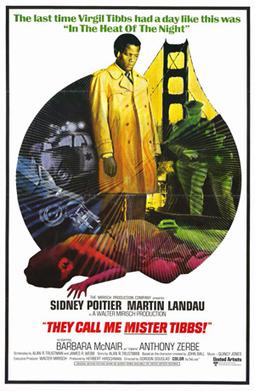
18 Days of Paranoia #13: They Call Me Mister Tibbs! (dir by Gordon Douglas)


The 1970 police procedural, They Call Me Mister Tibbs!, opens with a murder in San Francisco.

A prostitute has been found dead in a sleazy apartment building and, according to witnesses, she was visited, shortly before her death, by the Reverend Logan Sharpe (Martin Landau).  Rev. Sharpe is a prominent civic leader, an outspoken liberal who is a friend of the civil rights movement.  Sharpe is currently at the forefront of a campaign to pass a city referendum that will add a “mini city hall” to every neighborhood and will help to fight against the gentrification of San Francisco.  If Sharpe’s guilty, it will mean the death of the referendum.

Despite the fact that there’s a ton of evidence piling up against him and he kind of comes across as being a little bit creepy (he is, after all, played by Martin Landau), Rev. Sharpe insists that he’s innocent.  Yes, he’s been visiting prostitutes but he’s not a client.  No, of course not!  Instead, Sharpe explains that he’s simply counseling them and praying for their souls.  In fact, as far as Sharpe is concerned, this whole thing is just an attempt by the establishment to discredit his efforts to help the poor and underprivileged.

Heading up the investigation is a friend and supporter of Sharpe’s, Detective Virgil Tibbs (Sidney Poitier).  That may seem like a good thing for Sharpe, except for the fact that Tibbs is an honest cop and he’s not the type to let friendship stand in the way of doing a thorough investigation.  Tibbs admits that he supports Sharpe’s campaign and he wants the reverend to be innocent.  But Tibbs is all about justice.  Whether it’s teaching his son an important lesson about smoking or tracking down a potential serial killer, Virgil Tibbs is always going to do the right thing.

There are other suspects, all of whom are played by suitably sinister character actors.  Anthony Zerbe plays a criminal who lived near the prostitute.  Ed Asner plays her landlord, who may have also been her pimp.  Is Sharpe being set up by the powers that be or is Tibbs going to have to arrest a man whom he admires?

They Call Me Mister Tibbs! was the second film in which Sidney Poitier played Virgil Tibbs.  The first time he played the role was in 1967, when he co-starred with Rod Steiger in the Oscar-winning In The Heat of the Night.  In that film, Poitier was a Philadelphia cop in the deep south who had to work with a redneck sheriff.  In They Call Me Mister Tibbs!, Virgil is now working in San Francisco and he has to work the case on his own.

They Call Me Mister Tibbs! is a far more conventional film than In The Heat of the Night.  Whereas In The Heat of the Night had a wonderful sense of place and atmosphere, They Call Me Mister Tibbs! could just as easily have taken place in Los Angeles, Phoenix, or even Philadelphia.  With the exception of some slight profanity, They Call Me Mister Tibbs! feels more like a pilot for a TV show than an actual feature film.  Perhaps the biggest problem with the film is that there’s no real surprises to be found within the film.  You’ll guess who the murderer is within the first 10 minutes of the film and you’ll probably even guess how the movie will eventually end.

On the plus side, just as he did in In The Heat of the Night, Sidney Poitier brings a lot of natural authority to the role of Virgil Tibbs.  He’s actually allowed to show a sense of humor in this film, which is something that the character (understandably) couldn’t do while he was surrounded by bigots and rednecks during his previous adventure.  Virgil gets a few family scenes, where we watch him interact with his wife and his children.  The scenes feel out of place but, at the same time, Poitier plays them well.

With Sharpe attempting to get his referendum passed and the possibility that riots could break out if Sharpe is indeed guilty of murder, there’s a slight political subtext to They Call Me Mister Tibbs!  Sharpe’s argument that he was being set up by the establishment undoubtedly carried a lot of weight in 1970.  Still, this is ultimately a shallow (if adequately entertaining) film that, for the most part, is only made memorable by Poitier’s commanding performance.

Other Entries In The 18 Days Of Paranoia:

  1. The Flight That Disappeared
  2. The Humanity Bureau
  3. The Private Files of J. Edgar Hoover
  4. The Falcon and the Snowman
  5. New World Order
  6. Scandal Sheet
  7. Cuban Rebel Girls
  8. The French Connection II
  9. Blunt: The Fourth Man 
  10. The Quiller Memorandum
  11. Betrayed
  12. Best Seller

Cobra (1986, directed by George Pan Cosmatos)


“You’re the disease.  I’m the cure.”

When a madman pulls out a gun in the middle of a supermarket, he starts out by firing at the produce department.  He doesn’t shoot at anyone who works in the produce department.  Instead, in slow motion, he blows away cabbages and apples.  Then he shoots a shopping cart.  He finally gets around to shooting one innocent bystander after telling him to walk down an aisle.

Outside the supermarket, a 1950 Mercury Monterey Coupe pulls up.  The personalized license plate reads Awsum 50.  The car’s driver (Sylvester Stallone) steps out of the car.  His name is Lt. Cobretti but everyone calls him Cobra.  Detective Monte (Andy Robinson, who played the killer in Dirty Harry) tells Cobra to stay out of it.  Cobra ignores him and goes into the store.

The guman raves that he’s a part of the “new world.”

“You wasted a kid for nothing,” Cobra says.  “Now, I think it’s time to waste you.”

And then Cobra does just that.

After getting yelled at by his superiors, Cobra drives back to his apartment, throws away his mail, and uses a pair of scissors as an eating utensil.  Just another day in the life of Cobra.

If you hadn’t already guessed, Cobra is the ultimate Sylvester Stallone-in-the-80s Cannon film.  In 1985, Stallone could do any film that he wanted to and, even if he wasn’t the director, the job was usually given to someone who wouldn’t stand in the way of letting Sly achieve his vision.  (That vision usually involved Stallone getting all of the good shots while everyone else dove for cover.)  Stallone is credited as the writer of Cobra and whatever else you can say about the man and his films, Stallone the screenwriter knew exactly what Stallone the actor was good at.  There’s not much meaningful dialogue in Cobra and most of it is made up of either Stallone threatening to shoot people or characters like the Night Slasher (Brian Thompson) bragging about how Cobra can’t touch him because of the constitution.  There is more intentional humor in Cobra than I think most people realize and there are a few scenes that only make sense if you accept that Stallone was poking fun of his own monosyllabic image.  For the most part, though, Cobra is nonstop violence from beginning to end.

Amazingly, Cobra started out as Beverly Hills Cops.  Before Eddie Murphy was cast as Axel Foley, Beverly Hills Cop was briefly meant to be a Sylvester Stalllone film.  Stallone, however, rewrote the script and took out most of the humor.  After the film’s producers reminded Stallone that they were trying to make a comedy, Stallone left the project and most of his ideas ended up in the script for Cobra.  The film features a murderous cult, led by the knife-wielding Night Slasher, that is determined to destroy anyone who they think is standing in the way of the “new world.”  Only Cobra can both stop them and also protect the life of their latest target, a model named Ingrid Knudsen (Brigitte Nielsen).  It’s hard to imagine Eddie Murphy dealing with any of this but it’s perfect for Stallone.

Cobra is a live-action cartoon and Cobra’s battle with the Night Slasher should be taken as seriously as He-Man’s battles with Skeletor.  The Night Slasher has no motivation beyond just being evil, Cobra never runs out of bullets or takes even a piece of shrapnel despite having hundreds of cultists shooting at him, and there’s an extended sequence where Ingrid poses with life-size robots.  Cobra chews on a toothpick and wears dark glasses and that’s all the personality he needs.  After all, crime is the disease and he’s the cure.


18 Days of Paranoia #12: Best Seller (dir by John Flynn)


The 1987 film, Best Seller, tells the story of two men, both equally capable of violence but with two very different moral codes.

Dennis Meechum (Brian Dennehy) is a cop who also writes true crime.  In the early 70s, he was the one of several cops who were attacked by a group of gunmen who were all wearing Richard Nixon masks.  Though he was shot, Meechum survived and he even managed to stab one his assailants.  15 years later, Meechum is still haunted by the incident.  Meechum is a brawler who doesn’t have much time for nonsense but he also has a strong moral code (or so he thinks).

Cleve (James Woods) talks fast and always seems like he’s a little bit nervous.  He has a quick smile and a joke for almost every occasion.  He’s also a professional assassin, a sociopath who is very interested in Dennis.  Cleve has spent the majority of his life working for a powerful businessman named David Madlock (Paul Shenar) but he’s recently been laid off.  Cleve wants revenge and he thinks that Dennis can help him get it.

Together …. THEY FIGHT CRIME!

Well, actually, they kind of do.  Madlock’s done a lot of illegal stuff and Cleve and Dennis are exposing him, his crooked corporation, and all of his powerful connections.  However, what Cleve really wants is for Dennis to write a best seller about his life.  Cleve wants Dennis to write his story and most importantly, he wants Dennis to make him the hero.  Dennis is still a cop and says that once all this is over, he’s going to have to arrest Cleve.  Of course, eventually, he discovers that Cleve was the man who shot him 15 years earlier.  At that point, Dennis says that he’s going to have to kill Cleve once all of this is over.

As a crime thriller, Best Seller hits all of the expected beats.  As soon as we find out that Dennis is a widower and that he has a teenage daughter, we know that she’s eventually going to be taken prisoner by the bad guys.  For that matter, we can also guess that there will be a few scenes where Cleve insists that Dennis is just like him.  When Cleve starts telling people that Dennis is his brother, it’s a fun scene because it’s well-acted by both Woods and Dennehy but it’s not exactly surprising.

But no matter!  Though the the overall plot may be predictable, there’s enough clever little twists and details that the film holds your interest.  For instance, there’s an extended sequence where Dennis insists that Cleve introduce him to his family.  For the next few minutes, the film stops being an action thriller and instead becomes a bit of a domestic comedy as Dennis meets Cleve’s friendly family, none of whom are aware that Cleve is a ruthless killer.  The stuff with Cleve’s family doesn’t move the plot forward but your happy it’s there because 1) James Woods gives a great performance in those scenes and 2) it suggests that the film (which was written by Larry Cohen and directed by John Flynn, who was previously responsible for the brilliant Rolling Thunder) has more on its mind than just shooting people.

The main reason why Best Seller works so well is because the two leads are perfectly cast.  Brian Dennehy was born to play tough cops while James Woods gives one of his best performances as the unstable but likable Cleve.  I’ve actually had people get made at me for saying that James Woods is a good actor, simply because they disagree with his politics.  But, when it comes to art and talent, I don’t care about anyone’s politics.  (I mean, if I only watched movies starring people whose politics where approved by Film Twitter, I would end up spending the entire pandemic watching romantic comedies starring Alec Baldwin and Rosie O’Donnell and why should I suffer like that?)  James Woods is a good actor and he’s great in Best Seller.

Other Entries In The 18 Days Of Paranoia:

  1. The Flight That Disappeared
  2. The Humanity Bureau
  3. The Private Files of J. Edgar Hoover
  4. The Falcon and the Snowman
  5. New World Order
  6. Scandal Sheet
  7. Cuban Rebel Girls
  8. The French Connection II
  9. Blunt: The Fourth Man 
  10. The Quiller Memorandum
  11. Betrayed

Tom Horn (1980, directed by William Wiard)


Today would have been Steve McQueen’s 90th birthday.

Sadly, McQueen died in 1980 at the absurdly young age of 50.  In life, McQueen never got as much respect as he deserved as an actor but in death, he’s been rediscovered as not just an icon of cool but also as an underrated actor who, much like Clint Eastwood, could say a lot without uttering a word.  (Be sure to read Marshall Terrill’s biography of McQueen.)  When Steve McQueen (as played by Damian Lewis) showed up in Once Upon A Time In Hollywood, it seemed appropriate.  McQueen and Tarantino both seem made for each other, even if McQueen died long before Tarantino even wrote his first screenplay.

McQueen made two films shortly before he died, The Hunter and Tom Horn. Unfortunately, neither one of them was a hit with audiences or critics.  The Hunter, which was McQueen’s last film, is a forgettable movie that features McQueen as a bounty hunter who can’t drive.  Tom Horn, however, was an underrated western that features one of McQueen’s best performances.

In Tom Horn, McQueen plays the title character, a legendary frontier scout who is known for the role he played in the capture of Geronimo.  When the film opens, Tom Horn has seen better days.  With the frontier changing and the old west being replaced by the modern age, Horn has been reduced to being almost a vagrant, wandering from town to town in search of work.  When the film begins, Horn has found employment as a “stock detective.”  He’s employed by the local cattlemen to keep rustlers from stealing their stock.  Horn uses the same violent methods that he’s always used, gunning down rustlers and often doing so in public.  What Horn doesn’t realize is that times have changed and the methods that previously made him a legend are now making him a pariah.  When the cattlemen realize that the townspeople are turning against them because of Horn’s activities, they conspire to take out Horn themselves.

Tom Horn is based on a true story.  In 1903, Tom Horn was hung for shooting a 15 year-old boy.  While it is agreed that Horn killed many men over the course of his life, he was undoubtedly framed for the murder for which he was executed.  While sitting in his jail cell, waiting to be executed, Horn wrote the autobiography upon which this movie is based.  The movie makes the argument that Horn was executed because he was a reminder of what the West used to be like.  In order to prove that they were now ready to be members of civilized society, the cattleman had to sacrifice Horn in the most public way possible.

The film does a good job of capturing the final days of the old west and Steve McQueen does an even better job of playing a man who doesn’t realize that his time has come to a close.  Horn often seems to be the only man who doesn’t understand that the time of outlaws and the gunslingers is coming to a close and that leaves him defenseless when he’s put on trial.  Even after found guilty, Horn remains confident that he will somehow escape the hangman’s noose.  Tragically, it’s not until time is up that Horn truly comes to understand that the world has changed and civilization no longer has place for men like him.  The same people who used to depend on men like Tom Horn now just want to forget that he ever existed.  McQueen took a long break between making The Towering Inferno and Tom Horn and dropped out of the public eye.  The only film he made during that period was a barely released version of Enemy of the People.  When McQueen made Tom Horn, he was also a man out of time and he brings a sense of resignation and loss to the role that he might not have been capable of doing earlier in his career.

Sadly, it was while filming Tom Horn that McQueen first started to show symptoms of the cancer that would eventually kill him.  Tom Horn was released in 1980 and never got the attention that it deserved.  It’s a minor western classic and features Steve McQueen at his best.


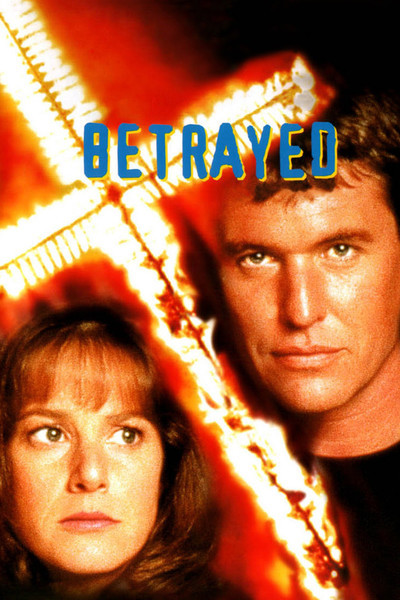
18 Days of Paranoia #11: Betrayed (dir by Costa-Gavras)


The 1988 film, Betrayed, starts out on a strong note but then quickly becomes annoying as Hell.

It opens with shots of a radio talk show host, an outspoken liberal named Sam Kraus (Richard Libertini).  Kraus berates his callers.  Kraus ridicules anyone who is to the left of Bernie Sanders.  When a man with a rural-accent calls in and attacks Karus for being Jewish, Kraus calls the man an idiot.  After he gets off the air, Kraus walks through a parking garage and stops in front of his car.  Another car pulls up beside Kraus and suddenly, a masked man with a gun opens fire on Kraus, killing him.  The gunman gets out of the car and spray paints, “ZOG” on Kraus’s car before then fleeing the garage.

(ZOG stands for Zionist Occupational Government.  It’s a term used by the type of anti-Semitic dipshits who thinks that the Protocols of Elder Zion are real.)

From this shockingly brutal opening, we cut to panoramic shots of beautiful farmland and crops being harvested in the American midwest, the heartland.  Gary Simmons (Tom Berenger) owns a farm.  He’s a Vietnam vet who nearly received the medal of honor.  He lives with his mother and he has two children.  (He’s divorced and his ex-wife died as the result of a mysterious hit-and-run in California.)  Almost everyone in his small hometown seems to worship Gary.  They’re certainly curious about his new girlfriend, Katie Phillips (Debra Winger).

And really, they probably should be.  Katie Phillips isn’t Katie Phillips at all.  She’s actually an FBI agent named Cathy Weaver and she’s been sent undercover to investigate whether or not Gary was involved in the murder of Kraus.  Cathy, who comes from a broken family and who we’re told has always been seeking some sort of deeper meaning in her life, is charmed by both Gary and his family.  In fact, she falls in love with Gary.  She tells her superior, Mike Carnes (John Heard), that there’s no way Gary is dangerous.  Mike doesn’t believe her but, of course, Mike has a personal stake in this because he and Cathy used to be romantically involved.

(That’s right, everyone.  Betrayed is so narratively lazy that it resorts to making Mike a scorned lover, even though the film’s plot would have worked just as well if he wasn’t.)

As I said, the first part of the movie works.  Debra Wingers gives a strong performance and Tom Berenger is a charming roughneck.  For the first half-hour or so, the film does a good job of showing why men like Gary and his friends are susceptible to conspiracy theories and why they feel that the entire world is stacked against them.  You can understand why Cathy is so troubled by her assignment because Gary’s friends are hardly master criminals.  For the most part, they’re farmers who feel like their entire way of life has been taken away from them.

Unfortunately, almost immediately after Mike refuses to allow her to end her investigation, Cathy returns to the farm and sleeps with Gary.  Not only is this a plot development a disservice to everything that has previously been established about Cathy as a character but it also marks the point where the movie entirely falls apart.  Immediately after sleeping with Cathy, Gary suddenly goes from being a complex but troubled character to being a cartoonish super villain.  And listen — we’ve all been there.  You meet a guy.  He’s handsome.  He says all the right things.  He seems like he’s sensitive.  He makes you feel safe.  You let down your defenses for one night and the next morning, he’s yelling at you for wearing a short skirt in public.  It happens.  Of course, in Gary’s case, it means that he’s not only criticizing the way that Cathy dresses but he’s also taking her on a hunt where the prey is terrified person of color who Gary and his friends have kidnapped.  It also means that Gary drags Cathy along on a bank robbery and then expects her to join him when he wants to assassinate a presidential candidate.  Even after all that, Cathy remains conflicted about what to do with Gary.  The problem is that it’s not like Gary’s a guy who needs sensitivity training or who spends too much time watching ESPN.  Gary is a guy who is carting around weapons and talking about how he wants to kill “mud people.”  That Cathy still has mixed emotions after all of that goes against everything that the film previously asked us to believe about her.  Gary becomes too cartoonish to be plausible and, as a result, he drags down Cathy’s character as well.

Unfortunately, as the film’s narrative falls apart, so do the majority of the performances.  While Debra Winger struggles to make her character’s motivations plausible, Tom Berenger is reduced to doing a lot of glaring.  (Poor John Heard spends most of the movie shouting and bugging his eyes.)  About the only actor who comes out Betrayed unscathed is John Mahoney, who plays Shorty.  Shorty is one of Gary’s friends.  He’s a friendly and personable guy who seems to sincerely care about everyone and who has a charmingly gentle smile.  He’s also a total racist and the contrast between Shorty’s amiable nature and his hateful thoughts provide the latter half of Betrayed with its only powerful moments.  Mahoney gets one big scene, where he talks to Cathy about how much he hates violence but, at the same time, he feels that the world has left him no other choice.  Mahoney does a great job with his small role.  It’s unfortunate that the rest of Betrayed couldn’t live up to his performance.

Other Entries In The 18 Days Of Paranoia:

  1. The Flight That Disappeared
  2. The Humanity Bureau
  3. The Private Files of J. Edgar Hoover
  4. The Falcon and the Snowman
  5. New World Order
  6. Scandal Sheet
  7. Cuban Rebel Girls
  8. The French Connection II
  9. Blunt: The Fourth Man 
  10. The Quiller Memorandum

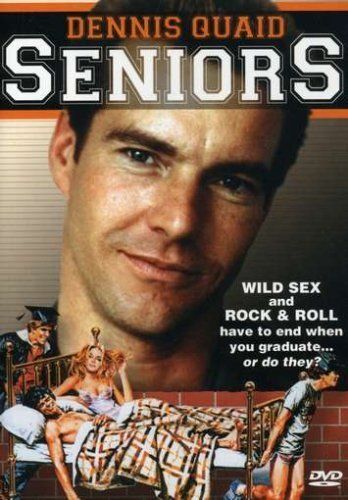
The Seniors (1978, directed by Rod Amateau)


Four college seniors (including one played by Dennis Quaid) are upset at the prospect of graduating, having to get real job, and losing Sylvia (Priscilla Barnes), the mute nymphomaniac who lives in their house with them and does all the cleaning and cooking.  They decide that the best way to avoid getting a real job is by setting up a fake company called Phantom Research.  They apply for and get a grant to study female sexuality, which essentially means that they pay the girls on campus to have sex with them.  Before you can say Risky Business (which was actually released years after this film), they expand their operations, get involved with some crooked businessmen, and nearly lose their lives.  It’s a comedy.

The Seniors is one of those films that used to come on television frequently when I was a kid.  I remember watching it when I was 12 and enjoying it, mostly because I was a stupid kid and I was at that age where any film about sex seemed clever and hilarious.  I recently rewatched it and discovered that there was only one funny bit and that was about a nerdy research assistant named Arnold (Rocky Flintermann) who helps out the seniors in return for them setting him up with Sylvia.  Throughout the film, the formerly virginal Arnold gets laid so often that he loses the ability to walk and then he dies.  Ha ha.  The rest of the film is just dumb.  The problem is that the film wants to be a raunchy, Animal House-style comedy but it was written by Stanley Shapiro (who previously wrote Doris Day comedies) and directed by Rod Amateau, who had previously directed several episodes of Gilligan’s Island.  Their style is all wrong for the material.

The film’s opening credits announce that it stars, among others, Ryan O’Neal, Clint Eastwood, and Charles Bronson.  A cartoon professor then walks out and announces that, “All of these big stars!  None of them are in this film!”  That’s too bad.  I would have liked to have seen some of those stars in this movie.  I think Eastwood would have told the seniors to get jobs and stop exploiting Sylvia.  Bronson would have blown away the entire operation but Ryan O’Neal probably would have been cool with it all.

O’Neal, Eastwood, and Bronson are not in the film.  Dennis Quaid is, though he probably doesn’t brag about.  Edward Andrews and Ian Wolfe both have minor roles as corrupt businessmen who help fund Phantom Research.  Alan Reed, the voice of Fred Flinstone, plays a professor.  This was his last performance before his death.

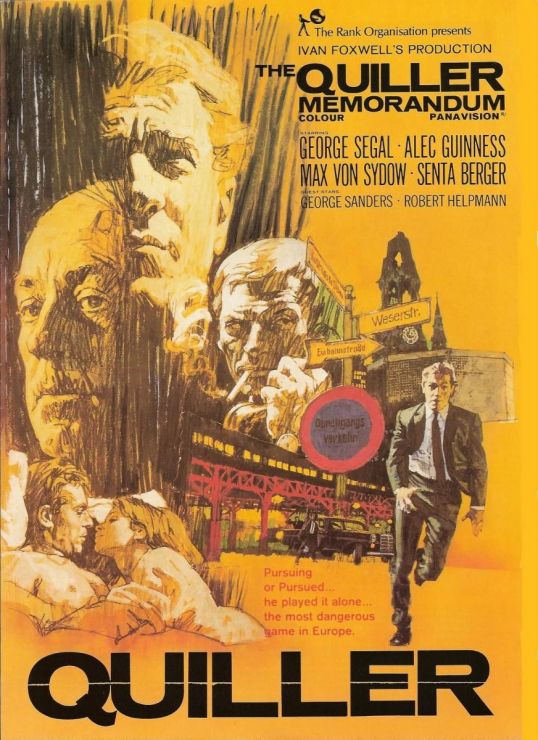
18 Days of Paranoia #10: The Quiller Memorandum (dir by Michael Anderson)


The 1966 film, The Quiller Memorandum, is a diabolically clever little spy thriller.

The film opens with a British secret agent getting gunned down while trying to make a call from a phone booth in Berlin.  While we never learn the exact name of the agency that the man was working for, we do discover that they don’t take kindly to their agents getting gunned down in phone booths.  They send in another agent, an American named Quiller (George Segal), to take his place.

In Berlin, Quiller’s boss is a man named Pol (Alec Guinness).  Pol explains that the man in the phone booth was actually the second of his agents to be assassinated in Berlin.  All of the agents were looking for information about a Neo-Nazi group called Phoenix.  Pol tells Quiller that it is vitally important they discover just where, in Berlin, Phoenix is headquartered.  Quiller is given a few items that were found on the dead man in the phone booth: a bowling alley ticket, a swimming pool ticket, and a newspaper article about a school where it was discovered that one of the teachers had Nazi sympathies.

Though The Quiller Memorandum was undoubtedly produced with the hopes of capitalizing on the popularity of the Bond films, Quiller is no James Bond.  We know that as soon as we see him.  It’s not just that Quiller’s an American while Bond was British.  It’s also that James Bond was played by the cool and calculating Sean Connery while Quiller is played by George Segal.  Whereas Connery’s Bond never loses his confidence, Segal’s Quiller comes across as being, at first, a bit cocky and, as a result, we worry about him.  Whereas Connery’s Bond rarely gave his actions a second thought, Segal brings a slightly neurotic edge to Quiller.  You take one look at Connery’s Bond and you know that he’s going to survive no matter what.  Quiller, however, you never get that feeling.  When he’s in danger, you worry about him because it’s easy to imagine him turning up like the man in the phone booth.

And, indeed, it doesn’t take long for Quiller to get captured by the members of Phoenix.  A man bumps him with a suitcase, injecting a drug into his system that makes Quiller become drowsy.  When Quiller awakens, he’s being interrogated by an erudite man named Oktober (Max von Sydow).  Oktober’s an aristocrat.  He speaks in a very calm tone, rarely showing any hint of anger.  The only thing that betrays his evil nature are his eyes, which are cold and soulless.

Even though Quiller survives the interrogation, it’s tempting to give up on him.  After all, Quiller got captured so easily and Oktober seems so clever that you kind of find yourself wondering if maybe the agency made a mistake when they gave this mission to Quiller.  That’s where The Quiller Memorandum surprises you, though.  Quiller turns out to be a lot more clever and resourceful than anyone gave him credit for being and, for that matter, the film itself turn out to have a few more twists and turns in store for the viewer.

It’s a clever and enjoyable spy film, featuring wonderful performances from Segal, Guinness, von Sydow, and Senta Berger as the teacher who may be in love with Quiller or who may have an agenda of her own.  The film may be a spy thriller but Michael Anderson directs it as if its a film noir, full of shadowy streets and morally ambiguous characters.  The script, by Harold Pinter, encourages us to trust no one and Anderson’s direction reminds us that we made the right decision.  On the dark streets of Cold War Berlin, no one is who they seem.

The Quiller Memorandum is a must-see for fans of 60 spy films.  Watch it with someone who you think you can trust.

Other Entries In The 18 Days Of Paranoia:

  1. The Flight That Disappeared
  2. The Humanity Bureau
  3. The Private Files of J. Edgar Hoover
  4. The Falcon and the Snowman
  5. New World Order
  6. Scandal Sheet
  7. Cuban Rebel Girls
  8. The French Connection II
  9. Blunt: The Fourth Man