Lisa Reviews a Palme d’Or Winner: Scarecrow (dir by Jerry Schatzberg)


With the 2021 Cannes Film Festival underway in France, I thought this would be a good opportunity to spend the next few days looking at some of the films that have won the Palme d’Or in the past.  As of this writing, 100 films have won either the Palme d’Or or an earlier version of the award like the Grand Prix du Festival International du Film.  Some of those films — like Parasite, The Tree of Life, The Piano, Pulp Fiction — went on to huge box office success and Oscar renown.  Others, like 1973’s Scarecrow, did not.

Scarecrow is an example of a type of film that was very popular in the 70s.  It’s a road film, one in which two or more people take a journey across the country and discover something about themselves and, depending upon how ambitious the film was, perhaps something about America as well.  Scarecrow centers on two drifters, who just happen to meet on a dusty road while they’re trying to hitch a ride.  Max (Gene Hackman, fresh off of winning an Oscar for The French Connection) is an ex-convict with a bad temper and a huge chip on his shoulder.  Lion (a young Al Pacino, fresh off of The Godfather) is an ex-sailor who views the world with optimism and who appears to be sweet-natured but simple-minded.  To be honest, it’s a little bit hard to believe that the perpetually resentful Max and the always hopeful Lion would ever become friends but they do.  They travel around the country, talking about their dreams of opening a car wash together.  They meet up with ex-girlfriends and ex-wives.  Eventually, they even end up in a prison farm together, where Lion, temporarily estranged from Max, is taken advantage of by a sadistic prisoner named Riley (Richard Lynch).

Scarecrow is an episodic film, one that moves at its own deliberate pace.  (If that sounds like a polite way of saying that the film is slow-moving …. well, it is.)  Director Jerry Schatzberg was a photographer-turned-director and, as a result, there’s several striking shots of Max and Lion standing against the countryside, waiting for someone to pick them up and give them a ride.  Whenever Max and Lion end up in a bar, the scene is always lit perfectly.  At the same time, Schatzberg also attempts to give the film a spontaneous, naturalistic feel by letting scenes run longer than one would normally expect.  There’s several scenes of Hackman and Pacino just talking while walking down a country road or a city street.  On the one hand, you have to appreciate Schatzberg’s attempt to convince us that Max and Lion are just two guys with big dreams, as opposed to two Oscar-nominated actors pretending to be societal drop-outs.  On the other hand, Schatzberg’s approach also leads to an interminably long scene of Gene Hackman eating a piece of chicken and if you think that Gene Hackman was the type of actor who wasn’t going to act the Hell out of gnawing on and gesturing with a chicken bone, you obviously haven’t seen many Gene Hackman films.

The main appeal of the film, for most people, will probably be to see Gene Hackman and Al Pacino, two of the top actors of the 70s, acting opposite of each other.  Reportedly, both Hackman and Pacino went full method for the film and spent their prep time on the streets of San Francisco, begging for spare change.  The end result is a mixed bag.  There are a few scenes — like when they first meet or when they’re in prison — in which Hackman and Pacino are believable in their roles and you buy them as two lost souls who were lucky enough to find each other.  There are other scenes where they both seem to be competing to see who can chew up the most scenery.   Sometimes, Pacino and Hackman are compelling acting opposite each other.  Other times, it feels like we’re just watching an Actors’ Studio improv class that someone happened to film.  Too often, Hackman and Pacino seem to be so occupied with showing off their technique that the film’s reality seems to get lost under all of the method showiness.  In the end, neither one of the film’s stars makes as much of an impression as Richard Lynch, who is genuinely frightening in his small but key role.

Scarecrow is an uneven film, one that is occasionally effective but also a bit too studied for its own good.  It wears it influences — Of Mice and Men, Midnight Cowboy, Five Easy Pieces — on its sleeve but it also fails to exceed or match any of those previous works.  That said, the film does have its fans.  (Schatzberg has been working on a sequel for a while.)  Certainly, the 1973 Cannes Jury (headed by none other than Ingrid Bergman) liked it enough to give it the Palme.

Scarecrow 2

Film Review: The Conjuring: The Devil Made Me Do It (dir by Michael Chaves)


The year is 1981 and Ed and Lorraine Warren (Patrick Wilson and Vera Farmiga, of course!) have just screwed up another exorcism.  Only Ed hears as Arne Johnson (Ruairi O’Connor) begs the demon that has possessed 8 year-old David Glatzel (Julian Hilliard) to enter him instead.  Unfortunately, Ed also has a heart attack and passes out before he can tell Lorraine what has happened.

The next month, a hollow-eyed Arne is walking down a road.  He’s just murdered his sleazy landlord, stabbing the man 22 times.  It seems like an open-and-shut case, except for the fact that Arne claims that he was possessed by a demon and that it was the demon who actually committed the crime.  At first Arne’s lawyer is planning to go for an insanity plea but then Ed and Lorraine invite her to come have dinner with them and to see their favorite doll, Annabelle.  The film immediately cuts to Arne’s visibly shaken lawyer announcing to the court that her client pleads “not guilty by reason of demonic possession.”

It’s a funny scene and I was a little bit surprised to see it because, in the past, The Conjuring films have always been distinguished by how seriously they took themselves.  The first two films both unfolded in atmospheres of growing dread, following families that not only had to deal with societal evolution but also with angry spirits.  The first two Conjuring films worked not only as horror films but also as period pieces, as stories about changing times.  Though Ed and Lorraine were always the main investigators, the first two films devoted as much time to exploring the dynamics of the haunted families as it did to portraying the Warrens.

The Conjuring: The Devil Made Me Do It (or, as we’ll call it in the interest of space, The Conjuring 3) takes a different approach, which I imagine has much to do with Michael Chaves directing the film instead of James Wan.  This time, Arne and the possessed family all remain ciphers.  We never learn much about who they are or who they were before they met the Warrens.  We don’t know what Arne was like before he became possessed and, as such, it’s hard to get emotionally invested in him once he does end up with a demon inside of him. 

Instead, the film emphasizes Ed and Lorraine Warren and their work to uncover the occultist who was behind the original possession.  Ed worries about Lorraine as she has psychic visions and wanders around yet another dirty basement.  Lorraine worries that Ed is going to give himself another heart attack as he hobbles through the woods in search of an evil spirit.  Lorraine proves her powers to a skeptical detective.  Ed complains that he doesn’t want people treating his wife’s abilities like a carnival sideshow but he still allows himself a slight smile when she selects the correct murder weapon.  Of course, at one point, Suspicious Minds is heard on the radio and we briefly flashback to Patrick Wilson singing the song in The Conjuring 2.  Once again, the film argues that Ed and Lorraine’s romance, their endless love, makes them uniquely capable of battling the Devil.

The film has its moments, largely because Patrick Wilson and Vera Farmiga are adorable as Ed and Lorraine.  At the same time, though, there’s a definite “greatest hits” feel to the third Conjuring film.  There’s little about the film that feels truly spontaneous or surprising and most of the scenes feel like reworkings of scenes that worked in the previous two films.  As good as Farmiga and Wilson are in their roles (and as much as I appreciate the idea of a Catholic super hero film franchise), Ed and Lorraine work best when they’re relating to and helping other characters.  The Conjuring 3 often solely focuses on them and the end result often feels more like an Insidious sequel than a Conjuring film.

The Conjuring 3 is enjoyable enough.  It gets the job done, while never reaching the emotional heights of the first two films.  It has enough jump scares to be a fun movie to watch on a rainy night but it’s not one that really sticks in your mind after it ends.

The_Conjuring_-_The_Devil_Made_Me_Do_It

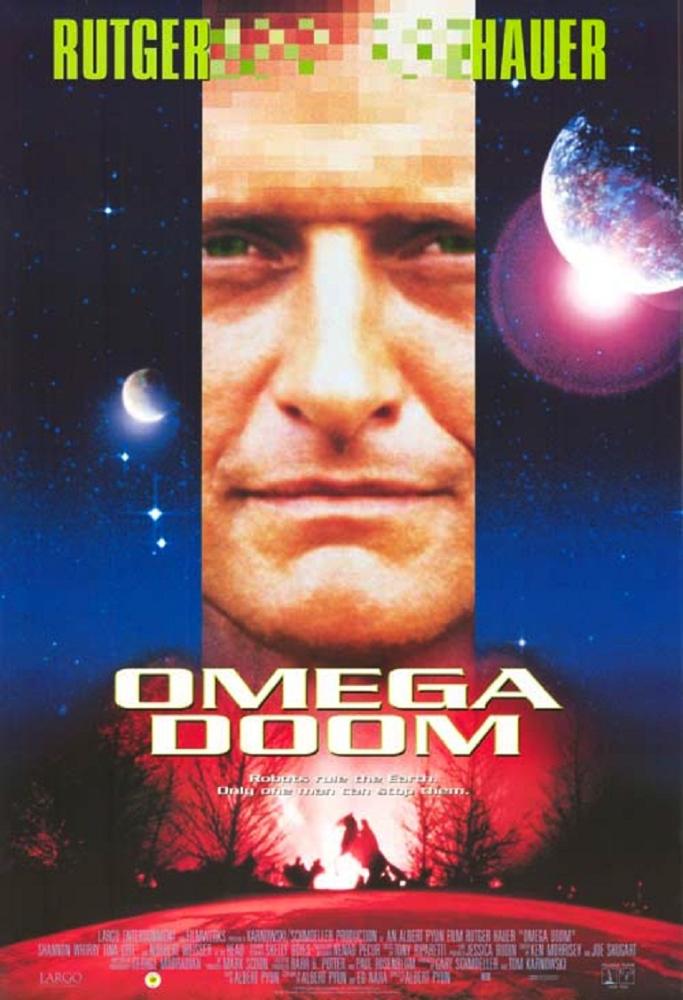
The TSL’s Grindhouse: Omega Doom (dir by Albert Pyun)


Omega Doom!  What’s all that about?

Seriously, don’t ask me.  I just watched this Albert Pyun-directed, 1996 sci-fi epic and I’m stil a bit confused as to what exactly was actually going on in the movie.  This is a movie that opens with a totally blank screen and then, eventually, two red suns appear in the sky.  The film takes place in the future, at a time when humans have nearly wiped themselves out of existence through their endless wars and the planet is now controlled by robots and cyborgs.  Omega Doom (Rutger Hauer) was a cyborg programmed to kill humans until he got shot in the head.  Apparently, taking a bullet to his cranium changed Omega’s programming and now….

Well, that’s the thing, isn’t it?  It’s kind of hard to say what exactly it is that Omega does now.  We do know that he spends a lot of time walking around because there’s a lot of scenes of him doing just that.  Eventually, he stumbles upon the ruins of a town that is now controlled by two warring bands of robots.  Before you can say Yojimbo or even A Fistful of Dollars, Omega is playing both sides against each other and …. well, I don’t know what the preferred outcome here is.  What is Omega Doom’s motivation?  He’s not making any money out of it because robots don’t need money and it’s not like there’s anything left to buy.  And he doesn’t seem to be interested in ruling the town himself because it’s kind of a dead end of a town.  I mean, there’s dead bodies and robotic parts all over the place.  It’s suggested that he might be looking for a secret stash of weapons that can be used to either kill or protect the remaining humans but, at the same time, we don’t ever really see any remaining humans and there’s no reason why Omega would care enough about them to get caught up in a war between robots on their behalf.

So, don’t ask me what’s going on.  I guess it really doesn’t matter because it’s not like you watch a film like this for the plot.  You watch it for the action!  Unfortunately, there’s not a whole lot of action to be found.  There’s a lot of scenes of robots talking about various exciting things that they could, in theory, be doing but no one ever seems to actually get around to doing any of that stuff.  Instead, all of the robots stay in their separate sections of the town and wait for everyone else to make the first movie.  Eventually, Omega makes a few moves but, even then, they’re not particularly exiting moves.  Omega carries a gigantic sword on his back and how I anticipated seeing what he was going to finally do with that sword.  Well, it turns out that Omega didn’t do very much with it at all.

Actually, the main reason you’re going to want to watch Omega Doom is because Rutger Hauer plays the title role and Hauer was always cool, even when he was appearing in a less than memorable film.  In Omega Doom, Hauer does a passable Clint Eastwood impersonation, delivering his lines with just the right amount of weary condescension.  Though you’re never quite sure why Omega is doing anything, Rutger Hauer is always watchable.

And, to be honest, I actually didn’t dislike Omega Doom as much as it may sound like I did.  It’s a slow movie and not much happens but, at the same time, I did like the look of the bombed-out city and, though the dialogue was largely forgettable, there was still the occasional line that suggested that Omega Doom had existential ambition, albeit unrealized ones.  “God took a vacation,” Omega says at one point and, for a split second, you get a hint of what Omega Doom could have been if it had a bigger budget and a better script.  It’s a film that had potential and it’s somewhat fascinating to consider how little of that potential was realized.

Of course, in the end, it all comes down to this: How can you possibly resist Rutger Hauer as a cyborg?

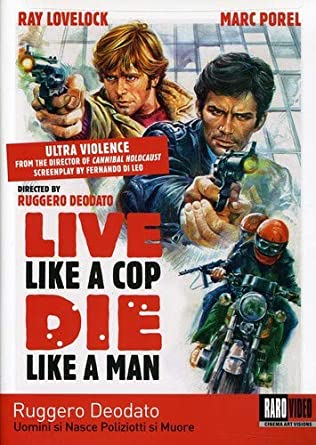
The TSL’s Grindhouse: Live Like A Cop, Die Like A Man (dir by Ruggero Deodato)


The 1976 film, Live Like A Cop Die Like A Man, takes place during the Christmas season.

We know this because the film opens with a man dressed like Santa Claus standing on a street corner in Rome and impotently watching as a woman is dragged behind a motorcycle by two men who were attempting to snatch her purse.  When she doesn’t let go of her purse, one of the men hops off the motorcycle and proceeds to kick her in the face until she stops moving.  Suddenly, two other men — our heroes, as it were — came driving up on a motorcycle of their own.  A chase ensues, through the streets of Rome, during which a blind man’s dog is graphically run over.  The chase which, it must be said, is very well-shot and directed, lasts for over 10 ten minutes and it ends with the two thieves being executed by, once again, our nominal heroes.

A lot of people are executed over the course of Live Like A Cop, Die Like A Man.  That’s because Detectives Fred (Marc Porel) and Tony (Ray Lovelock) have been given a license to kill anyone who breaks the law.  The film is a bit vague on just how exactly the license works and why, apparently, it’s only been given to Fred and Tony.  One major set piece features several dozen cops all waiting outside a house, powerless to get the three criminals within, until Fred and Tony arrive.  Fred and Tony, of course, solve the problem by killing everyone.  Why couldn’t the other cops have done that?  The film doesn’t really make that clear.

Admittedly, Fred and Tony aren’t the first movie cops to get results through unorthodox means.  The French Connection was a popular film in the 70s and it inspired a whole genre of Italian rip-offs, of which Live Like A Cop Die Like A Man is a definite example.  What sets Fred and Tony apart from cops like Popeye Doyle and Dirty Harry is the amount of joy that Fred and Tony seem to get out of killing people.  Early on, they show up at a party and proceed to set all of the cars on fire. They also set two criminals on fire, with Fred doing a happy little dance as the two men go up in flames.  It’s disturbing but there’s also a strange integrity to the film’s shameless embrace of violence.  Live Like A Cop, Die Like A Man doesn’t pretend to be about anything other than satisfying the vigilante fantasies of its audience.

And indeed, it should be considered that Live Like A Cop, Die Like A Man was released during the so-called Years of Lead, when a combination of political terrorism and open crime had made violence an almost daily part of Italian life.  When you’re living day-to-day with the knowledge that you could be blown up at any minute by the Red Brigade, the Ordine Nero, or the Mafia, I imagine that there would be something appealing about watching two young men who are perfectly willing to just shoot anyone who appears to be up to no-good.  It’s easy to imagine that, for audiences in 1976, the random violence of this episodic film mirrored the random violence of everyday life.  Though Live Like A Cop, Die Like A Man was obviously inspired by The French Connection, it perhaps has more in common with the original Death Wish, with the main difference being that Live Like A Cop’s vigilantes are officially sanctioned.

The film also places a good deal of importance on just how close Tony and Fred are supposed to be.  They live together in a ramshackle flat, they apparently spend all of their free time together, and, towards the end of the film, the only thing that keeps the two of them from taking part in a threesome is the sound of someone else being shot.  Unfortunately, Ray Lovelock and Marc Porel did not get along in real life and, as a result, there was never a Live Like A Cop Die Like A Man Part II.  Live Like A Cop would also be director Ruggero Deodato’s only stab at the polizieschi genre.  He went on, of course, to direct Cannibal Holocaust and The House on the Edge of the Park.  (Interestingly, Tony and Fred’s relationship is mirrored, to sinister effect, by the relationship between the characters played by David Hess and Giovanni Lombardo Radice in House On The Edge of the Park.)  Live Like A Cop, Die Like A Man has gone on to become a bit of a cult film and, as offensive as some will find it to be, it’s also so over-the-top in its violence and its celebration of officially sanctioned bad behavior that it becomes rather fascinating to watch.  It’s so without shame or apology that it’s hard to look away from it, even though you may want to.

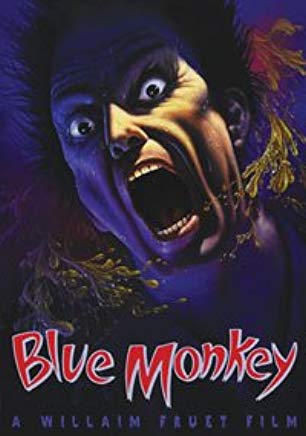
The TSL’s Grindhouse: Blue Monkey (dir by William Fruet)


1987 Blue Monkey

Last night, as I sat down to watch the 1987 Canadian film, Blue Monkey, I found myself singing a song in my head:

How does it feel
When you treat me like you do
And you’ve laid your hands upon me
And told me who you are?

I thought I was mistaken
And I thought I heard your words
Tell me, how do I feel?
Tell me now, how do I feel?

Unfortunately, it turned out that the only thing Blue Monkey had in common with the classic New Order song, Blue Monday, was an enigmatic title.  Just as the song never really mentions anything about Monday, Blue Monkey does not feature a single monkey.  One minor character does mention having a dream about a monkey but, otherwise, there are no monkeys in the film.  Speaking as someone who believes that almost any film can be improved the presence of a monkey, I was disappointed.

(Seriously, Nomadland would have been a hundred times better if Frances McDormand had a pet monkey.)

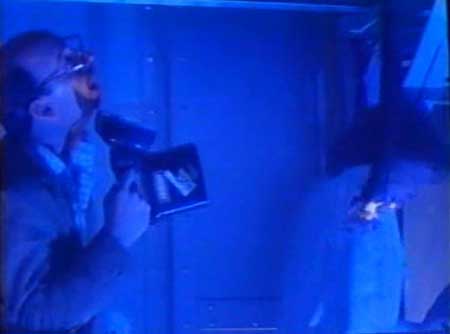
What Blue Monkey does have is a lot of blue.  The characters wear blue shirts and some wear blue uniforms.  Another wears a blue hat.  The film takes place in a hospital where almost all of the walls are painted blue.  Even worse, the majority of the film’s scenes are saturated with blue lighting.  

Here’s just two screenshots:

blue-monkey-1987-movie-image-7Blue-Monkey-1987-movie-William-Fruet-4

Seriously, some scenes were so blue that I was reminded of John Huston’s decision to suffuse Reflections in a Golden Eye with the color gold.  Personally, I think Huston made a mistake when he did that with Reflections but I can still understand the reasoning behind the decision and I can see what Huston was attempting to accomplish.  The blue in Blue Monkey feels like a distraction, as if someone realized, on the day before shooting, that the title didn’t make any damn sense.  “We’ll just make the whole movie blue!”

The problem, of course, is that the film goes so overboard with the blue lighting that it actually becomes difficult to look at the screen for more than a few minutes.  I had to keep looking away, specifically because all of those blue flashing lights were starting to make me nauseous and were on the verge of giving me a migraine.  At times, the image is so saturated in blue that you literally can’t make out what’s happening in the scene.  Of course, once you do figure out what’s happening, you realize that it doesn’t matter.

Blue Monkey takes place in a hospital.  A handyman has been having convulsions after pricking his finger on a plant that came from a mysterious island.  Perhaps that’s because a mutant larvae is now using his body for a host.  The larvae eventually develops into a giant grasshopper — NOT A MONKEY! — who stalks around the hospital and kills a few people.  The Canadian government is threatening to blow up the hospital unless something is done about the blue grasshopper.

It’s a Canadian exploitation film but Michael Ironside isn’t in it so it somehow feels incomplete.  That said, John Vernon plays a greedy hospital administrator and it’s fun to watch him get irritated with everyone.  A very young Sarah Polley has an early role as an annoying child.  There’s actually several children in this film and you’ll want to throw something at the screen whenever they show up, that’s just the type of film this is.  (Some of my fellow movie-watching friends were actually upset that the children survived that film.  I wouldn’t go that far but I still found myself hoping John Vernon would tell them all to shut up and let the adults handle things.)  Susan Anspach plays a doctor, showing that anyone can go from Five Easy Pieces to Canadian exploitation.  The film’s nominal star is Steve Railsback, playing a cop who comes to the hospital to check on his wounded partner and who ends up on grasshopper duty.  Steve Railsback has apparently said that he’s embarrassed to have appeared in this film.  Consider some of the other films that Steve Railsback has appeared in and then reread that sentence.  

In the end, Blue Monkey doesn’t add up too much.  There’s no Michael Ironside.  There’s no monkeys.  There’s just a lot of blue.

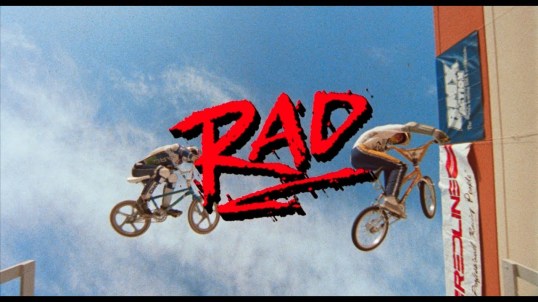
Film Review: Rad (dir by Hal Needham)


The 1986 film, Rad, tells the story of Christopher “Cru” Jones (Bill Allen).  Cru lives in a small, kind of ugly town in middle America.  Cru has a job delivering newspapers so, every morning, he rides around town on a bicycle and he throws rolled-up copies of USA Today at people.  He throws the papers fairly aggressively and doesn’t seem to have much concern about riding his bike through backyards or using his bike to jump over (or sometimes, onto) cars.  And yet, no one can stay mad at Cru because he has a plucky, can-do attitude and he can do all sorts of tricks on his bicycle.

Cru has a decision to make.  He can either go to college or he can compete in a bicycle race.  If he goes to college, he might actually be able to get a career and actually have a future.  If he wins the bicycle race, he’ll get a car and $100,000.  His mother (Talia Shire) feels that Cru should go to college.  Cru, however, says that his gut is telling him to enter the race….

Hey, Cru, your gut is lying to you!  Seriously, I’m all for Cru competing and showing off how good he is at a rather mundane and kind of boring sport but college is college.  There’s a scene early on in the film where one of Cru’s classmates is talking about all the schools to which he’s applied.  “UCLA, Princeton, SMU, Harvard….” Cru rides by and laughs but, 35 years later, who do you think currently has the nicer house?

Of course, despite his willingness to give up his future for $100,000 and a new car, it turns out that Cru might not even be able to compete.  The race’s evil sponsor (Jack Weston) is determined to make sure that his tea, wins the race and he keeps changing the rules to prevent Cru from being able to enter.  He demands that Cru find an official sponsor so Cru starts his own business.  He then demands that the business be worth at least $50,000!  Cru doesn’t have that type of money but — wait a minute — is that Ray Waltson, playing an eccentric businessman!?  Maybe he’s got $50,000!

Still, does Cru have the confidence necessary to enter the race and beat the best in the country?  Don’t worry, Cru’s little sister designs a t-shirt that reads, “Cru is Rad!”  Seriously, just try to beat that encouragement!

Anyway, you may be thinking that Rad sounds like it’s a pretty silly movie and it is.  Having now watched Rad, BMX Bandits, and Quicksilver, I am ready to announce that, in the 80s, there was absolutely no way to make BMX racing cinematic.  At the end of the movie, Cru performs a series of tricks while the end credits role and, instead of being impressed, you just notice how much Cru is struggling to maintain his balance.  Neither Bill Allen nor Bart Conner (who plays Cru’s main rival) have much screen presence and the whole film just looks and feels cheap.

And yet….

To be honest, it’s difficult to really dislike Rad.  For all of its many flaws, it’s all just so damn sincere.  Cru just wants to win that race so badly that it’s hard not to root for him and it is kind of touching to see the way the entire town rallies around him.  While the lead racers may have been blandly portrayed, Talia Shire, Jack Weston, Ray Waltson, and Lori Loughlin all turn in effective performances.  In fact, you could probably argue that Talia Shire is almost too good in her role.  She so effectively portrays the anguish of a mother watching her son throw his future away that you really do find yourself worrying about what’s going to happen to Cru when he’s older and he can’t get a job because he blew off college.  (I’m going to guess that Talia Shire’s presence in this film is due to the fact that it was produced by her late husband, Jack Schwartzman.)

Rad is sincere and unpretentious and rather silly.  Like a lot of 80s movies, it’s got a good soundtrack.  It especially makes good use of the song Send Me An Angel.  There’s also an out-of-nowhere scene where Cru and Lori Loughlin do a series of impromptu freestyle bike tricks on the middle of a dance floor and it’s just surreal enough to be memorable.

Rad is a simple but inoffensive tribute to throwing your life away.


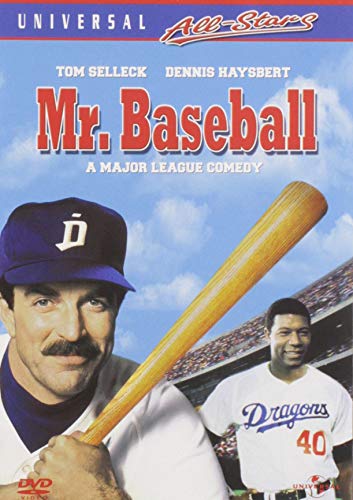
Mr. Baseball (1992, dir. by Fred Schepisi)


I watched Mr. Baseball last night because I was feeling depressed over the Rangers 25-42 record and I thought that watching a movie about baseball (it’s right there in title!) might cheer me up.

Tom Selleck plays Jack Elliott, an aging first baseman player who was once the MVP of the New York Yankees but whose best days are behind him.  Everyone realizes it but him.  Looking to sign a hotshot rookie, the Yankees put Jack on the trading block.  However, the only team that’s interesting in signing an arrogant veteran with a bad knee is a Japanese team, the Nagoya Chunichi Dragons.

Though he’s not happy about the trade, Jack move to Japan and takes his place as a member of the Dragons.  In Japan, he’s nicknamed “Mr. Baseball” and is told by the team’s owner that he’s expected to hit 54 home runs during the season.  However, Jack manages to alienate the team with his boorish attitude and his lack of understanding of Japanese culture.  With the help of another American player (Dennis Haysbert) and his girlfriend (Aya Takanashi), Jack finally sets aside his resentment, becomes a part of the team, and leads the Dragons into a pennant race.  He also learns how to improve his swing.

When Jack first arrived in Japan, I was worried that Mr. Baseball was going to be a culturally insensitive comedy, all about Jack teaching the Japanese players how to play baseball like the Americans.  I was dreading the thought of watching a movie full of stereotypes and cheap jokes about the way people talk.  Instead, Mr. Baseball actually treated Japanese baseball with respect and the emphasis was on Jack learning the importance of setting aside his ego, playing as a member of the team, and listening to the team’s manager, Uchimaya (Ken Takakurya).  Even though most of the film’s humor does come from the culture clash between the American Jack and his Japanese teammates, Mr. Baseball doesn’t really take any cheap shots at anyone and I appreciated that.  Instead, the theme of the film was that, cultural differences aside, everyone on the team loved the game of baseball.

Other than the fact that it was taking place in Japan, Mr. Baseball was a typical baseball film.  The plot did not hold many surprises.  Jack starts off as a star player, goes into a slump once he lets his ego get the better of him, and manages to come out of it just in time for the pennant race.  It’s predictable but Tom Selleck and Dennis Haysbert were convincing baseball players and I liked the film’s look at the culture surrounding baseball in Japan.  Mr. Baseball is hardly the greatest baseball movie ever made but it did cheer up this Rangers fan.

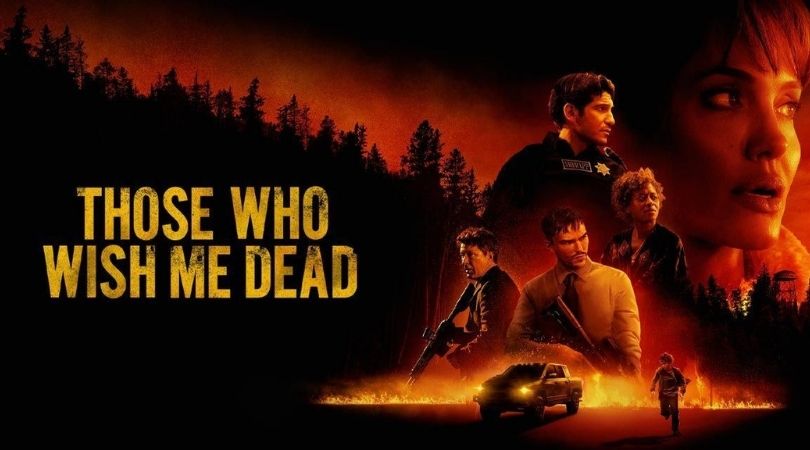
Film Review: Those Who Wish Me Dead (dir by Taylor Sheridan)


In Those Who Wish Me Dead, Angelina Jolie plays Hannah, a smokejumper who is haunted by a mistake that led to a family dying in a forest fire. All of her recent psych evals seem to indicate that Hannah is self-destructive and a danger to herself and potentially others. Of course, it doesn’t help that Hannah keeps doing things that are self-destructive and that put her and potentially others in danger. She’s watched over by her fellow smokejumpers and her ex-boyfriend, Ethan (Jon Bernthal). Even Ethan’s pregnant wife, Allison (Medina Senghorse) is looking out for Hannah.

Hannah, meanwhile, finds herself looking out for Connor (Finn Carter), a young boy whose father has been murdered by two ruthless assassins (Aidan Gillen and Nicholas Hoult). Because the boy has evidence that could lead to the downfall of an evil mob boss (played by Tyler Perry because, hey, why not?), the assassins search for Connor and they even set a forest fire to cover their tracks.

Trapped in the wilderness, Hannah, Connor, Ethan, and Allison have to somehow survive until the fire burns itself out and the smokejumpers can reach them. Meanwhile, the two assassins are closing in….

I was initially pretty enthusiastic about the prospect of watching Those Who Wish Me Dead on HBOMax but, ten minutes into the movie, I found myself wondering if maybe I was watching something that was made in 1998 and somehow not released until 2021. Everything about the film — from Hannah’s tortured backstory to the verbosely evil assassin played by Gillen — felt like it belonged in a direct-to-video thriller or maybe in a pilot for an old USA Network show starring Cynthia Rothrock and Lorenzo Lamas. It was very easy to watch this movie and to imagine Charlie Sheen and Patrick Swayze showing up as brothers fighting “the wildfire of the century!”

Oddly enough, Angelina Jolie probably could have starred in the 1998 version of this film. That’s how long we’ve been taking it for granted that Angelina Jolie can confront any crisis or any villain and basically kick its ass. That’s a huge reason why I was so looking forward to seeing Those Who Wish Me Dead. It’s been a while since we’ve had a chance to watch Angelina Jolie play an action hero and the fact that she was doing it in a film directed by Taylor Sheridan just made it all the more exciting. Unfortunately, though, Jolie doesn’t seem to be particularly invested in Those Who Wish Me Dead. There’s not much of the unpredictable spontaneity or the sense of danger that, in the past, made Angelina Jolie one of the most exciting actresses around. It’s easy to imagine that, just a few years ago, Jolie could have worked wonders playing someone as openly self-destructive as Hannah but, in Those Who Wish Me Dead, she instead often seems to just be going through the motions. If anything, Aidan Gillen makes a bigger impression, despite the fact that he’s just playing a standard bad guy.

(Speaking of bad guys, why is Tyler Perry playing a crime lord? There’s nothing menacing about Tyler Perry. The fact that Perry only appears in one scene makes his miscasting all the more obvious. As soon as you’ve said, “Wait — why is Tyler Perry in this movie?,” he’s gone. Perry needed at least two extra scenes where he could have killed someone or at least maybe cursed a little or anything else that could have established him as someone other than Tyler Perry making a strange cameo appearance.)

Taylor Sheridan both directed and had a hand in the script. Sheridan previously wrote Hell and High Water and Sicario and both directed and wrote Wind River. These are three of the best films of the past decade and, yet, in the early scenes especially, Those Who Wish Me Dead almost feels almost like a parody of those previous films. The early scenes, where Hannah hangs out with the other smokejumpers, especially ring false, with the blue collar dialogue feeling forced and artificial. Sheridan does better when directing the action scenes but there’s still an overwhelming blandness to the whole film. There’s too much talent involved for Those Who Wish Me Dead to be terrible but, at the same time, it’s hard not to feel that there’s also too much talent for it to be this forgettable.

Film Review: Nick Fury: Agent of S.H.I.E.L.D. (dir by Rod Hardy)


Uh-oh, Hydra is up to something!

If you don’t know who Hydra is, they’re an international group of villainous superspies. The organization was founded by a Nazi war criminal named Baron Von Strucker and they’re always trying to take over the world or destroy it. Hydra hasn’t had much success on either front but it’s not for lack of trying. Fortunately, there’s another super secret organization that’s been founded to keep Hydra from reaching their goals. The name of this organization is S.H.I.E.L.D. and they are headquartered in a big flying helicarrier thing. So, if you work for S.H.I.E.L.D., you not only get to save the world but you also have a hell of a work commute.

Anyway, Hydra’s latest plan is to steal the body of their founder and somehow not only bring him back to life but to also spread a deadly virus across the world. S.H.I.E.L.D. knows that it’s going to take the world’s greatest secret agent to defeat this plot but, unfortunately, Nick Fury (David Hasselhoff) is retired and living in an abandoned mine shaft in the Yukon. Nick wears an eye patch, smokes a cigar, and speaks in a permanently annoyed tone of voice. Nick’s done with saving the world. Or, at least, that’s what he thinks. When S.H.I.E.L.D. agent Valentina Allegra de Fontaine (Lina Rinna) informs him that Hydra killed an old friend of his while stealing the Baron’s body, Nick emerges from the Yukon in search of revenge!

Long before Samuel L. Jackson donned the iconic eye patch and brought Nick Fury to life as one of the mainstays of the MCU, David Hasselhoff played the character in this made-for-TV movie from 1998. The movie was meant to serve as the pilot for a Nick Fury television series. (Hasselhoff, by this point, was looking to move on from Baywatch.) Of course, it wasn’t picked up and today, whenever this early Marvel film is mentioned, it’s usually in a somewhat dismissive manner.

And, believe me, I can understand that instinct to preemptively dismiss Nick Fury: Agent of S.H.I.E.L.D. I mean, it’s David Hasselhoff and its from the 90s and it was made for TV. I get it. But, having watched the movie on Saturday night, I have to say that it’s actually not that bad. It’s low budget. It’s campy. It’s thoroughly silly. The film is full of actors giving uncertain line readings. And yet, it’s also fast-paced and, when taken on its own admittedly “special” terms, rather entertaining. In the role of Nick Fury, Hasselhoff plays the role with just enough self-awareness to indicate that he’s in on the joke. He delivers his lines with just the right amount of deadpan humor and he chews on that cigar as if the fate of the world depends upon it. In short, as opposed to almost everyone else in the film, Hasselhoff appears to be having a good time. In fact, one could argue that David Hasselhoff is a good Nick Fury for the same reason that Samuel L. Jackson is a good Nick Fury. Both of them play the character as if he’s someone who secretly realizes that he’s a character in a comic book film and who is determined to have as much fun with the role as he can.

The film’s plot does occasionally border on being incoherent but, honestly, who cares? Are you really watching a film like this for the plot? There’s a lot of explosions and one-liners. Hasselhoff has fun with the lead role, as does Sandra Hess in the role of Strucker’s daughter. It’s a dumb but entertaining. It’s also only 90 minutes long so it’s not like you’re having to sacrifice a major part of your life to watch it. Explosions and a short running time, who can complain about that?

Film Review: Save The Last Dance 2 (dir by David Petrarca)


Recently, I was shocked to discover that I had never reviewed the 2006 film, Save The Last Dance 2.

I mean, really, it seems like this is a film that I should have reviewed a long time ago. For one thing, it’s not only a dance film but it’s also a ballet film and, if you’ve been reading this site for a while, you know that I pretty much grew up going to dance class and doing pointe work and regularly injuring my ankle. Add to that, Saved The Last Dance 2 is a sequel to one of my favorite movies, the original Save The Last Dance. Really, why had I not already reviewed this film before tonight?

Well, some of it is because Save The Last Dance 2 isn’t very good. I mean, it’s basically a really forgettable sequel that lacks almost everything that made the original Save The Last Dance such a meaningful film. Oddly enough, despite preferring the original, I think I actually have watched Save The Last Dance 2 more times than I’ve watched the first film. For whatever reason, Save The Last Dance 2 is on Showtime constantly! It shows up early in the morning, when you’re still too tired to change the channel and you end up watching it because you’re lazy. This is a film that mocks you by both tarnishing the legacy of the first Save The Last Dance but by also reminding you that you don’t even have the willpower necessary to turn off the TV.

Save The Last Dance 2 continues the story of Sara, who has now been accepted to Julliard and who has broken up with her wonderful boyfriend from the first film. In the first film, Sara was played by Julia Stiles. In the second film, she’s played by Izabella Miko. On the one hand, Izabella Miko is far more convincing ballerina than Julia Stiles was. (Unlike Julia Stiles, Izabella Miko was a dancer who even studied at the School of American Ballet before she injured her back and decided to focus on acting instead.) On the other hand, Julia Stiles brought some needed edginess to the role whereas Izabella Miko is so constantly cheerful that it’s hard to really believe that the Sara in the sequel is the same Sara from the original film. Izabella Miko is likable as Sara but, in this sequel, the character has been robbed of everything that made her interesting in the first film. She’s just another cheerful teenager looking for success in an MTV Film.

Once Sara arrives at Julliard, she meets the usual collection of jealous classmates, demanding teachers, and quirky roommates. She also meets Miles (Columbus Short), a guest lecturer who is impressed by Sara’s hip-hop skills. Sara and Miles fall in love. Miles wants Sara to help him choreograph his next show but the demanding Monique Delacroix (Jacqueline Bisset) wants Sara to play the lead in Giselle. Playing the lead will demand all of Sara’s time and attention but it could also be her ticket to stardom. Unfortunately, it also means that she won’t be able to help out Miles, which this film portrays as somehow being the ultimate betrayal despite the fact that one assumes that Miles, being a guest lecturer on hip hop dance, knows more than one choreographer.

If the message of the first film was that Sara didn’t have to choose between loving ballet and loving hip hop, the message of the sequel is, “Actually, she does have to choose and she better pick the one that will allow us to put together a successful soundtrack.” It’s a bit depressing and hollow, to be honest. It goes against everything that made the first film special.

That said, I’ll probably watch Save The Last Dance 2 the next time I turn on the TV and it’s playing on Showtime. Changing the channel would require too much effort.