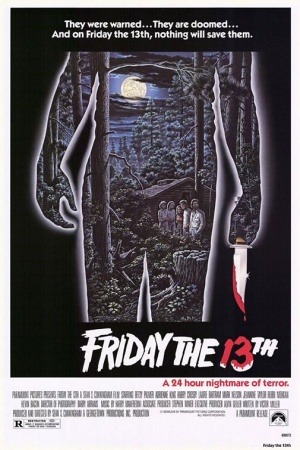
Usually, I am inevitably seem to end up spending Friday the 13th up at the Lake, sitting out on the deck of the lake house and suspiciously looking over at the nearby woods for movement. This week, however, I’m spending Friday the 13th at home so I should be safe!
(For the record, the Lake is next week.)
Anyway, everyone knows that Tuesday the 13th is a far more dangerous day than Friday the 13th but, for whatever reason, Friday the 13th is what gets all the attention. In fact, I’ve written several posts all about Friday the 13th. Here they are, for your reading enjoyment:
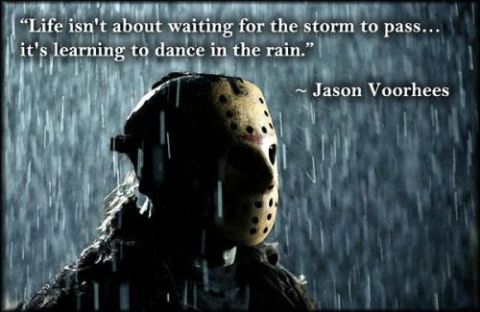
Anyway, have a good Friday the 13th! I would tell you to stay out of the woods but …. you know what? We, as a society, need to be willing to take more chances. So, go into the woods. Skinny dip in the lake. Ignore the signs that say stay out. Make love in a deserted cabin. Smoke weed at the deserted summer camp. Laugh at the camp fire stories about Jason. Strip down to your underwear and then wander around in the rain as if that’s the most sensible thing that you’ve ever done. Yes, Jason might get you. But you also might have a lot of fun. It’s worth the risk.
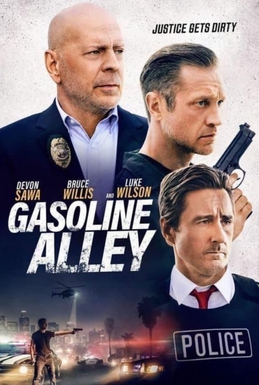
Believe it or not, Gasoline Alley is not that bad.
Don’t get me wrong. Gasoline Alley is definitely a pulpy film. The plot is full of twists and turns and it doesn’t always hang together. There’s more than a few holes to be found in the story. There’s also a few threads that are left hanging. Much as in real life, characters appear and then disappear almost at random. In many ways, the film plays out like a dream, a jumbled mix of concerns and ideas and images. The viewer is often left to figure out how to fit everything together on their own. Obviously, that type of approach won’t appeal to everyone but, for me, it was the perfect way to tell the film’s story. The world of Gasoline Alley often doesn’t make sense but neither does the world outside of your window. Gasoline Alley‘s mystery often feels like a jigsaw puzzle where someone has jammed pieces randomly into each square and then pounded on them until they managed to fit in the slots. It’s chaos but it’s an appropriate approach for a film that takes place in a chaotic world.
Gasoline Alley also one of the final films that Bruce Willis made before his retirement and, with all the rumors about whether or not Willis was pushed into spending the last few years of his career appearing in low-budget and B-movies, it’s often undeniably awkward to watch him in his final films. As is the case with almost all of Willis’s recent films, he doesn’t get much screen time in Gasoline Alley. He’s only in a handful of scenes and his dialogue is limited and delivered in a flat monotone. He plays a key character but much of what the character does and says occurs off-screen and is described to us second-hand. And yet, at the same time, Willis still has enough natural presence that his performance works as far as the basic needs of the film are concerned. He’s playing a character who is meant to be intimidating and Willis still has enough of that tough guy energy that his performance is effective.
Willis plays a homicide detective named Freeman. Freeman and his partner, Vargas (Luke Wilson), are investigating the murder of four prostitutes and their number one suspect is a tattoo artist named Jimmy Jayne (Devon Sawa). Jimmy’s father was a decorated police detective. His mother was a prostitute. Jimmy spent several years in prison for assault, though Jimmy claims that he was simply acting in self-defense. (“He came at me with a screwdriver,” Jimmy says, without further elaboration.) While he was in prison, Jimmy befriended an actor who was doing time for DUI. Having been released, Jimmy is now the tattoo artist to the stars. He has his own tattoo parlor, called Gasoline Alley. Because one of the murdered women was found with one of Jimmy’s personalized lighters on her body, Jimmy is a suspect. Jimmy, however, claims that he merely met her in a bar.
Jimmy starts to investigate the murders on his own and it quickly becomes clear that he’s a better investigator than either of the detectives who are on the case. Though Jimmy is trying to clear his name, he’s also determined to get justice for the murdered women, all four of whom appear to him as either ghosts or drug-induced hallucinations at a key moment in the film. Jimmy’s investigation leads him into the world of human trafficking, police corruption, and the darkest corners of the film industry. Indeed, one of Gasoline Alley‘s major points seems to be that everyone in Hollywood is corrupt. The actor who Jimmy saved in prison is a pretentious loser who, at one point, goes off on a rant that was obviously based on Christian Bale’s infamous Terminator meltdown. Meanwhile, the adult film industry is represented by a sleazy director who snorts cocaine, tells bad jokes, and throws parties that are almost exclusively populated by crooked cops. As one cop puts it, “He knows whose lives matter.”
Gasoline Alley has gotten terrible reviews but I think those reviews have more to do with the fact that this is a low-budget Bruce Willis flick than the film itself. Gasoline Alley is actually not bad at all. It’s an entertaining work of pulp fiction, a quickly-paced film that takes a look at how life is lived and lost in the shadows of “decent” society. Because he’s an ex-con, Jimmy is destined to be an outcast, regardless of how many stars come to him for their tattoos. But, at the same time, it’s Jimmy’s outcast status that allows him to infiltrate and understand the dark side of Los Angeles. It’s because Jimmy’s an outcast that he’s determined to get justice for the victims that respectable society would rather just ignore. Director Edward Drake fills the movie with images of neon-suffused decadence. The atmosphere may be sleazy but it’s also undeniably plausible. Luke Wilson does a good job playing Willis’s talkative partner but the film is stolen by Devon Sawa, who brings a mix of weary dignity and righteous fury to the role of Jimmy. Sawa has been through his own well-publicized troubles and perhaps that’s why he seems to instinctively understand why it’s so important that Jimmy not only clear his name but also get justice for those who have been victimized in the shadows. As played by Sawa, Jimmy is cynical and often tired but he still hasn’t given up his desire to make the world a better place.
No, Gasoline Alley is not a bad film at all. Instead, it’s a portrait of a harsh world and a look at the people who are simply trying to make it from one day to the next. Much like Robert Aldrich’s Kiss Me Deadly, Gasoline Alley is a journey through a brutal world where people get what they want at the cost of their own souls. It’s a film that, like many of the classic B-movies and film noirs of the 40s and 50s, will be rediscovered and better appreciated in the future.
Today, we celebrate May Day with this short film from 1974. A Good Days Work: Selling is all about how exciting it is to work in a fish market. I guess these film were made so that children in school could mentally prepare for the careers that were ahead of them and, indeed, I imagine a few kids in 1974 probably grew up to work in a New England fish market.
Anyway, I find this short film to be kind of moody and …. I don’t know, weird. The grainy images and the voyeuristic children are, to be honest, kind of unsettling. There’s a lot of ennui to be found in this film. Though it’s not the film’s fault, it’s hard to watch anything that was filmed in New England without expecting some sort of weird Stephen King thing to start happening. But, at the same time, it also taught children about fish markets so I guess that’s a good thing.
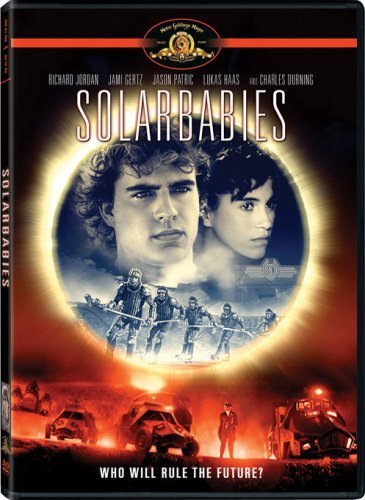
Solarbabies is a film that has a reputation. And it’s not a good one.
First released in 1986, Solarbabies is one of those post-Mad Max films that takes place in a post-apocalyptic desert society. There are no more trees. There is no more rain. Order is kept by force. The people are oppressed. Outsiders live in desert towns that have names like “Tiretown.” Children are forced to grow up in a combination of a prison and an orphanage. The orphanage’s Warden (played by Charles Durning) mourns for the way the world used to be, before it became a sun-drenched nightmare without plants or water. The fearsome Grock (Richard Jordan) makes sure that all of society’s rules are followed and the viewer knows he’s a bad guy because he wears a leather trench coat even when it’s over a 100 degrees outside. (Grock never sweats. If only the same could be said of the Warden.) The evil Professor Shandray (Sarah Douglas) experiments on living subjects. It’s a grim, grim world.
However, hope arrives in the form of a glowing orb! A ten year-old deaf boy named Daniel (Lukas Haas) finds the orb and, after regaining his ability to hear, he names it Bodhi. When Darstar (Adrian Pasdar) realizes that he can use Bodhi to protect the people of Tiretown, he steals the orb and runs off with it. Determined to retrieve Bodhi, Daniel chases after him
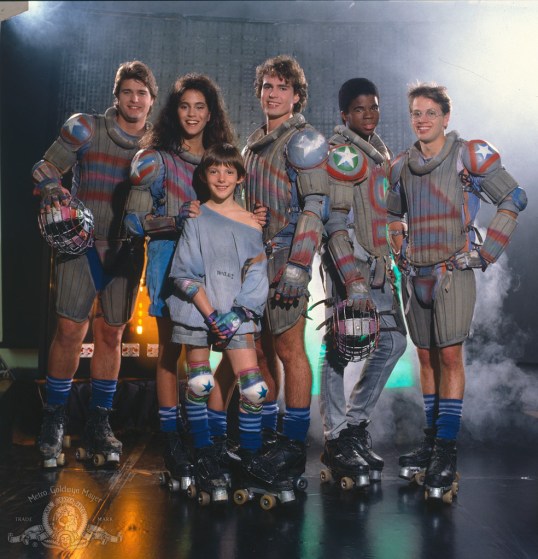
How will Daniel survive in the desert? Well, luckily, he’s not alone! Daniel was a member of the orphanage’s roller hockey team, the Solarbabies. Terra (Jami Gertz), Jason (Jason Patric), Metron (James LeGros), Rabbit (Claude Brooks), and Tug (Peter DeLuise) strap on their skates and roll out into the desert. Pursuing them is Grock and his stormtroopers.
Meanwhile, somewhere in the desert, an old man named Greentree (Frank Converse) hopes to help the world recover. Greentree looks like a thin version of Santa Claus and he hopes to bring rain and trees back to the Earth. Yes, his name is Greentree. There’s not really much room for subtlety in the world of Solarbabies.
Now, as I said at the beginning of this review, Solarbabies has a reputation. Today, it’s probably best known for being the film that nearly bankrupted Mel Brooks. Yes, that Mel Brooks. When Brooks originally signed on to produce Solarbabies, it was envisioned as being a low-budget sci-fi film that would not have any spectacular special effects. However, Brooks became convinced that Solarbabies had the potential to be a Star Wars-level hit so he increased the budget. He also brought in Alan Johnson to direct the film, despite the fact that Johnson was a choreographer who had only directed one other film and had no experience with science fiction. (Johnson’s previous film had been a remake of To Be Or Not To Be, which starred Brooks and featured Solarbabies’s Charles Durning in a supporting role). At Brooks’s insistence, the film was shot in Spain to save money. Unfortunately, no sooner had Johnson and the film’s cast arrived than Spain was hit by a series of unexpected storms that caused production to shut down. Even when the rain stopped, disagreements between Johnson and the cast delayed the film even further. The footage that was shot satisfied no one, leading to expensive reshoots. In the end, Mel Brooks invested close to $20 million dollars in the film, even taking a second mortgage out on his house. When the film was finally released, it was a critical and box office disaster, though Brooks later said that he did eventually break even after Solarbabies was released on DVD.
So, yes, Solarbabies has a bad reputation and it could be argued that it deserves it. Tonally, the film’s a mess. For a film that appears to have been made for a “family” audience, parts of the film are surprisingly violent Scenes of the Solarbabies playing LaCrosse and cheerfully crossing the desert are mixed with some surprisingly graphic scenes of Grock and Shandray torturing prisoners. Bodhi is a cute and glowing orb who gives Daniel back his hearing and then later brutally kills a lot of bad guys. Jason Patric, Jami Gertz, and Charles Durning all seem to be trying to take the film seriously while Richard Jordan and Sarah Douglas give performances that feel more appropriate for a Hammer horror film. Solarbabies is a bizarre mix of sincerity, sadism, and camp. Nothing about it makes much sense.
And yet….
Listen, I can’t help it. When I watched it last week, I enjoyed Solarbabies. For all of its many and obvious flaws, it’s a hard film not to like. It’s just so thoroughly ludicrous and messy that watching it becomes a rather fascinating viewing experience. It’s hard not to, at the very least, be entertained by the sight of the cast roller skating through the desert. A LaCrosse team battling futuristic Nazis for possession of a glowing orb that can cause rain to fall from a cloudless sky? As far as I’m concerned, it’s impossible not to enjoy that on some level.
Of course, I seem to be in the minority as far as that’s concerned. Alan Johnson never directed another movie after Solarbabies, though he did direct some of those really cool GAP commercials that aired in the early aughts. You know the ones that featured people enthusiastically dancing in khakis? That was him! Those commercials are kind of a guilty pleasure themselves. (Of course, because Mel Brooks nearly didn’t lose his house producing them, they’re not quite as infamous as Solarbabies.) But still, Johnson stared his directorial career by directing Charles Durning to an Oscar nomination in To Be Or Not To Be and he ended it by directing Durning in a box office flop. Well, no matter! I enjoyed Solarbabies and I don’t care who knows it.
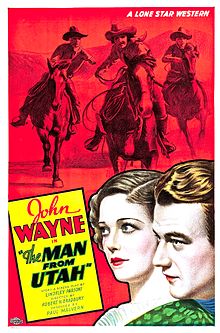
John Wayne is John Weston, the man from Utah. He’s a singing cowboy, the type who rides from town to town and sings to his horse while they’re crossing the range. John Wayne started his career in singing cowboy movies and he often complained that he wasn’t allowed to actually sing. Instead, his singing voice was always dubbed and it rarely matched his speaking voice. Audiences in 1934 may not have noticed but, for audiences today, there’s no way to hear John Weston sing and think, “That’s John Wayne.”
John Weston rides into town and guns down three bank robbers. The Marshal (George “Gabby” Hayes) is so impressed that he hires Weston and then sends him undercover into the local rodeo. The Marshal thinks the rodeo is corrupt because any rodeo rider who comes close to winning the prize money mysteriously dies of snakebite. That does seem suspicious. Weston discovers that Spike Barton (Edward Peil, Sr.) is murdering the riders and is planning on stealing the prize money for himself. Can the Man from Utah stop him without getting snakebit?
The Man From Utah features John Wayne in an early starring role, playing the type of character that he would later become famous for, the no-nonsense westerner who will do whatever he has to do to make sure justice is served. Though it would be another five years before Stagecoach made him a certifiable movie star, Wayne is already a confident hero in The Man From Utah. He only seems uncertain when he has to pretend to sing and it’s a good thing that John Ford helped him to leave the singing cowboy genre behind. If Wayne had entered Stagecoach singing a song to his horse, it would have been a much different movie.
The Man From Utah is also full of actual rodeo stock footage, most of which is exciting if you’re into that type of thing. The only problem is that most of the people at the rodeo are wearing modern clothing, making them seem out-of-place in a movie about the old west! Overall, though, The Man From Utah is a good and simple Western programmer and will be appreciated by fans of the genre.
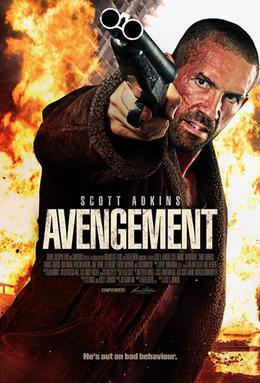
I’m not really sure if “Avengement” is actually a word but, regardless, that’s what Cain Burgess is determined to get. AVENGEMENT!
Martial artist Scott Adkins plays Cain in this 2019 British film. When we first meet Cain, he’s in prison but that quickly changes once he manages to escape. Cain heads to a pub, one that’s owned by his brother, Lincoln (Craig Faibrass). After he’s taken everyone in the pub hostage, we learn about how Cain not only came to be a prisoner but also how he ended up with some rather prominent facial scars. It turns out that Cain likes to tell a story and, for whatever reason, the gangsters are willing to sit around and listen. Through the use of flashbacks, we see how Cain went from being an innocent martial artist to being the most feared man in prison. We see how he learned to kill and how not even getting acid thrown in his face could slow him down. Cain’s a scary dude and he’s out for revenge! Or avengement!
Of course, we also can’t help but notice that a lot of Cain’s adventures feel as if they’ve been lifted from other British crime films. The talkative gangsters bring to mind the films of Guy Ritchie. A lengthy chase scene owes more than a little to the opening on Trainspotting. Even the fight in the pub owes a bit to the finale of Shaun of the Dead. It’s all a bit familiar but then again, that’s part of the appeal of the modern British crime thriller. We watch these films specifically for the posh villains and the pub fights and the often indecipherable dialogue. The familiarity is often exactly what the viewer is looking for. (That said, I was a little bit surprised by the lack of Russian mobsters wearing track suits. That was a missed opportunity.) I think the other reason why Americans, in particular, like British gangster films is the novelty of seeing that British gangsters can be just as unnecessarily violent as American gangsters. It’s nice to be reminded that America isn’t the only country that breeds violence.
Speaking of violence, Avengement is a very violent film and it’s also often a very bloody film. When you consider how much of the film takes place in prison, it’s not surprising that there’s a lot of stabbings. (What is somewhat surprising is that there are also a lot of stabbings outside of prison, even when there are guns nearby.) I’m usually not a fan of gratuitous violence but Avengement handles it all with a certain wit. The violence is so over-the-top that it’s hard not to suspect that the filmmakers are commenting on the excessive nature of other British gangster films. There’s a lengthy montage of Cain just fighting anyone who comes near him and it goes on for so long that it actually becomes somewhat humorous. It’s hard not to feel at least a little admiration for Cain’s determination to start a fight with every single person that he sees. He certainly doesn’t give up. Scott Adkins is a gymnast, along with being a martial artist, and there’s a grace to his movements that comes through even when the film is at its most brutal. Early on, I joked that the film would only work if its ultraviolent protagonist turned out to be likable and strangely enough, that’s exactly what happened. Scott Adkins, to my surprise, turned out to be not only an exciting fighter but also a pretty good actor. He shows enough screen presence in Avengement to make viewers hope that he’ll someday get a major action role.
Avengement is a ferocious but entertaining and unpretentious action film. Watch it. Experience it. Just don’t worry about trying to understand what everyone’s talking about. Just assume that everyone has a reason to want Cain dead and Cain has a reason to want the same for everyone else and there should not be any trouble at all.
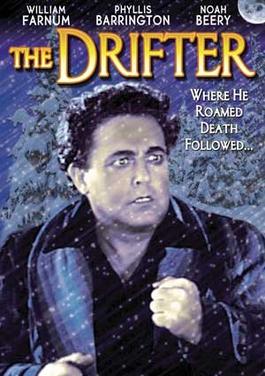
This line, which has been recycled in so many western parodies, is actually used seriously in The Drifter, a forgotten western from the pre-code era. The line is delivered by Montana (Russell Hopton) and he’s speaking to a mysterious character known only as The Drifter (William Farnum).
The Drifter is a French-Canadian who has spent decades searching for his lost-lost brother but who is now ready to go into town, get work as a logger, and hopefully find a woman to marry. Along with a mysterious man who is named Whitey and who is played by Charles Sellon, The Drifter is hired to work for local lumber magnate, John McNary (Noah Beery). The Drifter impresses everyone with his good hearted ways and he falls in love with McNary’s daughter, Bonnie (Phyllis Barrington). Unfortunately, Phyllis is already dating Paul LaTour (Bruce Warren), who is her father’s main business rival. But before The Drifter can concentrate on winning Phyllis away from LaTour and also solving the mystery of his own missing family, he has to deal with the most dangerous man in town, Montana. As Montana puts it, the town’s not big enough for both him and The Drifter.
The Drifter‘s story is potentially interesting but the low-budget, the shoddy production values, and a slow pace all conspire to do the film in. This was one of the countless western programmers that was produced in the early 30s. Like many of the other poverty row productions of the era, it starred an actor who had been huge during the silent era but who struggled to find work during the early years of the sound era. William Farnum started as a stage actor and as a protegee to Edwin Booth, who was largely considered to be America’s finest stage actor even if he was forever tainted by being the brother of presidential assassin John Wilkes Booth. Farnum’s very theatrical style of acting made him perfect for both Broadway and for the silent film era, a time when actors had to use big movements and dramatic facial expressions in order to convey their emotions. When the sound era came along, Farnum’s style was suddenly no longer in vogue and, unfortunately, it took him a while to adjust to working with sound. Even in a sound film like The Drifter where he had dialogue, Farnum gives the type of overly theatrical performance that was more common during the silent era. What’s interesting is that Farnum’s performance actually works for the character of The Drifter, who is meant to be an outsider who struggles to communicate with other people. Despite some implausible twists at the end, the rest of The Drifter isn’t as interesting.
Farnum eventually did adjust to the sound era and he became a respected character actor, playing many captains and many judges. In 1953, when he died at the age of 76, Hollywood turned out to pay their respects. Cecil B. DeMille and Paramount Picture co-founder Jesse B. Lasky served as pallbearers.
Having just gotten out of the army after serving in World War I, Bouncer (Nat Pendleton) and his friend, “Hell-Fire” Austin (Ken Maynard), head out to find their fortune in the west. Austin claims that he’s an old west legend but, despite his claims, he still can’t get away with not paying his bill at a local café. Austin and Bouncer are arrested and sentenced to work on a chain gang.
Times are tough but they start to look up when businessman Mark Edmonds (Alan Roscoe) arranges for them to be set free, on the condition that they train his horse and then ride it to victory in an upcoming race. Edmonds wants the ranch that’s owned by Judy Brooks (Ivy Merton) and, in order to get it, he has to make sure that her horse, Tarzan, doesn’t win the race and the prize money that comes with it. The only problem with the plan is that Austin likes Tarzan and he’s a little partial to Judy as well.
Hell-Fire Austin is an amusing film. Like many of the early western stars, Ken Maynard was a former rodeo star who turned to the movies and he looked authentic jumping on and riding a horse. In Hell-Fire Austin, he and Nat Pendleton are a good comedy team, playing off of each other as only two friends who have been through both war and prison could. The comedy comes less from what they say and more from their attitude towards each other. They’re stuck with each other, no matter how much they might wish differently. Hell-Fire Austin is an extremely simple movie but fans of the genre should enjoy it. It’s post-World War I setting adds an extra element of meaning to the story, with Austin and Bouncer standing in for all the soldiers who, having seen terrible fighting in Europe, were now back in America and wondering what to do with their rest of their lives. Austin and Bouncer had west, hoping to find a life like the one they’ve seen in the movies. They find it but, of course, they have to go to prison first.
Ken Maynard was an actor who probably could have been nicknamed “Hell Fire” himself. He was a big star in the early days of Hollywood but his reputation for drinking too much and being egotistical and temperamental sabotaged his career and he ended up back where he began, doing rodeo tricks for Ringling Bros. He spent his last years living in a trailer, nearly forgotten and selling “memorabilia” that later turned out to be fake, a sad ending for an authentic cowboy.
First, the only copies I could find were at the Internet Archive and on YouTube. The available copies run 48 minutes but according to the IMDb, Law of the Rio Grande originally had a 57-minute run time. If that number is correct, that means that the versions on the Internet Archive and YouTube are missing 9 minutes. Since there doesn’t appear to have been anything objectionable in the film (this is a 1931 b-western, after all), I’m going to guess that the 9-minutes were probably cut when the movie started playing on television in the 50s. That is something that happened to a lot of the old western programmers. Television was quick to buy them because they were cheap and they made for appropriate children’s programming but the movies were always edited for time and often, the original versions were lost.
Secondly, edited or not, Law of the Rio Grande is not very good. It was made, for a very low-budget, by Syndicate Pictures, a poverty row studio. The majority of the cast was made up of actors who had found success in the silent era but who never made the adjustment to the sound era. Though the actors have the right look to play cowboys, none of them know how to actually make dialogue sound convincing. There’s also a persistent sound of crackling static in the background of most of the scenes. I don’t know if that’s the fault of the film or if it’s just a bad upload but it’s obvious that the cast and crew of Law of the Rio Grande were not used to working with sound.
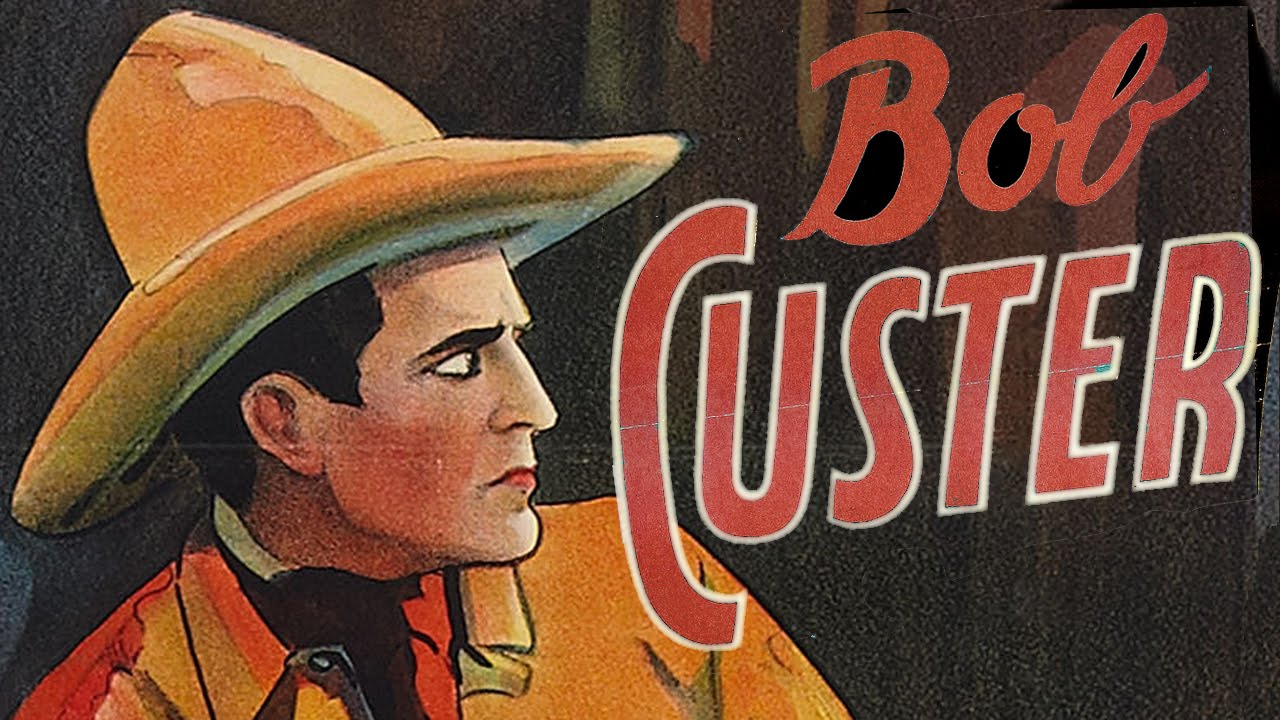
Despite the film’s title, the Rio Grande was nowhere to be seen in the version that I saw. Instead, the film is about two outlaws, Jim (Bob Custer) and Cookie (Harry Todd), who are determined to go straight. Jim and Cookie end up working for Colonel Lanning (Carlton S. King) and his daughter, Judy (Betty Mack). But then a former acquaintance known as the Blanco Kid (Edmund Cobb) shows up and threatens to reveal the truth about Jim’s background. It’s a typical western programmer, with the main message being you can’t escape your past but you can beat it up in a fair fight.
The kids probably loved it in 1931. Today, it’s mostly interesting as an example of one of Bob Custer’s final films. Custer was a legitimate rodeo star who went to Hollywood during the silent era and who had a lot of success because he looked authentic jumping on a horse. Like many silent era stars, he didn’t have to actually recite or even know his lines. He just had to be himself. Unfortunately, the sound era destroyed his career because, while he may have looked like a character from the old west, he didn’t sound like one. Unable to find work at the major studios, Custer ended up making movies like this one for studios like Syndicate Pictures. He retired from acting in 1936 and went on to become a building inspector for city of Los Angeles. It turned out that he was a better engineer than he wan actor and eventually, he named Chief Building Inspector for the city of Newport Beach, California. He passed away in 1974, nearly forty years after starring in his final film. He was 76 years old.
In this short and comedic western, Hoot Gibson plays a cowboy who is so mild-mannered that his nickname is Peaceful. William “Peaceful” Patton is such a pacifist that he’s even named after the first Quaker, William Penn. When the movie starts, a group of cowboys are shooting at each other from opposite sides of a ravine. Patton rides into the middle of the fight and tells them to put down their guns and settle things peacefully. Everyone ignores him.
Patton has gotten a job in a neighboring town, working on the ranch of Senora Martini (Lina Basquette). Leaving behind his beloved mother (Jessie Arnold), Patton heads to the Martini ranch and he discovers that everyone is scared to death of him. That’s because Patton looks just like a notorious outlaw known as The Hard Hombre. The Hard Hombre has killed a man for every year that he’s been alive. Realizing that he can use this to bring peace to the town and to help Senora Martini get her cattle back from rival rancher Joe Barlowe (G. Raymond Nye), Patton pretends to be the Hard Hombre.
Soon, everyone in town is getting along and Senora Martini has fallen in love with the man that she thinks is the Hard Hombre. But then, the Hard Hombre actually does show up in town! Even worse, Peaceful’s mother also shows up and wants to know why everyone thinks her son is a killer!
With a 64 minute running time, this low-budget programmer isn’t bad. It pokes fun at every western cliché, showing that even in the early days of Hollywood, the conventions of the western were already set in stone. The film gets a surprising amount of comedic mileage from people acting scared of the mild-looking and acting Hoot Gibson. Gibson was one of the earliest western stars, playing heroes who used their wits and who rarely carried a gun. Appearing in a film for a poverty row studio was a step down for Gibson but his casting still pays off in That Hard Hombre and he gives a good performance as a cowboy who just wants everyone to get along and to make his mother proud.