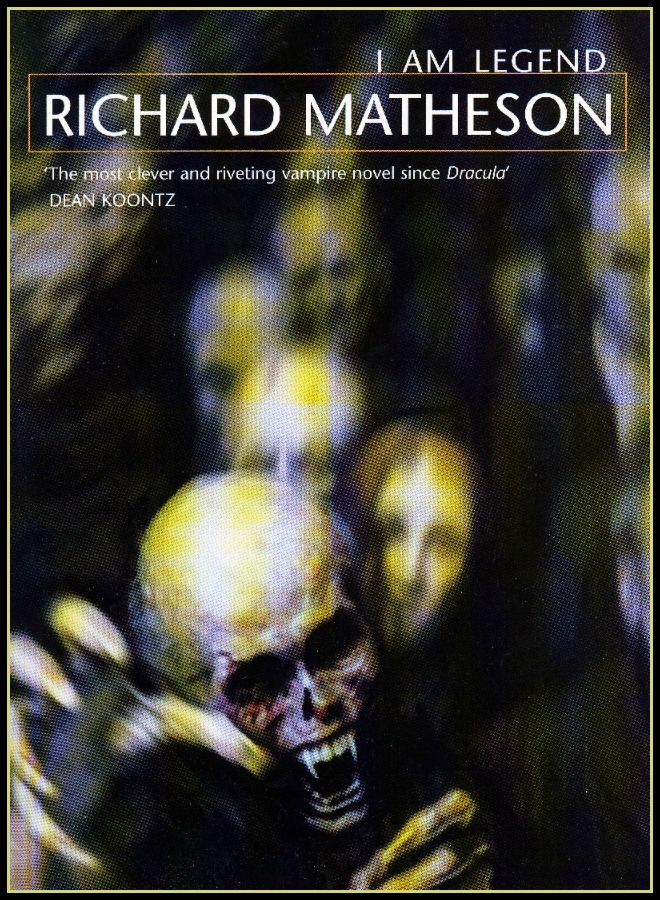
Horror Review: I Am Legend (by Richard Matheson)


“[I am] a new superstition entering the unassailable fortress of forever. I am legend.”Robert Neville

In 1954, Richard Matheson published a novel that would influence so many future generations of science-fiction and horror writers and film directors. Matheson’s body of work prior to 1954 could be summed up as good but nothing too exciting. His work thus far overlapped such pulp genres as horror, science-fiction and fantasy. This style would be the hallmark of his brand of story-telling. It would be in his novel I Am Legend that his unique style of combining different genres that Matheson would have his greatest and most epic work to date.

I Am Legend takes the vampire tale and brings it out of the shadows and darkness, so to speak. Set in the late 1970’s, I Am Legend begins its tale with humanity pretty much on the quick path to extinction due to a pandemic where the bacterium or virus involved caused symptoms very similar to what folklore had called vampirism. The protagonist of this tale was one Robert Neville. An unassuming man living in a Los Angeles suburban neighborhood who might just be the only living human being, or at least the only un-infected one, on the face of the planet. Neville’s been reduced to a day-to-day routine of defending his fortified home from the vampire-like infected humans who’ve tried attacking him and his home once night falls. This routine has become so ingrained in Neville that it starts him on a downward spiral to utter despair. He knows that he might just be the only human left and the prospect of such an idea almost becomes too much for his psyche. It’s this growing despair which gradually causes Neville to make little mistakes in his routine that puts him in greater levels of danger from those turned who see him as nothing but cattle.

His attempts to solve the mystery of why he’s the only one not affected by the disease becomes his way of keeping himself sane. Neville’s work in trying to find the answer leads him to take chances in keeping a vampire survivor alive and bound instead of just killing it outright. His experiments ranges from disproving the myths surrounding the vampire creature and acknowledging the scientific and/or psychological explanations to certain behavioral traits of these nocturnal creatures.

Neville’s studies on captured vampires tell him why certain things like garlic and sunlight causes such an extreme reaction on these creatures. Why do they have a certain invulnerability towards bullets but not a stake through the heart is one question he tries to answer through his research. He even surmises that the vampires aversion to crucifix was more psychological than anything supernatural. Neville arrives at this after observing a vampire’s reaction to a Star of David was similar to the reaction of another one towards the crucifix.

It’s events such as these which puts I Am Legend in a category all by itself. It still uses themes of horror which the vampires fulfill to great effect, but it also does a great job of taking the vampire tale out of the supernatural realm and into the scientific and logical. Neville’s attempts to keep himself sane, as his loneliness begin to weigh on his psyche and health, through these studies and experiments adds a level of the science-fiction to this tale. It’s the combination of these two genres which makes I Am Legend such an epic tale in scope yet it’s not that which gives the tale its heaviest impact. It’s Neville himself, more to the point, his desperate situation of being the last man on earth weighing on his mind. This tone gives this apocalyptic vampire tale such an intimate feel that the reader hopes and wishes for some sort of peaceful end to Neville; better yet, some hope that he might find clues that he might not be the last.

As the story moves forward, the line between who is human, who is monster and who is the true survivor become blurred as Neville’s forays into the city for supplies lead him to a community of others who have not succumbed to the monstrous effect of the pandemic. It’s this discovery that gives Neville a semblance of hope which momentarily lifts the heavy weight of inevitability from his mind. But not everything is at it seems at first glance. Neville finds this out as his encounters with this thriving community continue to give him more and more insight as to how they’ve survived. The climactic end to this tale has become such a classic ending that any other resolution wouldn’t have worked. The end worked as the best possible ending to Matheson’s tale. It also gives the books title a deeper and more profound meaning to it.

I Am Legend will continue to go down in literary history as one of the best examples of fantastic literature. It’s seemless blending of horror, science-fiction and the apocalyptic gives the tale both an epic and intimate feel and tone. It’s not wonder the very themes and premise of this story has influenced such horror writers and filmmakers as Stephen King (The Stand, Salem’s Lot) and George A. Romero (Night of the Living Dead, Dawn of the Dead, Day of the Dead). I Am Legend takes the vampire tale out of the shadows and darkness it usually in habits and brings it out to the light of science and logic with surprising results. A true classic piece of writing from Richard Matheson and one that still stands as the benchmark for apocalyptic tales.
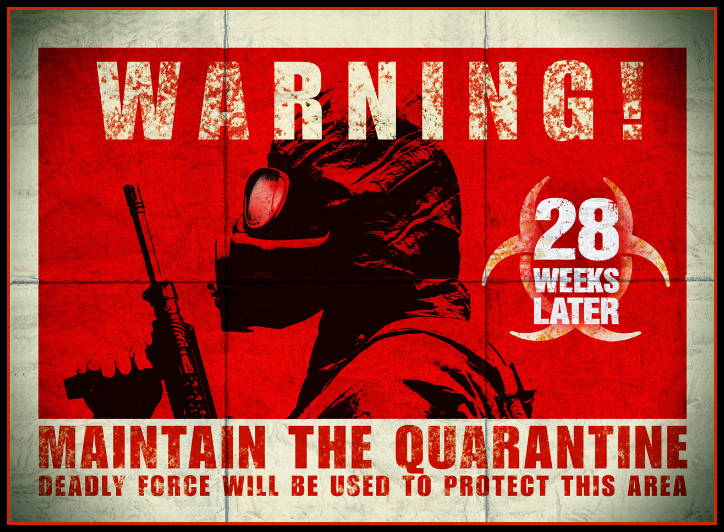
Horror Review: 28 Weeks Later (dir. by Juan Carlos Fresnadillo)


Danny Boyle and Alex Garland’s 28 Days Later was made in such a way that any sequel was almost destined to struggle in its shadow. Their film was not only one of the most influential horror films of the early 2000s, but also an exercise in experimental filmmaking and cinematic reinvention. It fused realism and terror through its digital photography, unconventional pacing, and minimalist score. Any follow-up would have to contend not just with its fresh twist on the zombie mythos (despite the infected not technically being zombies) but also its unique atmosphere, music, and stripped-down aesthetic. Against those odds, 28 Weeks Later manages to stand as an impressive and worthy successor—one that in some respects even surpasses the original.

Spanish director Juan Carlos Fresnadillo approaches the material with a clear reverence for Boyle and Garland’s vision while imprinting his own stylistic and emotional signature on the sequel. From the very first scene, Fresnadillo establishes a tone that blends despair and dread with human frailty. The film opens on a stunningly tense prologue in which Don (a gaunt and haunted Robert Carlyle) and Alice (Catherine McCormack) are living with several others in a rural cottage outside London during the first weeks of the Rage virus outbreak. In this sequence, Fresnadillo distills the central moral dilemma that runs through both films: whether to preserve one’s humanity through compassion or to surrender to pure survival instinct. When Don is forced to choose between rescuing his wife and saving himself, his decision—while horrifying to watch—feels horribly plausible. The following chase through open fields as he flees dozens of Rage-infected attackers captures the raw panic that made Boyle’s original so memorable, yet Fresnadillo shoots it with a sharper sense of chaos and movement. It sets the tone for a story that is both intimate in its human tragedy and apocalyptic in its reach.

Following this intense opening, the film transitions through an introductory credits montage that fills in the aftermath. Don’s escape was not the end of the story but the beginning of a grim reconstruction effort. The British Isles, we are told, were swiftly quarantined when it became clear the infection could not be contained. Twenty-eight weeks later, with the infected population presumed dead from starvation, a U.S.-led NATO force spearheads an ambitious effort to repopulate and rebuild. Led by General Stone (played with austere calm by Idris Elba), the military has converted London’s Isle of Dogs into a heavily fortified safe zone. This enclave represents both restoration and repression—a fragile bubble of civilization built atop the bones of horror.

Within this environment lives Don, now employed as a maintenance manager and struggling to suppress the guilt from his past. The arrival of his two children, Tammy (Imogen Poots) and Andy (Mackintosh Muggleton), who were abroad in Spain during the initial outbreak, reopens emotional wounds he had hoped were sealed. Their reunion, though heartfelt, carries an undercurrent of deception. Don’s explanation of their mother’s fate does not align with what the audience has already witnessed. This dishonesty propels the children into dangerous territory when they decide to sneak out of the Green Zone to retrieve personal belongings from their old cottage. While this act of recklessness fits with youthful impulses and emotional longing, it also feels like the film’s only contrived lapse in logic—an inevitable but frustrating horror trope that sets off the story’s next catastrophe.

What the children discover at the cottage reintroduces the virus in a shocking way. Without realizing it, they bring the Rage infection back into the supposedly secure refuge of London. As soon as containment is broken, the military response escalates with brutal efficiency. General Stone declares a “Code Red,” authorizing the use of extreme measures to eradicate the infected—including indiscriminate firebombing of civilian areas. These scenes echo not only classic apocalyptic tropes but also resonate as a grim reflection of post-9/11 militarism. Many viewers and critics interpreted this act of mass destruction as allegory for the United States’ War on Terror and the ethical corruption of occupation forces. Fresnadillo’s direction, while hinting at this reading, avoids heavy-handed political critique. His portrayal of military overreaction feels less ideological than tragic—a manifestation of fear, confusion, and the blunt-force nature of institutional power. The armed forces are not villains so much as desperate men trapped in an impossible moral quagmire. As in George A. Romero’s The Crazies, which 28 Weeks Later strongly recalls, the destructive consequences stem not from malice but from the futility of trying to maintain order amid chaos.

Where 28 Days Later focused on a small group of survivors and the intimate erosion of morality under crisis, 28 Weeks Later expands the scale dramatically. Fresnadillo transforms Boyle’s compact nightmare into a large-scale urban apocalypse. The sweeping aerial shots of a deserted London—bridges empty, streets silent—hammer home the desolation. When the city is engulfed in flames and gas clouds during the firebombing sequence, the imagery becomes both terrifying and grimly beautiful, a vision of civilization consuming itself. The sequel’s tone is darker and more nihilistic than Boyle’s film, which allowed a trace of optimism in its ending. Here, even innocence becomes a catalyst for doom: it is the children’s actions, driven by love and loss, that inadvertently reignite the infection and condemn the survivors to another wave of horror. This subversion of the “innocent child” trope underscores Fresnadillo’s bleak worldview—where sentiment and humanity, however noble, can still create destruction.

In several ways, 28 Weeks Later aligns more closely with Romero’s Living Dead films than with Boyle’s original. Though Boyle borrowed some of Romero’s thematic DNA, Fresnadillo fully embraces it. The infected may not be reanimated corpses, but the societal collapse, moral ambiguity, and recurring cycles of violence all trace back to Romero’s legacy. One of the sequel’s most striking qualities is its unflinching pessimism: even individuals acting out of love or duty become agents of devastation. The so-called survivors are reduced to primal instincts—running, hiding, killing—in a landscape where institutional power and human decency dissolve together. Fresnadillo makes the action kinetic without glamorizing it. His camera work, switching between chaotic handheld intensity and precise, panoramic destruction, keeps the viewer off balance, mirroring the unpredictability of the apocalypse itself.

The performances elevate the material beyond genre expectations. Robert Carlyle’s portrayal of Don is both gut-wrenching and terrifying. His character’s transformation—from remorseful father to infected embodiment of pure rage—serves as the film’s emotional and thematic anchor. Imogen Poots, in an early standout role, conveys resilience and vulnerability in equal measure, while Jeremy Renner delivers a strong supporting turn as Sergeant Doyle, the soldier torn between obedience and morality. Their performances, though sometimes confined within the film’s relentless pace, enrich its exploration of guilt, loyalty, and the futility of control.

Despite sacrificing some character depth for momentum, the film’s taut editing and grim atmosphere sustain tension throughout. Fresnadillo’s direction never loses sight of his central message: that humanity’s efforts to rebuild are perpetually haunted by its capacity for self-destruction. Even as the few surviving characters reach supposed safety, the final scenes undermine any hope of resolution. The closing image—infected sprinting through the streets of Paris—reminds viewers that, although the city itself appears intact and bustling in daylight, the Rage virus has now breached mainland Europe. This ending shifts the scale of threat from the quarantined British Isles to the broader continent, making containment and redemption feel like dangerous illusions.

As a sequel, 28 Weeks Later earns its place alongside 28 Days Later by honoring the original’s DNA while pushing its boundaries. It retains the visceral dread and societal commentary but broadens the lens to encompass collective failure rather than individual struggle. Fresnadillo’s approach feels colder and more apocalyptic, transforming the story into a study of fear’s infectious nature—social, political, and biological. While his film might not achieve the same creative purity as Boyle’s indie landmark, it succeeds in redefining the tone, expanding the mythology, and pushing the series toward a darker, more cinematic landscape.

In the end, 28 Weeks Later is both a continuation and an escalation—a relentless, despairing study of human fragility under crisis. Its pacing, performances, and imagery combine to create an experience that’s not only horrifying but profoundly unsettling in its realism. If 28 Days Later showed us the collapse of civilization, its sequel reveals the hopeless struggle to rebuild it. Few horror sequels accomplish that much, and fewer still end with such haunting inevitability.

Trailer: Act of Valor


Act of Valor is a film that I’ve been following for quite a bit now. For those who haven’t already heard about this film the premise is quite simple. It’s a film about a team of Navy SEALs who undergo a mission to stop a terrorist plot against the U.S. It’s a plot that has been done countless of time and not just with Navy SEALs as the protagonists. But with the Navy’s elite special-operations team having been involved in several well-documented events this past year (mainly the operation to find Osama bin Laden and his subsequent killing) they’ve become the go-to special-ops team Hollywood has latched onto.

What separates Act of Valor from other war action-thrillers of the past, present and future is the nature of it’s cast. While the film does have professional actors such as Roselyn Sanchez, Emilio Rivera and Nestor Serrano the ones who make up the SEAL team in the film are actual active duty members of the Navy SEALs. The film also uses actual SEAL team missions which the writer, Kurt Johnstad, had been given access to in order to create the screenplay for the film.

The trailer makes mention that the SEAL team members are real SEALs and they’re also using up-to-date tactics and equipment which every action filmmaker from Kathryn Bigelow to Michael Bay must be drooling to get their hands on. There is one question that will pop up as more and more people are exposed to this film leading up to it’s release.

Will the active duty SEALs be up to the task of actually emoting for the camera when not conducting the very operations in the film they’ve trained for years to perfect?

I guess we will have to wait until the film’s release date on February 17, 2012 to find the answer to that question.

Horror Review: The Serpent and The Rainbow (dir. by Wes Craven)


The word zombies conjures up the flesh-eating variety popularized by George Romero’s horror films and the legion of films from others soon after. Prior to 1968’s Night of the Living Dead the word zombies was synonymous more with the gothic-like horror films which took the Haitian voodoo folklore about the recently dead being brought back to life by voodoo priests to act as mindless slaves. It’s this version of the word zombie which Wes Craven decided to explore with his 1988 film adaptation of the Wade Davis non-fiction book The Serpent and The Rainbow. Wes Craven’s film fictionalizes the ideas and treatises put forward in Davis’ book and creates a film which tries to put to light the true horror which lay behind the voodoo folklore regarding zombies.

The film introduces us to the ethnobotanist character of Dennis Alan (played by Bill Pullman) who’s approached by a major pharma-corporation about researching the scientific origins and cause of the voodoo “zombie”. He heads off to Haiti at a time when it’s going through a political upheaval that would lead to the subsequent revolution that topples the dictatorship of that country’s leader, Francois “Baby Doc” Duvalier. During his time in Haiti he investigates story of a patient named Christophe who was reported dead 8 years past but seen recently walking about in a dazed manner. It’s while trying to get a handle on how Christophe was declared dead by authorities but then “resurrected” years later which brings Alan in contact with the local witch doctors who question Alan’s motives but also ridicule him for his narrow viewpoint regarding things which science cannot answer. But through persistence he finally gets one local to assist him in procuring the so-called “zombie powder” used to bring the dead back to life.

The Serpent and The Rainbow shows the real horror about zombification when Alan’s investigations and persistence to acquire the “zombie powder” brings the attention of the country’s secret police (the Tonton Macoutes) and one of it’s leaders and reported voodoo priest in Captain Dargent Peytraud (played by Zakes Mokae in a chilling performance) who warns him repeatedly not to continue. Repeated verbal warning and threats soon become more direct and physical as Alan finds out first-hand why no one in the country dares to speak of “zombies” to an outsider and why Captain Peytraud and his Tonton Macoutes were feared as if they were agents of the evil spirits of their voodoo faith.

Craven does a very good job in taking Wade Davis’ non-fiction book and creating a thrilling and suspenseful piece of horror which suggests that the lead character of Dennis Alan has stepped into a world that was steeped not just in the realm of science but also in the supernatural. The film includes some great scenes which shows Alan experiencing some very horrific nightmares which seems indistinguishable from his waking moments and vice versa. Unlike Craven’s previous work in horror which were imbued with some dark humor but always brutal in it’s depiction of everyday horror, this film rarely goes the gory route though the scenes of torture should make even the most hardened and jaded horror aficionado to squirm in their seat.

The true horror revealed by Craven’s film is the very human figure of Captain Peytraud and his Tonton Macoutes who use the local populace’s fear of “zombification” and how Peytraud has taken advantage of these people’s voodoo beliefs to control the public and keep themselves in power. It’s horror that many recognize and understand yet heightened even more with the addition of a local religious practice that’s relatively unknown and misunderstood by outsiders (especially by those in the West). The film never truly answers the question raised in the beginning of the film of whether the practice of “zombification” is wholly scientific and pharmacological in origins and cause or does religion and the supernatural has a hand in making the process occur. Even after the climactic encounter between Alan and Captain Peytraud in the end of the film only brings more questions which Craven seems to relish in not letting his film answer on either side of the discussion.

The Serpent and The Rainbow is one of those films during the 1980’s which never really got a fair shake from critics and the audience but has since gained quite a following in the years since it’s release. It’s actually one of Craven’s more subtle works during that period of time where violence in the film was the exception instead of the rule as in his past films. It’s a film which continues to gain fans as more and more younger film fans discover the film. Sometimes the word zombies doesn’t conjure up the typical flesh-eating variety but instead one even more horrific since it’s one based on real-life. Sometimes reality can be scarier than what we can conjure up in our minds. The Serpent and The Rainbow is one film which does a great job in supporting that.

Quickie Horror Review: Species (dir. by Roger Donaldson)


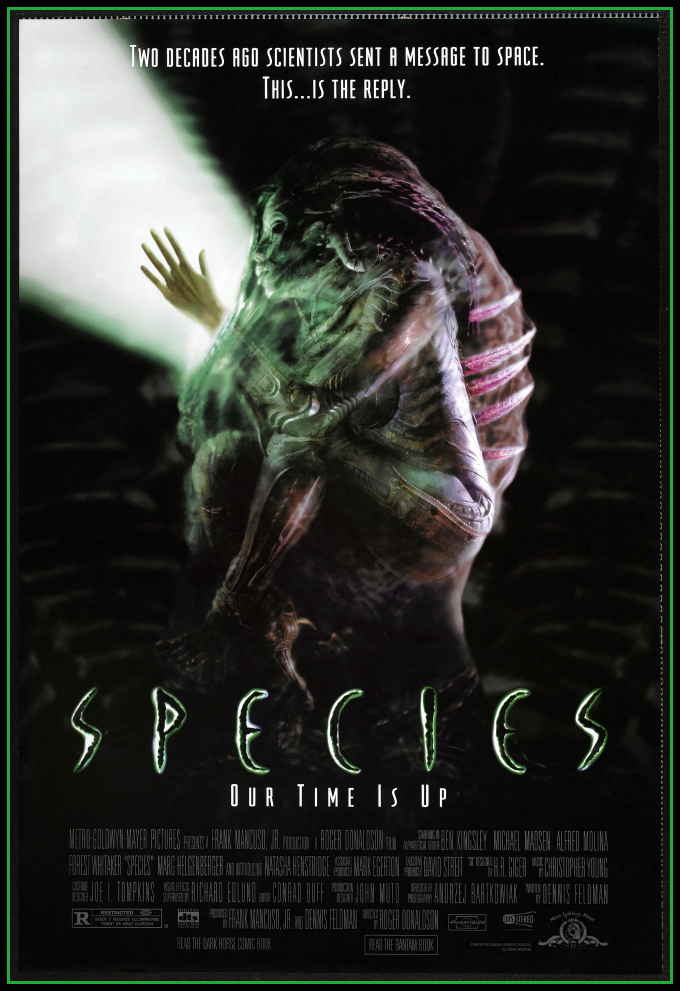
1995’s Species was a studio’s attempt to replicate the start of a new sci-fi/horror franchise like the one begun by Ridley Scott’s Alien. Roger Donaldson was tapped to direct this attempt with a cast that included Sir Ben Kingsley, Michael Madsen, Marge Helgenberger, Forrest Whitaker and Alfred Molina. The lucky gal who gets to play the role of Sil — the half-alien, half-human hybrid — fell on the stunning and gorgeous shoulders of Natasha Henstridge.

Species pulls from so many different sci-fi/horror films and shows from the past that it’s hard to find anything original in the story. There’s stuff from Alien, The Hidden, and even some episodes of The X-Files. The one original twist in this derivate film was the plot of an alien race sending over the genetic markers of its race and instructions on how to recombine it with human DNA to create a form of hybrid. Why the scientists decided to go through with such a seemingly dangerous task is known only to the writer who put pen to paper to create the screenplay. The bulk of the film’s story comes from one the creation of one such human-alien hybrid named Sil (the young version played by Michelle Williams in one of her very first roles) and how her creators and handlers begin to realize that she has an almost desperate need to procreate.

The acting by the select group of experts (Madsen, Helgenberger, Molina, Kingsley and Whitaker) were good enough and no one embarrassed themselves in the end. Henstridge does a fine job of being sexy and hot. It helped that she pretty much was naked through most of the film, or at least put herself in situations to be naked. In fact, Henstridge goes beyond just being the naked eye candy in the film, but does a great job playing the naive adult Sil who escapes her lab-prison as her instincts propel her to find the perfect mate. It’s during this search that much of the film’s gore make their appearance and there’s a bit of it.

The art design of Sil as the evolved alien hybrid came courtesy of the great Swiss surrealist, H.R. Giger who also did the design for the alien creature in Alien. Giger’s biomechanical designs have always been disturbing and beautiful at the same time and he didn’t disappoint with his design of Sil. If there was a quibble on Sil’s final design it was that it still resembled a bit too much of the alien design in Ridley Scott’s Alien. But it was still great to see H.R. Giger still creating such wonderful artwork and designs for people to see. His popularity has always been mostly composed of the elite circles of the artworld and those small, loyal art groups with a penchant for the surreal, weird and disturbing.

In the end, Species was a good sci-fi/horror that didn’t bore too much and for those who enjoy their gore this film had its equal share of the red stuff. Gratuitious nudity and sex from Natasha Henstridge as Sil the alien hybrid and the excellent designs from H.R. Giger gives this film enough good things to look at. It doesn’t bring anything new and pretty much reuses alot of other things from other movies, but Species was good enough albeit derivative of better past films and shows.

Quickie Horror Review: Deathwatch (Michael J. Bassett)


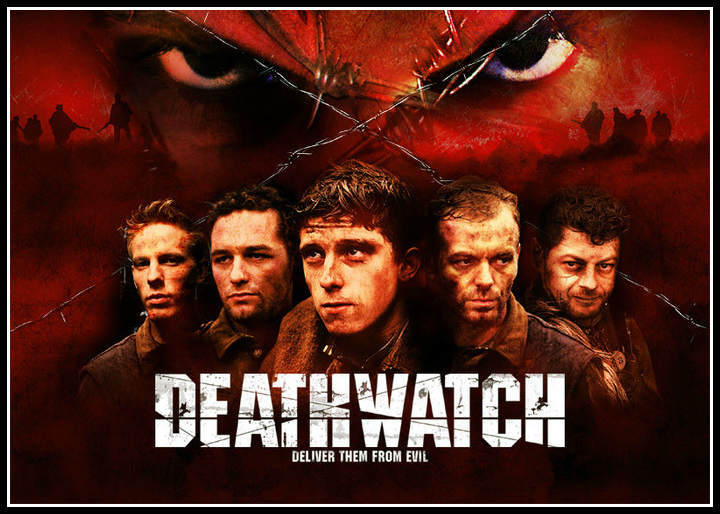
A horror film from Great Britain came out in 2002 starring Jamie Bell (from Billy Elliott) and Andy Serkis. This was a film which went under the radar of most people, but not horror fans who tend to pick up on little gems such as Michael J. Bassett’s Deathwatch.

Set during the height of the trench warfare in the Western Front during the First World War, the surviving remnants of a British Infantry company stumble upon a nearly deserted set of German trenches as they exit a fog-shrouded battlefield. Except for a couple of terrified German soldiers, the near-deserted trench only has dead German soldiers. As they spend their first night, it’s more than German soldiers they have to worry about, somewhere within the trenches something that’s hunting them down one by one.

Deathwatch does a good job in mixing in themes of horror and paranoia as the British soldiers and their lone German prisoner must try to figure out just who or what has been hunting them in the trenches since their arrival. Signs of this unknown enemy could be seen in the dead German soldiers piled on to of each other and wrapped in barbed wire. Blood flows freely from within the muddy walls of the trench system though no bodies could be seen within these walls. The film does a great job of creating such a claustrophobic atmosphere for the characters that it’s natural to see their progression from being battle-weary but alert to being paranoid to the point that they begin to hallucinate and, at times, turn on each other.

From the sound of it this film shares some similarity to Carpenter’s The Thing. As more and more of the survivors die, paranoia and suspicion grows amongst the rest as to who or what might be hunting them. The performances by the cast is good though nothing to write home about, but enough to convey the dread and paranoia sweeping through the trench. Jamie Belle as the teen British soldier with a conscience gives a understated performance while on the polar opposite is Andy Serkis scene-chewing his way through the bulk of the film as a soldier with sociopathic tendencies.

Deathwatch was a very good horror-suspense film that made great use of it’s World War I setting and borrowing themes and ideas from similar films. Michael J. Bassett’s direction kept the film moving and the film doesn’t skimp on the gore when it needed it to balance out the scenes of suspense throughout the film. It’s not a great film by any means, but it’s one of those little-known gems that one hears about and won’t be disappointed once they give it a try.

AMV of the Day: My First Kiss


The latest “AMV of the Day” is quite appropriate for this month of October. I will say that this particular AMV is more on the comedic side despite using an anime which has horror themes to it.

“My First Kiss” is an anime music video combining the fantasy horror anime series Dance of the Vampire Bund with the cheerful and double entendre-laden song “My First Kiss” by the group 3OH!3. CodeHeaven, the video’s creator, does a great job of picking the right scenes from the series to fit particular lyrics in the song. The series is fantasy horror, but it is also one of the more risque ones to make it’s jump from Japan to the US with most of it’s scenes intact. The video just hints at some of this and the song just adds to it to great effect.

Dance of the Vampire Bund is definitely not hentai, but it does have heavy ecchi moments which when paired with a song like “My First Kiss” makes for one fun anime music video.

Anime: Dance in the Vampire Bund

Song: “My First Kiss” (feat. Ke$ha) – 3OH!3

Creator: CodeHeaven


Quickie Horror Review: Dead Snow (dir. by Tommy Wirkola)


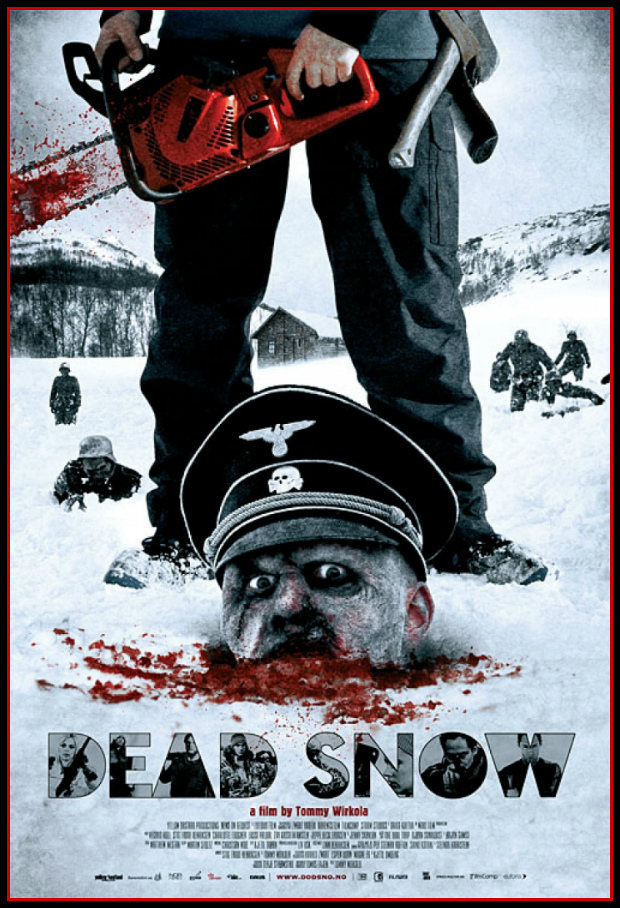
One thing about the zombie monster is that they’re pretty much a blank slate and anyone with an idea on how to use them can add their own spin to this undead staple in horror. Some have made zombies be undead Templar knights who hunted by sound. Some have even been made in combination with Egyptian mummies. There has even been zombies underwater fighting and trying to feed on sharks. In 2009, Norwegian Tommy Wirkola filmmaker took the zombie and combined it with that other icon of evil in entertainment, the Nazi. What he was able to create with this combo is the horror film Dead Snow.

The film begins with a lone woman running frantically through the snows somewhere in the mountain fjords of Norway with unknown figures chasing her. Like most horror films which begins like this her fate looks to be predetermined and how she finally buys it shows the audience that this is not going to be the usual zombie film as undead figures tear her apart and devour her while wearing the typical Nazi regalia. This gory start segues into the unfortunate group who will end up having to experience and deal with the sudden problem of WWII-era Nazis who had occupied Norway during the war and had ended up being buried (and presumed killed by the Norwegians near the end of the war) for decades in the snows of the Norwegian mountainside.

There’s really nothing too special about the seven students who decided to spend their Easter vacationing in the mountain cabin owned by the young woman killed earlier in the film. They’re not one-dimensional characters, but they’re also not the smartest tools in the shed as they make the usual mistakes young people make while staying at an isolated cabin high up in the mountain with a reputation for being haunted and cursed. The film’s director also co-wrote this script with screenwriter Stig Frode Henriksen and one could almost sense they were trying to emulate the group dynamics of the group in Edgar Wright’s instant zombie-comedy classic Shaun of the Dead. While Wirkola and Henriksen never reach the same level of creativity in their characters the actors playing them do a good enough job that we root for them to survive the siege of the suddenly hungry Nazi zombies outside their cabin.

Dead Snow does have something which raises the film from being dull and predictable into something very entertaining and thrilling through it’s many gory set-pieces. These scenes as the survivors try to fight their way and escape the Nazi zombies (or are they zombie Nazis) doesn’t skimp on the blood and gore. Wirkola may have known that the story of his film was very thin on plot with charactersa step or two above cardboard so decided to just let the grue fly. It’s here that Dead Snow suddenly becomes jet-fueled rollercoaster ride as bodies (both living and undead) get mutilated, decapitated, blasted, shot-up and everything in-between. The final stand-off with the final survivors and an increasing number of Nazi zombies makes this film worth watching.

Tommy Wirkola’s Dead Snow doesn’t bring too many new things to the zombie genre (Nazi zombies having been done decades earlier in films such as Shock Waves and Oasis of the Zombies), but he does add some dark humor and a healthy dose of over-the-top zombie mayhem that makes the film quite entertaining despite it’s flaws. Plus, how can one go wrong with picking something to watch that has Nazi zombies gallivanting their bloody way through Norwegian mountainsides with a hankering for Norwegian students.

Quickie Review: Re-Animator (dir. by Stuart Gordon)


“Who’s going to believe a talking head? Get a job in a sideshow.” — Herbert West

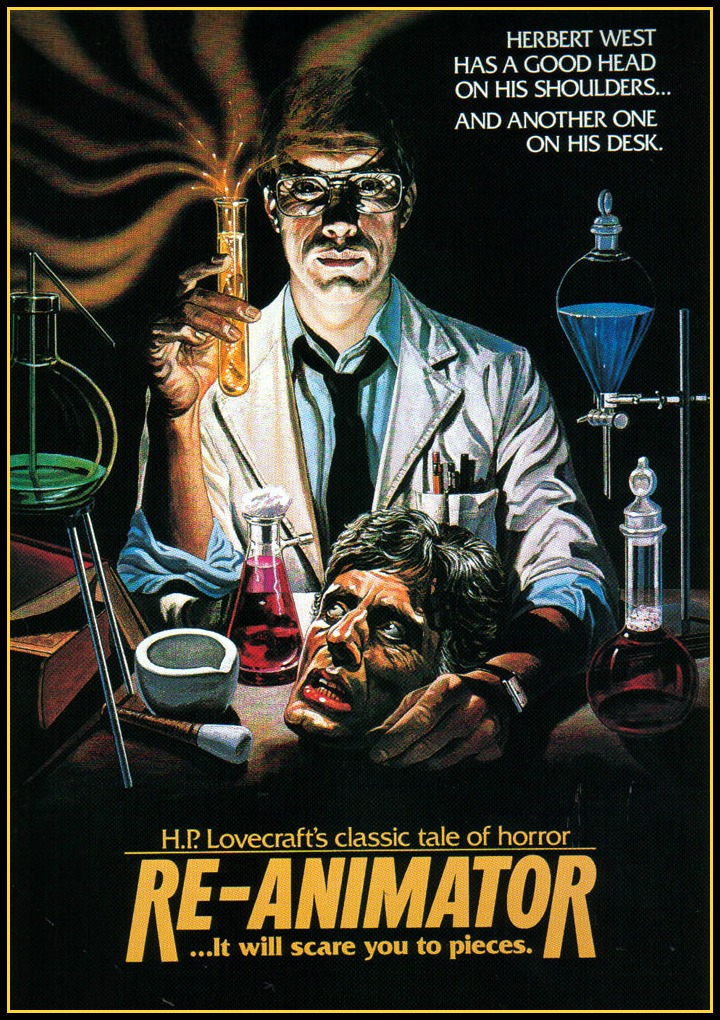
When discussing horror films of the 1980s, the conversation almost always turns to whether one has seen a particular cult classic. One such film is Re-Animator, Stuart Gordon’s 1985 adaptation of a little-known H.P. Lovecraft short story originally serialized from 1921 to 1922. While the story itself isn’t considered one of Lovecraft’s best, it inspired Gordon to create his own grisly take on the classic “Frankenstein monster” tale—with a unique blend of horror, humor, and gore.

The film follows Herbert West, a young, promising medical student obsessed with bringing the dead back to life. After being expelled from a Swiss university for his unorthodox experiments, West relocates to Miskatonic University in Arkham, Massachusetts, to continue his research in secret. He soon gains an unlikely partner in Dan Cain, a fellow medical student and landlord, who discovers West’s glowing green reagent and the terrifying results it produces.

Re-Animator plays out much like an over-the-top EC comic from the 1950s and early ’60s, full of lurid visuals and melodramatic dialogue. It’s a pulp horror film with a sci-fi twist, reveling in slapstick gore as the zombie-like corpses injected with West’s reagent come violently back to life. Unlike the flesh-eating zombies popularized by George A. Romero, these reanimated corpses are unique in their behavior, making the film stand out from typical zombie fare.

If the blood and gore weren’t enough, Re-Animator etched its place in exploitation horror history with one of the most infamous scenes ever: Megan (played by Barbara Crampton) and the severed reanimated head of West’s nemesis (played by David Gale) in a tense and chaotic encounter. This scene remains one of the most widely discussed moments in horror film history.

Gordon’s attempt to create his own “Frankenstein movie” was a huge success within the horror community, leading to two sequels. Jeffrey Combs continued to portray Herbert West in the follow-ups, though they never quite reached the original’s cult status. Still, Re-Animator firmly put both Stuart Gordon and Jeffrey Combs on the horror map—and horror fans everywhere are thankful they did.

Scenes I Love: Up


The passing of Steve Jobs has brought out condolences and praise for one of the most innovative and creative forces in technology, entertainment and how the world interacted in the digital age. One of the many things he has created and fostered was the animation studio we’ve grown to love and call Pixar. It’s difficult to fathom of anyone who doesn’t have at least one fond memory from watching a Pixar film. I have my favorite from several Pixar releases, but one that I really have enjoyed reliving over and over (sometimes with my brother who also loves the film) is the film Up from 2009. It’s from this cg animated film that I’ve chosen the latest “Scenes I Love” in honor of Steve Job.

I’m sure there’s many scenes other people love from this film. Whether it’s the great opening sequence that will bring the most cynical person to tears or scenes between crotchety, old Mr. Fredrickson and Wildlife Explorer Russell. I’m also sure that many would choose scenes involving their talking furry companion Dug. It’s the scene where Dug first meets up with Russell and Mr. Fredrickson which I love the best.

I would try and describe why I love this scene but I think watching it would be the best explanation why I love it so. The one below is a bonus and just shows why Dug is a favorite.