4 Shots From 4 Films is just what it says it is, 4 shots from 4 of our favorite films. As opposed to the reviews and recaps that we usually post, 4 Shots From 4 Films lets the visuals do the talking!
Today, we pay tribute to the legendary cinematographer, Vilmos Zsigmond. Born 90 years ago today in Hungary, Zsigmond got his start in the 60s with low-budget films like The Sadist but he went on to become one of the most in-demand cinematographers around. In fact, of all the people who started their career working on a film that starred Arch Hall, Jr., it’s hard to think of any who went on to have the type of success that Zsigmond did.
Zsigmond won one Oscar, for his work on Close Encounters of Third Kind. He was nominated for three more. He also received a BAFTA award for his work on The Deer Hunter and was nominated for an Emmy for his work on Stalin. He’s considered to be one of the most influential cinematographers of all time.
In honor of the memory of Vilmos Zsigmond, here are….
4 Shots From 4 Films
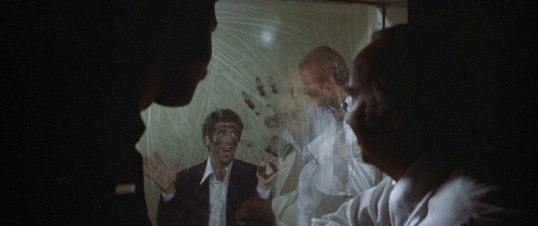
The Long Goodbye (1973, dir by Robert Altman, DP: Vilmos Zsigmond)
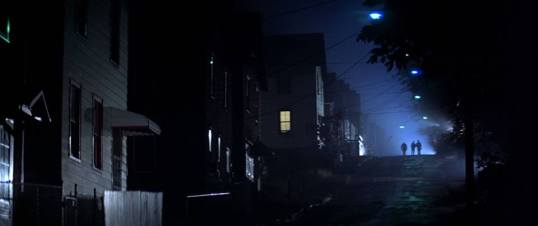
Close Encounters of the Third Kind (1977, dir by Steven Spielberg, DP: Vilmos Zsigmond)
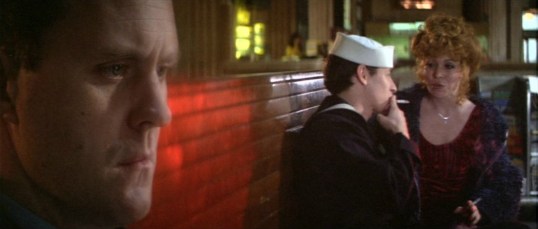
The Deer Hunter (1978, dir by Michael Cimino, DP: Vilmos Zsigmond)
Blow Out (1981, dir by Brian DePalma, DP: Vilmos Zsigmond)
There’s a lot of things happening in the world right now and I’m not even going to try to explain it all. I’m far better at writing about movies than I am about writing about what’s happening right outside of my front door. On the plus side, I can walk again! I sprained my toe a week and a half ago. I may be limping but I’m still getting around a lot better than I was a few days ago. So yay for good news!
Here’s what I watched and read this week. It seems like it should be more but …. oh well.
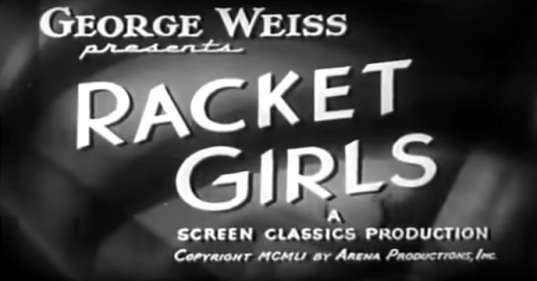
The other night, I watched the 1951 film Racket Girls with a select group of friends. We get together every Saturday night and watch a movie. Usually, the movie’s pretty bad. (For instance, we watched Disco Beaver From Outer Space one night.) Still, I think Racket Girlsmight be the worst film we’ve seen to date.
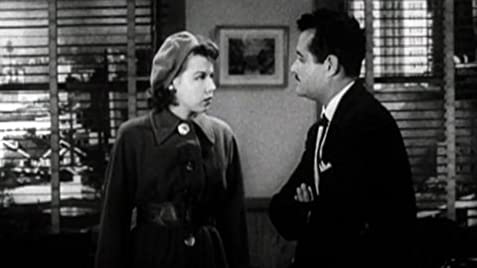
Racket Girls tells the story about how the mob infiltrated the sport of professional wrestling. Umberto Scali (Timothy Farrell) and his little friend Joe (Don Ferrara) make their living managing female wrestlers but it turns out that the wrestling hall is really a front for all of Umberto’s illegal activities. We’re told that there’s a lot of illegal activities going on but we don’t really see many of them. Anyway, Umberto borrows too much money from Mr. Big and then he gets the police mad at him and it looks like it all might lead to a bad end for Umberto and his little friend Joe.
Or maybe not. Who knows? This movie is only a 67 minutes long but it’s next to impossible to actually follow the plot. To be honest, I found the complete lack of background music to be more interesting than the plot itself. It gave the film a strangely existential feel. There’s no music. There’s no entertainment. There’s just a lot of wrestling and bullets.
In fact, I’d say that the film is 75% wrestling, which …. well, I guess whether or not that works depends on whether or not you’re a fan of grainy professional wrestling footage. I’m not a huge fan, though I’ve seen some good wrestling movies that were smart enough to explore the real people behind the outsized personas. In Racket Girls, no one really has a personality and no one has a persona either. There’s a lot of overhead shots of a wrestling ring and we hear what sounds like a crowd cheering even though we never actually see them. It’s actually a bit of an odd effect. It makes the wrestling scenes seem positively surreal. I kept waiting for that strange radiator woman from Eraserhead to step out in the ring and start singing, In Heaven, Everything Is Fine….
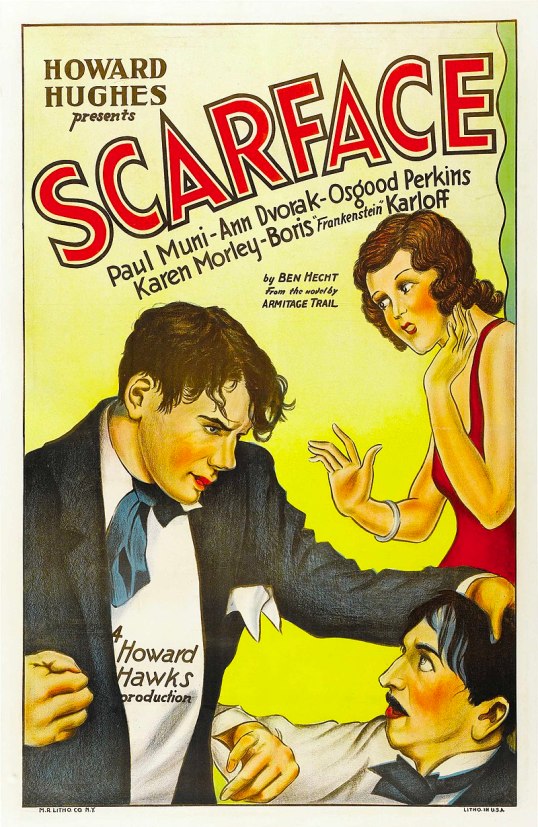
Anyway, the film does make a legitimate point about mob’s influence in professional sports. Umberto, it should be noted, doesn’t appear to be a very smart gangster. That’s his downfall. Still, if you enjoy watching movie featuring tough guys in black suits threatening each other …. well, this film probably still isn’t for you. I mean, a few of the actors playing the gangsters have got the look down but no one’s particularly convincing. It’s like a community theater production of The Sopranos or something. It’s like they remade Scarface with Justin Bieber.
As I watched this film, I found myself wondering whether or not Ed Wood was involved because the film just feels like an Ed Wood production. Also, it should be noted that Racket Girls was produced by George Weiss, who produced several of Wood’s films and that star Timothy Farrell appeared in at least 3 Wood-directed films. Ed Wood’s name doesn’t appear anywhere in the credit but I swear, this film has his finger prints all over it.
I’m probably making Racket Girls sound more amusing than it actually is. This is an incredibly boring movie. My friends nearly abandoned me about ten minutes into the movie and that hardly ever happens. I had to beg them to stay and watch the rest of the film. (I told them that there was a cartoon coming up that featured the first appearance of Bobba Fett. That was the same line I used to keep them from abandoning me two years ago when we were watching The Star Wars Holiday Special.) This is an offer that you can refuse. In fact, you should refuse it.
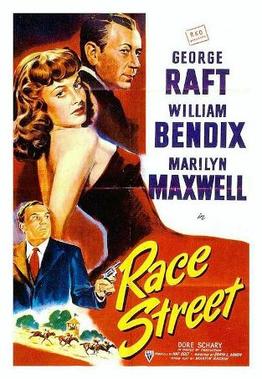
The 1948 film noir, Race Street, tells the story of what happens when the mob comes to San Francisco.
Led by the ruthless Phil Dickson (Frank Faylen, who you might recognize as Ernie the Cab Driver from It’s a Wonderful Life), the mob is looking to move in on San Francisco’s bookmaking rackets. Dickson wants all of the bookies to pay him for protection. Of course, he knows that he’s going to have a hard time convincing some of them to go along with his plans so he comes up with the brilliant idea of making an example of one bookie. He sends two of his men to talk to a small-time bookie named Hal Towers (Harry Morgan). They tell Hal that he can either pay Phil or he can suffer the consequences. Hal says that he’ll suffer the consequences so they promptly through him down a flight of stairs, killing him.
When Hal’s best friend, nightclub owner Dan Gannin (George Raft), discovers what has happened, he swears that he’s going to get revenge. Even after Dickson’s men abduct Dan and give him a brutal beating, Dan remains committed to getting justice for Hal. Lt. Barney Runson (William Bendix), who has been Dan’s best friend since childhood, tries to convince Dan to let the police handle it. He even tries to get Dan’s sister, Elaine (Gale Robbins) and Dan’s mysterious girlfriend, Robbie (Marilyn Maxwell), to convince him to back off but Dan won’t hear of it. Of course, because this is a film noir, Robbie has secret of her own….
Race Street is a low-budget noir that only has a running time of 79 minutes but still somehow finds time to sneak in a few musical performances from Gale Robbins. When the film first started, I have to admit that I wasn’t expecting much. George Raft seemed bored with his role and William Bendix’s opening narration didn’t fill me with much confidence. However, it didn’t take long for the film to win me over. Harry Morgan, for instance, brought a lot of wounded dignity to his relatively small role and his monologue before his murder is surprisingly moving. Frank Faylen was cast against type as the evil mobster but it worked. Seeing the normally amiable Faylen threatening to kill people was a good reminder that not all monsters look like monsters. Some of them look like the friendly Bedford Falls cab driver. As befits a film noir, the film is full of ominous shadows and sudden bursts of violence. The scenes where Hal is murdered and Dan is beaten both stand out as being perhaps a bit more brutal than one might expect a film from 1948 to be.
Race Street is a minor noir but aficionados of the genre should enjoy it. This is a short and no-nonsense film that gets the job done. It’s an offer you should not refuse.
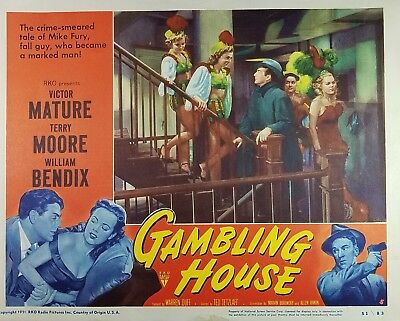
The 1950 film noir, Gambling House, begins with the aftermath of a murder.
A man’s been gunned down in an illegal gambling house. The murderer is gangster named Joe Farrow (William Bendix) but Farrow has no intention of going to prison. Fortunately, another gambler was wounded during the shoot out. Marc Fury (Victor Mature) will survive his injury but he might not survive being a witness. However, Farrow sends his gunmen to make Fury an offer. If Fury agrees to take the rap for the shooting, he’ll not only live but Farrow will pay him a good deal of money. Fury agrees because …. well, what else is he going to do?
Fury is arrested for the murder. He pleads self-defense and he’s acquitted at the trial. So far, so good, right? However, there’s always a complication. First off, there’s the fact that Farrow wasn’t exactly being honest when he promised to pay Fury. Farrow has no intention of giving Fury any money. In fact, now that Fury has been acquitted and the case is officially closed, it might be more convenient just to have Fury killed.
The other problem is that Fury’s trial brings him to the attention of the Immigration and Naturalization Service. The INS takes a look at Fury’s record and they discover that he’s not Marc Fury at all! (I know, it’s a shock. Who would think that a name like Marc Fury would be fake?) It turns out that his original name was Marc Furiotta and he was born in Italy. His family came to the U.S. when Marc was a child. Marc always assumed that he was a citizen but it turns out that his parents were never naturalized and therefore, Marc is in the country illegally! INS wants to deport him. Marc wants to stay in the United States.
Fortunately, Marc will have a chance to try to convince a judge to let him stay in the United States, despite his lengthy criminal record. Until his hearing (or until he makes bail), he’ll be detained at Ellis Island. Marc soon finds himself stuck on Ellis Island, presumably right underneath the base of the Statue of Liberty. (I know the Statue of Liberty isn’t actually on Ellis Island but the imagery just got stuck in my head while I was writing this review and I’ll be damned if I’m going to take it out.) He’s surrounded by earnest immigrants who can’t wait to become American citizens and that awakens his own patriotic feelings. He also meets a social worker named Lynn (Terry Moore) and he falls in love with her. When he appears before the judge, he explains that he can’t put into words why he wants to stay in America. He just know that he does. Awwww, what a wonderful story …. oh wait. He’s still got Joe Farrow trying to kill him, doesn’t he?
Gambling House is an odd film. Actually, it’s something like three different films at once. On the one hand, it’s a low-budget film noir, with menacing tough guys and a morally ambiguous hero and an outwardly respectable villain who is actually a member of the mob. On the other hand, it’s an earnest legal drama about an immigrant who comes to love his adoptive country. And then, on the other hand (that’s right, this movie has three hands), it’s a romcom where cynical Marc ends up falling for idealistic Lynn.
That’s a lot for one, low-budget 90-minute film to carry on its shoulder and sadly, Gambling House struggles to balance all of its different elements. It gets off to a good start, with Victor Mature delivering all of his lines with a scornful disdainful for anyone who looks at him. And the scenes with William Bendix as the mob boss are effective. But none of those scenes seem to belong in the same movie with Marc waiting on Ellis Island and Lynn explaining why she wants to help people become citizens. In the end, this is a film about many things but none of those things are really explored in that much depth.
Though this is a adequately directed and acted film and this is one scene, in which Marc looks at the New York skyline from the holding cell in Ellis Island, that achieves a certain visual poetry, this is still an offer that you can refuse.
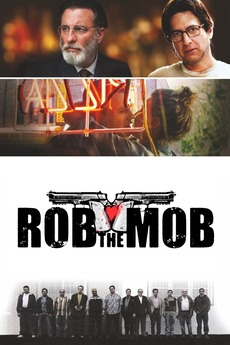
The 2014 film, Rob the Mob, tells the true story of a young couple in love who became minor celebrities when they robbed the mob. Of course, they also ended up with a huge target on their back, which tends to happen when you repeatedly humiliate a bunch of angry men who have weapons at their disposal.
The year is 1992 and Tommy Uva (Michael Pitt) and his wife, Rosemarie (Nina Arianda) are professional criminals who, after getting busted for trying to rob a florist on Valentine’s Day, end up working at a debt collection agency. Their boss (played by Griffin Dunne) spent time in prison for insider trading and he believes in giving convicts a second chance. The problem is that Tommy doesn’t really want a second chance. He’s actually pretty happy being a criminal.
Tommy has some issues with the Mafia, largely due to the fact that his father borrowed money from the mob to open up a shop and spent the rest of his short life being beaten and humiliated by loan sharks. Tommy believes that the pressure is what led his father to an early grave. Tommy’s mother (Cathy Moriarty), on the other hand, claims that it was the stress caused by Tommy being a criminal. Regardless, seeing his father repeatedly mistreated has definitely left Tommy with some anger issues.
Even though Tommy claims that he hates the Mafia, he still seems to be rather obsessed with them. At times, it’s hard to tell if Tommy is angry with the Mafia or if he’s just jealous about the fact that he’ll never be as rich or as powerful as the local neighborhood mobster. Tommy starts to skip work so that he can observe the trial of John Gotti. It’s while doing this that Tommy hears that guns are not allowed in Mafia social clubs.
Soon, Tommy is robbing those same clubs, taking all of the money that he can and humiliating the mobsters at the same time. (He forces one group of paunchy gangsters to march outside in their underwear.) With Rosemarie serving as his getaway driver, Tommy soon becomes something of a legend. The mobsters even nickname the pair “Bonnie and Clyde.” Because the Mafia doesn’t want to attract any unnecessary attention during the Gotti trial, Tommy and Rosemarie are able to get away with their activities for a while. But then they make the mistake of stealing a list that could bring down the entire New York Mafia….
Rob the Mob is a bit of an uneven film. The film starts with Tommy and Rosemarie getting high and then attempting to rob a florist and, in that scene, they both seemed like such idiots that I really wasn’t sure that I wanted to spend 104 minutes of my life watching a film about them. Even after Tommy got out of a prison and got a legitimate job, he still seemed like such an unsympathetic loser that I found myself wondering why I should care.
However, once Tommy and Rosemarie start actually robbing the mob, the film picks up. We meet Big Al, the temporary head of the New York mafia, and he’s played by Andy Garcia, who gives an intelligent and understated performance. Big Al may be a mobster but he’s not an unsympathetic character. The film presents him as being someone who has been unexpectedly thrust into a position of power and who is doing his best to keep everything from falling apart. Then, as the robberies continue, Ray Romano shows up as Jerry Cardozo, a reporter who makes “Bonnie and Clyde” famous but who realizes too late that he’s also put their lives in even greater danger than they were before. Over the past few years, Romano has gone from being a former sitcom star to being a surprisingly effective character actor and his performance here gives Rob the Mob its conscience.
Perhaps even more importantly, during the second half of the film, the chemistry of Michael Pitt and Nina Arianda finally won me over and I actually started to care about what would happen to Tommy and Rosemarie. Tommy and Rosemarie find a reason for living in their criminal activities. They go from being losers to being minor New York celebrities, even if they can’t reveal their actual identities. They may be idiots but their love is real and there’s something very touching about how much they actually do care about each other. It’s hard not to be happy for them, even if it’s obvious from the start that their story is not going to have a happy ending.
Rob the Mob is uneven but, in the end, it’s more than worth watching. This is an offer you should not refuse.
The 1948 film noir, Force of Evil, plays out like a fever dream of dark and disturbing things.
The film begins on the third of July with attorney Joe Morse (John Garfield) telling us that, by the end of the 4th of July, he will have made his first million dollars, something that he describes as being “an important moment in every man’s life.” Joe has an appreciation of money that one can only get from growing up poor. By his own admission, Joe spent most of his youth on the streets, committing petty crimes. It was his older brother, Leo (Thomas Gomez), who held things together back home and who kept Joe from getting into any truly serious trouble. Now, years later, Joe is an attorney and Leo is a small-time player in New York’s numbers racket.
(The numbers racket, as the film explains, is an illegal lottery in which people — mostly in working class neighborhoods — bet on which three numbers will be drawn at the end of the day. In this film, those three numbers are the last three digits of “the handle”, the amount race track bettors placed on race day at a major racetrack, published in the major newspapers in New York.)
Joe now works for Ben Tucker (Roy Roberts). Tucker may look like a respectable businessman and he may operate out of an office building but he’s actually a gangster. He got his start as a bootlegger and then, after prohibition ended, he moved into the number game. He and Joe have come up with a scheme to consolidate and take over the entire New York numbers racket. They’re going to fix the handle so that, on July 4th, everyone who picks “776” as their three numbers will win. (As Joe explains, a mix of patriotism and superstition leads to thousands of people picking 776 on every Independence Day.) When the small time operators don’t have the money to pay off the winners, Tucker will loan them the money to stay afloat. However, by accepting the loan, the operators will now be in debt to Tucker and Tucker will basically control their operations. Anyone who doesn’t want to work for Tucker will either be out of work or dead. It’s all strictly business.
The only problem is that Joe knows that the plan will basically bankrupt Leo. When Joe goes to Leo and tries to warn him, Leo refuses to listen to him. Leo may be a criminal but he’s an honest criminal and he has no interest in getting involved with someone like Ben Tucker. Leo watches out for the people working underneath him and treat them fairly, a concept that men like Ben Tucker will never understand. In fact, the only thing that Leo asks from Joe is that Joe make sure that Leo’s longtime secretary, Doris Lowry (Beatrice Pearson), is taken care of.
Needless to say, things get even more complicated from there….
Force of Evil presents us with a world where everyone — with exception of maybe Doris — is corrupt and where everything — from blackmail to murder — is strictly business. Greed is the motivator for every action and the more money that comes in, the easier it is to justify every ruthless act. Joe makes his fortune over the course of one of America’s most sacred holidays but it comes at the expense of his brother. His brother tries to do the right thing as far as his employee are concerned, just to discover that the Walter Tuckers of the world don’t care what happens to the people who work for them as long as the money keeps coming in. It’s a dark and cynical movie, a gangster movie were the cops are just as dangerous as the people they’re arresting and where concepts like love and loyalty mean nothing when there’s money to be made.
As directed by Abraham Polonsky, Force of Evil plays out like a filmed nightmare. Every interior seems to be full of ominous shadows and the exterior scenes always seem to find characters like Leo Morse and his timid accountant (Howland Chamberlain) dwarfed by the city around them. Gangsters like Ben Tucker and his associates emerge from the darkness, with the film’s final shoot-out taking place in complete darkness and featuring characters shooting at shadows despite not knowing who that shadow might belong to. It’s a dark and claustrophobic world that Polonsky presents, one that always seems to be closing in on the Morse brothers and the people unlucky enough to be around them. (The real world would later close in on Polonsky, an unapologetic Marxist whose ideology is obvious in the film’s portrait of crime just being another form of big business. Polonsky was among those blacklisted in the 50s. Force of Evil was the first of only three movies that he would ever direct.)
John Garfield plays Joe Morse with a barely contained anger. Even after he’s made his first million, he’s still angry at the world. Getting rich is his revenge on a society that predicted that someone like him would never amount to anything. Roy Roberts is perfectly sleazy as the outwardly respectable Walter Tucker and Marie Windsor has a few wonderful scenes as his vampish wife. Perhaps the film’s best performance comes from Howland Chamberlain, playing an accountant who soon finds himself in over his head as Tucker makes his move on Leo’s operation.
Tough, violent, and visually unforgettable, Force of Evil is an excellent gangster film and a classic noir. It’s definitely an offer that you can’t refuse.
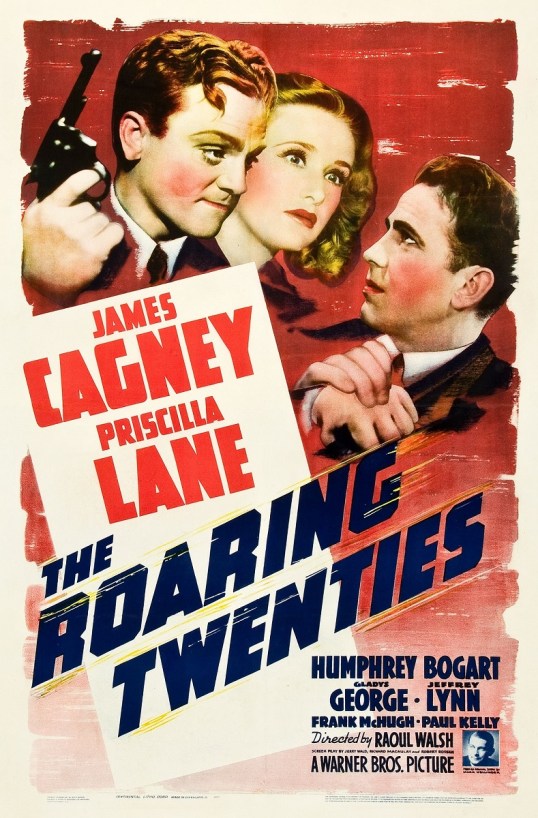
The 1939 gangster epic, The Roaring Twenties opens with newsreel footage of men like Franklin D. Roosevelt, Winston Churchill, and Adolf Hitler. We watch as they give speeches and as armed soldiers march across Europe. For those of us watching in the present, these are figures from the past. For audiences in 1939, though, these were the men who were shaping both their present and their future.
A narrator informs us that the world has changed much over the past few years and that it’s on the verge of changing again. The world is preparing for war and who knows what society is going to look like afterwards. (Interestingly enough, at the time that The Roaring Twenties was released, the U.S. was officially neutral when it came to the war in Europe, with many politicians arguing that the U.S. should pursue an isolationist foreign policy. Though the film seems to be speaking to a nation that was already committed to war but that was actually not the case.) The narrator goes on to say that it’s easy to forget what America was like just 20 years ago. World War I was ending. Soldiers were returning home. Prohibition has just become the law of the land and, as a result, there was now a whole new way to make illicit cash. It was a different era, the narrator tells us, one that is running the risk of being forgotten.
With that narration, it’s made obvious that The Roaring Twenties is designed to be more than just a gangster film. It’s also a history lesson. With Americans aware that another war might be coming, perhaps they needed to be reminded of what happened during and after the previous one. By that same token, with people across the world already dying in the fight for freedom, perhaps Americans needed to be reminded of what happened the last time they allowed the government to take those freedoms away.
The Roaring Twenties tells the story of three men who first met in 1918, while they were all hiding out in a foxhole while a bloody and violent war rages all around them. (The narrator somewhat archly notes that the three men — like all the men who fought and died in World War I — had been told that they were making “the world safe for democracy.”) The three of them become friend while under fire and they remain friends when they return home to a war-weary nation that refuses to take care of its veterans. Unfortunately, that friendship doesn’t survive the roaring 20s.
George Holly (Humphrey Bogart) is a former saloon keeper who becomes a major bootlegger after the passage of prohibition. George is the type who takes pleasure in gunning down a 15 year-old during World War I. (“He’ll never make 16,” George says after pulling the trigger.) He doesn’t improve once he returns home but he does find a lot of success as a bootlegger. Soon, he’s got a mansion. He’s got bodyguards. He goes to the best clubs and owns the best clothes. Prohibition may have been meant to put George Holly out-of-business but instead it’s made him a rich and influential man.
Lloyd Hart (Jeffrey Lynn) is a college-educated idealist, one who becomes a lawyer once he returns home. Even the most successful of bootleggers needs a good lawyer but Lloyd refuses to compromise his belief in the law, even when it comes to helping out his friends. Lloyd will eventually end up working out of the district attorney’s office, where he builds cases against men like George Holly.
And finally, there’s Eddie Bartlett (James Cagney). Eddie is the film’s main character. He’s a criminal but, unlike George, he’s not totally corrupt. In many ways, he’s an idealist but he’s never as self-righteous as Lloyd. While his friends worry about their place and their role in society, Eddie is just trying to survive. Before he went off to war, Eddie was a mechanic but, once he returns, he discovers that his job has been filled. With no other work available, Eddie is finally hired to drive a cab. What is those cabs could be used to smuggle alcohol? Eddie finds himself working with Panama Smith (Gladys George) while, at the same time, going to war with Nick Brown (Paul Kelly). In between making and losing a fortune (due to both the end of prohibition and the 1929 stock market crash), Eddie falls in love with singer Jean Sherman (Priscilla Lane). Because Eddie can’t leave the rackets, Jean ends up married to Lloyd instead.
The film follows these characters, from 1918 to 1933. Along the way, it also provides a critique of prohibition. Prohibition is presented as being a bad law, one that led to men like George Holly getting rich and which destroyed the lives of countless people. By making liquor illegal, the film argues, it also made it appealing to people who would have otherwise never had a drink. There’s a definite appeal to the forbidden. Interestingly enough, Eddie never takes a drink while he’s getting rich smuggling the stuff. It’s only after prohibition is repealed and Eddie finds himself once again reduced to driving a cab for a living that he becomes a drunk. Rich George and educated Lloyd might survive the end of prohibition by Eddie — who was as much a foot soldier during prohibition as he was during World War I — against finds himself cast out by a society that wants to forget about the national trauma that it’s just gone through. Eddie, however, isn’t going to go down without a fight. He’s played by James Cagney, after all.
The Roaring Twenties is a true classic. It works as a gangster movie, a historical epic, and a portrait of the side effects of out-of-control regulation. It tells the story about what happens when society becomes more interested in governing people than in helping them. Indeed, the film asks, what were men like Eddie Bartlett supposed to do when, after risking their lives for their country, they returned home to discover that their jobs were gone, rent had gone up, and the government wouldn’t even allow them to commiserate their sorrows over a cold beer? Who can blame America for rebelling? Who can blame the Eddie Barletts of the world for doing what they had to do to survive?
Finally, not only does The Roaring Twenties feature brilliant performances from genre veterans like Bogart and Cagney (in fact, this is a probably Cagney’s best gangster performance) but it also recreates the 20s with such skill that you can’t help but wish that you could have been a part of it. It all ends with a brilliant final scene on the steps of a church. “He used to be a big shot!” Yes, he was.
It’s been a long week. I’m currently limping because I sprained my big toe and it’s also summer in Texas, which means that the 100 degree day has arrived! Oh well. The first week of June is always unbearable, to be honest. When you go from reasonably temperate weather to walking into a wall of heat every time you step out your front door, it tends to lead to a certain amount of creative lethargy.