The Challenge (1982, directed by John Frankenheimer)


Rick Murphy (Scott Glenn) is a punch-drunk boxer who is hired to return an ancient sword to Japan so that it can be returned to its rightful owner, the honorable Toru (Toshiro Mifune).  Once in Japan, Rick becomes involved in a battle between Toru and his corrupt brother, Hideo (Atsuo Nakamura).  Hideo demands that Rick work as an undercover spy in Toru’s martial arts school or be beheaded.  Rick decides to keep his head and be a spy but he soon finds himself truly wanting to learn the ways of the Bushido.

A martial arts film is the last place most people would expect to find Scott Glenn and considering how miscast Glenn is, that’s understandable.  Scott Glenn feels very out-of-place as both a boxer and a modern-day samurai.  Scott Glenn is a very good actor but the role of Rick Murphy called for someone who could mix comedy with drama and be convincingly desperate.  That’s not Scott Glenn.  Who would have been better in the role?  Tom Berenger was already acting in 1982.  Or maybe even someone like Jan-Michael Vincent.  Vincent was a B-actor but, deep down, The Challenge is a B-movie.

The good thing is that the action often does make up for Glenn’s miscasting.  John Frankenheimer struggled with making the human drama compelling but he knew how to film a good fight.  John Sayles’s script is pulpy without ever being disrespectful to Japanese culture and, as always, Mifune looks like he could battle and defeat the entire world if he wanted to.

One final note: Steven Seagal worked behind-the-scenes on the film but we won’t hold that against it.
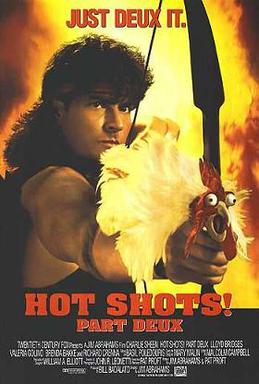
Hot Shots! Part Deux (1993, directed by Jim Abrahams)


Topper Harley (Charlie Sheen) is back but instead of being a knock-off of Tom Cruise, he’s now Sylvester Stallone.

When two separate teams of U.S. soldiers fail to rescue a group of hostages who are being held by Saddam Hussein (Jerry Haleva, who built an entire career out of his resemblance to the Iraqi dictator), it not only embarrasses America but threatens the reelection campaign of President Tug Benson (Lloyd Bridges).  President Benson can get away with throwing up on the Japanese ambassador and knocking over all the other Presidents with a shovel (though Gerald Ford falls on his own) but he can’t survive a hostage crisis.  Colonel Denton Waters (Richard Crenna) and Michelle Huddleston (Brenda Bakke) attempt to recruit Topper Harley from the Buddhist monastery, where he’s been living since the disappearance of Ramada (Valeria Golino).  Topper refuses to help with a third mission but, after Water is captured by Saddam, Topper does decide to lead the fourth mission.  Working with Ryan Stiles and Miguel Ferrer, Topper heads into the jungle to save Colonel Waters, reunite with Ramada, and discover his destiny.

The sequel to Hot Shots! is more of the same, a non-stop cavalcade of jokes, movie references, and deadpan one liners.  There are enough laugh out loud moments to make up for the jokes that don’t work.  I’ll always like the moment when Charlie Sheen sees Martin Sheen on another patrol boat.  (“Loved you in Wall Street!”)  It’s a movie made in the vein of Airplane! but the jokes aren’t as timeless as in that classic.  Everyone remembers Rambo enough to get the main joke and the interrogation scene in Basic Instinct has left enough of an impression that Topper’s “I know what to get your for Christmas,” comment to Michelle still draws a chuckle but do you remember Body of Evidence and the first President Bush vomiting at a state dinner?  Not all of the jokes have aged well but Charlie Sheen does a decent Rambo impersonation and Lloyd Bridges’s dim bulb President is one of the more relatable parts of the movie.  Fortunately, jokes about Saddam Hussein getting flattened by a piano will always be funny.

Hot Shots! (1991, directed by Jim Abrahams)


There are a lot of reasons why it’s hard to take Top Gun seriously but, for me, the biggest problem is that I’ve seen Hot Shots!  Directed by Jim Abrahams, Hot Shots! does for Top Gun what Airplane! did for disaster movies.

Charlie Sheen plays Topper Harley, the hot shot Navy Pilot who is haunted by the death of his father.  (“I’ve even got my father’s eyes,” Topper says before revealing that he carries them around in a cigarette case.)  Topper has left the Navy and is living in a teepee with the Old One.  Command Block (Kevin Dunn) asks Topper to return to the Navy to take part in Operation Sleepy Weasel.  Topper puts on a leather jacket and hops on a motorcycle.  The Old One tells Topper to pick up some batteries for his walkman.

Cary Elwes plays Kent Gregory, who says that Topper is not safe in the air.  Valeria Golino plays Ramada, the psyciatrist who helps Topper deal with his father issues.  Jon Cryer is Washout, who has wall-eyed vision.  Kristy Swanson is Bo, the only female pilot.  William O’Leary is the pilot who has the perfect life and wife but who everyone calls “Dead Meat.”  And finally Lloyd Bridges is Admiral Tug Benson, who has never successfully landed a plane and who has suffered and recovered from almost every war wound imaginable.  Tug is clueless but he loves America and his admiral’s hat.

Hot Shots! is one of the better parody films to come out in the wake of Airplane!  Charlie Sheen’s limitations as a dramatic actor actually made him a good comedic actor and Cary Elwes does a decent Val Kilmer imitation.  Some of the jokes have definitely aged better than others.  In 1991, Valeria Golino singing on a piano automatically brought to mind Michelle Pfieffer in The Fabolous Baker Boys but does anyone remember that film (or that scene) in 2025?  (The 9 1/2 Weeks scene is even more of a distant memory to most but Valeria Golino is so appealing in those scenes that most viewers — well, most male viewers — won’t mind.  In this case, the parody is far more successful than the original.)  Hot Shots! is at its best when imitating Top Gun‘s kinetic, music video-inspired style.  The mix of quick-cut editing and ludicrous dialogue is hard to resist.  After watching Charlie Sheen dance on his motorcycle and Cary Elwes explain what a chafing dish is for, it’s hard to take Top Gun seriously ever again.

Stripes (1981, directed by Ivan Reitman)


Bill Murray and Harold Ramis join the army.

Wait, that can’t be right, can it?  Bill Murray and Harold Ramis were cinematic anarchists.  Early in his career, Bill Murray was the ultimate smart aleck slacker who did not have any respect for authority.  Harold Ramis was hardly a slacker but he came across as someone more likely to be marching on the Pentagon than guarding it.  Stripes is one of the ultimate examples of a comedy where the laughs come from things  that don’t seem to go together suddenly going together.

John Winger (Murray) at least has a reason to join the army.  He has a dead end job.  He has just broken up with his girlfriend.  The country appears to be at peace so why not spend four years in the Army?  It’s harder to understand why John’s friend, Russell (Ramis), also decides to enlist, other than to hang out with John.  Along with Ox (John Candy), Cruiser (John Diehl), Psycho (Conrad Dunn), and Elm0 (Judge Reinhold), they enlist and go through basic training under the watchful eye of Sgt. Hulka (Warren Oates).  John and Russell go from treating everything like a joke to invading East Germany in a tank that’s disguised as an RV.  They also meet the two sexiest and friendliest MPs in the service, Stella (P.J. Soles) and Louise (Sean Young).  Russell goes from being an proto-hippie who teaches ESL to asking John if he thinks he would make a good officer.  John goes from not taking anything seriously to picking up a machine gun and rescuing his fellow soldiers.

It’s a comedy that shouldn’t work but it does.  It’s actually one of my favorite comedies, full of memorable lines (“Lighten up, Frances.”), and stupidly funny situations.  The cast is full of future comedy legends and P.J. Soles shows that she deserved to be a bigger star.  This was early in Bill Murray’s film career and he was still largely getting by on his SNL persona but, in his confrontations with Hulka, Murray got a chance to show that he could handle drama.  With all the comedic talent in the film, it’s Warren Oates who gets the biggest laughs because he largely plays his role straight.  Sgt. Hulka is a drill sergeant who cares about his men and who knows how to inspire and teach  but that doesn’t mean he’s happy about having to deal with a collection of misfits.  (Watch his face when Cruiser says he enlisted so he wouldn’t get drafted.)

The movie does get strange when the action goes from the U.S. to Germany.  What starts out as Animal-House-In-The-Army instead becomes an almost straight action movie and the movie itself sometimes feels like a recruiting video.  Join the Army and maybe you’ll get to steal an RV with PJ Soles.  That would have been enough to get me to enlist back in the day.  But the combination of Murray, Ramis, and Oates makes Stripes a comedy that can be watched over and over again.

Down Periscope (1996, directed by David S. Ward)


After being passed over twice as a result of both a “brushing incident” with a Russian submarine and an embarrassing tattoo, Lt. Commander Thomas Dodge (Kelsey Grammer, playing Dodge as being the laid back opposite of Frasier Crane) has finally been promoted and given his own submarine to command.  The catch is that the submarine is a rusty piece of junk from World War II and he’s been assigned a crew of misfits.  Captain Dodge is to take part in a war game.  Admiral Winslow (Rip Torn) wants Dodge to prove that even an out-of-commission submarine can be dangerous by infiltrating Charleston Harbor undetected and then blowing up a dummy warship in Norfolk Harbor.  If Dodge is successful, he’ll get a nuclear submarine to command.  If he fails, he’ll be assigned of desk job and probably leave the Navy.  While the sympathetic Winslow encourages Dodge to “think like a pirate,” the antagonistic Admiral Graham (Bruce Dern) pulls out all the stops to make sure Dodge fails.

I imagine that Down Periscope was probably pitched as Police Academy In The Navy and it follows the general rules of the Police Academy films, right down to casting Lauren Holly as the one woman on the submarine who has to overcome her own insecurities and prove herself to all the men.  Unfortunately, none of the misfits on the crew are as memorable as the cadets from Police Academy and the movie’s attempts to mix juvenile humor with suspenseful naval action are not at all successful.  Having Rob Schneider go totally over the top as Dodge’s second-in-command while having William H. Macy give a serious performance as the captain assigned to prevent Dodge from reaching the harbor indicates that Down Periscope has a definite identity problem.

Harry Dean Stanton plays Howard, who is the submarine’s chief engineer and who uses whiskey as a fuel to keep the submarine moving.  Toby Huss has a few amusing moments as the electrician who keeps electrocuting himself.  Grammer, Dern, and Macy have more than proven their talents in other projects and Rip Torn will always be remembered for bringing Artie to profane life on The Larry Sanders Show.  Director David Ward also directed Major League and wrote The Sting.  A lot of talent went into making Down Periscope so it’s a shame the film wasn’t more memorable.

Wrongfully Accused (1998, directed by Pat Proft)


Ryan Harrison (Leslie Nielsen) is a world-famous concert violinist who plays his instrument like Jimmy Page plays his guitar.  Harrison is invited to a party but when his host, Hibbing Goodhue (Michael York), is murdered, Harrison is wrongfully accused.  No one believes his story that the murder was committed by a one-eyed, one-armed, one-legged man.  Harrison is convicted of a crime he didn’t commit.  Maybe he should have asked for a preemptive pardon but that would probably have been too ludicrous an idea for even a parody film like this one.  An accident on the way to prison allows Harrison to escape.  He must now prove his innocence while being pursued by the determined Fergus Falls (Richard Crenna).

Wrongfully Accused is the only film to be directed by comedy writer Pat Proft and it’s a parody film in the style of Airplane!  There are sight gags, movie references, and a lot of ridiculous dialogue delivered in deadpan fashion by Leslie Nielsen.  Richard Crenna does a decent impersonation of Tommy Lee Jones.  There’s a North By Northwest parody that involves a toy airplane.  It’s not that there weren’t enough funny moments, it’s just that there weren’t enough of them.  Most of the jokes instead felt uninspired, as if Proft just turned on his TV and tossed in a joke about whatever movie he saw being advertised.  It feels like the script was written by using parody movie mad libs.  One reason why Airplane! holds up  so well is because it genuinely loved disaster movies and there was a sense of innocence to even the wildest of the jokes.  Wrongfully Accused has some funny moments but there’s no real affection for the movie being poked fun at.  The Fugitive feels like almost too easy a target.  Leslie Nielsen and Richard Crenna score some laughs but even they sometimes seem to be just going through the motions.

As the old saying goes, dying is easy.  Comedy is hard.

Game Review: American Outlaws: The Dillinger Gang (2017, by Will 1 1)


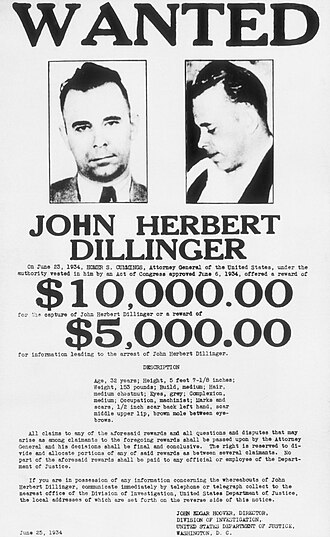
The time is the Great Depression and you are a lawyer who has had a terrible run of luck.  You’ve lost your money, your home, and your wife.  Sent to prison for a pretty crime, you befriend the legendary outlaw John Dillinger.  When you are both released on the same day, it’s time to get back to doing what Dillinger does best, robbing banks.

American Outlaws: The Dillinger Game is a choose-your-own-adventure style game, in which you are a member of Dillinger’s gang and an associate of outlaws like Baby Face Nelson, Red Hamilton, and Homer van Meter.  The choices start out simple.  Do you accompany Dillinger on his latest robbery?  Do you head to Indiana with Dillinger or do you instead decide to join Baby Face Nelson’s gang?  The choices start to get more difficult.  Do you run when the cops show up?  Do you fight with the cops?  When a member of the gang orders you to shoot someone, do you do it?  The game keeps a running tally of the number of gunfights you’ve taken part in, the number of people you’ve injured, the number that you’ve killed, the number of banks you’ve robbed, and the amount of money you’ve made.  Depending on the decisions you make, it’s totally possible to make it all the way through this game and retire without having killed or even injured someone.  It’s also possible to be such a viscous outlaw that even Baby Face Nelson wouldn’t mess with you.  The longer your play, the more money you can potentially make but the more money you make, the more likely it is that you’ll commit a crime that will make it impossible for you to safely retire.  You could end up the last member of the Dillinger Gang.  You could also just as easily end up getting taken down by the FBI.

It helps to know the history of the Dillinger gang.  That saved my life at least once.  In fact, it’s really not difficult to survive the game.  The sensible decisions are there and easy to make.  But why be sensible when you’re hanging out with John Dillinger and there’s more and more money to be made?

This is a good game because every choice really does effect what happens to your bank robber.  There are no throw-away choices and who your outlaw turns out to be really does depend on the decisions that you make.  Because there are so many different outcomes, this is a fast-paced game can be played again and again.

Play American Outlaws: The Dillinger Gang.

Great Moments In Comic Book History #39: LBJ Stands Up For The Hulk


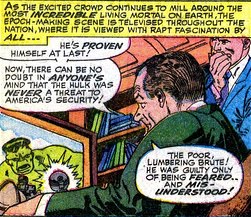
Say what you will about Lyndon B. Johnson, he was one of the few presidents to understand that the Hulk was not the menace that the media made him out to be.  In 1967, he even issued full amnesty to the Hulk in recognition for the number of times that Hulk had saved the planet.  Gil Kane captured the moment in Tales To Astonish #88.

Guilty of only being feared and misunderstood!  That was something that LBJ could probably relate to in 1967.  Unfortunately, after a fight with the masked criminal known as the Boomerang, Hulk was once again viewed as being a menace and General Ross threw the amnesty order away.  I guess that’s what they mean when they talk about the Deep State.

LBJ wasn’t popular with young readers and he didn’t make many appearances in the world of comics.  It’s a pleasant surprise that, one of the few times that he did appear, it was to do the right thing and offer some temporary hope to the Incredible Hulk.

Previous Great Moments In Comic Book History:

  1. Winchester Before Winchester: Swamp Thing Vol. 2 #45 “Ghost Dance” 
  2. The Avengers Appear on David Letterman
  3. Crisis on Campus
  4. “Even in Death”
  5. The Debut of Man-Wolf in Amazing Spider-Man
  6. Spider-Man Meets The Monster Maker
  7. Conan The Barbarian Visits Times Square
  8. Dracula Joins The Marvel Universe
  9. The Death of Dr. Druid
  10. To All A Good Night
  11. Zombie!
  12. The First Appearance of Ghost Rider
  13. The First Appearance of Werewolf By Night
  14. Captain America Punches Hitler
  15. Spider-Man No More!
  16. Alex Ross Captures Galactus
  17. Spider-Man And The Dallas Cowboys Battle The Circus of Crime
  18. Goliath Towers Over New York
  19. NFL SuperPro is Here!
  20. Kickers Inc. Comes To The World Outside Your Window
  21. Captain America For President
  22. Alex Ross Captures Spider-Man
  23. J. Jonah Jameson Is Elected Mayor of New York City
  24. Captain America Quits
  25. Spider-Man Meets The Fantastic Four
  26. Spider-Man Teams Up With Batman For The Last Time
  27. The Skrulls Are Here
  28. Iron Man Meets Thanos and Drax The Destroyer
  29. A Vampire Stalks The Night
  30. Swamp Thing Makes His First Cover Appearance
  31. Tomb of Dracula #43
  32. The Hulk Makes His Debut
  33. Iron Man #182
  34. Tawky Tawny Makes His First Appearance
  35. Tomb of Dracula #49
  36. Marvel Publishes Star Wars #1
  37. MAD Magazine Plays Both Sides
  38. The Cover of Green Lantern/Green Arrow #85


Great Moments In Television History #37: Eisenhower Hosts The First Televised Press Conference


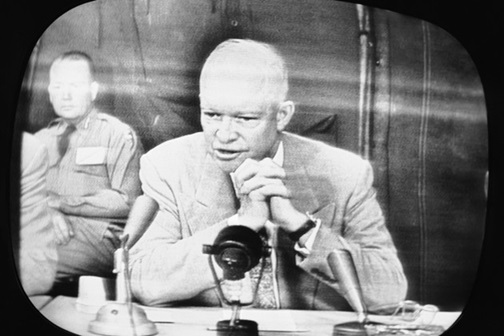
“Well, I see we’re trying a new experiment this morning.  I hope that doesn’t prove to be a disturbing influence.”

With those words, President Dwight D. Eisenhower opened the first ever televised (though pre-taped) presidential news conference.  For the first time, viewers at home could watch as the President took questions from the members of the press and answered them in his own words.  Today, we take it for granted and we even get bored with televised news conferences and speeches.  But seventy years ago today, on January 19th, 1955, what Eisenhower did was considered to be revolutionary and a little dangerous.  How would the public react to actually seeing the man who led the country answering questions in person.

Eisenhower was asked about the dangers of Communist China, the new budget bill, and his own opinion about how his first term had gone and whether had any plans for a potential second term.  Eisenhower laughed at the last query, saying, “It looks like a loaded question.”

Obviously, the new experiment worked.  The pubic continued to like Ike and, when he did run for a second term, he was elected just as easily as the first time.  The Democrats didn’t even bother to put a new candidate and instead just brought back Adlai Stevenson.  Eisenhower would be succeeded by John F. Kennedy, who went on to perfect Eisenhower’s “new experiment.”

Previous Moments In Television History:

  1. Planet of the Apes The TV Series
  2. Lonely Water
  3. Ghostwatch Traumatizes The UK
  4. Frasier Meets The Candidate
  5. The Autons Terrify The UK
  6. Freedom’s Last Stand
  7. Bing Crosby and David Bowie Share A Duet
  8. Apaches Traumatizes the UK
  9. Doctor Who Begins Its 100th Serial
  10. First Night 2013 With Jamie Kennedy
  11. Elvis Sings With Sinatra
  12. NBC Airs Their First Football Game
  13. The A-Team Premieres
  14. The Birth of Dr. Johnny Fever
  15. The Second NFL Pro Bowl Is Broadcast
  16. Maude Flanders Gets Hit By A T-Shirt Cannon
  17. Charles Rocket Nearly Ends SNL
  18. Frank Sinatra Wins An Oscar
  19. CHiPs Skates With The Stars
  20. Eisenhower In Color
  21. The Origin of Spider-Man
  22. Steve Martin’s Saturday Night Live Holiday Wish List
  23. Barnabas Collins Is Freed From His Coffin
  24. Siskel and Ebert Recommend Horror Films
  25. Vincent Price Meets The Muppets
  26. Siskel and Ebert Discuss Horror
  27. The Final Scene of Dark Shadows
  28. The WKRP Turkey Drop
  29. Barney Pops On National TV
  30. The Greatest American Hero Premieres
  31. Rodney Dangerfield On The Tonight Show
  32. The Doors Are Open
  33. The Thighmaster Commercial Premieres
  34. The Hosts of Real People Say “Get High On Yourself”
  35. The 33rd NFL Championship Game Is Broadcast In Color
  36. The Sopranos Premieres on HBO

Phantom Punch (2008, directed by Robert Townsend)


Ving Rhames plays Sonny Liston, one of the greatest heavyweights who ever boxed but whose legacy will forever be overshadowed by the man who defeated him twice, Muhammad Ali.

Phantom Punch hits all of the well-known notes of Liston’s life.  He grows up dealing with poverty and racism.  He goes to prison as a young man and it is there that a sympathetic priest (Rick Roberts) helps him discover that his talent for fighting can be transformed into the skills needed to be a heavyweight contender.  Sonny turns pro after he’s released but, even as he angles for a championship fight, he’s still collecting debts for mobsters like Savino (David Proval).  Sonny becomes the champ after defeating Floyd Patterson but is hated by white boxing fans who resent that, unlike previous black champs, he doesn’t seem to care about their approval.  Both of his losses to Ali lead to accusations that he threw the fights.  With the help of his manager (Nichols Turturro), he works his way back up the rankings and is poised for another shot at the title but the Mafia now wants him to throw his fights for real.  In 1971, Liston dies of what the police claim was a heroin overdose even though everyone knew that Liston hated needles.  There’s not much new to be found in Robert Townsend’s biopic of Liston but Ving Rhames is convincing as Sonny and even brings some humanity to one of boxing’s most fearsome champs.  It was a movie made for boxing fans and Rhames looks credible throwing a punch.

As I watched the movie, I wondered whether Liston really did throw his fights against Ali.  I don’t think he did, even though both fights were strange.  In the first fight, Sonny put something on his gloves that irritated Ali’s eyes.  When that didn’t stop Ali, Sonny retired to his corner and didn’t come out for the seventh round.  That led to rumors that the Mob ordered him to throw the fight but if you watch the match, it’s obvious that Sonny was trying to win and he just wasn’t prepared for Ali’s quickness.  Liston knew he was losing and, with an aggravated shoulder injury making it difficult for him to throw his heavy punches, Liston bowed to the inevitable and refused to give Ali the chance to knock him out.  The second fight was the one where the phantom punch occurred.  Liston fell so quickly that, when I first saw it, I thought he had thrown the fight.  It wasn’t until I watched the fight in slow motion that I saw that Ali did make contact with Liston before he fell.  Liston may have been many things but but he wasn’t a chump.  The so-called phantom punch was fast but it was real.