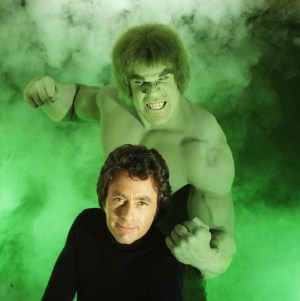
 It may seem hard to believe now but there was a time when comic book adaptations were considered to be a risky bet at best. In 1977, Marvel Comics sold the television rights for four of their characters to Universal Productions. This led to three unsuccessful pilots (one for Dr. Strange and two for Captain America), a Spider-Man series that lasted for two seasons, and The Incredible Hulk. As opposed to the other Marvel adaptations, The Incredible Hulk series was popular with fans and (some) critics and ultimately lasted for four seasons.
It all started with a 90 minute pilot that aired in 1977. Haunted by the car accident that caused the death of his wife and his inability to rescue her, Dr. David Banner (Bill Bixby) is researching why, in times of extreme stress, ordinary people can suddenly experience moments of super human strength. What he theorizes is that it is a combination of body chemistry and gamma radiation caused by sun spots. Eager to test his theory, David straps himself into a chair and zaps himself with gamma radiation. At first, it seems as if nothing has changed. But when David’s driving home, he gets a flat tire. When he struggles to change the tire, in the middle of a hurricane nonetheless, David gets mad. Suddenly, his eyes turn green and soon so does the rest of him as David Banner is transformed into the Incredible Hulk (Lou Ferrigno, except for one shot where the Hulk is played by Richard Kiel). The Hulk runs through the woods, accidentally scaring a girl and getting shot by a hunter. When the Hulk falls asleep, he transforms back into David, who has no memories of what he did while he was the Hulk. While David and his colleague, Elaina Marks (Susan Sullivan), investigate what happened to him, tabloid reporter Jack McGee (Jack Colvin) tries to uncover the results of David and Elaina’s research.
Other than introducing the Hulk and giving Banner a backstory, the pilot didn’t have much in common with the series that followed. Along with being a comic book adaptation, the series was also a remake of The Fugitive. With everyone convinced that the Hulk had murdered both him and Elaina, David was always on the run and trying to find a way to cure his condition. Every episode would begin with David working a new odd job and getting involved in a new situation and almost every episode ended with David hitchhiking while the show’s famous piano theme played over the final credits. Because David was always either getting beaten up or tangled in barbed wire, the Hulk would show up twice an episode. David Banner just couldn’t catch a break.
The pilot seems to take forever to get going, devoting a lot of time to David and Elaina doing research. In those days before the success of The Dark Knight and the MCU legitimized comic books as a cultural force, The Incredible Hulk was determined to show that it was not just a show for kids. Today, the pilot is too slow-paced and self-consciously serious but still contains the elements that made the show itself became a success. Bill Bixby takes his role seriously and Lou Ferrigno is the perfect choice for the Hulk. Decades after they first aired, the Hulk-transformation scenes are still undeniably cool. It was also during the pilot that Dr. Banner uttered those famous and oft-parodied words: “Mr. McGee, don’t make me angry. You wouldn’t like me when I’m angry.”
As of this week, reruns of The Incredible Hulk are now being shown, daily, on both H&I and the El Rey network. I will be watching.

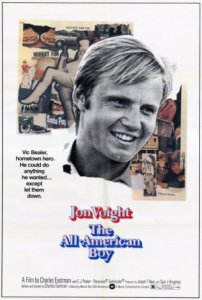 Vic “The Bomber” Bealer is an amateur boxer who appears to be poised to escape from life in his dreary hometown. He is such a good fighter that he is on the verge of making the U.S. Olympic Team and he is so good-looking that everyone, from his teenage girlfriend (Anne Archer) to his gay manager (Ned Glass) to a woman he meets at a gas station, automatically falls in love with him. However, after his girlfriend tells him that she is pregnant, Vic abandons both her and boxing. When she leaves town to have an abortion, Vic starts boxing again but then he learns that she may not have actually had an abortion and Vic leaves for Los Angeles, to see both her and his son.
 In this cop film, Robert Duvall plays Eddie Ryan, a tough New York detective who gets suspended from the force when he is accused of tossing a Puerto Rican suspect off of a roof. Eddie’s innocent but, because he spends all of his time talking about how much he hates Puerto Ricans and using Archie Bunker-style racial slurs, everyone assumes that he is guilty. Eddie is suspended from the force but then his former partner is killed while investigating an operation to smuggle guns to, you guessed it, Puerto Rico. Suspended or not, Eddie is going to track down the man who killed his partner. If that puts everyone from his girlfriend, Maureen (Verna Bloom), to NYC pedestrians in danger, that’s just the way it has to be.
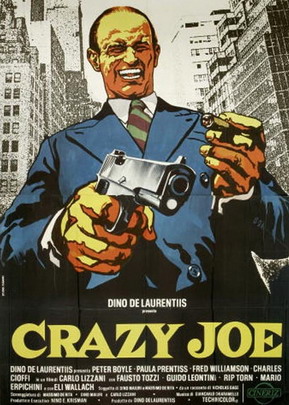 Crazy Joe (Peter Boyle) is a gangster with a chip on his shoulder and a self-taught intellectual who can (misquote) Sartre and Camus with the best of them. Sick of being taken for granted, Joe and his brother, Richie (Rip Torn), attempt to challenge the Mafia establishment. The mob sets Joe up and gets him sent to prison. While doing time, Joe befriends a Harlem gangster named Willy (Fred Williamson). Refusing to associate with the other Italian prisoners, Joe allies himself with the black inmates and even helps to start a riot over the prison’s inhumane conditions. When he is released, Joe hits the streets of New York with a vengeance, now backed up by Willy and his criminal organization.
 Jamie Shannon (Christopher Walken) is a professional mercenary who is hired, by a British businessman, to overthrow the government of Zangaro. Though Zangaro is currently ruled by a ruthless dictator, Shannon’s employers want to replace him with someone even worse, all so they can get their hands on the country’s platinum mines. After Shannon is captured and tortured by the government, he wants nothing else to do with Zangaro. Instead, he wants to return to New York and propose to his ex-wife (JoBeth Williams). But, when she turns down his proposal, Shannon and his mercenary army return to Zangaro.
 Following the events of
 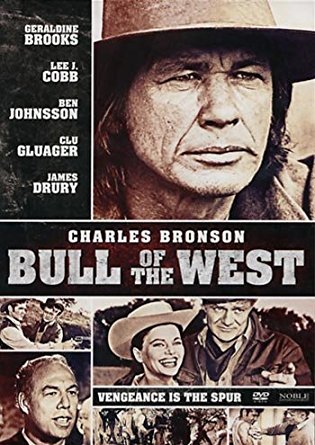 Welcome to the American frontier. The time is the 1880s and men and women everywhere are heading out west in search of their fortune. While stowing away on a train, veteran cowboy Johnny Wade (Brian Keith) meets the naive Steve Hill (Gary Clarke) and becomes a mentor to the younger man. Johnny teaches Steve how to shoot a gun and, when they get off the train at Medicine Bow, Wyoming, they get jobs working on the ranch of Georgia Price (Geraldine Brooks). When Georgia and Johnny plot to overgraze the land, Steve must decide whether he’s with them or with a rival rancher, Judge Garth (Lee J. Cobb).
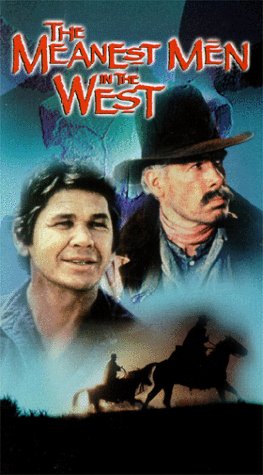 The Meanest Men In The West may “star” Charles Bronson and Lee Marvin and Sam Fuller may be credited as being one of the film’s two directors but don’t make the same mistake that I made. Don’t get too excited.
 California. The 1870s. Sheriff Pearce (Ben Johnson) boards a train with his prisoner, an alleged outlaw named John Deakin (Charles Bronson). The train is mostly full of soldiers, under the command of Major Claremont (Ed Lauter), who are on their way to Fort Humboldt. The fort has suffered a diphtheria epidemic and the soldiers are supposedly transporting medical supplies.
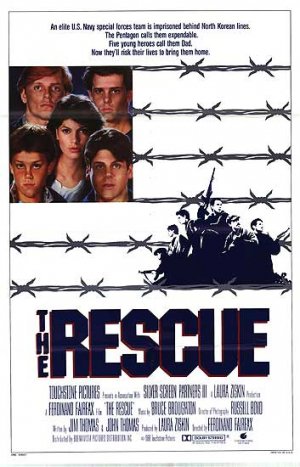 A group of Navy SEALs enter North Korea on a mission to destroy a submarine that has fallen into Kim Il-sung’s hands. They destroy the submarine but are captured before they can safely cross the border back into South Korea. With the SEALs facing a show trial and probable public execution, Admiral Rothman (James Cromwell) draws up a plan to rescure them. The U.S. government, not wanting to escalate the situation, shoots down the plan. (Americans giving up? Is Carter still president?) However, Rothman’s nerdy son, Max (Marc Price), gets a hold of the plan. Before you can say “Why didn’t anyone else think of this?”, he and the children of the SEALs are sneaking into North Korea and rescuing their fathers!
 Through the Shattered Lens