Missed Opportunities: Alien Nation (1988, directed by Graham Baker)


Alien Nation starts out with an intriguing premise but sadly doesn’t do enough with it.

In 1988, a spaceship lands in Mojave Desert.  Inside are 300,000 humanoid aliens, known as the Newcomers.  Intended to serve as intergalactic slaves, the Newcomers are now stuck on Earth.  (Of course, in the view of many humans, it’s Earth that’s stuck with them.)  Three years later, the Newcomers have settled in Los Angeles and they have adopted human names.  Some of them, like businessman William Harcourt (Terrence Stamp), have become successful and have been accepted by the human establishment.  The majority remain second-class citizens, facing discrimination and feeling alone in a world that doesn’t seem to want them.

Detective Matthew Sykes (James Caan) does not like the Newcomers but, after his partner is killed by one of the aliens, he ends up working with one.  Sam Francisco (Mandy Patinkin) is the first Newcomer to have been promoted to the rank of detective and is eager to prove himself.  Sykes renames him George and enlists him to investigate a series of recent Newcomer deaths.  Sykes’s real goal is to use Francisco’s Newcomer connections to investigate the death of his partner.  What the two of them discover is that the deaths are linked to a drug called Jabroka, which has no effect on human but was previously used to keep the Newcomers enslaved.

Alien Nation starts out with an intriguing premise.  I love the early scenes of Sykes driving down the streets of Los Angeles and seeing Newcomer prostitutes, Newcomer families, and even a Newcomer dance studio.  There is a lot promise in those scenes and they capture the feeling of a familiar world that has been irrevocably changed.  Both Caan and Patinkin give good performances and the alien makeup is still impressive.  Unfortunately, once Sykes and George start their investigation, the movie becomes a standard-issue police movie with a plot that could easily have been lifted from a Lethal Weapon rip-off.  So many interesting ideas are left unexplored, making Alien Nation an intriguing missed opportunity.  (There was later a television series based on the movie, which explored the Newcomer culture in greater detail.)

Alien Nation still has a strong cult following and I wouldn’t be surprised if it influenced District 9.  In 2016, it was announced that Jeff Nichols would be writing and directing a remake.  Nichols seems like the ideal director for a film like this and this is the rare case of a remake that I’m actually looking forward to.


Retro Game Review: Destroy All Humans! (2005, THQ)


I’m looking forward to 2020 for one reason and one reason only and it’s not the presidential election.

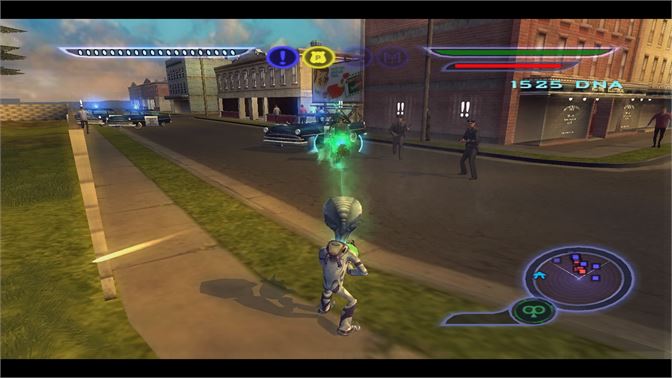
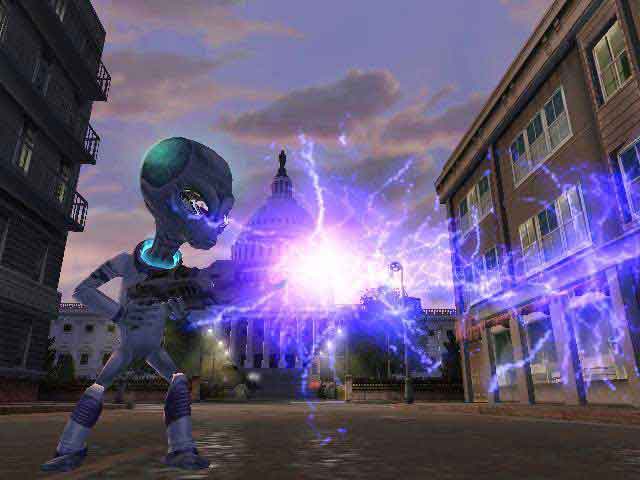
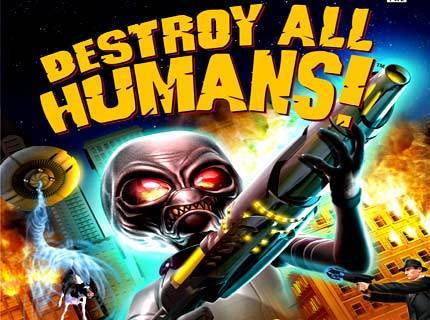
No, I’m looking forward to 2020 because that’s when I’ll finally be able to play Destroy All Humans! again!  The classic alien invasion game will be getting a full remake in 2020 and, once again, players will be able to help Crypto steal Furon DNA and conquer the planet.  It probably won’t be a minute too soon, either.  If 2019 is any indication, 2020 is a year that’s probably going to inspire a lot of people to wish they could beam up to their spaceship and blow things up.  With the remake of Destroy All Humans!, they should have the opportunity to do just that without causing any real world damage!

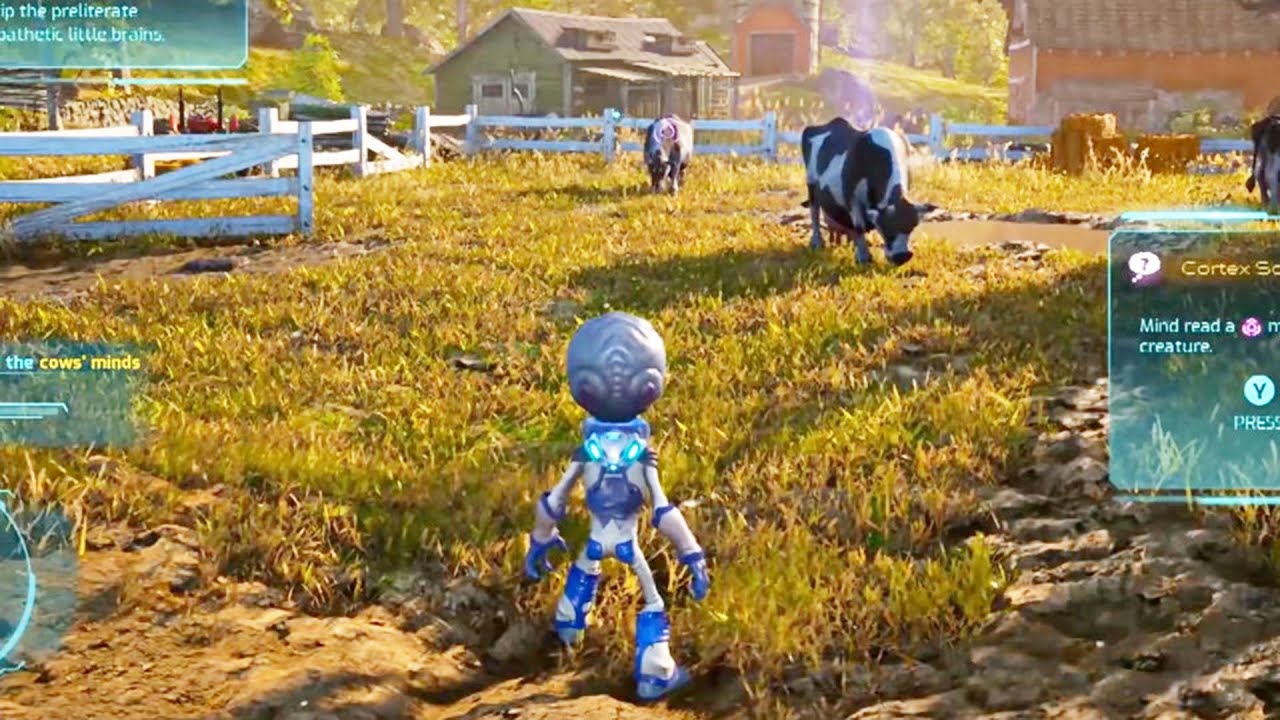
Back in the day (the 2005 day), Destroy All Humans! was the best reason to have either an Xbox or Playstation 2.  Crypto was a little grey man who sounded suspiciously similar to Jack Nicholson.  He came to Earth in 1959, on a quest to harvest brain stems, blow up cows, disrupt pool parties, and battle a mysterious government agency known as Majestic.  Though the game had a storyline and missions, it was also a sandbox game.  Once a location was unlocked, you could revisit and blow it up whenever you wanted to.  I lost track of how many times I took out Turnipseed Farm.  Being an industrious race, the humans always rebuilt as soon as you flew away.  It never seemed to occur to them to add any extra security precautions, no matter how many times you returned.

Because the game was set in 1959, it featured a full-on barrage of pop cultural references.  Crypto could read minds and it turned out that people all over America were thinking about Marilyn Monroe, Elvis, and whether or not they really liked Ike.  Crypto could also temporarily disguise himself as a human but, after a certain amount of time, he always reverted back to his original form.  If he reverted back while surrounded by humans, panic would ensue as the humans shouted that they were being invaded by “space commies!”

Of course, Earth was a dangerous place in the 1950s and it was common for Crypto to get killed.  Luckily, every time he died, a new Crypto clone took over and was even more eager to destroy all humans!

This was my favorite game on the Xbox and it’s one of the few that I really miss playing.  (I still have the game and the Xbox.  While the Xbox works, the controller’s seen better days and, whenever I do play one my old Xbox games, it seems like I spend the majority of the game trying to keep characters like Crypto and Tommy Vercetti from running over to the left side of the screen.)  I’m looking forward to once again taking control of Crypto and invading this lousy planet!

Is it 2020 yet?

(By the way, Case Wright once reviewed Tom Abernathy, the writer of Destroy All Humans!  Read that interview here.)

Great Moments In Comic Book History: “Even in Death…”


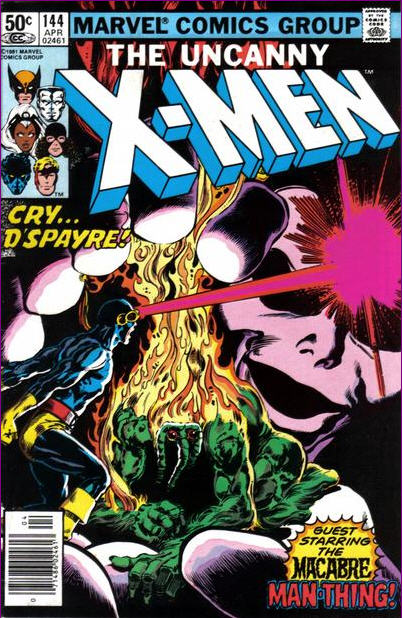
The Uncanny X-Men #144 finds Scott Summers (better known as Cyclops, the occasional leader of the X-Men) working on a fishing boat in the Florida Everglades.  Scott’s new boss, Lee Forrester, is obviously interested in him but Scott is still mourning Jean Grey.  It’s been months since Jean, consumed by the Dark Phoenix, chose to protect the universe by destroying herself.  Scott has taken a leave of absence from the X-Men to grieve and, as they used to say back in the day, find himself.

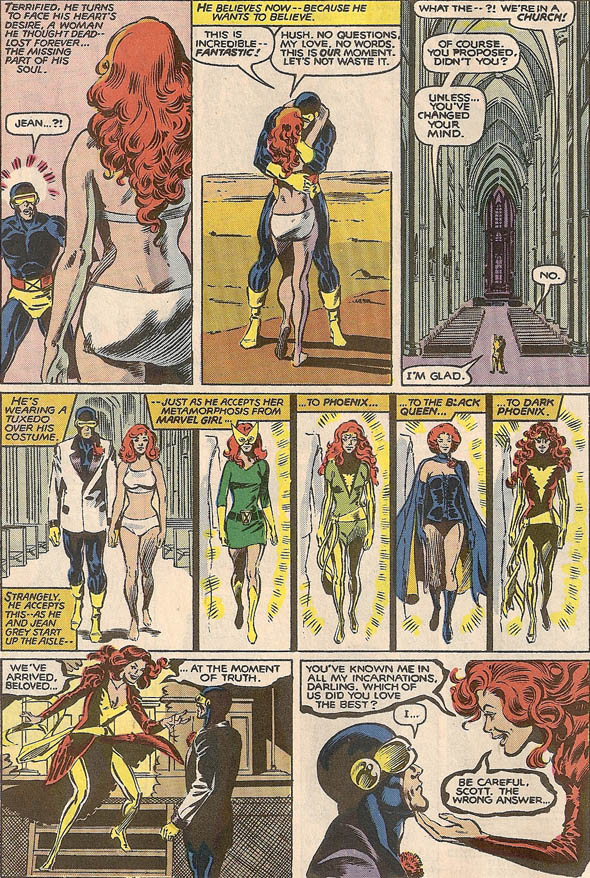
When the fear-inducing demon D’Spayre shows up, it not only drives Lee’s father to suicide but it also forces Scott to deal with his deepest fears.  Scott hallucinates the plane crash that led to him and his brother being separated from their parents.  He visualizes the X-Men dead, having been killed by Sentinels.  And finally, in the issue’s most famous scene, he finds himself walking down a church aisle with Jean.

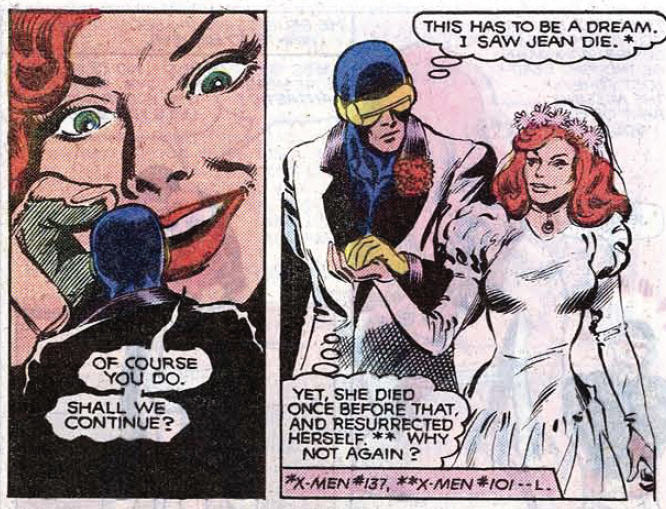
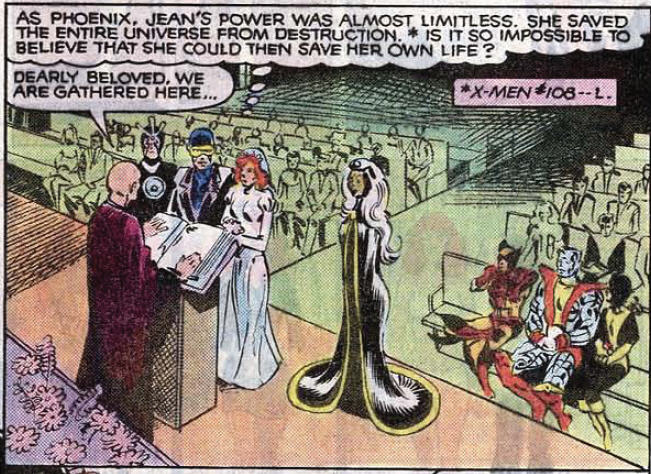
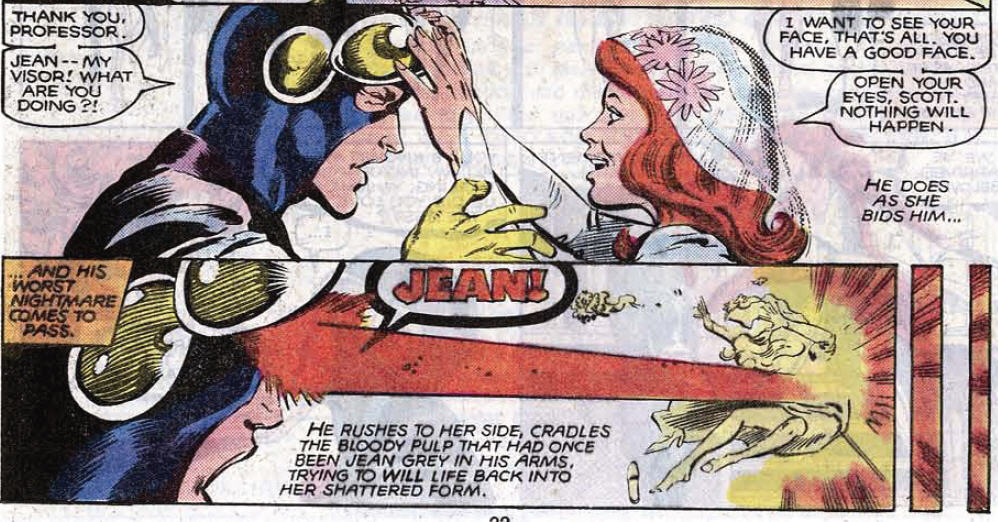
As they walk down the aisle, Jean’s costume changes to reflect all of the different roles that she played as member of the X-Men.  She goes from being in her underwear to being in her green Ms. Marvel costume to being the Phoenix to being the Hellfire Club’s Black Queen to finally being the Dark Phoenix.  When they reach the minister, Jean is dressed as a bride.  When the minister tells Scott that he may kiss the bride, Jean suddenly reaches up and lifts Scott’s visor.  A blast a red energy brings the wedding to an abrupt end.

Eventually, Scott teams up with the Man-Thing (who is Marvel’s version of Swamp Thing) and is able to easily defeat D’Spayre.  Since all you have to do to make D’Spayre go away is refuse to believe what he’s showing you, he is not one of Marvel’s most intimidating villains.  Still, Scott’s church hallucination provides not only a perfect coda for the Dark Phoenix saga but it also shows a comic book character dealing with depression.  That’s an emotion that, until Chris Claremont started writing the X-Men, super heroes rarely had to deal with for more than an issue or two.  Even Spider-Man, with all of his problems and guilt, always kept his sense of humor.  This issue of the X-Men finds Scott deeply mired in his grief.  Even after Scott defeats D’Spayre, the sadness remains but he swears to himself that will not surrender to it.

Of course, the impact of this issue is lessened by the fact that Marvel would later reveal that the Dark Phoenix who sacrificed herself was just an energy force that took on Jean’s memories and personality while the real Jean remained in suspended animation at the bottom of Jamaica Bay.  X-Men #144 is still a good issue and a good example of Chris Claremont’s ability to bring out the humanity in even those with super powers.

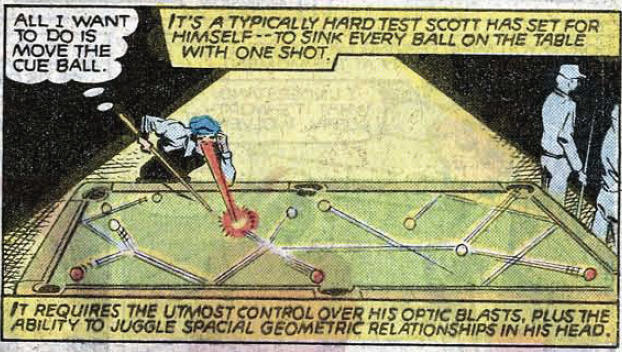
Plus, we learn how Cyclops plays pool

The Uncanny X-Men #144 (April, 1981)

“Even in Death”

  • Writer: Chris Claremont
  • Guest Penciler: Brent Anderson
  • Inker: Josef Rubenstein
  • Letterer: Tom Orzechowski
  • Colorist: Glynis Wein
  • Editor: Louise Jones
  • Editor-in-Chief: Jim Shooter

Previous Great Moments In Comic Book History:

  1. Winchester Before Winchester: Swamp Thing Vol. 2 #45 “Ghost Dance” 
  2. The Avengers Appear on David Letterman
  3. Crisis on Campus

Last Stand Of The X-Men: Dark Phoenix (2019, directed by Simon Kinberg)


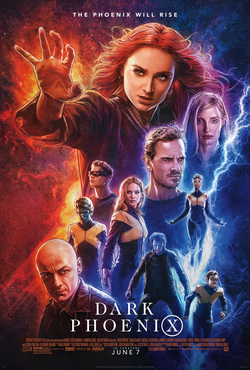
Last week, I finally watched Dark Phoenix and I could tell within 15 minutes that it wasn’t going to be good.  From the start, everything about it seemed to be off, particularly compared with other, more recent comic book films.  This is not Logan or Joker.  It’s not even as good as ApocalypseDark Phoenix felt like a comic book film from 2002 that somehow got made and released in 2019.

The latest installment of the X-Men film saga opens in 1992.  The X-Men have been hailed as heroes and it finally looks like like the dreams of Charles Xavier (James McAvoy) are going to come true.  Humans and mutants are going to co-exist.  Unfortunately, all of that progress is undone when Jean Grey (Sophie Turner) connects with a surge of energy and her powers go supernova.  Jean discovers that she was responsible for her mother’s death and her father rejected her as a result.  She also learns Xavier placed a mental block in her mind.  Seriously pissed off, Jean flees to the island of Genosha, which is ruled over by Magneto (Michael Fassbender).  She also accidentally kills Mystique, therefore freeing Jennifer Lawrence from having to appear in any more of these movies.  All the while, a shape-shifting alien named Vuk (a slumming Jessica Chastain) wants to capture Jean’s powers and use them for herself.

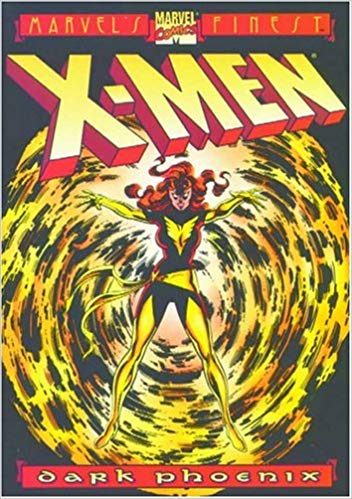
This was the second attempt to bring the Dark Phoenix saga to the screen and somehow, it was even more bland and forgettable than X-Men: Last Stand.  The Dark Phoenix saga is one of the greatest comic book storylines of all time but it seems destined to never be the basis of a good movie.  In the comic books, the Dark Phoenix saga was the accumulation of two decades of storytelling.  After being the most forgettable member of the original X-Men, Jean suddenly became the most powerful mutant in the world.  When she sacrificed herself for the good of the universe, it was not only the end of her life but also the end of one of Marvel’s longest-running love stories, as Cyclops could only cradle her body afterwards.  As usual, Marvel later lessened the emotional impact by revealing that the Phoenix wasn’t actually Jean but just an alien force that took on her memories and personality while the real Jean remained in suspended animation at the bottom of Jamaica Bay.  Despite this, the Dark Phoenix saga still remains a prime example of Marvel at its best.

Why, with such great source material and a talented cast, was this latest film version of the Dark Phoenix saga so cumbersome?  No one seemed to care.  Unlike in the comic books, there was no emotional depth to the story of Jean Grey losing herself and becoming the Dark Phoenix.  Instead, every scene felt like it was just there to set up the next CGI-fueled confrontation.   Sophie Turner and Tye Sheridan (who played Cyclops) seemed to barely know each other and the film spent more time on Nicholas Hoult’s Beast mourning for Mystique than on the relationship that should have been at the center of the film.  None of the actors seemed to be invested in the story.  I’ve never seen Jennifer Lawrence, Michael Fassbender, and James McAvoy look so bored.  The inevitable Magneto scene felt pointless.  The comic books could take a break from Magneto and let other villains have a turn.  The movies have to find an excuse to force him into every story.

It’s been said that the X-Men will be moving into the MCU and will get a whole new reboot.  We’ll probably get a third Dark Phoenix film someday.  I hope this one gets it right.

Home Invasion: Twice Dead (1988, directed by Bert Dragin)


Twice Dead is twice dumb but also twice the fun.

The fine and upstanding Cates family have recently inherited a mansion and are eager to move in.  The only problem is that the mansion is already inhabited!  Not only has a gang of street punks declared that the mansion belongs to them but the house is also home to the ghost of Tyler Walker (Jonathan Chapin).  A great actor, Tyler committed suicide after being swindled out of his possessions by the love of his life, Myrna.  After the Cates family plays an elaborate practical joke on the street gang (and the joke simply has to be seen to believed), the gang declares that they will take revenge.  Because the Cates’s daughter, Robin (Jill Whitlow), is dead ringer for Myrna, Tyler’s ghost decides to help take out the street punks.  Death by shotgun, dirt bike, and dumb waiter follows.

The two Cates children are played by Jill Whitlow and Tom Bresnahan.  Whitlow and Bresnahan ended up dating after they finished shooting the film and their obvious chemistry brings an apparently unintended subtext to all of their sibling interactions in Twice Dead.  Jill Whitlow also appeared in Night of the Creeps and, with her ability to be both sexy and wholesome at the same time, was one of the first crushes of many an 80s and 90s child.

A mix between The Amityville Horror and Death Wish 3, Twice Dead was one of the many horror films to come out of Roger Corman’s Concorde Pictures in the 80s.  It’s dumb but it has both Jill Whitlow and enough of a sense of humor to be entertaining.  The street punks, who all have names like Crip, Silk, Stony, and Candy, are all annoying so you don’t mind seeing them get killed in various ways.  Todd Bridges proves that the world don’t move to the beat of just one drum by playing a Petie, a friendly guy who likes to hang out at the library, while the amazing Charlie Spradling, who appeared in several films like this back in the day, plays a member of the gang.  Sadly, neither one of them comes to a good end.


Game Review: 1181 (2016, Grim and notgojira)


1181 is one of the best horror Interactive Fiction games out there right now.

It starts out simply.  You are a volunteer at a SETI lab, working the night shift.  It can be monotonous work.  Some of your colleagues seem to be struggling to adjust to the sterile nature of the place.  Not even you are sure what is really going on at the lab.  One night, something strange happens.  The lights go out.  A voice announces that you are on lock down.  And something is coming up the stairs and heading straight for you.

The is a well-written and well-programmed Twine game that makes good use of visuals.  Like most Twine games, it does run the risk of getting repetitive.  Be careful about accidentally clicking the same word that you clicked before unless you really want to go through the same descriptive passage two times in a row.  When played straight through, it’s a challenging and thought-provoking work of interactive fiction.  It comes with multiple endings, some of which are good and some of which are definitely not.

It can be played by clicking here.


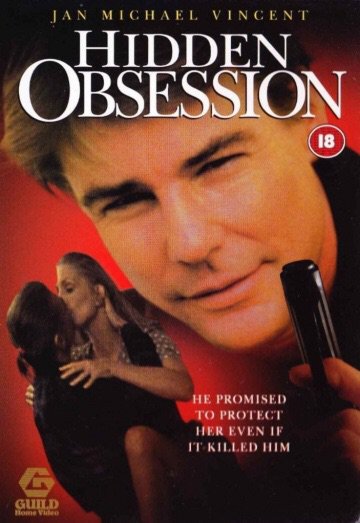
From The Cinemax Vault: Hidden Obsession (1993, directed by John Stewart)


Hidden Obsession comes to us from the glorious days of late night 90s Cinemax. 

Ellen Carlyle (Heather Thomas) is a TV anchorwoman who is looking forward to taking some time off.  The only problem is that everyone — from a crazed homeless man to an escaped convict that she helped put behind bars — wants to kill her.  She assumes that she’ll be safe if she just spends her vacation in a remote cabin in the mountains.  Fortunately, she’s got Deputy Ben Scanlon to look after her and keep her company in bed.  Unfortunately, Deputy Scanlon is played by Jan-Michael Vincent and Jan-Michael Vincent in a 90s direct-to-video flick is always bad news.  Ellen’s cameraman (Nick Celozzi) discovers that Scanlon is not really who he says he is but will he be able to warn Ellen in time?

By the standards of late night Cinemax, Hidden Obsession is tame.  Ellen Carlye is a role that Shannon Tweed could have worked wonders with but instead, television actress Heather Thomas gives a flat, listless, and usually clothed performance in the starring role.  Fortunately, this movie was made just before Jan-Michael Vincent started his final decline so, even though it is obvious that he had seen better days by the time he got around to playing Ben Scanlon, Vincent is still capable of giving a halfway decent performance.  Vincent throws himself into playing the psycho and he shows that, if not for the liquor and the drugs, he could have had a long and decent career as a B-movie villain.  Imagine if Vincent had been sober enough for Quentin Tarantino to give him the opportunities that he gave to Robert Forster and Michael Parks.  Unfortunately, it was not to be.

“Love hurts!” Ellen says.  It would be easy to say that this film hurts too but it’s really not memorable enough to be so bad that it’s good.  Like Witchtrap and Deadly Compansion, this film’s main appeal is to nostalgia.  These are the type of films that not only used to show up on late night Cinemax but which also lined the walls of your local Blockbuster.  These are movies of a bygone era.  Watch while you still can.

Game Review: 1-2-3… (2000, Chris Mudd)


click to enlarge

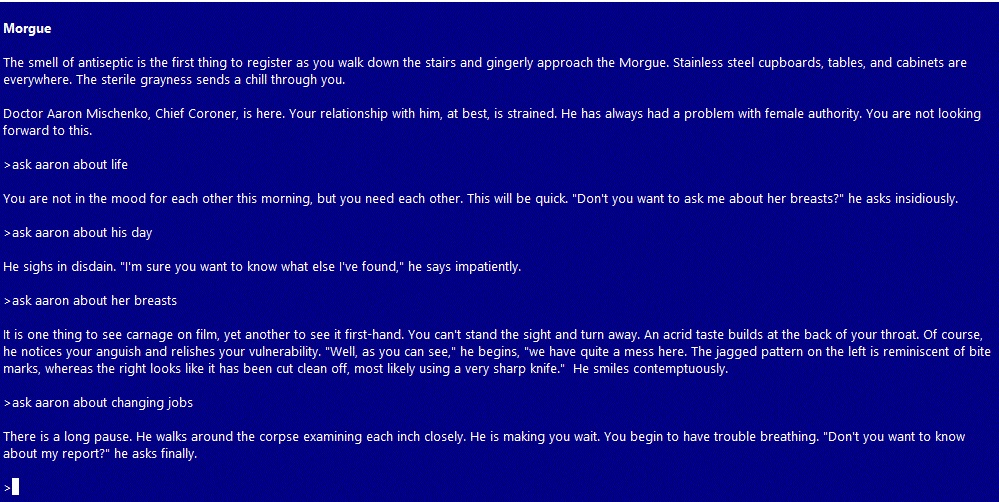
20 years after it was first released, 1-2-3…. is a game that is still infamous among members of the Interactive Fiction Community for its awkward use of NPCs.  At certain points in the game, you are a serial killer and, at other points of the game, you’re the detective who has been assigned to investigate the killer’s crimes.  If you’re the detective, you’re going to have to gather clues and interact with the coroner and Sgt. Fitzgerald.

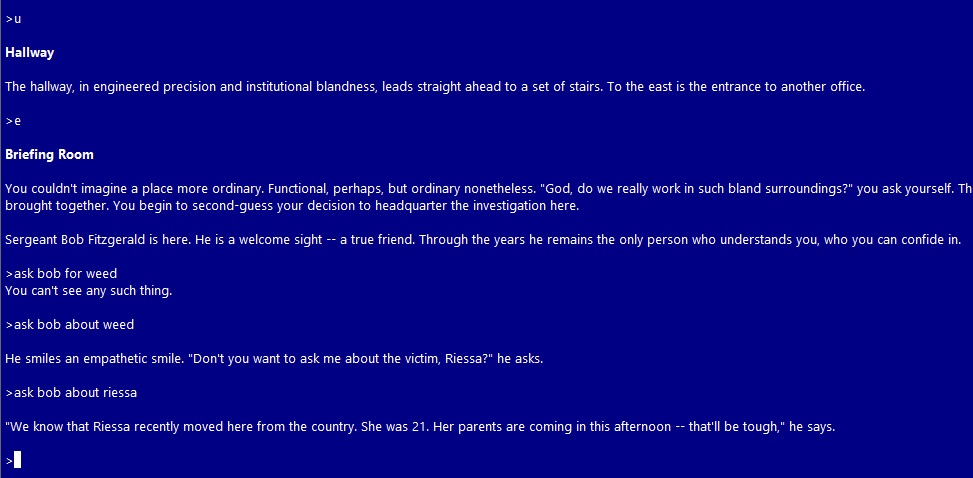
Ask the wrong question and their response will be something along the lines of “Wouldn’t you rather ask me about the victim?”

click to enlarge


After you ask all the right questions, the NPC will abruptly stop talking or responding to you.  In other words, this is not like an old Infocom game where you can have something close to resembling a conversation with the people you meet.  Instead, each character has a few pieces of information to share and, once they’ve shared, that’s it.  Most Interactive Fiction games are designed to allow you to feel as if you are the one controlling the flow of the story.  1-2-3… leaves you on the outside looking in as the game moves forward to it inevitable conclusion.

Despite it’s unfortunate reputation and the terrible social interactions, the descriptive passages in 1-2-3… are often well-written  The details are often vivid and I laughed whenever I tried to go in the wrong direction and the game blamed my confusion on a hangover.  Due to the graphic descriptions of the killer’s crimes, this is not a game for everyone but, at the same time, it’s not as bad as you may have heard.

It can be downloaded from here.

Not A Sequel: Witchtrap (1989, directed by Kevin Tenney)


“This is NOT a sequel to Witch Board!”

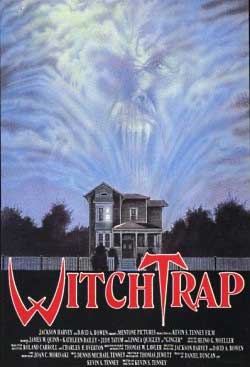
It may be directed by the same director and have a suspiciously similar title and it might feature a ghost that seems a lot like the malevolent spirit from Witch Board but Witchtrap is most assuredly not a sequel to Witch Board!  Got that?  Just in case you missed thr point, this VHS version of this movie opens with a credit that repeats “This NOT a sequel to Witch Board!”  On the version I saw, this was followed immediately by a trailer for Witch Board.

Witch Trap takes place in a haunted bed and breakfast.  The owner wants to make a lot of money with but first he wants a group of psychics to spend the night and determine whether or not the place is really haunted by the ghost of a magician and serial killer named Avery Launder.  (Avery Launder is played by J.P. Luebsen, who also played the evil spirit in Witch Board, to which this film is definitely not a sequel.)  Accompanying the psychics is a former cop named Tony Vincente (James W. Quinn) and an A/V technician named Ginger Kowalski (Linnea Quigley).  Ginger’s there so she can set up a tripod and take a shower.  Guess who is the first to die?

Witchtrap is the type of movie that used to show up all the time on late nighy Cinemax in the early to mid-90s.  There’s not much of a story but there’s boobs and plenty of blood and, back then, that’s all that a teenager secretly staying up late and watching cable really needed.  Watching it today, Witchtrap is mostly dull but it does try to be about something more than just ghosts and Linnea Quigley shower scenes.  The psychics spend a surprisingly large amount of time debating the universe and the concept of morality.  It doesn’t add up too much but at least it’s there.

As far as Kevin Tenney horror movies are concerned, Witchtrap can’t hold a candle to Night of the Demons and rumor has it that it’s not a sequel to Witchboard.  It’s forgettable but worth watching if you’re having early Cinemax nostalgia pains.

Game Review: Your Dog Has Been Abducted by Aliens (2012, David Yates)


Your dog has been abducted by aliens!  Can you find and rescue him?

This game is a Choose Your Own Adventure-type game, where you’re given a situation and then have to choose how to respond.  Making the right choice will lead to you eventually rescuing your dog.  Making the wrong choice could lead to everything from you not finding your dog to getting kidnapped by the police.

This a simple and very short game.  The author writes that he spent approximately two and a half hours on it.  By design, it’s not exactly challenging.  A good deal of the choices come down to “Search for your dog” or “Panic and run around in circles.”  In most cases, the correct choice should be obvious.  Even if the game isn’t challenging, it is well-written and it has some funny moments.  Anyone who has ever had to search for a pet will be able to relate to it.  And, if you’re a foreign alien Luddite, this game will give you a chance to learn how not to kidnap a dog.

It can be played by clicking here.