Monster Chiller Horror Theatre: Deadly Companion (1980, directed by George Bloomfield)


Deadly Companion starts with John Candy sitting in a mental institution and snorting cocaine while happily talking to his roommate, Michael Taylor (Michael Sarrazin).  Michael has been in the institution ever since the night that he walked in on his estranged wife being murdered.  Because of the shock, he can’t remember anything that he saw that night.  When his girlfriend Paula (Susan Clark) comes to pick Michael up, Michael leaves the institution determined to get to the truth about his wife’s murder.  Once Michael leaves, John Candy disappears from the movie.

Michael suspects that his wife was killed by her lover, Lawrence Miles (Anthony Perkins) but there is more to that night than Michael is remembering.  Deadly Companion is a typical low-budget shot-in-Toronto thriller from the early 80s, with familiar Canadian character actors like Michael Ironside, Al Waxman, Kenneth Welsh, and Maury Chaykin all playing small roles.  Michael Sarrazin is a dull lead but Anthony Perkins gets to do what he did best at the end of his career and plays a thoroughly sarcastic bastard who gets the only good lines in the film.

What’s interesting about Deadly Companion isn’t the predictable plot and it’s certainly not Michael Sarrazin.  Instead, what’s strange is that several cast members of SCTV show up in tiny supporting roles, though none of them get as much of a chance to make as big an impression as John Candy.  Deadly Companion is a serious thriller that just happens to feature Candy, Joe Flaherty, Eugene Levy, Catherine O’Hara, and Dave Thomas.  It’s strange to see Michael Sarrazin trying to figure out who killed his wife while Eugene Levy loiters in the background.  It leaves you waiting for a punchline that never comes.

The SCTV people are in the film because it was directed by George Bloomfield, who also directed several episodes of SCTV.  Since this film was made before SCTV really broke into the American marketplace, it was probably assumed that no one outside of Canada would ever find the presence of John Candy in a dramatic murder mystery distracting.  Of course, when Deadly Companion was later released on VHS in the late 80s, Candy and the SCTV crew were all given top billing.

Game Review: 16 Ways To Kill a Vampire at McDonalds (2016, Abigail Corfman)


It’s not easy being a vampire hunter, especially when you’re not even an important member of the group.  Most of the time, you don’t even get to fight the vampires.  You only get to serve as bait.  Yes, you’ve earned the night off.

What does a vampire hunter do on her night off?  Going to movies reveals that the only show playing is Blade: Trinity.  Getting a mani-pedi can only provide so much satisfaction.  So, you go to McDonalds.

And what do you run into at McDonalds?

A vampire!

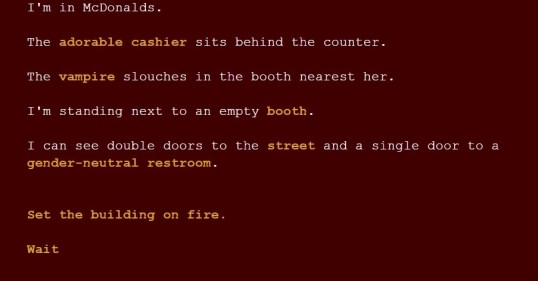
It’s now up to you to kill the vampire before the vampire kills the cashier and transforms her into a member of the undead.  Because you don’t carry the normal slayer weapons (and its your night off anyway), you’ll have to explore McDonalds and figure out how to use straws, napkins, fast food, and some other items to kill a vampire.  Fortunately for you, there are 16 different ways to kill a vampire at McDonalds.

Kill the vampire and get a happy ending.

Fail to kill the vampire and everyone will know that you were never really ready to be a slayer.

16 Ways To Kill A Vampire at McDonalds is fast-paced puzzle game that’s been written with a lot of heart and wit.  Killing the vampire himself isn’t that hard.  Instead, the fun of the game is replaying it so you can discover all sixteen different ways to do it.  Fortunately, after your first run-through of the game, you are given the option to skip some of the longer descriptive passages so you can get right to exploring McDonalds and seeing what you can do with fast food weaponry.  Don’t take too long though.  When the vampire makes his move, he moves quickly.

Each playthrough can last between five and 15 minutes.  The game can be played online by clicking here.

The Dirt On The Relentless: American Satan (2017, directed by Ash Avildsen)


The Relentless are the biggest band in the world, even though their music sounds like it belongs in the 80s.  Led by charismatic singer Johnny Faust (Andy Biersack), the Relentless have just released their debut album, American Satan.  Now, they’re touring the country, doing every drug they can get their hands on and every groupie that stops by their hotel.  The moral guardians say that The Relentless are a bad influence and are leading their children into Satanism.  For once, the moral guardians are right.  Back when they were just a struggling band in Los Angeles, The Relentless made a deal with Satan (Malcolm McDowell).  All they had to do was sacrifice the lead singer of a rival band (played by former teen idol Drake Bell) and all their dreams would come true.  However, if Johnny Faust had bothered to study his namesake, he’d know better than to make a deal with the devil.
The best thing about American Satan is that it was obviously made by people who know the music industry.  All of the details at the start of the film, with the Relentless struggling to get noticed and having to hit the streets and sell tickets to their own show, felt true.  It helps that most of the members of the Relentless were played by actual musicians.  What they lacked in acting talent, they made up for with authenticity.  The music industry is a tough business to break into, regardless of how good or bad your band is.  After watching Johnny and the Relentless struggle with crooked promoters and unsympathetic label owners, it was believable that they would consider signing a deal with the devil.

Much like the band, the movie lost its way after the contract with the devil was signed and official.  The rioting, the groupies, and the drugs were all too predictable and the movie just became The Dirt with Satan replacing Ozzy.  American Satan seems to be building up to an epic conclusion but it never seals the deal.  Instead, it just ends with a whimper, as if no one was sure where the story was supposed to be heading.  Still, any movie that finds roles for Malcolm McDowell, Bill Duke, Goldberg, and Denise Richards can’t be all bad.

At its worse, American Satan is an anti-climatic take on the Faust legend.  At its best, its Tipper Gore’s worst nightmare.

Game Review: An Act of Murder (2007, Christopher Huang)


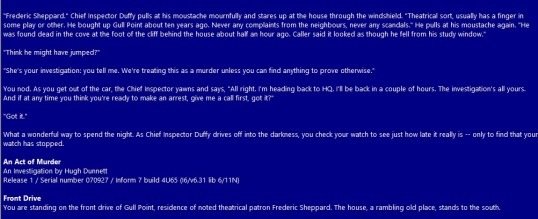
Several years ago, theatrical producer Fredric Sheppard bought a house on an oceanside cliff and now, his body is lying on the rock below.  Chief Inspector Duffy has dropped you off at the Sheppard house and told you to interrogate the people in the house, search for clues, and hopefully have the case solved by the morning.  You’ve got plenty of suspects, a handful of clues, and only a limited time to get the job done.  Get to work!

An Act Of Murder is a throw-back to the classic Infocom murder mysteries like Deadline and Suspect.  What makes this game interesting is the high amount of randomization.  Though the suspects and their backstories remain the same, the identity of the murderer and some of the key clues changes every time you start a new game.  Because there’s five separate suspects, that means that An Act of Murder is actually five games in one.  Of course, even if you tell Duffy to arrest the right suspect, you still have to have found all of the clues that prove their guilt.  If you don’t have all the clues, even arresting the right person could still lead to the case getting tossed out of court and you getting thoroughly humiliated.

In the tradition of the old Infocom games, each room is vividly described and each character is capable of variety of reactions depending on what you ask them and when you ask it.  The game also has a very helpful hint section and  a valuable and automatic notebook, which records every clue that you come across and every statement that you get.

An Act of Murder can be downloaded, for free, from here.

(After you’ve played the game and successfully solved the murder a few times, be sure to type XYZZY!)

Robot In Lust: Saturn 3 (1980, directed by Stanley Donen)


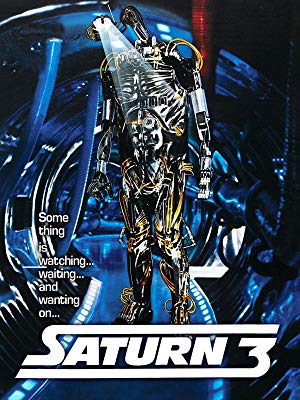
The time is the future and Earth is so polluted and overcrowded that the survival of humanity is dependent on space stations that are located across the galaxy.  On one of the moons of Saturn, Adam (Kirk Douglas) and Alex (Farrah Fawcett) are researching and developing new ways to grow food.  Alex is young and has never experienced life on Earth.  Adam is in his 60s and says that Earth is the worst place in the universe.  Alex and Adam are not just colleagues but lovers as well.  Inside the tranquil facility, Adam, Alex, and Sally the Dog live a lifestyle that feels more like late 70s California than 21st century Saturn.
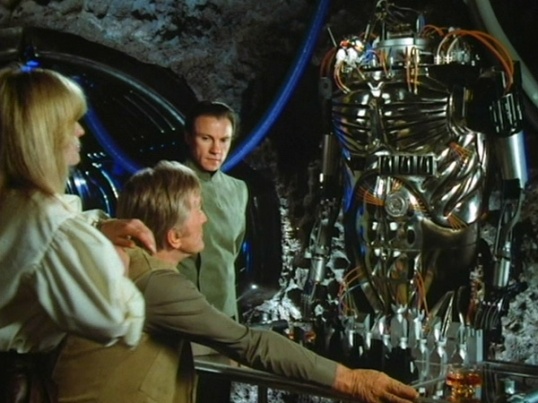
Adam is disturbed when a cargo ship arrives.  The ship is piloted by Captain James (Harvey Keitel, giving the film’s only interesting performance despite having had all of his dialogue dubbed by Roy Dotrice), who immediately takes an unwelcome interest in Alex.  (“You have a great body,” he says, “May I use it?”)  Captain James starts telling Alex stories about life back on Earth and encouraging her to abandon Adam.  Captain James also reveals that he’s accompanied by an 8-foot robot named Hector.  Hector is designed to replace one of the scientists.

If that’s not bad enough, it also turns out that Captain James is not really Captain James but instead, he’s Captain Benson.  Benson was originally assigned to fly the cargo ship but, after a psychological profile deemed him to be psychotic, Benson was replaced by James.  So, Benson killed James by pushing him out of an airlock.  Now, Benson is on Saturn 3 and he’s uploaded both his homicidal impulses and his lust for Alex into Hector’s programming.  Soon, Hector is rampaging through the facility, determined to have Alex for himself.

For an ultimately forgettable film that plays like an Alien rip-off (even though the two films were actually shot at the same time), Saturn 3 has long been infamous for its troubled production.  Martin Amis, who wrote an early draft of the script, even wrote a novel, Money, based on the filming of Saturn 3.  (In the novel, Kirk Douglas is renamed Lorne Guyland and insists on getting naked as much as possible in order to prove that he’s still virile.)  The film was originally meant to be the directorial debut of John Barry, the famed British production designer.  However, Barry departed the film after two weeks, with reports differing on whether he left voluntarily or if he was fired.  The film’s producer, Stanley Donen, took over as director.  Stanley Donen, who also directed legitimate classics like Singin’ In The Rain, Charade, and Two For The Road, confessed to having no affinity for science fiction and it’s obvious from watching his one foray into the genre that he was not exaggerating.

The idea behind Saturn 3, with Hector taking on the personality of it creator, is an intriguing one but the film doesn’t do much with it and the film’s choppy pace indicates that there was extensive executive tinkering both during and after filming.  Harvey Keitel is convincingly strange in his role but Farrah Fawcett is miscast as a scientist and Kirk Douglas does his usual grin and grimace routine, usually while naked.  (It doesn’t seem that Martin Amis had to stretch the truth too far.)  The 8-foot Hector looks impressive until he actually has to chase Fawcett through the facility.  That’s when it becomes obvious that anyone with two functioning legs could easily outrun the lumbering robot.

In space, no one can hear you scream.  But they might hear you laughing at Saturn 3.

Game Review: Ghost Town (1995, E.L. Cheney)


In this text adventure, you are a prospector in the old west.  You’re trying to find the old ghost town of Brimstone.  Though the town is deserted, it is rumored that it might be haunted.  It is also rumored that the town might be home to a fortune in gold.

Ghost Town is a fairly diverting text adventure.  The first few times that I played, I didn’t even make it to Brimstone.  Instead, I wandered around the endless prairie and then I got trapped in one location by a snake.

Once you figure out how to actually get by the snake, you can move on to the town.  It turns out that, despite the the rumors that the town is deserted, it actually is inhabited by a crazy lawman and he’s holding a woman hostage.  It’s up to you to defeat the lawman, rescue the woman, and hopefully make it out alive.

As text adventures go, it’s basic but it’s not a bad game.  I played it because I thought there would be actual ghosts but instead, it’s just a really evil sheriff.  If you can overlook some misspellings and questionable grammar, this a fairly well-programmed game and one that has more than its share of interesting locations.  It’s a game the rewards both persistence and an eye for small details.

It can be played at the Internet Archive.  Good luck getting past that snake!

Terminator Redux: Eve of Destruction (1991, directed by Duncan Gibbins)


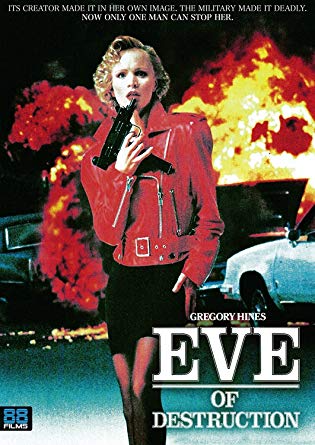
When Eve VIII (Renée Soutendijk), a robot that has been designed so that she can pass for a human, is taken on a test run though the city, things go terribly wrong when she gets caught up in a bank robbery.  When one of the robbers shoots her, it scrambles her circuits and causes her to switch into combat mode.  For some reason, someone thought it would be a good idea to install the equivalent of a nuclear bomb inside the robot so now, Eve VIII is wandering around the city, killing anyone who shes views as being a danger, and threatening to send both herself and everyone up in a nuclear fireball.
Realizing that Eve VIII’s test run has become a national emergency, the military calls in the best operative they’ve got and he turns out to be … Gregory Hines!?  The legendary Broadway song-and-dance man plays Colonel John McQuade, a special operative who has seen action in all of the world’s hot spots.  McQuade works with Eve VIII’s creator, Dr. Eve Simmons (also played by Renée Soutendijk) to try to track down the robot before it’s too late.  In a move that makes as much sense as installing the equivalent of a nuclear bomb inside of her, Eve VIII has also been programmed to have the same traumatic memories as her creator.  When Eve VIII destroys a cheap motel that Eve Simmons used to wonder about, McQuade announces that the key to trapping the robot is for Dr. Simmons to reval all of her “teenage sexual fantasies!”

The idea of a robot having and acting upon all of the repressed memories and desires of its creator is a good one but Eve of Destruction doesn’t do much with it.  Once McQuade and Dr. Simmons head off in pursuit of Eve VIII, it becomes just another low-budget Terminator rip-off.  Gregory Hines deals with being miscast by yelling all of his lines.  Renée Soutendijk does better as both Eve VIII and Dr. Simmons and even manages to generate some sympathy for the killer robot.  Interestingly, Soutendijk is best known for her work with Paul Verhoeven, whose RoboCop was an obviously influence on Eve of Destruction.

Eve of Destruction is a forgettable killer robot film from an era that was full of them.  Most disappointing of all is that Barry McGuire is nowhere to be heard.  If you do see the film, keep an eye out for the great Kevin McCarthy, playing yet another befuddled victim and, for some reason, going uncredited.

Game Review: The Haunted House of Hideous Horrors (2002, David Whyld)


You’re a pizza delivery man!  Mr. Desther has ordered a pizza but when you arrives at his house, he tells you that he has a problem with ghosts.  They’re all over his home and he wants you to get rid of them.  And if you don’t get rid of them, he’s not going to give you a tip.  At first, you’re reluctant to get involved but then he offers you £15.  (That’s $18.88 for our American readers.)  You’ll get rid of the ghosts at the risk of your own life and sanity.  And if you don’t do it, Mr. Desther’s pizza is free!

The Haunted House of Hideous Horrors is a short and simple text adventure.  It was designed for ADRIFT 4.0, which is the easiest IF interpreter to program for.  Unfortunately, ADRIFT’s vocabulary is also extremely limited so playing an ADRIFT game can often feel like an extended session of guess-the-verb.  That’s not as much of a problem in The Haunted House of Hideous Horrors as it is in other ADRIFT games.  David Whyld keeps things from getting too complicated or frustrating, though there is one notable moment when you’re told that you’ve entered a room that contains a dead body but, whenever you try to “look body” or “examine corpse,” you get a “There’s no such thing here” message.

There’s only one way to die in this game but you’re given so much advance warning that, if you die, it’ll mostly be due to your lack of reading comprehension.  Once you get used to the natural limitations of the ADRIFT story engine, this is a simple but enjoyable haunted house game that doesn’t take itself too seriously.  Download the game and, if need be, ADRIFT for free, get in that house, and earn your tip!

Robot Without A Cause: Class of 1999 II: The Substitute (1994, directed by Spiro Razatos)


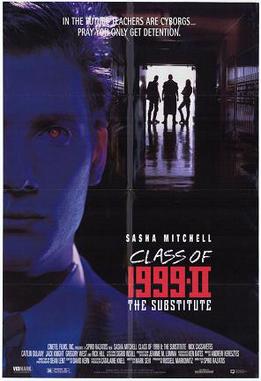
There’s a new substitute teacher at a local high school in Oregon and he’s not going to put up with any disrespectful punks.  John Bolen (Sasha Mitchell) can educate minds and change lives but only when he’s not busy killing any student with a bad attitude and trying to protect his fellow teacher, Jenna McKenzie (Caitlin Dulany).  Jenna is scheduled to testify against the local gang leader so every punk at school is trying to intimidate her and her boyfriend, Emmett (Nick Cassavetes!).  It takes Jenna and Emmett a while to realize that John is killing all of their students but soon, a mysterious man named G.D. Ash (Rick Hill) shows up and insinuates that John might be connected to the robot teachers that, two years earlier, terrorized a high school in Seattle.

This sequel to The Class of 1999 is mostly more of the same, with the main difference being that the focus is not on the students being hunted but instead on the teachers being “protected.”  If the first Class of 1999 was about the dangers of a no tolerance discipline policy, the sequel is all for it and suggests that maybe the world really would be better off if teachers could just kill some of their more disruptive students.  The first film’s director, Mark L. Lester, did not return for the sequel and directing duties were given to stunt coordinator to Spiro Razatos who, not surprisingly, emphasized action and stunts over characterization.  Fortunately, Sasha Mitchell was a champion kickboxer so he’s believable in the action scenes and he’s such a stiff actor that you could believe that he might be an android.  There’s a good and unexpected twist towards the end of the movie but, ultimately, the victims are too interchangeable and the direction is too flat for this sequel to duplicate the demented pleasures of either Class of 1999 or Class of 1984.

Game Review: Mystery House Possessed (2005, Emily Short)


Mystery House Possessed is an Interactive Fiction game by Emily Short.  It was one of the first IF games to be developed with Inform 7 and it is a classic of its kind.

Your friend Eulalie has died.  As per her instructions, her greedy heirs will be allowed to enter her house and spend the day searching for where she has hidden her diamond necklace.  However, she has also hidden something in the study and, in her final letter to you, she asked you to retrieve it.  She didn’t specify what it was, only that you would know it when you saw it.  And, Eulalie writes, if you happen to find the necklace, that’s cool too!

When you arrive at Eulalie’s house, her six heirs are already present and preparing to tear up the house in their search for her necklace’s hiding place.  It turns out that one of the heirs is a murderer and, unless you can figure out the killer’s identity, everyone in the house is going to die.  Including you!

What sets Mystery House Possessed apart from other interactive fiction games is the amount of randomization involved.  At the start of every new game, not only is a new killer selected but the location of the necklace changes as well.  The movements of the 6 NPCs also change from game to game and you’ll have to keep track of who has picked up each of the potential weapons that have been left around the house.  You might even have to pick up one of those weapons yourself so that you can be ready if the killer comes after you.

It’s a short game, with a clear goal and time limit.  Because of the heavy randomization, it’s also a game that can played over and over again.  Like almost all of Emily Short’s games, Mystery House Possessed is well-written with a careful attention to detail and challenging without being impossible to win.  If you’ve never played an interactive fiction game before, Mystery House Possessed is a good place to start.