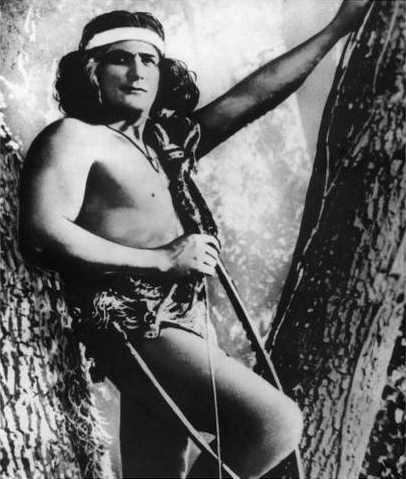
Elmo Lincoln.
That name may not sound all the imposing but Elmo Lincoln played a very important role in the early days of Hollywood. He was the first actor to play the adult version of Tarzan, the Lord of the Jungle. Originally from Indiana, Elmo Lincoln was a 29 year-old former sailor and boxer when he was selected to replace Stellan Windrow as the star of 1918’s Tarzan of the Apes. (A stunt man, Windrow had already filmed the majority of Tarzan’s stunts before he was drafted to serve in World War I.) Lincoln, who had already appeared in a few of D.W. Griffith’s films, would briefly find stardom as a result of playing Tarzan.
Of course, it takes a while for Lincoln to appear in Tarzan of the Apes. The film was reportedly two hours long when it was initially released but today, it only exists in a 61-minute version. (Because each municipality had its own board of censors, the version of Tarzan of the Apes that played in one city could be quite different from the version that played in another. Unfortunately, with that many censors snipping scenes from city to city, a lot of footage that was cut from the film was undoubtedly lost forever.) The first half of the film deals with the birth of Tarzan while the second half features Tarzan as an adult. Technically, the first actor to play Tarzan was the uncredited baby who appears shortly after Lord Greystoke (True Boardman) and his wife (Kathleen Kirkham) are abandoned by mutineers in Africa. After the baby is given to the Apes, child actor Gordon Griffith takes over the role. Finally, once an expedition is sent to investigate whether or not the stories about Tarzan are true, Elmo Lincoln takes over the role and saves Jane (Enid Markey) after she’s kidnapped by a group of natives. The film ends with Tarzan and Jane just starting to fall in love. (A sequel, The Romance of Tarzan, was released that same year but it’s a lost film.)
In the role of Tarzan, Elmo Lincoln is …. well, he’s okay. He’s not a great actor but he’s a good Tarzan. He’s obviously strong and athletic and he looks convincing when he’s hiding in the trees. Lincoln was not a particularly expressive actor and that natural stiffness is noticeable whenever he’s called upon to demonstrate anything other than grim determination. He has a strong physical presence and, in 1918, that was probably enough to make him a star. When he gazes at Jane and the title cards tells us that he’s saying, “Tarzan is a man and man does not force the love of a woman,” the viewer believes it. If I was lost in the jungle, I’d probably want Elmo Lincoln to help me out. We wouldn’t have much to talk about but I would have faith in his ability to take care of any problems that we ran into on the way back to civilization.
That said, the film is at its best when it depicts Tarzan’s childhood. There’s a sense of fun and wonder to those scenes that is missing from the second half of the film. Gordon Griffith did a good job as the young Tarzan. Louisiana is a surprisingly effective stand-in for the jungles of Africa. By today’s standards, Tarzan of the Apes can seem a bit creaky. (The camera barely moves at all.) But watching it, one can still understand why Hollywood fell in love with the idea of a man raised by apes. One can even understand why, for a brief period of time, Elmo Lincoln became a star.






 Through the Shattered Lens