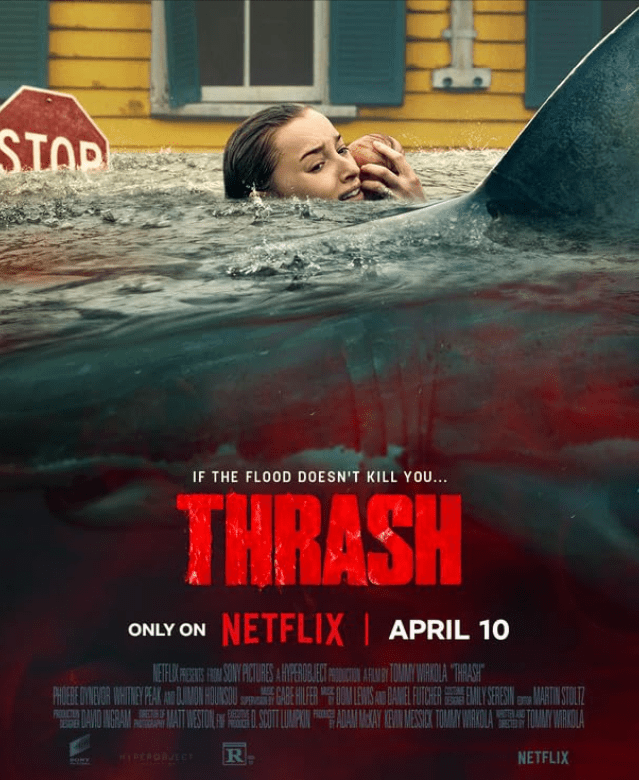
Thrash, Film Review by Case Wright (wri/dir: Tommy Wirkola)


It’s not quite shark week, but we’re still all in on sharks eating people here at TTSL. I watched this shark v people movie with Lisa and it was pretty fun. It did have a touch of environmentalist gobbledygook, but it was brief enough to ignore. My advice to anyone doing a shark film is to stick to reality: sharks. You don’t need to bring in vampires, werewolves, or climate change to raise the stakes.

There is a category five hurricane that hits a South Carolina town, it breaks the seawall, the town is taken by the sea, and sharks come in to eat everyone. There were some decent tropes to keep the popcorn popping: abusive foster parents, redneck foster kids, a pregnant woman who gives birth, an annoying anxiety-ridden lady who stares at things through the movie and rises mostly to the occasion, and a wise sailor/marine biologist who actually saves the day.

The mean foster parents and some good Samaritans become shark food, but that was about it. I was happy to see the foster parents die, but one of the foster parents was straight up murdered by the foster kids, which made the foster kids less sympathetic to me. Yes, foster dad was a horrible jerk, but there was no reflection on the fact that they killed him. You would’ve thought the abusive foster parent would’ve been well thought of by the director and writer because he was a state subsidized parent. I thought government intervention was supposed to make everything better?

My three big critiques is that there were not enough deaths, some scenes were too bright, and the protagonist did not get to save the day. “Thrash” was low on the body count; it made me wonder if they ran out of money or had to donate half of their money to an NGO. Did it have to be “Sharknado” levels of shark chomping? No, but I think that there were only five deaths in this film and that’s a little light.

The other critique is the lighting; typically, Netflix films are really dark and I don’t mean mood; it’s actually difficult to see. “Thrash” went the other direction and there was clear sunlight in a number of scenes that were supposed to be at night. The director had an environmentalist streak; so, maybe it was purposeful to lower a carbon footprint and use daylight to film? I do not have a good answer because it took me out of the story.

Finally, the anxiety-ridden star, whom I will call Anxious Girl, was more annoying than inspiring. Also the film ended where the Anxious Girl and the pregnant woman needed to be rescued by Anxious Girl’s uncle. I don’t think the writer understood that this was a failure. The Anxious Girl faced her fears and should’ve saved the day, but it was her Uncle, a minor character, who had to save the protagonist and pregnant woman. Was the Anxious Girl annoying? Sure, but she grew as a character and by taking away her chance at true heroism, it made the victory hollow and deflated.

Is the film worth watching? Sure. Like a tinder date missing a left-arm, “Thrash” was all right.
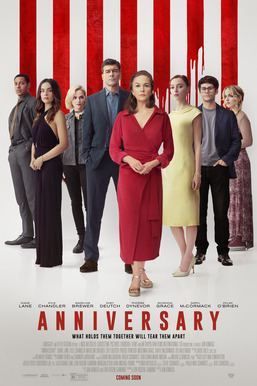
Catching Up With The Films of 2025: Anniversary (dir by Jan Komasa)


 Anniversary begins with a party.  Ellen Taylor (Diana Lane), a professor at Georgetown University, is celebrating the 25th anniversary of her marriage to Paul (Kyle Chandler), a restauranteur.  The family has gathered at Lina and Paul’s ocean-side mansion.  Daughter Cynthia (Zoey Deutch) and her husband Rob (Daryl McCormick) are environmental attorneys.  Another daughter, Anna (Madeleine Brewer), is a performance artist who is very close to the youngest child, teenage Birdie (McKenna Grace).  Finally, Josh (Dylan O’Brien) is the only son, a struggling writer who arrives with his fiancée, Liz Nettles (Phoebe Dynevor).

Ellen immediately recognizes Liz as a former student, one who wrote a dissertation advocating for a one-party state.  At the time, Ellen called out Liz’s totalitarian ideology, to the extent that Liz accused Ellen of bullying her and ended up transferring to a different college.  Now, Ellen is not happy to discover that Liz has written a book called The Change and that Josh has abandoned his own “sci-fi trilogy” to help Liz out with her projects.  Liz is polite to Ellen but, before she leaves, she gives her future mother-in-law a forced hug and says, “I’m not scared of you anymore.”

From there, the film jumps forward from year-to-year, from gathering-to-gathering.  Liz’s book is a best-seller that soon sparks a movement.  Ellen watches in horror as her neighbors start to fly Change flags (which is the American flag, with the stars in the center).  Josh goes from being awkward and dorky to being arrogant and finally threatening.  With each year, the Change becomes more powerful and more menacing, until eventually Paul can’t even stand outside at night without a drone warning him that he’s violating curfew.  Anna becomes a fugitive while Birdie tries to find her place in a rapidly changing world.  The tragedies that follow all feel inevitable.

Anniversary is definitely an uneven film.  Some of the performances are better than others.  Diane Lane, Kyle Chandler, Dylan O’Brien, and Phoebe Dynevor all give excellent performances.  If nothing else, this film shows that Dylan O’Brien may be one of the most underrated actors working today.  At the same time, Madeline Brewer goes so over-the-top that I was almost relieved when Anna had to go into hiding and Zooey Deutch is let down by a script that doesn’t seem to be quite sure what to do with her character.  There are a few moments that are a bit too heavy-handed for their own good and the viewer is sometimes left to wonder if the film has the self-awareness necessary to understand that the Taylors, with their combination of wealth and radical chic politics, are often their own worst enemies.

That said, Anniversary is definitely a film of the moment.  There are enough brilliant scenes — like a meeting with two “census takers” that gradually turns menacing — to make up for the scenes that don’t work.  It’s best moments have an undeniable power in which the viewer realizes that the film’s melodrama is far more plausible today than it would have been in a pre-COVID era.  The scene where Paul is told that he is violating curfew would seem heavy-handed if not for the fact that, in 2020, we pretty much saw the same thing happening across the country.

Some online critics have complained that The Change’s ideology is purposefully left vague but that misses the point that most successful movements actually are vague about the details.  (Historically, most American third party movements tend to fall apart as soon as they start taking actual policy positions.)  The Change becomes powerful specifically because people can view it as being whatever they want it to be.  Whereas some people might see it as a return to a “simpler” time, others will view it as the warmth of collectivism replacing the frigidity of rugged individualism.  The Change is all about vibes and paranoia, the feeling that people are being left behind by the system and the only way to solve the problem is for everyone to embrace The Change without question.  The thing that all the followers of The Change share is a belief that dissent cannot be tolerated.

Anniversary is a crudely effective film, one that shows a small act of revenge can grow into something much larger.  It was overlooked when released but it still carries a powerful punch.