Late Night Retro Television Review: Monsters 2.6 “The Farmer’s Daughter”


Welcome to Late Night Retro Television Reviews, a feature where we review some of our favorite and least favorite shows of the past! On Wednesdays, I will be reviewing Monsters, which aired in syndication from 1988 to 1991. The entire series is streaming on YouTube.

Say, have you heard the joke about the traveling Bible salesman and the farmer’s daughter?  How about the one about the Man from Nantucket….

Episode 2.6 “The Farmer’s Daughter”

(Dir by Michael Warren Powell, originally aired on November 5th, 1989)

On a rainy night, traveling salesman Howard Filby (Soupy Sales) has an accident in front of the farmhouse owned by …. well, the show just calls them Ma (Bobo Lewis) and Pa (George Hall).  Ma and Pa seem like good country folks.  (That said, just their names brought to mind the owners of the Ma & Pa General Store on King of the Hill.  “I guess your Pa because you’re PA-thetic!”  “And you’re Ma because you’re always ridin’ mah ass!”)  Ma and Pa are willing to let Howard spend the night at the farmhouse, out of the rain.  He can just sleep up in the attic.  They’ll have to put up a privacy sheet, of course.  Their daughter Lucy (Stephanie Phillips) also stays up in the attic.

That privacy sheet doesn’t stay up for long.  Howard becomes intrigued by Lucy’s silhouette and her sultry voice.  When the sheet comes down, Howard is relieved to discover that Lucy is just as attractive as she sounded.  Lucy asks Howard for his undying love and Howard’s willing to give it.  Lucy talks about heading downstairs to let Ma and Pa know that they’ll be getting married.  Howard’s a little bit surprised to hear that….

Howard’s even more surprised when he accidentally pulls off a chunk of Lucy’s skin.  It turns out that Lucy is not quite who Howard thought she was and that Howard is hardly the first salesman to be brought to the farmhouse and sent up to the attic.  Even as Howard struggles in the attic, Ma and Pa sit in their living room and smile at the sound of another fender bender outside….

This was a nicely atmospheric episode.  Having heard all the various stories and jokes about traveling salesman and farmer’s daughters, I can’t say that I was particularly surprised by the direction that the story took but the episode still works as an example of American folk horror.  Soupy Sales was a comedian and a children’s show host and, according to Wikipedia, his trademark was getting a pie slammed in his face.  (Ouch!)  With that in mind, I guess it’s not a surprise that Sales’s performance occasionally leans a bit too much towards the goofy side.  (There’s a difference between playing the role with humor and just mugging for the camera.)  However, Stephanie Phillips, George Hall, and Bobo Lewis are all effectively creepy as the faux friendly farmhouse inhabitants.

Interestingly enough, this episode was co-written by character actor Bob Balaban.  As a director, Balaban was responsible for Parents, another film about a seemingly perfect married couple with a secret.
The Films of 2024: Shirley (dir by John Ridley)


In 1972, a New York Congressperson named Shirley Chisholm made history when, in January of that year, she announced that she would be a candidate for the Democrat presidential nomination.  Chisholm, who had already made history when she became the first Black woman to be elected to Congress, was also the first Black woman to run for a major party’s presidential nomination.

(For the record, U.S. Senator Margaret Chase Smith of Maine and the Rev. Channing Phillips were, respectively, the first woman and the first Black to run for a major party’s presidential nomination.  Smith lost the Republican nomination to Barry Goldwater in 1964.  In 1968, Phillips was the first Black to have his name officially put into nomination at a major party political convention.)

Of course, Chisholm did not win in 1972.  She was one of many liberal candidates who declared that they were running as an alternative to the presumed front runner, U.S. Sen. Edmund Muskie.  When Muskie’s campaign stalled in New Hampshire, it was George McGovern (and not Shirley Chisolm, John Lindsay, Eugene McCarthy, or Fred Harris) who benefitted.  For the most part, the media viewed Chisholm as being a protest candidate, one who had a small but loyal activist base but which couldn’t compete with candidates like McGovern and Hubert Humphrey.  Still, Chisholm went into the convention with a handful of delegates and, with McGovern not having enough pledged delegates to win outright, it was expected that Shirley Chisholm would at least be able to get some concessions from him in return for her support.

Political conventions being what they are, things didn’t work out that way.  Due to several backroom deals, George McGovern was able to secure the nomination during the first round of voting.  McGovern went on to suffer a landslide defeat and for years, his general election campaign would be held up as an example of how not to run for President.  Chisholm returned to the U.S. Congress, where she served for another ten years.

Featuring Regina King in the title role, Shirley is a dramatization of that primary campaign.  In many ways, it’s a typical Netflix docudrama.  It’s well-made and it’s tasteful and occasionally, it’s a little bit boring.  Political junkies will enjoy it, particularly if they’ve studied the 1972 presidential election.  My inner history nerd was thrilled as largely forgotten historical figures were casually mentioned in the dialogue.  Who would have guessed that a film released in 2024 would have featured characters talking about the presidential campaigns of Sam Yorty, John Lindsay, and Walter Fauntroy?  Sadly, no mention is made of Patsy Mink.  While Shirley Chisholm was making history as the first Black woman to run for president, U.S. Rep. Patsy T. Mink of Hawaii was doing the same as the first Asian-American woman to run.

It’s an uneven film, one that takes it time getting started.  Filmmaker John Ridley is a better writer than director.  Some of the scenes, like the ones of Chisholm mentoring a young Barbara Lee (Christina Jackson), felt a bit too much on the nose.  (That said, Barbara Lee did start her career as a volunteer with the Chisholm campaign and, while in Congress, she regularly cited Chisholm as an inspiration.)  But then there were other scenes that worked wonderfully, like Chisholm visiting segregationist George Wallace (W. Earl Brown) after Wallace had been shot.  The film is at its best when it reaches the Democrat Convention and Chisholm goes from being elated to disappointed as one of her strongest allies goes from supporting her to announcing that it’s time for all the black delegates to line up behind McGovern.  Regina King’s performance, especially towards the end of the film, captures both Shirley Chisholm’s strength and her vulnerability.  It’s not always easy being a trailblazer.

Finally, if you want to learn more about Shirley Chisholm’s 1972 presidential campaign, I suggest the 2005 documentary, Shirley Chisholm ’72: Unbought and Unbossed.

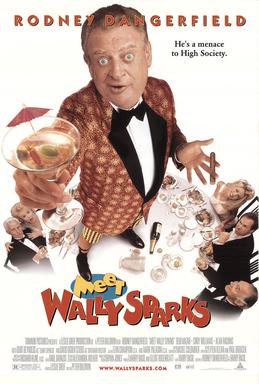
Meet Wally Sparks (1997, directed by Peter Baldwin)


Wally Sparks (Rodney Dangerfield) is a talk show host with a program that is so raunchy that even Jerry Springer says, “At least this isn’t The Wally Sparks Show!”

Despite being a huge hit amongst teens and college students, the show is on the verge of being canceled by the head of the network, Mr. Spencer (Burt Reynolds, wearing a fearsome toupee).  He is tired of Wally’s antics and he tells Wally and his producer, Sandy Gallo (Debi Mazar), that they have a week to make the show respectable.

Wally doesn’t know what to do.  Wally Sparks act respectable?  Wally’s a guy who don’t get no respect, no respect at all.  Then Sandy finds a letter inviting Wally to attend a party at the home of Georgia Governor Floyd Patterson (David Ogden Stiers), a noted critic of the show.  Hoping to get the interview that will save the show, Wally and Sandy head down south.

At the party, Wally acts like Wally and scandalizes all of the politicians and socialites.  He also shares a bottle of whiskey with a horse and then rides the horse through the mansion.  The party is a disaster but, after Wally claims that he can’t walk because of a spinal injury he suffered when he fell off the horse, the Governor allows him to recuperate in the mansion.  Wally causes more chaos while also teaching the Governor’s wife (Cindy Williams) how to play strip poker and eventually exposing a scheme to blackmail the Governor into building  a Confederate-themed amusement park.

Rodney Dangerfield playing a talk show host sounds like a great idea and there are a lot of talented people to be found in Meet Wally Sparks.  Debi Mazar is an actress who should have appeared in a lot more movies and she and Rodney Dangerfield make a good team.  The movie actually gets off to a funny start, with a montage of actual talk show hosts talking about how much they hate Wally Sparks and his show.  Gilbert Gottfried has a cameo as a manic guest and Wally repeats some of Rodney Dangerfield’s classic jokes.

Unfortunately, the movie starts to fall apart as soon as Burt Reynolds threatens to cancel the show for being too lowbrow.  No network executive has ever threatened to cancel a show that’s bringing in the ratings, regardless of how lowbrow it might be.  Things get even worse after Wally goes to Atlanta and ends up staying there.  The movie tries to recreate the Snobs vs. the Slobs dynamic of previous Dangerfield films but the Governor comes across as being such a decent man that there’s no joy to be found in watching his life get turned upside down.  The movie has a surprisingly large number of subplots, including one about Wally’s son (Michael Weatherly) falling for the Governor’s daughter (Lisa Thornhill), but most of them go nowhere and just distract from the man who should have been the film’s main attraction, Rodney Dangerfield.  By the end of the movie, even the usually irrepressible Dangerfield seems to have been neutered.

Rodney Dangerfield was a national treasure but Meet Wally Sparks was not the best showcase for his persona or his style of humor.  Fortunately, Caddyshack and Back To The School are available to watch anytime that we need a good laugh and we want to show Rodney Dangerfield a little respect.

Retro Television Review: The Love Boat 4.14 “First Voyage, Last Voyage/April, the Ninny/The Loan Arranger”


Welcome to Retro Television Reviews, a feature where we review some of our favorite and least favorite shows of the past!  On Wednesdays, I will be reviewing the original Love Boat, which aired on ABC from 1977 to 1986!  The series can be streamed on Paramount Plus!

Oh, hey, Charo’s back.

Episode 4.15 “First Voyage, Last Voyage/April, the Ninny/The Loan Arranger”

(Dir by Roger Duchowny, originally aired on January 17th, 1981)

April’s back!

Played by Charo, April Lopez was one of the few recurring characters on The Love Boat.  Whereas other actors appeared frequently but always as different characters, Charo was always April whenever she boarded The Love Boat.  The first time she boarded the ship, she did so as a stowaway.  The next two times, she boarded as the cruise’s entertainment.  This season, however, April boards as someone who has grown tired of show business.  When last we saw her, April was in love with a guy named Tex and planning on playing Las Vegas.  However, when April boards this time, she quickly informs both Julie and Isaac that she and Tex are no longer a couple and Vegas didn’t work out because she was expected to play her guitar while naked.

(“They could have at least gotten you a cello,” Isaac replies.)

April wants a new career, which she gets when she meets Ty Younger (Larry Linville), who is wealthy but who also has two bratty kids who are always chasing off their nannies.  They can’t chase off April, who understands that the best way to calm a bratty child is to grab your guitar and sing to them at night.  April gives up show business to become a nanny but I don’t think it’ll last.  April is too impulsive to settle down, and Ty’s kids really are the worst.  (As well, Charo and Larry Linville didn’t exactly generate a lot of heat in their scenes together.)  April may leave the boat with a new family but hopefully, she’ll return alone in the fifth season.

Speaking of the worst, Cindy Simmons (Maureen McCormick) is dying but her parents (Ty Hardin and Kathleen Nolan) haven’t gotten around to telling her yet.  Cindy thinks that she’s made a full recovery from her recent illness.  Her parents don’t want to upset Cindy but when Cindy meets and falls in love with Paul Harris (Jay Thomas), they realize that they’re going to have to tell Cindy the truth.  Poor Cindy!  Fortunately, this is The Love Boat and Paul isn’t going to let a little thing like impending death get in the way of romance.  I’ve lost track of how many times I’ve seen Maureen McCormick on both The Love Boat and Fantasy Island.  For this episode, McCormick does a pretty good job with her role and she and Jay Thomas make for an attractive couple.

“I guess I’m still getting my sea legs,” Cindy says to Paul.

“Your legs look mighty fine to me,” Paul replies.

That’s about as witty as things get on this cruise.

Finally, Joey (Richard Kline) is a mob enforcer who has been sent to collect a debt owed by Tony Patacchio, a gambling addict.  However, Joey gets distracted when he meets a woman named Antoinette (Lisa Hartman) who enjoys gambling.  Joey falls for Antoinette and, unable to find Tony, he even spends the night in her cabin.  Hmmm …. Tony …. Antoinette …. Toni….

Yes, Joey has fallen in love with the person he was supposed to rough up.  Fortunately, Joey is willing to fix a poker game so that Toni can win enough of his money to pay off her debt.  When Toni realizes that Joey lost his money to her on purpose, she declares that she can’t take his money.  “If we were married,” Joey says, “It would be our money.”

Richard Kline is not a particularly believable debt collector.  (Tony Soprano would have tossed him in a dumpster.)  It’s also strange that his boss would send him to collect a debt without bothering to give him a physical description of the person he was supposed to intimidate.  The whole storyline was full of holes but I’m surprised to say that I did end up rooting Kline and Hartman to get together.  The two of them had enough chemistry to overcome the fact that their story made very little sense.

Previously, whenever Charo was a guest star, she dominated the entire episode, for better or worse.  With this episode, she seems kind of bored with the whole thing, as if Charo was just as fed up with show business as April.  Instead, it was Maureen McCormick and Jay Thomas who dominated the episode with Richard Kline and Lisa Hartman also getting their share of good scenes.  It makes for a bit of an uneven episode but I defy anyone not to feel something when Paul declares that he wants to spend the rest of Cindy’s life with her.  Mixing romantic melodrama and goofy comedy is what made The Love Boat a treasure of American pop culture.

May Day AMV of the Day: Summer (Naruto Shippūden)


In some countries, May Day is a holiday that signifies the start of summer!  In honor of that holiday, please enjoy today’s AMV of the Day!  (No, I’m not sure why video has the “no video” thumbnail that YouTube used to use.  The video is there, just hit play.)

Song: Summer by Calvin Harris

Anime: Naruto Shippūden

Creator: MartusSsia01

Past AMVs of the Day

The Eric Roberts Collection: The Savant (dir by Sherri Kauk)


I swear, I will sit through the worst films for the promise of an Eric Roberts cameo.

Roberts is only featured in about two minutes of 2019’s The Savant.  According to the credits, he was playing a character named Lonnie.  At one point, he called the film’s hero, police officer Nick Tantino (Frank Giglio), and had a nonsensical conversation with him while he was arresting a random person.  I’m not really sure who Lonnie was supposed to be and the scene had very little to do with the film’s story.  In fact, the scene just randomly occurred.  I’m going to guess that the film needed to be padded out and someone said, “Let’s call Eric Roberts and add another name to the cast.”

Eric Roberts is not the only familiar face to show up in the film.

Martin Kove plays a literature professor who is also a sensei.  One of his former students, an evil District Attorney named Zane Carroll (played by Eric Etebari), calls him for advice.

Former TV actress Joyce DeWitt plays a detective.  Her partner, who tells a lot of bad jokes, is played by comedian and former Howard Stern flunky, Jackie Martling.

Veteran genre actress Julie McCullough plays a judge, who screams at a defense attorney.

Thomas G. Waites, who was one of The Warriors, plays a police chief.

Robert Loggia shows up as Dr. Reno, a psychiatrist who bellows at everyone and who explains how the savant mind works.  Of all the “names” in the film, Loggia gets the most screentime.  Interestingly enough, Loggia died in 2015 and The Savant was released four years later.  I’m not sure when The Savant was actually filmed but considering how messy the film is and how many plot points are brought up and then abandoned and also the fact that the characters often look totally different from scene-to-scene, I’m going to guess shooting went on for a while.

As for the film, it’s about an autistic savant named Anthony (Miguel Jarquin-Moreland) who beats up a bully.  Nick, who has been assigned to work as a glorified security guard at Anthony’s high school, takes Anthony under his wing and trains him to be a MMA fighter.  It turns out that the secret of communicating with Anthony is to speak to him in Spanish so we get several scenes of Nick calling him a “pendejo” in order to get Anthony to fight.  The entire film builds up to a cage match between Anthony and his bully just for Nick to suddenly cancel the match and instead enter the ring to fight Zane, who is not just a district attorney but also the sensei of his own karate school.

Zane is determined to not only defeat Nick in the ring but to also destroy Nick’s career by telling the police about the time that Nick killed two men in Italy.  The murders are not in the record because, according to Zane, they happened “before we had international law.”  What?  Anyway, Zane decides to create a false criminal record for Nick because Zane is jealous over the fact that Nick is falling in love with Anthony’s sister, a defense attorney named Cassy (Suzy Kaye).  Zane even sleeps with Nick’s ex-wife to get revenge.  Seriously, I love the fact that Zane is both a prosecutor and a sensei.  I mean, how does he find the time?

There’s a lot of plot in this movie.  None of it really makes sense but it’s hard not be amused at just how incoherent it all is.  The film is full of random and seemingly unrelated scenes, like a lengthy sequence where a defense attorney argues that his client, a doctor, was performing euthanasia when he shot three heroin addicts in the head.  “Free Dr. Clark!” the courtroom crowd chants.  (Of course, Dr. Clark is never again mentioned after this scene.  The shouts of “Free Dr. Clark” brought to mind the “Free Hat!” episode of South Park.)  The Savant plays out like a fever dream, one that dares you to try to make sense of it all.

Well, good luck with that.  I could sit here and spending hours write about all of the film’s plot holes.  But what’s important is that this film featured a lot of Robert Loggia yelling and about two minutes of Eric Roberts.  Plan accordingly.

Previous Eric Roberts Films That We Have Reviewed:

  1. Star 80 (1983)
  2. Blood Red (1989)
  3. The Ambulance (1990)
  4. The Lost Capone (1990)
  5. Love, Cheat, & Steal (1993)
  6. Love Is A Gun (1994)
  7. Sensation (1994)
  8. Dark Angel (1996)
  9. Doctor Who (1996)
  10. Most Wanted (1997)
  11. Mr. Brightside (2004)
  12. Six: The Mark Unleased (2004)
  13. Hey You (2006)
  14. In The Blink of an Eye (2009)
  15. Enemies Among Us (2010)
  16. The Expendables (2010) 
  17. Sharktopus (2010)
  18. The Dead Want Women (2012)
  19. Deadline (2012)
  20. The Mark (2012)
  21. Miss Atomic Bomb (2012)
  22. Lovelace (2013)
  23. The Mark: Redemption (2013)
  24. Self-Storage (2013)
  25. This Is Our Time (2013)
  26. Inherent Vice (2014)
  27. Road to the Open (2014)
  28. Rumors of War (2014)
  29. Amityville Death House (2015)
  30. A Fatal Obsession (2015)
  31. Stalked By My Doctor (2015)
  32. Joker’s Poltergeist (2016)
  33. Prayer Never Fails (2016)
  34. Stalked By My Doctor: The Return (2016)
  35. The Wrong Roommate (2016)
  36. Dark Image (2017)
  37. Black Wake (2018)
  38. Stalked By My Doctor: Patient’s Revenge (2018)
  39. Clinton Island (2019)
  40. Monster Island (2019)
  41. Seven Deadly Sins (2019)
  42. Stalked By My Doctor: A Sleepwalker’s Nightmare (2019)
  43. The Wrong Mommy (2019)
  44. Exodus of a Prodigal Son (2020)
  45. Free Lunch Express (2020)
  46. Her Deadly Groom (2020)
  47. Top Gunner (2020)
  48. Deadly Nightshade (2021)
  49. Just What The Doctor Ordered (2021)
  50. Killer Advice (2021)
  51. The Poltergeist Diaries (2021)
  52. A Town Called Parable (2021)
  53. Bleach (2022)
  54. My Dinner With Eric (2022)
  55. Aftermath (2024)

The TSL Grindhouse: Jailbait (dir by Jared Cohn)


First released in 2014, Jailbait tells the story of Anna Nix (Sara Malakul Lane).

Anna is a teenager who loves to play the cello, largely because it allow her a mentally escape from her abusive homelife.  When her stepfather sexually assaults her, Anna pushes him back and he ends up hitting his head on a wall and promptly dying.  After her own mother testifies that Anna is lying about the abuse she suffered at the hands of her stepfather, Anna is sent to a juvenile prison.

Warden Frank Baragan (Steve Hanks) has a quick smile and a dorky sense of humor and he might seem earnest and supportive when he tries to encourage Anna to play her cello at the prison talent show but he quickly reveals himself to be as much of a perv as Anna’s stepfather.  Warden Frank is willing to help Anna but only if she does things for him.  (You can guess what things.)  And, even when Anna complies, Frank makes it clear that there’s no way he’s going to support her efforts to get parole.

There’s a lot to deal with in this prison.  Anna’s cellmate, the well-meaning Genie (Jennifer Robyn Jacobs), may love her but Genie can only provide so much support.  Meanwhile, gang leader Kody (Erin O’Brien) provides Anna with protection but only as long as Anna follows orders.  (Kody even forces Anna to get a tattoo identifying her as being a part of the gang.)  As soon as Anna tries to get away from Kody, she finds herself targeted.  Anna soon starts smoking and then injecting drugs, becoming an addict who is continually sent to the dark, dirty, and vermin-infested isolation cells, where no clothing is allowed.  (Yuck!  If I was ever on one of those Scared Straight shows, all of that would be enough to keep me out of prison.)  Will Anna be able to survive long enough to not only impress the other prisoners with her cello skills but also to expose the corrupt warden?

Released by The Asylum, Jailbait hits all of the usual women-in-prison movie beats.  It’s definitely a sordid film, one of those movies where everyone somehow still looks good despite living in a filthy prison and only getting to take a shower once or twice a week.  (Occasionally, someone will get a smudge of dirt on their face but considering the amount of time that many of the characters spend locked away naked in a filthy cell, everyone still looks remarkably clean and healthy.)  That said, Jailbait was still better than I was expecting, largely due to the performance of Sara Malakul Lane, who didn’t let the fact that she was starring in an exploitation film keep her from giving a fully committed performance.  She gets strong support from Jennifer Robyn Jacobs, Erin O’Brien, and especially Steve Hanks.  (Oh, how you will hate the Warden!)  Director Jared Cohn is a veteran when it comes to directing on a low budget and he keeps the action moving quickly.

Don’t get me wrong, of course.  The film has its flaws.  I’ve read a few comments online from some people who felt that the cello scenes were not convincing.  I’ve never played the cello so, to be honest, I really wouldn’t know.  But, with all that in mind, this film is far better than I would expect any film called Jailbait to be.

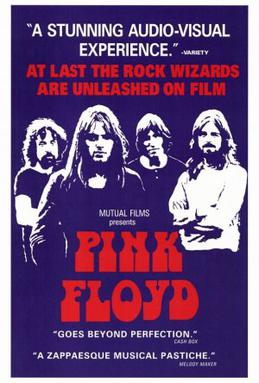
Concert Film Review: Pink Floyd: Live At Pompeii (dir by Adrian Melben)


The summer after I graduated high school, I took a trip to Italy.

I absolutely loved it.  There’s nothing more wonderful than being 18 and irresponsible in one of the most beautiful and romantic countries in Europe.  I also loved it because everywhere I looked in Italy, I saw the remains of history.  When I was in Rome, I visited the Colosseum.  When I was in Southern Italy, I visited Comune di Melissa, the village where some of my ancestors once lived.  When I visited Florence, I became so overwhelmed by the beauty of it all that I nearly fainted.

And then there was Pompeii.  I spent a day visiting the ruins of Pompeii and it was an amazing experience.  The eruption of Mt. Vesuvius in 79 AD may have been horrific for the Romans but it’s also gave history nerds like me a chance to step right into the past.  Beyond just the thrill of seeing how the world once was, I have two main memories of Pompeii:

First, there was the visit to Pompeii’s brothel.  An Australian tourist lay down on one of the stone slabs so that his family could take pictures of him.

Secondly, there was the fact that I wore a really pretty red dress for my visit but I failed to take into account that 1) the area around Pompeii is very hilly and 2) it was a very windy day.  So, I can say that I’ve not only visited but I’ve flashed Pompeii as well.

My love for Italy and my memories of Pompeii are the two main reasons why I watched the 1972’s Pink Floyd: Live at Pompeii.  It certainly wasn’t due to any great love for Pink Floyd, a band for which I have mixed feelings.  On the one hand, I can’t deny their talent and I do like quite a few of their songs, if they do all tend to be a bit on the portentous side.  On the other hand …. Roger Waters!  Bleh, Roger Waters.  Waters was one of the founders of Pink Floyd and, for a while, the band’s de facto leader.  He’s also a rabid anti-Semite and a defender of Vladimir Putin’s.  That said, I’ve discovered that I can justify listening to Pink Floyd by remembering that the rest of the band hates Roger Waters as well and that Waters himself eventually left Pink Floyd.  Waters’s bandmate, David Gilmour, has flat-out called Roger Waters an anti-Semite.  Of course, as I watched Pink Floyd: Live at Pompeii, I realized that I wasn’t sure which one was Waters and which one was Gilmour.

I should note that there are multiple versions of this documentary.  The version that I watched was the original, which has a 64-minute running time and features the band performing at the ancient Roman amphitheater in Pompeii.  This version was released in 1972.  In 1974, it was re-released with additional footage of the band working on Dark Side of the Moon.  This version also featured interviews with the members of the band.  Presumably, if I had watched the ’74 version, I would know who was Waters and who was Gilmour.

But I watched the 1972 version, where the emphasis is on the band performing their music while shots of Pompeii flash on the screen.  Other than the film crew, there is no audience watching the band perform.  (I guess that one could claim that this documentary was an early music video.)  There’s no interviews with the band and the members are so focused on their music that none of them really get much chance to show off much personality.  The 1972 version, without any interviews, is a “These guys sure can play!” documentary.  For the most part, it’s an entertaining film to watch.  Pink Floyd’s music, which can be both silly and thrilling at the same time, has just the right otherworldly feel for Pompeii.  Though they were oddly anonymous in the way that many big bands from the 70s were, the members of the band were definitely talented and their music sounded like something one would hear minutes before getting swallowed up in a flood of molten lava.

In the end, the important thing is that Pink Floyd sounded good.  And, as always, Pompeii was beautiful.

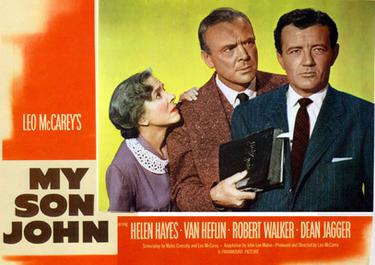
A Loyalty Day Film Review: My Son John (dir by Leo McCarey)


Oh my God, did you know that it’s Loyalty Day!?

Well, actually, it’s not Loyalty Day for everyone.  In fact, a lot of the world’s citizens are celebrating Communist May Day today.  However, here in the United States, it’s Loyalty Day.  Even if you are an American, it’s possible that you’ve never heard of Loyalty Day.  It was first celebrated in 1921 and it was intended to provide a non-Communist alternative to International Workers Day.  It wasn’t until 1955 that Loyalty Day was officially recognized by Congress.

From Wikipedia:

Loyalty Day is defined as follows in 36 U.S.C. § 115:

  • (a) Designation.— May 1 is Loyalty Day.
  • (b) Purpose.— Loyalty Day is a special day for the reaffirmation of loyalty to the United States and for the recognition of the heritage of American freedom.
  • (c) Proclamation.— The President is requested to issue a proclamation—
    • (1) calling on United States Government officials to display the flag of the United States on all Government buildings on Loyalty Day; and
    • (2) inviting the people of the United States to observe Loyalty Day with appropriate ceremonies in schools and other suitable places.

Though released before it officially became a holiday, the 1952 film, My Son John, is perfect for Loyalty Day.

The John of the title is John Jefferson (Robert Walker, in his final role), an employee of the State Department.  While his younger brothers (played by Richard Jaeckel and James Young) are two high school football stars who are looking forward to serving their country in Korea, John is an intellectual who considers concepts like patriotism to be simplistic and naive.  While his father (Dean Jagger) sings patriotic songs at the American Legion hall, John rolls his eyes at such middle class activities.  (“If you don’t like your Uncle Sammy,” move to another country, John’s father sings.)  The only person to whom John is especially close is his nervous mother, Lucille (Helen Hayes).

However, John is keeping a secret from even Lucille.  He’s a double agent, working for the communists!  With FBI agent Stedman (Van Heflin) hot on his trail, will John ever be able to see the light about the communists?  And, how will the communists respond to John having doubts about the cause?

My Son John was a dream project for Hollywood director Leo McCarey.  (It’s not a coincidence that the devoutly Catholic McCarey made a film about a devoutly Catholic family who discovers that one of their own has become a communist.)  McCarey carefully supervised every detail of the film and he was even able to talk stage legend Helen Hayes into starring in the film, her first in 14 years.  My Son John is full of scenes of shadowy communists, smug intellectuals, and all-American FBI agents marveling at the strength of Lucille Jefferson’s faith.  Everything that is today often cited as a negative aspect to living in the suburbs is presented as being a positive in My Son John.  The film’s communists come into a world of happy families, big houses, and well-manicured lawns and they set out to make everyone else as miserable as they are.  There’s nothing subtle about either McCarey’s approach or Helen Hayes’s performance but, as is often the case with propaganda, the film is crudely effective.

My Son John was Robert Walker’s final film.  In fact, he died before completing work on the film, leading the ending being rewritten.  (No longer would John personally deliver a commencement address.  Instead, his words come out of a tape player that has been rolled out on stage.  A holy light shines down on the player while The Battle Hymn of the Republic plays in the background.  It’s bizarre but it’s also probably the most memorable part of the movie.)  Scenes from Strangers On A Train were rather awkwardly spliced into final moments of My Son John, never mind the fact that Robert Walker’s gleefully evil performance as Bruno Antony had little in common with his self-tortured performance as John Jefferson.

Surprisingly, considering that My Son John was released at the height of the anti-Communist era, the film was not a success at the box office.  (Audiences seemed to better appreciate low-budget and pulpier anti-communist films, like I Was A Communist For The FBI.)  Still, thanks to the Internet, My Son John is still available to be viewed on this Loyalty Day.

So, remember — if you don’t like your Uncle Sammy …. well, actually, the cool thing about this country is that you don’t have to like your Uncle Sammy.  You have the right to decide for yourself how you feel about old Uncle Sammy.  That’s an idea that is worth being loyal to.

Celebrate May Day With The Pulps


Today is May Day, which is known in some countries as International Workers Day.

For those who celebrate, here are ten pulp covers that celebrate unique jobs and the people who do them.

by George Gross

by Jack Faragasso

by Julian Block

by Paul Stahr

by Robert Bonfils

by Robert Bonfils

by Robert McGinnis

by Rudolph Belarski

Artist Unknown

Artist Unknown