This is from 1957. Don’t try this at home.
This is from 1957. Don’t try this at home.
All things considered, this seems like the right video for the day before the Oscars.
Enjoy!
On this date, 68 years ago, Frank Sinatra won his only Oscar when Mercedes McCambridge announced that he had won Best Supporting Actor for his role in From Here To Eternity. This is the role that some claimed the mob got for him, though the truth was that he was given the role after his-then wife, Ava Gardner, made an appeal to studio head, Harry Cohn. At that time, Gardner was actually a bigger star than Sinatra, whose career was considered to be in decline.
Sinatra in decline? The Academy disagreed! And so did the audiences who would make Sinatra a star for many decades to come.
Previous Moments In Television History:
This is from the 4th issue of 1994’s Marvels, in which Kurt Busiek reimagined the early history of the Marvel Universe through the eyes of photographer, Phil Sheldon. The artwork is by the amazing Alex Ross.
On this page, Spider-Man is climbing up the Daily Bugle. That’s something that happened frequently in Spider-Man’s own comics but Marvels was the first comic to capture what it would be like for the ordinary people inside the building to suddenly look over and see Spider-Man, complete with a wrinkled suit, climbing up the outside windows. Long before any of the movies were released or the PS4 game meticulously recreated New York, this page from Marvels made Spider-Man seem real.
Previous Great Moments In Comic Book History:
 After taking a month off from playing the Locked Door games, I got back to them this week by playing Locked Door VII: Out of Line.
Again, you start out in the most boring room you’ve ever seen. Bob is standing around and being useless. Rex is your faithful companion. Explore the area and, once again, you’ll find the shed and the stairs and the crate and all of the things that have been present in every Locked Door game. You’ll also find a few new rooms and a some new puzzles to solve. It may be because I was rusty after not playing the game for a month but I found the new puzzles to be challenging. Some of that is because the game still occasionally suffers from the “Guess the Verb” syndrome but, at the same time, some of the puzzles actually are clever and require some thought. The game is fun but it just needs a little bit of polish.
After I played the latest version, I glanced over the other Locked Door games. As of right now, there’s a total of 11 episodes, each with its own tag line. The tag line of Locked Door XI: The U.S. Theatrical Cut is “Can You Beta Test This Thing?” That does intrigue me. Could the game’s rough edges and guess the verb moments be intentional? From the start, Locked Door has satirized the needlessly complicated locked door puzzles that seem to show up in almost every work of Interactive Fiction. Could all of the Locked Door games be a part of an elaborate practical joke?
Maybe I’ll learn more when I played the eighth installment next week next week.
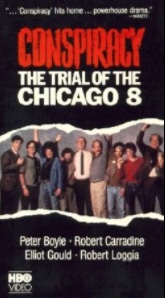 The year is 1969 and, in an Illinois courtroom, 8 political radicals stand accused of conspiring to disrupt the 1968 Democratic Convention. The prosecution is putting the entire anti-war movement on trial while the defendants are determined to disrupt the system, even if it means being convicted. The eight defendants come from all different sides of the anti-war movement. Jerry Rubin (Barry Miller) and Abbie Hoffman (Michael Lembeck) represent the intentionally absurd Yippies. Tom Hayden (Brian Benben) and Rennie Davis (Robert Carradine) are associated with the Students for a Democratic Society. Bobby Seale (Carl Lumbly) is one of the founders of the Black Panthers while David Dellinger (Peter Boyle) is a longtime peace activist. John Friones (David Kagan) and Lee Weiner (Robert Fieldsteel) represent the common activists, the people who traveled to Chicago to protest despite not being a leader of any of the various organizations. Prosecuting the Chicago 8 are Richard Schulz (David Clennon) and Tom Foran (Harris Yulin). Defending the 8 are two radical lawyers, Leonard Wienglass (Elliott Gould) and William Kunstler (Robert Loggia). Presiding over the trial is the fearsome and clearly biased Judge Julius Hoffman (David Opatoshu).
Conspiracy: The Trial of the Chicago 8 is a dramatization of the same story that inspired Aaron Sorkin’s The Trial of the Chicago 7 but, of the two films, it’s Jeremy Kagan’s The Trial of the Chicago 8 that provides a more valuable history lesson. By setting all of the action in the courtroom and recreating only what was said during the trial, director Jeremy Kagan and his cast avoid the contrived drama that marred so much of Sorkin’s film. Kagan trusts that the true story is interesting enough to stand on its own. Kagan includes documentary footage from the convention protest itself and also interviews with the people who were actually there. While Kagan may not have had the budget that Sorkin did, his film has the authenticity that Sorkin’s lacked. Kagan also has the better cast, with Michael Lembeck and Barry Miller both making Abbie Hoffman and Jerry Rubin into something more than the mere caricatures that they are often portrayed as being.
The Trial of the Chicago 8 was a film that Jeremy Kagan spent a decade trying to make. When he first tried to sell the idea behind the film to CBS in 1976, Kagan had Marlon Brando, Walter Matthau, George C. Scott, and Dustin Hoffman all willing to work for scale and take part in the production. CBS still passed on the project, saying that no one was interested in reliving the 60s. It wasn’t until 1987 that Jeremy Kagan was finally able to revive the film, this time with HBO. It actually worked out for the best because, with HBO, there was no need to try to come up with a “clean” version for the language that was used in the courtroom or in the interviews with the actual participants. The defendants could be themselves.
Though it has been overshadowed by Sorkin’s subsequent film, The Trial of the Chicago 8 is the definitive film about what happened in the aftermath of the the 1968 Democratic Convention.
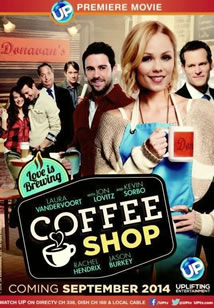
Donavan (Laura Vandervoort) owns a coffee shop in a small town. Everyone loves her shop but she’s not making any money because she’s not a good manager and she lets her staff and her customers walk all over her. When Ben (Cory M. Grant) comes in the shop and tries to order tea, Donavan thinks that he’s the businessman who wants to buy her shop and turn it into a parking garage. She yells at him but then it turns out that he’s a playwright from New York who is just on vacation after his latest flop. Donavan and Ben fall in love but then the real businessman shows up and it looks like Donavan might lose her business. And then, on top of everything else, Donavan discovers that Ben is writing a play about her situation so she breaks up with him and tells him that he’s not welcome in her shop, even if he has the perfect plan to save it. Who thinks like that!? He’s so inspired by her and how much everyone in town loves her that he wants to immortalize her on stage. How is that a bad thing?
Even though this wasn’t made for Hallmark, it basically is a Hallmark film. There’s no profanity. There’s no sex. I don’t know why it was even rated PG. I liked the small town and the coffee shop looked like it would be a nice place to hang out. The story was too predictable and a lot of Donavan’s financial problem were due to her just being really bad at her job so I had a hard time feeling sorry for her. She should have let someone else run the coffee shop if she was that incompetent.
On a personal note: I’d like to own a coffee shop but I would want it to be located near a baseball stadium. Coffee and baseball is a combo I can get behind.
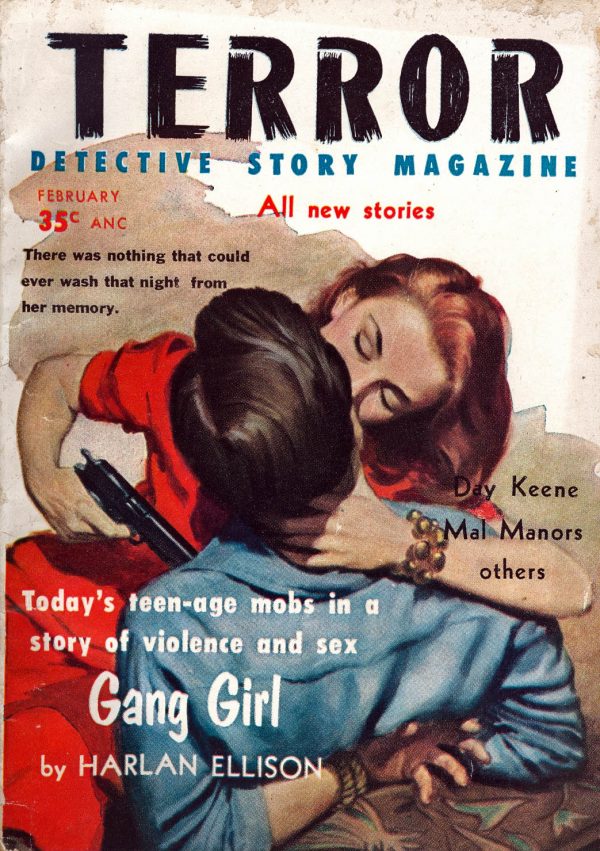
The veteran illustrator Shannon Stirnweis passed away in 2019, at the age of 87. The following is taken from the obituary, which originally appeared in the Monadnock Ledger-Transcript on Jan. 23, 2019:
Serving in the Army in 1954, he was stationed in Germany where he illustrated for the Army. Working as an Illustrator in NYC, he was President of the Society of Illustrators and one of the founding fathers of the Graphic Artists Guild. Shannon illustrated over 35 children’s books as well as 3 books for Grumbacher Library, “The Art of Painting Dogs”, “The Art of Painting Cats”, and “The Art of Painting the Wild West”. He recently published a book on his life as a painter, “80 Years Behind the Brush”. He wanted to be remembered most for painting scenes of the American West.
Below is a small sampling of some of his work for the pulps:


The 1965 film, Doctor Zhivago, is not only notable as one of the many David Lean-directed films to be nominated for Best Picture. It’s also remembered as being one of two Best Picture nominees to feature, albeit in a small role, the madman of European cinema, Klaus Kinski.
In this scene, set in the aftermath of Russia’s communist revolution, Kinski explains why he, despite being a prisoner, is the only free man on the train. Due to his German accent, Kinski was dubbed by actor Robert Rietty and he doesn’t have much screen time but he still manages to steal the movie.
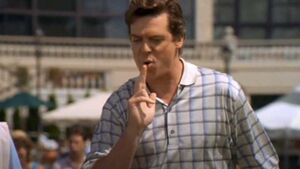
Poor Shooter McGavin! As played by the great Christopher McDonald, Shooter McGavin is the often unacknowledged hero of the 1996 comedy classic, Happy Gilmore.
I know, I know. Most people will tell you that Shooter is actually the bad guy. He’s the snooty pro golfer who tries to keep aspiring hockey player-turned-golfer Happy Gilmore (Adam Sandler) from competing on the PGA tour. And it is true that he does allow himself to get consumed with jealousy over Happy’s popularity. And he does definitely cross the line when he buys and holds hostage the house where Happy’s grandmother has spent almost her entire life. (“She’s so old! Look at her! She’d old!” Happy exclaims at one point.) But try to look at it from Shooter’s point of view.
Shooter has spent years playing golf. He’s practiced. He’s paid his dues. He’s done what he had to do to earn his spot as America’s best golfer. And now, he finally has a chance to win his first championship. And what happens? A very loud hockey player shows up from out-of-nowhere and totally changes the sport. What really has to be galling is that Happy’s not even a good player. He can’t putt. He has no strategy. His only skill is the distance that he can hit the ball. And yet, despite all that, Happy becomes a media superstar. The only people willing to stand up to Happy and defend the honor of the game are Bob Barker and …. Shooter McGavin.
Really, Shooter doesn’t really start to go after Happy until Happy’s fans starts to purposefully antagonize him. Remember Happy’s ex-boss showing up to heckle Shooter even though he still had that nail in his head? Seriously that’s not right. I mean, who shows up to support the dude who put a nail in your head? Shooter McGavin had every reason to be concerned about that.
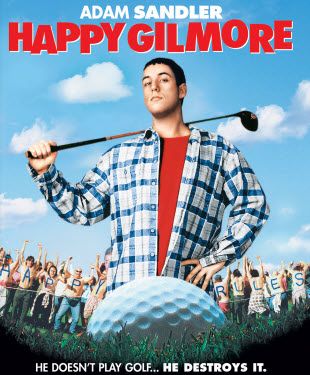
Despite the fact that Shooter was treated rather unfairly, Happy Gilmore is definitely a favorite of mine. I pretty much love the entire film, from Carl Weathers’s enjoyably demented performance as Happy’s mentor to the famous scene of Bob Barker beating Happy to a pulp. For those who only know Adam Sandler from his later, lazier comedies, Happy Gilmore will be a bit of a revelation because Sandler and the entire cast actually seem to be making an effort to make a good and funny comedy. The staid world of golf turns out to be the perfect foil for Sandler’s manchild antics. And for those who prefer Sandler when he’s playing serious roles, he actually does a pretty good job in Happy Gilmore’s few sincere moments. His scenes with his grandmother are actually rather sweet.
Happy Gilmore remains Sandler’s best comedy and it’s a personal favorite of mine. Every time I watch it, I laugh and that’s a good thing. I also like to think that Shooter and Happy eventually set aside their differences and got their own talk show on ESPN. They deserved it.
Previous Guilty Pleasures
 Through the Shattered Lens