Here’s hoping this month finds you with joy, family, friends, fiends, ghouls, and ghosts!
Today is also the start of the Shattered Les’s annual horrorthon! Sit back, enjoy the reviews, the art, and the music videos, and have a great month of ghoulish fun!
Bad Girl takes place in rural Australia. A family has just bought a new home. Peter (Ben Wispear) and Michelle (Felicity Price) are minor celebs, the type whose houses are often featured in magazines. They have a 17 year-old, adopted daughter named Amy (Sara West). When the film begins, Amy is the bad girl of the title. She has a bad attitude, she dressed in all black, she considers smoking crack as soon as they arrive at the news house, and she’s continually told that she’s being given “one more chance.” Amy takes one look around the house and decides that she doesn’t want that chance. Soon, she’s trying to run away.
Fortunately, it appears that Amy has made a new friend! Chloe (Samara Weaving) says that she lives next door. Chloe appears to be everything that Amy isn’t. Chloe is polite. She’s respectful. She doesn’t smoke crack cocaine. She doesn’t try to run away. She doesn’t regularly threaten to commit suicide. I mean, is she even a teenager!? At first, Peter and Michelle are happy that Chloe is Amy’s friend. Chloe might just be the good influence that Amy needs. But — wait a minute! What if …. what if Chloe is the bad girl!?
Well, you can probably already guess the answer to that one. Here’s one thing that I’ve learned from both the movies and real life: anyone who appears to be perfect is secretly screwed up. Chloe appears to be such an idealized friend that she might as well have psycho written across her forehead. In other words, it’s no spoiler to tell you that Chloe has an agenda of her own and soon, Amy is going to be faced with the unenviable task of trying to convince her parents that the perfect girl is actually the bad girl.
There’s a lot about Bad Girl that’s predictable and the parents aren’t particularly sympathetic. Even though Amy has, admittedly, given them reason to be concerned, they’re still way too quick to side against her as far as I’m concerned. It’s totally possible that may have been intentional on the part of the filmmakers but it still makes it difficult to really care about what happens to Peter and Michelle.
That said, Bad Girl does work when it just focuses on the relationship between Amy and Chloe. They have an interesting dynamic. Chloe wants to live what she believes Amy’s life to be while Amy secretly wants to be the person who she initially believes Chloe to be. However, neither Amy nor Chloe are really who everyone assumes that they are. Trapped out in the middle of nowhere, Amy and Chloe have both built up fantasies about what life is like out in the rest of the world. The only difference is that Amy, for all of her problems, can tell the difference between reality and fantasy while Chloe is so determined to live the fantasy that she’s willing to destroy reality. Sara West and Samara Weaving both do a great job of bringing Amy and Chloe to life. In fact, they do such a good job acting opposite each other that you kind of regret that their friendship is going to have to end. You find yourself wishing that all of their fantasies could have come true.
Bad Girl has its flaws but it worth watching for the performances of West and Weaving.
I took this picture a few years ago, on a foggy October morning. Usually, this is a normal-looking neighborhood but, on that morning, it looked creepy so I had to get out there with my camera and get some pictures of it all. We had many mornings like this that October. We’ll probably have even more this October.
What’s an Insomnia File? You know how some times you just can’t get any sleep and, at about three in the morning, you’ll find yourself watching whatever you can find on cable or Netflix? This feature is all about those insomnia-inspired discoveries!
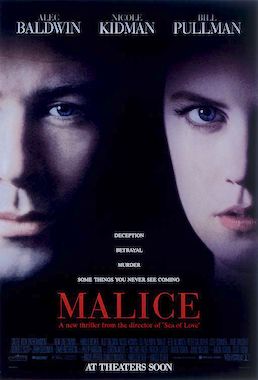
If you were having trouble getting to sleep last night around 12 midnight, you could have turned over to the Cinemax and watched the 1993 thriller, Malice. And then you could have spent the next few hours trying to figure out what you just watched.
Seriously, there’s a lot going on in Malice. The screenplay is credited to Aaron Sorkin and Scott Frank and while it has enough overly arch dialogue and untrustworthy women to plainly identify it as being a product of Sorkin’s imagination, it’s also filled with a mini-series worth of incidents and subplots and random characters. This is also one of those films where no one can simply answer a question with a “yes” or a “no.” Instead, it’s one of those movies where everyone gets a monologue, giving the proceedings a rather theatrical feel. It’s the type of thing that David Mamet could have pulled off. (Check out The Spanish Prisoner for proof.) Harold Becker, however, was a far more conventionally-minded director and he often seems to be at a loss with what to do with all of the film’s Sorkinisms (and, to be fair, Frankisms as well).
The film starts out as a thriller, with a serial rapist stalking a college campus and Prof. Andy Safian (Bill Pullman) becoming an unlikely suspect. Then it turns into a domestic drama as Andy and his wife, Tracy (Nicole Kidman), talk about starting a family. Then Andy meets a brilliant surgeon named Jed Hill (Alec Baldwin) and the film turns into a roommate from Hell story after Jed moves in with them. Then it becomes a medical drama after a mistake by Dr. Hill leaves Tracy unable to have children. Then it returns briefly to the campus rapist story before then turning into a modern-day noir as Andy discovers that Tracy has secrets of her own. (Whenever one watches a film written by Aaron Sorkin, you can practically hear him whispering, “Women are not to be trusted….” in the background.) Even as you try to keep up with the plot, you find yourself distracted by all of the cameos. George C. Scott glowers as Jed’s mentor. Anne Bancroft acts the Hell out of her role as a drunken con artist. Peter Gallagher is the lawyer you distrust because he’s Peter Gallagher. Tobin Bell shows up as a handyman. Gwynneth Paltrow, in one of her first roles, plays dead convincingly
It’s a big and busy and messy film and it too often mistakes being complicated for being clever. Bill Pullman is a likable hero but you have to be willing to overlook that the script requires him to do some truly stupid things. Nicole Kidman is always well-cast as a femme fatale but again, the script often lets her down.
Surprisingly enough, it’s Alec Baldwin who comes out of the film unscathed. Watching Baldwin in this film, it’s hard to believe that he’s the same actor who has since become something of a bloated self-parody. Yes, he’s playing an arrogant character (which is pretty much his trademark) but, in Malice, he actually brings a hint of subtlety and wit to his performance. Baldwin does very little bellowing in the film, despite playing a role that one would think would naturally appeal to all of his bellowing instincts. Malice is a mess but it’s nice to see the type of actor that Alec Baldwin once was.
On August 1st, 1981, MTV premiered. Over the course of 24 hours, 166 unique music videos were played on MTV. Yes, there was a time when the M actually did stand for music.
The 67th video to make its MTV premiere on August 1st was one of the videos that Kate Bush did for Wuthering Heights. There’s actually two videos for this song, each featuring similar choreography. One version features Kate dressed in a white dress and dancing in a mist-filled room. The other version features Kate in a red dress and dancing in a grassy area. In both videos, the suggestion is that Kate Bush is playing a ghost, which makes either version of Wuthering Heights a good video to start October with.
Both videos have their fans and I’m not sure which one was first played on MTV. But I’m going to go with the video of Kate dressed in white because it was the first of the two videos to be released and it was specifically made for the UK. Produced three years before the premiere of MTV, this video is considered to be one of the most influential ever made and it helped to show that music videos could be more than just simple performance clips.


 Through the Shattered Lens