A Midnight Clear (1992, directed by Keith Gordon)


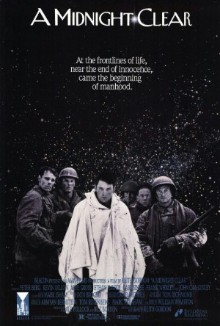
In December of 1944, with the world at war and Christmas approaching, a small U.S. Army Intelligence squad is sent to a deserted chateau near the German lines.  The squad, which was decimated during the Battle of the Bulge, is made up of six young soldiers who all have genius IQs.  They’ve been hardened by war but they’re still young enough to have some hope for the future.  Leading them is “Mother” Wilkinson (Gary Sinise), an officer who cares about his men but who has been mentally struggling with not only the war but also with the recent death of a child back home.

At first, the chateau seems like a perfect sanctuary, a place to wait for the war to end.  But then the Americans discover that there is a regiment of German soldiers nearby.  The Germans are just as young as the Americans and when the two groups meet each other, they don’t fire their guns but instead have a snowball fight.  The Germans say that they know the war is about to end and that they want to surrender before the Russians arrive.  However, the Germans are worried about their families back home and what will happen when word gets back that they’ve surrendered.  They request a staged fight so that it will appear that they were captured in combat.  Almost everyone is down with the plan but it turns out that it’s not easy to fake a war in the middle of a real one.

Based on a novel by William Wharton, A Midnight Clear is one of the best Christmas films that hardly anyone seems to have heard of.  It’s a war film that is more concerned with the men who fight the wars than with the battles. Along with Sinise, the ensemble cast includes Ethan Hawke, Peter Berg, Kevin Dillon, Ayre Gross, Frank Whaley, and John C. McGinley and all of them make an impression, bringing their characters to life.  By the end of the movie, you feel like you know each member of the squad and their individual fates hit you hard.  Some of them make it to the next Christmas and tragically, some of them don’t.  The film starts out almost gently and all of the soldiers are so intent on just letting the war end while they hide out at the chateau that you find yourself believing that it could actually happen.  When reality intrudes, it’s tragic and poignant.  Intelligently directed by Keith Gordon (making his directorial debut), A Midnight Clear is an unforgettable anti-war story that has an amazing final shot.  A Midnight Clear makes an impression on Christmas and every other day.
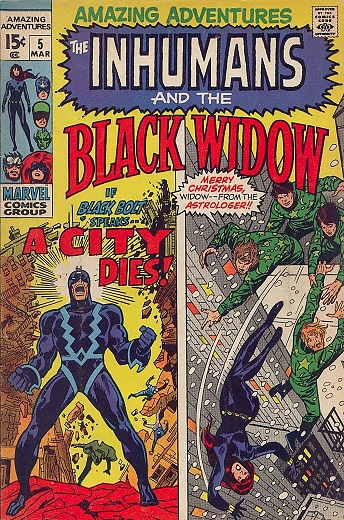
Great Moments In Comic Book History: “….And To All A Good Night”


In 1970, Marvel finally gave Black Widow her own solo series.

Of course, she had to share the spotlight with The Inhumans.  When Marvel revived their anthology series, Amazing Adventures, each issue featured two stories.  The Inhumans starred in the first story while the second story would feature Natasha Romanoff (a.k.a., The Black Widow) and her assistant, Ivan.  While The Inhumans dealt with cosmic concerns and royal intrigue, Natasha and Ivan would battle more down-to-Earth criminals.  It was not a perfect combination as the Inhumans had little to do with the Black Widow and vice versa.  But, for 8 issues, they made it work.

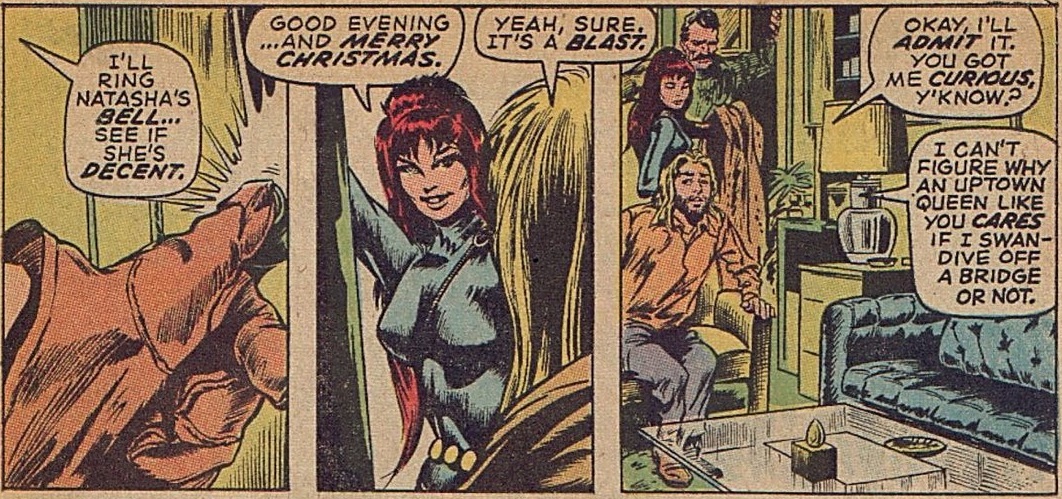
The 5th issue of Amazing Adventures was a Christmas issue and it featured a story that was dark even by the standards of Marvel in 1970.  Ivan comes across a teenage boy who is about to jump off a bridge.  Ivan grabs him and takes him to the Black Widow’s luxury apartment, located at the top of Manhattan’s Mammon Towers.  “You mean that jet set chick who cooled the Young Warriors’s scene a while back?” the teenager says, showing that he knows all of the hip lingo.

When Ivan and the teenager arrive at the apartment, the Black Widow has just stepped out of the shower.  (Every issue of Amazing Adventures featured at least one scene of the Black Widow either showering or getting dressed.)  The Black Widow wishes Ivan and the still nameless teenager a Merry Christmas but the teenager isn’t impressed.

The teenager explains that he’s from Utah.  He came to New York with “a dime in my pocket, sawdust in my skull” and eventually, he ended up crashing at the pad of a cult leader called The Astrologer.  Using the stars as his guide, the Astrologer sent his cult out to commit crimes.  At first, the teenager was cool with all of the the petty theft but when the Astrologer suggested robbing a blood bank and holding all of New York’s O-type blood hostage, that was a bridge too far.

As the teenager finishes his story, the members of the cult show up.  Out on the balcony of her apartment, Natasha fights several of them off before a cult member named Willie gets in a lucky punch and knocks her down.  The teenager shouts that he won’t allow the Black Widow to die because of his mistakes and he jumps at Willie.  Both of them fall off the balcony and plummet several stories to their death.

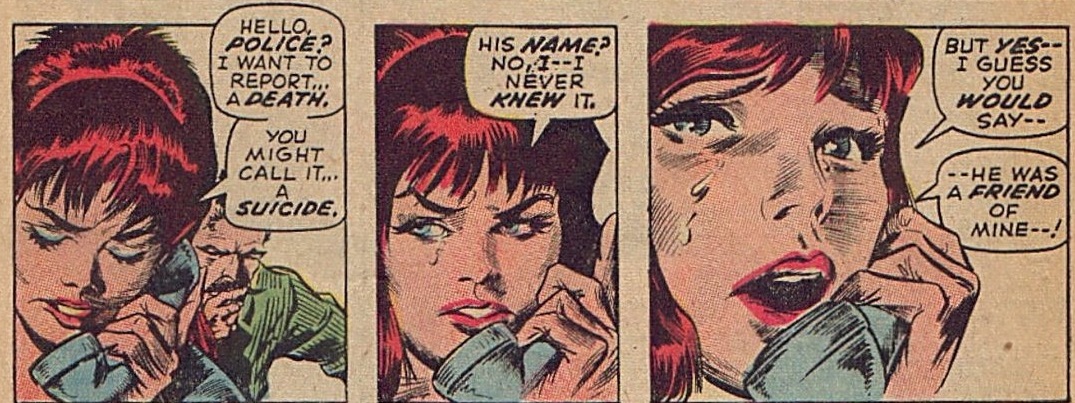
With tears in her eyes, Natasha calls the police to report a death.  No, she and Ivan never learned the teenager’s name. “But yes,” Natasha says, “I guess you would say — he was a friend of mine!”

Merry Christmas, right?

Three issues later, Black Widow would get her revenge on the Astrologer and the villain was never seen again.  She never did learn the teenager’s name but his brief appearance was one of the key moments in her brief run in Amazing Adventures.  His sacrifice not only established that the Black Widow lived in a dangerous world where even Christmas could end with a sudden death but it also epitomized the concepts of sacrifice and redemption.  He may have been a runaway and a petty criminal with “sawdust in my skull” but could still save the life of a hero.

Amazing Adventures (Vol. 2 #5, March, 1970)

“…And To All A Good Night”

  • Writer — Roy Thomas
  • Artist — Gene Colan
  • Inker– Bill Everett
  • Letterer — Artie Simek

Previous Great Moments In Comic Book History:

  1. Winchester Before Winchester: Swamp Thing Vol. 2 #45 “Ghost Dance” 
  2. The Avengers Appear on David Letterman
  3. Crisis on Campus
  4. “Even in Death”
  5. The Debut of Man-Wolf in Amazing Spider-Man
  6. Spider-Man Meets The Monster Maker
  7. Conan The Barbarian Visits Times Square
  8. Dracula Joins The Marvel Universe
  9. The Death of Dr. Druid

Great Moments In Television History: Bing Crosby and David Bowie Share a Duet


In 1977’s Bing Crosby’s Merrie Olde Christmas, Bing and his family travel to the UK to visit Bing’s long-lost relative, Sir Perceval Crosby.  It’s while staying at the Crosby estate that Bing celebrates Christmas and discovers that Sir Percy lives next door to David Bowie!

You might not expect Bing Crosby and David Bowie to have much in common as far as musical tastes are concerned but that’s where you’re wrong.  After discussing their parenting techniques and their favorite songs, Crosby and Bowie share a duet that has become a classic.

From Bing Crosby’s Merrie Olde Christmas (which aired on ITV 33 years ago today), here are David Bowie and Bing Crosby performing Little Drummer Boy/Peace on Earth.

Previous Great Moments In Television History:

  1. Planet of the Apes The TV Series
  2. Lonely Water
  3. Ghostwatch Traumatizes The UK
  4. Frasier Meets The Candidate
  5. The Autons Terrify The UK
  6. Freedom’s Last Stand

Scene That I Love: Linus’s Speech in A Charlie Brown Christmas


Merry Christmas!

I know that a lot of people missed A Charlie Brown Christmas this year.  When all of the Peanuts holiday specials were bought by Apple TV+, it looked they would never air on free television again.  Luckily, people got mad enough that Apple made a deal with PBS to resume airing the specials.  But how many of you knew that before you just read it?  Hopefully, everyone involved will do a better job of getting the word out next year.

For those of you who missed it this year, here’s the most famous scene from A Charlie Brown Christmas.  When A Charlie Brown Christmas was first aired in 1965, Charles Schulz had to fight to keep CBS from removing the scene in which Linus explains the true meaning of Christmas.  It has gone on to become one of the most popular moments in the special.

For those who missed it, here it is:

An Unlikely Weapon: The Eddie Adams Story (2008, dir. by Susan Morgan)


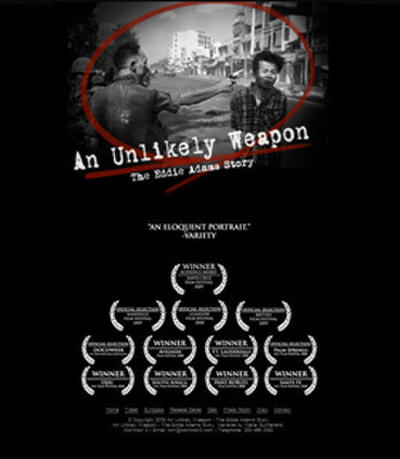
In 1968, Eddie Adams took a picture that would change history.

Adams was 34 years old and working as a photographer for the Associated Press.  He was covering the war in Viet Nam.  On February 1st, Adams saw a Viet Cong prisoner being led through the streets of Saigon.  Adams was among the many who followed, taking pictures.  Adams wasn’t expecting to capture anything unusual.  He thought it was just another day in Saigon.  Instead, he captured a shot of Saigon police chief Nguyễn Ngọc Loan executing the prisoner in the street.  Adams just happened to catch the exact moment that Loan fired his gun into the man’s head.

After the picture appeared in newspapers around the world, it became a rallying cry for the anti-war movement and it has since always been included in every documentary made about the Vietnam Conflict.  The picture won Eddie Adams a Pulitzer Prize and it has been frequently cited as a picture that changed history.  But Eddie Adams was never happy with it.  Adams felt that it overshadowed every other picture that he took over the course of his long career and he also felt that it just wasn’t a very good picture.  He hated the way that the picture was used to demonize Loan and, years later, when there was an attempt to charge Loan with a war crime, Adams testified on Loan’s behalf.  Adams later wrote of the picture, “Two people died in that photograph: the recipient of the bullet and General Nguyen Ngoc Loan. The general killed the Viet Cong; I killed the general with my camera.”

An Unlikely Weapon is a documentary about Eddie Adams and his career.  It not only tells the story of the photograph but it also looks at Adams’s later work.  Adams went from war photography to fashion photography and even spent a while working for Penthouse (“Before it got raunchy”).  Years after taking that picture in Saigon, he took photographs of refugees and activists around the world.  The pictures were published in an acclaimed book called Speak Truth To Power.  Adams hated the title, which he said was forced on him by the publishers.  As the documentary shows, Adams was a perfectionist.  That’s why his pictures are so powerful but it’s also why he was never happy with any of them.  An Unlikely Weapon features several interviews with the late Adams and his colleagues and it’s inspirational to hear the story behind how they captured some of the most influential images in history.

Every photographer dreams of capturing the perfect picture.  An Unlikely Weapon tells the story of a photographer who did just that and never forgave himself for it.  It’s a documentary that should be required viewing for everyone who carries a camera.

Overcomer (2019, dir. by Alex Kendrick)


John Harrison (played by Alex Kendrick, who also directed the film and co-wrote the script) is a high school basketball coach whose entire season comes to a crashing halt when the local manufacturing plant moves to another city and most of his players move with it.  The high school is left with next to no athletes and John nearly loses his job until he finally agrees to coach cross country, even though John doesn’t consider it to be a sport.  When only one student shows up to try out for the cross country team, John ends up exclusively coaching Hannah (Aryn Wright-Thompson), who has asthma and a lot of heart.

John is also doing volunteer work at the local hospital.  That’s where he meets Thomas (Cameron Arnett), who used to be a championship runner before he got involved in drugs and who is now blind due to diabetes.  John eventually discovers that Thomas is actually Hannah’s father, who she was told had died.  With the help of John, Thomas, and Principal Brooks (Priscilla Shirer), Hannah tries to find the inner strength to overcome all obstacles and win the state championship.

I usually love inspiring movies but Overcomer just didn’t really work for me.  I think I would have liked it better if the movie had just focused on Hannah but instead, it was more about her coach and his family than it was about her.  Hannah should have been at the center of the story but instead, it was almost all about John and how upset he was was over having to coach her.  Even in the scenes with Thomas, it was more about how the coach felt than how Hannah felt about learning that her father was still alive.  Along with being a sports film, Overcomer is also a religious film and it gets pretty preachy.  In one scene, the principal teaches Hannah how to pray, which is something that I don’t think many public school official could get away with in real life.

I appreciated the message of Overcomer, about having faith and giving it your all, but the movie otherwise didn’t work for me.

Prepare For The Future With The Covers Of Science Fiction Quarterly


by Edmund Emshwiller

Science Fiction Quarterly began it’s initial run in 1940 and, with the world distracted by war in the present, it ceased publication in 1943.  However, once the war was over and people were once again looking to the future, Science Fiction Quarterly was revived in 1951 and ran until 1958.  Over the course of its run, it published many of the current and future “big names” in science fiction.  Isaac Asimon, Arthur C. Clarke, James Blish, and Donald Wolheim were among the writers whose work appeared in the pages of Science Fiction Quarterly.  When Science Fiction Quarterly ceased publication in 1958, it was the last of the science fiction pulp magazines.  When there were no more issues of Science Fiction Quarterly, it was the end of the era but, considering the future success of the magazine’s writers, it would also be the beginning of a new age.

With 2020 soon coming to a close, now seems like a good time to look to the future with the covers of Science Fiction Quarterly.

by A. Leslie Ross

by Alex Schomburg

by Allen Gustav Anderson

by Edmund Emshwiller

by Edmund Emswhiller

by Frank Kelly Freas

by Frank Kelly Freas

by Frank R. Paul

by Jack Binder

by Leo Morey

by Milton Luros

by Milton Luros

by Milton Luros

Scenes That I Love: The Phone Call From Sam Wainwright From It’s A Wonderful Life


Tonight, NBC will be airing It’s A Wonderful Life.

Watching It’s A Wonderful Life on Christmas Eve is a tradition for many people.  It definitely is for me and my family.  I’ve watched It’s A Wonderful Life so many times that I’ve practically got the entire movie memorized.  It’s not only my favorite Christmas movie but also one of my favorite movies of all time.

Everyone knows, of course, that It’s A Wonderful Life is a film about a man named George (played by Jimmy Stewart) who gets a chance to see what the world would be like without him.  What I think is often overlooked is that it’s also a powerful and poignant love story and that the scenes between George and Mary (Donna Reed) are some of the most intensely romantic ever filmed.

In the scene below, George and Mary get a phone call from Mary’s ex, Sam Wainwright.  Sam has a business opportunity but George has more on his mind than staying in Bedford Falls and making money.  This scene, which begins with Mary upset and George feeling lost, ends with one of the most powerful kisses of the 1940s.

This is a scene that I love from a movie that I love and I look forward to watching it tonight!

Guilty Pleasure No. 50: Maid in Manhattan (dir by Wayne Wang)


Whenever I see that the 2002 film, Maid in Manhattan, is going to be playing on HBO or Cinemax, I always think to myself, “I can’t understand why everyone hates on this film.  I mean, it’s not that bad.  It may be predictable and silly but it’s kind of sweet and Jennifer Lopez and Matthew McConaughey have a tame but sexy chemistry.”

Of course, then I watch the film and I discover that Maid in Manhattan is not the film where Jennifer Lopez and Matthew McConaughey fall in love.  That’s The Wedding Planner.  Instead, Maid in Manhattan is the one where Jennifer Lopez is a maid who works in a big fancy hotel and who is a single mother to a precocious child who is obsessed with Richard Nixon.  Maid in Manhattan is also the one where Jennifer Lopez falls in love with Ralph Fiennes.  Fiennes plays a candidate for the U.S. Senate.  Everyone is worried that he’ll never make it to Washington if people discover that his girlfriend is a maid.  I think his bigger problem is that he’s a Republican running for the U.S. Senate in New York.  (At least, I assume he’s a Republican because — as we learn from his conversations with Lopez’s son — he certainly seems to know a lot about and be rather sympathetic to Richard Nixon.)

I still like Maid in Manhattan, though perhaps not as sincerely as I like The Wedding Planner.  Some of that is because Maid in Manhattan takes place during the Christmas season and I love a good wintry romance.  Some of it is because this is probably the only mainstream film to feature people discussing the good points of Richard Nixon.  There’s the fact that Jennifer Lopez is always perfectly cast as someone determined to make something out of her life, regardless of whether or not the world supports her or not.  She’s always had the ability to make steely ambition sympathetic and that’s a good ability to have when you’re playing a maid who is determined to get promoted into management.

Finally, there’s the odd romantic pairing of Ralph Fiennes and Jennifer Lopez.  It’s one of those things that shouldn’t work and yet, strangely, it does.  Fiennes always brings a certain off-center, neurotic energy to his performances, which not only explains why he’s played so many villains but also why it’s strange to see him starring in a romantic comedy.  And yet, that odd energy is exactly what Maid in Manhattan needs.  It keeps the viewer on their toes and it makes the surprising discovery that Fiennes and Lopez have romantic chemistry all the more rewarding.

Don’t get me wrong, of course.  This is a deeply silly movie and there’s a lot of less than sparkling dialogue and the plot falls apart if you even start to think about it.  The entire story revolves around mistaken identity, with Fiennes not realizing that Jennifer Lopez is a maid and …. well, it’s all a bit unnecessarily complicated.  The film also takes Fiennes’s political aspirations a bit too seriously.  It’s not quite as bad the whole thing with Matt Damon running for the Senate in The Adjustment Bureau (“Due to his charming concession speech, he will someday be elected President,” — whatever, Beto) but it gets close.

But, still — I love romance and I love New York and the pairing of Jennifer Lopez and Ralph Fiennes in Maid in Manhattan is just too strange (and oddly effective) for me to resist.

Previous Guilty Pleasures

  1. Half-Baked
  2. Save The Last Dance
  3. Every Rose Has Its Thorns
  4. The Jeremy Kyle Show
  5. Invasion USA
  6. The Golden Child
  7. Final Destination 2
  8. Paparazzi
  9. The Principal
  10. The Substitute
  11. Terror In The Family
  12. Pandorum
  13. Lambada
  14. Fear
  15. Cocktail
  16. Keep Off The Grass
  17. Girls, Girls, Girls
  18. Class
  19. Tart
  20. King Kong vs. Godzilla
  21. Hawk the Slayer
  22. Battle Beyond the Stars
  23. Meridian
  24. Walk of Shame
  25. From Justin To Kelly
  26. Project Greenlight
  27. Sex Decoy: Love Stings
  28. Swimfan
  29. On the Line
  30. Wolfen
  31. Hail Caesar!
  32. It’s So Cold In The D
  33. In the Mix
  34. Healed By Grace
  35. Valley of the Dolls
  36. The Legend of Billie Jean
  37. Death Wish
  38. Shipping Wars
  39. Ghost Whisperer
  40. Parking Wars
  41. The Dead Are After Me
  42. Harper’s Island
  43. The Resurrection of Gavin Stone
  44. Paranormal State
  45. Utopia
  46. Bar Rescue
  47. The Powers of Matthew Star
  48. Spiker
  49. Heavenly Bodies

4 Shots From 4 Films: Special Michael Curtiz Edition


4 Shots From 4 Films is just what it says it is, 4 shots from 4 of our favorite films. As opposed to the reviews and recaps that we usually post, 4 Shots From 4 Films lets the visuals do the talking.

December 24th is not just Christmas Eve!  It’s also the anniversary of the birth of Michael Curtiz!  Michael Curtiz was born in Budapest in 1886 and, after getting his start making silent films in Hungary, he eventually came to the United States and became one of the most important directors of Hollywood’s Golden Age!  Curtiz mastered every genre and worked with every star and the end result was some of the greatest films ever made.

Today, we honor the legacy of Michael Curtiz with….

4 Shots From 4 Films

Mystery of the Wax Museum (1933; Dir by Michael Curtiz)

The Adventures of Robin Hood (1938, dir by Michael Curtiz)

Casablanca (1943, dir by Michael Curtiz)

King Creole (1958, directed by Michael Curtiz)