Film Review: Streets of Fire (dir by Walter Hill)


File this one under your mileage may vary…

Okay, so here’s the deal.  I know that this 1984 film has a strong cult following.  A few months ago, I was at the Alamo Drafthouse when they played the trailer and announced a one-night showing and the people sitting in front of me got so excited that it was kind of creepy.  I mean, I understand that there are people who absolutely love Streets of Fire but I just watched it and it didn’t really do much for me.

Now, that may not sound like a big deal because, obviously, not everyone is going to love the same movies as everyone else.  I love Black Swan but I have friends who absolutely hate it.  Arleigh and I still argue about Avatar.  Leonard and I still yell at each other about Aaron Sorkin.  Erin makes fun of me for watching The Bachelorette.  Jedadiah Leland doesn’t share my appreciation for Big Brother and the Trashfilm Guru and I may agree about Twin Peaks but we don’t necessarily agree about whether or not socialism is a good idea.  And that’s okay.  There’s nothing wrong with healthy and respectful disagreement!

But the thing is — Streets of Fire seems like the sort of film that I should love.

It’s a musical.  I love musicals!

It’s highly stylized!  I love stylish movies!

It’s from the 80s!  I love the 80s films!  (Well, most 80s films… if the opening credits are in pink neon, chances are I’ll end up liking the film…)

It takes place in a city where it never seems to stop raining.  Even though the neon-decorated sets give the location a futuristic feel, everyone in the city seems to have escaped from the 50s.  It’s the type of city where people drive vintage cars and you can tell that one guy is supposed to be a badass because he owns a convertible.  All of the bad guys ride motorcycles, wear leather jackets, and look like they should be appearing in a community theater production of Grease.

Singer Ellen Aim (Diane Lane) has been kidnapped by the Bombers, a biker gang led by Raven (Willem DaFoe).  Ellen’s manager and lover, Billy Fish (Rick Moranis), hires Tom Cody (Michael Pare) to rescue Ellen.  Little does Billy know that Cody and Ellen used to be lovers.  Cody is apparently a legendary figure in the city.  As soon as he drives into town, people starting talking about how “he’s back.”  The police see Cody and automatically tell him not to start any trouble.  Raven says that he’s not scared of Cody and everyone rolls their eyes!

It’s up to Cody to track Ellen down and rescue her from Raven and … well, that’s pretty much what he does.  I think that was part of the problem.  After all of the build-up, it’s all a bit anti-climatic.  It doesn’t take much effort for Cody to find Ellen.  After Cody escapes with Ellen, it doesn’t take Raven much effort to track down Cody.  It all leads to a fist fight but who cares?  As a viewer, you spend the entire film waiting for some sort of big scene or exciting action sequence and it never arrives.  The film was so busy being stylish that it forgot to actually come up with a compelling story.

I think it also would have helped if Tom Cody had been played by an actor who had a bit more charisma than Michael Pare.  Pare is too young and too stiff for the role.  It doesn’t help to have everyone talking about what a badass Tom Cody is when the actor playing him doesn’t seem to be quite sure what the movie’s about.  Also miscast is Diane Lane, who tries to be headstrong but just comes across as being petulant.  When Cody and Ellen get together, they all the chemistry of laundry drying on a clothesline.

On the positive side, Willem DaFoe is believably dangerous as Raven and Amy Madigan gets to play an ass-kicking mercenary named McCoy.  In fact, if McCoy had been the main character, Streets of Fire probably would have been a lot more interesting.

I guess Streets of Fire is just going to have to be one of those cult films that I just don’t get.

Cleaning Out The DVR: The Colossus of Rhodes (dir by Sergio Leone)


I recorded this 1961 Italian film off of TCM on June 14th!

From 280 BC to 226 BC, a 108 feet high statue of the sun-god Helios stood in the Greek city of Rhodes.  It was reportedly built to celebrate a major military victory and it overlooked the harbor, serving to both welcome friends and intimidate enemies.  No one’s quite sure what it actually looked like but we do know that it was considered, by its contemporaries, to be one of the Seven Wonders of the World.  No trip to Greece was complete without a stopover in Rhodes so that the curious could feast their eyes upon the Colossus.  Eventually, the statue was destroyed in an earthquake and it was never rebuilt.

The statue serves as the centerpiece for the aptly named 1961 film, The Colossus of Rhodes.  The film opens with its dedication and ends with the earthquake that toppled it.  (Of course, in the film, the earthquake occurs just a week or two after the dedication.)  The film imagines that the Colossus was not just a monument to a God.  No, instead, this film suggests that the Colossus was an elaborate torture chamber, one that could pour fire down on anyone trying to sail underneath it.  Inside the Colossus is an elaborate labyrinth of dungeons, where anyone who has displeased the king is punished.

And, indeed, quite a few people have displeased the king.  King Serse (Roberto Camardiel), it turns out, is a mad tyrant who spends all of his days eating grapes and having people executed in the coliseum.  (He’s like Nero but without the artistic temperament.)  Not only do the rebels want him dead but so does his evil second-in-command, Thar (Conrado San Martin).  With the people angry that they’ve been forced to build a giant statue for no reason other than their king’s vanity, it seems like a perfect time for a revolution!

Caught in the middle of it all is Darios (Rory Calhoun).  Darios is from Athens and the only reason he came to Rhodes was to visit his uncle and see the statue.  At first, Darios is more interested in trying to get laid than the revolution.  When that doesn’t quite work out, Darios tries to leave the island, just to discover that, thanks to the Colossus, escape is impossible.  When Darios is accused of being a supporter of the revolution, he has no choice but to take up arms against Serse, which is exactly what Thar wants him to do…

The plot’s is more than a little convoluted and Darios is never the most sympathetic of heroes but The Colossus of Rhodes is still an enjoyable example of the peplum genre.  Though the acting is frequently stiff, the film is visually impressive, with both the Colossus and ancient Rhodes brought to wonderfully decadent life.  The idea that the Colossus was actually just an elaborate torture chamber is handled well and the frequent battle scenes are well-choreographed.  (I was particularly impressed with a scene of Darios fighting off an army while also trying to maintain his balance on the Colossus’s arm.)  And, of course, the climatic earthquake is as grandly operatic as you would hope.  Say what you will about the Italian film industry, it always delivered what audiences wanted.

That said, the main reason that The Colossus of Rhodes is known today is because it was the Sergio Leone’s first directorial credit.  (It was, however, the second film that he actually directed.  Though uncredited, he previously replaced Mario Bonnard as the director of 1959’s The Last Days of Pompeii.)  While The Colossus of Rhodes was obviously very different from the spaghetti westerns for which Leone is best known, there are some thematic similarities between the film and Leone’s future work:

For instance, much like Clint Eastwood in the Dollars Trilogy, Charles Bronson in Once Upon A Time In The West, and the gangsters in Once Upon A Time In America, Darios starts out as an amoral hero.  When Darios does join the revolution, it’s reminiscent of James Coburn aiding Rod Steiger in Duck, You Sucker

The corrupt and greedy Serse has much in common with the crooked land barons and businessmen who lurked behind-the-scenes in Once Upon A Time In The West.

Even the torture chamber in the Colossus brought to mind the grisly torments that both Clint Eastwood and Eli Wallach had to endure in The Good, The Bad, and The Ugly.

(Unfortunately, unlike other Leone films, Ennio Morricone did not provide the score for The Colossus of Rhodes.  Instead, Angelo Francesco Lavagnino provided a rather standard “epic” orchestration.)

The Colossus of Rhodes may not be a great film but, as an early work of a great filmmaker, it’s definitely worth watching.


Music Video of the Day: Respect Yourself by Bruce Willis (1987, directed by ????)


Bruce Willis, R&B star?

It nearly happened!

Well, actually, it didn’t come close to happening but it wasn’t for lack of trying.  In 1987, when Willis was still best known for co-starring on Moonlighting, Motown records released The Return of Bruno, an album that featured Willis and a host of well-respected musicians performing 10 R&B classics.

The Return of Bruno is actually a concept album, with Willis taking on the role of Bruno Radolini, a legendary soul singer who influenced everyone from Elton John to The Bee Gees.  The Return of Bruno peaked at number 14 on the US Billboard 2000 chart and was later named the 4th worst album ever recorded by Q Magazine.  It has since become a collector’s item.  (My father owns a copy!)   Willis performed the songs in his own style, which means that despite the presence of Booker T. Jones, The Pointer Sisters, and The Temptations performing backing vocals, this is still the smirkiest R&B album of all time.  The best way to describe it would be to say that it sounds like John McClane performing karaoke.

There’s an idea!  Die Hard 6: Sing For Your Life.

Heard you the first time, Bruce!

The biggest hit to come off the album was a cover of Respect Yourself, a duet with June Pointer that featured backing vocals from the other Pointer Sisters.  The music video for Respect Yourself plays to what was then considered to be Bruce’s main strengths as an actor: blue collar cockiness and a refusal to let something like a lack of any real musical talent hold him back.

http://www.youtube.com/watch?v=a3vMKSA0OKc

Two years after The Return of Bruno, Willis released one final album, another collection of R&B covers called If It Don’t Kill You, It Just Makes Your Stronger.  Considering Willis went from The Return of Bruno to starring in Die Hard, it was an appropriate title.

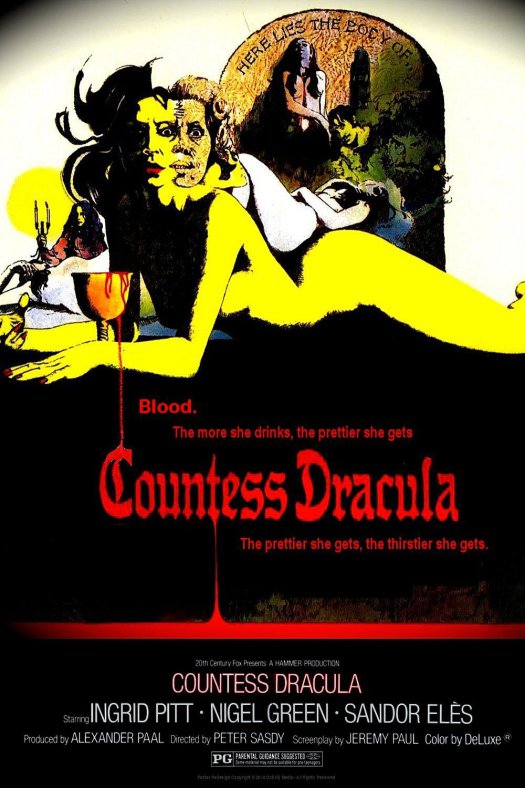
Forever Young: Ingrid Pitt in COUNTESS DRACULA (20th Century Fox/Hammer 1971)


gary loggins's avatarcracked rear viewer

Iconic Ingrid Pitt became a horror fan favorite for her vampire roles in the early 1970’s.  The Polish-born actress, who survived the horrors of a Nazi concentration camp as a child during WWII, played bloodsucking lesbian Carmilla in Hammer’s THE VAMPIRE LOVERS, based on the classic story by J. Sheridan LeFanu, and was a participant in the Amicus anthology THE HOUSE THAT DRIPPED BLOOD opposite Jon Pertwee in that film’s best segment. Finally, Ingrid sunk her teeth into the title role of COUNTESS DRACULA, a juicy part where she’s not really a vampire, but a noblewoman who gets off on bathing in blood, loosely based on the real life events of Hungarian Countess Elizabeth Bathory.

Portrait of the real Elizabeth Bathory

Bathory (1560-1614) was the most infamous female serial killer in history, officially found guilty of 80 murders, yet a diary allegedly found puts the count as high as 650!…

View original post 383 more words

Music Video of the Day: Numb by U2 (1993, directed by Kevin Godley)


For today’s music video of the day, we break down the video that the New Musical Express named as being the 16th worst video of all time.  Ladies and gentlemen, it’s time to get … Numb!

0:06 — Drip drip drip.  Someone’s in for an unpleasant shock when they get the water bill.

0:30 — Numb is one of the few U2 songs to feature lead vocals from The Edge.  The Edge’s real name is David Howell Evans.

0:35 — That’s U2’s bassist, Adam Clayton, blowing smoke in the Edge’s face.  Clayton is the only member of U2 not to sing on this track but he still plays an important role in the video, as we’ll soon see.

0:50 — Who doesn’t love a good massage?

1:00 — The Edge is learning that singing lead has its advantages.

1:17 — “You’re not Bono!”

1:23 — Holding the rope in the background is, once again, Adam Clayton.

1:45 — As Clayton ties up The Edge, drummer Larry Mullen, Jr. makes an appearance.  It was actually Mullen’s idea to start the band that would eventually become U2.

1:53 — However, Mullen has obviously been overshadowed by Bono.

2:11 — Oh no, they killed the Edge!

2:13 — Hello?

2:15 — Is anyone there?

2:20 — With the Edge apparently dead, now seems like a good time to tell you that Numb was the first single released off of U2’s 1993 album Zooropa, which many consider to be the moment that U2 went from being an energetic group of rockers to the most pretentious band on the planet.  Numb, like the rest of the album, is about sensory overload.

2:23 — Numb was originally recorded for Achtung Baby and was called Down All The Days.  No one in the band liked the song but they still reworked it for Zooropa.

2:27 — Edge, can you hear me?

2:33 — Larry Mullen, Jr. is the new Edge.

2:41 — Adam considers tying Larry up but realizes that he wasted all of his rope on The Edge.

3:00 — The Edge lives!

3:18 — But with those feet in his face, The Edge might wish that he was dead.

3:36 — The Edge catches the bouquet.

3:51 — That is Morleigh Steinberg dancing in front of the Edge.  Nine years after the release of this video, the Edge and Steinberg got married.

4:12 — Just the fact that the fans are using cameras instead of phones proves this video was made in the early 90s.

4:17 — “Excuse me, Mr. Edge, but we have a wedding party coming in so if you and your friends could please vacate the room…”

4:25 — The Edge ain’t going nowhere.

Numb was originally release as a video single, so if you wanted to listen to it outside of Zoorupa, you had to buy it on VHS.  Also included on the tape was a video for Love is Blindness.

The Covers of Strange Detective Mysteries


Welcome to the world of Strange Detective Mysteries!  Published from 1937 to 1943, Strange Detective Mysteries featured bizarre crime fighters (like Captain Satan) solving bizarre and often supernatural mysteries!  Below are just a few covers from Strange Detective Mysteries.  When known, the artist has been credited.

by Clifford Benton

by John Newton Howitt

Music Video of the Day: Outside by Aaron Lewis featuring Fred Durst (2000, directed by ????)


Today’s music video of the day comes from the era when it was believed that all good music had to be depressing as hell.  I can still remember those days back in 2000, driving around Baltimore with my friends.  Whenever this song came on the radio, everyone would fall silent and listen to every single lyric.  They were deep, man.  And we were deep because we could appreciate them.

The majority of this video was filmed in Biloxi, Mississippi during the 1999 Family Values Tour.  When Staind’s Aaron Lewis took the stage to perform a solo, he decided to play a song that he was still in the process of writing.  That song was Outside and Lewis finished the lyrics while performing them.

So, what is Fred Durst doing there?  It’s easy to forget what a big deal Durst and Limp Bizkit were back in the day.  In 1999, along with helping to destroy Woodstock ’99, Limp Bizkit headlined the Family Values tour.  When Outside first started to get radio airplay, it was often promoted as being a Fred Durst song, despite the fact that Durst contributed little beyond “This is the real motherfucking deal, y’all,” and “I’m feeling those lighters.”  As easy as it is to disparage Durst’s contributions, his presence in the video undoubtedly helped it to achieve frequent play on MTV2.

A studio version of Outside was later included on Staind’s second album, Break the Cycle.