Well, there’s one thing that you can definitely say for sure about not only Twin Peaks but also about every other film that David Lynch has ever made. (And make no mistake — they may be calling this the third season of Twin Peaks but it’s obviously meant to be more of an 18-hour film than a traditional television series.) Lynch moves at his own pace. He knows where he’s going but, often, he doesn’t seem to be in any hurry to get there.
And, quite frankly, that can sometimes to be frustrating. David Lynch requires patience on the part of the viewer and a willingness to have faith in his ability as an artist. To a certain extent, the modern world almost seems to be set up to make things as difficult as possible for an artist like David Lynch. We’re used to things being fast-paced. We’re used to having immediate (if superficial) answers to any and all questions. In a time when movies are dominated by hyperactive editing and overwhelming soundtracks, David Lynch has the courage to portray moments of silence and stillness. It’s what sets him apart from other filmmakers. It’s also the reason why this critically acclaimed director has always struggled to get his films made. In 41 years, David Lynch has had ten films theatrically released. Michael Bay directed his first film twenty years after the release of Eraserhead and he has gone to direct twelve more.
Part 5 of Twin Peaks is a perfect example of Lynch’s deliberate pace. As I watched it, I found myself occasionally saying, “When is Cooper going to get normal again!?” I mean, Kyle MacLachlan is doing great work as Dougie/Cooper but how many more times am I going to have to watch him get confused over the need to urinate? That’s a joke that’s getting old.
Yes, I was frustrated.
But here’s the thing:
As frustrated as I may be by the whole Dougie/Cooper situation, I’m not going anywhere. I trust David Lynch and, throughout Part 5, there were scenes that reminded me of why I trust David Lynch. The man is a genius. I’m thinking of the three women in pink nonchalantly watching as the casino pit boss got beaten. I’m thinking of the close-up on Amanda Seyfried’s face after she snorted the cocaine. I’m thinking of Russ Tamblyn ranting.
I will follow David Lynch anywhere.
As for Part 5, it opened with Lynch’s camera prowling through the streets of Las Vegas, a city that seems especially Lynchian.
Out at the Rancho Rosa Development, the two hitmen who were sent to kill Dougie are still sitting outside of the deserted house that Dougie used for his lost weekend with Jade. They’re watching Dougie’s car. One of them calls a woman and tells her that they still haven’t seen Dougie. She does not take the news well. She sends a message to Argentina, where it is apparently received by a black box sitting in a basin.
In South Dakota, the coroner has found something in the stomach of the body that was found underneath the head of Ruth Davenport. It’s a gold ring, one that has an inscription: “To Destiny, With Love, James C.” (I’ve listened to the line about the inscription about a dozen times and I’m pretty sure that’s what the coroner said. If I’m wrong, please let me know.)
(CORRECTION: According to Dylan Lange, host of Dylan Knows, the inscription read: To Dougie With Love, Janey-E. Thank you, Dylan! — LMB)
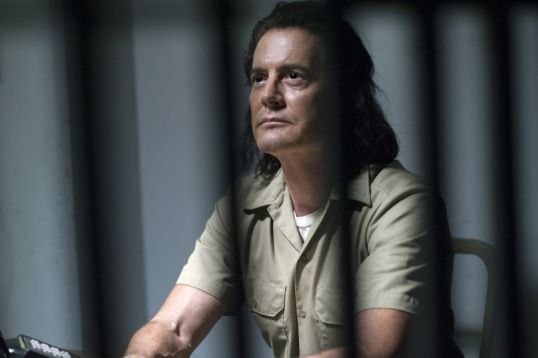
In his prison cell, Doppelganger Cooper (Kyle MacLachlan) stares at himself in his cell’s tiny mirror. He flashes back to the time he and Killer BOB shared a laugh in the Black Lodge. He sees himself smashing his face into the mirror at the Great Northern.
In Twin Peaks, we are reintroduced to Mike Nelson (Gary Hershberger), who was Bobby’s best friend and fellow drug dealer during the first two seasons of Twin Peaks. (He eventually became Nadine’s boyfriend during the time that she had amnesia and thought she was 16.) Mike is a grown-up, suit-wearing professional now, sitting in an office that is decorated with the mounted heads of dead deer. Mike is conducting a job interview with Steve Burnett (Caleb Landry Jones), who appears to be a real loser. Mike informs Steve that his resume is the worst resume that he’s ever seen and then kicks him out of the office.
At the Sheriff’s Department, Doris Truman (Candy Clark) comes by to yell at Frank (Robert Forster) about something. Honestly, I kinda tuned out this scene and I hope that Doris doesn’t become a major character. If anything, Frank is even more laconic than his brother.
Back in Las Vegas, Janey-E (Naomi Watts) finally gets Dougie/Cooper (Kyle MacLachlan) out of the house. She has to tie his necktie for him. As she tells him everything that he needs to do, Dougie/Cooper stares at her with a blank look. It’s interesting that, as frustrated as Janey-E gets with Dougie/Cooper, she still tries to rationalize his strange behavior.
At the Rancho Rosa development, Dougie’s car continues to sit there. The two hitmen drive by again. They are followed by five more guys, who are all in a black car and playing their music super loud.
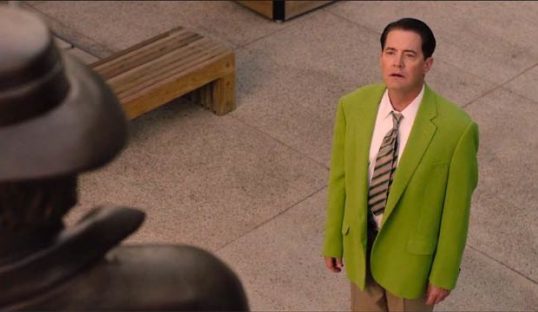
Janey-E drops Dougie/Cooper off at his place of employment. Apparently, Dougie worked for Lucky Seven Insurance. However, Dougie/Cooper is less interested in his job and more fascinated by a statue of a cowboy pointing a gun. In an oddly beautiful scene, he imitates the statue’s pose. Finally, one of his co-workers wanders by and tells Dougie to “get the lead out” because they have a meeting. That co-worker is carrying 8 cups of coffee so, of course, Dougie/Cooper follows after him.
At the meeting, which is full of vapid insurance people, Dougie/Cooper reveals that he can now tell when people are lying. Apparently, whenever someone lies, a green light flashes across their face. When Dougie/Cooper offends another agent (played by Tom Sizemore, no less) by calling him a liar, their boss, the wonderfully named Bushnell Mills (Don Murray), defuses the situation by giveing Dougie/Cooper several case files to take home with him.
Out in the hallway, Dougie/Cooper needs to pee but, like a panicking Sim, has no idea what to do. Luckily, one of his co-workers, assuming that the men’s room must be locked, sneaks Dougie/Cooper into the ladies room.
At the Silver Mustang Casino, Rodney Mitchum (Robert Knepper) and Bradley Mitchum (Jim Belushi) demand to know how Cooper/Dougie could possibly have won 30 jackpots. Rodney’s way of handling it is to beat up the pit boss (David Dastmalchian) while three women in pink stand in the corner of the room and nonchalantly watch.

Back at Rancho Rosa, Drugged-Out Mother (Hailey Gates) is passed out so her son leaves the house and walks across the street, intent on investigating Dougie’s bomb-laden car. Fortunately, before the kid can set the bomb off, the black car pulls up. The five men jump out of the car and tell the kid to “get the fuck outta here!” They’re planning on stealing Dougie’s car for themselves. Of course, as soon as the engine starts, the car explodes and takes three of the car thieves with it. The kid runs back to his house, where the junkie mom is just now starting to come out of her stupor.
At a nearby carwash, Jade (Nafessa Williams) is getting her car washed when she comes across the key to Cooper’s room at the Great Northern. She drops the key in a nearby mailbox.
At the Double R Diner — it’s Norma (Peggy Lipton) and Shelley (Madchen Amick)! 25 years have passed and they’re still exactly where we left them. Except that Shelley now has a daughter named Becky (Amanda Seyfried) and Becky’s married to Steve. Becky comes by the diner to borrow money from Shelley. Then she goes outside and snorts cocaine with Steve. Lynch’s camera gives us a close-up of Becky’s face as the drugs temporarily takes away all of her problems. In this scene, not only does Becky look like Shelley’s daughter (Madchen Amick and Amanda Seyfried really do look like they could be related) but there’s also a disconcerting resemblance to Laura Palmer as well.
(Also, remember how Shelley used to say that she married Leo because of his car? Well, Steve has a corvette of his own.)
Back in Vegas, Dougie/Cooper is still acting weird. He doesn’t understand that, when riding an elevator, you’re supposed to get off when the doors open. Some people get upset with him about that but Dougie/Cooper is more interested in going outside and staring at that statue. Of course, Dougie/Cooper is still holding onto those case files.
At the Sheriff’s Department, Andy (Harry Goaz) and Hawk (Michael Horse) go through the Laura Palmer case files, searching for what’s missing.
In his trailer, Dr. Jacoby (Russ Tamblyn) goes live online, delivering a rant about globalist corporate conspiracies and selling his gold-painted shovels so that his listeners can “dig yourself out of the shit.” Nadine (Wendy Robie) and Jerry (David Patrick Kelly) listen appreciatively.
At the Pentagon, Col. Davis (Ernie Hudson) is informed that they’ve gotten another “database hit” on Garland Briggs’s fingerprints. Apparently, in the years since his mysterious death, Briggs’s finger prints have shown up in 16 different locations.
At the Roadhouse, the kickass band Trouble is playing. Meanwhile, a handsome but dangerous looking man (Eamon Farren) sits under a sign that says no smoking and smokes a cigarette. When a Roadhouse employee tells him to put out his cigarette, the man hands over a pack of cigarettes. Inside the pack are several hundred dollar bills. So, apparently, the Roadhouse is still the center of the Twin Peaks drug trade.

When Charlotte (Grace Victoria Cox) tries to flirt with him, the man suddenly turns violent, grabbing her and taunting her with, “Do you want to fuck me, Charlotte? Do you want to fuck? I’m going to laugh when I fuck you, bitch!” It’s a deeply unpleasant scene, as Lynch obviously meant for it to be.
The man’s name is not mentioned but, according to the end credits, he’s Richard Horne. Presumably, he’s a member of the infamous Horne Family. Is he a cousin? Or maybe Jerry’s kid? Or, even more intriguingly, Audrey’s son? Whatever he is, Richard is bad news.
(And let’s not forget that, way back at the start of Part One, the Giant told Cooper to remember “Richard and Linda.”)
At FBI Headquarters, Tamara (Chrysta Bell) compares the finger prints of both Cooper and his Doppelganger.
At the South Dakota prison, Doppelganger Cooper finally gets his phone call. The warden (James Morrison) thinks that they’ll be able to listen in on the call but Doppelganger Cooper has other plans. After taunting everyone listening, Cooper pushes several keys on the phone, which somehow causes every alarm in the prison to go off. While the warden tries to restore order, Doppelganger Cooper says, into the phone, “The cow’s jumped over the moon.” As soon as Doppelganger Cooper hangs up, the alarms fall silent.
In Argentina, the black box changes into a small ring.
In Vegas, Dougie/Cooper continues to stare at the statue.
And so, the latest episode ends. The story may be moving at its own pace but I can’t wait to see where else it leads.
Twin Peaks on TSL:
- Twin Peaks: In the Beginning by Jedadiah Leland
- TV Review: Twin Peaks 1.1 — The Pilot (dir by David Lynch) by Lisa Marie Bowman
- TV Review: Twin Peaks 1.2 — Traces To Nowhere (directed by Duwayne Dunham) by Jedadiah Leland
- TV Review: Twin Peaks 1.3 — Zen, or the Skill To Catch A Killer (dir by David Lynch) by Lisa Marie Bowman
- TV Review: Twin Peaks 1.4 “Rest in Pain” (dir by Tina Rathbone) by Leonard Wilson
- TV Review: Twin Peaks 1.5 “The One-Armed Man” (directed by Tim Hunter) by Jedadiah Leland
- TV Review: Twin Peaks 1.6 “Cooper’s Dreams” (directed by Lesli Linka Glatter) by Lisa Marie Bowman
- TV Review: Twin Peaks 1.7 “Realization Time” (directed by Caleb Deschanel) by Lisa Marie Bowman
- TV Review: Twin Peaks 1.8 “The Last Evening” (directed by Mark Frost) by Leonard Wilson
- TV Review: Twin Peaks 2.1 “May the Giant Be With You” (dir by David Lynch) by Leonard Wilson
- TV Review: Twin Peaks 2.2 “Coma” (directed by David Lynch) by Jedadiah Leland
- TV Review: Twin Peaks 2.3 “The Man Behind The Glass” (directed by Lesli Linka Glatter) by Jedadiah Leland
- TV Review: Twin Peaks 2.4 “Laura’s Secret Diary” (dir by Todd Holland) by Lisa Marie Bowman
- TV Review: Twin Peaks 2.5 “The Orchid’s Curse” (dir by Graeme Clifford) by Lisa Marie Bowman
- TV Review: Twin Peaks 2.6 “Demons” (dir by Lesli Linka Glatter) by Leonard Wilson
- TV Review: Twin Peaks 2.7 “Lonely Souls” (directed by David Lynch) by Jedadiah Leland
- TV Review: Twin Peaks 2.8 “Drive With A Dead Girl” (dir by Caleb Deschanel) by Lisa Marie Bowman
- TV Review: Twin Peaks 2.9 “Arbitrary Law” (dir by Tim Hunter) by Lisa Marie Bowman
- TV Review: Twin Peaks 2.10 “Dispute Between Brothers” (directed by Tina Rathbone) by Jedadiah Leland
- TV Review: Twin Peaks 2.11 “Masked Ball” (directed by Duwayne Dunham) by Leonard Wilson
- TV Review: Twin Peaks 2.12 “The Black Widow” (directed by Caleb Deschanel) by Leonard Wilson
- TV Review: Twin Peaks 2.13 “Checkmate” (directed by Todd Holland) by Jedadiah Leland
- TV Review: Twin Peaks 2.14 “Double Play” (directed by Uli Edel) by Jedadiah Leland
- TV Review: Twin Peaks 2.15 “Slaves and Masters” (directed by Diane Keaton) by Lisa Marie Bowman
- TV Review: Twin Peaks 2.16 “The Condemned Woman” (directed by Lesli Linka Glatter) by Leonard Wilson
- TV Review: Twin Peaks 2.17 “Wounds and Scars” (directed by James Foley) by Lisa Marie Bowman
- TV Review: Twin Peaks 2.18 “On The Wings of Love” (directed by Duwayne Dunham) by Jedadiah Leland
- TV Review: Twin Peaks 2.19 “Variations on Relations” (directed by Jonathan Sanger) by Lisa Marie Bowman
- TV Review: Twin Peaks 2.20 “The Path to the Black Lodge” (directed by Stephen Gyllenhaal) by Lisa Marie Bowman
- TV Review: Twin Peaks 2.21 “Miss Twin Peaks” (directed by Tim Hunter) by Leonard Wilson
- TV Review: Twin Peaks 22.2 “Beyond Life and Death” (directed by David Lynch) by Lisa Marie Bowman
- Film Review: Twin Peaks: Fire Walk With Me (dir by David Lynch) by Lisa Marie Bowman
- Here’s The Latest Teaser for Showtime’s Twin Peaks by Lisa Marie Bowman
- Here’s The Newest Teaser for Showtime’s Twin Peaks by Lisa Marie Bowman
- 12 Initial Thoughts About Twin Peaks: The Return Parts One and Two by Lisa Marie Bowman
- This Week’s Peaks: Parts One and Two by Ryan C. (trashfilm guru)
- TV Review: Twin Peaks: The Return Parts One and Two (dir by David Lynch) by Lisa Marie Bowman
- 4 Shots From 4 Films: Special Twin Peaks Edition by Lisa Marie Bowman
- This Week’s Peaks: Parts Three and Four by Ryan C. (trashfilm guru)
- 14 Initial Thoughts About Twin Peaks: The Return Part Three by Lisa Marie Bowman (dir by David Lynch)
- 10 Initial Thoughts About Twin Peaks: The Return Part Four by Lisa Marie Bowman (dir by David Lynch)
- TV Review: Twin Peaks: The Return Parts Three and Four (dir by David Lynch) by Lisa Marie Bowman
- 18 Initial Thoughts About Twin Peaks: The Return Part 5 (dir by David Lynch) by Lisa Marie Bowman
- This Week’s Peaks: Part Five by Ryan C. (trashfilm guru)




 In this cop film, Robert Duvall plays Eddie Ryan, a tough New York detective who gets suspended from the force when he is accused of tossing a Puerto Rican suspect off of a roof. Eddie’s innocent but, because he spends all of his time talking about how much he hates Puerto Ricans and using Archie Bunker-style racial slurs, everyone assumes that he is guilty. Eddie is suspended from the force but then his former partner is killed while investigating an operation to smuggle guns to, you guessed it, Puerto Rico. Suspended or not, Eddie is going to track down the man who killed his partner. If that puts everyone from his girlfriend, Maureen (Verna Bloom), to NYC pedestrians in danger, that’s just the way it has to be.



 Through the Shattered Lens