Next week DC promises to “change everything we thought we knew about the universe” or somesuch bullshit with their wretchedly insulting Doomsday Clock cash-grab, so before that hits let’s take a look at what the final week of the world as we used to know it had to offer, shall we? Time for another dive into what LCS and the US Postal Service brought my way —
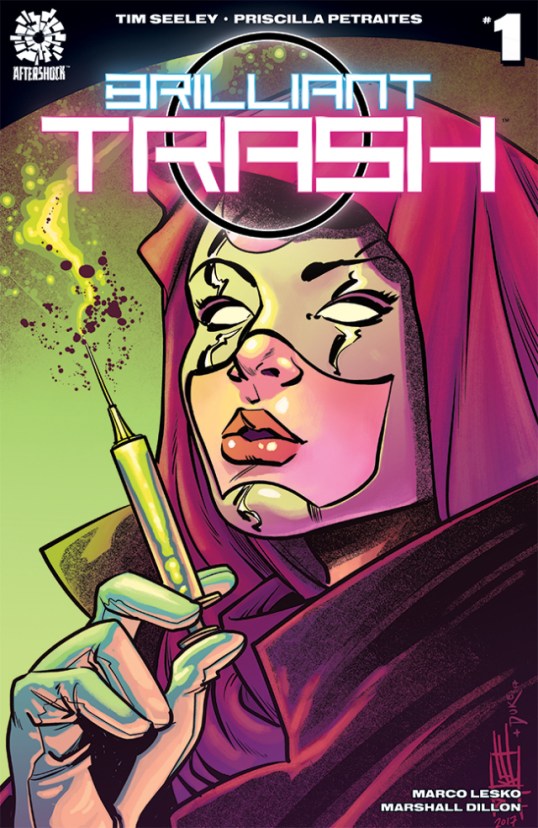
I’ve never been able to get a firm handle on Tim Seeley, finding his stuff to be wildly up and down (often within the same series — I’m looking at you Revival), but when he’s on, he’s on. Before it had a premature and all-too-convenient “ending” forced on it, Effigy was shaping up into something flat-out amazing, and given that some of the same themes of media obsession and instant celebrity seemed to be at the heart of Brilliant Trash, the…
J.J. McQuade is a former Marine who keeps the peace in El Paso through a combination of karate and machine guns. McQuade lives in a house in the desert, with only a wolf and refrigerator full of beer to provide companionship. He prefers to work alone, even though his captain (R.G. Armstrong) insists that McQuade partner up with a rookie named Kayo Ramos (Robert Beltran). Ramos is eager to prove himself but Lone Wolf McQuade has to work alone. Otherwise, his nickname would not make any sense.
Things change when McQuade’s teenage daughter (Dana Kimmel) is put in the hospital by an arrogant and sleazy arms dealer named Rawley Wilkes (David Carradine). McQuade is out for both justice and revenge and Ramos’s knowledge of how to turn on a computer proves to be helpful. Also teaming up with McQuade: an FBI agent (Leon Isaac Kennedy), a retired Ranger named Dakota (L.Q. Jones), and Rawley’s former lover (Barbara Carrera), who now happens to be McQuade’s current lover.
The predictable storyline is not what makes Lone Wolf McQuade a classic. Instead, it’s that this movie features both Chuck Norris and David Carradine at the height of their abilities. The whole film is directed like a grand western, with Norris and Carradine taking the roles that would usually go to Clint Eastwood and Lee Van Cleef. The plot may be full of holes but when these two face off, none of that matters. Neither Carradine nor Norris used stunt doubles for their fight scenes and it makes all the difference.
This was one of the first movies to feature Chuck Norris with the beard that’s become his trademark. Wisely, Chuck doesn’t say much in the movie and leaves most of the heavy-duty acting to his co-stars. (Though he may be an icon of cool, Chuck has never been anyone’s idea of a great actor.) Carradine’s performance as Rawley feels like an early version of his best known role, Bill in Kill Bill. L.Q. Jones and R.G. Armstrong both bring their own history as members of the Sam Peckinpah stock company to the film while Barbara Carrera livens up her part with a sultry spark. Keep an eye out for both William Sanderson and Sharon Farrell in small roles. Speaking of small roles, Daniel Frishman almost steals the entire damn movie as a rival arms dealer.
Though it wasn’t produced by Cannon, Lone Wolf McQuade is an essential for fans of Chuck Norris.
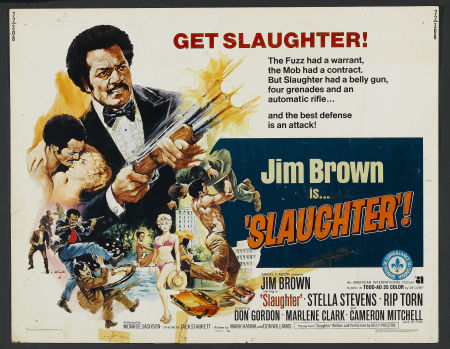
Jim Brown is one bad mother… no wait, that’s Richard Roundtree as Shaft! Jim Brown is one bad dude as SLAUGHTER, a 1972 Blaxploitation revenge yarn chock full of action. Brown’s imposing physical presence dominates the film, and he doesn’t have to do much in the acting department, ’cause Shakespeare this ain’t – it’s a balls to the wall, slam-bang flick courtesy of action specialist Jack Starrett (RUN ANGEL RUN, CLEOPATRA JONES , RACE WITH THE DEVIL) that doesn’t let up until the last second, resulting in one of the genre’s best.
Ex-Green Beret Slaughter (no first name given) is determined to get the bad guys who blew up his dad’s car, with dad in it! Seems dear ol’ dad was mob connected and knew too much. Slaughter’s reckless abandon in seeking revenge lands him in hot water with Treasury agents, and he’s “persuaded” to assist them in taking down…
The Emoji Movie is basically Inside Out, except instead of taking place inside of an awkward teen’s head, it takes place inside of an awkward teen’s phone. Instead of sharing a universal story about the pain of growing up, it shares a universal story about the pain of having too many lame apps on your phone. Instead of featuring a melancholy voice performance by Richard Kind as a forgotten toy, it features an annoying voice performance from James Corden as a forgotten emoji. Instead of being really wise, funny, and sad, the Emoji Movie is dumb, stupid, and idiotic. Otherwise, it’s just like Inside Out.
Gene (voiced by T.J. Miller) is a Meh Emoji. He lives in Textopolis. His job is to look like he’s always meh but instead, he’s always full of emotion and positivity. His boss, Smiler (Maya Rudolph), says that Gene must be a malfunction and therefore, he has to be deleted. Gene says, “No, I must discover who I actually am!” With the help of the forgotten hand emoji, Hi-5 (that would be James Corden), Gene flees from app to app. (It’s kinda like The Lego Movie but not funny, touching, or clever.) They track down a hacker named Jailbreak (Anna Faris) and, at one point, they’re all rescued by a blue bird that comes flying over from the Twitter app. They’re all chased by a bunch of bots and I have to admit that I liked the bots just because they were trying to destroy Gene and Hi-5. Anything that would have ended James Corden’s lameass Ricky Gervais imitation would have been fine with me.
Nobody (or, at the very least, nobody who writes for this site) is as enthusiastic a capitalist as I am but the naked commercialism of The Emoji Movie really tested my patience. Essentially, it’s just an 86-minute advertisement with a vapid “Be yourself!” message tacked on. (If The Emoji Movie was sincere in its message of individuality, it wouldn’t celebrate the idea of people communicating exclusively in emoji.) Early on, when Gene and Hi-5 escaped into Candy Crush, I rolled my eyes. Later on, when an awed Gene said, “This is Spotify?”, I nearly threw a shoe at the TV.
(I did enjoy the scene where the Just Dance app got deleted, just because the dancer — who was voiced by Christina Aguilera — let out a terrifying scream as the app collapsed around her. I’ve always imagined that’s what happens whenever I delete anything.)
Usually, I try to force myself to come up with at least 500 words for every review that I write but the really does seem to be more effort than this movie deserves. (I was actually tempted to write this review exclusive in emoji but then I realized I was just be playing the movie’s game.) I will say this: children will like The Emoji Movie because children are stupid. Ask them again in five years and this will be their response:
In Mudbound, Jonathan Banks plays one of the most hateful characters to ever appear in a motion picture.
We never find out the character’s given name. Everyone just calls him Pappy. He’s the patriarch of an unimpressive family, a wannabe king who has no kingdom over which to rule. Pappy never has a kind word to say to anyone. He even tends to be brusque with his grandchildren. When one of his sons returns from serving in World War II, Pappy only wants to know if he got laid in Europe and how many men he killed. Pappy only killed one man in World War I but he did it face-to-face. He’s proud of that.
As much as Pappy dislikes the members of his family, it’s nothing compared to how much Pappy hates people who aren’t white. Pappy is the type to demand that, when he dies, he not buried anywhere near anyone black. Pappy is also the type who takes it as a personal insult if a black man uses the same door that he uses. When he sees Ronsel Jackson (Jason Mitchell) using the font door of the local grocery store, it doesn’t matter that Ronsel has just returned from serving his country and is still wearing his uniform. It also doesn’t matter that Ronsel’s mother is helping to raise Pappy’s granddaughters. What matters is that Ronsel is defying the social norms of 1940s Mississippi and Pappy takes that as a personal insult.
There are six narrators in Mudbound, all of whom tell us their story and share with us their thoughts. Pappy is not one of those narrators and, for that, I was thankful. I would have been frightened at the thought of entering his hate-fueled mind. All we have to do is look into his hateful eyes or listen to his scornful voice and we know what’s going on in Pappy’s head. He’s a man who has accomplished nothing in his long life, whose only happiness comes from making others miserable, and who fears the change that he secretly knows is coming. It’s not just hate that makes Pappy demand an apology when Ronsel Jackson uses the front door. It’s fear.
Mudbound tells the story of two families in Mississippi and the farmland on which they both live and work. (Early on, when a skull with a bullet hole is discovered, we’re informed that an old slave cemetery is under plowed fields.) Pappy’s oldest son, Henry McAllan (Jason Clarke), owns the land. Desperate for his father’s approval, Henry hopes to succeed as a farmer but he soon proves himself to be rather clueless. Henry’s wife is Laura (Carey Mulligan). Laura was a 31 year-old virgin when she met Henry. She tells us that she married him because she didn’t want to be alone. She stays with him because she loves their children.
The Jacksons live on Henry’s land. They’re tenant farmers and Hap (Rob Morgan), the family patriarch, dreams of one day owning his own farm. While Pappy openly hates the Jacksons, Henry treats them with a patronizing condescension. (Whereas Pappy knows that he’s hated, Henry actually thinks that the Jacksons look up to him. There’s not a lot of humor to be found in Mudbound but I couldn’t help but smile at Henry’s cluelessness about how little Hap thought of him.) Henry and Laura even hire Hap’s wife, Florence (Mary J. Blige), to serve as a housekeeper. Henry and Laura think they’re doing Florence a favor, never considering that they are essentially asking Florence to neglect her own family so that she can take care of their’s.
The Jackson and the McAllans do have one big thing in common. They both have sons serving in the army. Ronsel is a sergeant who is both surprised and happy to discover that white Europeans are not the same as white Americans. Henry’s younger brother, Jamie (Garrett Hedlund), is a captain in the Air Force. When the war ends, both Ronsel and Jamie return to their families. Jamie returns with a severe case of PTSD and a drinking problem. Having experienced freedom in Europe, Ronsel is angered to return to a country where he is still expected to sit in the back of the bus and cheerfully accept being treated like a second class citizen.
When both of them are caught off guard by the sound of a car backfiring, Ronsel and Jamie immediately recognize each other as returning soldiers. A friendship develops between them, one that goes against the racist norms of their society. Violence and tragedy follows.
Mudbound is a Netflix film. It’s currently getting a one-week theatrical release so that it’ll be Oscar-eligible. (If it is nominated for best picture — and many think that it may be — it’ll be the first Netflix film to be so honored.) That said, the majority of the people who see Mudbound will see it via Netflix. That’s a shame because, visually, Mubound is a film that should be seen on a big screen. The imagery — the farmland that seems to stretch on forever, the storms that always seem to roll in at the worst possible moment, the scenes of Ronsel and Jamie in Europe — is frequently beautiful and haunting. (The comparisons to the work of Terrence Malick are justified.) Even when viewed on a laptop, Mudbound still looks good but I fear that the small screen will rob the film of some of its epic scope. Since Mudbound is a leisurely paced film, I fear that many members of the Netflix audience are going to be tempted to hit pause and then not return to the film for an hour or two, therefore robbing Mudbound of its cumulative power.
Over the time that I’ve spent writing this review, I’ve come to realize that I actually liked Mudbound a lot more than I originally thought I did. As opposed to many of the films that I’ve seen this year, I have a feeling that Mudbound is actually going to stick with me. Carey Mulligan, Mary J. Blige, Jason Clarke, and Rob Morgan all give wonderful performances, though the cast standout is Jason Mitchell, playing a man who, having tasted freedom, refuses to silently go back to the way things were.
Mudbound is a very good film. I wouldn’t necessarily call it a great film, though many other critics and viewers are. Director Dee Rees captures some beautiful images and some wonderful performances but the film itself has some pacing problems. The first part of the film is occasionally too slow while a few of the final scenes felt rushed. I haven’t always been a huge fan of Garrett Hedlund in the past and, when the movie started, I had my doubts about whether or not I’d be able to accept him as Jamie but, by the end of the movie, he had won me over. In the past, I’ve found Hedlund to be a little stiff but, having now seen Mudbound, I have to say that he’s grown as an actor. I’m looking forward to seeing where his talent takes him next.
Even if it does have flaws, Mudbound is a powerful film and one that I recommend taking the time to watch.
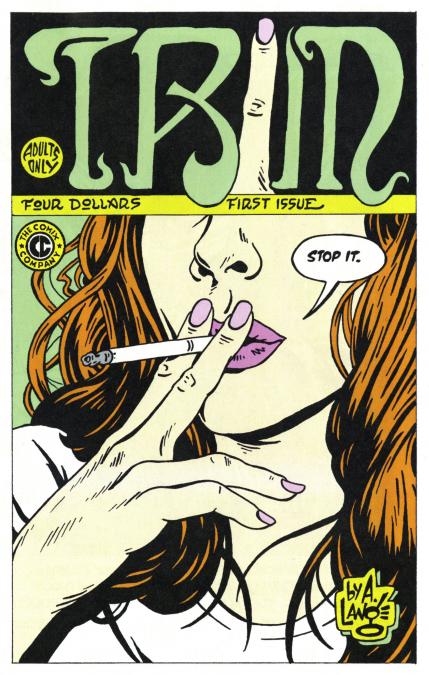
Aaron Lange has issues — five of ’em, literally, as regards his annually-issued comics anthology series Trim — and too many to count, in the figurative sense, as is plainly evident in Trim‘s pages. Consider : this is a guy who, according to a TCJ piece from a few years back, relocated to Philadelphia because his previous hometown, Cleveland, wasn’t a big enough shithole.
I’ve only spent a mercifully short amount of time in both cities and I have to say that at least Lange got that much right : Cleveland, after all, has every bit the air of a town whose best days are behind it as its (numerous) critics charge, while Philly very much feels like a place that never had any “best days,” and almost certainly never will.
Living in environs such as these is bound to inculcate a certain type of attitude among those…
How about a little Muse for today’s music video of the day?
I’ve always found it ironic that this band is named Muse because I’m usually at my most productive whenever I’ve got them playing in the background. There are just certain groups that help to get me in the mood to write. The Chemicals Brothers is one. So is Jakalope. Sleigh Bells, definitely. And then there’s Muse.
Starlight is a favorite of mine. According to my BFF, I once stayed up for six days straight, listening to this song over and over again. I think she’s exaggerating but it is a song that I listen to frequently.
Starlight was directed by Paul Manor. The band is performing on the deck of the MS Ocean Chie, which Wikipedia describes as being a “handysize bulk carrier.” I have no idea what that description means, beyond the fact that the boat’s deck was big enough for Muse to perform. According to Matt Bellamy, there is a deeper symbolism behind them performing on the boat. The video is about a band that is lost at sea because, at the time, Muse felt they were “outside what’s happening in the music scene.”

 Chuck Norris is J.J. McQuade, Texas Ranger!


 Through the Shattered Lens