I swear that thumbnail used to be Branigan sitting with the three drag queens. I would say that sex sells, but it’s Laura Branigan. For her, this doesn’t look out of place at all.
Watching this music video now is bittersweet because to the best of my knowledge, it was her last. After doing this video for her cover of Donna Summer’s Dim All The Lights, she retired to take care of her husband who had been diagnosed with cancer. He passed away in 1996.
The more and more I read from the book I Want My MTV, the more and more director Marty Callner seems to be quite the character. It makes me want to hear the story of how he ended up directing Branigan’s early videos. Was he cutting his teeth like David Fincher did with Rick Springfield and Loverboy? Were they friends? I can’t find any mention of it in the book. Callner comes up mainly in the discussion of hair metal bands since, if nothing else, he is credited, along with Tawny Kitaen, for really kicking off Whitesnake’s career.
This time Lynn Spinnato directed a video for Branigan. I can only find three music video credits. She does have a bio on her website that says she worked with numerous other artists than the three I can find documented.
The video contains at least three drag queens: Miss Understood, Hedda Lettuce, and Vivacious. You might have seen them at some point over the years since they have made appearances in both film and television. The oddest thing I came across is that if Wikipedia is to be believed, then Miss Understood performed at “Blaine Trump’s Valentine’s Day dinner.” Blaine used to be married to Donald’s brother Robert. There’s a connection I can’t say I expected to come across when I picked out this music video to spotlight.
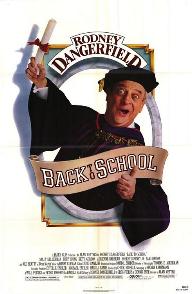
Thornton Melon (Rodney Dangerfield) started with nothing but through a combination of hard work and chutzpah, he started a chain of “Tall and Fat” clothing stores and made a fortune. Everyone has seen his commercials, the one where he asks his potential customers, “Do you look at the menu and say, ‘Okay?'” He has a new trophy wife named Vanessa (Adrienne Barbeau) and a chauffeur named Lou (Burt Young). Thornton never even graduated from high school but he gets respect.
However, his son, Jason (Keith Gordon), doesn’t get no respect. No respect at all. Jason is a student at a pricey university, where he is bullied by Chas Osborne (William Zabka) and can’t get a date to save his life. Jason’s only friend is campus weirdo Derek Lutz (Robert Downey, Jr.). When Thornton sees that his son isn’t having any fun, he decides to go back to school!
Back to School is a predictable but good-natured comedy. It is like almost every other 80s college comedy except, this time, it’s a 65 year-old man throwing raging parties and making the frat boys look stupid instead of Robert Carradine or Curtis Armstrong. On the stand-up stage, Dangerfield always played the (sometimes) lovable loser but in the movies, Dangerfield was always a winner. In both Caddyshack and Back to School, Dangerfield played a self-made man who forced his way into high society and showed up all of the snobs. While Back to School is no Caddyshack, it does feature Rodney at his best.
Rodney may be the funniest thing about Back to School but a close second is Sam Kinison, who owed much of his early success to Rodney Dangerfield’s support. Kinison plays a history professor, who has some very strongly held views about the Vietnam War and who punctuates his points with a primal screen.
Also, keep an eye out Kurt Vonnegut, playing himself. Rodney hires him to write a paper about Kurt Vonnegut for one of his classes. The paper gets an F because Rodney’s literature professor (Sally Kellerman) can tell that not only did Rodney not write it but whoever did knows absolutely nothing about the work of Kurt Vonnegut.
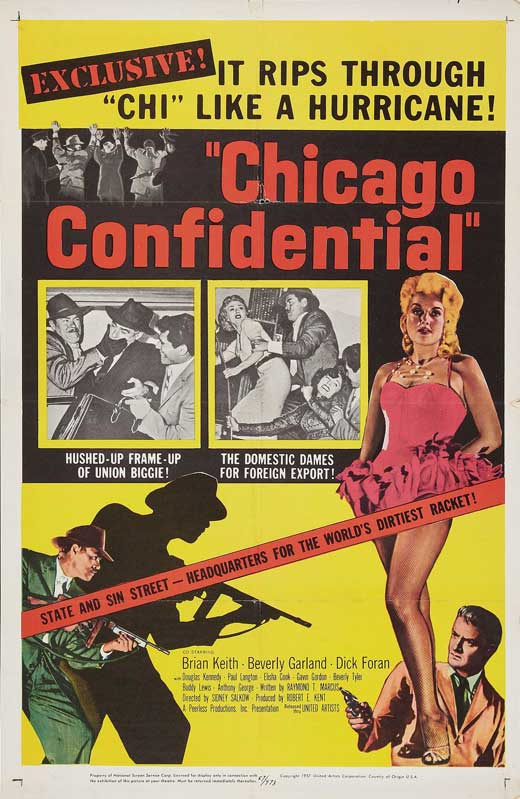
CHICAGO CONFIDENTIAL is just a routine ‘B’ crime drama, one of many churned out in the 50’s. Yet the performances of stars Brian Keith , Beverly Garland , and an above-average supporting cast helped elevate the by-the-numbers material into something watchable. It’s those Familiar Faces we all know and love from countless movies that made CHICAGO CONFIDENTIAL work for me.
The story revolves around racketeers muscling in on the Worker’s National Union so they can bring their “numbers rackets and ‘B’ girls” to the city. Politically ambitious State’s Attorney Jim Fremont is dead set on busting them up, and when the union’s treasurer is murdered, the finger of suspicion is pointed at honest Union President Artie Blane. Blane’s been framed by his rival, VP Ken Harrison, who takes his orders from “disbarred attorney” Alan Dixon, “one of the masterminds of the old Capone gang”. Blane is brought to trial and, thanks to some chicanery by an “old derelict” with the…
I brought it up when I talked about Get It On (Bang A Gong). This is the actual video that features model Caroline Cossey. Cossey is both intersex and transgender. One doesn’t equate to the other–or lesbian, gay, or bisexual. She just happens to be both intersex and transgender. The intersex part is a bit complicated, but for that, I refer you to the Wikipedia article on her. She was in For Your Eyes Only (1981) as an extra. After For Your Eyes Only, the tabloid News Of The World published an article about her being transgender.
The video is probably more remembered for the song, animation, bright colors, and use in both National Lampoon’s European Vacation (1985) and the Family Guy episode called It’s A Trap. However, once you know about Cossey, it does change the way you view this music video. In particular, the shaving cream on the face, which is followed by a reveal of Cossey’s breasts.
Vic “The Bomber” Bealer is an amateur boxer who appears to be poised to escape from life in his dreary hometown. He is such a good fighter that he is on the verge of making the U.S. Olympic Team and he is so good-looking that everyone, from his teenage girlfriend (Anne Archer) to his gay manager (Ned Glass) to a woman he meets at a gas station, automatically falls in love with him. However, after his girlfriend tells him that she is pregnant, Vic abandons both her and boxing. When she leaves town to have an abortion, Vic starts boxing again but then he learns that she may not have actually had an abortion and Vic leaves for Los Angeles, to see both her and his son.
Sadly, there is something about boxing that has always brought out the pretentious side of some filmmakers and that is the case with The All-American Boy. This episodic film (which claims to portray “The Manly Art In Six Rounds”) tries to present Vic as being an anti-hero but mostly, he just seems to be vacant loser. Vic sulks through the entire film, despite not really having much to sulk about. When one of his conquests asks him what he is thinking, Vic replies, “I ain’t thinkin'” and the movie provides no reason to doubt him on this point. I was not surprised to learn that The All-American Boy was filmed in 1969 and was deemed unreleasable until the combined success of Midnight Cowboy and Deliverance made Voight into a star. On the plus side, when he made the film, Jon Voight looked like he could actually step inside the ring and throw a few punches. On the negative side, the boxing scenes go heavy on the slow motion which, when overused, just looks stupid. Raging Bull, this film is not.
When it comes to The All-American Boy, Duke has the right idea:
The Longest Day is a pain-staking and meticulous recreation of invasion of Normandy, much of it filmed on location. It was reportedly something of a dream project for the head of the 20th Century Fox, Darryl F. Zanuck. Zanuck set out to make both the ultimate tribute to the Allied forces and the greatest war movie ever. Based on a best seller, The Longest Day has five credited screenwriters and three credited directors. (Ken Annakin was credited with “British and French exteriors,” Andrew Marton did “American exteriors,” and the German scenes were credited to Bernhard Wicki. Oddly, Gerd Oswald was not credited for his work on the parachuting scenes, even though those were some of the strongest scenes in the film.) Even though he was not credited as either a screenwriter or a director, it is generally agreed that the film ultimately reflected the vision of Darryl F. Zanuck. Zanuck not only rewrote the script but he also directed a few scenes as well. The film had a budget of 7.75 million dollars, which was a huge amount in 1962. (Until Steven Spielberg’s Schindler’s List, The Longest Day was the most expensive black-and-white film ever made.) Not only did the film tell an epic story, but it also had an epic length. Clocking in at 3 hours, The Longest Day was also one of the longest movies to ever be nominated for best picture.
The Longest Day also had an epic cast. Zanuck assembled an all-star cast for his recreation of D-Day. If you’re like me and you love watching old movies on TCM, you’ll see a lot of familiar faces go rushing by during the course of The Longest Day. American generals were played by actors like Robert Mitchum, Robert Ryan, Henry Fonda, and John Wayne. Peter Lawford, then the brother-in-law of the President of the United States, had a memorable role as the Scottish Lord Lovat, who marched through D-Day to the sounds of bagpipes. When the Allied troops storm the beach, everyone from Roddy McDowall to Sal Mineo to Robert Wagner to singer Paul Anka can be seen dodging bullets. Sean Connery pops up, speaking in his Scottish accent and providing comic relief. When a group of paratroopers parachute into an occupied village, comedian Red Buttons ends up hanging from the steeple of a church. When Richard Beymer (who is currently playing Ben Horne on Twin Peaks) gets separated from his squad, he stumbles across Richard Burton. Among those representing the French are Arletty and Christian Marquand. (Ironically, after World War II, Arletty was convicted of collaborating with the Germans and spent 18 months under house arrest. Her crime was having a romantic relationship with a German soldier. It is said that, in response to the charges, Arletty said, “My heart is French but my ass is international.”) Meanwhile, among the Germans, one can find three future Bond villains: Gert Frobe, Curt Jurgens, and Walter Gotell.
It’s a big film and, to be honest, it’s too big. It’s hard to keep track of everyone and, even though the battle scenes are probably about an intense as one could get away with in 1962 (though it’s nowhere near as effective as the famous opening of Saving Private Ryan, I still felt bad when Jeffrey Hunter and Eddie Albert were gunned down), their effectiveness is compromised by the film’s all-star approach. Often times, the action threatens to come to a halt so that everyone can get their close-up. Unfortunately, most of those famous faces don’t really get much of a chance to make an impression. Even as the battle rages, you keep getting distracted by questions like, “Was that guy famous or was he just an extra?”
Among the big stars, most of them play to their personas. John Wayne, for instance, may have been cast as General Benjamin Vandervoort but there’s never any doubt that he’s playing John Wayne. When he tells his troops to “send them to Hell,” it’s not Vandervoort giving orders. It’s John Wayne representing America. Henry Fonda may be identified as being General Theodore Roosevelt II but, ultimately, you react to him because he’s Henry Fonda, a symbol of middle-American decency. Neither Wayne nor Fonda gives a bad performance but you never forget that you’re watching Fonda and Wayne.
Throughout this huge film, there are bits and pieces that work so well that you wish the film had just concentrated on them as opposed to trying to tell every single story that occurred during D-Day. I liked Robert Mitchum as a tough but caring general who, in the midst of battle, gives a speech that inspires his troops to keep fighting. The scenes of Peter Lawford marching with a bagpiper at his side were nicely surreal. Finally, there’s Richard Beymer, wandering around the French countryside and going through the entire day without firing his gun once. Beymer gets the best line of the film when he says, “I wonder if we won.” It’s such a modest line but it’s probably the most powerful line in the film. I wish The Longest Day had more scenes like that.
The Longest Day was nominated for best picture of 1962 but it lost to an even longer film, Lawrence of Arabia.
Seventy-three years ago today, when the first wave of American troops stormed Omaha Beach during the Allied invasion of Normandy, photo journalist Robert Capa was with them. Capa took 106 pictures on D-Day but, because of an accident at a London photo lab, all but eleven of them were destroyed.
The eleven that survived, nicknamed the Magnificent Eleven, are a portrait of bravery and a tribute to the men who, on that morning, risked (and, in many cases, sacrificed) their lives to help defeat Hitler’s war machine. By the end of D-Day, 4,014 Allied troops were confirmed to have been killed in action.
Robert Capa survived D-Day. Though he initially swore that he would never cover another war, Capa accepted an assignment in 1954 to travel to Southeast Asia and cover the First Indochina War. It was there that Capa was killed when he stepped on a land mine. He was 40 years old.
Sometimes I remember a special day or month, and sometimes I forget. When I noticed it was Pride Month, I thought I should deliberately put in a couple in that area. I’m glad I remembered this one specifically because much like special times, I always forget that I have Joe Jackson music in my collection.
Technically, my first exposure to Jackson’s music was when I saw There’s Something About Mary (1998). It featured the song Is She Really Going Out With Him? I was really introduced to Jackson’s work by way of the album Strange Little Girls by Tori Amos. I liked the song, found out it was a cover, and sought it out. Cut to a few years later, and I got to see the video for the first time. In fact, I’m quite sure that the version I’ve embedded here is the exact airing of it that I saw.
Back in the early to mid-2000s, VH1 Classic used to do this thing where they would play two songs that would have some connection to each other. I’m pretty sure the pairs would have some connection to each other as well. I don’t remember them ever telling the audience that. I just recall noticing that they played this song along with I Don’t Like Mondays by Boomtown Rats. That song was covered by Amos on the same album. I picked up on a couple of other connections, and figured that’s what they were doing.
If you look around online, then you’ll find plenty of other people who have already written out their opinions on the song and video.
This is one of those that has some material from the book I Want My MTV:
Jeff Ayeroff [former creative director at Warner Bros. Records and the co-chairman of Virgin Records America]: Joe Jackson ended up selling many more records than Elvis Costello did, mainly because of his videos he did with Steve Barron.
Joe Jackson: Music videos weren’t even discussed when I made my first album in 1979. By 1982, there’d been a distinct shift. I made videos with Steve Barron for “Real Men” and “Steppin’ Out,” and by the time we got to “Breaking Us In Two,” I said to the label, “I don’t think this song should have a video.” I was told I had to made a video, whether I liked it or not. “Breaking Us In Two” was a crappy video. I was embarrassed. So I decided in my great wisdom that not only would I no longer make videos, but I would write an anti-video editorial for Billboard magazine. I mean, I’m not such a miserable bastard that I won’t admit that some videos are great fun. But I believed MTV was beginning to have a negative effect on music.
I’m well aware that refusing to make videos accomplished nothing whatsoever except–how should I put this?–to make my next record less successful. It damaged my career and it never fully recovered.
I like Breaking Us In Two. I see where he’s coming from on that one though. Out of the three Steve Barron videos, Steppin’ Out is the best. You can tell from all three of those videos that Barron was trying to craft a reusable formula for his songs. They have all have a similar visual style. Most importantly, Barron found a good place for Jackson. Yes, I’m aware he does more than just play the piano. I’m referring to the idea of each video being a short film that happens to have Jackson pop in, not as a the star, but as the story teller. Kind of like a holographic musical narrator.
Jackson didn’t completely leave music videos. He came back with other ones, which includes getting the Propaganda Films treatment for his song Nineteen Forever. You might know a couple of the people who worked or founded Propaganda Films, such as Nigel Dick, David Fincher, Michael Bay, Mark Romanek, and in the case of Nineteen Forever, Jackson got Alex Proyas.
Despite the 1979 comment, you can find several music videos from 1979. I guess they were done just for fun rather than something that he was obligated to make and weren’t taken so seriously. You can see the second one in the video for his song I’m The Man.
As for this video, it’s pretty basic all things considered. You have the kid who doesn’t like seeing a girl getting pushed around. Then you have the same kid going to put on some powder in a mirror with an American flag in the lower right. He decides against it, and instead goes and watches Red River (1948). Then you get some of the typical gay imagery with bikers and our main character who has grown up to be James Dean. He has trouble with girls and isn’t sure if it’s just that he isn’t good with them or if it’s something else. Jackson pops up occasionally, but isn’t the main focus.
The best part of the video is how it cuts back to footage from earlier in the video as you approach the tragic ending. I especially like the part where it implies that the kid who shot at the girl may or may not be straight himself. They also pair the two guys hitting it off with each other with him not being able to kiss the girl he’s with because she pulls away.
Despite the content of the song and video, it appears to have done well on early-MTV. If there’s one thing I’ve learned from doing these posts, it’s that music video history is distorted. For awhile, early Bon Jovi music videos, like the one for Runaway, were not to be played because it conflicted with the current image of the band.
 Thornton Melon (Rodney Dangerfield) started with nothing but through a combination of hard work and chutzpah, he started a chain of “Tall and Fat” clothing stores and made a fortune. Everyone has seen his commercials, the one where he asks his potential customers, “Do you look at the menu and say, ‘Okay?'” He has a new trophy wife named Vanessa (Adrienne Barbeau) and a chauffeur named Lou (Burt Young). Thornton never even graduated from high school but he gets respect.
 Vic “The Bomber” Bealer is an amateur boxer who appears to be poised to escape from life in his dreary hometown. He is such a good fighter that he is on the verge of making the U.S. Olympic Team and he is so good-looking that everyone, from his teenage girlfriend (Anne Archer) to his gay manager (Ned Glass) to a woman he meets at a gas station, automatically falls in love with him. However, after his girlfriend tells him that she is pregnant, Vic abandons both her and boxing. When she leaves town to have an abortion, Vic starts boxing again but then he learns that she may not have actually had an abortion and Vic leaves for Los Angeles, to see both her and his son.


 Through the Shattered Lens