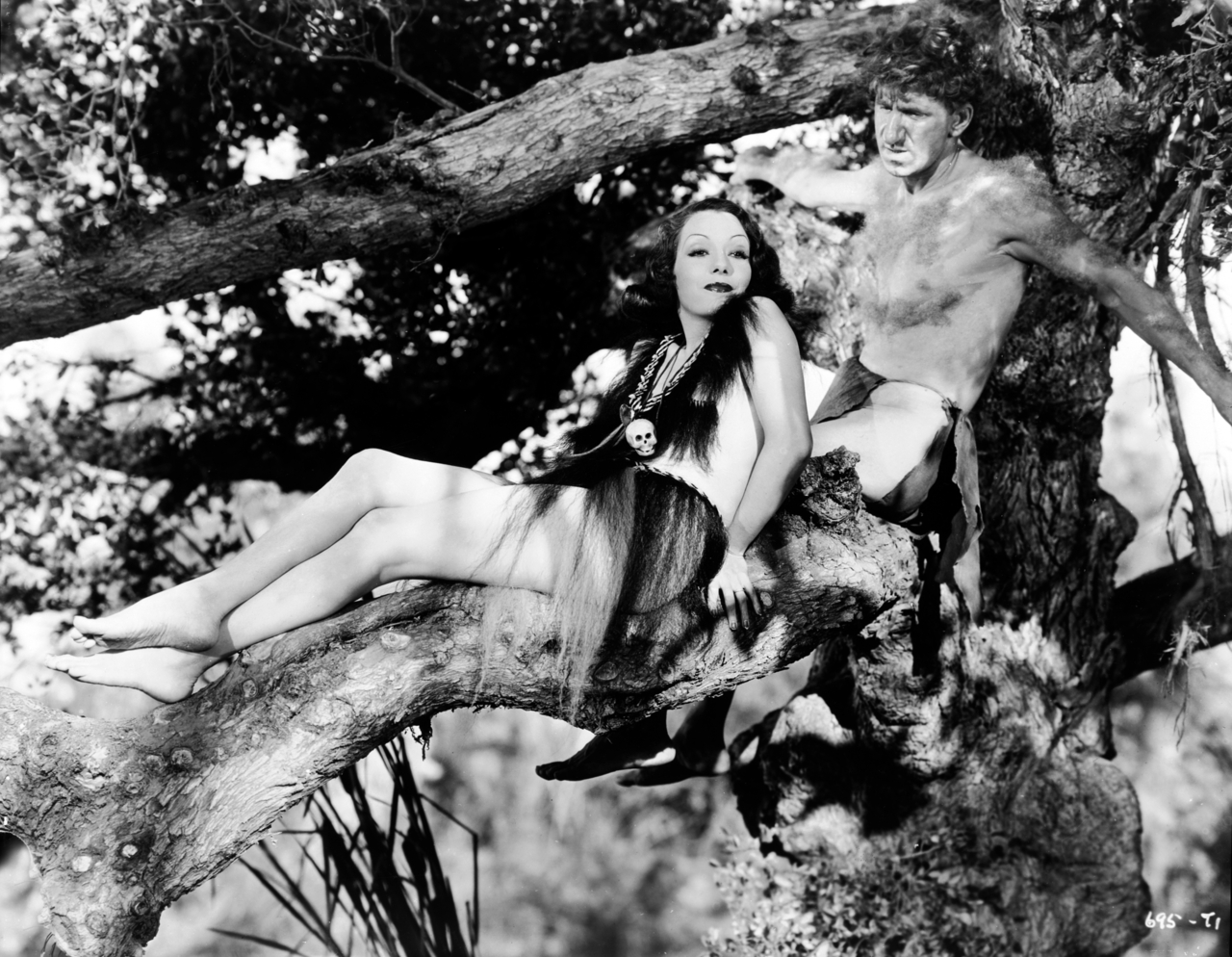
One of the most bizarre films of the Pre-Code (or any) era is HOLLYWOOD PARTY. This practically plotless hodgepodge stars Jimmy Durante as jungle movie hero Schnarzan, whose films are tanking at the box office. The public has grown tired of his battles with “moth-eaten, toothless lions”, so his producer decides to buy new ones from the adventurer Baron Munchausen (radio star Jack Pearl doing his schtick). Schnarzan throws a big Hollywood party for the Baron, hoping to win his favor, but screen rival Liondola (dialect comic Georges Givot), disguising himself as the Grand Royal Duke of Peloponnesia, crashes the bash and tries to buy the lions for himself with the help of Oklahoma oil baron Harvey Crump (the perpetually perplexed Charles Butterworth).
All this is just an excuse for a series of unrelated comic bits featuring some of the era’s top funnymen. Durante, as the nominal star, gets the bulk of the material…
Let me start by stating the obvious. I have seen a lot of horror movies. I love horror as a genre and, in fact, it was my love of horror that first led to me becoming a film blogger in the first place. I have seen a lot of scary and shocking images onscreen. I know the experience of watching a movie and screaming. I also know the experience of watching a horror movie and being bored out of my mind.
I have also seen a lot of home invasion movies. The home invasion genre is not a complicated one. A group of people are isolated and trapped in their home while, outside, some terrible menace tries to enter the house. Night of the Living Dead is a home invasion film. The final 20 minutes of Straw Dogs (both the remake and the original) are home invasion films. Michael Haneke made two of the ultimate home invasion films with two separate versions of Funny Games. And, of course, we can’t talk about the home invasion genre without mentioning the brilliant You’re Next.
The home invasion genre works so well because, at its center, is a very real fear: the fear that, even within our own home, we are not safe. When I get home, I am practically obsessive about checking to make sure that I always close and lock the door behind me but really, what good would that really do if someone was determined to get in? Like everyone, I chose to believe that things like a locked door or a closed window is going to keep me safe but, honestly, if someone wants to get in, they’re probably going to find a way. Locks and alarms and calls to 911 can only do so much. Perhaps for that reason, home invasion movies always frighten me. I can watch a zombie graphically devour someone in an Italian horror film and it doesn’t bother me at all. But a well-directed home invasion movie?
That’ll keep me up for a week!
(And I know what you’re saying: “Lisa, if home invasion movies scare you so much, why do watch them?” It’s a legitimate question and it’s something that I’ve often wondered myself. I think, ultimately, it comes down to this: the only way to conquer our fears is to face them.)
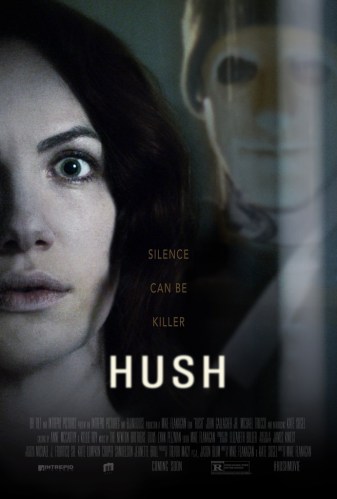
With all that in mind, allow me to now come to the point of this review. Last night, I watched Hush, which was just recently released by Netflix. Hush is a home invasion movie. Kate Siegel (who also co-wrote the script) plays Maddie, a writer who has been deaf and mute since she was 13 years old. Still dealing with the a bad break-up, Maddie lives in an isolate cabin in the wilderness. By day, she works on her second novel and occasionally visits with her neighbor. And by night — well, on this particular night, she finds herself being watched by a man.
The Man (who is played by John Gallagher, Jr.) wears a white mask that gives him a permanent smile. He carries a crossbow with him, a crossbow that has 8 notches on it. When we first meet the man, he’s stabbing Maddie’s neighbor, Sarah (Samantha Sloyan), to death. And now, he’s turned his attention to Maddie…
I say this without hyperbole: Hush is one of the scariest home invasion movies that I’ve ever seen. The plot may occasionally seem familiar but director Mike Flanagan keeps things moving at an almost unbearably intense pace and he creates an atmosphere of such dread that you never feel truly safe assuming that anyone is going to survive the movie. John Gallagher, Jr, who speaks with a deceptively soft voice, is terrifying as the Man. The fact that he has no motives beyond his own sadism makes him all the more frightening.
But, ultimately, the reason the film works so well is because of Kate Siegel. Kate Siegel gets an introducing credit in this film. According to the imdb, Hush is not her first film but that introducing credit still feels appropriate. Siegel is wonderful in the role of Maddie, giving a performance of such ferocity and empathy that Hush announces that a major talent has arrived and that Kate Siegel is a force to be reckoned with.
Hush is not always an easy film to watch. The violence is visceral, the often spurting blood looks real and, when bones were snapped, it sounded disturbingly authentic. Throughout the entire film, I found myself wondering what I would do if I was Maddie. I cheered whenever it appeared that she might be able to escape the Man and I screamed whenever it became clear that she would not. This is an intense and frightening home invasion film and one that all horror fans should see. Hush captures our most primal fears and makes us wonder if we have what it takes to conquer them.
Hush will undoubtedly give me nightmares but I’ll take them.
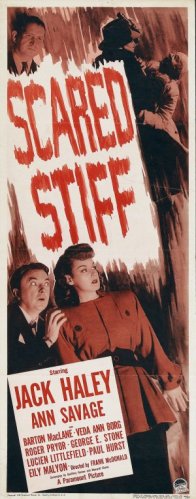
Last night, as a gentle rain fell outside, I watched the 13th film in Mill Creek’s Fabulous Forties box set, 1945’s Scared Stiff. (The version in the box set appeared under the title Treasure of Fear, which was what the title was changed to when the film was later re-released. However, the film was originally entitled Scared Stiff and that’s the title that I’m going to use. Scared Stiff is just a better title and I happen to like the Scared Stiff film poster, featured above. So, just remember that if you ever find yourself watching an old movie called Treasure of Fear, you’re actually watching Scared Stiff.)
As I attempted to watch Scared Stiff, I was reminded of some of the problems that occasionally come with watching a film that has slipped into the public domain.
On the one hand, the public domain is great because it makes it a lot easier to watch old movies. And while it’s true that many public domain films aren’t exactly classics, there are a few gems to be found. For instance, since I started watching the movies in the Fabulous Forties box set, I’ve discovered The Black Book, Trapped, and Jungle Book.
On the other hand, being in the public domain means that virtually anyone can duplicate and sell a copy of the film. As a result, many of these films are available (and frequently viewed) in versions that are of an extremely poor quality and which have often been haphazardly edited.
That’s one reason why it’s going to be difficult for me to review Scared Stiff. The version that I saw was, even for a public domain B-movie, rough. The picture was slightly fuzzy and the sound quality was not the greatest. I don’t think you can ever truly understand that importance of a clean soundtrack until you listen to a scratchy one.
As for Scared Stiff itself, it’s a comedic murder mystery and thankfully, it’s only 65 minutes long. Jack Haley plays a reporter who covers chess tournaments for his uncle’s newspaper. Unfortunately, Haley’s not a very good reporter so his frustrated uncle orders him to go to Grape City so that he can cover a beauty contest, apparently believing that there’s no way that Haley could possibly screw that up.
However, Haley manages to do just that. He gets off the bus at Grape Center, instead of Grape City. He finds himself stranded at an inn that’s run by two twins (both played by Lucien Littlefield). The twins hate each other for reasons that aren’t clear. However, they do possess a chess set that was once owned by Marco Polo! One twin owns the white pieces while the other owns the black pieces! Haley wants to buy all the pieces but things get complicated when it turns out that a gang of thieves are also in town and they want to steal the set for themselves.
But that’s not at all! One of the passengers on the bus is found murdered and he has a chess piece in his hand. Of course, everyone suspects Haley. So, Haley has to get the chess pieces, clear his name, and hopefully get to Grape City before his uncle fires him.
Scared Stiff is way too frantic for its own good and I have a feeling that I would feel the same even if I had seen a version that didn’t sound scratchy or often look fuzzy. That said, it is interesting to see Jack Haley, who is best known for being The Tin Man in The Wizard of Oz, play a human being. Also of interest, to film noir fans, was that Haley’s girlfriend was played by Detour‘s Ann Savage. Both Haley and Savage gave good performances but it was not enough to save this misbegotten little film.
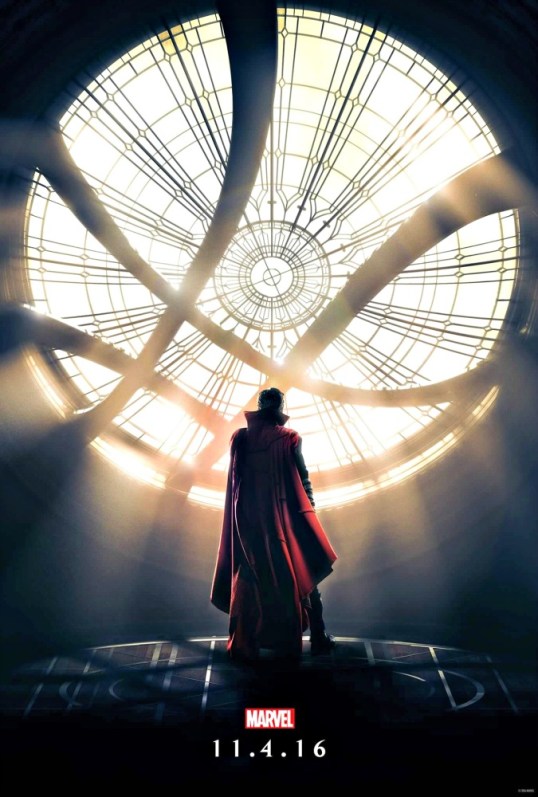
This coming November sees the arrival of not just another new character from the Marvel Comics pages onto the big-screen, but the parting of the curtains to give the Marvel Cinematic Universe it’s first glimpse at the mystical and magical.
The MCU has been mostly about advanced technology, techno-thrillers and a corner or two of the cosmic, but Feige and company has never truly explored the esoteric and occult side of the Marvel Cinematic Universe. With the release of tonight’s teaser trailer for Doctor Strange we will finally get a glimpse into this unseen corner of the MCU.
Doctor Strange is set for a November 4, 2016 release date.
Here’s the latest trailer for A Monster Calls, which is based on a book that I absolutely adore and which everyone needs to read! The trailer looks pretty good and if anyone was born to voice a tree monster, it’s Liam Neeson!
A Monster Calls is coming out this fall, presumably just in time for Oscar season.
Here’s the trailer for the upcoming thriller, Our Kind of Traitor! I have to admit that, having watched the trailer, I have mixed feelings. I love Ewan McGregor but I am so sick of movies featuring Russian mobsters.
My love for Ewan will be put to the test on July 1st!
THE BEGUILED was the third of five collaborations between star Clint Eastwood and director Don Siegel. It’s definitely the most offbeat, a Gothic Western set during the Civil War. Clint plays John McBurney, a wounded, half-dead Yankee found in the woods by one of the girls from Miss Martha’s Seminary for Young Ladies. What unfolds from there is unlike anything the duo ever did before or after, a tale of sexual desire and vengeance that’s one of the most unusual entries in the Western canon.
Clint Eastwood has one of his most unsympathetic roles as McBurney. Although we feel bad about the condition he’s in, we soon realize what an amoral, manipulative scoundrel he is. Flashbacks reveal his lies about his role in the Union Army. Even as he suffers some major “misery” (hint, hint) at the hands of Miss Martha, Clint’s McBurney isn’t a likeable figure. This offbeat casting probably contributed to the…
What’s an Insomnia File? You know how some times you just can’t get any sleep and, at about three in the morning, you’ll find yourself watching whatever you can find on cable? This feature is all about those insomnia-inspired discoveries!
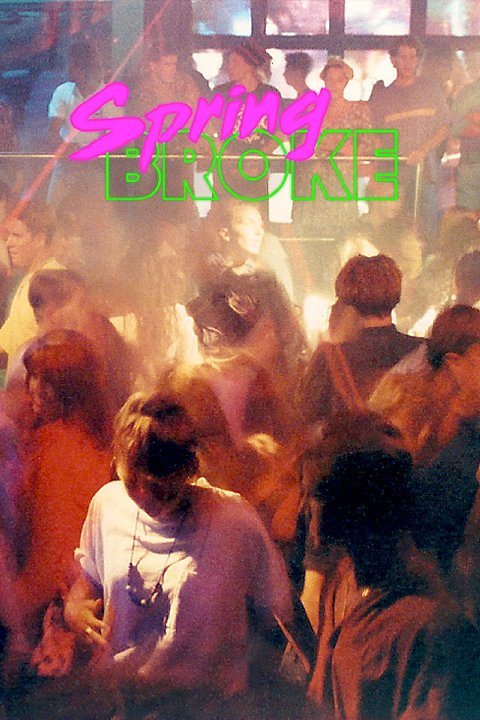
If you were up at 12 midnight last night (and really, who wasn’t?), you could have turned over to Showtime and watched a new documentary called Spring Broke.
I have to admit that the main reason I watched Spring Broke was because I assumed that it would be a light-hearted and mostly empty-headed celebration of spring break decadence. I always loved spring break and really, the worst part of graduating from college was that I lost that one week out of the year when you could basically do absolutely anything without having to worry about any negative consequences.
But it turns out I was wrong. Spring Broke does feature a few scenes of sandy decadence but, for the most part, it focuses more on the business aspect of spring break than on the fun. It starts with footage of clean-cut, square-jawed college students partying in Florida in the late 50s and the early 60s and then follows as spring break gets progressively wilder and, in some ways, far more dangerous. As one observer points out, when you have 20 drunk college students jumping off a balcony and into the pool below, only 19 are going to make it into the water. One out of the 20 is always going to end on the pavement “splattered like a watermelon.” Spring Broke is one of those documentaries that claims to show how a good thing eventually fell apart. What does Spring Broke blame for the corruption of spring break?
Capitalism, of course. But that’s not surprising. It’s very rare that you see a documentary that doesn’t blame everything on capitalism.
Spring Broke is basically a collection of talking head interviews, mixed in with footage of past spring breaks. As is typical for many documentaries, the various interviewees can split into three separate and distinct groups:
First off, there’s the faded celebrities. These are people who used to be famous but who you probably really haven’t thought about recently. It’s rare that the celebrities ever have anything interesting to say but, for marketing purposes, they have to be present in the film. The main Spring Broke celebrity is Pauly Shore.
Secondly, there’s the people who were actually involved with the documentary’s subject matter but who worked behind-the-scenes. They give the inside details of what was really going on. These people usually aren’t as smooth in their delivery as the faded celebrity but, because they were actually there, they are still often interesting to listen to. In Spring Broke, this group of people is made up of a collection of businessmen, nightclub managers, resort owners, local politicians, and MTV executives. The businessmen and the politicians had the most interesting stories to tell (and I especially enjoyed the interview with the cantankerous old man who took it upon himself to try to save Florida from insane spring breakers, largely because he reminded me of twitter mainstay Leo Mcallister) but I have to admit that I always find it interesting when MTV executives show up in documentaries. That’s because the MTV executives (as opposed to the on-air talent) almost always turn out to be the blandest and most boring people interviewed and that pattern continues with Spring Broke. (One exec even uses the term “synergy” without a hint of irony.)
And then finally, every documentary has to interview an expert. The expert is someone who has nothing to do with the subject of the documentary but who has still written a book about it. You can always tell who the expert is supposed to be because they’re usually the least attractive person in the film. Spring Broke‘s expert had bad teeth and hipster glasses.
Spring Broke was a fairly interesting documentary. Clocking in at a fast-paced 78 minutes, Spring Broke didn’t always go into as much depth as I wanted it to. For instance, I would have preferred to have heard more about the conflict between the spring break-loving businessmen and the spring break-hating townspeople. But as an anthropological history and a look at how economics shape culture, it’s an interesting look at the surface that hints at a bigger story underneath.






 Through the Shattered Lens