Film Review: Beyond the Grave (dir by Davi de Oliveira Pinheiro)


Poster_Engl

Beyond the Grave is an intriguingly enigmatic film about the end of the world.

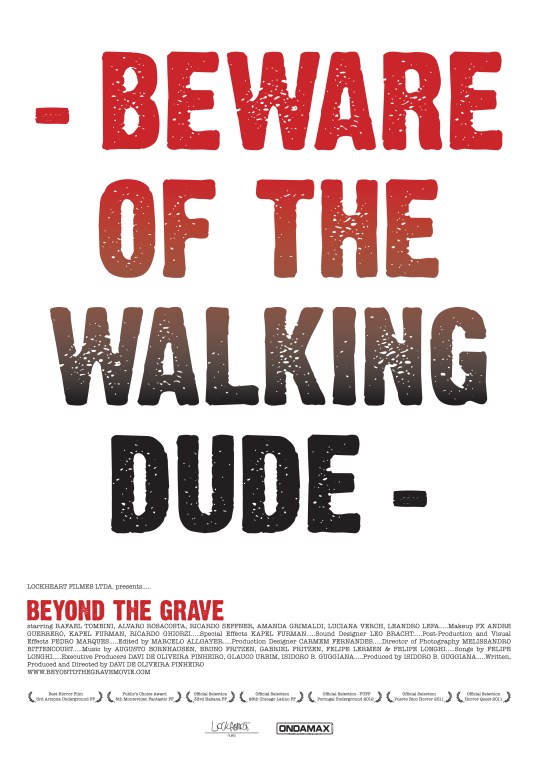
Why was the world ended?  To the film’s credit, this is left intentionally vague.  Some characters mention that the “Seven Gateways of Hell” have been opened.  (Just the term “Seven Gateways of Hell” pays wonderful homage to Lucio Fulci’s horror classics, The Beyond and City of the Living Dead.)  At one point, we spy some graffiti reading, “Beware the Walking Dude,” which, of course, brings to mind the apocalyptic fiction of Stephen King.  Occasionally, small groups of “returners” are seen aimlessly wandering up and down empty highways.  Are they zombies or are they something else?  Occasionally, on the radio, a disembodied voice is heard over a car radio.  “This is the end of the world,” the voice says, “If you are listening to this, it is already too late.”

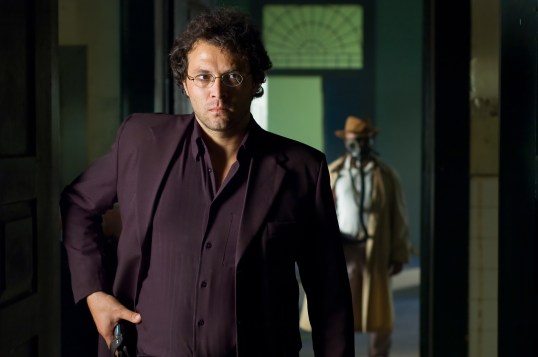
One thing that quickly becomes obvious is that there’s very few “normal” people left alive.  One of these is a mysterious and enigmatic man known as the Officer (Rafael Tombini).  The Officer, who carries both a sword and a gun that carries only one bullet, drives a police car over the deserted landscape and dispenses his own form of justice.  Who he works for or if there’s any sort of controlling legal authority left in this world is another issue that the film leads intriguingly vague.

(I appreciated the fact that the film — much like Romero’s original Dead films and Cormac McCarthy’s The Road — only hinted at what had causes it’s world-changing cataclysm.  When it comes to end of the world, there should never be any simple answers.)

The Officer is hunting a demonic force known as the Dark Rider and, as he explains, it’s a search that he began before the world even ended.  (And, indeed, we saw in a brief flashback that the Dark Rider existed even when there was still civilization.)  Throughout the film, the Dark Rider jumps from body to body, all the while uttering, “What is near me, shall become mine.”

Working with two teenagers, the Officer searches the Dark Rider, taking time to only briefly rest at a compound.  When, about 42 minutes into the film, the Officer finally tracks the Rider down, something totally unexpected happens, something that forces the audience to reconsider everything that they had previously assumed about how the film was going to work.  I’m not going to tell you what happens.  That’s something you should discover for yourself.

Beyond the Grave is a visually stunning hybrid of a film.  It’s a western, a zombie movie, a postapocalyptic action film, and a philosophical rumination of man’s place in the universe, all wrapped up in one!  Director Davi de Oliveira Pinheiro gets the most out of the film’s bleak locations and Rafael Tombini gives an excellent lead performance as the enigmatic Officer.  Beyond the Grave is an intriguing film, both for the questions it answers and for the ones that it leaves unanswered.  It’s a film that any horror fan should see and will appreciate.

Still_02

Back to School #46: Heathers (dir by Michael Lehman)


heathers-movie-poster

Well, it had to happen.  We have finally reached the end of the 80s with this Back to School series of reviews.  The 80s are often considered to be the “Golden Age of Teen Films,” largely due to the efforts of director-writer-producer John Hughes.  In films like The Breakfast Club and Ferris Bueller’s Day Off, Hughes skillfully mixed teen comedy with teen drama and the end results were some of the best-remembered and most influential films ever made.  At the same time, it’s also can’t be denied that, even as he was dealing with real issues of class differences and sexuality, Hughes also tended to idealize his teenage protagonists.  They were often cast as noble savages, struggling to survive in a world that was exclusively run by cynical and judgmental adults.  In The Breakfast Club, Ally Sheedy says that when you grow up, your heart dies.  That, more than anything, defines the way that most of the great teen films of the 80s tended to view the world.

By the end of the 80s, John Hughes had stopped making films about high school and teenagers and so, it is perhaps appropriate that the final Back to School review of the 80s should be for a 1989 film that often time seems to be taking place on a totally different plant from the films of John Hughes.  If Hughes told us that your heart dies when you grow up, Heathers would seem to suggest that most people’s hearts were never alive to begin with.

Heathers takes place at Westerburg High, a school full of student so rich that their mascot is a Rottweiler.  Westerburg is run by a clique of three mean girls, all of whom are named Heather.  Heather Chandler (Kim Walker) is their leader.  Cheerleader Heather McNamara (Lisanne Falk) is weak-willed and insecure.  And finally, Heather Duke (Shannen Doherty) is the smartest of the Heathers.  She’s also bulimic.  Now, there is a fourth member of the ruling clique but she’s a bit of an anomaly because she’s neither mean nor named Heather.  Instead, her name is Veronica (Winona Ryder) and she is valued for her ability to forge signatures.

Heathers

Since joining the Heathers, Veronica has drifted away from old friends like Betty Finn (Renee Estevez).  And though Veronica quickly realizes that she doesn’t really belong with the Heathers, she doesn’t know how she can break free without also destroying her reputation of Westerburg.  Then, she meets J.D. (Christian Slater), a prototypical rebel with a cause.  J.D. is not only an outsider at Westerburg but he’s proud of it.  Soon, he and Veronica are a couple and J.D. is pulling Veronica into his plans to destroy the social hierarchy of Westerburg High.

When a practical joke arranged by J.D. and Veronica leads to the accidental death of Heather Chandler, J.D. convinces Veronica to forge a suicide note.  As a result, Heather Chandler is canonized by the same students that she previously terrorized.  However, J.D. is not done killing.  With each new death (and with each forged suicide note), a new social hierarchy starts to form at Westerburg until, eventually, J.D. comes up with a plan that owes a bit to the end of Massacre at Central High

fashion-film-volume-8-heathers--large-msg-132147013822

Heathers is a darker than dark comedy and one that I imagine probably could not be made today.  (To be honest, I’m a little bit surprised that it could be made in 1989.)  Seriously, a comedy where one of the main plot points is that students become more popular after everyone has been fooled into thinking they committed suicide?  (Not to mention a scene where a grieving father shouts, “I love my dead gay son!”)  People would get so offended if this film was made today but you know what?  They would be totally missing the point.  The film isn’t making fun of suicide as much as it’s exposing the hypocrisy of a society that only seems to care about people after they die. To me, the most important scenes aren’t the ones where people react to the fake suicides.  Instead, the heart of Heathers‘s dark vision is to be found in the scene where a true outcast like Martha Dunnstock (Carrie Lynn) fails in her attempt to commit suicide and is ridiculed by the same students and teachers who were previously patting themselves on the back at Heather Chandler’s funeral.

Heathers is dark but it’s also a genuinely funny film, filled with great lines and performances.  (“Fuck me gently with a chainsaw,” is my personal favorite.)  It’s a film that still carries quite a satiric bite and a perfect film with which to end the 80s.

8-Heathers-quotes


George Romero Picks Up Where He Left Off With “Empire Of The Dead : Act Two” #1 — But What About Everyone Else?


4087873-01

I’ll admit that it brands as being in a tiny minority, but George A. Romero’s Empire Of The Dead  is my favorite ongoing zombie story right now. I’ve long since given up hope for The Walking Dead as both a TV series — blasphemy to some around these parts, I know — and a monthly comic,  with Kirkman and his cohorts long having since lost the plot, in my view, in both of that franchise’s iterations, but good ol’ George, after stumbling out of the gate a bit in Act One of this, his latest (and first printed-page) undead epic, really seems to be in the midst of getting a damn solid little tale going here, and I couldn’t be happier about it. Well, actually, I suppose I could 

For one thing, the second five-issue arc of what’s slated to be a 25-parter (bearing the official copyright title this time of George Romero’s Empire Of The Dead Act Two #1) starts off with some notable changes on the creative front. Gone is artist extraordinaire Alex Maleev, who towards the end of the first series was blowing some deadlines (not that his art wasn’t worth the wait, it most certainly was), and in is Dalibor Talajic, fresh from drawing two rather unremarkable Dexter min-series for Marvel (not that it was his fault — his illustrations were fine, but Jeff Lindsay really mailed it in on the script front, particularly in the atrocious second series,  Dexter Down Under, which is a bit of a shock given that he, ya know, created the character and everything), and who, like his predecessor, is tackling both the penciling and inking duties on the book. Talajic’s art is fine as far as these things go — and his style seems to have taken a healthy leap forward from that aforementioned Dexter work — but the change is still a jarring one, and overall the look of the series has changed from grim and gritty “naturalistic” horror to more standard-issue Marvel Comics “house style” renderings, so that’s kind of a drag. I knew the switch was coming, and it’s a little less violent than I’d feared, but — I dunno. No offense to Talajic, but I think that if bringing on a new artist was inevitable, a guy like Declan Shalvey, for instance, would have been a better fit.

Maleev’s off the cover assignment, too, but if the work of new cover artist Alexander Lozano is any indication, we’re in good hands on that front. Yeah, admittedly, the scene depicted on the cover shown above doesn’t actually happen in the book, but so what? It’s still got a classic “old-school horror comic” vibe to it and wouldn’t feel at all out of place adorning the front of an old Warren mag like Creepy  or Eerie. I liked it a lot, and I think most other readers will, as well.

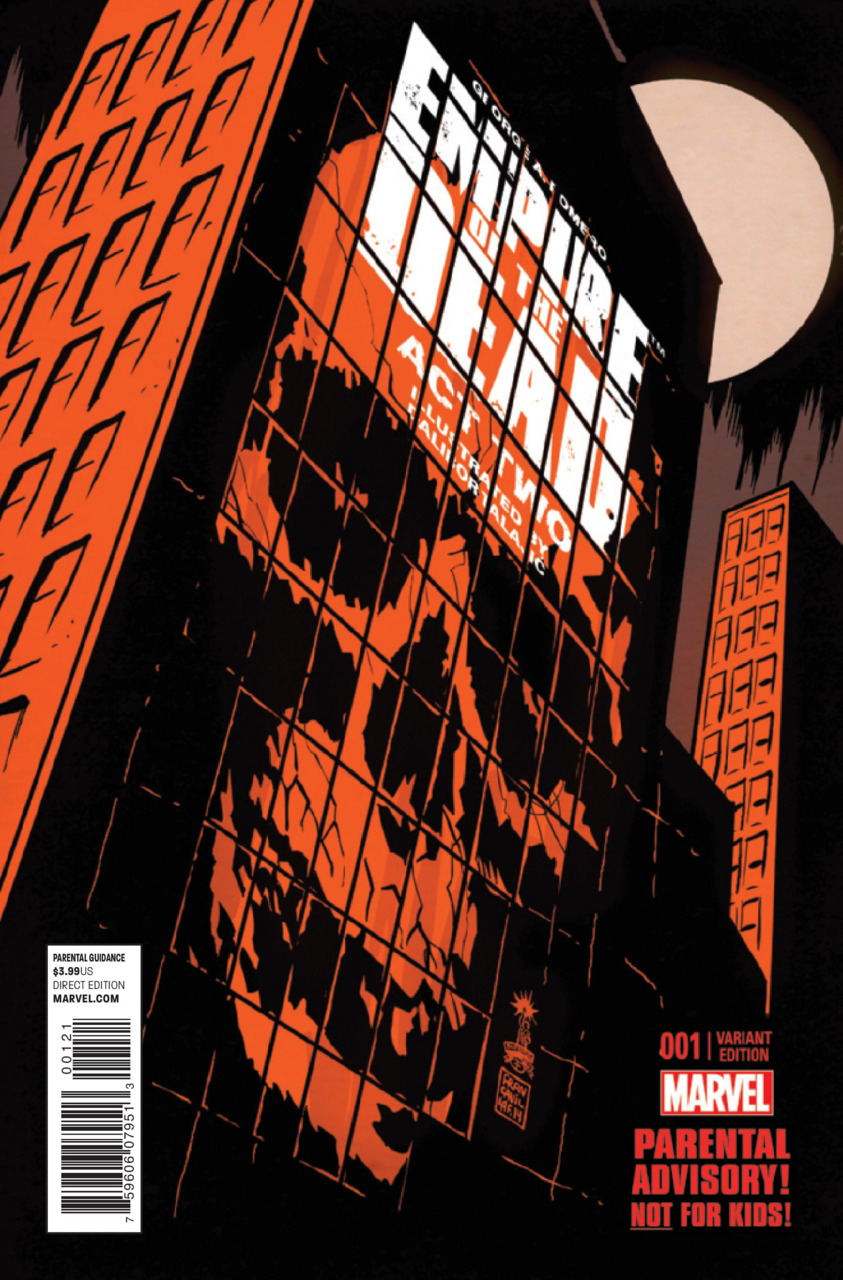
There’s also been a change of artists for the variant covers, but again, this is no problem in my estimation. Yes, Arthur Suydam’s “NYC” cover series was a blast, but when you’ve got Francesco Francavilla stepping up to the plate in his absence, well — who’s complaining? This guy has been one of my favorite cover artists for years now (have you seen the incredible work he’s been doing on Dynamite’s new Twilight Zone comic?), and my only gripe about his alternate cover for this issue (as shown below) is that my LCS didn’t get a single copy of it, otherwise you can bet that I would’ve snapped it up pronto.

4088277-01-variant

On the story front, I’m pleased to report that Romero is continuing the steady roll he’s been on since the fourth issue of Act One which is when, for my money, things really started kicking into another gear. As with most first issues (although whether or not this can actually be considered a “first” issue is debatable, I suppose), we’re in “pure set-up” mode here, but the payoffs to the various storylines that are running look like they’re going to be big, provided the father of the entire modern zombie revival doesn’t drop the ball. Semi-intelligent “walker” (whoops, wrong comic) Xavier seems to be making a quantum leap forward in becoming “civilized” under the tutelage of Dr. Penny Jones, and has formed a real emotional bond with her wayward young friend (whose name, in case you’d forgotten — as I admit I had — is Jo), and shares a secret with her that most likely will shake the entire series to its core. Dr. Jones, for her part, seems to be torn between responding to the romantic advances of the vampiric Mayor Chandrake and his head “zombie wrangler,” Paul Barnum, but rest assured there’s more to that situation than meets the eye — Barnum hints that he’s keeping a pretty big secret himself, and the Mayor, while not one to lose any sort of contest (and he drops some ominous threats to that very effect), may be forced to devote more of his attentions elsewhere, as the campaign to unseat him currently being waged by his nephew, Billy, seems to be gaining some traction. But is Billy really driving this train — or is he being set up for a spectacular “crash and burn” come-uppance?

And speaking of being set up — what of southern rebel-rouser Dixie Peach and her newly militarized entourage? A major development occurs in this issue that may end up marking her as  expendable to her own cause. I admit that the timelines attached to some of these various plot-threads do seem a bit garbled, and probably could’ve benefited from an eidotr who was paying somewhat closer attention ( the Xavier subplot seems to have advanced by several days, if not weeks, as has the mayoral race, while the subplot involving Dixie Peach and her no-longer-quite-allies seems to be picking up more or less right where it was left hanging in Act One), but if that all sounds intriguing to you — and trust me when I say it is — then put your reservations about the change behind this book’s drawing board aside, and queue up for the rest of Act Two, because it appears it could be quite a memorable ride.


Back to School #45: Say Anything… (dir by Cameron Crowe)


220px-Say_Anything

For the past two and a half weeks, we’ve been taking a chronological look at some of the best, worst, most memorable, and most forgettable teens films ever made.  We started with two films from 1946 and now, 43 films later, we’ve reached the end of the 80s.  And what better way to close out the decade that is often considered to be the golden age of teen films than by taking a look at two films from 1989 that both paid homage to the films that came before them and also served to influence the many films that would come after.

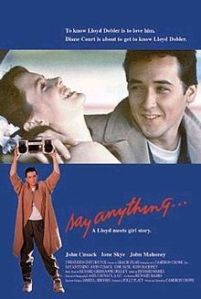
When people talk about Say Anything…, they usually seem to talk about the fact that it was the directorial debut of Cameron Crowe (who, it must be said, launched the golden age of teen films by writing Fast Time At Ridgemont High) and that it features what may be John Cusack’s best performance.  Famously, Cusack apparently felt that — after performances in Class, Sixteen Candles, and Better Off Dead — he was through playing teenagers.  But then he read Crowe’s script and was so impressed by it that he agreed he would play a student one last time.

It may, however, have helped that the character Cusack plays, a likable and easy-going kickboxing enthusiast named Lloyd Dobler — is only briefly seen as a student.  He graduates from high school early on in the movie.  That majority of Say Anything… deals with the summer right after high school.*  Lloyd has an unlikely but heartbreakingly real romance with Diane Court (Ione Skye), the valedictorian.

Cusack is so charming as Lloyd (and, needless to say, he gets all of the best lines) that I think people tend to overlook the fact that Ione Skye is equally as good.  Diane is actually a far more challenging role than Lloyd.  Whereas Lloyd is distinguished by his confidence and his friendly manner, Diane is neurotic, shy, and unsure of herself.  She’s won a scholarship to study in England and is scheduled to leave at the end of the summer but she’s scared of flying.  Even worse, her father, Jim Court (John Mahoney), is being investigated by the IRS.  As the summer progresses, Diane is forced to deal with the fact that not only has her seemingly perfect father broken the law but, when he’s confronted with his crimes, he uses his daughter as his excuse.  Yes, Jim seems to be saying, I stole money but I only did it to give you the best life possible.

Everyone seems to remember Say Anything… as the film that has that scene where Lloyd serenades Diane by holding that radio over his head.  And yes, that’s a wonderfully romantic scene, even if it’s been parodied so many times that it’s probably no longer as effective as it was when the film was first released.  But for me, Say Anything… is truly about Diane growing up and realizing that her father is not the saint that she thought he was.  (Making this realization especially upsetting is the fact that, initially, Mahoney is so likable in the role.)  You’re happy that Lloyd is there for her and you truly do come to love him because he is the perfect boyfriend, but ultimately, Say Anything… is Diane’s story.

(That said, though, I have to admit that some of my favorite scenes are just Lloyd talking to his friends.  Lili Taylor gives a great performance and how can you not laugh at Jeremy Piven hanging out at the convenience store?)

Ultimately, of course, the film works because both Lloyd and Diane come across as real human beings.  They’re not just boyfriend and girlfriend.  Instead, they’re two very likable characters who have been lucky enough to find each other.  In the end, you love Lloyd not because he’s funny or quirky but because he loves Diane for who she is.

Of course, it also helps that Say Anything has the perfect ending.

Ding!

Say-Anything_199

—-

* On a personal note, the summer after I graduated high school was the best summer of my life because I spent most of it in Italy!  Viva Iatalia!

Back to School #44: Some Kind of Wonderful (dir by Howard Deutch)


some_kind_of_wonderful

For the past two and a half weeks, I’ve been reviewing, in chronological order, some of the best, worst, most memorable, and most forgettable teen films ever made.  We started with two films from 1946 and now, we find ourselves coming to the close of the decade that is often considered to be the Golden Age of teen films, the 1980s.  For our 44th entry in Back to School, we take a quick look at 1987’s Some Kind of Wonderful.

Why a quick look?

Because, quite frankly, there’s not that much to say about it.

Some Kind of Wonderful is a story about an artistic, lower-class misfit who has a crush on one of the popular kids.  The only problem is that the popular kid is being cruelly manipulated by one of the richest students in school.  The misft also has a best friend who is totally in love with the misfit but the misft has somehow failed to notice this.  Eventually, the misfit does get to date the popular kid.  Both the popular kid and the misft are given a hard time by the members of their collective clique but they still manage to go on one truly amazing date.  Finally, the film ends with a big show down at a party and two people kissing outside.

Sound familiar?

If it does, that probably means that you’ve seen Pretty In Pink.  Some Kind of Wonderful is basically a remake of Pretty In Pink, the only difference being that the genders have been reversed and that the film is a lot more heavy-handed (and predictable) when it comes to examining class differences.   (Not coincidentally, both films were written by John Hughes and directed by Howard Deutch and it must be said that when it comes to Some Kind of Wonderful, it’s easy to feel that both of them were simply going through the motions.)  The misfit is an aspiring painted named Keith (Eric Soltz).  His best friend is a drummer named Watts (Mary Stuart Masterson).  The object of Keith’s affection is Amanda (Lea Thompson).  Unfortunately, even though she lives in the same poor neighborhood as Keith and Watts, Amanda is dating the rich (and therefore, evil) Hardy (Craig Sheffer).

Some-Kind-of-Wonderful-some-kind-of-wonderful-2841626-1024-768

When Keith finally works up the nerve to ask out Amanda, he doesn’t realize that she’s just broken up with Hardy and is on the rebound.  Watts is skeptical, telling Keith, “Don’t go mistaking paradise for a pair of long legs,” and I’m just going to admit that, as the proud owner of a pair of long legs, that line really annoyed me.  I guess it’s because I’ve known people like Watts, who always act like there’s something wrong with wanting to look good.

Shut up, Watts.

Shut up, Watts.

With the help of Watts and Duncan (Elias Koteas), the school bully that Keith managed to befriend in detention, Keith takes Amanda out on an amazing date and shows her a wonderful portrait that he’s painted of her.  At the same time, Hardy — angry because someone from a lower class is now dating his ex-girlfriend — starts to plot his own revenge…

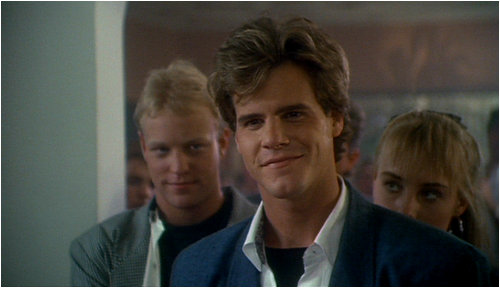
There are some positive things about Some Kind of Wonderful.  There are two really good and memorable scenes that, momentarily, manage to elevate the entire film.  There’s the moment when Keith shows Amanda the painting.  And then there’s the erotically charged scene in which Keith and Watts practice how to kiss.  Koteas, Thompson, and Masterson all gives good performances.  Eric Stoltz is, at times, a bit too intense to sell some of the film’s more comedic moments but overall, he’s well-cast here.  (In fact, the only performance that I really didn’t care for was Craig Sheffer’s.  Sheffer one-dimensional villain only served to remind me of how good James Spader was in Pretty In Pink.)

That's no James Spader

That’s no James Spader

And yet, there’s just something missing from Some Kind of Wonderful, something that keeps this film from being … well, wonderful.  I have to wonder if I had never seen Pretty In Pink, would I have thought more of Some Kind of Wonderful?  Perhaps.  Whereas Pretty In Pink was full of the type of small details and clever moments that make it a joy to watch and rewatch, Some Kind of Wonderful is one of those films that you can watch once and enjoy it without ever necessarily feeling the need to ever watch it again.

Eric Stoltz is going to kill someone

Back to School #43: River’s Edge (dir by Tim Hunter)


In his film guide, Heavy Metal Movies, Mike McPadden describes the disturbing 1987 teen crime drama River’s Edge as being “666 Candles“.  It’s a perfect description because River’s Edge appears to not only be taking place in a different socio-economic setting than Sixteen Candles and The Breakfast Club but perhaps on a different planet as well.

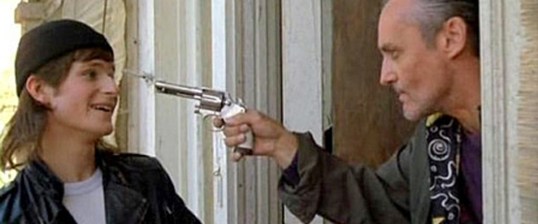
River’s Edge opens with a close-up of a dead and naked teenage girl lying on the edge of a dirty, polluted river and it gets darker from there.  The dead girl was the girlfriend of the hulking John Tollet (Daniel Roebuck, playing a character who is miles away from his role in Cavegirl).  As John explains to his friends, he strangled her for no particular reason.  His friends, meanwhile, respond with detachment.  Their unofficial leader, the hyperactive Layne (Crispin Glover), insists that since nothing can be done about the dead girl, their number one concern now has to be to keep John from getting caught.  While Layne arranges for John to hide out with a one-legged drug dealer named Feck (Dennis Hopper), two of John’s friends, Matt and Clarissa (played by Keanu Reeves and Ione Skye), consider whether or not they should go to the police.  Oddly enough, John really doesn’t seem to care one way or the other.

Seriously, River’s Edge is one dark film.  If it were made today, River’s Edge would probably be directed by someone like Larry Clark and, in many ways, it feels like a distant cousin to Clark’s Bully.  The teenagers in River’s Edge live in a world with little-to-no adult supervision.  Matt’s mom is more concerned with whether or not Matt has been stealing her weed than with the fact that Matt might be covering up a murder.  The local high school teacher is a former hippie who won’t shut up about how much better his generation was compared to every other generation.  In fact, the only adult with any sort of moral code is Feck and he’s usually too busy dancing with a sex doll to really be of much help.  It’s a world where no one has been raised to value their own lives so why should they care about a dead girl laying out on the banks of the river?

The film features good performances from Keanu Reeves, Ione Skye, and Daniel Roebuck but really, the entire movie is stolen by Crispin Glover and Dennis Hopper.  In the role of Layne, Glover is a manic wonder, speaking quickly and gesturing even when he isn’t making a point.  When Layne first shows up, he seems like he’s just overly loyal to his friend John but, as the film progresses, it becomes more apparent that he’s less concerned about protecting John and more interested in ordering other people to do it.  For Layne, protecting John is ultimately about maintaining power over Matt, Clarissa, and the rest of their friends.

As for Dennis Hopper — well, this is one of those films that you should show to anyone who says that Hopper wasn’t a great actor.  The role of a one-legged drug dealer who lives with a sex doll sound like exactly the type of role that would lead Hopper to going totally over-the-top.  Instead, Hopper gave a surprisingly subtle and intelligent performance and, as a result, he provided this film with the moral center that it very much needs.

Glover and Hopper


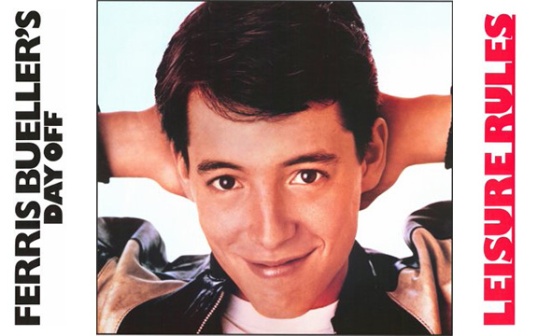
Back to School #42: Ferris Bueller’s Day Off (dir by John Hughes)


ferris-buellers-day-off-movie

Life moves pretty fast. If you don’t stop and look around once in a while, you could miss it. — Ferris Bueller (Matthew Broderick) in Ferris Bueller’s Day Off (1986)

While I was rewatching the 1986 John Hughes comedy Ferris Bueller’s Day Off for this review, I found myself thinking about all of the days (or, to be more precise about it, half-days) that I took off back when I was in high school.  It wasn’t that I didn’t like school.  Though I certainly didn’t truly appreciate it at the time, I actually had a pretty good time in high school.  I had an interesting and diverse group of friends.  I had lots of drama and lots of comedy.  I got good grades as long as it wasn’t a Math class.  (Drama, History, and English were always my best subjects.)  My teachers liked me.  But, at the same time, I couldn’t help but resent being required to go to school.  I do not like being told that I have to do something.

So, I would skip on occasion.  For some reason, it always seemed like my favorite classes were early in the day.  So, I’d go to school, enjoy myself up until lunch, and then me and a few friends would casually walk out of the building and we would be free!  There was a Target just a few blocks down the street from our high school and sometimes we’d go down there and spend a few hours shoplifting makeup.  Eventually, we did get caught by a big scary security guy who threatened to call our parents, made us return everything that we had hidden in our purses and bras, and then told us that we were never to step foot in that Target ever again.  And you know what?  In all the years since, I have yet to step back inside of that Target.

Interestingly enough, with all of the times that we skipped school, the worst thing that ever happened to me or any of my friends is that we got banned from Target.  We all still graduated, most of us still went to college, and, as far as I know, none of us have ever been arrested for a major crime.  None of us ever regretted missing any of the classes that we skipped.  For all the talk of how skipping school was the same thing as throwing away your future, it really was not that big of a deal.

ferrris38

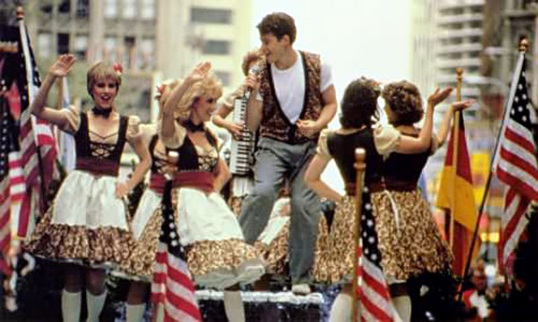
I think that’s one reason why, despite being nearly 30 years ago, Ferris Bueller’s Day Off is a film that continues to speak to audiences.  It’s a film that celebrates the fact that sometimes, you just have to take a day off and embrace life.  Technically, Ferris, Cameron (Alan Ruck), and Sloane (Mia Sara) may be breaking the law by skipping school and you could even argue that they’ve stolen Cameron’s dad’s car.

But, who cares?

You know who probably had perfect attendance in high school?  Principal Rooney (Jeffrey Jones) and seriously, who wants to grow up to be like that douchebag?

FerrisBueller_034Pyxurz

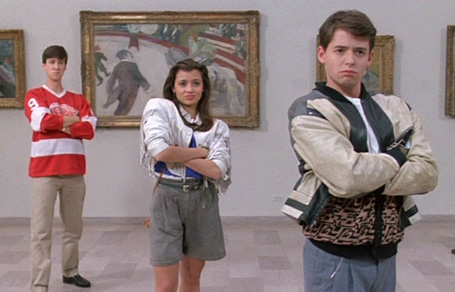
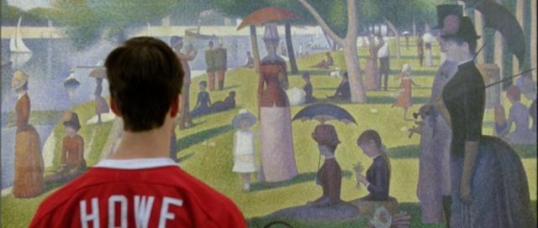
Whenever I do watch Ferris Bueller (and I’ve seen it more times than I can remember because seriously, I freaking love this movie!), I always find myself wishing that real-life could be as much fun as the movies.  As much as I may have enjoyed skipping school and shoplifting, it’s nothing compared to everything that Ferris does during his day off!  Ferris goes to a baseball game!  He takes his friends to a fancy restaurant!  He goes to an art museum!  (And, much like Sloane, my heart swoons at this point because I would have loved to have known a guy who would skip school so he could specifically go to the museum.)  Perhaps most importantly, he encourages his best friend Cameron to actually have a good time and enjoy himself.

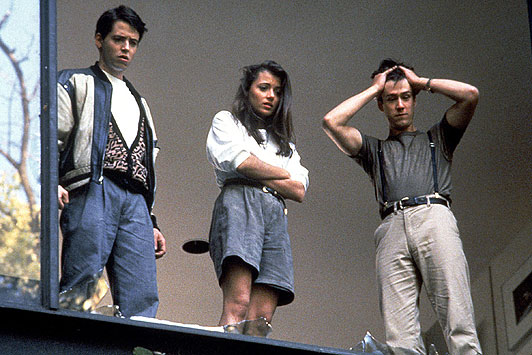
Ferris, Sloane, and Cameron

In Susannah Gora’s book You Couldn’t Ignore Me If You Tried, an entire chapter is devoted to the making of Ferris Bueller’s Day Off and, to be honest, it’s actually makes for rather melancholy reading.  Ferris Bueller was the last teen film that John Hughes directed and the book suggests that a lot of this was due to the fact that Hughes didn’t have as good a time making the film as audiences would later have watching it.  In the book, Mia Sara speculates that Hughes never bonded with the cast of Ferris Bueller in the same way that he did with the casts of Sixteen Candles and The Breakfast Club.

gal_ferris_bueller_02

And indeed, it’s hard to imagine either Ferris Bueller or Matthew Broderick popping up in either one of those two films.  Ferris is far too confident to relate to the angst-driven worlds of Sixteen Candles, The Breakfast Club, or Pretty in Pink.  True, he doesn’t have a car and his sister (Jennifer Grey) resents him but otherwise, Ferris’s life is pretty much care-free.  Not only does he live in a beautiful house but he’s also already come up with a definitive philosophy for how he wants to live his life.  You look at Ferris and you know that he probably grew up to be one of those people who ended up working on Wall Street and nearly bankrupted the country but you don’t care.  He’s too likable.

ferrisbuellerkj09-05-26

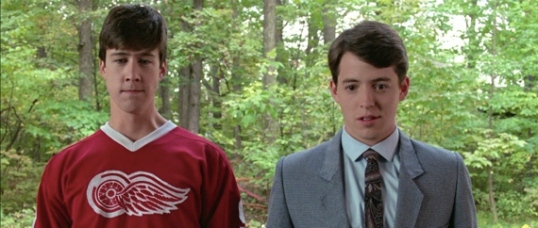
His best friend, Cameron, is far more angsty but even his overwhelming depression doesn’t seem like it would be at home in any of Hughes’s other films.  If Cameron was a member of the Breakfast Club, he’d probably just sit in the back of the library and zone out.  Regardless of how much Judd Nelson taunted him, Cameron would stay in his shell.  If Cameron was in Sixteen Candles, it’s doubtful he would have been invited to the party at Jake Ryan’s house in the first place.  His depression is too overwhelming and his angst feels too real for him to safely appear in any film other than this one.  As a character, Cameron could only appear in Ferris Bueller’s Day Off because only Ferris Bueller would be capable getting Cameron to leave his bedroom.  On the one hand, the film may seem like a well-made but standard teen comedy where a lovable rebel defeats a hateful authority figure.  But, with repeat viewings, it becomes obvious that Ferris Bueller is truly about the battle for Cameron’s damaged soul.

ferris2.preview

There’s a prominent theory out there that the entire film is supposed to be Cameron’s daydream and that Ferris either doesn’t exist or he’s just a popular student who Cameron has fantasized to be his best friend.  I can understand the theory because Cameron really is the heart of the movie.  At the same time, I hope it’s not true because, if this is all a fantasy, then that means that Sloane never said, “He’s going to marry me,” while running back home.  And that would be heart-breaking because I love that moment!

628x471

Ferris Bueller’s Day Off may have John Hughes final teen film as a director (he would go on to write and produce Some Kind of Wonderful) but at least he went out on a true high note.

FerrisBueller-532_1444534a

Trailer: Fury (International)


Fury-2014-Movie-Banner-Poster

I must admit that World War II films are a favorite of mine. Even bad ones I tend to enjoy. Whether it’s alternate fantasy fares like Tarantino’s Inglourious Basterds or something that combines historical accuracy with dramatic license like Spielberg’s Saving Private Ryan, the World War II genre always manage to hit straight and true to my film wheelhouse.

This October there looks to be another World War II film that seems almost tailor-fit for me. I’m talking about David Ayer’s follow-up to his underappreciated film End of Watch. This follow-up is Fury and tells the story of an American tank crew in the waning days of World War II in Europe. Just from the two trailer released I already know that I’m seeing this. Ayer looks to be exploring the bond of a tank crew that has seen war from the deserts of Africa and now to the urban and forested landscapes of Germany.

The film is already getting major buzz as a major contender for the upcoming awards season and I, for one, hope that it’s a well-deserved buzz. Even with Shia LaBeouf being part of the cast is not dampening my excitement for this film. Even if it doesn’t live up to the hype I know that I’ll probably still end up enjoying it.

This trailer looks to be selling the utter brutality and carnage of World War II’s final days in Europe when German forces were literally fighting for their homeland and that makes for a desperate enemy (who still had weapons and soldiers that were still hands down better than what the Allies had one-on-one).

On a side note, I like the fact that the tracers in the film actually look like tracers which means they look like freakin’ laser blasts. That’s how tracers behave.

Fury is set to hit theaters on October 17, 2014 in the United States and October 22, 2014 internationally.

Sailor Moon Crystal – Act 5 – Makoto – Sailor Jupiter!


Jupiter


It has been a while, my friends. Yes, we were all forced to suffer through a lifeless, Sailor Moon-less week of tedium and sorrow. Yes, I suffered alongside you. The only thing that could settle my heart was peering through the veil and onto the future, where this episode and its boundless promise awaited. Fortunately, it would seem that most of us have survived and come out the other end. Thank God that, at long last, Act 5 of Sailor Moon Crystal has finally arrived (give ye no thanks to Hulu, for they continue to be absorbed by the foul Geico Pig commercials, and have broken faith with the people of Earth).

As is customary, let us begin this week’s celebration of Sailor Moon with a moment of silence for those of us in Canada and other territories who, as of yet, cannot legally drink from the ever-filled chalice of Sailor Moon Crystal. I wish that I were strong enough to stand in solidarity with you, my friends. 

But I am weak.

Back to business as usual in Sailor Moon Crystal, this week we look to meet Sailor Jupiter, the fourth Pretty Guardian. During the cold open, Luna, everyone’s favourite Moon Cat, is busy pointing out that Usagi-chan does not pay attention to what’s going on. Usagi is going to argue, but then is nearly run over by a car, only to be knocked aside by another girl, who then wanders off in the rain. However, some bit of that tall brunette remains with Usagi, who stares after her. One cool thing about Usagi is how empathic she seems to be. She can sense special things about people without even meaning to. She’s a very sympathetic character in this treatment, probably more so than how the original anime handled her – well, the Ocean dub anyway.

Now let’s rock out.

Jadeite appears to be out of the picture. I was expecting him to get dramatically slain, or at least banished into crystal or the infinite labyrinth of eternal ice or whatever. But no. Queen Beryl is mad because her team keeps losing. Nephrite has a plan. He’s going to exploit love. I feel like if it were really that easy, Nephrite, someone would have done it already. I mean, I get that you Dark Kingdom guys are like weird robots and you don’t really “get” people, but c’mon.

At school, Usagi and her friends swoon over wedding coverage. Good times all around. Master Expositor and Master Creepy Swirly Eye Dude Umino breaks into their conversation to mention that several men have gone missing while shopping for wedding wear. Let’s put a pin in that, shall we? I feel like we all know how these Sailor Moon stories go by now. More importantly, Usagi once again literally runs in to the mysterious brunette we all know is named Makoto. Umino, Exposition Master tells us that this girl is a new transfer student, that she is rumoured to have superhuman strength, and that she was kicked out of a previous school for fighting.

So she’s probably a good candidate for the X-Men.

Poor Makoto. Nobody wants to hang out with her. People are intimidated by her reputation, and she does seem to stand about six feet tall. We all know that Usagi can only see the best in other people though, right? Of course she sidles her way up to Makoto during lunch. It’s a running gag now when Makoto saves Usagi from her clumsiness right? Because dear ole Makoto barehands a baseball that was about to clock our Pretty Guardian of the Moon in her face, and then throws a pitch I’m fairly certain is illegal back toward the diamond. Time for some exposition! Makoto is a real do-it-yourselfer. She cooks, she made her own purse, and she’s living by herself. Seems rough, for a middle school student, that’s for sure.

Usagi is so nice, that she immediately wins Makoto over. I think we all saw that coming. Of course, Makoto then says the magic word, when she admits to looking for an arcade in town. Booyakasha!

At the arcade, Makoto is a real ace at the ubiquitous Sailor V video game. She also has googly eyes for Usagi’s friend Motoki, who works there. Ami continues to be astonished by Usagi’s ability to make friends. Frankly, I am too. Probably no one ever was so delightful as Usagi. I mean, she’s giving people nicknames now. That’s an entirely new stage of awesome. While wandering around town, of course, the friends end up at the cursed bridal shop. Let me just unstick that pin from earlier real quick. They say there’s a bride-ghost there, and that grooms have gone missing. Mannequins are creepy enough without them coming to life, thank you! 

Things go from bad to worse when that selfsame bride mannequin creeps up on poor Motoki and brainwashes him. He goes looking for Makoto! That Nephrite…

Political commercials are boring. I’m pretty unlikely to be swayed by a crazy-slanted 20 second sound byte. I can promise I don’t want to use Geico though, after my 29083048th dose of the Geico Pig. You know I used to think the Geico commercials with the gecko were pretty clever? Yeah. We’re about ten years past that now. Hulu has much to answer for.

Noted pervy weirdo Tuxedo Mask awakens Usagi in the middle of the night and steals away with her through her bedroom window. Luna notices, more or less panics, and calls in the big guns. As I think we’d otherwise hoped, the Sailor Guardians confront the evil mannequin – obviously, Nephrite’s pawn, not a ghost, but a servant of Evil! – but she’s got some tricks. Nephrite shows up to taunt our heroes. Usagi gives a speech about love. Against your expectations, it mostly results in the Sailor Guardians getting owned by green magic…. but also in Makoto judo flipping the mannequin, and standing up for herself.

You go girl. Obviously, it’s about this time that she’s revealed as Sailor Jupiter. Her transformation is notably cool. Lightning is always a fun visual effect, and they do it nicely here, as Makoto becomes the Guardian of Love and Courage, Sailor Jupiter! She immediately summons both a hurricane of apparently-sharp flowers and a bunch of freaking lightning, busting up that stupid mannequin, and leaving Nephrite looking like a fool.

As a coda, Luna gives Sailor Moon a cool new toy, and me an opportunity to see commercials from the other political party. Woooo, senate elections! And a Wal-Mart commercial that makes me feel bad for employees of Wal-Mart. Are they really doing people’s shopping for them now? Actually, come to think of it, that’s probably a lot more fun than the baseline retail experience. I redact my sympathies.

Only a fortnight from now though, our odyssey will continue, with Act VI. It sounds like we’ll finally learn a little bit more about our mysterious possibly-ally… Tuxedo Mask! Well, I’m stoked. Meet me there. We’ll talk about it. We’ll do lunch. It’ll be great. In the meantime, remember your friends who can’t watch, and try not to taunt them with your knowledge of how great this show is.
Back to School #41: Pretty In Pink (dir by Howard Deutch)


pretty_in_pink-2

“Blane!  That’s not a name, that’s a major appliance!” — Duckie (Jon Cryer) in Pretty In Pink (1986)

(SPOILERS!)

Blane or Duckie?  Duckie or Blane?  Which one should Andi have gone to the prom with?

That’s the question at the heart of the 1986 film Pretty In Pink.  In Susannah Gora’s excellent book You Couldn’t Ignore Me If You Tried (which, incidentally, has been an important source of information for this entire Back to School series of reviews), a good deal of space and debate is devoted to whether or not Andi (played by Molly Ringwald) should have ended up going to the prom with either Duckie (Jon Cryer) or Blane (Andrew McCarthy).  What’s interesting is just how passionate the arguments on both side of the debate get.  Those in the pro-Duckie camp, like producer Lauren Shuler Donner and director Howard Deutch, frame the debate as almost being a moral one.  Those on the pro-Blane side — people like John Hughes (who wrote the film’s script) and Andrew McCarthy — make a convincing argument that the audience wanted to see Andie with Blane.

Perhaps most importantly, Molly Ringwald — who not only played Andie but upon whom the character was largely based — makes little secret of which suitor she preferred.  Molly Ringwald is pro-Blane all the way.

Myself — well, I’m going to hold off on saying which side I come down on.

pinkdvd5

Both Blane and Duckie have their flaws and their strengths.  Blane, for instance, comes from a wealthy family and spends too much time worrying about what his loathsome friend Steff (James Spader, who gives a wonderfully evil performance that justifies why he is quoted in Gora’s book as saying, “I figure I got a lock on this whole teen asshole thing,”) thinks.  But, at the same time, Blane is obviously more sensitive than the rest of his rich friends.  There’s a soulful sincerity to McCarthy’s performance and, until he breaks Andi’s heart by giving into peer pressure, he truly is every girl’s dream boyfriend.

124139__pretty_in_pink_l

And then there’s Duckie.  As played by Jon Cryer, Duckie is the type of best friend that we all hope we’re lucky enough to have.  You never have any doubt that he’ll always be there for Andie and it just takes one look at how he’s dressed to understand that Duckie doesn’t care about peer pressure.  Duckie may be an outcast but, unlike Steff and Blane, he’s confident in himself.  And whereas Blane is always wrestling with doubt, Duckie knows that he loves Andie.  And if your heart doesn’t hurt a little when he confesses that fact to Andi, then you probably don’t have one to begin with.  Add to that, as cute and charming as Blane is, you know he’d never break out into a random dance routine.  Blane is no Duckie but, at the same time, Duckie is also no Blane.

And who Andie should take with her to the prom (or if she should even go at all) is an important question because, if anyone deserves to have the perfect prom, it’s Andie.  Not only does she work hard to support her alcoholic and depressed father (the great Harry Dean Stanton) but she has great taste in music (or, at least, she does for someone living in the 80s) and she makes her own clothes.  One reason why we love Blane is because he discovers that, even if Andie isn’t rich, she’s still the most interesting girl in the entire school.  One reason why we love Duckie is because he didn’t have to discover this.  He already knew it.

Pretty-in-Pink-pretty-in-pink-21203179-497-278

The film, of course, originally ended with Blane giving into peer pressure and canceling his date with Andie.  Andie is heart-broken but refuses to surrender.  Wearing the pink dress that she specifically made for the event, Andie still goes to the prom and, as the film ends, she shares a dance with Duckie, the one who, all along, loved her unconditionally.

As is recounted in Gora’s book, test audiences loved the movie but hated that ending.  And so, a new ending was shot.  Blane shows up at the prom without a date.  He apologizes to Andie.  He shakes Duckie’s hand.  He tells Andie that he always believed in her, he just didn’t believe in himself.  (Watching at home, Lisa says, “Oh my God!” and wipes away a tear.)  As he leaves, even Duckie realizes that Andie belongs with Blane.  Andie and Blane are reunited in the parking lot and Duckie goes off with Kristy Swanson.

And you know what?  That ending — that ending is perfect.  Because yes, Duckie did love Andie but Andie loved Blane and the prom is a time to be with someone who you think you’ll love forever.  (Little realizing, of course, that you’ll eventually only think of your former prom date as being that guy who keeps inviting you to play games on Facebook.)  Pretty in Pink is one of the most romantic high school movies ever made and one reason it works is because the ending is all about celebrating that romance.  It may not be realistic and yes, it might even be borderline immoral to allow Blane to be so easily redeemed after breaking Andie’s heart but who cares?

The wonderful thing about romance is that it doesn’t have to make sense.

It just has to be.

61SL9To9GLL._SY300_