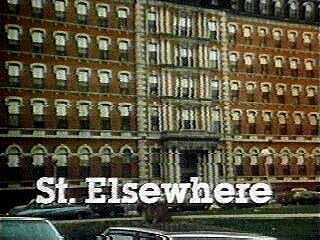
Retro Television Review: St. Elsewhere 2.13 “In Sickness and In Health”


Welcome to Retro Television Reviews, a feature where we review some of our favorite and least favorite shows of the past! On Fridays, I will be reviewing St. Elsewhere, a medical show which ran on NBC from 1982 to 1988.  The show can be found on Hulu and, for purchase, on Prime!

This week, Victor gets married!

Episode 2.13 “In Sickness and In Health”

(Dir by Mark Tinker, originally aired on February 8th, 1984)

This week’s episode features three storylines.

The least interesting one features Joan Halloran’s father, Charlie Halloran (William Windom), being admitted to and eventually dying at St. Eligius.  The entire Halloran family comes out to visit Charlie and this is one of the storylines that would have worked better if I had the slightest bit of interest in Joan or her family.  For the most part, though, Joan is a boring character and her wealthy family is not that interesting.  I got the feeling this storyline was mostly included to remind us that Joan is a character on the show.  We really have seen much of her over the past few episodes.

Dr. Chandler trained for the Boston Marathon by running the route in the rain.  A car ran him off the road.  A dog chased him.  An attractive woman flirted with him.  (He is Denzel Washington, after all!)   And he finally reached the finish line and nearly collapsed while imagining everyone cheering for him.

Finally, Ehrlich married Roberta.  The wedding took place at Dr. Craig’s house.  Dogger (Kevin Scannell) was the best man and turned out to be just as crude as you might expect someone named Dogger to be.  Dr. Craig was disgusted by the whole thing.  Roberta got cold feet after her mother confessed to having never loved her father.  However, Dr. Craig’s abrasive mother-in-law (Lurene Tuttle) was there to order Roberta to take a chance and marry the man who she might eventually come to love.  This marriage is so obviously doomed.  I’m predicting Ehrlich will be divorced before the season ends.

This episode really didn’t work.  Dr. Chandler training for the Boston Marathon finally gave Denzel Washington something to do but the storyline excuse was mostly just an excuse to do some Boston location shooting.  The Halloran storyline didn’t work because the Hallorans themselves aren’t that interesting.  And, after all the build-up, the wedding was a bit anti-climatic.

They can’t all be winners.

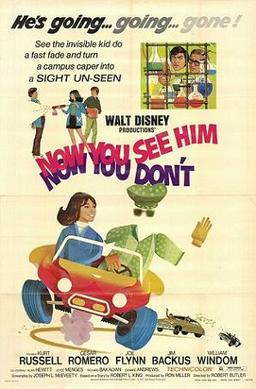
I Watched Now You See Him, Now You Don’t (1972, Dir. by Robert Butler)


Dexter Riley (Kurt Russell) is back and just in time because Medfield College is on the verge of getting closed down again.

In The Computer Wore Tennis Shoes, buying a computer was supposed to be the solution to all of Medfield’s financial problems.  I guess it didn’t work because Medfield is broke again and corrupt businessman A.J. Arnoe (Cesar Romero) is planning on canceling the school’s mortgage so that he can turn it into a casino.

There is some hope.  Dexter has accidentally created an invisibility spray.  Not only does it tun anything that it touches invisible but it also washes away with water so there’s no risk of disappearing forever.  Dexter and his friend Schuyler (Michael McGreevey) know that they can win the science fair with their invention but the science fair doesn’t want to allow small schools like Medfield to compete unless they really have something big to offer.  Dexter tells the Dean (Joe Flynn) that he has a sure winner but Dexter also refuses to reveal what it is because he doesn’t want word to leak before for the science fair.  The Dean decides to raise the money to pay off the mortgage by becoming a golfer, as one does.  Schulyer works as the Dean’s caddy while Dexter uses the invisibility spray to help the Dean cheat.  That’s a good message for a young audience, Disney!  But when Arno finds out about the spray, he wants to steal it so he can rob a bank.

This was even dumber than The Computer Wore Tennis Shoes but it was also hard to dislike it.  The comedy was too gentle, Kurt Russell and the rest of the cast were too likable, and the special effects were too amusingly cheap in that retro Disney way for it to matter that the movie didn’t make any sense.  When a bunch of college kids learn the secret of invisibility and use it to cheat at golf, you know you’re watching a Disney film.

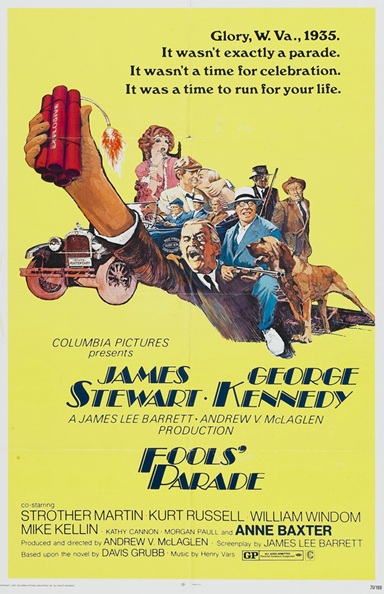
Film Review: Fools’ Parade (dir by Andrew V. McLaglen)


1971’s Fools’ Parade opens in 1935.

Three men are released from the West Virginia state penitentiary and given a train ticket out of town by the prison captain, Council (George Kennedy).  The men are a bank robber named Lee Cottrill (Strother Martin), a young man named Johnny Jesus (a young Kurt Russell), and a courtly older man named Mattie Appleyard (James Stewart).  Despite his polite tone of voice and his folksy manner, Appleyard is actually the most notorious of the three men being released.  Convicted of murdering two men, Appleyard has spent the past 40 years in prison.  Both Appleyard and Cottrill are looking to go straight.  Every day of his sentence, Appleyard worked and earned money.  Along with a glass eye, Appleyard leaves prison with a check for $25,000 dollars.  Appleyard plans to cash the money at the bank and then open a store with Cottrill.

Unfortunately, Appleyard has been released at the height of the Great Depression.  The streets are full men desperately looking for work.  People will do anything to feed their families or to make a little extra money.  Salesman Roy K. Sizemore (William Window) transports guns and dynamite.  Willis Hubbard (Robert Donner) works as a conductor on the train.  Aging prostitute Cleo (Ann Baxter) offers to sell the virginity of her adopted daughter, Chanty (Katherine Cannon).  Junior Killfong (Morgan Paull) sings on the radio and occasionally takes on deadlier work with his friend, Steve Mystic (Mike Kellin).  As for Captain Council, he’s decided that he’s going to make his money by ambushing the train carrying the three men that he has just released from prison.  After killing the men, Council will cash Appleyard’s check himself.

Of course, it doesn’t quite work out as simply as Council was hoping.  Willis Hubbard has a crisis of conscience and lets Appleyard, Cottrill, and Johnny know what Council is planning.  The three men narrowly make their escape but Council frames Appleyard for a murder that he didn’t commit.  Now wanted once again, the three men must not only get the money but also clear their names.  It won’t be easy because, as Hubbard explains, they may be free from the penitentiary but now, they’re trapped in “the prison of 1935.”

Fools’ Parade really took me by surprise.  I watched it because it featured two of my favorite actors, James Stewart and Kurt Russell.  And both Stewart and Russell give very good performances in the film.  Stewart was always at his best when he got a chance to hint at the melancholy behind his folksiness and the young Kurt Russell plays Johnny with a sincerity that makes you automatically root for him.  For that matter, the normally sinister Strother Martin is very likable as Lee Cottrill, a bank robber who is still struggling with the idea of going straight.  But, beyond the actors, Fools’ Parade is a genuinely sad portrait of desperate people trying to survive.  At one point, Sizemore and Cottrill watch as their train passes a camp of people who have been displaced by the Great Depression and it’s even implied that the villainous Council has some regret over what he’s become.  (There’s a small but poignant scene in which Council and Cleo acknowledge the passage of time and, for a minute, the viewer realizes these two people were, at one time, maybe as idealistic and optimistic as Johnny.)  It’s a well-acted film, one in which moments of humor are mixed with moments of true sadness.  I may have picked the film for Jimmy and Kurt but, in the end, the film’s story and performances drew me in.  The 63 year-old Stewart proved that he could still give a memorable performance and the 20 year-old Kurt Russell proved that he was a future star in the making.  If you haven’t seen it, this is definitely a film to check out.

Icarus File No. 18: Brewster McCloud (dir by Robert Altman)


First released in 1970, Brewster McCloud takes place in Houston.

A series of murders have occurred in the city.  The victims have all been older authority figures, like decrepit landlord Abraham Wright (Stacy Keach, under a ton of old age makeup) or demanding society matron Daphne Heap (Margaret Hamilton, who decades earlier had played The Wicked Witch in The Wizard Of Oz).  The victims all appear to have been killed by strangulation and all of them are covered in bird droppings.  Perplexed, the Houston authorities call in Detective Frank Shaft (Michael Murphy) from San Francisco.  Shaft only wears turtlenecks and he has piercing blue eyes.  He looks like the type of guy you would call to solve a mystery like this one.  It’s only later in the film that we discover his blue eyes are due to the contact lenses that he’s wearing.  Frank Shaft is someone who very much understands the importance of appearance.  As one detective puts it, when it comes to Shaft’s reputation, “The Santa Barbara Strangler turned himself in to him.  He must have really trusted him.”

Perhaps the murders are connected to Brewster McCloud (Bud Cort), who lives in a bunker underneath the Astrodome and who seems to be fascinated with birds.  Brewster dreams of being able to fly just like a bird and he’s spent quite some time building himself a set of artificial wings.  A mysterious woman (Sally Kellerman) who wears only a trenchcoat and who has scars on her shoulder blades that would seem to indicate that she once had wings continually visits Brewster and encourages him to pursue his dream.  However, she warns him that he will only be able to fly as long as he remains a virgin.  If he ever has sex, he will crash to the ground.

Brewster thinks that he can handle that.  Then he meets a tour guide named Suzanne Davis (Shelley Duvall, in her film debut) and things start to change….

Brewster McCloud is a curious film.  The story is regularly interrupted by a disheveled lecturer (Rene Auberjonois) who is very much into birds and who, over the course of the film, starts to more and more resemble a bird himself.  The film is full of bird-related puns and there are moments when the characters seem to understand that they’re in a movie.  Frank Shaft dresses like Steve McQueen in Bullitt and his blue contact lenses feel like his attempt to conform to the typical image of a movie hero.  (A lengthy car chase also feels like a parody of Bullitt’s famous chase scene.)  When the old woman played by Margaret Hamilton dies, the camera reveals that she’s wearing ruby slippers and a snippet of Somewhere Over The Rainbow is heard.  As played by Bud Cort, Brewster is the perfect stand-in for the lost youth of middle class America.  He knows that he’s rebelling against something but he doesn’t seem to be quite sure what.  Brewster, like many idealists, is eventually distracted by his own desires and his once earnest plans come cashing down.  Brewster becomes an Icarus figure in perhaps the most literal way possible, even if he doesn’t come anywhere close to reaching the sun.  As with many of Altman’s films, Brewster McCloud is occasionally a bit too esoteric for its own good but it’s always watchable and it always engages with the mind of the viewer.  One gets the feeling that many of the film’s mysteries are not necessarily meant to be solved.  (Altman often said his best films were based on dreams and, as such, used dream logic.)  With its mix of plain-spoken establishmentarians and quirky misfits, Brewster McCloud is not only a classic counterculture film but it’s also a portrait of Texas on the crossroads between the cultures of the past and the future.

Though it baffled critics when it was released, Brewster McCloud has gone on to become a cult film.  It’s a bit of a like-it-or-hate-it type of film.  I like it, even if I find it to be a bit too self-indulgent to truly love.  Quentin Tarantino, for his part, hates it.  Brewster McCloud was released in 1970, the same year as Altman’s Oscar-nominated M*A*S*H.  (Both films have quite a few cast members in common.)  Needless to say, the cheerfully and almost defiantly odd Brewster McCloud was pretty much ignored by the Academy.

Previous Icarus Files:

  1. Cloud Atlas
  2. Maximum Overdrive
  3. Glass
  4. Captive State
  5. Mother!
  6. The Man Who Killed Don Quixote
  7. Last Days
  8. Plan 9 From Outer Space
  9. The Last Movie
  10. 88
  11. The Bonfire of the Vanities
  12. Birdemic
  13. Birdemic 2: The Resurrection 
  14. Last Exit To Brooklyn
  15. Glen or Glenda
  16. The Assassination of Trotsky
  17. Che!

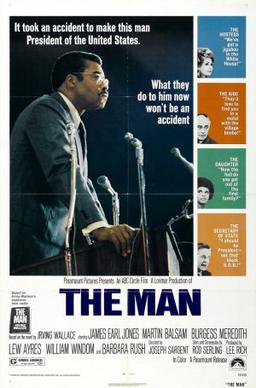
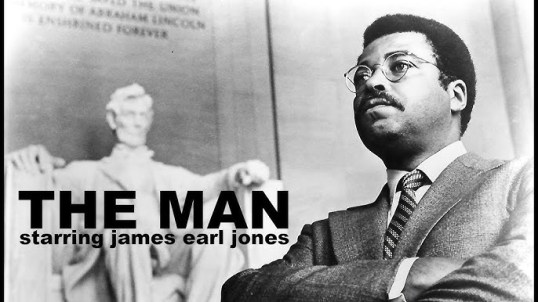
Starring James Earl Jones: The Man (dir by Joseph Sargent)


In 1972’s The Man, James Earl Jones stares as Douglass Dilman.

Dilman is a black college professor and a U.S. Senator.  To his friends, he’s a symbol of progress.  To his enemies, he’s a sell-out who is viewed as being improperly radical.  The U.S. Senate, eager to prove that it’s not a racist institution, has elected Dilman as the President Pro Tempore.  He is now fourth in line for the presidency but that doesn’t concern racist senators like Senator Watson (Burgess Meredith).  A lot would have to happen before Dilman would ever become President.

Needless to say, a lot does happen.

The President and the third-in-line Speaker of the House are attending a conference at a historic building in Frankfort when the roof collapses on them.  We don’t actually see this happen.  We just hear the people in the White House talk about how it’s happened.  We also don’t really learn many details about why the roof collapsed.  Someone nonchalantly says, “It’s an old building.”  Myself, I spent the entire movie waiting for some sort of big revelation of a conspiracy behind the roof collapse but it didn’t happen.  Apparently, in 1972, the Secret Service just let the President go anywhere without checking the place out first.  That said, it’s not a good thing when a serious movie opens with a dramatic plot development that, at the very least, draws a chuckle from the audience.  Seriously, we lost our President because a roof fell on him?  How is America ever going to live that down>

Vice President Noah Calvin (Lew Ayres) is wheeled into the White House cabinet room.  This was not the first time that a Ayres played a Vice President called upon to succeed the President.  Unlike in Advice and Consent, the Vice President announced that he cannot accept the honor of being sworn in because he’s too sick.  (Since when does the Vice President have the option to refuse to do his Constitutional duty?)  With Calvin putting the country ahead of his own ambition, Senator Watson announces that Secretary of State Eaton (William Windom) will be the new President.  No, Eaton says, Dilman will be the new president.  But once Dilman screws up and is either impeached or resigns, fifth-in-line Eaton will be sworn in.

Except …. it wouldn’t work that way.  Excuse me while I put my history/political nerd hat on….

First off, Calvin is apparently still Vice President so if Dilman did step down, Calvin would once again be the successor.  What if Calvin refused a second time?  As soon as the Speaker of the House died, the House of Representatives would elect a new Speaker and that person would be third-in-line.  And, as soon as Dilman became President, the Senate would elect a new President Pro Tempore and that person would be fourth-in-line.  In other words, Eaton is no closer to being President than he was before.

My reason for going  into all of this is to illustrate that The Man is a film about American politics that doesn’t really seem to know much about American politics.  That said, it does feature the great James Earl Jones as Douglass Dilman and Jones gives such a good and thoughtful performance that it almost doesn’t matter that no one else in the film seems to be taking it all that seriously.  Jones plays Dilman as being a careful and cautious man, one who understands that he occupies a huge place in history (Barack Obama was only 11 years old when this film came out) but whose main concern is just doing a good job as President.  Dilman finds himself in the middle.  On one side, he has advisors warning him not to scare America by being too radical.  On the other side, his activist daughter (Janet MacLachlan) brands Dilman a sell-out.  When a black student named Robert Wheeler  (Georg Stanford Brown) is arrested for assassinating a South African government official, Dilman’s first instinct is to believe Wheeler’s been framed but, as the film progresses, doubts start to develop and Dilman must decide whether or not to risk an international incident.  It’s an interesting story, well-played by James Earl Jones and Georg Stanford Brown.

It was originally mean to be a made-for-TV movie but, in order to capitalize on the excitement on the 1972 presidential election, it was released into theaters.  As a result, the film often has the cheap look of a made-for-TV movie and quite a few members of the cast give performances that feel more appropriate for television than the big screen,  (Some members of the cast, like Burgess Meredith, just overact with ferocious abandon.)  In the end, The Man is mostly of interest from a historical point of view.  (In 1972, the idea of a black man being elected President seemed so unrealistic that the movie actually had to drop the roof on 50% of the government just to get Dilman into the Oval Office.)  James Earl Jones, who would have turned 94 today, is the main reason to watch.

Retro Television Review: Fantasy Island 5.14 “Daddy’s Little Girl/The Whistle”


Welcome to Retro Television Reviews, a feature where we review some of our favorite and least favorite shows of the past!  On Tuesdays, I will be reviewing the original Fantasy Island, which ran on ABC from 1977 to 1984.  Unfortunately, the show has been removed from most streaming sites.  Fortunately, I’ve got nearly every episode on my DVR.

This week, the stars align and John Carradine shows up on Fantasy Island.

Episode 5.14 “Daddy’s Little Girl/The Whistle”

(Dir by Don Chaffey and Don Weis, originally aired on January 30th, 1982)

The plane is landing and Mr. Roarke and Julie are getting ready to meet their guests for the weekend.  But wait a minute — where’s Tattoo!?  Roarke explains that Tattoo has volunteered to spend the weekend learning how to do CPR.  When a voluptuous nurse walks by, Julie rolls her eyes and says that Tattoo only cares about learning “mouth-to-mouth.”

“Julie!” Mr. Roarke snaps, even though Julie is probably correct.

Anyway, any episode without Tattoo feels strange and that’s certainly true of this episode.  There are two fantasies, one of which was dramatically better than the other.  The lesser of the two fantasies involves Christa Ackland (Genie Francis) and her efforts to find out the identity of her father.  All she knows is that her mother (Carolyn Jones) knew her father in the Philippines during World War II.  Christa is going to be married on Fantasy Island and she wants her real father to give her away.

Three men, all of whom served in the Air Force together, step forward and claim, one after the other, to be Christa’s father.  When Christa finally confronts her mother, she learns that her father is not Gene (John Ericson), Al (Alan Hale, Jr.), or Bert (Gene Nelson).  Instead, he was a guy named …. well, Guy.  Guy was shot down while on a mission.  Gene, Al, and Bert all explain that the stepped forward and claimed to be her father out of loyalty to Guy and because they didn’t want Christa to learn on her wedding say that her father was dead.  (Apparently, they felt that information would be better received after the honeymoon.)  Christa is surprisingly forgiving.  She realizes that her stepfather (William Windom) has more than earned the right to give her away.  Christa marries George Stickney (James Daughton, the head of the evil frat in Animal House) and Julie cries at the wedding.  Awwww!

The main problem with this storyline was that Genie Francis gave a surprisingly bad performance as Christa.  Instead of coming across as someone who truly wanted to know about her real father, she instead came across as being petulant and more than a little self-righteous.  Carolyn Jones, William Windom, and the three potential fathers were all likable but none could make up for the unsympathetic lead character.

The other fantasy was a bit more fun, even if was impossible to follow the story.  Iconologist Adrian Brilles (Edward Winters) dreams of making a great discovery that will bring him fame and prove his theories about ancient hieroglyphics to be correct.  Mr. Roarke sends him to a ghost town that is also the home of a museum of ancient artifacts.  Working with curator Leila Proctor (Ann Turkel), Adrian discovers what he describes as being “the Rosetta Stone of hieroglyphics.”  He also discovers an ancient whistle that will grant him three wishes.

There are a few townspeople, all of whom take a lot of interest in Adrian’s work.  Their leader is the town’s mortician and he’s played by — YES! — JOHN CARRADINE!  And though Carradine doesn’t get to do much and was obviously physically frail when he filmed this episode, his famous voice and his piercing stare combine to make the Mortician a memorable character.  There’s also a fairly ridiculous scene where the townspeople reveal their true selves, which means dancing around while wearing rubber demon masks.  It’s silly but it’s effective.

It’s never quite clear what’s happening at the ghost town, beyond the three wishes being a set up to bring the demonic townspeople into the world and to cost Adrian his soul.  Fortunately, Mr. Roarke pops up and gives Adrian some cryptic advice about the third wish being the most important.  For his first wish, Adrian wishes for the townspeople to be their true selves.  (Cue the demon dance.)  For his second wish, he goes for fame and adulation.  For his third wish, he cancels the first two wishes and this somehow set free not only his soul but Leila’s as well.

Yep, it doesn’t make much sense but it’s got John Carradine and a bunch of horror imagery so it’s fun.  That’s all I really ask for when it comes to Fantasy Island.  The whistle fantasy makes up for the wedding fantasy and the lack of Tattoo.  This was a worthwhile trip to the Island.

Retro Television Review: Pigs vs. Freaks (dir by Dick Lowry)


Welcome to Retro Television Reviews, a feature where we review some of our favorite and least favorite shows of the past!  On Sundays, I will be reviewing the made-for-television movies that used to be a primetime mainstay.  Today’s film is 1984’s Pigs vs. Freaks!  It  can be viewed on YouTube.

In the late 1960s, a small town is divided between the conservative older generation and their rebellious hippie children.  Former high school football star Doug Zimmer (Patrick Swayze) has just returned from fighting in Vietnam and, unlike many of his former classmates, he is firmly on the side of the establishment.  He wears his hair short.  He has a job as a cop.  He tries to keep his younger sister, Janice (Penny Peyser), from hanging out with hippies like his former best friend, Neal (Grant Goodeve).

Neal is also the son of the local police chief, Frank Brockmeyer (Eugene Roche).  Though Frank and Neal have different political beliefs and Frank is always telling Neal to get a haircut, they still have a respectful relationship.  When Neal complains that cops like Doug and his partner, Sgt. Cheever (Brian Dennehy), are always harassing the hippies who want to play football in park, Frank suggests a football game between the hippies and the police.  When Neal agrees, the game becomes known as “Pigs vs. Freaks.”

While Frank coaches the Pigs and signs a few former athlete as police reservists, Neal recruits his former little league coach, a bearded guru who now goes by the name of Rambaba Organimus (Tony Randall) to serve as the Freak’s coach.  He also places a call to a former football star named Mickey South (Adam Baldwin) and talks him into coming down from Canada to play in the game.  Of course, Mickey is wanted by the FBI for dodging the draft so it might not seem like a great idea for him to risk federal prison for an exhibition football game but no matter!  Who cares that there are now two federal agents watching the Freaks practice?  There’s a game to be won!

Pigs vs. Freaks is an amiable mix of comedy and drama.  Some of the comedy, like Tony Randall’s bearded guru and Stephen Furst’s perpetually frantic hippie linebacker, is a bit too broad but there’s enough moments of dramatic insight that it’s easy to overlook those flaws.  I appreciated the fact that both the Freaks and the Pigs are treated fairly, with both sides getting a chance to make a case for themselves.  When they first appear and start harassing the hippies for playing football in the park, it’s easy to dismiss both Doug and Cheever as fascists but a later scene, which is very well-played by both Brian Dennehy and Patrick Swayze, establishes them as just being two men who are confused by the direction of the world.  Swayze, in particular, gives a strong performance that reveals the vulnerability underneath Doug’s tough exterior.  As for the hippies, Mickey South is no self-righteous crusader but instead someone who feels the Vietnam War is wrong but who is also someone who both misses and loves his home country.  Adam Baldwin does a wonderful playing him and is well-matched with Grant Goodeve, who plays the most reasonable hippie that one could hope to meet.

It’s a likable film and well-intentioned, a portrait of two opposing groups brought together by the love of one game.  Some will cheer for the Pigs.  Some will cheer for the Freaks.  I cheered for both.

Late Night Retro Television Reviews: Highway to Heaven 1.18 “A Child of God”


Welcome to Late Night Retro Television Reviews, a feature where we review some of our favorite and least favorite shows of the past!  On Thursdays, I will be reviewing Highway to Heaven, which aired on NBC from 1984 to 1989.  The entire show is currently streaming on Tubi and several other services!

For this week’s rather sad episode, Jonathan confronts a reverend who has lost his way.

Episode 1.18 “A Child of God”

(Dir by Michael Landon, originally aired on February 6th, 1985)

After spending years away, Marsha Stearns (Coleen Maloney) has returned home.  She wants her parents, Sarah Stearns (Patricia Smith) and Rev. David Stearns (William Window), to take care of her young daughter, Amy (Natalie Gregory).  The Reverend Stearns wants nothing to do with Marsha or his granddaughter because Amy was born out of wedlock.  He considers Marsha to be an embarrassment to his church and a sinner who cannot be forgiven.

(Yikes!  It looks like Rev. Stearns kind of missed all of the important stuff dealing with forgiveness.  “Judge not, and you will not be judged; condemn not, and you will not be condemned; forgive, and you will be forgiven.”  That’s Luke 6:37.)

What neither the Reverend nor his wife knows is that Marsha is terminally ill and only has a few weeks to live.  However, Marsha’s new neighbor — Jonathan Smith — does know and he confronts the Reverend and rather forcefully denounces him until Reverend Stearns forgives her daughter and visits her in the hospital right before she dies.

This was a pretty sad episode and it did bring some tears to my eyes, largely because it made me think about my mom.  That said, the most interesting thing about this episode was how angry Jonathan got at Reverend Stearns and his unforgiving attitude.  For the past 17 episodes, Jonathan has been a mellow and peaceful angel who has always recognized that everyone has some good in them.  But in this episode, when he confronts the Reverend, there is no way not to notice that Jonathan is truly pissed off.  For once, Jonathan doesn’t even hide the fact that he’s an angel.  He wants Rev. Stearns to know that he’s in trouble with Jonathan’s boss.  And really, it makes sense.  Why wouldn’t Jonathan be especially angry at a reverend who is failing in his duties?  He and Jonathan both work for the same company and Jonathan obviously sees the Reverend’s attitude as being a personal insult.  Jonathan is working hard and Rev. Stearns is screwing everything up.

Rev. Stearns does learn his lesson and embraces humility, though that doesn’t make up for all of the years that he refused to even acknowledge his granddaughter’s existence.  The episode ends with him giving a rather lengthy sermon, in which he suggests that maybe he got to hung up on the whole idea of condemning sin when he should have been focusing on loving everyone.  It’s a bit of a dull ending.  William Windom has the right look for the role but, whenever he has to pretend to preach, he comes across as being a bit dry and stiff.  Fortunately, Coleen Maloney is much more convincing and poignant as his estranged daughter.

Next week …. Scotty returns!

Retro Television Reviews: The Love Boat 3.10 and 3.11: “The Love Lamp Is Lit/Critical Success/Rent a Family/Take My Boyfriend, Please/The Man in Her Life”


Welcome to Retro Television Reviews, a feature where we review some of our favorite and least favorite shows of the past!  On Wednesdays, I will be reviewing the original Love Boat, which aired on ABC from 1977 to 1986!  The series can be streamed on Paramount Plus!
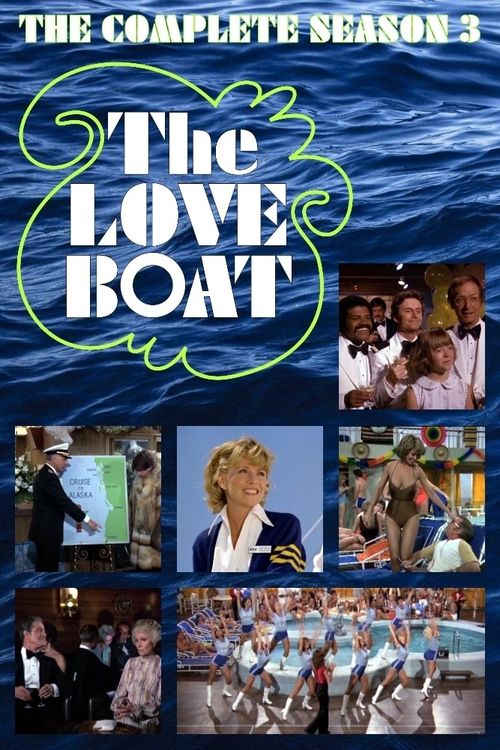
This week, it’s a double length episode of The Love Boat as the Dallas Cowboy Cheerleaders take over the cruise!

Episodes 3.10 and 3.11 “The Love Lamp Is Lit/Critical Success/Rent a Family/Take My Boyfriend, Please/The Man in Her Life”

(Dir by Roger Duchowny, originally aired on November 10th, 1979)

This episode features the first time that Jill Whelan (as Vicki) is included in the opening credits and what an episode to be included in!  It’s time for a special charity cruise of the Love Boat!  In order to raise money for an orphanage in Mexico, the Dallas Cowboys Cheerleaders will be performing on the boat!

I don’t really follow football but I do know that both the Cowboys and their cheerleaders were really popular back in the 70s and 80s.  (Living in Texas, I’ve become very good at sympathetically nodding whenever anyone starts talking about frustrated they are with the Cowboys.)  Still, the idea of the cheerleaders performing on a cruise ship for a charity drive seems a little off.  I mean, shouldn’t they be cheering at a football game?  As I always do when it come to things involving cheerleaders, I asked my sister Erin if any of this made sense to her.  Erin suggested that I not worry about it because it’s The Love Boat.  And really, she has a point.  The Dallas Cowboy Cheerleaders marching onto the boat in full uniform and practicing their routines by the pool makes about as much sense as 11 year-old Vicki suddenly living on a cruise ship.  With The Love Boat, you just have to kind of go with it.

The Cheerleaders play themselves, with three of them getting storylines of their own and I will say that they all came across as being likable and natural in their performances.  I always kind of dread any episode that features celebrities playing themselves because just because someone is famous, that doesn’t mean they’re going to be a good actor.  (I still remember all of those stiff basketball player cameos on Hang Time.)  But the cheerleaders all do a good job, even if none of them are given particularly challenging roles.

Stacy (Tami Barber), for instance, is shocked when Mark Scott (Stephen Shortridge) boards the cruise.  Mark was someone who pursued her in Dallas but she wanted nothing to do with him.  However, on the boat, Mark shows that he’s a nice guy underneath his smooth exterior.  He even choreographs a new routine for the charity performance.  Good for him!

Wendy Ames (Gaye Carter) boards the boat with her mother, Helen (Dina Merrill) and Helen’s boyfriend, Bill (William Windom).  Helen gets jealous of the amount of time that Wendy and Bill are spending together and, when she sees the two of them looking at wedding rings, she decides that they’re having an affair!  No, Helen — Bill wants to marry you!  This whole storyline was silly, to be honest.  Helen just came across as being unnaturally paranoid.

Lisa (Kim Kilway) meets and falls for Paul (Bill Daily), who is the newest vice president of the greeting card company that is sponsoring the cruise.  Paul loves Lisa to but he has a problem.  He’s traveling with his fake family!  Why does Paul have a fake family?  Apparently, Paul’s boss (John Hillerman) only hires family men.  (That sounds like a lawsuit in the making.)  Paul recruited a fake wife (Roz Kelly), mother (Patsy Kelly), and son (Jackie Earle Haley, who appears to be having a lot of fun playing bratty) to pretend to be his family.  The truth comes out, of course.  Fortunately, Lisa is remarkably forgiving and Paul avoids getting fired by promising to marry and start a family with Lisa as quickly as possible.  Again, this all sounds like the beginning of Supreme Court case.

Among the non-cheerleaders, Lou (Larry Linville) and Nora (Gunilla Hutton) are two jewel thieves who board the boat so that they can find some diamonds they hid the last time they took a cruise.  They hid the diamonds in a lamp and it turns out that the lamp is now in the possession of a member of the crew.  This leads to Nora flirting with Gopher, Isaac, and Doc and then quickly abandoning them once it becomes clear that they don’t have the lamp.  (These scenes were fun, largely because of Gunilla Hutton’s comedic timing.)  Finally, Lou and Nora get the diamonds but they have a change of heart and, along with declaring their love for each other, Lou and Nora also donate the $500,000 that they’re going to make from selling the diamonds to the orphanage!  Yay!  Assuming that Lou and Nora don’t get arrested while trying to fence the stolen merchandise, the orphanage will greatly benefit.

Meanwhile, an acerbic theatrical critic (Douglas Fairbanks, Jr.) tries to get an actress (Ginger Rogers) to agree to appear in his new play.  In the end, they realize they’re in love and Ginger Rogers sings Love Will Keep Us Together.

There was a lot going on in this episode but it was enjoyably silly in the way that the best episodes of The Love Boat usually are.  It was excessive and ridiculous, but fun.  On The Love Boat could you get Jackie Earle Haley mocking his fake father while Ginger Rogers sang a song.  This was an enjoyable episode and it did Dallas proud.
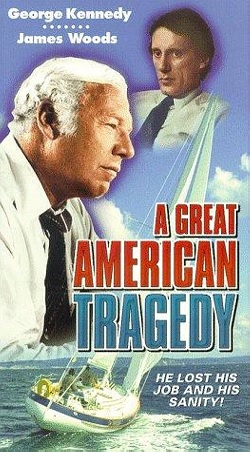
Retro Television Reviews: A Great American Tragedy (dir by J. Lee Thompson)


Welcome to Retro Television Reviews, a feature where we review some of our favorite and least favorite shows of the past!  On Sundays, I will be reviewing the made-for-television movies that used to be a primetime mainstay.  Today’s film is 1972’s A Great American Tragedy!  It  can be viewed on YouTube!

Brad Wilkes (George Kennedy) had a good career, working as an aerospace engineer.  He was able to buy a nice house.  With his wife, Gloria (Vera Miles), he was able to raise a good family.  He was even able to buy a sailboat, one that is the pride of the entire marina.  But then, one day, he’s told that the company is letting him go.

Returning to his home, Brad tells Gloria that he’s lost his job but that everything’s going to be okay because not only does he have a $10,000 pension but he’s sure he can find a new job.  “Of course, I might not be making $35,000 a year….” he says.

(Watching at home, I said, “Pfffft!  I make more than that!”  But, of course, Brad is talking about $35,000 in 1972 money, which would be the equivalent of a quarter of a million today.)

However, Brad soon discovers that getting a new job will not be as easy as he assumed.  It turns out that there are a lot of people out there looking for work and most of them are younger, cheaper, and better educated than Brad.  The bills start to pile up.  His former boss (Robert Mandan) informs Brad that his pension is going to be $7,000 less than he thought.  Brad forces himself to go down to the unemployment office so that he can collect $25 a week and then suffers the humiliation of being offered a loan by his well-meaning son-in-law (played by a youngish James Woods).  Gloria gets a job at the same clothing store where she used to shop and her lecherous boss (Kevin McCarthy) starts to hit on her.

For Brad, the final humiliation comes when he has to sell the boat.  A younger boat owner (Tony Dow, with a huge mustache) puts Brad in contact with a woman named Paula (Natalie Trundy).  Paula wants to buy the boat and, after they take it out on the water, Brad finds himself tempted to cheat on his wife.  It all gets to be too much for Brad and soon, he’s on a plane to Nevada where hopefully one good night at the craps table will be enough to pay his bills….

Watching this film, I found myself feeling very sorry for Brad while, at the same time, becoming very frustrated with him.  On the one hand, his company tossed him out after years of loyal service and then tried to screw him out of his pension.  On the other hand, Brad spent almost the entire movie in denial about how bad things actually were.  It’s one thing to be proud and it’s another to just be stubborn.  Knowing that he has next to no money, Brad still insists on throwing his annual 4th of July party and he even invites his former boss to come over and celebrate.  Brad simply cannot bring himself to admit that his old life is over but really, who can blame him?  He’s not the one who chose to be fired.

A Great American Tragedy was directed by J. Lee Thompson, who also did Cape Fear, The Guns of Navarone, the Planet of the Apes sequels, and several Charles Bronson films.  There are no fight scenes to be found in A Great American Tragedy but Thompson does get good performances from his cast and the film makes great use of George Kennedy’s likability.  The viewer remains sympathetic to Brad, even when he makes mistake after mistake.  A film about a formerly secure family suddenly discovering just how much the economy sucks, A Great American Tragedy remains just as a relevant today as when it was first made.