It’s strange to hear Leslie Nielsen drop an F bomb.
That was my main though I watched Camouflage. Leslie Nielsen plays a hard-boiled private detective named Jack Potter who reluctantly takes on an apprentice named Matty McKenzie (Lochlyn Munro). Mostly to get Matty, a failed stage actor, out of his hair, Jack sends him to handle a minor case in the small town of Beaver Ridge. The minor case becomes a major case when it becomes clear that a murder is being planned.
Camouflage starts out like a typical Leslie Nielsen mockbuster, with Nielsen providing a ridiculous, Frank Drebin-style narration. But the film itself develops into a dark comedy where Matty finds himself in a small town where everyone’s got secret. Nielsen gives an almost-serious performance as Potter, playing him as a cynic with a tragic backstory and little patience for his protegee. There’s a tonal imbalance between the moments of broad comedy and the more serious moments and the film doesn’t work as a result but it is interesting to see a post-Airplane! Leslie Nielsen playing things relatively straight.
One interesting thing about Camouflage is that it was written by Billy Bob Thornton and Tom Epperson but, in the final cut, the screenplay is credited to Reginald Perry. (The small town setting is one that Thornton used frequently in his scripts and it’s easy to imagine him playing the role of Jack Potter in alternate version of this film.) Camouflage reportedly sat on the shelf for quite a while before it was finally given a release and Nielsen’s narration often feels like it was something that was added in post-production to try to both bring the disjointed film together and to draw in the Naked Gun fans. I have a feeling the story behind this film is probably more interesting than the film itself.
17 year-old Brad Crain was at the movie theater in April of 1991 to see Steven Seagal’s latest action film, OUT FOR JUSTICE! Seagal’s career had shot out of a cannon with his first three films being the highly successful movies ABOVE THE LAW (1988), HARD TO KILL (1990), and MARKED FOR DEATH (1990). As a guy who loved action movies, Seagal (with his pony tail) was a cool new action star, and I was down for it.
Steven Seagal plays Detective Gino Felino, a Brooklyn cop called into duty when a guy who grew up with him in their neighborhood, mob enforcer Richie Madano (William Forsythe), goes completely off the rails. Hooked on drugs and looking to settle some personal scores, Richie murders Gino’s partner, and begins turning their neighborhood into a war zone, even pulling a woman out of her car and blowing her away in broad daylight over a simple traffic incident. Convinced that Richie will not leave the neighborhood he grew up in, Gino talks Captain Ronnie Danziger (Jerry Orbach) into letting him have an unmarked police car, a shotgun, and his approval to engage in a manhunt for the drugged out psycho. From that point forward, Gino shakes down Richie’s family members and associates to try to find out where he is. As bodies and broken bones pile up, Gino is determined to do whatever it takes to bring Richie to justice!
I’ll just say up front that OUT FOR JUSTICE is my personal favorite Steven Seagal film. It’s not the crowd pleaser or the box office champ that the next year’s UNDER SIEGE (1992) would be, and film critics largely blew it off when it first hit cinemas, but it does feature the star at his most charismatic, something that would all but disappear after the mid-90’s. I love the way Seagal plays Gino. Sure he’s tough, but he talks more, he laughs more, and it feels like he’s actually enjoying himself. His Gino isn’t just a badass cop, he’s a neighborhood guy, a former street punk who grew up and made something positive out of himself. Seagal’s performance here truly works, and he plays the role with so much confidence that it’s a shame that he didn’t remain this engaged in future performances.
OUT FOR JUSTICE is a badass action film. After it opens with Richie’s horrific murders, it then follows Gino’s hunt for the killer into smoky bars filled with wannabe tough guys who know more than they’re letting on. They get their asses handed to them. It follows Gino as Richie’s goons attack him at various places, from meat shops to apartment buildings, and he dispatches them with calm precision, but often in gruesome ways. I still wince when I see the results of meat cleaver fights and close quarter shotgun blasts. OUT FOR JUSTICE is a throwback to an era when action films featured men with integrity who kick ass and take names. While the movie does have some melodrama and humor, at the end of the day, this is tough-guy cinema done right.
I did want to shout out a few other things about OUT FOR JUSTICE that helps put it over the top for me. William Forsythe is incredible as Richie Madano. He’s sweaty, twitchy, cruel, and completely unhinged. He makes you believe that he’s literally capable of doing anything, and it seems like his goons may be following more out of fear than anything else. His Richie is a man who doesn’t expect that he’ll be alive that much longer, so he’s willing to cross every line that may have once mattered in his life. Director John Flynn captures the urgency of the film’s action very well, and we can feel the tension as Gino tries to locate the crazy Richie as quickly as possible before more innocent people are killed. He isn’t afraid to show the brutality of the violence as part of Gino’s quest, either. This shouldn’t be surprising when you recognize that Flynn directed the revenge classic ROLLING THUNDER (1977) about fifteen years earlier. The one last thing I wanted to point out about OUT FOR JUSTICE is that it was written by R. Lance Hill, who wrote the brutal Charles Bronson hitman film THE EVIL THAT MEN DO (1984). These are talented guys who know how to tell tough stories about even tougher men who are willing to do what it takes to get justice when no one else can.
At the end of the day, Steven Seagal would go on to make a lot more movies, but I don’t think he ever quite recaptured the balance of charisma and toughness that he shows here. And OUT FOR JUSTICE is a badass action movie that doesn’t really care what movie critics think, either. Buoyed by Seagal’s performance, the film’s action is angry, focused, unapologetic, and still hits hard over thirty years after it was originally released.
Today is actor William Forsythe’s 70th birthday. Forsythe is a good character actor, and I’ve always had a fondness for a movie he appeared in called STONE COLD, because it was partially filmed in the town of Conway, Arkansas, which is about seven miles from the house I grew up in. I even remember when they had the downtown blocked off so they could film their scenes. STONE COLD starred All-American football player Brian Bosworth, who was making his film debut. As was the norm back in those days, Forsythe played a really bad guy. So happy birthday, Mr. Forsythe! Enjoy!
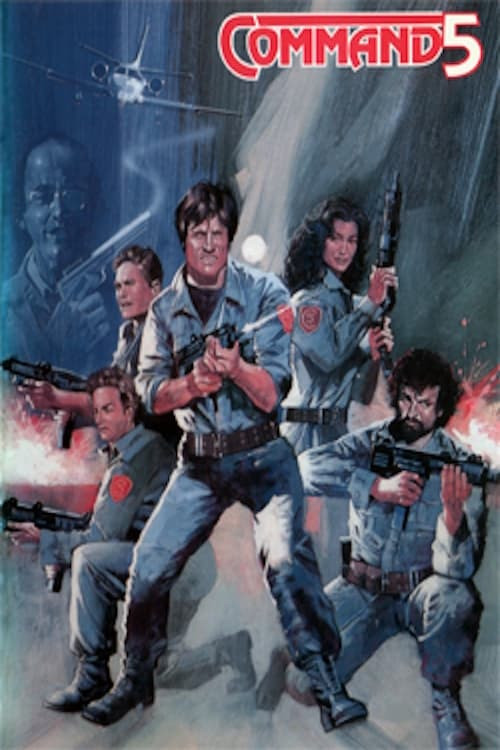
Morgan (Stephen Parr) is a mysterious government operative who puts together a special paramilitary force to take on extreme threats. He says that only misfits are allowed to join his group because they have the edge he needs. Smith (William Russ) is a wild Texan who drives like a maniac. Psychiatrist Winslow (Sonja Smits) can fire an Uzi better than any man. Kowalski (John Matuszak) is a demolitions expert who listens to Beethoven. Jack Coburn (Wings Hauser) is a rebellious detective who is good with a throwing knife.
After a montage of their extensive training and a scene where our heroes take a look at the bullet-proof RV that they’ll be traveling the country in, the movie finally gets down to business. A motorcycle-riding terror cult led by Delgado (Gregory Sierra) has taken an entire town hostage and is threatening to kill everyone unless they’re given a flight out of the country. Our heroes drive their bulletproof van into town and try to defeat the bad guys. There’s one good scene where the RV is driving down the town’s main street and getting hit nonstop with bullets. The scene was obviously ripped off from the end of Clint Eastwood’s The Gauntlet but it’s still exciting to watch. Otherwise, the action in this one is pretty rudimentary.
I guess Command 5 was supposed to be a pilot for television show that never went into production. It is very much a television production. There’s a lot of shooting but no blood. Wings Hauser is less dangerous than usual. The whole thing ends with Command 5 looking forward to adventures that were never to come. Watching the pilot, you can see why it never became a show. The characters were all thinly-written and never seemed to have much of a connection with each other and Hauser and Russ both seemed to be competing to be the loose cannon of the group. This one is for Wings Hauser completists only.
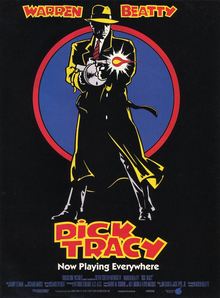
The year is 1937 and “Big Boy” Caprice (Al Pacino) and his gang of flamboyant and often disfigured criminals are trying to take over the rackets. Standing in their way is ace detective Dick Tracy (Warren Beatty), the yellow trench-wearing defender of the law. Tracy is not only looking to take down Caprice but he and Tess Trueheart (Glenne Headly) are currently the guardians of The Kid (Charlie Korsmo), a young street kid who witnessed one of Caprice’s worst crimes. Tracy’s investigation leads him through a rogue’s gallery of criminals and also involves Breathless Mahoney (Madonna), who has witnessed many of Caprice’s crimes but who also wants to steal Tracy’s heart from Tess.
Based on the long-running comic strip, Dick Tracy was a labor of love on the part of Warren Beatty. Not only starring but also directing, Tracy made a film that stayed true to the look and the feel of the original comic strip (the film’s visual palette was limited to just seven colors) while also including an all-star cast the featured Madonna is an attempt to appeal to a younger audience who had probably never even heard of Dick Tracy. When Dick Tracy was released, the majority of the publicity centered around Madonna’s participation in the film and the fact that she was dating Beatty at the time. Madonna is actually probably the weakest element of the film. More of a personality than an actress, Madonna is always Madonna no matter who she is playing and, in a film full of famous actors managing to be convincing as the members of Dick Tracy’s rogue gallery, Madonna feels out of place. Michelle Pfeiffer would have been the ideal Breathless Mahoney.
It doesn’t matter, though, because the rest of the film is great. It’s one of the few comic book films of the 90s to really hold up, mostly due to Beatty’s obvious enthusiasm for the material and the performances of everyone in the supporting cast who was not named Madonna. Al Pacino received an Oscar nomination for playing Big Boy Caprice but equally good are Dustin Hoffman as Mumbles, William Forsythe as Flaptop, R.G. Armstong as Pruneface, and Henry Silva as Influence. These actors all create memorable characters, even while acting under a ton of very convincing makeup. I also liked Dick Van Dyke as the corrupt District Attorney. Beatty knew audience would be shocked to see Van Dyke not playing a hero and both he and Van Dyke play it up for all its worth. Beatty embraces the comic strip’s campiness while still remaining respectful to its style and the combination of Danny Elfman’s music and Stephen Sondheim’s songs provide just the right score for Dick Tracy’s adventures. The film can be surprisingly violent at times but the same was often said about the Dick Tracy comic strip. It wasn’t two-way wrist radios and trips to the Moon. Dick Tracy also dealt with the most ruthless and bloodthirsty gangsters his city had to offer.
Dick Tracy was considered to be a box office disappointment when it was originally released. (Again, you have to wonder if Beatty overestimated how many fans Dick Tracy had in 1990.) But it holds up well and is still more entertaining than several of the more recent comic book movies that have been released.
Sheriff Hugh “Smokey” Turner (Walter Barnes) of Cyco County, Arkansas is determined to capture teenage car thief and prankster, Roscoe Wilton (Jimmy McNichol). Roscoe is determined to disrupt the high school homecoming dance by abducting the homecoming queen, Peggy Sue (Janet Julian). Peggy Sue is, at first, determined to escape from Roscoe but changes her mind as they flee from her father, who just happens to be Sheriff Turner.
From producer Roger Corman, Smokey Bites The Dust is an 88-minute car chase film where the most spectacular getaways and crashes are lifted from other Roger Corman productions. Eagle-eyed viewers will spot footage from Eat My Dust, Grand Theft Auto, and Moving Violations. In order to explain why the cars keep changing from scene to scene, the chase moves from county-to-county where both Roscoe and Sherriff Turner inevitably end up ditching (or crashing) their old car and then stealing a new vehicle to continue the pursuit.
That’s not much of a plot so the run time is padded out with several subplots. A local moonshiner tries to sell his special brew to a group of Arabs. Peggy Sue’s boyfriend, Kenny (William Forsyth, in one of his first films), joins in the chase. Dick Miller flies around in a helicopter and also gets involved in the chase. None of it makes any sense and none of it is particularly amusing but Roger Corman undoubtedly made a lot of money pushing this thing into Southern drive-ins and letting people assume it was some sort of a sequel to Smokey and the Bandit.
Most of the acting is pretty bad. When it comes to being an incompetent sheriff, Walter Barnes is no Jackie Gleason. Jimmy McNichol comes across as being seriously disturbed. Of the main cast, Janet Julian is alone in giving an appealing and naturalistic performance as Peggy Sue. While Julian (who has since retired from acting) never became the star she deserved to be, she is remembered for her later turn as Christopher Walken’s lawyer and girlfriend in 1990’s King of New York.
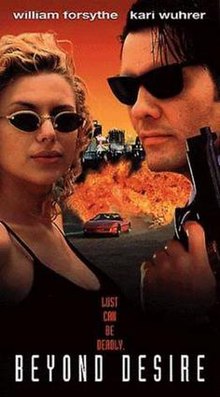
1995’s Beyond Desire tells the story of Ray Patterson (William Forsythe). He’s spent the last 14 years in jail, convicted of a murder that he says he didn’t commit. He likes to sing. He’s obsessed with Elvis. He claims that he doesn’t know how to drive because he’s been in prison for the last 14 years but he appears to be in his mid-40s so you have to kind of wonder if maybe Ray just wants other people to drive him around. After all, Elvis never drove himself.
Perhaps because everyone is sick of listening to him as he sings Amazing Grace in his cell, Ray is released from prison. Since he was serving his time in Nevada, this means that Ray now has to walk down a desert road and hope that someone gives him a ride. Fortunately, for Ray, a woman named Rita (Kari Wuhrer) pulls up in fancy red car and asks him where he’s going. Rita explains that she’s always had a fantasy about picking up someone who has just been released from prison. Ray accepts her offer of a ride and soon, they’re at a desert motel, engaging in saxophone-scored, Vaseline-on-the-lens softcore sex. Ray may have forgotten how to drive but apparently, he didn’t forget everything during those 14 years he spent in prison. If nothing else, this film reveals more of William Forsythe than most viewers probably ever thought they’d see.
Soon, Ray and Rita are head to Vegas. Of course, it turns out that Rita wasn’t quite honest about why she picked up Ray. Rita is a high-priced escort and she works for a local crime boss named Frank (Leo Rossi). Frank wants Ray to reveal the location of some stolen money. Ray, meanwhile, feels that Frank is the key to clearing his name and catching the real murderer. At first, it seems like everyone is just manipulating everyone else but Rita and Frank do eventually end up falling in love. Can their love survive bullets and hints of betrayal?
Like many 90s crime films, Beyond Desire is one of those films that was obviously made to capitalize on the success of Quentin Tarantino. The characters of Ray and Rita are such obvious copies of True Romance‘s Clarence and Alabama that the film comes close to turning into a self-parody. Ray is a big Elvis fan and occasionally quotes lyrics at inopportune times. The soundtrack itself is full of Elvis songs, though the budget apparently wasn’t big enough to actually get the rights to any of Elvis’s recordings. Instead, we get cover versions, the majority of which feel rather wan. The film emphasizes the garish glitz of the Vegas Strip but none of the quirky beauty of it. Las Vegas, an adult playground sitting in the desert, is pure Americana. That was something that was captured by Francis Ford Coppola in The Godfather, Martin Scorsese in Casino and David Lynch in Twin Peaks: The Return. The film uses Vegas as a convenient backdrop but it has nothing to say about the location itself.
Like the majority of road movies, the film tends to meander a bit. Ultimately, the road leads to nowhere. That, in itself, is not necessarily a problem. The same could be said of Tony Scott’s True Romance or any number of films directed by Wim Wenders. Unfortunately, this film wasn’t directed by Tony Scott or Wim Wenders. Instead, it was directed by the guy who did Halloween 5 and the end result is a film that, even when taken as a purely stylistic exercise, still feels rather empty. It’s a shame because William Forsythe shows off a lot of quirky, bad boy charm in the role of Ray and Kari Wuhrer make Rita into a far more complex and conflicted character than one might expect. But, unfortunately, the film itself just doesn’t live up to their performances.
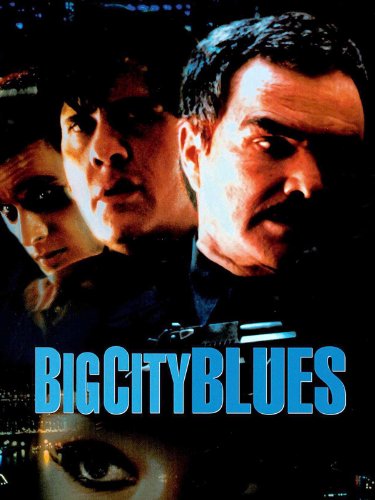
If you have ever wonder why Burt Reynolds, despite receiving an Oscar nomination for Boogie Nights and being a favorite of so many of the up-and-coming directors of the 90s and early 2000s, never made a real comeback, you only have to watch Big City Blues.
In Big City Blues, Burt plays a hitman who loves to watch and talk about old movies. Over the course of one very long night, Burt and his partner (played by William Forsythe) drive through the city. In between doing violent jobs for their boss, they talk. Burt talks about movies. Forsythe talks about how he doesn’t understand Burt’s love of the movies. They talk nonstop and if this is making you think of Pulp Fiction, it’s probably intentional. Today, I think people forget just how many Pulp Fiction rip-offs were released throughout the 90s, all featuring talkative criminals who were obsessed with pop culture. Burt Reynolds and William Forsythe have got the equivalent of the roles played by John Travolta and Samuel L. Jackson. Unfortunately, Reynolds and Forsythe don’t have the same chemistry as Travolta and Jackson. You believed that Travolta and Jackson had been working together for years and, when they talked, that they were having an actual conversation. Despite both of them being credited as executive producers on the film, Reynolds and Forsythe come across as being two talented actors who are phoning it in for a paycheck.
When the film isn’t focused on Reynolds and Forsythe, it follows two trans women (played by Giancarlo Esposito and Ayre Gross) as they walk around the city and debate whether or not Esposito should get sex reassignment surgery. When it’s not following Esposito and Gross, it’s focusing on a sex worker (Georgina Cates) who wants to be a movie star and who keeps seeing evidence that she has a doppelganger who is living the respectable life that she craves. Cates searches for her doppelganger while also servicing her clients, who are all typical middle-aged pervs. (One gets off from listening to Cates sing Ol’ McDonald Had a Farm.) Eventually, the paths of all the characters cross and Reynolds talks about how life is just celestial roulette.
Big City Blues doesn’t add up to much. Like many 90s indie films, the characters are all talkative to the point of feeling like parodies. (When the movie isn’t trying to rip-off Quentin Tarantino, it feels like a half-baked imitation of Richard Linklater.) Even the likable performances of Cates, Esposito, and Gross can’t overcome how overwritten and derivative the script feels. Beyond the script, the film just looks bad. All of the scenes take place at night and the lighting is often so dark that it’s impossible to see what’s actually happening from scene to scene. It feels amateurish.
So why was Burt Reynolds in this? This was the first film that Reynolds made after the filming of Boogie Nights. Probably thinking that Boogie Nights would flop, Reynolds signed up to appear in this Pulp Fiction knock-off, which is something that many former stars did in the 90s. Instead of flopping, Boogie Nights turned out to be the film that reminded everyone that Reynolds could be a very good actor with the right material. Unfortunately, Reynolds himself didn’t think much of the film and, perhaps even worse as far as Hollywood was concerned, he was open about not thinking much of the film. As a result, even with that Oscar nomination, Reynolds didn’t get the type of career resurrection that John Travolta got from Pulp Fiction and Robert Forster and Pam Grier got from Jackie Brown. That’s too bad. Burt Reynolds deserved better.
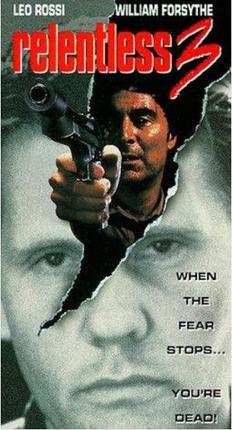
Detective Sam Deitz (Leo Rossi) is back and somehow, his life is even more crappy than before.
Detective Deitz is still an intense New Yorker struggling to fit in with the laid back California lifestyle. Watching a Relentless film, you would think that it’s a crime to be laid back in New York. After three films, Deitz should no longer be as much of a fish out of water as he is in Relentless 3.
Deitz is now divorced and he hardly ever sees his son. That bothers him but also means that there aren’t anymore arguments between Deitz and his wife about him bringing his work home. Deitz is now out on the dating scene. The movie spends a lot of time on scenes of Deitz trying to pick up women. It’s not easy because he’s an intense New Yorker and they’re all laid back California girls. He eventually meets and falls for Paula (Signy Coleman).
Meanwhile, there’s a new serial killer on the scene. Walter (William Forsythe) lives with a mentally unstable woman and is always bragging about how he’s a star. He picks up women in bars, take them home, kills them, and then has sex with their dead bodies before eventually dumping them around Los Angeles. Even though Deitz no longer wants to chase serial killers, he agrees to serve as a consultant. When Walter finds out that the famous Sam Deitz is working the case, he decides to make it personal. Being a “star,” Walter wants to compete with the best.
Relentless 3 gets off to a good start but it runs out of gas quickly. William Forsythe is an effective villain and some of the early scenes of him picking up women are suspenseful. Also, there’s an effective scene where Walter mails Deitz a patch of tattooed skin and proves, as if there was any doubt, that Walter was one sick puppy. But the movie, which should be a relentless cat-and-mouse game between Deitz and Walter, gets sidetracked with all of the scenes of Deitz trying to get back into the dating scene. For all the build-up, the final confrontation between Deitz and Walter feels like a let down. This Relentless film just isn’t relentless enough.
Leo Rossi still does a good job as Deitz but it seems like we learned as much as we need to know about the character during the first two Relentless films and nothing that Deitz does surprises us anymore. Despite good performances from Rossi and Forsythe, Relentless 3 never comes together.
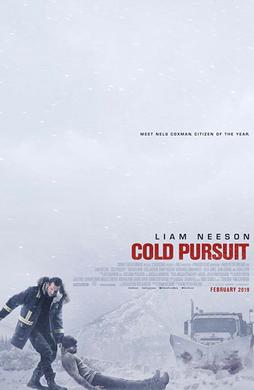
Released back in February (just in time for Valentine’s Day!), Cold Pursuit was this year’s Liam Neeson revenge flick.
This time, Neeson played Nels Coxman, a snow plow driver who speaks in a raspy tone of voice and tends to walk around with a thousand-yard stare on his face. After his son is killed by gangsters, Nels sets out for revenge. It turns out that Nels’s father was some sort of mob enforcer so both Nels and his brother (William Forsythe) have apparently inherited the “instinctively know how to kill” gene So, while Nels’s wife (Laura Dern) stays at home and has a nervous breakdown, Nels heads out and starts killing folks. Since the gangsters are led by an idiot named Viking (Tom Bateman), they all assume that they’re being targeted by a rival drug gang, one which is led by a Ute named White Bull (Tom Jackson). So, while the two drug gangs are killing each other off, Nels is busy killing any stragglers that he comes across. It all adds up to a lot of killing.
Cold Pursuit is different from other Liam Neeson revenge films by the fact that it’s an out-and-out parody of the genre. So, while Neeson walks through the film with his usual glum expression and commits all the usual mayhem that we’ve come to expect from a vengeance-driven Neeson, everyone else plays their role as broadly as possible. Tom Bateman leaves not a single piece of scenery unchewed in the role of Viking while Tom Jackson is stoic to the point of insanity in the role of White Bull. Whenever a gangster gets killed, a title card appears, listing his name, his nickname, and his religion. Meanwhile, two cops (Emmy Rossum and John Doman) prove to be comically ineffective.
And I will admit that I did laugh a few times while watching Cold Pursuit. The scene where Neeson asks his brother to explain why everyone has a nickname made me smile. Some of the murders are clever and the action scenes are frequently so over-the-top that you can’t help but be amused by them.
That said, Cold Pursuit didn’t really work for me. I think the problem is that the filmmakers spent so much time trying to parody Neeson’s films that they didn’t consider that the majority of those films are themselves already parodies. I mean, just watch The Commuter and tell me that film isn’t cheerfully winking at the audience. Since Neeson’s screen persona hasn’t really been a serious one for close to ten years now, parodying it isn’t quite the subversive act that Cold Pursuit seems to think it is. The difference between Neeson’s other films and Cold Pursuit is the difference between merely winking at an audience or pulling a gun on an audience while demanding, “LAUGH, DAMN YOU!” Sometimes, the funniest jokes are the ones that you pretend you’re not making.
On the plus side, the film looks gorgeous. It takes place in the Colorado mountains and makes great use of the frozen landscape. And George Fenton’s score is nicely evocative and well-used in the film. Finally, Liam Neeson is always fun to watch, even when it’s in a somewhat flawed film like this one.
 It’s strange to hear Leslie Nielsen drop an F bomb.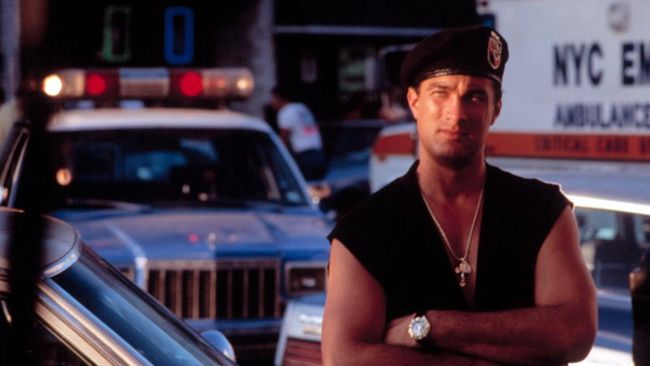

 Through the Shattered Lens