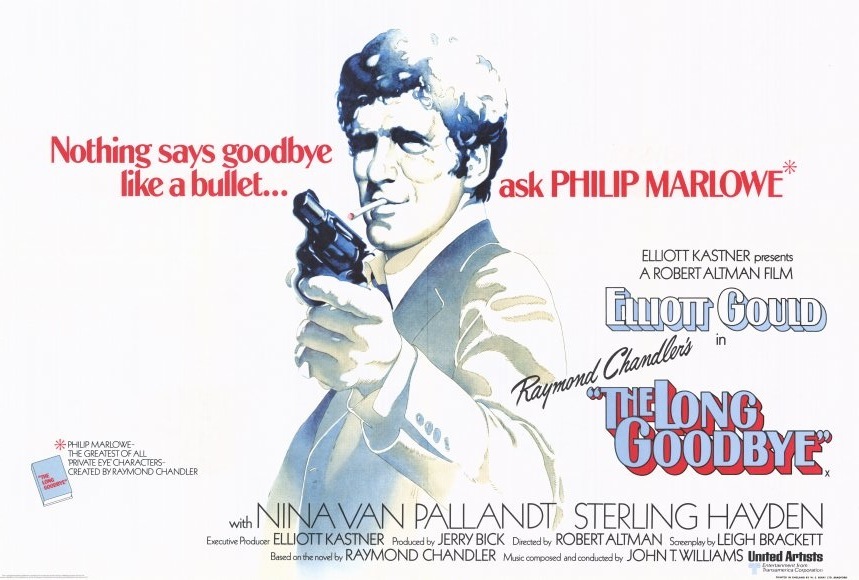
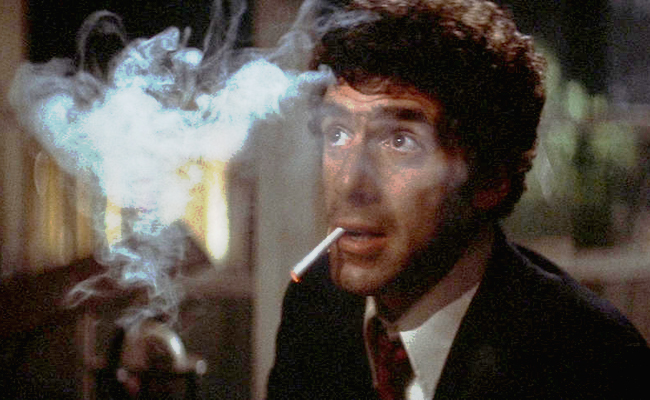
Elliott Gould was a hot Hollywood commodity in the early 1970’s. The former Mr. Barbra Streisand broke through in the 1969 sex farce BOB & CAROL & TED & ALICE, earning an Oscar nomination for supporting actor. He was marketed as a counter-culture rebel, quickly appearing in MOVE, GETTING STRAIGHT, LITTLE MURDERS, and Robert Altman’s M*A*S*H. But his flame dimmed just as fast, and his erratic onset behavior and rumored drug abuse caused him to become unemployable. When Altman decided to make the neo-noir THE LONG GOODBYE, he insisted on casting Gould as Philip Marlowe. The film put Gould back on the map, and though critics of the era weren’t crazy about it, THE LONG GOODBYE stands up well as an artifact of its era and a loving homage to Raymond Chandler’s hard-boiled hero.
Philip Marlowe is clearly an anachronism is 70’s LA, with his ever-present cigarette, cheap suit, beat-up ’48 Lincoln…
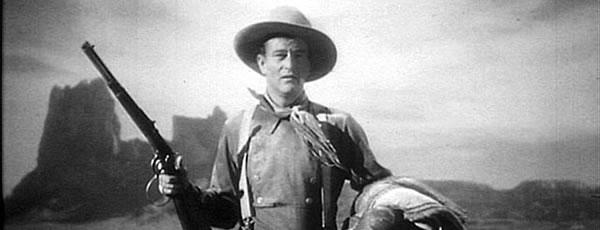
If you think the characters and Western tropes in STAGECOACH are familiar, you’re right. But let’s be clear… STAGECOACH introduced many of these now-clichéd devices to film, and is one of the enduring classics of the American West. Director John Ford was well versed in Westerns, having cut his professional teeth on them during the silent era. This was his first sound Western and Ford was determined to reinvent the genre, with much more adult themes than the usual Saturday matinée kiddie fare. He succeeded with a daring story featuring an outlaw and a prostitute as his heroes, and exceeded his goal by creating a brand new Hollywood star in the process: John Wayne.
Wayne had been a football player for the USC Trojans when an injury caused him to lose his scholarship. Through some university connections, he was able to gain employment in the film industry as a prop…
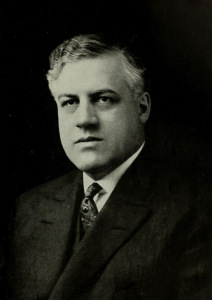
Over on Through the Shattered Lens Presents the Oscars, we are reimagining Oscar history, one year at a time. Today, we take a look at 1920. Prohibition goes into effect, women finally get the right to vote, Harding is elected President, D.W. Griffith finally gets some recognition, and Fatty Arbuckle is the most popular man in Hollywood!
On January 16th, the 18th Amendment went into effect and prohibition became the law of the land. Suddenly, it was illegal to transport and sell alcohol in the United States. As social reformers rejoiced, the government grew and ordinary citizens started to hoard whatever liquor they had. (Selling alcohol was illegal but drinking it was not.) Perhaps the people happiest about prohibition were the gangsters who now had a totally new market to exploit.
In 1919, as the Spanish Flu continued to infect and kill millions, the world tried to recover from World War I. After spending six months at the Paris Peace Conference, President Woodrow Wilson returned to the U.S. and launched an ultimately unsuccessful campaign to bring the United States into the newly formed League of Nations. On September 25th, while barnstorming across the nation in support of the League, a physically exhausted Wilson collapsed and never truly recovered. On October 2nd, a stroke left him partially paralyzed and blind in one eye.
Even before Wilson’s physical collapse, the U.S. population had reason to feel uncertain about the future. On January 6th, the wildly popular Theodore Roosevelt died in his sleep. Before his death, Roosevelt had been widely expected to run for President in 1920 and hopefully return the U.S. to the peace and prosperity…
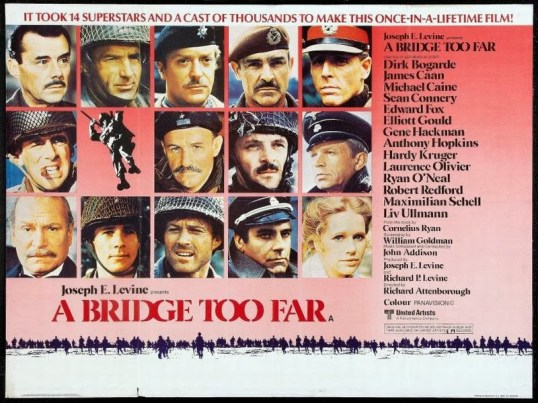
“Well, as you know, I always felt we tried to go a bridge too far” — Lt. Gen. Frederick Browning
With the recent passing of Sir Richard Attenborough I decided to bring up one of the films which first brought his name to my attention. I was quite the young lad when I first saw Attenborough’s epic war film A Bridge Too Far. I would say that it was one of my earlier memories of watching a film with my father who was a major fan of war films. One could say that I got my appreciation and love for the genre from him.
A Bridge Too Far was adapted from the Cornelius Ryan book of the same name which depicted from start to finish the disastrous World War II battle known as Operation Market Garden. The film states that the Allied landings at Normandy, France in the summer of 1944 had the German forces reeling and on the verge of collapse. With Eisenhower having to choose between competing plans to chase Hitler’s forces right into Berlin from his two best generals in George S. Patton and Bernard Montgomery, the film already lays down something that’s become synonymous with military disasters throughout history. Political expediency and pressure on Eisenhower led to an operation that was never attempted in military history and one which required every aspect of the operation to go according to plan for it to work. As the film would show this was not meant to be.
The film begins with the operation’s early days as Allied commanders rush to put Montgomery’s plan to drop 35,000 paratroopers behind German lines in occupied-Netherlands in order to capture and hold key bridges until Allied armored forces arrived to reinforce them. It’s a daring plan that the Attenborough films with a obvious confidence and enthusiasm, but also one that already showed some nagging doubts from field commanders who would be in the thick of the fighting if intelligence reports were inaccurate. One could almost say that Attenborough was making the film a sort of anti-war message which was a rarity when it came to Hollywood and and film industry depicting the events of World War II at the time.
While the film does explore that very anti-war theme throughout it’s really a by-product of how the battle itself unfolds and shown to the viewers that might give one such an idea. Yet, in the end A Bridge Too Far was a much more complicated film to just be labeled as an anti-war film. Yes, the battle itself was a disaster for the Allied forces of American, British and Polish soldiers involved, but despite the political bumbling and military arrogance of those who command from behind a desk, the film actually does a great job of showing that bond soldiers earn when confronted with the horrors of battle.
Attenborough and producer Joseph E. Levine pulls together an all-star cast for the film with names such as Sean Connery, Edward Fox, Robert Redford, Michael Caine and Laurence Olivier just to name a few. Films such as A Bridge Too Far rarely get made anymore in this day and age. The cast itself is part of the reason why the film still holds up to scrutiny decades after it’s release. While all-star casts such as this seemed to have been common place before the 1980’s it still looked like a daunting task for Attenborough to manage so many Hollywood stars and veteran British actors. Every character from Hopkin’s Col. Frost, Connery’s Gen. Urquhart and Redford’s Maj. Cook get to shine in their sections of the film as their individual stories about the battle all tie-in together to show just how complicated the events that they were filming truly turned out to be.
At times, one almost could feel overwhelmed by the amount of recognizable names and faces that come across the screen, yet Attenborough and producer Levine were able to juggle not just the logistics of the film’s screenplay, but the egos and reputation of the very stars who would become the backbone of the film.I think in a lesser filmmaker A Bridge Too Far could easily have turned into the very Operation Market Garden it was trying to depict.
It’s a film that never celebrates the concept of war itself, but actually shows that war remains a bloody and chaotic affair that relies not just on planning and execution but on the whims of lady luck. While Attenborough’s film never reached the sort of iconic status that another Cornelius Ryan adapted film has attained in The Longest Day, it does remain the more powerful of the two as it doesn’t just explore the historical event as a sort of academic exercise, but as an exploration of that old military adage of “No plan survives contact with the enemy”.
So, in the end I recommend that those looking to watch and experience the earlier directorial works of Sir Richard Attenborough should check out A Bridge Too Far. It remains to this day one of his more underappreciated films especially when compared to his later more acclaimed films like Gandhi, Chaplin and Shadowlands.
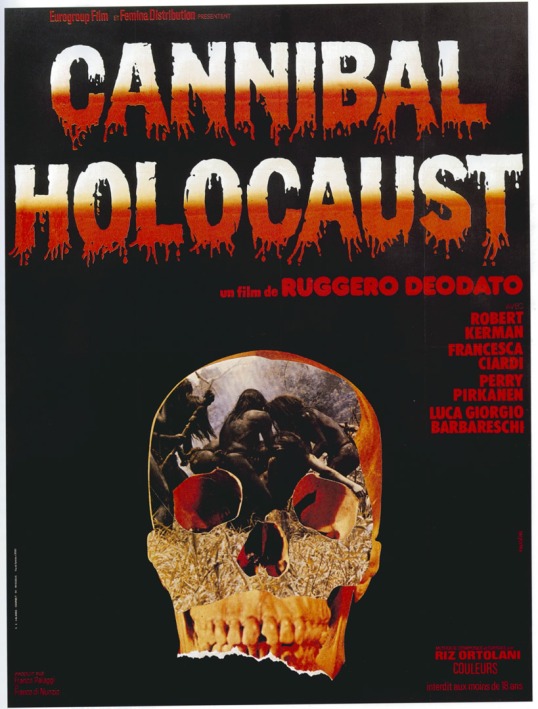
The month of October here at Through the Shattered Lens wouldn’t be complete if I didn’t introduce one of the very films which this site was made for: Cannibal Holocaust.
This 1980 film by Italian exploitation filmmaker Ruggero Deodato remains of the best examples of grindhouse filmmaking. It continues to be many people’s teop ten grindhouse and exploitation films list. Cannibal Holocaust could be considered as the best of the cannibal subgenre films which first began with Umberto Lenzi’s 1972 The Man from the Deep River.
Cannibal Holocaust also remains one of the best found footage films which has regained a sort of come back the last couple years with such popular found footage horror films like the Paranormal Activity series right up to 2012’s The Bay from Barry Levinson. It’s no surprise that Deodato’s film has survived the test of time as new legions of horror fans discover his films and older fans return to watch it again.
The film itself has continued to gain notoriety as newer fans discover the film. Upon it’s release the film was censored or outright banned from many countries who thought it was an actual snuff film (an allegation that even got Deodato and the film’s producers arrested in Italy on charges of murder) or because of atual animal cruelty performed by the film crew on live animals during the shoot. While the notion of Cannibal Holocaust was an actual snuff film remains a sort of urban legend amongst the new and young horror fans discovering it for the first time it really was the allegations of animal cruelty that continues to haunt the film to this day as it remains banned it several countries.
While the film was finally removed from the UK’s “video nasties” list it still hasn’t been released fully uncut and unedited in that country unlike the rest of the world. Though with the global reach of the internet such censorship and banned lists have become irrelevant and thus has given Cannibal Holocaust a much wider reach than it has ever had.
Cannibal Holocaust may be over thirty years old now, but it remains one of the finest example of grindhouse and exploitation filmmaking. It will continue to live on for future generations of horror fans and gorehounds to discover.
We’re at the home stretch in the Roger Moore-era of Ian Fleming’s James Bond film series. During his time in the role as Britain’s super spy extraordinaire we’ve seen him put his own personal stamp on the role. It was a daunting task seeing the role had been played by Sean Connery early in the film series and had done such a great job of making the character such a cultural icon that anyone following him would forever be compared. Moore doesn’t just hold his own, but has built such a loayl following in the role that many consider his portrayal of Agent 007 as the best in the series.
His Bond when compared to Connery’s portrayal was more the witty charmer who tried to use his wits and brains to solve problematic (usually dangerous ones) situations he finds himself in. Connery’s Bond was more the physical type whose charm belied a much darker personality streak that Moore’s portrayal could never pull off no matter how the writers tried.
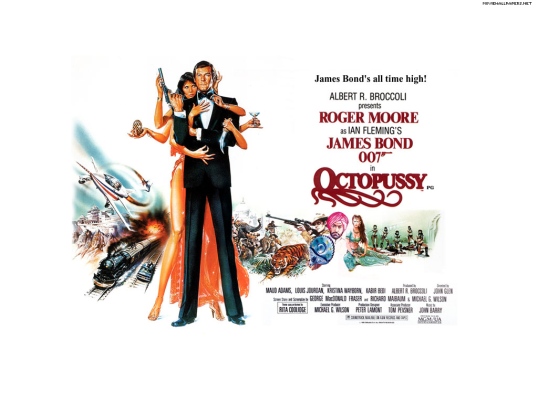
The Roger Moore-era also redefined the franchise as more more about action and less and less thriller with each new film. This culminates in Moore’s most action-packed film in the role with the 13th Bond film (produced by EON) in Octopussy.
The film begins with one of the more impressive opening sequences in the series as we find Bond in the middle of an undercover mission in Cuba. This intro’s stunt work with Bond piloting a mini-plane in and around Cuban airspace to escape and, at the same time, fulfill his mission remains a highlight in the series where each new film tries to raise the bar in terms of well-choreographed and very complicated action scenes.
Octopussy sees Bond traveling to India, East and West Germany to halt the nuclear and warmongering ambitions of a Soviet general who sees his country’s nuclear disarmament talks with the West as inviting defeat for the Soviet Union. We also have the theft of priceless Russian treasures like the Faberge Eggs being used to finance this general’s plan to complicate bond’s main mission. The plot for Octopussy is a reminder of the time it was filmed in. Reagan and Thatcher had a strong control of the West and their confrontational attitudes towards the Soviet Union and it’s satellite states made people believe that the world was on the brink of war. This public sentiment affected the fiction and entertainment of the time with Cold War thrillers becoming ascendant once more.
As much as the basic outline of the film’s plot looked to be impressive on the face of it the way the story unfolded was quite a hit-and-miss affair. I put some of this on the shoulders of it’s director John Glen who seemed more interested in moving the story from one action scene to the next while paying just the minimum of lip-service to the quieter scenes that occur in-between.
This being Moore’s sixth Bond film we pretty much know how his Bond operates. So, it falls to fleshing out his rivals and enemies to help create a much more interesting film beyond the extravagant action scenes. We learn about the agendas and personalities of Bond’s rivals through too much exposition info dumps. Even the title’ character of Octopussy (played by Maud Adams) we don’t get to learn much of other than a brief personal history dialogue she has with Bond the first time we meet. Of Bond’s two enemies in the film one is the warmongering General Orlov (played by Steven Berkoff) who comes off like an over-the-top caricature with a distinct speech pattern to match. The other is the exiled Afghan prince Kamal Khan who comes off a bit more fleshed out as Octopussy’s covetous partner-in-crime. Louis Jourdan as Kamal Khan plays the role with a sense of panache and joie de vivre that at times he’s able to match Moore’s Bond in the charisma department whenever the two share the screen together.
What should interest people about Octopussy are the very action scenes I spoke about earlier. From the opening sequence in Cuba to a thrilling race against time that traverses from East Germany to West Germany to stop a nuclear weapon from detonating it’s no wonder some people consider Octopussy as a favorite. I enjoyed the film for these very sequences despite missteps in the overall execution of the plot and inconsistencies in the performances of the cast. Yet, the film had the DNA to be much better and after repeated viewings one could see that in the hands of a different filmmaker and changes in the cast this sixth Moore-era Bond film had the potential to be one of the best.
Octopussy would mark the start of the franchise’s decline in the face of much more violent and action-packed action films of the 80’s. The film tried to keep up with this rising trend in action filmmaking during the 80’s. It was able to succeed in a fashion in making the series much more action-packed (though quite bloodless in comparison to what was about to come out of Hollywood in the coming years), but in doing so the film’s storyline and characters suffered that the film doesn’t hold up the test of time unlike some of the early Connery and Moore films.
On a side note, the film did have one of my favorite Bond song’s with Rita Coolidge singing “All Time High” in the intro sequence. A song title that was quite ironic considering that the film definitely didn’t hit an all time high.
With the previous Bond entry, Diamonds Are Forever, we finally see Sean Connery run out of gas when it came to playing the title role of James Bond. Yet, despite the obvious boredom Connery was having in the film the producers of the series were still wanting him to come back for another Bond film. Maybe it was his experience during the production of Diamonds Are Forever or Connery finally decided it was truly time to go the series’ producers didn’t get their wish and were in a rush to find someone new to wear the mantle o Agent 007.
They finally found their new James Bond in the form of English-actor Roger Moore and production on Live and Let Die began soon after.
Roger Moore, for me, has always been the start of the less serious, but much more fun era of the James Bond franchise. His films still had the intrigue and action of the Connery-era, but the writers and producers of the series put in more one-liners and humor in the story. We begin to see the start of this in the previous Bond film (not handled as well and came off as awkward at times), but it was in Live and Let Die and in Roger Moore that this change in the series’ tone finally hit it’s stride.
The film dials back the global domination attempts by the series of villians both SPECTRE and not. This time around Bond must investigate the deaths of three MI6 agents who had been investigating one Dr. Kananga, the despot of the fictitious Caribbean island of San Monique. Kananga (played by Yaphet Kotto) also has an alter-ego in the form of Mr. Big who runs a series of soul food restaurants as a front for his drug business. Every Bond film always tries to out-elaborate the previous one with it’s villains plans. There’s no attempts by Kananga/Big to dominate the world. His plans are pretty capitalistic in a ruthless sort of way. He wants to corner the drug market in the US by flooding the illegal drug market with his own heroin which he plans to give away for free thus bankrupting the other crime lords and drug dealers.
This plan by Kananga actually looks to be very sound and it helps that he has the beautiful seer Solitaire (played by a young and beautiful Jane Seymour) to help him outwit ad stay ahead of his competitors and the law. His plan would’ve succeeded if not for the meddling of one British super-spy named James Bond.
Live and Let Die might not have been as serious about it’s story as the early Connery films, but it definitely had a much more faster pace with more action to distinguish Moore from Connery. One particular famous action sequence involves Bond escaping from Kananga’s drug farm in the Louisiana Bayou country being chased not just by Kananga’s henchmen but by the local police in the form of Sheriff J.W. Pepper who plays the role of fool and comedy relief in the film. Even the smaller action scenes in the film had more life and fun to them like Bond escaping a gator pit by timing a run across the backs of a line of gators to safety.
Where the previous bond film’s attempt at injecting humor and more action into the story were more failures than successes in this film Roger Moore Bond film they worked in due part to Moore’s playful delivery of the one-liners and bon mots the role has become known for of late. Any trepidation that audiences and producers might have had about Moore taking on the role that had been made famous by Connery soon went away as this film played out.
Live and Let Die still remains my favorite of all the Roger Moore Bond films and saw it as the highlight of his time playing the character. While the follow-up films were good in their own right it was this initial Moore entry in the series where the writers, Moore and veteran Bond filmmaker Guy Hamilton were able to find the perfect balance of thrilling action and humor that the rest of the Moore-era films couldn’t replicate.
Next up for James Bond…The Man with the Golden Gun.
I think it’s a well-known fact that the Austin Powers series was spoofing the spy film of the 60’s and 70’s with it’s main target for laughs being the iconic James Bond character and his international adventures of action and intrigue. The James Bond films with each successive entry became more and more fantastic as the megalomania of each new villain became more and more cartoonish and over-the-top and the gadgets themselves started entering the realm of science-fiction (for that time and era, at least) and back-of-the-comic-book ingenuity. I think the tipping point for the series that took James Bond from action thriller to spoofing it’s own past was with Sean Connery’s last official film as James Bond with Diamonds Are Forever.
To say that Sean Connery was truly getting tired and bored with playing the character James Bond on the big screen would be an understatement. His previous Bond entry with You Only Live Twiceshowed him pretty much disinterested with the role and one would almost think he was phoning in his performance. After that film Connery had announced his retirement from playing Bond, but after George Lazenby also retired from the role after just one film Connery was soon back for one more ride on the James Bond train.
Diamonds Are Forever once again pits James Bond against his arch-nemesis, the leader of SPECTRE and feline connoisseur, Ernst Blofeld. This time around the role of Blofeld was played by the actor Charles Gray and the film does a good job in explaining why the character has been played by so many different actors in each entry he appeared in. It is in this early sequence in the film that we begin to see that this latest James Bond entry had jumped the shark when it came to trying to keep things even remotely believable. It’s the film’s biggest flaw an, at the same time, what made it such an interesting, fun ride.
Even the plot of the film owes more to the spoofs of the Blofeld character by way of the Austin Powers films as Bond must try to stop SPECTRE from using smuggled South African diamonds from being used to create weaponized satellite with a massive “laser” that SPECTRE will use to destroy the nuclear arsenal of every superpower then auction off the rights to be the only nuclear power to the highest bidding country. It’s pretty much the the basic foundation of what would be the plot for the first Austin Powers, but with this film filmmaker Guy Hamilton still tried to treat the script as something that was of the serious Bond when it was more 60’s camp through and through.
Diamonds Are Forever may be the weakest of all the Connery Bond films, but it’s groovy sensibilities that celebrated the 60’s (despite the film having been made in 1971) psychedelic, swinging lifestyle poked fun at Bond’s predilection as a suave and charismatic womanizer that wouldn’t have looked out of place in a 60’s love-in. Even the action sequences was something that looked more humorous than thrilling whether it was Bond escaping SPECTRE henchmen on a moon buggy to the inept duo assassins Mr. Wint and Mr. Kidd looked more at home in an action comedy than a series that was known for serious action.
I would be remiss to not mention that this was the only time the Bond series had a redhead as a Bond Girl in the vivacious form of Jill St. John as Tiffany Case. I would also like to think that the other Bond Girl in the film, played by Lana Wood (Natalie Wood’s younger sister), was also a redhead but I’m not entirely sure since most audiences probably didn’t pay too close attention to Plenty O’Toole’s hair color. Either way this would be the only Bond film that would cast what fellow writer Lisa Marie calls the 2%.
Diamonds Are Forever might not have been the sort of return Sean Connery envisioned for himself when he agreed to return as James Bond after taking a film off, but then again this wouldn’t be the first time he would retire from the role only to come back again. Yet, despite all it’s flaws (there were many of them) the film does entertain though probably not in the way it’s filmmakers hoped it would. I do believe that it was this film that finally brought in Roger Moore as the next Bond, but also convinced the film’s producers to tailor the Bond films using some of the humorous aspect of Diamonds Are Forever but tempered to accompany the action in the story.
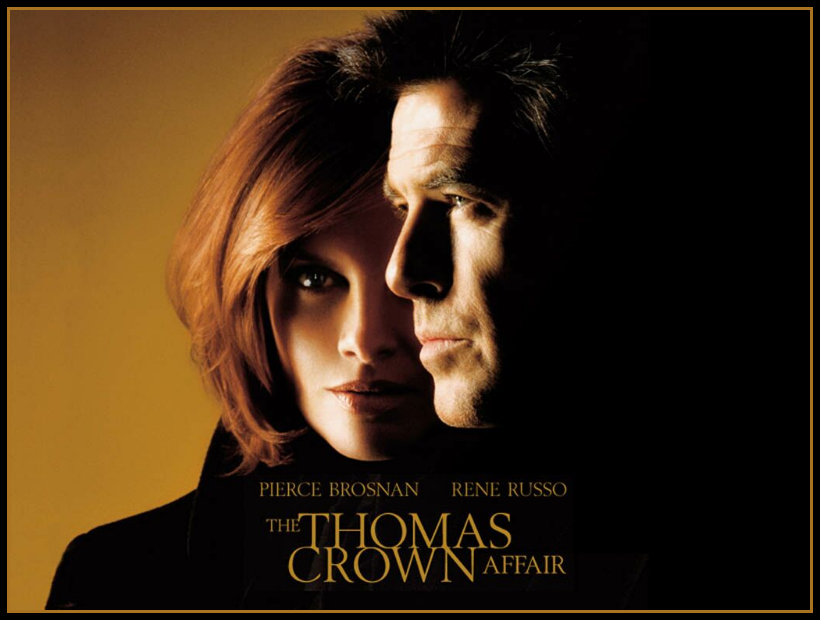
In 1968 there was a little caper film titled The Thomas Crown Affair starring the ever-cool Steve McQueen and a radiant Faye Dunaway. The film was considered hip, cool and sexy in its way during the late 60’s. It took 31 years, but a remake was finally made of this film but this time around starring Pierce Brosnan and Rene Russo in the roles originally played by McQueen and Dunaway. With some great direction from thriller and action filmmmaker John McTiernan, 1999’s The Thomas Crown Affair ends up being the exception to the rule of remakes of older films turning out lesser than the original. This modern and updated version of The Thomas Crown Affair actually surpasses the original McQueen production. McTiernan’s film ably combines humor, thrilling action set pieces, sexy chemistry between the leads and just a beautifully shot film.
Set in New York that never looked as good as shot by McTiernan and his crew, Pierce Brosnan stars and shines as the title character Thomas Crown. Thomas Crown is a suave, roguish and successful businessman who has everything a man could ask for: money, power and any woman he desires.
What does a man like Crown would ever want in life?
The film looks at this and shows that no amount of money in the world could replace the adrenaline rush and thrill of getting acquiring it. Crown does this by staging a complex and elaborate plan to steal a Monet (San Giorgio Maggiore at Dusk) from the NY Metropolitan Arts Museum and do so in the middle of the day. His plan goes off without a hitch and with none the wiser. This heist sequence was actually very fun to watch as McTiernan never lost command of the many threads being weaved to pull off Crown’s plan. McTiernan would one-up this with the climactic finish in the same museum but with a sequence I could only call as the anti-heist.
With the heist completed, the film soon introduces Crown’s foil in the form of Rene Russo as insurance investigator Catherine Banning. Ms. Russo never looked more beautiful, sensual and sexy as she did in this film. Her performance as the determined and crafty Banning more than holds up to Brosnan’s roguish and playful performance as Thomas Crown. From the moment she appears onscreen as the camera slowly pans up her silky-stocking leg and garters, Russo dominated the scene and pretty much commanded attention from everyone. This was especially true whenever she shared the screen with Denis Leary as police detective in charge of investigating the Monet heist. Leary’s always a strong performer in any film he’s in but was pretty much lost in the wake of Russo’s performance when both were on the screen.
The rest of the film was pretty much Crown and Banning trying to get into each others’ heads to find the one advantage that would give them an upper-hand in the “game” they’ve both decided to play. It’s hard to see who is chasing who in the film. Is Banning chasing Crown as her one and only suspect for the theft or is Crown playing her as part of a much more complicated scheme to spice his life. These questions swirl within the frame of the heist investigation and the growing relationship between the two strong-willed characters.
To say that Brosnan and Russo’s on-screen chemistry was strong would be a big understatement. The two pretty much sizzle when together. Whether it’s a playful, flirtation during a nice dinner out on the town to the two steamy dance numbers in the middle of the film. When Crown asks Banning if she wanted to dance or does she want to dance the temperature just went up by degrees. Their love scenes together shows that it could still be done with class and also have a sense of playfulness and fun. It also showed that young couples doing love scenes onscreen have nothing on the mature couple.
There’s not much else to say about McTiernan’s remake of the Thomas Crown Affair than to say that he took a good film, that showcased Steve McQueen’s coolness for everyone to see, and made a much more superior production in every sense. The direction was excellent and the cinematography was beautiful in every second shot. The cast performance was very strong with the two leads in Brosnan and Russo acting their hearts out on the screen. This film shows that remakes really are not bad ideas when put into capable hands. It would be nice to see how the sequel — tentatively titled The Topkapi Affair — to this film turns out with pretty much the same cast and crew returning. I, for one, will be there to see it when it comes out.






 Through the Shattered Lens