You know, as much as I hated Freshman Father, I really like it when Hallmark actually tries to do something different. That’s the case with Chasing A Dream. This is going to be a short one because there is very little to this movie.
That’s our main character Cam Stiles (Andrew Lawrence). He is a high school football star. He and a runner friend of his are at a party. Cam wants to stay, the friend wants to go, and go he does. Of course something happens to him on the way home and he gets killed by a car.
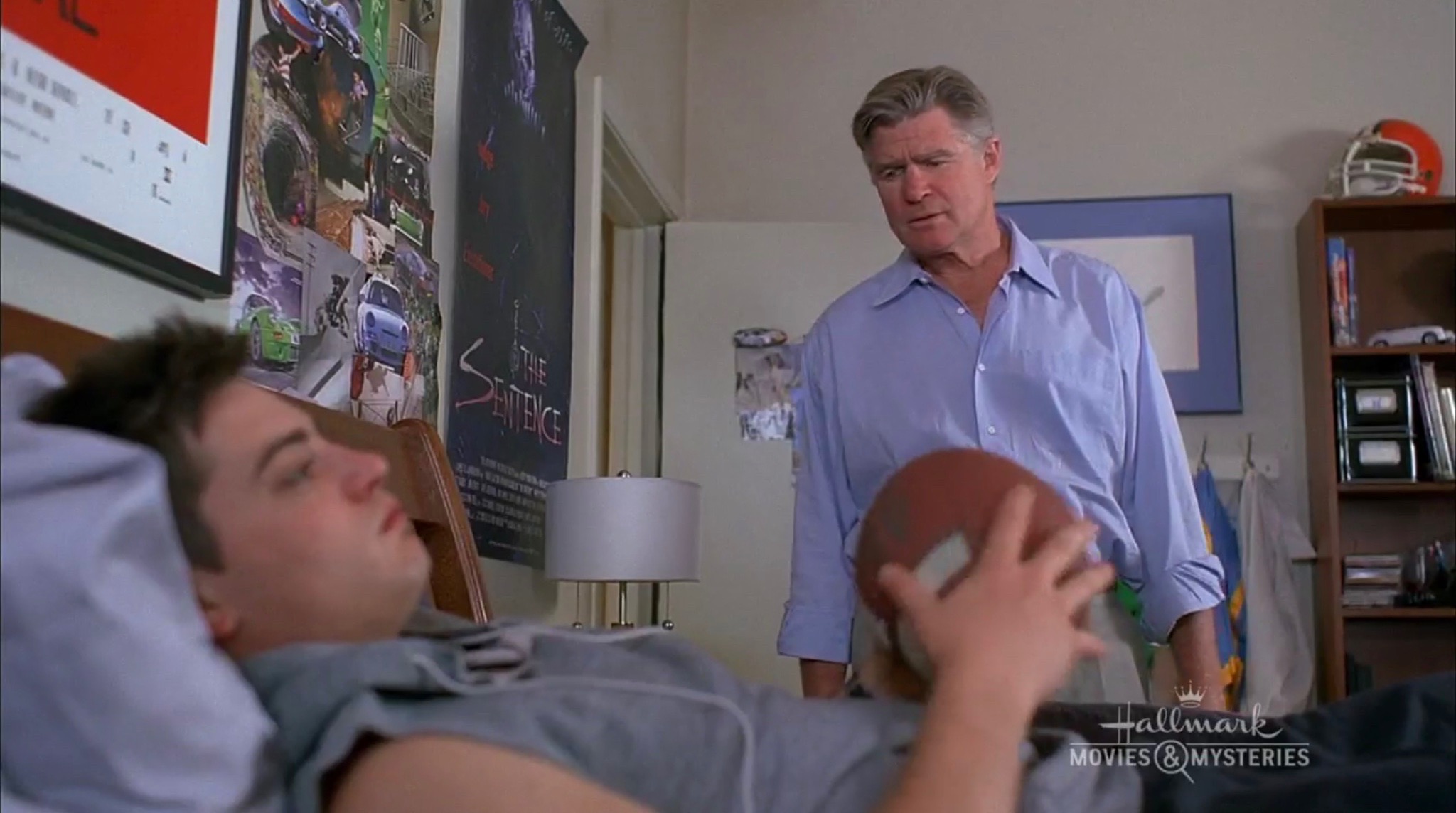
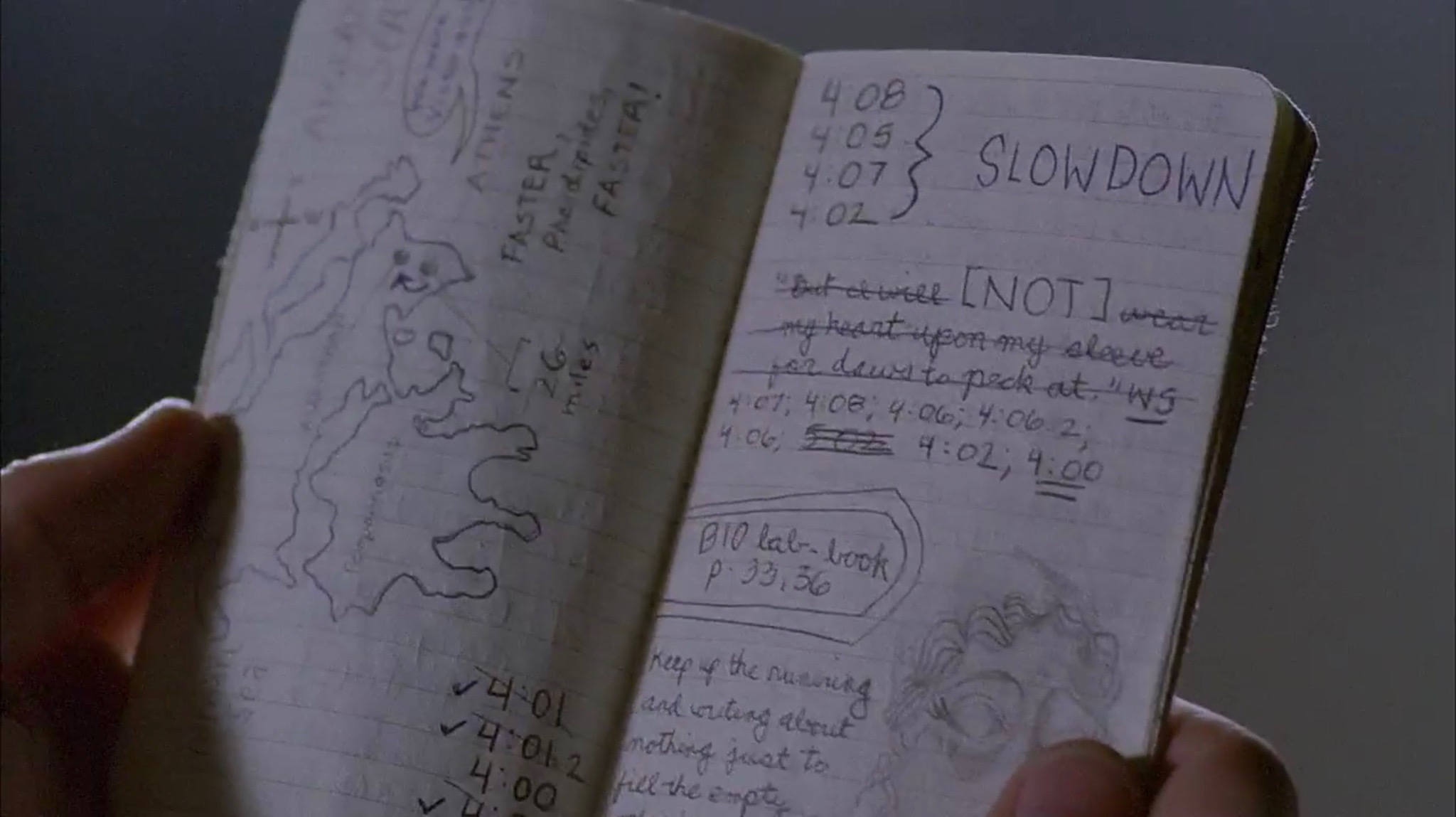
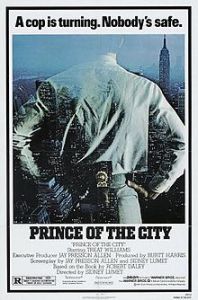
Cam takes it hard and his father played by Treat Williams isn’t exactly understanding. His father coaches the football team on which his son plays. It’s not that his friend was some nobody that hasn’t been properly memorialized or anything. It’s just that Cam is having trouble getting over it. That is, until he stumbles upon a little booklet his friend had. In it his friend was keeping track of mile times. His friend was trying to do a 4 minute mile.
And that’s the rest of the movie. Cam decides that he certainly isn’t slow being an athlete and all. So he decides that for him, getting over the loss of his friend would be finishing what his friend started. That is it. Seriously, up to and including the last line of the movie, it is about Cam doing a four minute mile, then he’ll be okay.
Along the way he has to convince the track/cross country coach to let him in. He has to fight his father a bit because football was his way to college. And finally he has to actually do it, which includes his own Apollo Creed. HINT! HINT! HINT!
I liked this one. It does have a couple of problems that are worth mentioning though. It’s one of those Hallmark movies where it feels like the script was longer, then certain scenes were cut out. A couple of times there’s a bit of a jump where it feels like there should have been something in between to smooth it out. Also, the dead friend appears as a ghost of sorts in a couple of scenes. It’s just an idealized version of his friend that Cam is seeing encouraging him on, but I think given that they followed through with the right ending, then they should have left those parts out.
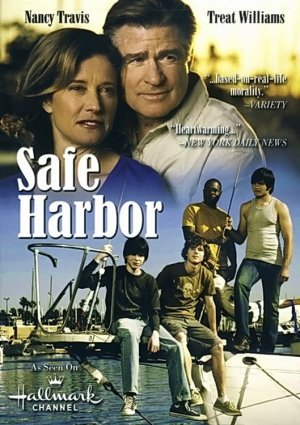
Safe Harbor (2009) – As far as Hallmark movies go, this was one of the best I’ve seen. Although, it’s almost like it’s 20 years past when it should have been released. It’s about a retired couple played by Nancy Travis and Treat Williams. One day a judge shows up who knows Williams and just dumps a couple of toubled kids on them who need a place to stay. It’s a little of the blue, but okay cause Williams gives a bit of background later. Turns out Williams once punched a cop after that officer shot his dog. Apparently, Williams had been living under a bridge. It’s after that he joined the Merchant Marine. Quite a lot of important information that his wife apparently didn’t know after all those years. I almost expected him to say I also used to go by the name Arnold Friend and did something really bad once.
Of course the judge finds a way to dump a few more kids on them. The couple steps up and decides to take care of them. They meet a little resistance from a lady in Social Services, some of the locals, especially after a fire, and one of their mothers, but for the most part it’s just getting the kids over their issues. Doing that, the movie works. It just feels like something that should have been released in 1989 as it feels reminiscent of episodes of MacGyver.
Since Mystery Woman: Game Time felt the need to censor the word “butt” in the phrase “pain in the butt”, I was rather shocked that not once, but twice, Travis and Williams try to have sex before being interrupted by the kids.
This is one of the good ones.
Notes from the Heart Healer (2012) – This has to be the most forgettable of the Hallmark movies I have watched so far. It’s a movie technically, but barely. It’s the third film in a trilogy and I’ve only seen this one. It’s about a writer who seems to be an advice columnist type. A lady turns up at one of her book signings. She has been fired, has no place to stay, and has a baby she can’t take care of. She tries to turn to the writer for help, but when the writer’s husband shows up, she runs away. Later on she drops the baby off at the writer’s doorstep.
What follows is a very forgettable story of the writer mulling over a child she had to give up for adoption and what to do with the baby she now has in her hands. There were only two parts that were memorable. First, during the film the writer jots down some diary entries and in one she mentions that cutting the baby in two story. Honestly, I’m not sure why, but what was memorable was that she felt the need to refer to it as a decision made by “Biblical” King Solomon. A war on Christmas type thing where we want to make sure you don’t divorce the widely known story from it being in the bible? I’m really just guessing. It just stuck with me like hearing someone say “up twice down twice” when saying the Konami code. Just not something I think I’ve ever heard someone feel the need to do when that story is referenced. The second thing is when the husband reacts to something about the baby in kind of an asshole manner, for lack of a better word. But it doesn’t really go anywhere.
There, that those are the things I strongly remember tells you how forgettable this one is. Maybe the first two were better. I’ll probably find out eventually.
Mystery Woman: Vision of a Murder (2005) – Once again, we join Kellie Martin and Clarence Williams III for another murder mystery. I haven’t mentioned her in my earlier reviews of these movies, but there is a character played by Nina Siemaszko who is basically Martin’s Beth Davenport from The Rockford Files. She’s an attorney who is frequently part of the case and definitely is in this one. In this one Martin joins Siemaszko to go to a spa and take photographs of the place. Siemaszko is going there for the spa. It’s not just a spa, but a place that does plastic surgery and other such beauty treatments.
It’s run by Charles Shaughnessy so you know something is up. But just in case you didn’t, Felicia Day is in this looking and acting like “the dog who gets beat” in that lyric from the Alice In Chains’ song Man In The Box. She might as well be wearing a sign around her neck that says “I’ve got secrets to tell.”
Describing much more is spoiling it. A dead body turns up at the spa and Day turns out to be psychic. There is a funny scene where Kellie Martin pretends to be a doctor. Funny, since she’s most famous for her role on ER. And finally, that when you get near the ending, no, it isn’t clever enough to end the way you hope.
Still, decent entry in the series and one of two of them that Kellie Martin directed herself.
Second Chances (2013) – Yet another Hallmark romance, right? Well, not exactly. Don’t get me wrong, there is a couple, but that’s not really where the story is. The story is with her kids. It’s also a Larry Levinson Production so apparently that means they must include goofs with technology. Not sure why that’s a thing, but it seems to be.
But let’s back up here. The story begins with a firefighter and a 911 dispatcher. They kind of know each other from going back and forth on the radio during calls, but they’re really still strangers. He gets injured and needs to spend some serious downtime according to his doctor played by James Eckhouse of Beverly Hills, 90210 fame. He’s quite good and makes the most of the few scenes he’s in. The dispatcher gets her hours cut back and decides to rent out a room at her house to make up the difference. The firefighter decides to move in. That’s this movie’s excuse for the boy and girl to spend time together.
However, this is when the kids kind of take over the movie. They know that their Mom needs money so they decide to start charging residents of a nursing home a dollar for reading to them. These parts are the best parts of the film. It’s actually a shame that there had to be other parts cause if they had made that the whole film and let it go deeper then it could have been even better. But they don’t, so we do get a little romance between the two as well as some backstory on them. It really isn’t worth going into because you’re watching this for the kids and the two tech goofs.
The first tech goof comes really early in the movie. They obviously thought no one would notice and I don’t blame them here, but considering what it would have taken to make it right, it’s pretty stupid. If you have a better version of this then the one I watched on TV and can prove me wrong, then I’m all ears, but the firefighter picks up a sealed copy of a game the kid is supposedly playing from their living room table and talks to the kid about it. The kid isn’t a collector or anything. That sealed copy of the game is what he is supposedly playing. It’s weird because the two games under it are open. Again, if you have a higher definition copy and see differently, then tell me. But here’s what I was able to capture.
Notice the top of the box that shouldn’t be shining if it were really open.
The second goof, there’s no mistake. Throughout the movie there is a fake 911 dispatch screen. Fake because it’s in a Hallmark movie, but not fake because it looks ridiculous. That is, until for reasons beyond me, they felt the need to give us a closeup of the terminal portion of it where we can see that it’s a DOS command line. It’s open to a directory called “C:\Users\Art Department\” and apparently someone has been typing random crap in and trying to execute it only to get error messages.
Like I said though, this is one of the better Hallmark movies, and the credit goes to the story with the kids.
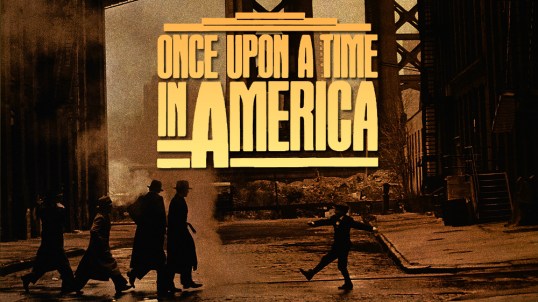
Before I start this review of Sergio Leone’s 1984 gangster epic, Once Upon A Time In America, I want to issue two warnings.
First off, this review is going to have spoilers. I’ve thought long and hard about it. Usually, I try to avoid giving out spoilers but, in this case, there’s no way I can write about this movie without giving away a few very important plot points. So, for those of you who don’t want to deal with spoilers, I’ll just say now that Once Upon A Time In America is a great film and it’s one that anyone who is serious about film must see.
Secondly, I’m not going to be able to do justice to this film. There’s too much to praise and too much going on in the film for one simple blog post to tell you everything that you need to know. Once Upon A Time In America is the type of film that books should be written about, not just mere blog posts. Any words that I type are not going to be able to match the experience of watching this film.
For instance, I can tell you that, much as he did with his classic Spaghetti westerns, Sergio Leone uses the conventions of a familiar genre to tell an epic story about what it means to be poor and to be rich in America. But you’ll never truly understand just how good a job Leone does until you actually see the film, with its haunting images of the poverty-stricken Jewish ghetto in 1920s New York and it’s surreal climax outside the mansion of a very rich and very corrupt man.
I can tell you that Ennio Morricone’s score is one of his best but you won’t truly know that until you hear it while gazing at Robert De Niro’s blissfully stoned face while the final credits roll up the screen.
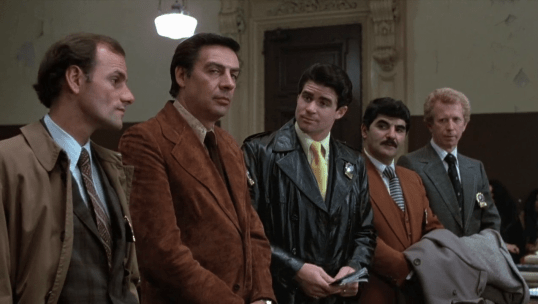
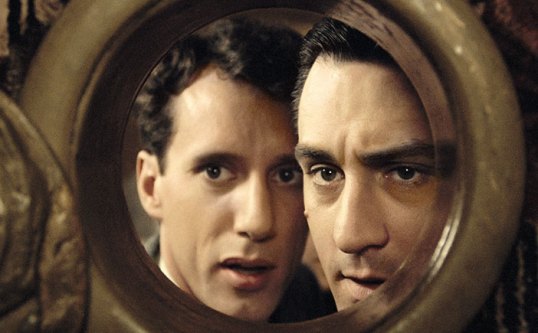
I can tell you that the film’s cast is amazing but you probably already guessed that when you saw that it featured Robert De Niro, James Woods, Treat Williams, Danny Aiello, Joe Pesci, Burt Young, Tuesday Weld, Elizabeth McGovern, and Jennifer Connelly. But, again, it’s only after you’ve seen the film that you truly understand just how perfectly cast it actually is. Given the politics of Hollywood and the fact that he’s unapologetically critical of Barack Obama, it’s entirely possible that James Woods might never appear in another major motion picture. A film like Once Upon A Time in America makes you realize what a loss that truly is.
So, if you haven’t seen it yet, I encourage you to see it. Order it off of Amazon. Do the one day shipping thing. Pay the extra money, the film is worth it.
Much like The Godfather, Part II (and Cloud Atlas, for that matter), Once Upon A Time In America tells several different stories at once, jumping back and forth from the past to the present and onto to the future.
The film’s “past” is 1920. Noodles (Scott Tiler) is a street kid who lives in New York’s ghetto. He makes a living by doing small jobs for a local gangster and occasionally mugging a drunk. He’s also the head of his own gang, made up of Patsy (Brian Bloom), Cockeye (Adrian Curry), and Dominic (Noah Moazezi). Despite his rough edges, Noodles has a crush on Deborah (Jennifer Connelly), a refined girl who practices ballet in the back of her family’s store. When Nooldes meets Max (Rusty Jacobs), the two of them become quick friends. However, their criminal activities are noticed by the demonic Bugsy (James Russo), who demands any money that they make.
The film’s “present” is 1932. Noodles (Robert De Niro) has spent twelve years in prison and, when he’s released, he discovers that some things have changed but some have remained the same. Max (James Woods), Cockeye (William Forsythe), and Patsy (James Hayden) are still criminals but they’ve prospered as bootleggers. Occasionally, they do jobs for a local gangster named Frankie (Joe Pesci) and sometimes, they just rob banks on their own. During one such robbery, they meet a sado-masochistic woman named Carol (Tuesday Weld), who quickly becomes Max’s girlfriend.
As for Noodles, he continues to love Deborah (Elizabeth McGovern). But, when he discovers that she’s leaving New York to pursue a career as an actress, he reveals his true nature and rapes her. It’s a devastating scene — both because all rape scenes are (or, at the very least, should be) devastating but also because it forces us to ask why we expected Noodles to somehow be better than the men who surround him. After spending nearly two hours telling ourselves that Noodles is somehow better than his friends and his activities, the movie shows us that he’s even worse. And, when we look back, we see that there was no reason for us to believe that Noodles was a good man. It’s just what we, as an audience, wanted to believe. After all, we all love the idea of the romanticized gangster, the dangerous man with a good heart who has been forced into a life of crime by his circumstances and who can be saved by love. In that scene, Once Upon A Time In America asks us why audiences continue to romanticize men like Noodles and Max.
As for the gang, they’re hired to serve as unofficial bodyguards for labor leader Jimmy O’Donnell (Treat Williams) and, in their way, help to found the modern American labor movement. (“I shed some blood for the cause,” Patsy says while showing off a huge bandage on his neck.) When fascistic police chief Aiello (Danny Aiello) needs to be taken down a notch, they kidnap his newborn son and hold him for ransom. (While pulling off this crime, they also manages to switch around all the babies and, as a result, poor babies go home with rich families and vice versa, neatly highlighting both the power of class and the randomness of fate.) However, the good times can’t last forever and, when prohibition is repealed, the increasingly unstable Max has to find a new way to make some money.
Finally, the film’s third storyline (the “future” storyline) takes place in 1967. Noodles has spent decades living under a false identity in Buffalo. When he gets a letter addressed to his real name, Noodles realizes that someone knows who he is. He returns to a much changed New York. Carol now lives in a retirement home. Deborah is an acclaimed Broadway actress. Jimmy O’Donnell is the most powerful union boss in America. Fat Moe’s Speakeasy is now Fat Moe’s Restaurant.
Once Noodles is back in town, he receives a briefcase full of money and a note that tells him that it’s an advanced payment for his next job. He also receives an invitation to a party that’s being held at the home of Christopher Bailey, the U.S. Secretary of Commerce.
Who is Secretary Bailey? He’s a shadowy and powerful figure and he’s also a man who is at the center of a political scandal that has turned violent. And, when Noodles eventually arrives at the party, he also discovers that Secretary Bailey is none other than his old friend Max.
How did a very Jewish gangster named Max transform himself into being the very WASPy U.S. Secretary of Commerce? That’s a story that the film declines to answer and it’s all the better for it. What doesn’t matter is how Max became Bailey. All that matters is that he did. And now, he has one final favor to ask Noodles.
(There’s a very popular theory that all of the 1967 scenes are actually meant to be a hallucination on Noodles’s part. And the 1967 scenes are surreal enough that they very well could be. Though you do have to wonder how Noodles in 1932 could hallucinate the Beatles song that is heard when he returns to New York in 1967.)
Once Upon A Time In America is an amazing film, an epic look at crime, business, and politics in America. It’s a film that left me with tears in my eyes and questions in my mind. The greatness of the film can not necessarily be put into words. Instead, it’s a film that everyone needs to see.
Let’s continue to get caught up with 6 more reviews of 6 more films that I saw in 2014!
At Middleton (dir by Adam Rodgers)
“Charming, but slight.” I’ve always liked that term and I think it’s the perfect description for At Middleton, a dramedy that came out in January and did not really get that much attention. Vera Farmiga is a businesswoman who is touring colleges with her daughter (Taissa Farmiga, who is actually Vera’s younger sister). Andy Garcia is a surgeon who is doing the same thing with his son. All four of them end up touring Middleton College at the same time. While their respective children tour the school, Vera and Andy end up walking around the campus and talking. And that’s pretty much the entire film!
But you know what? Vera Farmiga and Andy Garcia are both such good performers and have such a strong chemistry that it doesn’t matter that not much happens. Or, at the very least, it doesn’t matter was much as you might think it would.
Sorry, I know that’s not the best way to start a review but Barefoot really bothered me. In Barefoot, Scott Speedman plays a guy who invites Evan Rachel Wood to his brother’s wedding. The twist is that Wood has spent most of her life in a mental institution. Originally, Speedman only invites her so that he can trick his father (Treat Williams) into believing that Speedman has finally become a responsible adult. But, of course, he ends up falling in love with her and Wood’s simple, mentally unbalanced charm brings delight to everyone who meets her. I wanted to like this film because I love both Scott Speedman and Evan Rachel Wood but, ultimately, it’s all rather condescending and insulting. Yes, the film may be saying, mental illness is difficult but at least it helped Scott Speedman find love…
There’s a lot of good things that can be said about Divergent. Shailene Woodley is a likable heroine. The film’s depiction of a dystopian future is well-done. Kate Winslet has fun playing a villain. Miles Teller and Ansel Elgort are well-cast. But, ultimately, Divergent suffers from the same problem as The Maze Runner and countless other YA adaptations. The film never escapes from the shadow of the far superior HungerGamesfranchise. Perhaps, if Divergent had been released first, we’d be referring to the Hunger Games as being a Divergent rip-off.
However, I kind of doubt it. The Hunger Games works on so many levels. Divergent is an entertaining adventure film that features a good performance from Shailene Woodley but it’s never anything more than that. Considering that director Neil Burger previously gave us Interview with the Assassin and Limitless, it’s hard not to be disappointed that there’s not more to Divergent.
Gimme Shelter (dir by Ron Krauss)
Gimme Shelter, which is apparently based on a true story, is about a teenage girl named Apple (Vanessa Hudgens) who flees her abusive, drug addicted mother (Rosario Dawson). She eventually tracks down her wealthy father (Brendan Fraser), who at first takes Apple in. However, when he discovers that she’s pregnant, he demands that she get an abortion. When Apple refuses, he kicks her out of the house. Apple eventually meets a kindly priest (James Earl Jones) and moves into a shelter that’s run by the tough Kathy (Ann Dowd).
Gimme Shelter came out in January and it was briefly controversial because a lot of critics felt that, by celebrating Apple’s decision not to abort her baby, the movie was pushing an overly pro-life message. Interestingly enough, a lot of those outraged critics were men and, as I read their angry reviews, it was hard not to feel that they were more concerned with showing off their political bona fides than with reviewing the actual film. Yes, the film does celebrate Apple’s decision to keep her baby but the film also emphasizes that it was Apple’s decision to make, just as surely as it would have been her decision to make if she had chosen to have an abortion.
To be honest, the worst thing about Gimme Shelter is that it doesn’t take advantage of the fact that it shares its name with a great song by the Rolling Stones. Otherwise, it’s a well-done (if rather uneven) look at life on the margins. Yes, the script and the direction are heavy-handed but the film is redeemed by a strong performance from Vanessa Hudgens, who deserves to be known for more than just being “that girl from High School Musical.”
Heaven is For Real (dir by Randall Wallace)
You can tell that Heaven is For Real is supposed to be based on a true story by the fact that the main character is named Todd Burpo. Todd Burpo is one of those names that’s just so ripe for ridicule that you know he has to be a real person.
Anyway, Heaven Is For Real is based on a book of the same name. Todd Burpo (Greg Kinnear) is the pastor of a small church in Nebraska. After Todd’s son, Colton, has a near death experience, he claims to have visited Heaven where he not only met a sister who died before he was born but also had a conversation with Jesus. As Colton’s story starts to get national attention, Todd struggles to determine whether Colton actually went to Heaven or if he was just having a hallucination.
You can probably guess which side the movie comes down on.
Usually, as a self-described heathen, I watch about zero faith-based movies a year. For some reason, I ended up watching three over the course of 2014: Left Behind, Rumors of War, and this one. Heaven is For Real is not as preachy (or terrible) as Left Behind but it’s also not as much fun as Rumors of War. (Rumors of War, after all, featured Eric Roberts.) Instead, Heaven Is For Real is probably as close to mainstream as a faith-based movie can get. I doubt that the film changed anyone’s opinion regarding whether or not heaven is for real but it’s still well-done in a made-for-TV sort of way.
According to my BFF Evelyn, we really liked The Other Woman when we saw it earlier this year. And, despite how bored I was with the film when I recently tired to rewatch it, we probably did enjoy it that first time. It’s a girlfriend film, the type of movie that’s enjoyable as long as you’re seeing it for the first time and you’re seeing it with your best girlfriends. It’s a lot of fun the first time you see it but since the entire film is on the surface, there’s nothing left to discover on repeat viewings. Instead, you just find yourself very aware of the fact that the film often substitutes easy shock for genuine comedy. (To be honest, I think that — even with the recent missteps of Labor Day and Men, Women, and Children — Jason Reitman could have done wonders with this material. Nick Cassavetes however…) Leslie Mann gives a good performance and the scenes where she bonds with Cameron Diaz are a lot of fun but otherwise, it’s the type of film that you enjoy when you see it and then you forget about it.
Haywire was an action film that came out in 2011. It briefly got a lot of attention because it starred MMA fighter Gina Carano in her feature film debut and it was directed by Steven Soderbergh. I have to admit that I didn’t care much for Haywire. Some of that is because Gina Carano herself didn’t seem to be a very good actress but my main issue with the film was with Steven Soderbergh. Don’t get me wrong — I know that Soderbergh can be a genius. However, he’s also a remarkably pretentious filmmaker. Sometimes that pretension works, like with The Girlfriend Experience. But, in the case of Haywire, all the pretension served to do was to make a thin story even more annoying.
John Stockwell, on the other hand, is a director who is the very opposite of pretentious. Whereas Soderbergh often makes genre films that try too hard to be art, Stockwell makes genre films that are so unapologetic about being genre that they often become art despite themselves. Stockwell may never be as acclaimed as Soderbergh but, on the whole, he’s a much more consistent filmmaker.
Take In The Blood for instance. In the Blood came out earlier this year, got thoroughly mediocre reviews, and disappeared from theaters pretty quickly. When I watched it last night, I had very low expectations.
But you know what?
In the Blood isn’t bad.
In fact, it’s a perfectly entertaining and, ultimately, rather empowering film.
In In The Blood, Gina Carano plays Ava. Ava, we quickly learn, has led a difficult life. Raised in extreme poverty by a father who taught her early how to fight and how to defend herself, Ava is a former drug addict. When she goes to rehab, she meets and falls in love with fellow addict Derek (Cam Gigandet). Once they’re both clean, Ava and Derek marry despite the concerns of Derek’s wealthy father (Treat Williams).
For their honeymoon, Derek and Ava go to the type of Caribbean island where bad things always happen in movies like In The Blood. They meet Manny (Ismael Cruz Cordova), who agrees to be their guide on the island. One night, Manny takes them out to a club where Ava ends up getting into a huge fight with literally everyone on the dance floor, including a local gangster played by Danny Trejo. The next morning, Manny takes them zip lining but Derek ends up plunging from the zip line and crashing down to the ground below. He’s rushed to the hospital where he promptly vanishes.
Despite being ordered to return to America by police chief Luis Guzman, Ava is determined to figure out what has happened to her husband and she’s willing to beat up the entire island to do it…
Obviously inspired (much like almost every other low-budget action film released over the past few years) by Taken, In The Blood is a familiar but enjoyable burst of pulp fiction. As opposed to Soderbergh’s approach to Haywire, Stockwell doesn’t worry about trying to disguise the genre roots of In The Blood. Instead, he simply tells the story and he tells it well. In The Blood is a film that’s full of beautiful island scenery, villainous character actors, and enjoyable melodramatic dialogue. The pace never falters and the action is exciting. In a few years, the club fight scene will be remembered as a classic of action cinema.
And best of all, Gina Carano kicks ass! In The Blood gives her a chance to show what she can actually do when she has a director who is willing to get out of her way. As opposed to Haywire, where she often seemed to get lost amongst all of Soderbergh’s showy techniques, Gina Carano gives a confident and determined performance in In The Blood. After having to sit through countless action films where every female character is either a victim or a pawn, there is something so wonderful about seeing a movie where a woman gets to do something more than whimper and beg. Regardless of how predictable the film’s plot may be, the fact that it’s a woman — as opposed to a man — who is getting to kick ass (and look good while doing it!) serves to make In The Blood something of a minor masterpiece of the pulp imagination.
If nothing else, In The Blood shows that sometimes it’s best to keep things simple.