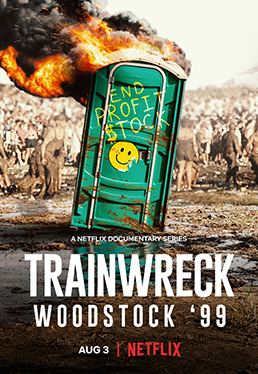
In August of 2022, Netflix premiered a three-part documentary about Woodstock ’99.
Trainwreck: Woodstock ’99 took a look at how the third Woodstock musical festival went from being the most highly anticipated event of the summer of 1999 to being a total disaster. I started watching the documentary the week that it premiered. I was halfway through the first episode when I realized that I needed to make sure that my car insurance had been renewed. I stopped the program, hopped online, made sure that my payment had been received and then….
Well, I don’t exactly remember what I did but I do know that I did not return to Woodstock ’99. Indeed, I kind of forgot about Woodstock ’99. It wasn’t until last night, when Jeff and I were looking for something to watch on Netflix, that I saw Trainwreck: Woodstock ’99 listed under “continue watching.” I did the math. I decided that, given that it had been nearly four years since I watched the opening 30 minutes of the first episode, it was perhaps to finally see what Woodstock ’99 was all about.
The three-part documentary features archival footage from the concert and also interviews with the people behind Woodstock ’99, a few people who attended, and some of the artists who performed. To be honest, I wish that more of the performers had been interviewed. Considering that one of the festival’s organizers literally blamed Fred Durst for the rioting, it’s a shame that Durst didn’t share his side of the story. I’m not a huge fan of Fred Durst but the decision to blame him for the crowd getting out of control has always seem to be a bit too convenient to me. As the documentary shows (sometimes unintentionally), people had reason to be angry long before Fred Durst stepped out on stage and told them to “break shit.” As a once popular performer who has since come to be seen as a bit of a self-parody, Durst makes for an easy scapegoat.
For all the talk about what Woodstock has represented throughout the years, all three of the festivals were ultimately about making money for the organizers. Michael Lang may have been a hippie who said the first Woodstock was about ending the war in Vietnam and that the third Woodstock was about promoting gun control but he was also a businessman. The first Woodstock only made money because of the success of the famous documentary. Woodstock ’94 lost money because the fence surrounding the festival was torn down and people were able to get in without buying tickets. Woodstock ’99 was designed to be secure and impenetrable. Instead of being held in a field, it was held on a deserted air force base where the asphalt made the summer heat unbearable and where the empty hangars helped to create a dystopian atmosphere. Woodstock ’99 was designed to be village. Unfortunately, it turned out to be a village where bottled water eventually ended up costing $14.00 and the toilets ended up overflowing. (One interviewee discusses waking up on the third day and discovering that she was suffering from something called “trench mouth.” Even the name sounds terrifying.)
The documentary features a few people who rightly point out that the festival’s organizers created a situation where the third night’s riot was almost inevitable. Michael Lang apparently had not listened to any new music since the 70s and, hence, didn’t understand that there was a world of difference between the mellow hippies of 1969 and the fans of Korn, Limp Bizkit, and Kid Rock. Amazingly, Lang thought it would be a good idea to hand out candles so that the festival could end with a candlelight vigil against gun violence. The candles were instead used to start fires. As the festival grounds burned, the fence was finally torn down, a sound tower was pulled to the ground, and eventually the national guard showed up. The organizers of the Festival, including Lang, put the blame on almost everyone but themselves.
I’ve often said that movie and documentaries made between 2019 and 2024 often feel as if they are artifacts from a different age. That’s how quickly the culture shifted after the election of 2024. That’s the case with Trainwreck: Woodstock ’99. The final thirty minutes of the documentary are spent classifying Woodstock ’99 as being an example of white privilege and it seems a little performative today but that was pretty much the prism through which everything was viewed and discussed in 2022. The truth of the matter is that there were a lot of reasons why Woodstock ’99 was a disaster and almost all of them come down to the greed at the heart of the enterprise. It was greed that led to festival being held in the worst possible location. It was greed that led to cutting corners when it came to security and the hiring of the half-assed “Peace Patrol,” a group of amateur security guards who failed to protect the most vulnerable people at the festival. (At least five rapes and numerous other sexual assaults occurred a the concert.) And it was ultimately Michael Lang’s desire to pretend that the concert was about something other than greed that led to a bunch of angry, tired, and intoxicated people being handed candles.
This documentary shows why Woodstock ’99 was the final Woodstock. (There was an attempt to put together a 50th anniversary festival in 2019 but, perhaps thankfully, it fell apart.) It’s a shame that Woodstock ended the way it did. It could have been a great American tradition. Instead, the festival of peace and love ended with fire and destruction.

