I was a bit shocked to realize that I hadn’t reviewed Escape from New York for this site. Leonard’s reviewed it.Jeff’s reviewed it. I’ve reviewed quite a few Italian films that were inspired by Escape from New York. Last year, I devoted an entire day to how much I love Kurt Russell. I’ve shared John Carpenter’s theme music, more than once. I’ve reacted to Mamdani’s election by telling my friends that it’s time to escape from New York. I’ve lost track of the number of times that I’ve told Leonard that it is “Time to leave the Bronx,” even though he doesn’t live in the Bronx. (What do I know? I live in Texas.) But I’ve never actually reviewed Escape From New York.
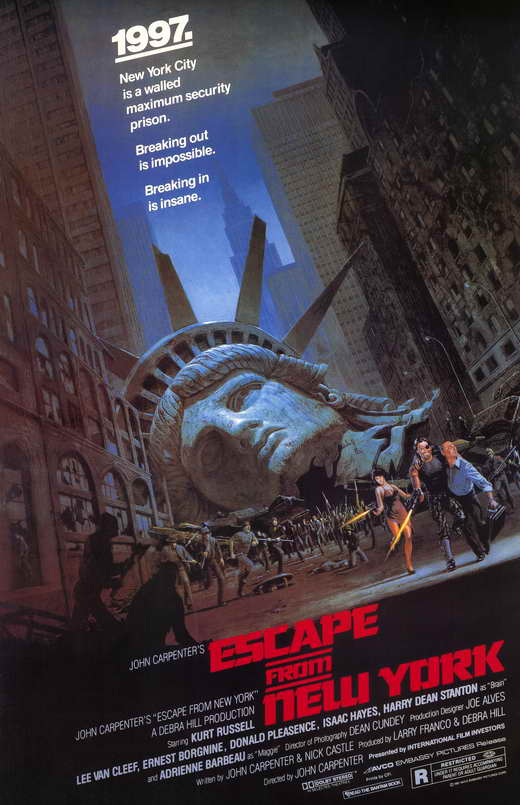
I love Escape from New York but I have to say that the film itself can’t live up the brilliant poster art. The first time I watched Escape from New York, I was really disappointed that the Statue of Liberty’s head never appeared in the middle of a street in Manhattan. If the film were made today, one imagines that the filmmakers would be able to do all sorts of things with the Statue of Liberty. But Escape from New York was made in 1981, in the days before rampant CGI. Escape from New York was made at a time when directors had to be somewhat clever and that definitely works to the film’s advantage. The lack of big time special effects meant that Carpenter had to emphasize character and atmosphere. Escape From New York might not feature the Statue of Liberty’s head but it does feature an amazing cast and a host of unforgettable characters. When you manage to get Kurt Russell, Ernest Borgnine, Donald Pleasence, Harry Dean Stanton, Adrienne Barbeau, Lee Van Cleef, and Isaac Hayes all in the same film, there’s no way it isn’t going to be memorable.
We all know the plot. Kurt Russell plays career criminal Snake Plissken. (Everyone thought Snake was dead.) When the President (Donald Pleasence) finds himself trapped on the prison island of Manhattan, Snake is the man who is sent to rescue him. The fate of the world depends on rescuing the President. If the President isn’t rescued, it could lead to nuclear war. Snake doesn’t really care about the fate of the world. He does care about the fate of himself, however. He’s been injected with a poison that will kill him unless he receives the antidote in 24 hours.
(The doctor who gives Snake the poison is named Dr. Cronenberg. Meanwhile, Frank Doubleday appears as a thug named Romero. Lee Van Cleef’s police commissioner is named Hauk, as in Howard Hawks. Tom Atkins plays Captain Rehme, as in producer Bob Rehme. The film may be about the collapse and possible end of the world but John Carpenter’s having fun. And, of course, so are we.)
The President has been captured by the Duke of New York (Isaac Hayes). It doesn’t take Snake long to track down the Duke. But rescuing the President and making it back to safety turns out to be far more difficult and violent than anyone was anticipating. Snake gets some help, from characters like Cabbie (Ernest Borgnine), Brain (Harry Dean Stanton), and Maggie (Adrienne Barbeau). Of course, that help is largely due to everyone’s self-interest. The recurring theme is that no one really cares that much about whether or not the President or even Snake lives or dies. Maggie loves Brain but, otherwise, there’s not much individual loyalty to be found in this film. Instead, everyone just cares about getting the Hell out of New York. In the end, even the President turns out to be a bit of a jerk.
(I do have to say that I absolutely love Donald Pleasence’s performance in Escape from New York. The “You’re the Duke! You’re the Duke! A Number One!” scene? That was Pleasence at his most brilliant.)
It’s a wonderfully acted and directed film, one that is often darkly humorous. (While Kurt Russell delivers his lines with a endearing self-awareness, Carpenter has a lot of fun imagining the type of criminal society that would emerge on an isolated Manhattan.) It’s also a film that understands the power of New York City. Depending on who you ask, New York either represents the worst or the best of America. That’s true today and, watching Escape from New York, it’s easy to guess that was probably true in 1981 as well. There’s a power to the “New York” name and it’s why this film wouldn’t have worked if it had been called Escape From Houston or Escape From Spokane. (One reason why Escape From LA failed was because the cartoonishness of Los Angeles couldn’t compete with the grit of New York.) We all know the saying — “New York, New York: If you can make it there, you can make it anywhere.” This film reminds us that it’s also true that if you can escape from there, you can escape from anywhere. Escape from New York brilliantly captures the way that most of the rest of country view New York but, by limiting the action to Manhattan, it also presents a story that can be enjoyed by people in Brooklyn, the Bronx, Queens, and Staten Island. I imagine the film is especially popular on Staten Island.
Escape From New York is a brilliant work of the pulp imagination. It’s a film that will probably outlive the city.
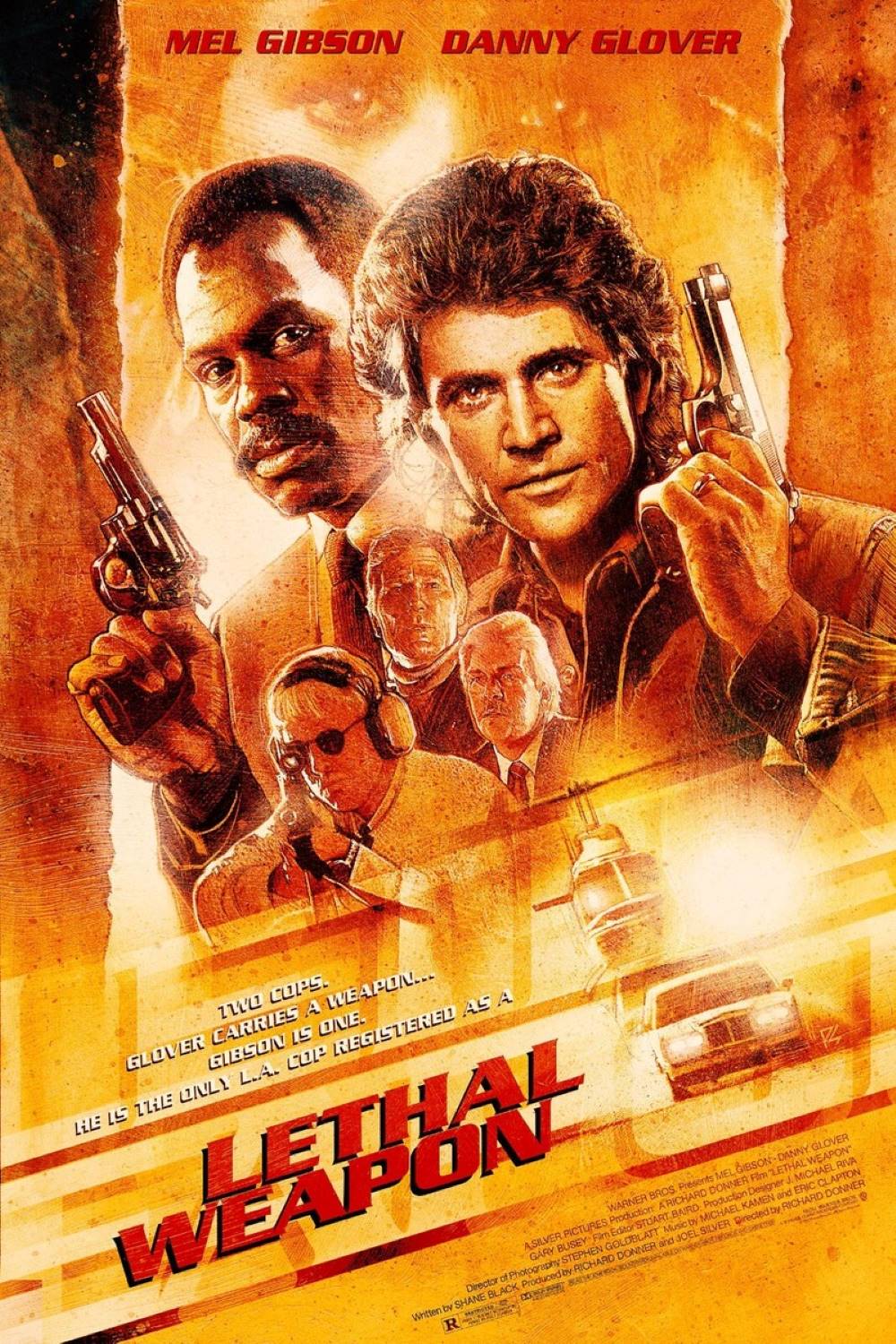
Lethal Weapon is one of those action movies that looks like pure genre formula on paper but somehow plays like lightning in a bottle on screen. From the opening moments, it feels like a film that knows exactly what kind of ride it wants to deliver and leans into that mission with confidence, attitude, and just enough heart to make the bullets and explosions actually matter.
The premise itself is as straightforward as they come, and that simplicity is part of the charm. Martin Riggs is the textbook “cop on the edge,” a former special forces sniper whose life has completely fallen apart after the death of his wife. He’s volatile, depressed, and teetering on the edge of suicidal, which gives everything he does an extra layer of danger. On the other side of the pairing is Roger Murtaugh, a seasoned detective staring down his 50th birthday, trying to balance a long career in homicide with the quiet, constant pull of his family at home. When these two are thrown together and assigned to a case involving drugs, dead bodies, and shady ex-military criminals, the story plays out across familiar beats: suspicious deaths, escalating confrontations, close calls, and a trail that leads them deeper into a dangerous operation. The crime plot is pulpy and direct rather than twisty, but the film uses it as a sturdy framework rather than the main point of interest, keeping the investigation moving while the characters come into focus. Much of that sharp setup and snappy progression comes from Shane Black’s script, which crackles with knowing genre savvy, pitch-perfect banter, and a keen eye for how personal pain fuels action-hero antics.
What really makes Lethal Weapon feel alive is how much time it spends letting Riggs and Murtaugh exist as people before they fully morph into the “classic duo” that pop culture remembers. The film doesn’t rush past the small stuff. Riggs is introduced living in a rundown trailer on the beach with his scruffy dog for company, drinking and stumbling through life with the casual recklessness of someone who genuinely doesn’t care if he sees tomorrow. Those early moments of him alone, flirting with self-destruction, give his later heroics a sense of tragic context: he’s not just fearless, he’s half-convinced he has nothing left to lose. Murtaugh’s introduction is a complete contrast: a crowded home, kids, a loving wife, and the kind of loud, chaotic domestic life that’s full of relatable irritation and warmth. Seeing him grumble through birthday milestones or awkwardly handle family situations does more for his character than any speech about his years on the force could. These slices of everyday life build a strong emotional foundation so that when the bullets start flying, there’s something at stake beyond catching bad guys. Black’s writing shines here, weaving those intimate details into the thriller beats without ever feeling forced or preachy.
The chemistry between Mel Gibson and Danny Glover is the film’s true secret weapon. Gibson plays Riggs as an unpredictable live wire, able to flip from goofy physical comedy to chilling seriousness in an instant. He sells the idea that this is a man barely keeping it together, yet still razor-sharp when it comes to the job. There’s a constant sense that his jokes and antics are a flimsy barrier over something very raw. Glover, by contrast, keeps Murtaugh grounded and human; his performance is packed with little sighs, muttered reactions, and weary facial expressions that speak volumes. He comes across as a guy who has seen too much, loves his family, and genuinely wants to do the right thing, but is exhausted by how hard that is in practice. Their initial friction hits the expected “mismatched partners” beats: Murtaugh thinks Riggs is unstable and dangerous, while Riggs treats Murtaugh like a fussy old man who doesn’t get it. Yet as they move through stakeouts, interrogations, and gunfights, their banter evolves from pure irritation into an easy rhythm filled with barbs, mutual respect, and eventually real affection. Shane Black’s dialogue is the glue for all of it—witty, profane, and laced with just enough vulnerability to make the laughs land harder and the tension feel real.
Richard Donner’s direction is a huge part of why all of this clicks as well as it does. He has a knack for blending big, commercial genre instincts with an eye for character detail, and Lethal Weapon is a textbook example of that balance. He stages action scenes with clear geography and rhythm, so even when things get loud and chaotic, you always know where you are and what everyone is trying to do. At the same time, he’s just as interested in the quiet beats: a pause on Riggs’ face after a joke lands flat, Murtaugh’s body language when he walks into his noisy home after a brutal day, the way a conversation in a car can shift from banter to confession in a couple of lines. Donner keeps the film moving at a brisk pace, but he knows when to let a shot linger or a silence hang long enough to tell you what the characters can’t quite say out loud. His tonal control—jumping from dark to funny to tense without completely losing the thread—is a big reason the movie doesn’t collapse under its own genre juggling, and it pairs beautifully with Black’s script that sets up those shifts so precisely.
Tonally, Lethal Weapon walks a tricky line, and that’s a big part of its identity. On one hand, this is a story with genuinely dark undercurrents. Riggs’ suicidal impulses are not a throwaway character quirk; the film gives time to scenes where he nearly acts on them and struggles in a very raw way with his grief and loneliness. The case they’re working breaks open into territory involving drugs, exploitation, and violence that’s sometimes nasty rather than cleanly heroic. On the other hand, the film is full of humor, ranging from quick one-liners to broad physical bits. The Murtaugh household provides a lot of that levity: awkward conversations with his kids, Riggs stumbling through family dynamics, and the contrast between domestic calm and the chaos of the streets. The movie often jumps from heavy emotional beats to comedic ones and back again, and while the transitions can be abrupt, that mixture is part of what keeps it from feeling like just another grim cop story. The laughter doesn’t erase the darker material, but it does give the movie a sense of momentum and charm that keeps it entertaining instead of oppressive. Black’s screenplay nails this push-pull, using humor as both release valve and revelation.
As an action film, Lethal Weapon delivers a steady run of sequences that are energetic, clear, and tactile. The action is built around physical stunts, dangerous-looking falls, and gunfights that feel chaotic without becoming incoherent. One memorable sequence has Riggs dealing with a jumper on a rooftop in a way that instantly tells you everything about his mentality and willingness to risk himself. Another set piece in a more open, exposed environment lets the film escalate tension step by step before violence finally erupts. Through it all, Donner keeps a strong sense of spatial clarity; you can track where the characters are, what they’re trying to do, and how each decision raises the stakes. The fights feel scrappy and painful rather than overly slick, and that slightly rough quality actually works in the movie’s favor, making each impact land harder. Riggs, especially, moves like a human weapon, hurling himself into situations with a recklessness that ties directly into his psychological state, all fueled by Black’s clever plotting that makes those risks feel personal.
Underneath the gunfire and explosions, there’s a surprisingly sturdy emotional core tying everything together. Riggs’ grief isn’t just window dressing; it’s the lens through which his every decision makes sense. The movie doesn’t lecture you about what he’s feeling, but it shows it—through quiet moments alone, through the anger that erupts at all the wrong times, and through the way he throws his body into danger almost as if daring the world to take him out. Murtaugh’s arc is more subtle but still strongly drawn. He’s at an age where he has to confront the reality that he can’t keep pace with younger, more reckless colleagues forever, and yet his sense of duty keeps pulling him into situations where his family might lose him. Throughout their investigation, Murtaugh’s protective instincts—toward his loved ones, toward Riggs, and toward innocent people caught in the crossfire—become as important as his skills as a detective.
The relationship that develops between Riggs and Murtaugh is the heart of the film and the main reason it sticks in the memory. At first, Murtaugh just wants to survive partnering with a man he genuinely believes might be unhinged, while Riggs seems to treat their pairing as just another chaotic twist in a life already off the rails. As they trade confessions, back each other up in tight spots, and slowly understand what the other is carrying, their bond shifts into something like brotherhood. Murtaugh becomes a kind of anchor for Riggs, offering not just backup in a fight but also a place at the table, both literally and figuratively. Riggs, in turn, forces Murtaugh out of his comfort zone, reminding him that he still has plenty of courage and fire left in him. The film doesn’t turn their connection into a sentimental soapbox, but it lets small moments—a shared laugh after a narrow escape, a quiet conversation after the chaos—do the emotional lifting, with Black’s words giving those scenes their understated power.
If there’s a clear weak spot, it’s that the villains are fairly thinly drawn, operating more as looming threats than fully realized characters. They are dangerous and organized, capable of serious brutality and clearly involved in serious criminal operations, but the movie doesn’t spend much time exploring their motivations or inner lives. They’re the kind of antagonists designed to be obstacles: formidable enough to make the heroes’ victories feel earned, but not so complex that they distract from the central duo. For a character-driven action film, that trade-off mostly works. When Lethal Weapon is firing on all cylinders, the tension doesn’t come from wondering what the bad guys will do next so much as from seeing how Riggs and Murtaugh will handle whatever gets thrown at them and what that reveals about who they are.
Structurally, the film keeps a tight pace, always nudging the story forward even when it pauses for character beats. Expository scenes rarely feel like dry info dumps; they’re often laced with jokes, personal jabs, or subtle shifts in how the two leads relate to each other. The downtime moments—a quiet drink, a shared meal, a conversation in a car between partners who would rather pretend they’re fine—are as important as the louder ones. By the time the case ramps up to its most intense passages, there’s been enough time with these characters to care less about the mechanics of the plot and more about whether these two damaged, stubborn men can come out the other side with something to hold onto.
What ultimately makes Lethal Weapon work so well is that it doesn’t settle for being just a checklist of genre requirements. Yes, it has gunfights, dark humor, car chases, and tough-guy posturing. But wrapped around all of that is a story about grief, aging, loyalty, and how unlikely partnerships can change the trajectory of a person’s life. Donner’s steady hand behind the camera, Shane Black’s razor-sharp script, and the powerhouse performances turn what could have been a forgettable cop thriller into something much more memorable. For anyone who enjoys action movies that care as much about the people pulling the triggers as the bullets they fire, Lethal Weapon stands out as a defining entry in the buddy-cop mold, powered by the messy, heartfelt dynamic at its center and the sure-footed craftsmanship that brings it all together.
Though the Academy of Motion Picture Arts and Sciences claim that the Oscars honor the best of the year, we all know that there are always worthy films and performances that end up getting overlooked. Sometimes, it’s because the competition too fierce. Sometimes, it’s because the film itself was too controversial. Often, it’s just a case of a film’s quality not being fully recognized until years after its initial released. This series of reviews takes a look at the films and performances that should have been nominated but were, for whatever reason, overlooked. These are the Unnominated.
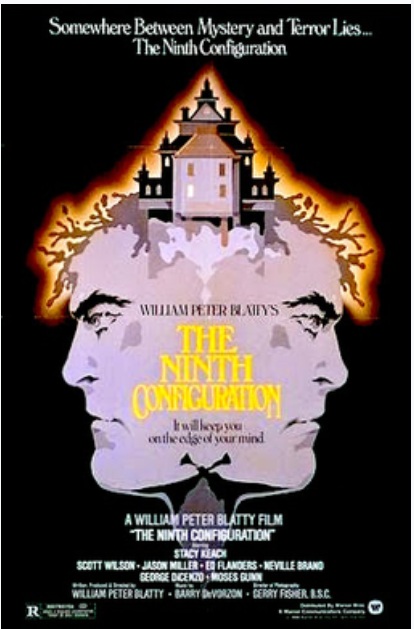
Some films defy easy description and that’s certainly the case with 1980’s The Ninth Configuration.
The film opens with a shot of a castle sitting atop of a fog-shrouded mountain. A voice over tells us that, in the early 70s, the castle was used by the U.S. government to house military personnel who were suffering from mental illness. Inside the castle, the patients appear to be left to their own devices. Lt. Reno (Jason Miller) is trying to teach dog how to perform Shakespeare. Astronaut Billy Cutshaw (Scott Wilson) is haunted by the thought of being alone in space and refuses to reveal why he, at the last minute, refused to go to the moon. The men are watched over by weary and somewhat sinister-look guards, who are played by actors like Joe Spinell and Neville Brand.
Colonel Kane (Stacy Keach) shows up as the new commandant of the the castle. From the first minute that we see Kane, we get the feeling that there might be something off about him. Though he says that his main concern is to help the patients, the man himself seems to be holding back secrets of his own. With the help of Colonel Fell (Ed Flanders, giving an excellent performance), Kane gets to know the patients and the guards. (Despite the objections of the guards, Kane says that his office must always be unlocked and open to anyone who want to see him.) He takes a special interest in Cutsaw and the two frequently debate the existence of God. The formerly religious Cutshaw believes the universe is empty and that leaving Earth means being alone. Kane disagrees and promises that, should he die, he will send proof of the afterlife. At night, though, Kane is haunted by dreams of a soldier who went on a murderous rampage in Vietnam.
The film start out as a broad comedy, with Keach’s smoldering intensity being matched with things like Jason Miller trying to get the dogs to perform Hamlet. As things progress, the film becomes a seriously and thoughtful meditation on belief and faith, with characters like Kane, Billy, and Colonel Fell revealing themselves to be quite different from who the viewer originally assumed them to be. By the time Kane and Cutshaw meet a group of villainous bikers (including Richard Lynch), the film becomes a horror film as we learn what one character is truly capable of doing. The film then ends with a simple and emotional scene, one that is so well-done that it’ll bring tears to the eyes of those who are willing to stick with the entire movie.
Considering all of the tonal shifts, it’s not surprising that the Hollywood studios didn’t know what to make of The Ninth Configuration. The film was written and directed by William Peter Blatty, the man who wrote the novel and the script for The Exorcist. (The Ninth Configuration was itself based on a novel that Blatty wrote before The Exorcist.) By most reports, the studio execs to whom Blatty pitched the project were hoping for another work of shocking horror. Instead, what they got was an enigmatic meditation on belief and redemption. The Ninth Configuration had the same themes as The Exorcist but it dealt with them far differently. (Because he wrote genre fiction, it’s often overlooked that Blatty was one of the best Catholic writers of his time.) In the end, Blatty ended up funding and producing the film himself. That allowed him complete creative control and it also allowed him to make a truly unique and thought-provoking film.
The Ninth Configuration was probably too weird for the Academy. Though it received some Golden Globe nomination, The Ninth Configuration was ignored by the Oscars. Admittedly, 1980 was a strong year and it’s hard to really look at the films that were nominated for Best Picture and say, “That one should be dropped.” Still, one can very much argue that both Blatty’s script and the atmospheric cinematography were unfairly snubbed. As well, it’s a shame that there was no room for either Stacy Keach or Scott Wilson amongst the acting nominee. Keach, to date, has never received an Oscar nomination. Scott Wilson died in 2018, beloved from film lovers but never nominated by the Academy. Both of them give career-best performances in The Ninth Configuration and it’s a shame that there apparently wasn’t any room to honor either one of them.
The Ninth Configuration is not a film for everyone but, if you have the patience, it’s an unforgettable viewing experience.
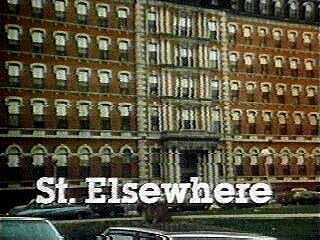
Welcome to Retro Television Reviews, a feature where we review some of our favorite and least favorite shows of the past! On Fridays, I will be reviewing St. Elsewhere, a medical show which ran on NBC from 1982 to 1988. The show can be found on Hulu and, for purchase, on Prime!
This week, Judith Light has got a gun!
Episode 1.18 “Dog Day Hospital”
(Dir by Victor Lobl, originally aired on March 22nd, 1983)
Finally, Dr. Ehrlich is performing his first solo operation. Dr. Craig is assisting but Ehrlich is in charge. He gets to play his music in the OR. He gets to decide what type of retractor to use. It’s a simple hernia operation. The patient (Sam Anderson) is awake and babbling through the whole operation.
Unfortunately, there’s also an angry woman in the OR and she has a gun. Barbara Lonnicker (Judith Light) is eight months pregnant, despite her husband claiming that he got a vasectomy at St. Eligius. As she already has several children to deal with, she wants to see the doctor who screwed up the vasectomy but she’s just as willing to shoot any other doctor to get her revenge. The operation continues while Dr. Craig and Dr. Westphall negotiate with her.
I have to admit that I did find a lot of this episode to be amusing. Ehrlich’s excitement over getting to do his first operation, Dr. Craig’s stuffy annoyance with being interrupted by a woman with a gun, and the patient’s nonstop rambling all made me smile more than once. And Judith Light, not surprisingly, was great as the woman with the gun. I loved the her husband was played by Tom Atkins. You never know who you might see at St. Eligius! That said, after the episode ended, I couldn’t help but think about how dumb the whole thing actually was. How are people always managing to get guns into St. Eligius? How did Barbara manage to get into an operating room without being stopped beforehand? (Luther does tell her that she can’t be back there but he’s the only one who seems to notice her before she bursts into the OR.) How come no one in the hospital seems to be more upset about the fact that there’s a woman waving a gun around an operating room? At one point, Barbara shoots Ehrlich’s radio and hardly anyone seems to react. The plot is played for laughs and that’s fine. But, in this case, the story was a bit too implausible for its own good.
Meanwhile, Nurse Rosenthal returned to work after her mastectomy and struggled to get back into her routine. Carolyn Pickles did a great job portraying Rosenthal in this episode. And Fiscus and Shirley Daniels visited an old woman in a nursing home. The subplots were handled well but, for the most part, this episode still felt as if it was trying a bit too hard.
2009’s AmazingRacer is the story of a teenage girl who meets her mother and learns how to ride a horse.
Shannon Greene (Julianne Michelle) is traumatized when her father dies and, having been told that her mother died giving birth to her, she now believes herself to be an orphan. However, Dr. Rita Baker (Daryl Hannah) reveals that Shannon’s father was just a damn liar. First, he told Shannon’s mother that her baby was stillborn. Then, as Shannon was growing up, he told her that her mother was dead. This is a lot to take in for both Shannon and the viewer. Myself, I wondered not only how someone could do that but why they would do that. Making the scene in which Shannon hears the truth even more surreal was the presence of Michael Madsen and Joanna Pacula, playing Shannon’s guardians. Madsen played his good guy role in much the same way he played his bad guy in Reservoir Dogs.
Anyway, Shannon ends up living with her mother, Dr. Christine Pearson (Claire Forlani), and her mother’s boyfriend, Eric (Jason Gedrick). Understandably, considering everything that she’s been through, Shannon is initially difficult and bratty but eventually, she comes to enjoy working on Eric’s horse ranch. She even starts riding a horse and winning races! This brings her to the attention of evil Mitchell Prescott (Eric Roberts), who wants her horse for himself and even has a spy working on the ranch….
There are a lot familiar faces in this movie. Charles Durning makes his final film appearance as Floyd. Steve Guttenberg has a bizarre cameo as a guy transporting a horse trailer. Scott Eastwood and Kirsta Allen show up. When it’s time for Shannon to finally start training for the big race, Lou Gossett Jr. pops up as the trainer. The film itself a fairly predictable horse ranch movie and it’s enjoyable if you like that sort of thing. (Myself, I like ranches and I like horses so I don’t mind movies like this.) But really, most of the movie’s entertainment value comes from guessing who is going to show up next. Some of the famous faces are bit distracting. But sometimes, it really pays off. I really wish Lou Gossett, Jr.’s role had been bigger because he does a great job with what little time he has.
As for Eric Roberts, he gets a bit more screentime than usual. One gets the feeling that he may have actually spent more than two days shooting his scenes for this one. Roberts is playing a villain here and he gives a enjoyably avuncular performance as the evil Mitchell. Roberts has fun with the role and, as a result, he’s fun to watch in this movie.
I enjoyed Amazing Racer. It had horses and it has Eric Roberts. What more could you want?
Previous Eric Roberts Films That We Have Reviewed:
Within the first five minutes, the film features not only a training montage but also a scene where a family cheering good news immediately gets a phone call delivering bad news. (“SHUT UP!” our hero yells at his friends and family.) By the time the film hits the five minute mark, it has managed to denounce communism, terrorism, laziness, and drunk driving! And that’s even before James Spader shows up as a cocaine-sniffing teenage crime lord!
First released in 1986 and directed by the same guy who did the first Friday the 13th, The New Kids tells the story of Loren (Shannon Presby) and his sister, Abby (Lori Loughlin). Their father (Tom Atkins) was a badass army colonel who fought communists, received commendations from the President (and that President was Ronald Reagan so you know those commendations were for doing something cool and not just for posting memes on twitter), and who taught his children self-defense. Every morning, he exercised with them and drilled into their heads the importance of being disciplined and willing to stand up for themselves. Sadly, their father and mother were both killed in a car accident after meeting with President Reagan at the White House.
Though they’ve been taught how to survive in the world by an expert, Loren and Abby are both teenagers and the law says that they need adult supervision. They move down to Florida and stay with their Uncle Charlie (Eddie Jones), Charlie owns a run-down amusement park that he’s decided to call Santa Land. He figures that tourists who are driving to “Walt Disney World and Epcot” will want to stop off at Santa Land. Personally, I think the tourists will probably want to keep driving to where they actually want to go but who knows? Uncle Charlie does have a petting zoo and there is something oddly charming about the idea of Santa hanging out in the bayous of Florida. I mean, there’s a reason why Santa Claus And The Ice Cream Bunny is beloved by viewers all over the world.
At the high school, everyone notices Loren and Abby. Abby gets a dorky boyfriend named Mark (Eric Stoltz …. no, really!) and Loren starts dating the sheriff’s daughter, Karen (Paige Lynn Price). Unfortunately, the new kids have been noticed by Eddie Dutra (James Spader) and his gang of inbred rednecks. Dutra and his gang deal drugs and have a pit bull who they’re hoping to enter into dog fights. (“Went straight for the jugular,” one gang member says at one point.) Dutra decides that he likes Abby, which leads to Loren getting protective, which leads to Dutra and the boys waging their own war on Abby and Loren and everything eventually comes to a deeply satisfying Straw Dogs-style conclusion at Santa Land.
The New Kids is one of those films that succeeds by being thoroughly absurd and over-the-top. Dutra and his gang aren’t just evil. Instead, they’re downright Satanic in their determination to destroy the new kids. The gang is fearsome enough, especially Gordo (Theron Montgomery), who is the fat future forklift operator from Hell. But what really makes this gang memorable is the fact that their leader is James Spader, with bright blonde hair, a smooth Southern accent, and moves that are so assured that he sometimes seem to be dancing across the screen. Dutra’s evil and the cocaine that he snorts leads to him making some bad decisions but he’s got style. As for the New Kids, Shannon Presby is a bit bland as Loren but that blandness actually provides a nice contrast to Spader’s more flamboyant performance. Lori Loughlin is likable and kicks Gordo in the balls, which is pretty cool. (Gordo more than deserved it.)
Cheerfully sleazy and unapologetically ridiculous, The New Kids is 80s exploitation cinema at its best.
105 years ago, on this date, the great character actor Dan O’Herlihy was born in Wexford, Wexford County, Ireland.
O’Herlihy would have a long career as an actor, making his feature debut in 1947’s Odd Man Out and working steadily in film and television for the next 50 years. For modern viewers, he is perhaps best remembered for his role as The Old Man in the first two Robocop films and his performance as the sinister trickster, Conal Cochran, in 1982’s Halloween III: Season of the Witch.
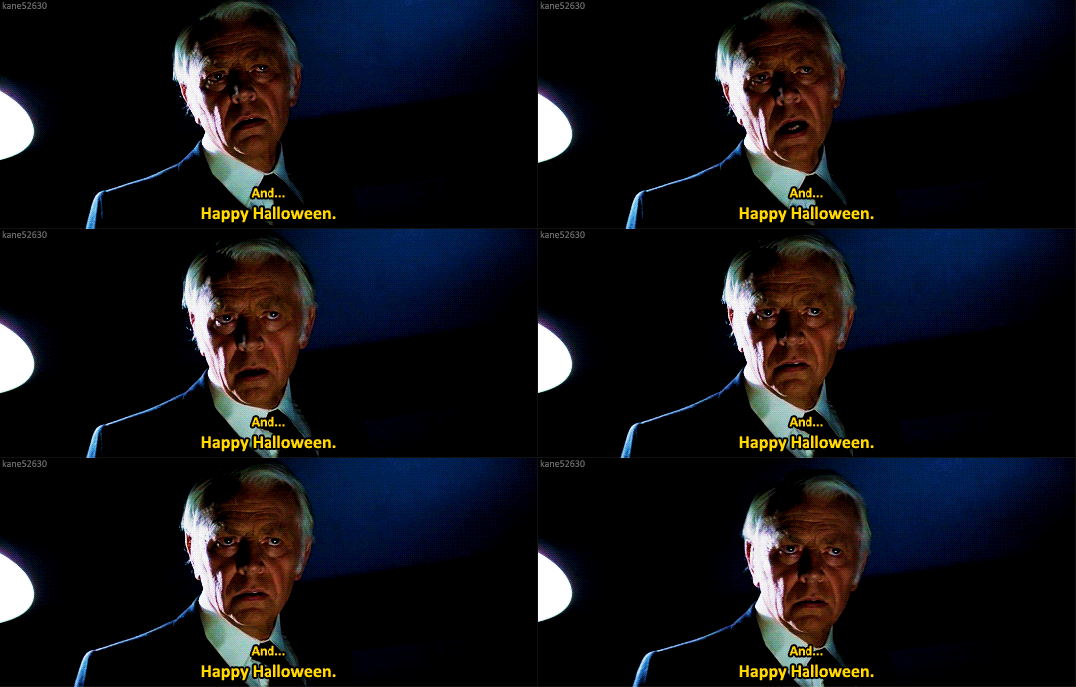
Today’s scene that I love from from the latter film. O’Herlihy explains the mean of Halloween to a trapped Tom Atkins. O’Herlihy truly turned Conal Cochran into one of the great horror villains of the 80s and his performance is one of the main reasons that the rather oddball Halloween III retains a loyal audience to this day.
In New York City, murders are being committed by a hulking man dressed in a policeman’s uniform. The NYPD brass (led by William Smith and Richard Roundtree) want to cover up the fact that the murders are being committed by an apparent maniac cop but Lt. Frank McRae (Tom Atkins) leaks the news to the press. With the citizens taking up arms against cops, the brass is eager to frame adulterous cop Jack Forrest (Bruce Campbell) for not only murdering his wife but also committing all of the murders. Lt. McRae believes that Jack is innocent.
Why is the brass so eager to frame Jack? Maybe it’s because they know that the Maniac Cop is actually Matt Cordell (Robert Z’Dar), a formerly good cop who was sent to Sing Sing on trumped up brutality charges. Cordell was killed in prison but he has now come back to life and is seeking revenge on the police force that he feels betrayed him.
Written by Larry Cohen and directed by William Lustig, Maniac Cop is the first of three Maniac Cop films. While the other two Maniac Cop movies largely work and hold up well, the first Maniac Cop is undoubtedly the worst of the trilogy, with most of the kills occurring offscreen and the action moving very slowly. The film is full of genre vets and Tom Atkins gives another one of this good tough guy performances. Bruce Campbell disappointingly plays his role straight and Robert Z’Dar, as intimidating as he is, is actually underused in this film.
As with most films written by Cohen, Maniac Cop has an interesting political subtext. It focuses on cop brutality and corruption with Cordell becoming a symbol of most people’s mixed feelings about the police. But the Maniac Cop trilogy wouldn’t really come to life until the second film. The first spends a lot of time setting Cordell up as a relentless avenger but there’s not much of pay-off.
In 1990, long-time friends George Romero and Dario Argento collaborated on Two Evil Eyes, anthology film that was based on the writings of Edgar Allan Poe. An Italian-American co-production, Two Evil Eyes featured two stories. The first was directed by George Romero, while the second was directed by Argento.
The Facts In The Case of Mr. Valdemar
(Dir by George Romero)
The first story is Romero’s, a modernized version of The Facts In The Case of M. Valdemar.
Jessica Valdemar (Adrienne Barbeau) is the 40 year-old wife of 65 year-old, Ernest Valdemar (Bingo O’Malley). Jessica only married Ernest for her money and, now that he’s on his death bed, she and her lover, Dr. Robert Hoffman (Ramy Zada), have hypnotized to him to do and say whatever they tell him to say and do. Even though Ernest is essentially comatose, the hypnosis allows them to force Ernest to sign his name to legal documents and to tell his suspicious attorney (E.G. Marshall) that he indeed wants to leave all of his money to Jessica.
When Ernest dies while under the influence of hypnosis, Jessica and Robert attempt hide his body in the basement. But is Ernest really dead? Jessica is convinced that she hears groaning from the basement and she wonders if the hypnosis has somehow left Ernest in limbo, between life and death. Robert thinks that Jessica is being foolish but it turns out that she’s not. After much paranoia and betrayal, one conspirator is dead and the other is a part of the living dead.
Usually, I like Romero’s work but this one didn’t work for me. From the flat cinematography to the shallow performances, this film felt more like an episode of a television show than anything else. Perhaps if it had been a stand-alone film, Romero could have found a way to make the material a bit more cinematic. (The story’s final shot, of blood dripping on a hundred dollar bill, is the film’s strongest moment and the part that feels the most Romeroesque.) But as a shortened chapter of an anthology film, it fell flat.
The Black Cat
(Dir by Dario Argento)
The Dario Argento segment is based on several different Poe stories. While the majority of the story is taken from The Black Cat, it also contains elements of Annabel Lee, Telltale Heat, The Pit and the Pendulum, and Buried Alive. Though this segment doesn’t really work, it’s obvious that Argento is a fan of Poe’s work and, for other Poe fans, there’s a lot of fun to be found in all of the Poe references that Argento sneaks into his story.
Harvey Keitel stars as Rod Usher, a crime scene photographer who loves his work a bit too much. He’s excited about the fact that his book of photography is about to be published. He’s less happy about the fact that his girlfriend, Annabel (Madeleine Potter), has adopted a black cat that is constantly glaring at Rod. Rod is eventually driven mad by both the cat’s apparent hatred of him and the fact that the cat itself keeps showing up no matter how far he goes to get rid of it. (This film features violence against a cat, which I hated. But it also featured a cat getting revenge and I appreciated that.) Eventually, Rod’s paranoia leads to violence and murder.
Look, this is a film about a guy who has an obsessive hatred of a cat. Obviously, this is not a film that I’m going to enjoy because I love cats. That said, I can still judge the film on its merits, even if it’s not for me on a personal level. While Argento is able to build up a good deal of tension and suspense in this film, the overall film doesn’t work because Harvey Keitel, supremely talented actor that he is, was totally the wrong choice for Rod Usher. Keitel, who reportedly did not get along with Argento during filming, gave a self-indulgent performance that featured a lot of bellowing. It’s as if Keitel is trying to compete with the constantly moving camera. The problem is that a star of a film like this has to be the director and Keitel’s histrionics take the viewer right out of the story.
Considering all of the talent involved, Two Evil Eyes is a disappointment.
Today’s horror scene that I love features an actor appreciated by horror fans everywhere, the great Tom Atkins.
The son of a Pennsylvania steel mill worker who originally planned to follow in his father’s footsteps, Tom Atkins served in the U.S. Navy and noticed that officers seemed to have all the fun. He also noticed that the officers all had college degrees so, upon getting out of the service, he enrolled in Pittsburgh’s Duquesne College. It was while at Duquesne that Atkins met a girl who was involved with a local theater group and he discovered that he actually enjoyed acting. Atkins made his film debut in 1968’s The Detective and he’s been working steadily ever since. A favorite of both John Carpenter and George Romero, Atkins has been a reliable horror fixture since the early 80s.
In this scene, from 1982’s Halloween III, Tom Atkins plays a doctor who desperately tries to stop the cruelest Halloween prank of all. One reason why this scene is so effective is because, if Tom Atkins can’t stop the broadcast, then that means nobody can.


 Through the Shattered Lens