Review: The Hunt for Red October (dir. by John McTiernan)


“I’m a politician. Which means that I am a cheat and a liar, and when I’m not kissing babies, I’m stealing their lollipops.” — Dr. Jeffrey Pelt, National Security Advisor

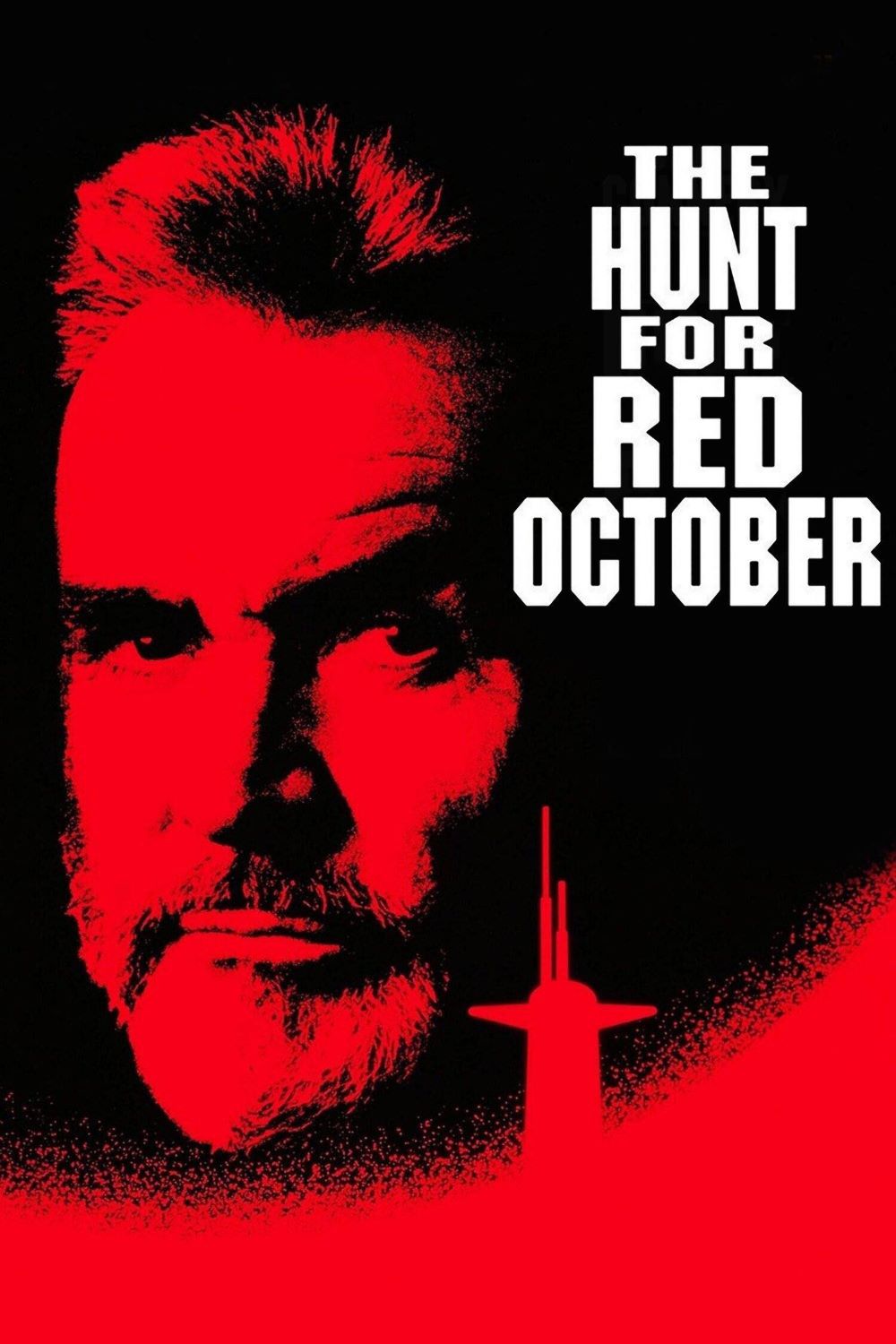
The Hunt for Red October glides into the tail end of Cold War cinema like a stealthy sub cutting through midnight swells, packing a smart mix of spy intrigue and nail-biting underwater showdowns that keep you locked in from the opening credits. Directed by John McTiernan, fresh from helming Die Hard, this 1990 adaptation of Tom Clancy’s doorstopper novel smartly distills pages of naval geekery into a taut, propulsive thriller where Soviet skipper Marko Ramius—Sean Connery in full brooding mode—pilots the formidable Red October, a behemoth sub with a hush-mode propulsion system that ghosts past detection like a shadow in fog.

McTiernan shines in wrangling the script from Clancy’s tech-heavy tome, slicing through the babble to propel the story with crisp momentum and unrelenting suspense, turning potential info-dumps into pulse-quickening beats that hook casual viewers and sub nerds alike. The premise grabs fast: Ramius’s bold maneuvers ignite a transatlantic frenzy, with U.S. and Soviet forces locked in a paranoid standoff over what looks like an imminent crisis. That ’80s-era distrust simmers perfectly here, crammed into a runtime that pulses with fresh urgency decades later, amplified by those dim-lit sub corridors in steely teal tones that squeeze the air right out of the room.

Alec Baldwin embodies Jack Ryan as the reluctant brainiac from CIA desks, sweaty and green around the gills yet armed with instincts that cut through official noise like a periscope through chop. Pulled from family downtime—teddy bear in tow—he injects everyday stakes into the global chessboard, proving heroes don’t need camo or cockiness, just smarts and stubbornness. Connery’s Ramius dominates as a haunted vet with a personal chip on his shoulder, steering a tight-knit officer corps including Sam Neill’s devoted second-in-command, their quiet bonds hinting at deeper loyalties amid the red menace.

Standouts fill the roster seamlessly: James Earl Jones lends gravitas as the steady Admiral Greer backing Ryan’s wild cards; Scott Glenn commands the American hunter sub with laconic steel; Jeffrey Jones brings quirky spark to the sonar savant whose audio tricks flip the script on silence. The dialogue crackles with shorthand lingo and understated jabs, forging a crew dynamic that’s as pressurized as the hull plates, pulling you into hushed command post vibes without a whiff of cheesiness.

​​

McTiernan elevates the genre by leaning on wits over blasts—thrilling pursuits deliver without dominating, letting mind games and split-second calls drive the dread, all while streamlining Clancy’s minutiae into seamless propulsion. Gadgetry gleams without overwhelming: the sub’s whisper-quiet tech sparks clever cat-and-mouse in hazard-filled depths, ramping uncertainty to fever pitch. Pacing builds masterfully from war-room skepticism—Ryan battling brass skepticism—to heart-in-throat ocean dashes, every frame taut as a bowstring. Practical models and effects ground the peril in gritty tangibility, no digital gloss, evoking Ice Station Zebra‘s frosty traps but streamlined into a relentless machine that dodges the older film’s drag. It’s a clinic in balancing spectacle and smarts, where tension coils from isolation’s cruel math: one ping too many, and it’s lights out.

On the eyes and ears front, the movie plunges into submersed nightmare fuel—consoles pulsing crimson in battle stations, scopes piercing mist-shrouded waves, silo bays looming like sleeping leviathans. McTiernan tempers his action flair for thinker-thrills; Basil Poledouris’s great orchestral score surges with iconic power through the chases—those brooding horns, choral swells, and rhythmic pulses echoing engine throbs have etched into legend, pounding your chest like incoming cavitation and elevating every dive. Audio wizardry seals the immersion: hull groans, ping echoes, bubble roars craft a metallic tomb where errors echo eternally. Flaws peek through—early scenes drag with setup chatter, foes skew broad-stroked—but the core hunt erases them, surging to a sharp, satisfying close that nods to Ryan’s budding legend without overplaying the hand.

’90s tentpole lovers and thaw-era history fans find a benchmark here, as the film plays the long con of trust amid torpedoes, fusing bombast with nuance that reboots chase in vain. It bottles superpower jitters spot-on—frantic commands clashing with strike debates—yet softens adversaries via Connery’s world-weary depth and Neill’s subtle conviction. Endless rewatches uncover gems: crew hints dropped early, sonar hacks foreshadowing real tech leaps. Baldwin’s grounded Ryan—chopper-barfing, suit-clashing, chaos-navigating—earns triumphs the hard way, contrasting Das Boot‘s bleak grind with upbeat ingenuity that feels won, not waved. Poledouris’s motifs linger post-credits, a symphonic anchor boosting replay pulls.

Endurance stems from mastering sub-horror’s essence: solitude sharpening choices, where flubs invite apocalypse. Ramius embodies defector realism—war-weary idealist mirroring history’s turncoats—while Clancy’s specs (sub classes, velocities) anchor without anchoring down. McTiernan sidesteps flags; zero flag-waving, pure operator craft in dodges and climactic finesse that blends brains with boom. Quirks delight—the premier’s bluster, aides’ cool calculus—padding a 134-minute gem that exhales you surfacing, amped. Expands on score’s role too: “Hymn to Red October” choral rise mirrors Ramius’s quiet rebellion, threading emotional undercurrents through mechanical mayhem, a Poledouris hallmark outlasting the film.

Bottom line, The Hunt for Red October captivates via cerebral kick—shadow games in fluid physics, intellect over muscle, audacious plays punking empire folly. Sparks post-view chin-strokes on allegiances and risks. Connery’s gravelly “One ping only, Vasily” endures as gold; storm-watch it, trade sofa for sonar station—raw thrill spiked with savvy. Sub saga staple? This silent stalker nails every target.
Music Film Review: The Rocky Horror Picture Show (dir by Jim Sharman)


It feels strange to actually watch The Rocky Horror Picture Show without an audience.

I say this because the film is actually far better known for its fans than anything else.  First released in 1975 to middling reviews and, at first, anemic box office returns, The Rocky Horror Picture Show went on to become the first great cult film.  It’s literally been playing in theaters for 25 years, which has to be some sort of record.  When one sees Rocky Horror Picture Show in a theater, one does not merely sit back and watch in a state of suspended animation.  Instead, most of the audience becomes a part of the show.  They yell, they dance, and many of them return night-after-night.  I have been to two midnight showings of the Rocky Horror Picture Show and I have to admit that it was actually pretty intimidating both times.  The people in the audience — the veterans who knew every line and knew exactly what to do — were, more or less, friendly.  I’ve read some online horror stories about people who felt like they weren’t welcome the first time they attended a showing.  I had the opposite experience.  No one was rude, no one glared.  It was definitely a cliquey group but I felt as if they had earned the right to be in their clique.  No one seemed to be bothered by the fact that I was mostly there just to observe.  (I should also mention that neither showing that I attended demanded that the first-time watchers stand up or go to the front of the theater or anything like that.  Apparently, there’s quite a few people online who got upset over being singled-out as “virgins” and never got over it.)  But it was intimidating in much the same way as meeting a friend of a friend is intimidating or exploring a new town is intimidating.  I was surrounded by people who had a deep connection with each other, one that had been forged by sharing the same experience for years.  It was a communal experience that was actually touching to see, even if I never stopped feeling like an outsider.

It’s interesting to compare the midnight showings of The Rocky Horror Picture Show to the midnight showings of The Room.  I attended several midnight showings of The Room and I have to admit that I eventually soured on them as it became clear that many people were showing up to taunt the film as opposed to enjoying it for the odd, communal experience that it was.  The last few The Room showings that I attended were filled with a hostility that left me feeling a bit uncomfortable.  Whereas The Room’s cult has often felt a bit mean-spirited (as if everyone had gathered together to laugh at Tommy Wiseau for thinking he could make a movie), The Rocky Horror Picture Show‘s cult is based on a genuine love for the film.

As for the film itself, I watched it last month without an audience and I judged it solely as a film.  The pacing is a bit off and, without the group experience, it’s a lot easier to notice that the film’s storyline doesn’t make a bit of sense, though that was undoubtedly deliberate on the part of the filmmakers.  That said, Tim Curry’s performance still gives the film a jolt of energy, recapturing your attention and holding it until the film comes to a close.  (The genius of Curry’s performance as that, as flamboyant as it is, he still plays Dr. Frank-n-Furter as being an actual characters with feelings and emotions.  He doesn’t just coast on attitude.  One need only compare him to Laverne Cox in the 2016 TV production to see how strong Curry’s performance is.)  Susan Sarandon brings some depth to her performance as Janet and, if Barry Bostwick is a little on the dull side of Brad …. well, the heroes who appeared in the film that Rocky Horror sends up were rarely that exciting.  I enjoyed the snarky humor of Richard O’Brien’s performance and the energy that Meat Loaf brought to the production.  Charles Gray, in the role of the Criminologist, really doesn’t get enough credit for holding the film’s disparate parts together.

In the end, when viewed as a film as opposed to a communal experience, The Rocky Horror Picture Show is undoubtedly flawed but it’s still energetic enough to work.  The love for the old sic-fi films comes through and Tim Curry’s uninhibited performance works with or without an audience.  The Rocky Horror Picture Show is a film that brings people together and I hope it continues to do so.

Guilty Pleasure No. 82: The Shadow (dir. by Russell Mulcahy)


As Guilty Pleasures go, The Shadow is a movie that has absolutely everything you need for a fun, campy ride. An Al Leong cameo, alongside James Hong? Check. Heroes and Villains taking time out to discuss their wicked plans (and how they’ll be stopped) over a glass of fine American Bourbon? Check. Early 90s Era CGI? Mark it down. Duel Wielding Pistol shooting action? Got it. Tim Curry just being there? Sweet.

After the wild success of Tim Burton’s Batman in 1989, Hollywood was scrambling to squeeze what they could out of the Superhero Movie. The Punisher, with Dolph Lundgren, would come out the same year. We’d end up with The Rocketeer (one of my personal favorites), BarbWire, Dick Tracy,The Crow, The Mask, and The Phantom, among others leading into the mid-90s. Among these was 1994’s The Shadow, based off the 1930’s character from Walter B. Gibson. Pre-dating all of the before mentioned characters (including DC’s Batman by almost a decade), The Shadow started as a series of radio stories before moving on to other forms of media. The movie didn’t do very well on it’s original release. Much like the magic that clouds men’s minds, audiences were more enraptured with The Crow months before and The Lion King. Some may remember a Shadow movie was made, but it was eclipsed by more popular films at the time.

At the same time, there were major advances happening in audio technology, thanks to a tiny Universal film called Jurassic Park. Jurassic Park helped to usher in an update in sound quality known as The Digital Experience (which we now know as DTS for short). As theatres coverted to the new sound system, various films in the early to mid nineties would make use of it, such as The Crow, The Mask, Timecop and The Shadow. By the time my family picked up their first Laserdisc player, DTS quality sound was available at home. My dad had a series of speakers lined around the living room of our house so that regardless of where you sat, the sound would move around you. One of the best tests of it was with John Carpenter’s The Thing, where Blair is standing off against the crew. The gunfire from his pistol would richochet from the front to the rear speakers, making the kids duck down.

The Shadow also made of use of this in certain areas, particularly with the way voices carried in a room. The part with Shiwan Khan’s voice moving over the city at night was amazing to hear with the right sound system. Just about any scene where The Shadow spoke had this sweet spatial effect that I loved.

The Shadow is the tale of Ying Ko (Alec Baldwin, The Getaway), a.k.a. Lamont Cranston. Living high in the Opium Fields of Tibet, he is a man of darkness, having inflicted great evil over time. Kidnapped and brought to a Tulku (a wise man) who has decided it’s time for redemption, Cranston is taught to cloud men’s minds, bending people to his will and to hide every aspect of himself save for one thing, his Shadow. He then returns seven years later to that “most wretched lair of villainy we know as” New York City, for we all know that the weed of crime bears bitter fruit.

Cranston spends most of his nights at The Cobalt Club with his Uncle Wainwright (Jonathan Winters, It’s a Mad, Mad, Mad, Mad World), who also happens to be the Police Commissioner. It allows him to keep up appearances while making sure the police don’t put The Shadow in their spotlight. When he meets the beautiful Margot Lane (Penelope Ann Miller, The Relic), he’s not only smitten, but finds her ability to read minds a dangerous threat to him.

When a metal casket from Tibet arrives at the New York Museum of Natural History, it reveals Shiwan Khan (John Lone, The Last Emperor), the last descendant of Genghis Khan. Gifted with the same abilities as Cranston, Khan has plans for the city and the world. He would rather have Cranston join him than to kill him. This turns the story into a classic Bond-like cliche where the hero and villain spend the bulk of the movie explaining their plans.

Enjoying the successes of Death Becomes Her and Jurassic Park, writer David Koepp was on a roll. The Shadow doesn’t take itself too seriously. Koepp and director Russell Mulcahy (Highander) splash moments of light comedy at just about every turn, mostly through the witty banter between characters. Some are over the top, particularly with Tim Curry’s character, while others are more subtle, like with Ian McKellan (The Lord of the Rings). If you’re looking for a serious drama in your superhero film, this isn’t it. Additionally, there are one or two elements that make no sense whatever. Mongol warriors walking around in full armor that no one ever seems to notice and taking rides in taxicabs (unless we assume they’re masked by Khan’s magic).

Most of the movie was filmed on the Universal Studios New York backlot, which explains why some scenes look like they were borrowed from Walter Hill’s Streets of Fire (that also used it years before). The mystical Tibetan Phurba dagger that echoes the disposition of its owner was a variant of the one used in Eddie Murphy’s The Golden Child in the late 80s.

if the movie’s climax between The Shadow and Khan feels a bit abbreviated, it’s because of a last minute change in filming. The original plan for the ending involved a series of mirrors, but an earthquake earlier in the year caused damage to the props the production team planned to use. So, what we get is a quicker scene, still falling in line with Mulcahy’s penchant for glass shattering, but leaving the audience to partially wonder what we could have had if everything worked out.

Finally, the real gem in all this is Jerry Goldsmith’s score. Although out of print, you can still find most of the tracks on YouTube, and the songs keep the immersion flowing. While I don’t see the film getting any kind of remakes in the near future, it’s nice to know everything came together (as well as it could) for this entry. Then again, who knows?

Previous Guilty Pleasures

  1. Half-Baked
  2. Save The Last Dance
  3. Every Rose Has Its Thorns
  4. The Jeremy Kyle Show
  5. Invasion USA
  6. The Golden Child
  7. Final Destination 2
  8. Paparazzi
  9. The Principal
  10. The Substitute
  11. Terror In The Family
  12. Pandorum
  13. Lambada
  14. Fear
  15. Cocktail
  16. Keep Off The Grass
  17. Girls, Girls, Girls
  18. Class
  19. Tart
  20. King Kong vs. Godzilla
  21. Hawk the Slayer
  22. Battle Beyond the Stars
  23. Meridian
  24. Walk of Shame
  25. From Justin To Kelly
  26. Project Greenlight
  27. Sex Decoy: Love Stings
  28. Swimfan
  29. On the Line
  30. Wolfen
  31. Hail Caesar!
  32. It’s So Cold In The D
  33. In the Mix
  34. Healed By Grace
  35. Valley of the Dolls
  36. The Legend of Billie Jean
  37. Death Wish
  38. Shipping Wars
  39. Ghost Whisperer
  40. Parking Wars
  41. The Dead Are After Me
  42. Harper’s Island
  43. The Resurrection of Gavin Stone
  44. Paranormal State
  45. Utopia
  46. Bar Rescue
  47. The Powers of Matthew Star
  48. Spiker
  49. Heavenly Bodies
  50. Maid in Manhattan
  51. Rage and Honor
  52. Saved By The Bell 3. 21 “No Hope With Dope”
  53. Happy Gilmore
  54. Solarbabies
  55. The Dawn of Correction
  56. Once You Understand
  57. The Voyeurs 
  58. Robot Jox
  59. Teen Wolf
  60. The Running Man
  61. Double Dragon
  62. Backtrack
  63. Julie and Jack
  64. Karate Warrior
  65. Invaders From Mars
  66. Cloverfield
  67. Aerobicide 
  68. Blood Harvest
  69. Shocking Dark
  70. Face The Truth
  71. Submerged
  72. The Canyons
  73. Days of Thunder
  74. Van Helsing
  75. The Night Comes for Us
  76. Code of Silence
  77. Captain Ron
  78. Armageddon
  79. Kate’s Secret
  80. Point Break
  81. The Replacements

Horror Scenes that I Love: Pennywise Visits The Library In It


Admittedly, this scene from the 1990 version of It is a bit more goofy than scary but still, I love Tim Curry’s performance as Pennywise the Clown.  When the first part of the latest version of It came out, it was kind of fashionable to dismiss the 1990 version.  But then the second movie came out and everyone was like, “We waited a year for this!?  Give us back our Tim Curry!”

Anyway, in this scene, Pennywise shows at the Derry Public Library and offers Richie (Harry Anderson) some balloons.

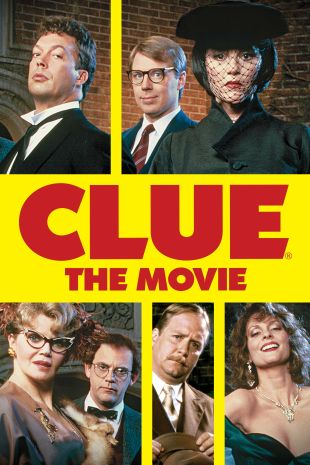
Film Review: Clue (dir by Jonathan Lynn)


It was a dark and stormy night in 1954….

The 1985 comedy, Clue, opens with a set of six strangers arriving at an ominous mansion in New England.  They’re meet by Wadsworth (Tim Curry), an oddly charismatic butler who explains that all six of the strangers have a few things in common.  They all work in Washington D.C.  They are all, in some way, involved with the government.  And they’re all being blackmailed by Mr. Boddy (Lee Ving), the owner of the house.

The six strangers have all been assigned nicknames for the night.

Miss White (Madeleine Khan) is the enigmatic widow of a nuclear physicist who may have had communist sympathies.  Actually, Miss White is a widow several times over.  All of her husbands died in circumstances that were a bit odd.  Is Miss White a black widow or is she just unlucky?  And what about the flames of jealousy that she occasionally mentions?

Professor Plum (Christopher Lloyd) is a psychiatrist who once worked for the World Health Organization and who has an unfortunate habit of sleeping with his patients.

Mr. Green (Michaele McKean) explains that he works for the State Department and that he is also secretly gay.  If his secret got it, he would be deemed a security risk or perhaps even a communist agent.

Mrs. Peacock (Eileen Brennan) is the wife of a U.S. Senator who forced to resign after getting caught up in a bribery scandal.

Colonel Mustard (Martin Mull) is a somewhat stuffy war hero-turned-arms dealer.

And finally, Miss Scarlet (Lesley Ann Warren) is Washington D.C.’s most powerful and most witty madam.

Once everyone is in the house, Wadsworth explains that the police have been called and will arrive in 45 minutes, at which point Mr. Boddy will be arrested and everyone’s secrets will be exposed.  Mr. Boddy’s solution is to suggest that one of the six kills Wadsworth.  After tossing everyone a weapon, Mr. Boddy turns out the lights.  When the lights come back on, Wadsworth is still alive but Mr. Boddy is not.  But who murdered Mr. Boddy?  And in what room?  And with what weapon?  And what to make of the other people who were either in the house or show up at the front door, like the maid, Yvette (Collen Camp), or the motorist (Jeffrey Kramer) who shows up to use the phone or the traveling evangelist (Howard Hesseman)?  Can the mystery be solved before the police show up and presumably arrest everyone?

Based on the old board game, Clue is a hilariously exhausting film, one that mixes smart wordplay and broad physical comedy to wonderful effect.  It’s not often that you see a film that gets equal laughs from two people colliding in a hallway and from characters accusing each other of being communists.  In fact, it’s so easy to marvel at the physical comedy (especially the lengthy scene where Tim Curry runs from room to room while explaining his theory about who committed the murders) that it’s easy to forget that the film is also a sharp satire on political corruption, national paranoia, 50s morals, and the McCarthy era in general.  Since all of the characters are already convinced that they’re either surrounded by subversives or in danger of being accused of being a subversive themselves, it’s not a great leap for them to then assume that any one of them could be a murderer.  I mean, if you’re willing to betray your country than who knows what you might be willing do in the study with a candlestick?

The cast is full of comedy veterans, all of whom know how to get a laugh out of even the mildest of lines and none of whom hold back.  Madeline Kahn, in particular, is hilarious as Miss White though my favorite suspect, in both the game and the movie, has always been Miss Scarlet.  Not only is she usually portrayed as being a redhead in the game but, in the movie, her dress is to die for.  In the end, though, it’s perhaps not a surprise that the film is stolen by Tim Curry’s energetic performance.  The film’s final 15 minutes are essentially a masterclass in physical comedy from Tim Curry but he’s just as funny when he’s delivering his frequently snarky dialogue.  Both Wadsworth the character and Tim Curry the actor appear to be having a blast, running from room to room and shouting out accusations.

When Clue was originally released, it was released with three different endings.  Apparently, the audience wouldn’t know which ending they were going to get before the movie started.  I guess that the idea was to get people to go the movie three times to see each ending but I imagine few filmgoers had the patience to do that and who knows how many viewers went to multiple showings just to discover that the randomly selected ending was one that they had already seen.  I’m surprised that I haven’t come across any reports of riots breaking out.  Fortunately, the version of Clue that is now available for viewing features all three endings.  Of course, none of the endings make much sense.  Hercule Poirot would demand a do-over, especially if he was being played by Kenneth Branagh.  But the fact that it’s all so ludicrous just adds to the comedy.  I watched Clue two Fridays ago with a group of friends and we had a blast.  It’s definitely a movie that’s more fun when you watch it with other people.

(That said, as far as incoherent solutions are concerned, the third one was my favorite and I think Poirot would agree.)

As for the board game itself, I used to enjoy playing it when I was a kid.  We had really old version from the 60s and I always used to imagine what all of the suspects were like when they weren’t being accused of murder.  I always imagined that Mr. Green and Miss Scarlet probably had something going on.  Today, I’ve got a special Hitchcock edition of the game.  It’s all good fun, this never-ending murder mystery.

Horror Film Review: It (dir by Tommy Lee Wallace)


Last month, before I saw the latest film version of Stephen King’s It, I watched the 1990 miniseries version.

This was my first time to watch the It miniseries, though I had certainly heard about it.  Most of the reviews that I had read seemed to be mixed.  Everyone seemed to agree that Tim Curry was the perfect choice for the role of Pennywise the Dancing Clown.  However, many other reviewers complained that the program’s television origins kept It from being as effective as it could be.  “Not as scary as the book,” everyone seemed to agree.  The actors who played the members of the Loser Clubs as children all seemed to receive general acclaim but not everyone seemed to be as enamored with the adult cast.  And everyone, even those who liked the miniseries as a whole, complained about the show’s finale, in which Pennywise took the form of a giant spider.

Well, I have to agree about the giant spider.  That spider looked painfully fake, even by the standards of 1990s television.  Not only does the spider look too fake to truly be scary but, once that spider showed up, that meant that Tim Curry disappeared from the film.  Curry deserved every bit of acclaim that he received for playing the role of Pennywise.

All that said, the miniseries was still a lot better than I had been led to believe.

Certainly, it’s not as frightening as the book or the movie.  Considering that the It miniseries was produced for network television, that’s not surprising.  As opposed to the movie, the miniseries attempts to cover King’s entire novel.  That’s a lot of material, even when you have a five hour running time.  Obviously, a good deal of the story had to be cut and there are a few scenes in the miniseries that feel a bit rushed.  Characters like Audrey Denbrough and Stanley Uris, who were compelling in the novel, are reduced to being mere bystanders.  Some of the novel’s most horrific scenes — like Henry Bowers cutting Ben — are either excised or heavily toned down.  If the novel was as much about the hypocrisy of the adults of Derry as the paranormal horror of Pennywise, that theme is largely left out of the miniseries.

That said, It still had its share of memorable moments.  The image of a clown standing on the side of the road, holding balloons, and waving is going to be creepy, regardless of whether it’s found in a R-rated film or on ABC.  The death of little George Denbrough is horrific, regardless of whether you actually the bone sticking out of his wound or not.  Even the library scene, in which a grown-up Richie Tozier deals with a balloon filled with blood, was effectively surreal.

As for the actors who played the members of the Losers Club, the results were occasionally uneven.  The actors who played them as children were all believable and had a credible group chemistry.  You could imagine all of them actually being friends.  As for the adults, some of them I liked more than others.  Harry Anderson, Dennis Christopher, and Tim Reid gave the best performances out of the group.  John Ritter and Annette O’Toole were somewhere in the middle.  Richard Thomas was absolutely awful and I found myself snickering whenever he was filmed from behind and I saw his pony tail.  Richard Masur, unfortunately, wasn’t around long enough to make much of an impression one way or the other.

Ultimately, though, the miniseries (much like the book) suffers because the adults are never as interesting as Pennywise.  Tim Curry dominates the entire movie and, when he’s not onscreen, his absence is definitely felt.  Watching the miniseries made me appreciate why the film version kept Pennywise’s screen time to a minimum.  Pennywise is such a flamboyant and dominant character that, if not used sparingly, he can throw the entire production out of balance.

Despite its flaws, I liked the miniseries.  Yes, it’s uneven.  Yes, it’s toned down.  Yes, it works better in pieces than as a whole.  But, taken on its own terms, It was effective.  Director Tommy Lee Wallace creates a suitably ominous atmosphere and the child actors are all properly compelling.  And, finally, that damn clown is always going to freak me out.

Just for fun, here’s a trailer for It, recut as a family film:

Cleaning Out The DVR Yet Again #34: The Rocky Horror Picture Show: Let’s Do The Time Warp Again (dir by Kenny Ortega)


(Lisa recently discovered that she only has about 8 hours of space left on her DVR!  It turns out that she’s been recording movies from July and she just hasn’t gotten around to watching and reviewing them yet.  So, once again, Lisa is cleaning out her DVR!  She is going to try to watch and review 52 movies by the end of Wednesday, December 7th!  Will she make it?  Keep checking the site to find out!)

The Rocky Horror Picture Show: Let’s Do The Time Warp Again aired on Fox on October 20th, 2016.

I’ve actually come across some debate online whether the Fox version of The Rocky Horror Picture Show should be considered a remake or merely a tribute to the original film.  It really doesn’t matter.  Whether it’s a tribute or a remake, it’s way too bland to succeed as either one.  Regardless of whether you think the original film (or the original stage play, for that matter) is a transgressive mindfuck or an overrated slog, you can’t deny that director Jim Sharman, star Tim Curry, and writer Richard O’Brien fully committed themselves to being subversive and challenging the audience.  The Fox version was directed by Kenny Ortega, who is best known for the High School Musical films.  Ultimately, this version feels so safe and bland that you could easily imagine Brad and Janet watching it while on church retreat.

It’s like Rocky Horror channeled through Glee channeled through the rockmentary episode of Saved By The Bell.

(“Friends forever.  It’s a nice idea.'”)

As for the cast, I thought Victoria Justice did a pretty good job as Janet, though it’s impossible for me to see her without singing that Best Friend’s Brother song that TeenNick always used to play in between episodes of Degrassi.  Reeve Carney did an acceptable Richard O’Brien impersonation as Riff-Raff.

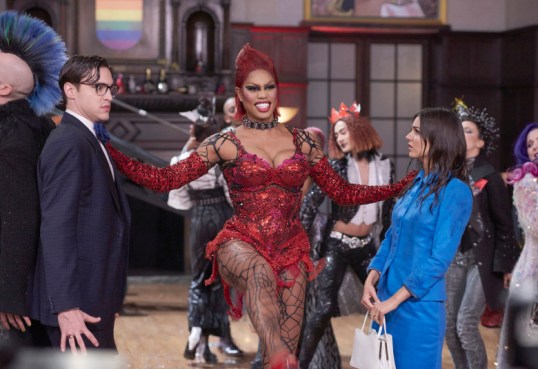
Laverne Cox took on the role of Dr. Frank-n-Furter and somehow, she managed to make that role boring.  You know who would have made a great Frank-n-Furter?  Adam Lambert.  But he was stuck playing Eddie, the delivery boy who gets eaten.  Lambert did a pretty good job as Eddie but let’s be honest — ANYONE WHO CAN SING CAN PLAY EDDIE!  Frank-n-Furter, on the other hand, is a dynamic character and, for a production of Rocky Horror to work, Frank has to dominate the entire show.  Far too often, Cox seemed to blend into the background.

As for the original Frank, Tim Curry showed up as the Criminologist.  Curry had a stroke in 2012 and now uses a wheelchair.  Here’s hoping the best for him!

As for this version of Rocky Horror, it will soon be forgotten.  Actually, it probably already is forgotten.  I had forgotten about it until I saw it on the DVR.  As opposed to some of the other made-for-TV musicals that have recently aired — Sound of Music, Grease — this version of Rocky Horror was not aired live.  To be honest, I think it would have been better if it had been a live production.  At the least, it would have brought an air of potential danger, the thought that anything could happen, to the production.

That’s what this version was missing.

Oh well!