Embracing the Melodrama #53: Crash (dir by Paul Haggis)


crash-2004-poster

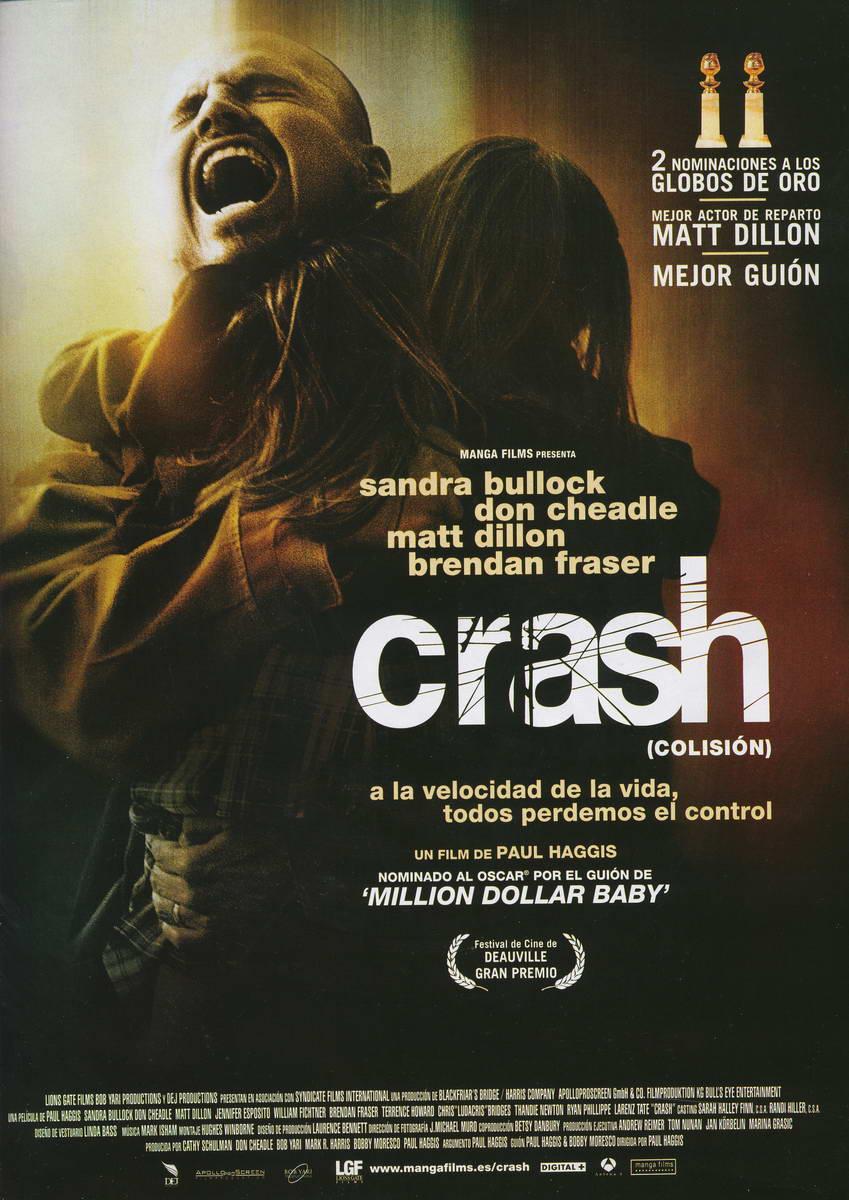
For the past two weeks, I’ve been reviewing, in chronological order, some of the most and least memorable melodramas ever filmed.   We started way back in 1916 and now, after 52 reviews, we’ve finally reached the year 2004.  And that can only mean that it is time to review the worst film to ever win an Oscar for best picture of the year.  I am, of course, talking about Crash.

Crash is an ensemble piece that follows a multi-racial cast of characters as they deal with issues of race, crime, and — well, that’s about it.  In Crash, everyone’s life revolves around race and crime.  Well, I take that back,  There is at least one character whose life revolves around being a good maid to the white woman who employs her.  But otherwise, it’s all about race and crime.  The film is set in Los Angeles which, from what I’ve read, is actually a pretty big city but you really wouldn’t know that from watching Crash.  All of the characters in Crash are constantly and randomly running into each other.  I think director/screenwriter Paul Haggis is trying to make a statement about the power that coincidence plays in the world but, often times, it just feels like lazy plotting.

Anyway, here are the characters who are meant to bring Los Angeles to vivid cinematic life:

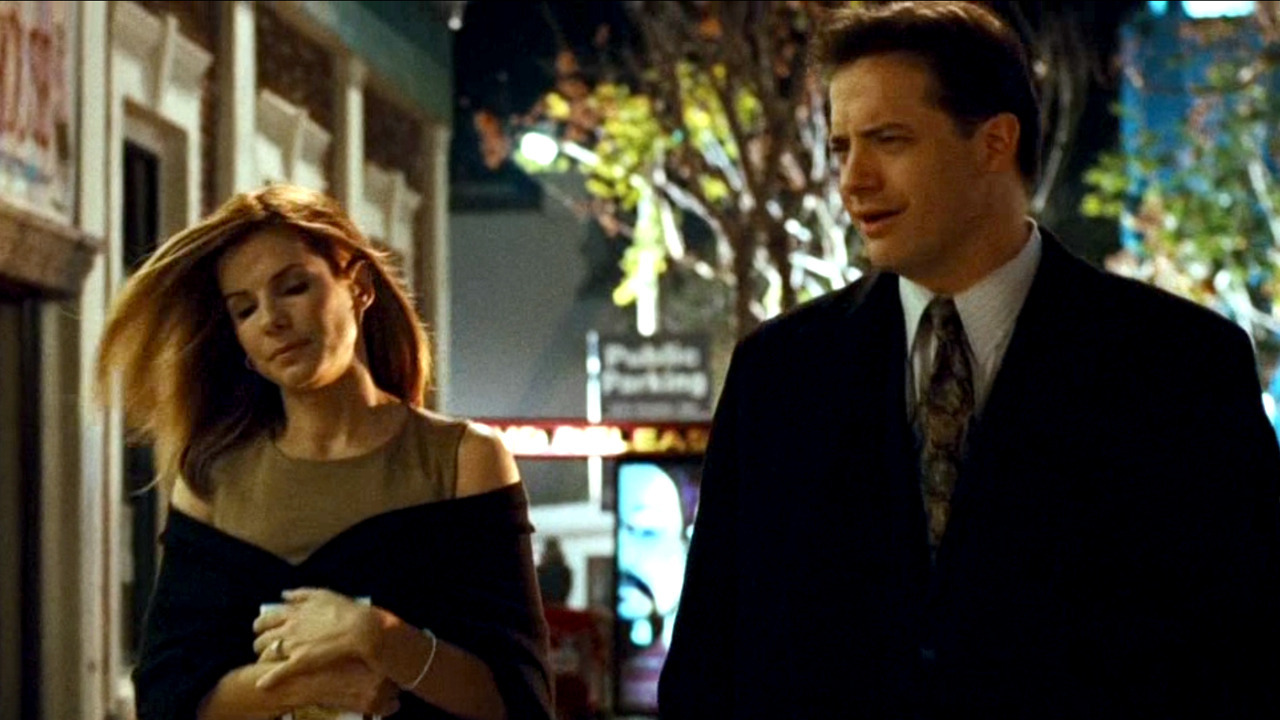
Brendan Fraser and Sandra Bullock play rich white people Rick and Jean Cabot.  Rick Cabot has just been elected District Attorney of Los Angeles County.  (Because when I think of a successful urban politician, I automatically think of Brendan Fraser…)  Jean is his materialistic wife.  At the start of the film, they’re carjacked by two young black men, which leads to Jean suspecting that every non-white she sees is secretly a gang member.  Later, Jean falls down a flight of stairs but she’s helped by her maid, who happens to be — surprise, surprise — not white!  Apparently, this teaches Jean an important lesson about tolerance.  The message, I guess, is that white people can be redeemed by interacting with their minority servants.

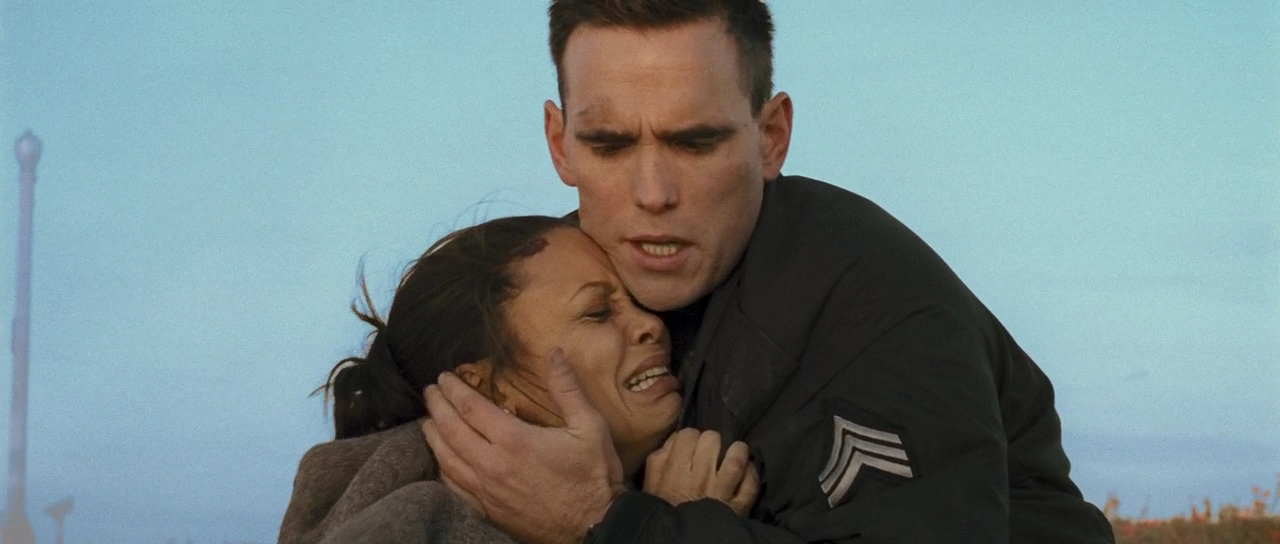
And then there’s Cameron (Terrence Howard) and his wife Christine (Thandie Newton) who are upper class and black.  Cameron directs sitcoms for a living and, at work, he has to deal with Fred (Tony Danza) constantly double guessing him and demanding that he reshoot scenes.  One night, as they leave an awards ceremony, Cameron and Christine are pulled over by two white cops — the racist Ryan (Matt Dillon) and his idealistic partner Hansen (Ryan Phillippe).  Ryan proceeds to molest Christine while giving her a pat down.  The next day, Christine is involved in a car accident on the freeway and is pulled from the burning car by none other than Officer Ryan.  The point here, I suppose, is that the same pervert who finger rapes you one night is just as likely to be the same guy who comes across your overturned car on the freeway.  For that scene alone, Crash deserves the title of worst best picture winner ever.

crash-2004 4

But that’s not all!

There’s also Detective Graham Waters (Don Cheadle), who has been assigned to investigate a police corruption case that would not be out of place in an episode of … well, just insert your own generic cop show title here.  Graham also visits his mentally unstable mother who demands that Graham find his younger brother.  Now, of course, as soon as we hear this, we know that Graham’s brother is going to have to turn out to be one of the other characters in the film.  Since there are only three other black males in this film (and since Cameron appears to be the same age as Graham), it’s not difficult to figure out who it’s going to be.

It’s either going to be Anthony (Ludacris) or Peter (Larenz Tate), who also happen to be the same two men who carjacked the Cabots’ car at the start of the film.  Larenz Tate probably gives the best performance in this whole sorry mess of a film, even if his role is ultimately a thankless one.

There’s also a locksmith named Daniel (Michael Pena), who finds himself being stalked by an angry Middle Eastern man.  Daniel’s story contains a hint of magic realism, presumably because Paul Haggis was reading something by Gabriel Garcia Marquez while writing the script.

Crash

You can fault Crash for many things but you also can’t deny that it’s far more ambitious than the typical bad film.  In the space of 112 minutes, Paul Haggis attempts to say everything that needs to be said about race and class in America.  Unfortunately, while watching the film, it quickly becomes obvious that Haggis really doesn’t know much about race and class in America.  Hence, the film becomes a collection of scenes that think they mean something while actually meaning nothing.  Crash is less about race in America and more about how other movies have traditionally portrayed race in America.  Unfortunately, director Haggis does not have the self-awareness to truly bring the subtext of screenwriter Haggis’s script to life.

The main theme of Crash seems to be that everyone has a good side and a bad side and that you can the hero of one story while being the villain of another.  That’s not a bad theme, it’s just an incredibly mundane one.  The film illustrates this theme by continually having a character say something racially offensive just to then have him do something heroic in the very next scene.  As a result, the characters don’t come across as being so much complex as just incredibly inconsistent.  Crash is never as deep as it thinks it is.

Reportedly, Crash was inspired by Paul Haggis’s own experience of getting carjacked.  Haggis has said that being a victim of crime led to some intense soul searching on his part.  Hopefully, Haggis got something better than just Crash out of the whole experience.

still-of-terrence-howard-in-crash-(2004)-large-picture

Trailer: Sabotage (Red Band)


Sabotage

Since Arnold Schwarzenneger left the California governor’s office and politics he’s gone back to doing what he was good at (or at least good at during the 80’s and 90’s). His first couple of films since getting back in front of the camera has been average at best (though I must say that Last Stand was pretty fun).

Now, we have him back in another film, but this time around one that’s a very hard, gritty R-rating that he hasn’t done since ever. He’s always had rated-R films, but they had a certain fun tone to them. With David Ayer’s Sabotage it looks like Schwarzenneger is trying to flex his hardcore bones. It’s definitely a surprise to hear him curse like a sailor during the red band trailer.

Sabotage is set for a March 28, 2014, release date.

Film Review: Lee Daniels’ The Butler (dir by Lee Daniels)


Dare I admit it?

When I saw Lee Daniels’ The Butler, I was not impressed.

Yes, the audience applauded as the end credits rolled.  And yes, I know that almost all of the mainstream critics have given it a good review.  I know that Sasha Stone has been hyping it as a surefire Oscar contender.  I know that, up until 12 Years A Slave introduced us all to an actress named Lupita Nyong’o, Oprah Winfrey was considered to be the front-runner for the Best Supporting Actress Oscar.

But it doesn’t matter.  The Butler did little for me.

I also realize that the film ended with a title card that announced that what I had just watched was dedicated to the American civil rights movement.  In many ways, that title card felt like emotional blackmail, implying that if you criticized The Butler than that meant you were also criticizing the brave, real life men and women who risked their lives to fight for equal rights.

However, when you put emotions and good intentions to the side, the fact of the matter is that Lee Daniels’ The Butler is not that good of a movie.  One need only compare The Butler to some of the other films that were released this year that dealt with the African-American experience — films like 12 Years A Slave and Fruitvale Station — to see just how safe and uninspiring The Butler truly is.

The Butler tells the story of Cecil Gaines (Forrest Whitaker), the son sharecroppers (played by David Banner and Mariah Carey) in the deep south.  After Cecil’s father is murdered by plantation owner Thomas Westfall (Alex Pettyfer), Cecil is raised and educated by the wealthy Annabeth Westdall (Vanessa Redgrave).  Eventually, the teenaged Cecil leaves the plantation and ends up working in a hotel where he’s educated in how to be a master servant by the elderly Maynard (Clarence Williams III, who brings a quiet dignity to his role).  Cecil eventually gets promoted to a hotel in Washington, D.C.  It’s there that he meets and marries Gloria (Oprah Winfrey).

In 1957, Cecil is hired to work at the White House.  Along with befriending two others butlers (played by Cuba Gooding, Jr. and Lenny Kravitz), Cecil also gets the chance to observe history play out first hand.  Starting with Dwight Eisenhower (played by Robin Williams) and ending with Ronald Reagan (Alan Rickman, giving a performance that is incredibly bad), Cecil watches as President after President deals with the civil rights movement.  Some presidents, like John F. Kennedy (James Marsden) are portrayed as being heroes while others, like Richard Nixon (John Cusack), are portrayed as being villains but all of them have the watchful eye of Cecil Gaines in common.

Meanwhile, at home, Gloria has a brief affair with Howard (played by Terrence Howard and really, you have to wonder what Cecil was thinking leaving his wife alone with anyone played by Terrence Howard) and Cecil’s oldest son, Louis (David Oyelowo), gets involved with the civil rights movement and grow increasingly estranged from his father.

The Butler actually starts out pretty well.  There’s a lengthy sequence where Louis and a group of students are trained on how to conduct a sit-in that’s extremely compelling to watch.  However, then John Cusack shows up wearing a big fake nose and the entire film starts to fall apart.

From a cinematic point of view, the film fails because it ultimately seems to be more dedicated to trotting out a parade of celebrity cameos to actually telling a compelling story.  As is his usual style, Lee Daniels directs with a heavy hand and, as a result, the film is full of emotionally-charged scenes that fail to resonate for longer than a handful of minutes.

My main issue with The Butler is that the film literally contains no surprises.  Nothing out of the ordinary happens and, at no point, is the audience actually challenged to consider the way they view history or race relations.  Whereas films like Fruitvale Station and 12 Years A Slave truly challenge our assumptions, The Butler encourages us to pat ourselves on the back for being so enlightened.  Every single frame of The Butler is specifically designed to fool us into thinking that we’re watching an important and challenging movie.

Because of a silly copyright lawsuit, the official title of The Butler is Lee Daniels’ The Butler.  However, that title is very appropriate because The Butler is definitely a Lee Daniels film.  Even if you didn’t know it beforehand, it would be easy to guess that the  same man who directed Precious and The Paperboy also directed The Butler.  As a director, Daniels specializes in making simplistic points in the most bombastic way possible.  The results are films, like The Butler, that are more concerned with manipulating an audience than challenging an audience.  When audiences applaud at the end of The Butler, they aren’t so much applauding the film as much as they are applauding themselves for having seen it.

Is It Too Late To Hate On Movie 43?


Originally,  I wasn’t planning on ever seeing Movie 43.

Remember Movie 43?  That’s the comedy with the huge ensemble cast that came out in January and stayed in theaters for about a week.  The trailers looked terrible, the commercials looked terrible, and finally, the reviews were terrible.  In fact, the reviews were so terrible (Richard Roeper called it the Citizen Kane of bad movies) that, at first, I was perfectly content never to see it.

However, as time passed, I continually heard Movie 43 referred to as being one of the worst films ever made.  Every 12 months, I post my picks for the 26 worst films of the year and I knew that Movie 43 was one of those films that would either appear on that list or, if it didn’t, I would have to be willing to defend the title’s absence.

I realized that before I could either defend or condemn, I would have to sit through the movie.  After all, I figured, it’s only 90 minutes of my life.

90 minutes that I’ll never get back, I might add.

Movie 43 is an anthology film in which 13 separate comedic sketches are loosely linked together by one overarching story.  For the most part, this is a film that was presumably made both for adolescent boys and for men who still think like adolescent boys.  Most of the humor is derived from bodily functions and there’s a real strain of misogyny running through the entire film.  However, the film’s problem is not that it’s crude and misogynistic but that it manages to be so dull about being crude and misogynistic.  If you think its hilarious when Meg is insulted on Family Guy or when Seth McFarlane smirks after making an anti-Semitic comment, you might enjoy Movie 43 but the rest of us are going to find far less to enjoy.

Oddly enough, there are actually two different versions of Movie 43 in circulation.  In the version that was released in U.S. theaters, the various vignettes are tied together by a story in which an insane director (Dennis Quaid) pitches scene after scene to a callous movie executive (Greg Kinnear).  In the version that was released in the UK, they’re linked together by a story about 3 teenagers searching for the most offensive film ever made.  To be honest, both versions are pretty stupid but I prefer the one about the 3 teenagers, if just because that way I can pretend that neither Dennis Quaid nor Greg Kinnear had anything to do with this movie.

As for the sketches themselves, there’s 13 of them and they are a mixed bag as far as both humor and quality are concerned:

1)      The Catch (dir by Peter Farrelly)

Kate Winslet and Hugh Jackman go on a blind date.  Jackman has testicles hanging from his neck and only Winslet thinks this is an odd thing.  This skit goes on forever.

2)      Homeschooled (dir by Will Graham)

Liev Schreiber and Naomi Watts explain how they’re making sure that their teenage son is getting the full high school experience despite the fact that he’s being homeschooled.  They do this through a combination of hazing and incest.  This skit worked pretty well, mostly because of the dedication that Schreiber and Watts brought to their absurd roles.

3)      The Proposition (dir by Steve Carr)

Uhmm…yeah.  So, this is the skit that opens with Anna Faris asking Chris Pratt to defecate on her.  I skipped over it because, quite frankly, life is too short.

4)      Veronica (dir by Griffin Dunne)

Neil (Kieran Culkin) is working the night shift at a depressing grocery store when his ex-girlfriend Veronica (Emma Stone) comes in.  They argue about who infected who with an STD.  Little do they realize that Neil has accidentally turned on the intercom and everyone in the store can hear them.  I actually kind of liked this short skit.  Culkin and Stone had a lot of chemistry and it was well-directed by Griffin Dunne.  Plus, it only lasted 2 minutes and, therefore, ended before the joke got old.

5)      iBabe (dir by Stephen Brill)

The iBabe is an MP3 player that happens to look like a life-size nude woman.  Unfortunately, a fan was built into the iBabe’s vagina and now, teenage boys are being dismembered while fingering and fucking iBabe.  Richard Gere plays the President of the company that makes iBabe.  I’ve never thought of Richard Gere as being a comedic actor and his performance here does nothing to change that.

6)      Superhero Speed Dating (directed by James Duffy)

Robin (Justin Long) goes speed dating and Batman (Jason Sudekis) tries to mess things up for him.  This skit – which also features (and wastes) Uma Thurman, Kristen Bell, and Bobby Cannavale – is so incredibly bad that I don’t even know where to begin.  Between this film and his appearance in last year’s The Conspirator, I’m having to rethink my slight crush on Justin Long.

7)      Machine Kids (directed by Jonathan Von Tulleken)

This commercial parody asks us to consider the children who work inside copiers and vending machines and how they are effected when we criticize those machines for not accepting our dollar.  This was actually so weird that I couldn’t help but love it.

8)      Middleschool Date (dir by Elizabeth Banks)

7th grader Amanda (Chloe Moretz) is having her first “middle school” date with Nathan (Jimmy Bennett) when she starts her first period.  In response, Nathan and his older brother (Christopher Mintz-Plasse) panic.  Believe it or not, this was actually one of the better parts of Movie 43, if just because the scene’s humor comes not from Amanda getting her period but instead from how every male around her descends into histrionics as a result.   It helps that this was the only part of Movie 43 that was both written and directed by women.  It also helps that director Elizabeth Banks is so clearly on Amanda’s side.  The end result is one of the few moments in Movie 43 that doesn’t feel misogynistic. 

9)      Tampax (dir by Patrik Forsberg)

This is another fake commercial.  Two girls are at the beach.  One uses tampax tampons and the other doesn’t.  Guess which one gets eaten by a shark?  As opposed to the previous skit, this bit of menstrual humor was obviously written and directed by a man (and the message, not surprisingly, is “Ewww!  Girls are scary and dangerous!”) but I’m going to have to admit that this one made me laugh if just because, like Middleschool Date, it reminded me of some of the period horror stories that I used to hear (and believe) back when I was younger.  (Though I was raised to be more concerned about bears than sharks…)

10)  Happy Birthday (dir by that noted comedian, Brett Ratner)

Pete (Johnny Knoxville) kidnaps an angry leprechaun (Gerard Butler) and gives it to Brian (Seann William Scott).  The leprechaun’s equally angry brother (also played by Gerard Butler) shows up and violence ensues.  Watching this skit was like being told a joke by someone who has no sense of humor.

11)  Truth or Dare (dir by Peter Farelly and Patrik Forsberg)

Halle Berry and Stephen Merchant are on a first date and Merchant has testicles on his neck…oh wait.  Sorry, that was Hugh Jackman and Kate Winslet’s skit.  In this skit, Berry challenges Merchant to game of truth or dare.  It escalates as the dares get continually more and more outrageous.  Whoops?  Did I say outrageous?  I meant to say stupid and oddly dull.  Watching this skit was like listening to a someone who has no sense of humor continue to tell a joke even though everyone else has already guessed the punchline.

12)  Victory’s Glory (dir by Rusty Cundieff)

In this parody of “inspirational” sports movies, Coach Jackson (Terrence Howard) speaks to his basketball team before they play their first game against an all-white team.  The gist of the speech is that Jackson’s team is going to win because they’re black and the other team is white.  This skit started out strong but, like a lot of Movie 43, it ran on for a bit too long.

13)  Beezel (dir by James Gunn)

This was actually my favorite part of Movie 43.  Unfortunately, since Beezel shows up in the middle of the end credits, I get the feeling that a lot of disappointed audience members had probably already walked out of the theater before it even began.  Beezel is a cartoon cat who has an unhealthy obsession with his owner (Josh Duhamel).  When Duhamel’s girlfriend (played by Elizabeth Banks) catches Beezel masturbating to pictures of Duhamel in a swimsuit, Beezel responds by plotting her demise.  Beezel was actually the only part of Movie 43 that truly felt edgy and unpredictable.  This is largely because this segment was directed by James Gunn, one of the few truly transgressive artists currently working in mainstream film.

So, here’s the question: is Movie 43 the worst film of 2013 as so many critics have claimed?  A few isolated moments aside, Movie 43 is pretty bad.  Even the parts of the film that do work can’t hope to compete with the pure horrifying incompetence of that parts that don’t.  However, thanks largely to James Gunn and Elizabeth Banks, it’s still a smidgen or so better than Tyler Perry’s Temptation.  (For all of its failings, Movie 43 never suggests that AIDS is God’s way of punishing wives who stray.  Nope, for that message, you have to go to Tyler Perry.)

Movie 43 is not the worst film of 2013.

It just seems like it.

Trailer: On The Road


Here’s the trailer for the film that will probably end up dominated my twitter timeline when it’s eventually released.  I follow a lot of big Kerouac fans (and I think Big Sur is one of the great American novels) and I’ll be interested to see what they think of the long-delayed film version of On The Road.  For now, I’ll just say that it’s rarely a good sign when the film version of an iconic novel is full of star cameos and I have a hard time imagining the dependably dull Garrett Hedlund as Dean Moriarty.

(Already, I can hear people complaining about the prominence of Kristen Stewart in the film’s trailer….)