Retro Television Review: Fantasy Island 7.7 “The Wedding/Castaways”


Welcome to Retro Television Reviews, a feature where we review some of our favorite and least favorite shows of the past!  On Tuesdays, I will be reviewing the original Fantasy Island, which ran on ABC from 1977 to 1984.  Unfortunately, the show has been removed from most streaming sites.  Fortunately, I’ve got nearly every episode on my DVR.

This week, Lawrence ruins everything.

Episode 7.7 “The Wedding/Castaways”

(Dir by Bob Sweeney, originally aired on November 26th, 1983)

Ugh, this episode.

Nerdy Fred Connors (Richard Gilliland) wants to spend a weekend alone with a beautiful woman.  His favorite supermodel, Christy Robbins (Phyllis Davis), has been pressured by her manager (Steve Perry) into agreeing to spend the weekend with Fred at Pelican Cove.  Fred and Christy will have their picture taken before and after their weekend together to show just how much spending time alone with Christy Robbins will improve one’s outlook on life.

Let’s just stop here and state the obvious.  This makes ZERO sense.  Christy’s manager has no idea who Fred is.  He doesn’t even meet Fred until it’s time to him and Christy to go to Pelican Cove.  Christy is a world-famous model.  In what world would a celebrity agree to be abandoned on an isolated island with a total stranger?  The photographers aren’t staying on the island with them.  Instead, Christy and Fred are dropped off on the island and then everyone else leaves.  If I was Christy, I would get a new manager.

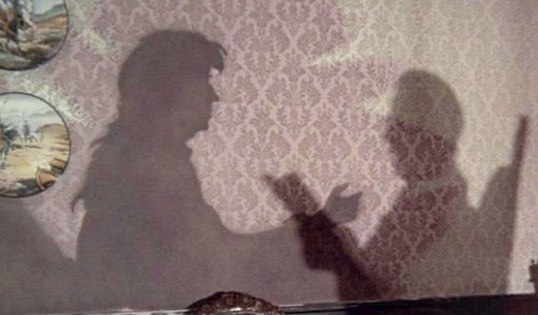
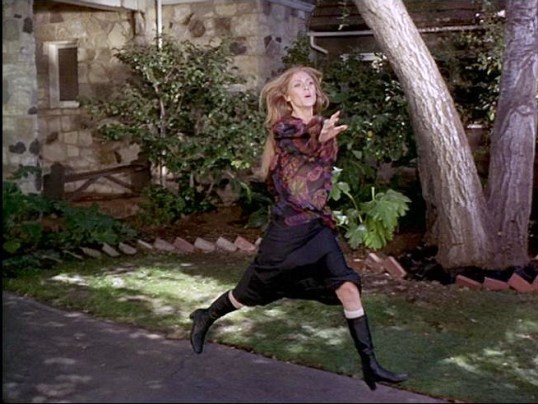
A rival model named Celina Morgan (Shannon Tweed) was also up for the “abandoned on an island with a possible sex maniac” gig and she’s upset that she lost out to Christy.  So, she sneaks out to Pelican Bay herself and soon, she and Christy are fighting over the right to spend their time with Fred.  It’s dumb and it makes no sense and, considering that the whole fantasy is basically two beautiful woman fighting over one dorky guy, it’s actually feels a bit demeaning and mean-spirited.

Of course, it’s nowhere near as mean-spirited as the other fantasy.  Lucy Gorman (Jeannie Wilson) is unhappy in her marriage to Dr. Jack Gorman (Gordon Thomson).  She tells Roarke that the only good thing that came out of her marriage was her daughter (Andrea Barber) but Lucy even feels jealous of her!  Lucy wants to go back to her wedding day so she can see what would happen if she left her husband at the altar and pursued another doctor (Richard Pierson).

Well, the main that would happen is that Lucy’s daughter would never be born.  But somehow, this doesn’t occur to Lucy until the fantasy has started.  How would that not occur to a mother?  This fantasy was …. I can’t even begin to describe how annoying it was.  Lucy came across as being very self-centered and kind of dumb.

I swear, the seventh season has just been terrible so far and I blame one person.

And, no, it’s not Mr. Roarke.

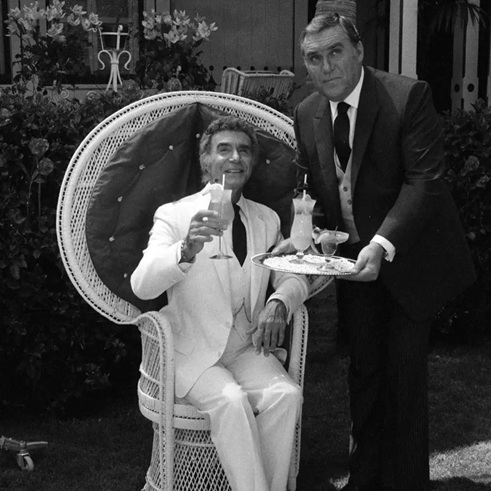
Seriously, ever since Lawrence showed up, the Island just hasn’t been the same.  Are we sure that Lawrence isn’t the Devil?  I mean, I know the Devil was traditionally played by Roddy McDowall on this show but I’m sure he change his appearance.  There’s something sinister about Lawrence and I don’t trust him.  He doesn’t care about Roarke and he doesn’t care about the fantasies.

What a disappointing trip to the Island.  Traditionally, the last season of any show is usually the worst but it’s still painful to watch Fantasy Island misfire like it did with this episode.

Horror on TV: One Step Beyond 3.21 “Night of Decision” (dir by John Newland)


In tonight’s episode of One Step Beyond, an important historical figure is consumed with self-doubt.  Fortunately, a spirit guide appears to give him the strength to keep fighting, even though victory will eventually lead to an even greater war.

Who knew George Washington was so neurotic?

CAN YOU PROVE IT DIDN’T HAPPEN!?

This episode aired on February 21st, 1961.

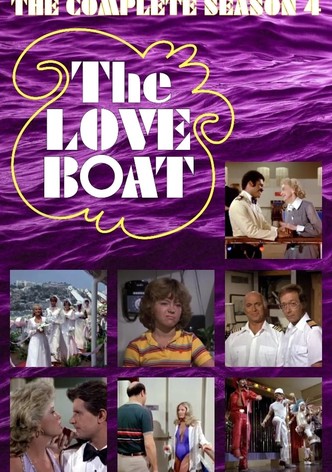
Retro Television Review: The Love Boat 4.25 & 26: “This Year’s Model/The Model Marriage/Vogue Rogue/Too Clothes for Comfort/Original Sin”


Welcome to Retro Television Reviews, a feature where we review some of our favorite and least favorite shows of the past!  On Wednesdays, I will be reviewing the original Love Boat, which aired on ABC from 1977 to 1986!  The series can be streamed on Paramount Plus!

This week, it’s time for the fashion festival!

Episode 4.25 and 4.26 “This Year’s Model/The Model Marriage/Vogue Rogue/Too Clothes for Comfort/Original Sin”

(Dir by Roger Duchowny, originally aired on May 2nd, 1981)

This week, the Love Boat sails to Acapulco for the International Fashion Festival!  Vicki, who hopes to grow up to be a fashion designer, is excited about meeting her idols.  Doc, Gopher, and Isaac are excited about the models.  Captain Stubing starts the cruise by reminding everyone to do their job for once.  It’s about time Stubing told them that.  Does Doc even keep office hours anymore?

This one of those two-hour episodes of The Love Boat that gets chopped into two episodes for syndication.  As such, it’s double-sized, with twice as many guest stars and the boat actually sailing to Acapulco during filming.  That doesn’t mean that the storyline are any more complicated than usual on this episode.  Despite being longer then usual, the episode follows the usual Love Boat pattern.  The extra time is largely taken up with a travelogue of Mexico (watch as a limo very slowly drives to a luxury hotel!) and the fashion show.

Fashion designers Gloria Vanderbilt, Bob Mackie, Halston, and Geoffrey Beene all appear as themselves.  They’re listed as guest stars but they don’t actually do anything other than board the ship and then show off their designs.  They don’t find love on the boat, nor do they search for it.  (Well, Halston probably did….)  Interestingly enough, none of them — not even the famous Halston — has much of a screen presence and in the scene where they introduce themselves to the crew, they’re all so stiff that it is somewhat difficult to watch.  It’s obvious that none of them were actors but it’s also interesting to consider that there was a time when someone could be internationally famous without being a natural on camera.

There are also a few fictional designers on the cruise.  They’re the one who actually have storylines.  Harvey Blanchard (Dick Shawn) is not aware that his daughter, Mandy (Debra Clinger), has married his nerdy assistant, Alvin Beale (Richard Gilliand).  Mandy wants Alvin to tell her father that they re married during the cruise but first, Alvin is going to have to figure out what to do after he accidentally dumps some designer clothes down a laundry chute and they end up shrinking in the dryer.  (“Have you ever considered designing children’s clothing?” Alvin asks his boss.)

Benita James (Elke Sommer) is an “up-and-coming” fashion designer who falls in love with Sidney Sloan (Mike Connors), despite the fact that he’s an industrial spy who has been hired to steal her designs.  Sid falls in love with Benita as well and decides that he can’t betray her.  But when Sid’s partner (Steve Franken) ransacks Benita’s cabin, will Sid be able to convince her that he wasn’t involved?

Charles Paris (Robert Vaughn, looking somewhat embarrassed) is a cosmetics tycoon who boards the boat looking for the new Ms. Paris, the model who will be the face of his company.  Will he pick Liz(Morgan Brittany) the model with whom he is falling in love, or will he pick Joanne Atkins (Carmilla Sparv), the model who has been told that, since she’s now over 35, her career is over?

Speaking of Joanne, she falls in love with Captain Stubing and Stubing falls in love with her.  Meanwhile, the married heads of her modeling agency (Anne Baxter and McClean Stevenson, who looks almost as embarrassed as Robert Vaughn) argue over whether or not Joanne is too old to continue on as a model.

Julie is excited because her former sorority sister, Melissa (Cristina Ferrare), is a model on the cruise.  Julie can’t wait to spend the whole cruise with her but Melissa meets and falls in love with Larry (Chris Marlowe).  When Melissa and Larry run off to get married, Julie takes her friend’s place in the fashion show.

And really, the fashion show is what this episode is all about.  The stories aren’t particularly important.  We’re here for the clothes!

Bob Mackie starts things off with a really cute collection of lingerie and pajamas, which happen to be my favorite things to wear.  I loved his collection.

Gloria Vanderbilt follows with sporty summer fashion, and watching her collection, I found myself wanting to go play tennis with my neighbors.

Geoffrey Beene follows with a collection of plaid suits that will be familiar to anyone who has ever binged a 70s sitcom.

“Up and comer” Benita James presents a collection of truly hideous cocktail dresses.

And Halston closes things out with evening wear.  “Red is my favorite color,” Halston says, “It’s so fun.”  This redhead appreciates the sentiment, even if it was kind of obvious that Halston didn’t bring his top designs on the cruise with him.

As the highlight of the episode, the fashion show was definitely entertaining though. it was impossible not to smile at just how ugly Benita James’s designs actually were.  Seriously, someone went to the trouble to hire two industrial spies to steal those designs?

As for everything else, it all works out.  This is The Love Boat.  Everything always works out.  Charles Paris announces that the new Ms. Paris will be Joanne but then he asks Liz to be “Mrs. Paris.”  Sid and Benita decide to get married as well.  Captain Stubing gets to have sex for once.  I think that may be the first time that’s happened since this show started.  Julie enjoys modeling.  Everyone either finds love or decides not to get divorced.  That’s a successful cruise!

This cruise was fun in its silly way.  Bob Mackie definitely won the fashion show.  Though the designers may not have been comfortable on camera and McClean Stevenson looked like he was on the verge of jumping overboard from embarrassment, this was The Love Boat at its most entertaining.


Late Night Retro Television Review: CHiPs 1.19 “Crash Diet”


Welcome to Late Night Retro Television Reviews, a feature where we review some of our favorite and least favorite shows of the past!  On Mondays, I will be reviewing CHiPs, which ran on NBC from 1977 to 1983.  The entire show is currently streaming on Freevee!

This week, Ponch gets to be a hero!  Take that, Baker!

Episode 1.19 “Crash Diet”

(Dir by Don McDougall, originally aired on February 23rd, 1978)

There’s a madman on the freeway and his name is Leonard!

Leonard (Herman Poppe) is a veteran who suffered a traumatic brain injury while serving in Vietnam.  He returned home and was making good progress until his wife was killed in a car accident.  (Leonard was the one driving.)  Leonard now hates cars and, after running away from both his sister’s house and the VA hospital, Leonard sets up camp off the highway.  Occasionally, he’ll jump out of the shadows and throw dirt at a motorist.  Leonard isn’t trying to hurt anyone but those big clumps of dirt take people by surprise.  When he throws a clump of dirt at Ponch, the cops get involved.

Ponch makes it his mission to find Leonard and help him get the help that he needs.  And, for once, Ponch manages to do just that.  Yay Ponch!  Yet, it seems odd that Baker would not be more involved with this case, as it has previously been established that Baker is also a vet and that he also served in Vietnam.  One would think that Baker would be somewhat invested in helping Leonard but, in this episode, Baker is mostly along for the ride.

Maybe Baker is preoccupied with the nude volleyball team that he met at the start of the episode.  When he and Ponch pulled over a van to give the driver a ticket, they were shocked to discover that the van was full of naked women.  It turns out that the local naturalist community has their own volleyball league and the women are all players.  Later, Baker and Ponch come across the now-clothed women playing in the park.  Ponch and Baker play a game and totally get their asses kicked.  That was satisfying to watch.

Meanwhile, Division wants each precinct to lost a total of 1,000 pounds by the end of the week.  (It’s like the Weight Loss episode of The Office.)  Officer Grossman (Paul Linke) worries that he won’t be able to lose 18 pounds in time.  Baker and Ponch each agree to lose an extra five pounds so Grossman will only have to lose 8.  Awwww!  Then they pull a prank that makes Getraer think that he’s gained 10 pounds.  That was kind of mean but I guess Getraer deserved it for …. for what?  Trying to make everyone eat healthy and take care of their bodies?

This episode was a mixed bag.  The show’s trademark chases were pretty lackluster this week.  But I thought Leonard’s story was well-handled, well-intentioned, and sensitively acted.  (Yes, even by Erik Estrada.)  As well, Paul Linke had some funny moments as Grossman.  This episode may not have been CHiPs at its best but it was still an entertaining 40 minutes.

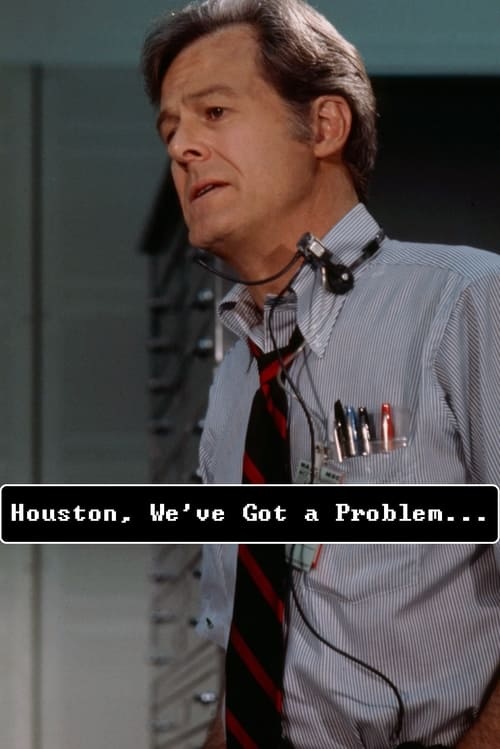
Retro Television Reviews: Houston, We’ve Got A Problem (dir by Lawrence Doheny)


Welcome to Retro Television Reviews, a feature where we review some of our favorite and least favorite shows of the past!  On Sundays, I will be reviewing the made-for-television movies that used to be a primetime mainstay.  Today’s film is 1974’s Houston, We’ve Got A Problem!  It  can be viewed on YouTube!

The year is 1970 and Apollo 13 is the latest manned NASA mission into space.  The head of the mission of Jim Lovell and the destination is the Moon.  Unfortunately, the American public has gotten so used to the idea of men going to the Moon that hardly anyone is paying attention to Apollo 13.  That changes when Lovell contacts mission control in Houston and utters those famous words, “Houston …. we’ve had a problem.”  An oxygen tank has exploded, crippling the spacecraft and leaving the three men in danger.  If Houston can’t figure out how to bring them home, Apollo 13 could turn into an orbiting tomb.

Yes, this film tells the story of the same crisis that Ron Howard recreated in Apollo 13.  The difference between Houston, We’ve Got A Problem and Apollo 13 (beyond the fact that one was a big budget Hollywood production and the other a low-budget made-for-TV movie), is that Apollo 13 largely focused on the men trapped in space while Houston, We’ve Got A Problem is totally Earthbound.  In fact, Jim Lovell does not even appear in the ’74 film, though his voice is heard.  (The film features the actual communications between the crew and Mission Control.)  Instead, the entire film follows the men on the ground as, under the leadership of Gene Kranz (Ed Nelson), they try to figure out how to bring the crew of Apollo 13 home.  Houston, We’ve Got A Problem is a far more low-key film than Apollo 13, one that features narration from Eli Wallach to give it an effective documentary feel but one that also lacks the moments of wit and emotion that distinguished Apollo 13.  

NASA cooperated with the making of the film and it works best when it focuses on the men brainstorming on how to solve the biggest crisis that the American space program had ever faced to that date.  The film is less effective when it tries to portray the effects of the men’s work on their home lives.  Sandra Dee is wasted as the wife who can’t understand why her engineer husband (reliably bland Gary Collins) can’t spend more time at home.  Clu Gulager plays the guy who fears he’s missing out on time with his son.  Robert Culp plays the man with a heart condition who places his hand over his chest whenever anything stressful happens.  Steve Franken has to choose between his religious obligations and his obligation to NASA.  The melodrama of those fictional moments are awkwardly mixed with the based-in-fact moments of everyone calmly and rationally discussing the best way to save the crew.  Jim Lovell, as a matter of fact, complained that Houston, We’ve Got A Problem did a disservice to the flight controllers by presenting them all as being hopelessly inept in their lives outside of mission control.  (Lovell was reportedly much happier with Apollo 13.)

Because it features the actual conversations between the crew and Mission Control, Houston, We’ve Got A Problem is interesting as a historical document but it never escapes the shadow of Ron Howard’s better-known film.

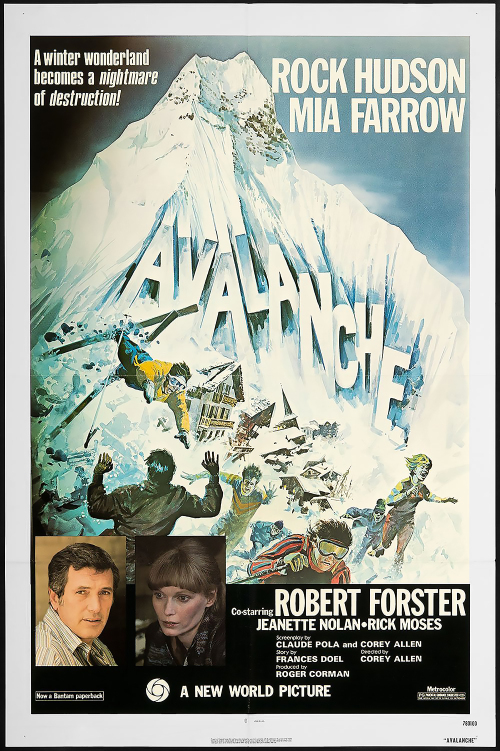
Film Review: Avalanche (dir by Corey Allen)


The 1978 film Avalanche tells the story of a beautiful resort that’s been built in the mountains of Colorado.  Self-righteous photographer and activist Nick Thorne (Robert Forster) keeps insisting that it’s not environmentally safe to build a resort up in the mountains.  According to him, there’s too much snow building up and it’s inevitably going to lead to an avalanche.

The owner of the resort, David Shelby (Rock Hudson), insists that Nick doesn’t know what he’s talking about.  Sure, David may have had to cut a few ethical corners to get his resort built and he may currently be under criminal investigation but that doesn’t make David a bad guy.  All he wants is to have a nice and expensive resort located in the most beautiful and dangerous place on Earth.  Does that make him a bad guy?

Unfortunately, if David was watching the film with the rest of us, he would be aware of all the shots of snow ominously building up on the side of the mountain.  However, David would still probably be distracted by the presence of his ex-wife, Caroline (Mia Farrow).  David would love to get back together with Caroline but Caroline finds herself growing attracted to Nick.  When David isn’t chasing after Caroline, he’s trying to keep his mother, Florence (Jeanette Nolan), from drinking all of the liquor in the resort.  Good luck with that!  Florence is an eccentric old person in a disaster film so, of course, she’s going to be drunk off her ass for the majority of the run time.

There are other dramas occurring at the resort, of course.  TV personality Mark Elliott (Barry Primus) is upset because his ex, Tina (Cathey Paine), is hooking up with arrogant skier Bruce Scott (Rick Moses).  Bruce is upset because Tina expects him not to cheat on her.  Ice skater Cathy Jordan (Pat Egan) is hoping to conquer her insecurities.  Rival ice skater Annette River (Peggy Browne) is …. well, she’s there.  To be honest, I’m not really sure what the whole point of the ice skating rivalry was since they all end getting buried in snow regardless.  Then again, maybe that is the point.  An avalanche doesn’t care about your personal dramas.  All it cares about is destroying tacky resorts that overuse wood paneling.

Yes, the avalanche does come crashing down the mountain eventually.  It takes a while, though.  There’s almost an hour of Rock Hudson walking around with a pained look on his face before the snow finally comes crashing down.  For all of Nick’s talk about how the avalanche would probably be the result of too many people skiing, it actually happens because someone crashes a plane into one of the mountains.

Obviously, the avalanche is the main reason why anyone would want to watch a movie called Avalanche.  Anyone with any knowledge of the disaster genre knows that no one watches these movies for the human drama.  They watch them because they want to see at least 10 minutes of solid destruction.  A disaster movie can get away with almost anything as long as the disaster itself looks good.

The disaster in Avalanche does not look particularly good.  This film was directed by Roger Corman and, despite being one of the most expensive films that Corman ever produced, the avalanche effects are definitely a bit cut-rate.  At the same time, the cheapness of the special effects does provide the film with its own odd charm.  Just consider the scene where one of the ice skaters gets covered in snow while spinning around with a triumphant smile on her face.  (Sure, she might be dead and she’ll certainly never make it to the Olympics but at least she finally mastered a fairly basic skating move.)  The avalanche effects are super imposed over the image of the skater spinning but it’s obvious that it didn’t occur to anyone to tell the skater, “Hey, act like there’s a gigantic amount of snow crashing down on you!”  It’s so inept as to be charming, like when a child draws a really ugly picture but it’s cute because at least they tried and, as a result, you wait until the child leaves your house before you throw it away.

The thing I love about Avalanche is how everyone is even more ineffectual after the avalanche than they were before it.  Usually, in a movie like this, the disaster leads to unexpected heroism and the villains getting the comeuppance.  In this one, the avalanche just inspires more stupidity.  Fire trucks and ambulances literally collide with each other while heading for the resort.  At one point, a group of fireman set up a net directly underneath someone falling out of a ski ramp chair just for the person to somehow land a few inches to the left of them.  Though the film sets David Shelby up to be the villain, it’s hard not to feel that everyone at the resort is just an idiot.

Listen, I love Avalanche.  It’s terrible but it’s a lot of fun and the less-than special effects go along perfectly with the overheated (or, in some cases, underheated) performances.  Rock Hudson wanders through the movie with a strained smile on his face that has to be seen to be believed while Mia Farrow and Robert Forster both try so hard to make their underwritten characters credible that you can’t help but kind of appreciate their devotion to a lost cause.  If nothing else, the shots extras reacting to superimposed shots of the avalanche makes this film worth a look.  This is a cheap and silly movie and if you don’t enjoy it, I don’t know what’s wrong with you.

TV Review: Night Gallery 1.3 “The House/Certain Shadows on the Wall”


The third episode of Night Gallery aired on December 30th, 1970.  While Americans were undoubtedly finalizing their plans for a wild New Year’s Eve (because, after all, Nixon was president and every day was a party), NBC and Rod Serling invited viewers to take a tour through a darkened museum, one where every painting told a story.

This episode of Night Gallery featured two stories:

The House (dir by John Astin, written by Rod Serling)

The House opens with Elaine Latimer (Joanna Pettet) talking about a recurring dream.  She’s driving her car through the countryside when she comes across a large house.  Though she’s never seen the house, she finds herself drawn to it, as if she somehow belongs in the house.  As Elaine describes her dream, we come to realize that she’s talking to a psychiatrist (Steve Franken) and that Elaine is recovering from mental breakdown.  Her doctor tells Elaine that the dream is nothing to worry about.

However, when Elaine is driving home, she realizes that the countryside looks familiar.  Soon, she’s pulling up in front of the house from her dreams!  When Elaine gets out of the car, she’s greeted by a real estate named Peugeot (Paul Richards) who asks her if she’s interested in buying the house.  As Peugeot gives her a tour of the estate, he mentions that the house is thought to be haunted….

I liked The House.  It was an atmospheric little tale and, from the minute that Elaine started talking about her dream, the story captured my attention.  (I should admit that I also have recurring dreams about a house that I’ve never actually seen before.)  Admittedly, the story does play out at a very deliberate pace and requires a bit of patience but the dream sequences are effectively surreal and Joanna Pettet gives an empathetic performance in the lead role.

Certain Shadows On The Wall (dir by Corey Allen, written by Rod Serling)

This segment features Agnes Moorehead as the sickly Emma, who is poisoned by her own brother, the despicable Stephen (Louis Hayward).  After Emma’s death, Stephen is shocked to discover that, even though Emma is gone, her shadow remains on the wall.  While Stephen is trying to make sense of that, his other two sisters (played by Grayson Hall and Rachel Roberts) have plans of their own for how to deal with their duplicitous brother.

Like The House, Certain Shadows On The Wall is appropriately atmospheric.  The ending is a bit weak as Stephen gets what he deserves but the shadow itself doesn’t have much to do with his actual fate.  Just when you’re waiting for Agnes Moorehead to make a sudden, ghostly appearance, the story comes to an end.  Still, this is an effective segment and it features excellent work from its ensemble.  I especially liked the performance of Grayson Hall, which features one of the most frightening glares that I’ve ever seen.

The third episode of Night Gallery was a definite improvement over the two that came before it.  Both segments tell intriguing stories, though it’s obvious that the show was still better at coming up with good premises than effective endings.

Previous Night Gallery Reviews:

  1. The Pilot
  2. The Dead Man/The Housekeeper
  3. Room With A View/The Little Black Bag/The Nature of the Enemy

Film Review: Westworld (dir by Michael Crichton)


“Draw,” says Yul Brynner.

“Whatever,” says a tourist who has spent a lot of money to spend their vacation at the Delos amusement park.

BANG!  Down goes the tourist, as the robot revolution of 1983 begins.

Recently, TCM broadcast the 1973 science fiction thriller, Westworld.  Since I am absolutely obsessed with the more recent HBO revival, there was no way I could resist watching the original film.  It was an interesting experience.  While the film is far more simpler and straight-forward than the television series, they both essentially tell the same story.  A bunch of rich humans pay a lot of money to pretend to be either cowboys or knights or Roman citizens for a week.  Everyone has a great time until, eventually, the robots stop doing what they were supposed to do and instead, begin to fight back.

One thing that the movie and the series definitely shared is a less-than-positive view of humanity.  The movie focuses on two businessmen.  Peter (Richard Benjamin) is the nerdy one.  John (James Brolin) is the hypermasculine one.  Peter is visiting Westworld for the first time.  John is a frequent guest who loves gunning down any robots who looks at him the wrong way.  Neither one of these characters is particularly likable.  Peter starts out as a self-righteous hypocrite who ends up sleeping with a sexbot, despite being married.  John brags about how easy it is to kill the robots, mostly because the robot’s are programmed to not fight back.

Meanwhile, the human engineers who work behind-the-scenes and keep Delos running are all blandly incompetent.  When the robots start to malfunction, the engineers can only shrug and wonder why.  They’re so ineffective that, halfway through the movie, they get sealed up in their own control room, slowly suffocating to death while the park collapses around them.

As opposed to the TV series, the robots in Westworld never achieve any sort of real consciousness.  Even when they malfunction, it doesn’t lead to a true rebellion as much as it just causes them to ignore any previous directives about killing the guests.  When the Gunslinger (Yul Brynner) starts stalking Peter and John across the park, it’s not an act of ideology or, for that matter, even revenge.  It’s simply that the Gunslinger has been programmed to be a killer and this is what a killer does.

It all leads to an extended chase sequence involving the Gunslinger and Peter and, despite the fact that it doesn’t have much of a personality, it’s hard not to be on The Gunslinger’s side.  If nothing else, the Gunslinger is at least good at what it does.  Peter, on the other hand, is perhaps one of the most incompetent heroes to ever show up in a movie.  After spending the first half of the movie being smug and dealing with robots programmed not to fight back, Peter now has to try to win on an even playing field.

Westworld was the directorial debut of writer Michael Crichton.  The film’s flaws are largely the flaws that you would expect from a first-time director.  Occasionally, the pacing falters and the first half of the film sometimes moves a bit too slowly.  (There’s one saloon fight that seems to go on forever.)  During the first half of the film, there’s several scenes involving another tourist (played by Dick Van Patten) who seems like he’s going to play a major role in the film but, after the first hour, the character literally vanishes from the film.

Despite those flaws, Westworld remains an exciting mix of suspense and science fiction.  Though his actual screentime is rather limited, Yul Brynner easily dominates the entire film.  In the role of the Gunslinger, Brynner is a relentless killing machine.  What makes the character especially disturbing is that Brynner plays him without a hint of emotion or expression.  The Gunslinger gets no pleasure out of killing nor does he seek to accomplish any sort of identifiable goal.  The Gunslinger simply kills because that’s what he was programmed to do.

While I prefer the HBO series, the original Westworld is still an exciting and entertaining film, one that probably seems a lot more plausible today than when it was first released 46 years ago.  Watch it the next time your home robot gets bored.

Horror on TV: Kolchak: The Night Stalker 1.15 “Chopper” (dir by Bruce Kessler)


Tonight on Kolchak….

There’s a headless man riding a motorcycle, using a sword to behead members of a rival motorcycle gang!  And …. well, really what else do you need to know?  When a headless cyclists start killing people, you don’t worry about why.  There is a reason however and everyone’s favorite nervous journalist is going to find out what it is!

This episode originally aired on January 31st, 1975!

Enjoy!

http://www.youtube.com/watch?v=3raQnXP2s3s

A Movie A Day #245: The Missouri Breaks (1976, directed by Arthur Penn)


After Tom Logan (Jack Nicholson) and his gang of rustlers (played by Randy Quaid, Frederic Forrest, and Harry Dean Stanton) rob a train, Logan uses the money to buy a small ranch.  Their new neighbor is Braxton (John McLiam), a haughty land baron who considers himself to be an ambassador of culture to the west but who is not above hanging rustlers and hiring gunmen.  One such gunman is the eccentric Robert E. Lee Clayton (Marlon Brando), a “regulator” who speaks in a possibly fake Irish brogue, is a master of disguise, and uses a variety of hand-made weapons.  Braxton hires Clayton to kill Logan and his men, despite the fact that his daughter (Kathleen Lloyd) has fallen in love with Logan.

A flop that was so notorious that it would be five years before Arthur Penn got a chance to direct another film, The Missouri Breaks is best remembered for Marlon Brando’s bizarre performance.  Brando reportedly showed up on the set late and insisted on largely improvising his part, which meant speaking in a comical Irish accent, singing an impromptu love song to his horse, and disguising himself as an old woman for one key scene.  (According to Patrick McGilligan’s Jack’s Life: A Biography of Jack Nicholson, co-star Harry Dean Stanton grew so incensed at Brando’s behavior that he actually tried to rip the dress off of Brando, saying that he simply would not be “killed’ by a man wearing a dress.)  Brando’s later reputation for being a disastrously weird performer largely started with the stories of his behavior on the set of The Missouri Breaks.

I had heard so many bad things about Brando and The Missouri Breaks that I was surprised when I finally watched it and discovered that it is actually a pretty good movie.  For all of his notoriety, Brando does not enter this leisurely paced and elegiac western until after half a hour.  The majority of the movie is just about Jack Nicholson and his gang, with Nicholson giving a low-key and surprisingly humorous performance that contrasts well with Brando’s more flamboyant work.  While Arthur Penn may not have been able to control Brando, he still deftly combines moments of comedy with moments of drama and he gets good performances from most of the supporting cast.  Quaid, Stanton, Forrest, and Nicholson are all just fun to watch and the rambling storyline provides plenty of time to get to know them.  Whenever Brando pushes the movie too close to self-parody, Nicholson pulls it back.   The Missouri Breaks may have been a flop when it was released but it has aged well.