Retro Television Reviews: The Love Boat 6.21 “The Captain’s Crush/Out Of My Hair/Off-Course Romance”


Welcome to Retro Television Reviews, a feature where we review some of our favorite and least favorite shows of the past!  On Wednesdays, I will be reviewing the original Love Boat, which aired on ABC from 1977 to 1986!  The series can be streamed on Paramount Plus!
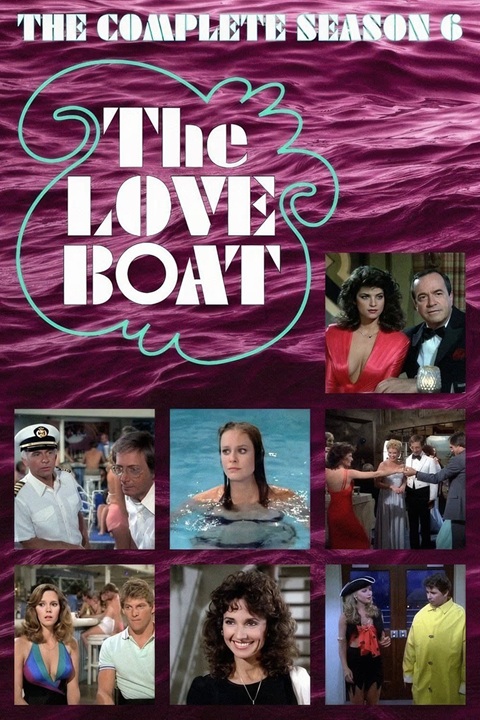
Welcome aboard, it’s love!

Episode 6.21 “The Captain’s Crush/Out Of My Hair/Off-Course Romance”

(Dir by Ted Lange, originally aired on February 19th, 1983)

Kathy Costello (Stella Stevens) is looking forward to taking a cruise with her husband, Joe (Monte Markham).  However, at the last minute, Joe decides that he would rather go to a golf tournament than take a vacation with his wife.  The angry Kathy boards the boat and immediately runs into her ex-boyfriend, Ted Cole (Ron Ely).  Kathy enjoys spending time with Ted but then suddenly, Joe shows up on the cruise.  He’s not happy to discover his wife is spending time with her ex.  The main problem with this story is that there’s no one to root for.  Kathy is cheating but her husband is being a jerk.  It’s rare that I ever watch an episode of The Love Boat and say, “This should end with divorce,” but this episode inspired me.

Meanwhile, Lydia (Delta Burke) boards the boat with her wealthy fiancé (Jeffrey Tambor).  Lydia’s ex-boyfriend (Richard Gilliland) also boards the boat, hoping to break up their engagement.  This storyline felt oddly similar to the other storyline and it suffered from the same problem.  There was no one to root for.  None of these people deserved to get married.

Finally, movie star Janine Adams (Joan Collins) boarded the boat and ate dinner with the Captain.  The next day, the tabloid news wires are full of speculation that the Captain is going to become Jane’s tenth husband and the Captain starts to think that maybe he’d like to be Jane’s tenth husband.  Go for it, I say!  Seriously, Janine and the Captain are as close to a likable couple as this episode has so they might as well get married.  Of course, they don’t get married.  I guess that’s a good thing.  It’s hard to imagine The Love Boat without Captain Stubing at the helm.

This episode was directed by Ted Lange and, as usual, he gets good performances from the cast.  Unfortunately, this cruise is let down by two weakly-written stories.
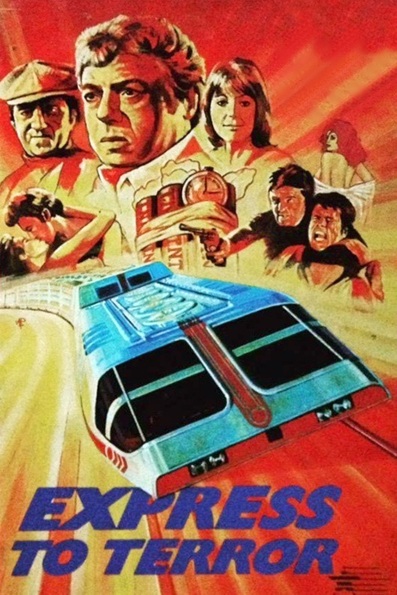
Icarus File No. 24: Express to Terror (dir by Dan Curtis)


The year was 1979 and Fred Silverman, the president of NBC, had an idea.

How about a television series in which each week’s episode would depict a different group of passengers going on a trip?  The passengers would all be dealing with their own stories, some of which would be dramatic and some of which would be humorous.  With any luck, some of them might even fall in love over the course of their journey!

To keep the audience interested, the show would also feature a cast of regular characters, the crew.  Edward Andrews would play the captain, a sensible and by-the-book type.  Robert Alda played Doc, the doctor who was also a bon vivant.  Patrick Collins was the goofy purser.  Nita Talbot played Rose, the perky director of entertainment.  Michael DeLano was the bartender who always had the best advice for the passengers….

Does this sound familiar?

If you think that it sounds like Fred Silverman just ripped off The Love Boat …. well, you’re wrong.  The Love Boat took place on a boat.  Supertrain took place on a train.

At the time that Supertrain went into production, it was the most expensive television production of all time.  Before the pilot film was even shot, NBC had spent ten million dollars on the Supertrain sets.  Not only was a fake train built but two models were also constructed for the shots of the train moving through the countryside.  At the time, the assumption was that the costs would be easily covered by the money that NBC stood to make from broadcasting the 1980 Summer Olympics.  Unfortunately, Jimmy Carter decided that the U.S. would be boycotting the Olympics as a way to protest Russia’s invasion of Afghanistan.  The only thing that kept NBC from going bankrupt was that the BBC was apparently run by someone even more incompetent than Fred Silverman.  The BBC paid $25,oo per episode for the rights to air Supertrain in the UK.  Supertrain proved to be such a disaster that the BBC never actually aired the episodes that they had purchased.

1979’s Express to Terror was the pilot to Supertrain.  (It was later released in some territories as a stand-alone film.)  Directed by horror impresario Dan Curtis (who was also brought in to produce the series), Express to Terror opens with an apparently drunk Keenan Wynn playing the role of railway baron Winfield Root.   Winfield loudly announces to a group of nervous investors that he has created ” an atom-powered steam turbine machine capable of crossing this country in 36 hours!”  A few months later, Supertrain sets off from New York to Los Angeles.

The main thing that one notices about the train is that it’s incredibly tacky.  For all the money that Winfield Root (not to mention NBC) poured into the thing, it looks awful.  The cabins are bland and also seem to be constantly shaking as the train rumbles over its tracks.  Whereas The Love Boat featured glorious shots of passengers enjoying themselves on an open-air deck, Express to Terror features a lot of shots of passengers trying to squeeze their way through narrow and crowded hallways.  There’s a disco car, which sounds like fun but actually looks like a prom being held in a locker room.  There’s a swimming pool but you can’t really lay out by it because it’s on a train.  Winfield is among the passengers and he continually refers to the train as being “Supertrain” in conversation, which just sounds dumb.  “The next person who stops Supertrain,” he announces “will be walking to L.A!”

The main drama features Steve Lawrence as Mike Post, a Hollywood agent with a gambling problem who thinks that someone on the train is trying to kill him.  Actually, the assassin is after a different Mike Post (Don Stroud) but that Mike Post is a criminal who, after entering the witness protection program, changed his name to Jack Fisk.  The criminal Post is hoping that the agent Post will be killed by mistake.  The criminal Mike Post has a girlfriend named Cindy (Char Fontane) who falls in love with the agent Mike Post.  Fred Williamson appears as a football player-turned-assassin.  George Hamilton plays a Hollywood executive.  Don Meredith is the alcoholic best friend of the agent Mike Post.  Stella Stevens is on the train as a diva.  So is Vicki Lawrence, playing a naive innocent.

Express to Terror tries to mix comedy and drama but it doesn’t really work because the “Good” Mike Post doesn’t really seem to be worth all the trouble.  Steve Lawrence gives a mind-numbingly bad performance in the role and, as a result, “Good” Mike Post really isn’t any more sympathetic than “Bad” Mike Post.  The main problem is that “Good” Mike Post comes across as being a coward and there’s only so much time that you can watch a coward act cowardly before you lose sympathy for him.  Being scared is one thing.  Being so dumb that accidentally gets your fingerprints on a knife that’s just been used to kill a man is another thing.

As for the members of the crew — the captain, the doctor, the bartender, and such, they take a back seat to the drama of the two Mike Posts.  It’s a bit odd because no one on the train — not even Winfield Root — seems to be that upset by the fact that one of their passengers is murdered while the train is going through a tunnel.  You would think that everyone would be worried about the future of Supertrain at that point.  A murder is not good for publicity but Winfield Root is oddly unconcerned about it.  I swear, light rail people are almost as heartless as bicyclists!

Of course, the worst thing about Express to Terror is that it promises terror but it doesn’t deliver.  When I see a the word “terror” in a film directed by Dan Curtis, I expect a little terror!  Other than Steve Lawrence’s overacting, there really wasn’t anything particularly terrifying about Express to Terror.

As for Supertrain, it ran for nine episodes and was promptly canceled.  Fred Silverman left NBC and spent the rest of his career as an independent producer.  Supertrain’s tracks got too close to the sun and they nearly took down a network.

Previous Icarus Files:

  1. Cloud Atlas
  2. Maximum Overdrive
  3. Glass
  4. Captive State
  5. Mother!
  6. The Man Who Killed Don Quixote
  7. Last Days
  8. Plan 9 From Outer Space
  9. The Last Movie
  10. 88
  11. The Bonfire of the Vanities
  12. Birdemic
  13. Birdemic 2: The Resurrection 
  14. Last Exit To Brooklyn
  15. Glen or Glenda
  16. The Assassination of Trotsky
  17. Che!
  18. Brewster McCloud
  19. American Traitor: The Trial of Axis Sally
  20. Tough Guys Don’t Dance
  21. Reach Me
  22. Revolution
  23. The Last Tycoon

Retro Television Review: Fantasy Island 7.9 “Fantasy Island Girl/Saturday’s Child”


Welcome to Retro Television Reviews, a feature where we review some of our favorite and least favorite shows of the past!  On Tuesdays, I will be reviewing the original Fantasy Island, which ran on ABC from 1977 to 1984.  Unfortunately, the show has been removed from most streaming sites.  Fortunately, I’ve got nearly every episode on my DVR.

This week, we have two fantasies that seem very familiar.

Episode 7.9 “Fantasy Island Girl/Saturday’s Child”

(Dir by Leslie H. Martinson, originally aired on December 10th, 1983)

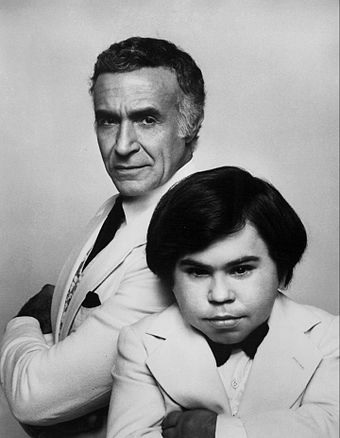
Actress Marion Sommers (Stella Stevens) comes to the Island.  Lawrence is a huge fan and can’t imagine what fantasy she could possibly have.  Roarke explains that Marion wants to be reunited with her children.  The twist is that her children don’t know that Marion is their mother.  They think that their mother died and that they were adopted by Fran Woods (Diane Baker).

Marion is told that, because of the way she phrased her fantasy, she’ll get to meet her children on the island but she can’t tell them that she’s their mother.  The children have spent the last few years with Ms. Woods as their mother.  Marion agrees but she doesn’t keep her word and, by the end of her fantasy, she’s told both Bill (David Kaufman) and Ellie (Amy Linker) that she is their mother and that she wants them to come with her.  Bill and Ellie reject her, saying that Ms. Woods will always be their mother.  However, they would like it if Marion would be their friend.

Lawrence asks Marion to give him her autograph so he can give it to his niece.  Then, after Marion leaves, Lawrence tells Roarke that he doesn’t have a niece….

This fantasy seemed awfully familiar.  I don’t really have the time to go back and reread every Fantasy Island review that I’ve written but I’m pretty sure that this show has already gone to the “I’m  a famous actress who wants to meet the children that I gave up” well more than a few times.  In this case, it just felt like everyone was going through the motions.

As for the other fantasy, it involved the Fantasy Island Girl Beauty Pageant and, again, I’m pretty sure I’ve seen several versions of this pageant fantasy in the past.  This time, it’s the pageant’s producer, Nick Gleason (Paul Burke), who has a fantasy.  It seems that Nick has a reputation for fixing his pageants so his fantasy is to run a totally “clean” and honest pageant.  It seems like he could have just done that on his own without even having to go to Fantasy Island.  Since when have fantasies become about doing things that most people would just do naturally?

Nick’s daughter, Tina (Audrey Landers), enters the pageant and suddenly, Nick finds himself tempted to fix the pageant for her.  When Roarke explains this to Tina, Tina withdraws from the pageant and Nick doesn’t fix the pageant.  Nick is so happy that he finally put on a honest pageant but the only reason he didn’t fix the pageant was because Tina dropped out.  If she hadn’t dropped out, he totally would have rigged it.  So, I’m not really sure that Nick has anything to brag about.  It’s kind of like bragging about not robbing a bank because it was closed on Sunday.

Lawrence is appointed as one of the judges for the beauty pageant.  You know who really enjoyed beauty pageants?  Tattoo.  This would have been a fun fantasy for Tattoo.  Instead, we just get Lawrence looking all huffy and puffy.

The trip to the Island was no fantasy.

Retro Television Review: Fantasy Island 6.16 “Eternal Flame/My Date With Burt”


Welcome to Retro Television Reviews, a feature where we review some of our favorite and least favorite shows of the past!  On Tuesdays, I will be reviewing the original Fantasy Island, which ran on ABC from 1977 to 1984.  Unfortunately, the show has been removed from most streaming sites.  Fortunately, I’ve got nearly every episode on my DVR.

This week, our trip is all about getting older.

Episode 6.16 “Eternal Flame/My Date With Burt”

(Dir by Don Weis, originally aired on March 5th, 1983)

When I first saw that one of the fantasies this week was called “My Date With Burt,” my immediate assumption was that someone would come to Fantasy Island and demand to go on a date with Burt Reynolds.  I was actually looking forward to seeing if Burt would play himself or if they would just have some stand-in who was always shot from behind.  Unfortunately, I was wrong.

The Burt in this case is Burt Hunter (Ron Ely), an actor who is the latest to be cast as a James Bond-type of secret agent.  Margaret Winslow (Sandra Dee) has a crush on him and wants to meet him.  For his part, Burt is depressed because he’s getting older and the producers of his films want to replace him with a younger actor.  At first, Burt just goes out with Margaret in order to generate some publicity for himself.  He hires a stuntman to fake a fight so that Burt can emerge as a big ol’ hero.  Burt is trying to save his career but Margaret is not amused by any of that.  Margaret realizes that films are not real life.  Margaret’s pretty old to only now be figuring that out.  Anyway, Margaret and Burt still fall in love and leave the Island together.

This fantasy was predictable but it did give us one of those fun Tattoo subplots where Tattoo claimed to be Burt Hamilton’s best friend and tried to get involved in managing his career.  Tattoo always had a side hustle going and good for him!  One gets the feeling that Roarke didn’t pay him that much.  Seriously, Tattoo was always trying to find a way to make more money.  Pay the man what he’s worth, Mr. Roarke!

Our other fantasy features Linwood Bolton and Randi Oakes as Alex and Diana Weston, two newlyweds who want to find the Fountain of Youth so that they can be young and in love forever.  Yay!  Roarke has them take a dip in a pool and, when they emerge, they’re on an isolated island that is ruled over by Ra-Mas (Alex Cord) and Maatira (the great Stella Stevens).  Maatira will let them drink from the fountain but there’s a catch …. one of the cups is full of poison!  Alex can be eternally young and he can be spend the rest of eternity as Maatira’s lover but Diana has to die.  And Diana does die.  Luckily, the water from the fountain can also bring people back to life.

This was a weird fantasy and you really do have to wonder what would have happened if Alex hadn’t come to his senses and if Diana hadn’t been revived.  Would Roarke have just shrugged and told Tattoo to burn Diana’s passport?  It just doesn’t seem like that would be good for business.  That said, Stella Stevens was an actress who was always willing to embrace the melodrama and she does so here, keeping things somewhat entertaining.

This was a pleasant if not particularly memorable trip to the Island.

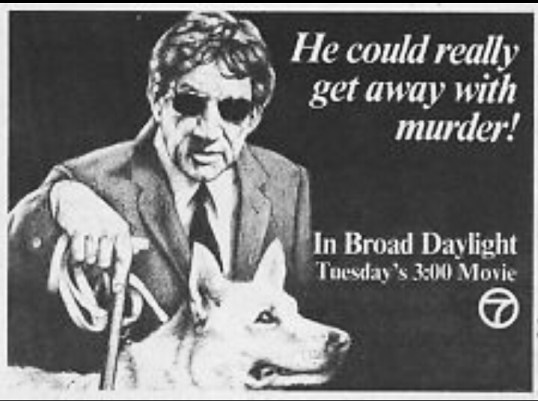
Retro Television Review: In Broad Daylight (dir by Robert Day)


Welcome to Retro Television Reviews, a feature where we review some of our favorite and least favorite shows of the past!  On Sundays, I will be reviewing the made-for-television movies that used to be a primetime mainstay.  Today’s film is 1971’s In Broad Daylight!  It  can be viewed on YouTube.

Tony Chappel (Richard Boone) is an actor who has just recently lost his sight as a result of an accident.  Released from the hospital, Tony struggles to adjust to living in a world without his vision.  When one cab driver says to him, “Didn’t you used to be Tony Chappel?,” he flinches as he realizes that his career as a famous actor is now considered to be over.  One day, he comes home early and overhears his wife (Stella Stevens) fooling around with his lawyer and “best friend” (Fred Beir).  Tony promptly decides to murder his wife and frame his friend for the crime.

Tony decides to use his acting skills to his advantage.  He memorizes the the area around him so that he can make his way through it by memory.  He puts on a fake beard, speaks with Greek accent, and makes a point of carrying a camera with him.  He starts taking public transportation and going out of his way to be talkative and social  Everyone that he meets, he tells them about how he’s been taking pictures of the city and how he can’t wait to see how they come out.  When his wife is eventually murdered, the police receive a reports of a mysterious Greek man, one who was definitely not blind, in the area.  However, Lt. Bergman (John Marley) has his doubts and comes to suspect that Tony is the killer.

In Broad Daylight was made from an early script written by Larry Cohen, who would later go on to direct films like God Told Me To.  It’s a clever script, one that sets up an intriguing premise and which ends on a properly twisty and satisfactory note.  The film works because it is as much of a character study as a thriller.  Tony’s wife not only cheats on him but also betrays him at the moment when he needs her and his friends the most.  Tony has gone from being a movie star to being a man who can barely walk from one room to another.  He’s already angry.  Discovering that his wife is laughing at him behind his back is the last straw.

Larry Cohen reportedly felt that Richard Boone was miscast as Tony.  I felt that Boone did a pretty good job, even if he did overact a bit while Tony was trying to convince everyone that he was a Greek tourist.  Stella Stevens is perfectly cast as his wife and Suzanne Pleshette is sympathetic as his nurse.  Godfather fans will be happy to see John Marley not having to deal with a horse’s head but instead playing the clever detective who attempts to solve the murder.

In Broad Daylight is a clever and entertaining thriller and character study.

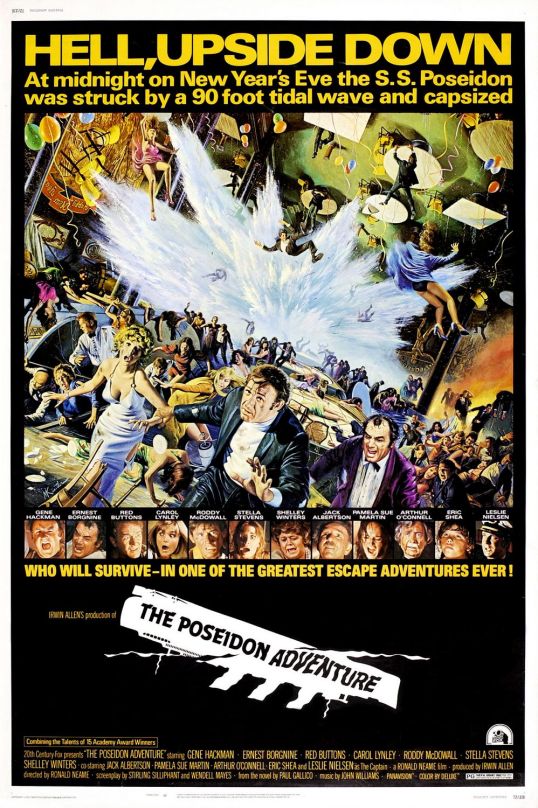
Scenes That I Love: Ernest Borgnine Yells In The Poseidon Adventure


Ernest Borgnine, that great character actor, was born 104 years ago today.  In tribute, today’s scene that I love comes from one of my favorite Borgnine films, 1972’s The Poseidon Adventure.

Borgnine was a great yeller and, in The Poseidon Adventure, he even manages to outyell the great Gene Hackman.

Late Night Retro Television Reviews: Highway to Heaven 1.10 “Help Wanted: Angel”


Welcome to Late Night Retro Television Reviews, a feature where we review some of our favorite and least favorite shows of the past!  On Thursdays, I will be reviewing Highway to Heaven, which aired on NBC from 1984 to 1989.  The entire show is currently streaming on Tubi and several other services!

This week, Mark falls in love and Jonathan directs a movie.

Episode 1.10 “Help Wanted: Angel”

(Dir by Michael Landon, originally aired on November 21st, 1984)

This is a strange episode.

The first half of the episode plays out like almost a parody of Highway to Heaven.  In fact, I would assume that it was a parody except for the fact that this was only the show’s tenth episode and that’s a bit early for any show to start intentionally parodying itself.

Still in Hollywood, Jonathan and Mark come across a sign that has been posted by someone named Joey.  “Angels Needed,” the sign says.  The sign has an address that turns out to be a community center, one that is populated by a mix of cranky retired people and young criminals.  The center’s maintenance worker is a developmentally challenged young man named Joey Smalls (Dennis Fimple).  Joey put up his sign because he wants an angel to help an elderly screenwriter named Martin Lamm (John Lormer).  Martin has written a script about a magician and he wants to not only make the film but also fill the cast with people from the neighborhood.

No sooner have Mark and Jonathan stepped into the community center and met Joey and Martin then they are suddenly joined by a man named Petros (Al Ruscio).  Petros speaks in a thick Greek accent and he says that he has also seen Joey’s sign, he has read Martin’s script, and he wants to produce the movie.  And he wants Jonathan to direct it and Mark to play the role of a sea captain who falls in love with a woman who has “a past,” as Petros puts it.  As the woman, they cast Stella (Stella Stevens), who actually does have a past.

We then jump forward several weeks.  Jonathan is directing the film, even though he doesn’t seem to have a crew and we don’t actually see any cameras filming anything.  Joey has impressed everyone with the sincerity of his acting and he is now friends with former gang member, Chewy (Randy Vasquez).  Mark, meanwhile, is falling in love with Stella.

So, that’s the first half of the episode.  It’s all very broadly acted and the dialogue frequently crosses the line from sentimental to mawkish.  I have to admit that I rolled my eyes more than a few times because it all felt so overdone.

But then, the second half of the episode opens with Petros approaching Jonathan.  Jonathan asks Petros about his past.  Petros says that he was born in Galilee and that, before starting his current line of work, he was a fisherman.  Jonathan realizes that Petros is actually St. Peter and he’s been sent down to help Jonathan out with his mission.  It turns out that Jonathan’s mission is not really about Joey or Martin.  Instead, it’s about Stella, who is going to die and it’s about Mark, who is about to lose the woman that he’s fallen in love with.  Realizing that Stella’s character is also going to die in the movie that he’s supposedly directing, Jonathan asks if they can just rewrite the script but Peter tells him that they can’t.  What is going to happen is going to happen.

And it does happen, though not before Mark asks Stella to marry him and Stella says yes.  When she finds out that she’s ill, Stella leaves Mark a note saying that she’s dumping him for an ex-boyfriend.  At first, Mark is angry but, with Jonathan’s help, he realizes the truth.  Mark finds Stella waiting for him on the beach where they filmed their scenes for the movie and they get married as the ocean crashes behind them.  And then, off-screen, Stella dies.

And I went from rolling my eyes to actually wiping away tears because, as broad and kind of annoying as the first half of the episode was, the second half was sensitively directed by Michael Landon and sincerely acted by both Victor French and Stella Stevens.  If the first half felt like a parody, the second half was a reminder of why this show still remains popular on so many streaming platforms.  At its best, there was an unapologetic earnestness to Highway to Heaven.  This was a show that said that it was okay to cry and to have emotions and to care about people.  This was a strange episode but, ultimately, a surprisingly effective one.

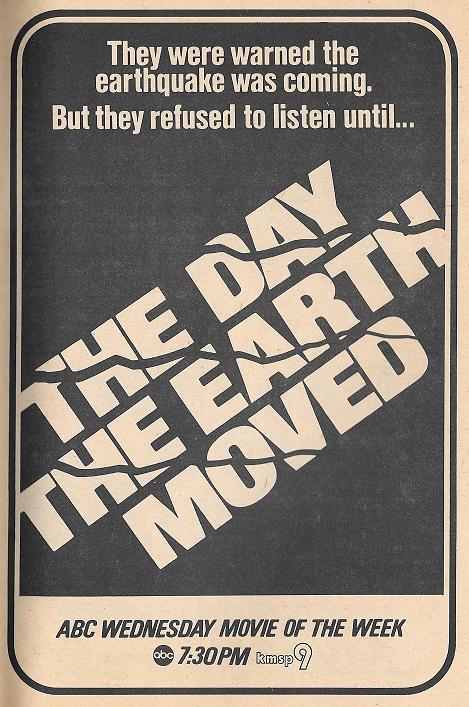
Retro Television Reviews: The Day The Earth Moved (dir by Robert Michael Lewis)


Welcome to Retro Television Reviews, a feature where we review some of our favorite and least favorite shows of the past!  On Sundays, I will be reviewing the made-for-television movies that used to be a primetime mainstay.  Today’s film is 1974’s The Day The Earth Moved!  It  can be viewed on YouTube!

Sitting in the middle of the Nevada desert, there’s a town called Bates.

Bates was once a thriving community but the years and the hot Nevada winds have not been kind to it.  Now, it consists of only a  few buildings and a speed trap.  Judge Tom Backsler (William Windom) is the most powerful man in this tiny community and he’s determined to return Bates to its former glory.  His plan is to open up a Christmas park and to remake Bates as “Santa Claus’s home away from the North Pole.”  In order to raise the money for that project, he and the police run an aggressive speed trap.  When pilot and photographer Steve Barker (Jackie Cooper) is caught in the speed trap, it turns out that he doesn’t have enough money to pay his fine.  So, his car is impounded and he’s put to work, sweeping up the dust and helping to get the Christmas park ready to open.

With the help of friendly little townsgirl, Steve is finally able to escape from Bates and return to his job.  He works with his wife, Kate (Stella Stevens), and his best friend, Harley (Cleavon Little), as surveyors.  When someone wants to buy a stretch of the Nevada desert, Steve and Harley fly over the land and take pictures.  Looking over the latest batch of pictures, Steve deduces that not only is there going to be an earthquake but it’s going to destroy the town of Bates!  Can Steve return to the town that once held him prisoner and convince the townspeople to leave with him before disaster hits!?

In many ways, The Day The Earth Moved is a standard made-for-TV disaster flick.  Only Steve and Kate realize what’s about to happen and they struggle to get anyone else to believe them.  Indeed, it seems like the world is almost conspiring to keep them from warning everyone about the incoming earthquake.  The film’s story checks off all of the expected disaster movie plot points.  That said, the town of Bates itself — with its gigantic Santa Claus standing in the middle of the desert — is a nicely surreal location and the repeated shots of a deserted farm being gradually destroyed by minor tremors achieve a certain ominous grandeur.  Jackie Cooper and Stella Stevens are believable as a husband and wife who love each other despite the fact that they’re often very annoyed with each other.  To the film’s credit, William Windom’s character is not portrayed as being a cardboard villain but instead as someone who simply wants to give his neighbors some place decent to live.  The Day The Earth Moved is predictable but well-done.

Of course, the main reason anyone will have to watch this film will be for the earthquake.  Unfortunately, this is where viewers will run into a common problem that has afflicted many made-for-TV movies.  The low-budget earthquake is just not that impressive.  For all the scenes of people yelling, it’s always pretty obvious that the camera is doing most of the shaking.  But you know what?  It’s a made-for-TV movie from 1974.  Cut it some slack and just go with it.

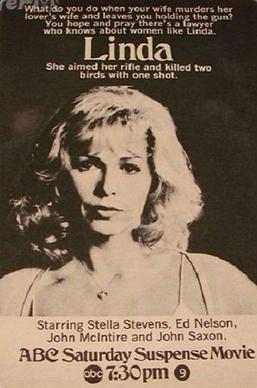
Retro Television Reviews: Linda (dir by Jack Smight)


Welcome to Retro Television Reviews, a feature where we review some of our favorite and least favorite shows of the past!  On Sundays, I will be reviewing the made-for-television movies that used to be a primetime mainstay.  Today’s film is 1973’s Linda!  It  can be viewed on YouTube!

If nothing else, Linda has a wonderfully opening.

Two couples are on the beach.  Paul Reston (Ed Nelson) is talking to Anne Braden (Mary-Robin Redd) about his troubled marriage and his plans to leave his wife.  Paul’s wife, Linda (Stella Stevens), is talking to Jeff Braden (John Saxon) and looking at the rifle that he’s just handed her.  It doesn’t take long to notice that Paul and Linda seem to be closer, respectively, to Anne and Jeff than to each other.

When Anne stands up and walks toward the ocean, Linda shoots her in the back.  When Jeff runs over to Anne’s body, Linda pulls the trigger again and Jeff collapses.  Stunned by his wife’s actions, Paul runs back to his car and drives into town to get the police.  (This is another one of those movies that could have only been made in the pre-smartphone era.)  When Paul and the police return, they find Anne’s body but Jeff and Linda are nowhere to be seen.

Suddenly, Linda and Jeff come walking down the beach.  Jeff is carrying a bunch of fish and a fishing pole.  They look shocked when they see the police.  Then, when Jeff sees Anne’s body, he accuses Paul of killing her and attacks him.  Paul is arrested and taken to jail.

As I said, it’s a wonderful opening, full of twists and entertaining overemoting.  In fact, it’s so good that it’s difficult for the rest of the film to keep up.  After being charged with Anne’s murder, Paul hires a folksy attorney named Marshall Journeyman (John McIntire).  Unlike everyone else, Journeyman believes Paul’s story that he’s being framed by Jeff and Linda.  Journeyman sets out to prove that Paul is innocent.

Of course, the audience already know that Paul is innocent because the audience saw exactly what happened.  Watching the film, it was hard for me to not to feel that the story would have benefitted by a little more ambiguity as to whether or not Paul was a victim or if he truly was the delusional madman that both Linda and Jeff tried to paint him as being.  We know from the start what Jeff and Linda are doing so the only question really becomes how Journeyman is going to trick them into revealing the truth.  Unfortunately, even getting them to do that turns out to be a bit too easy.  The movie suggests that Journeyman is a brilliant investigator but, in the end, it all really just comes down to the villains not being very smart.

That said, the film’s cast does a good job.  Ed Nelson is sympathetic as the confused husband and John McIntire brings so much homespun charm to Journeyman that I got the feeling that this film was probably designed to be a pilot for a possible series.  Best of all, John Saxon and Stella Stevens play the scheming couple.  Saxon gets to wear a swimsuit and dramatically shout to the Heavens as he pretends to be shocked over Anne’s murder.  Stevens smirks at every question and accusation and appears to be having a great time playing an old school femme fatale.  The cast makes this movie worth it.

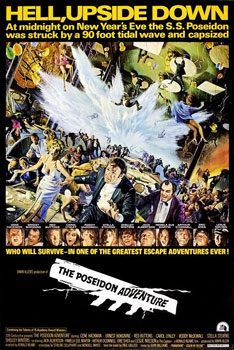
Scenes That I Love: Happy New Year From The Poseidon


Happy new year!

With 2023 coming in like a tidal wave, it only seem fitting that the first scene that I love for this year should come from 1972’s The Poseidon Adventure.  Just as how Die Hard has recently been acclaimed as one of the great Christmas films, The Poseidon Adventures is one of the best of the New Year’s Day films.  It’s also perhaps the only film in which Gene Hackman managed to overact more than even Ernest Borgnine.  I mean, don’t get me wrong.  It’s a strong competition between two great actors, neither of whom was known for being particularly subtle when it came to barking out their lines.  But, in the end, Hackman still managed to take the overacting crown for this film.

(That said, what’s New Year’s Day without Borgnine shouting, “Where’s your God now, Preach-ah!?”)

In the scene below, the passengers ring in the new year while Leslie Nielsen faces the tidal wave that will soon turn the boat upside down.  Whatever else you may want to say about this particular film, it does a great job of contrasting the celebrations in the ballroom with the dread on the bridge.  While everyone else is counting down and celebrating and mugging for the camera, Nielsen can only stare in stoic horror as the wave approaches.  He does the only thing that a captain can do.  He sounds the alarm.  He sends out an S.O.S.  Unfortunately, the alarm can barely be hard over the celebrations of the new year and the S.O.S. man is quickly swept away by the crashing of the wave.

The scene goes from celebrating the future to highlighting the type of old-fashioned, nature-fueled destruction that has been wiping out civilizations since the beginning of time.  It doesn’t matter how many plans you’ve made.  It doesn’t matter how rich  you are.  It doesn’t matter how safe you feel or how much you cling to the furniture as the world turns upside down.  Fate, whether it’s in the form of a wave or some other natural disaster, is pitiless.  That’s one reason why disaster movies, as melodramatic as they could often be, so entranced audiences.  Everyone knew that it would just as easily happen to them.  Just as no one expected the tidal wave on New Year’s, no one would be expecting to leave the theater to be confronted by an earthquake or a tornado.  But it could definitely happen.  Life, like society, is a fragile thing.  If not even Gene Hackman, Stella Stevens, Shelley Winters, and Roddy McDowall could make it to the end of the movie, what hope is there for anyone?  Of course, the thing to remember is that they may not have made it but Ernest Borgnine, Red Buttons, Carol Lynley, and a few others did.  They survived, though I imagine they spent the rest of their lives dreading January 1st.

Needless to say, neither the passage of time nor the wave can be escaped.  As much as we may have things left to do in 2022, it’s too late now. 2023 is here and the world has moved on.