For tonight’s excursion into the horrific side of television, we have the very first episode of Kolchak: The Night Stalker!
The Kolchak of the title was a reporter named Carl Kolchak (played by Darren McGavin). Kolchak was kind of a nervous fellow because every story that he reported on seemed to involve some sort of terrible supernatural creature! Seriously, that would make anyone anxious.
In his first episode, Kolchak investigates a series of murders and comes to suspect that Jack the Ripper might be haunting the streets of 1970s Chicago.
This episode originally aired on September 13th, 1974.
For today’s horror on the lens, we have 1973’s The Night Strangler.
This is the sequel to The Night Stalker and it features journalist Carl Kolchak (Darren McGavin) in Seattle. (After all the stuff that happened during the previous movie, Kolchak was kicked out of Las Vegas.) When Kolchak investigates yet another series of murders, he discovers that paranormal murders don’t just occur in Las Vegas and aren’t just committed by vampires.
I actually prefer this movie to The Night Stalker. The Night Strangler features a truly creepy villain, as well as a trip down to an “underground city.” It’s full of ominous atmosphere and, as always, Darren McGavin is a lot of fun to watch in the role in Kolchak.
For today’s horror on the lens, we have a real treat! (We’ll get to the tricks later…)
Long before he achieved holiday immortality by playing the father in A Christmas Story, Darren McGavin played journalist Carl Kolchak in the 1972 made-for-TV movie, The Night Stalker. Kolchak is investigating a series of murders in Las Vegas, all of which involve victims being drained of their blood. Kolchak thinks that the murderer might be a vampire. Everyone else thinks that he’s crazy.
When this movie first aired, it was the highest rated made-for-TV movie of all time. Eventually, it led to a weekly TV series in which Kolchak investigated various paranormal happenings. Though the TV series did not last long, it’s still regularly cited as one of the most influential shows ever made.
Anyway, The Night Stalker is an effective little vampire movie and Darren McGavin gives a great performance as Carl Kolchak.
Old west outlaw Frank Calder (Oliver Reed) wants to learn how to read so he and his gang ride into the nearby town and kidnap Melissa Ruger (Candice Bergen). Because he saw her reading to a group of children, Calder assumed that Melissa was a school teacher. Instead, Melissa is the wife of a brutal cattle baron and hunter named Brandt Ruger (Gene Hackman). Even after Calder learns the truth about Melissa’s identity, he keeps it a secret from his gang because he knows that they would kill her and then kill him as punishment for kidnapping the wife of a man as powerful as Brandt. Stockholm Syndrome kicks in and Melissa starts to fall in love with Calder. Meanwhile, Brandt learns that his wife has been kidnapped and, with a group of equally brutal friends, he sets out to get her back. In Brandt’s opinion, Calder has stolen his personal property. Using a powerful and newly designed rifle, Brandt kills Calder’s men one-by-one until there is a final, bloody confrontation in the desert.
Coming out two years after Sam Peckinpah redefined the rules of the western genre with The Wild Bunch, The Hunting Party owes a clear debt to Peckinpah. Much as in The Wild Bunch, the violence is sudden, brutal, and violent. What The Hunting Party lacks is Peckinpah’s attention to detail and his appreciation for the absurd. Instead, The Hunting Party is just one shooting after another and, devoid of subtext or any hint of a larger context, it quickly gets boring.
Fans of Oliver Reed, however, will want to watch The Hunting Party because it features one of his best performance. For once, Reed is actually playing the nice guy. He may be an outlaw but he still cries when a mortally wounded member of his gang begs Calder to put him out of his misery. Gene Hackman is also good, even though he’s playing one of his standard villain roles. (The less said about Candice Bergen’s performance, the better.) The Hunting Party may be dully nihilistic but Oliver Reed shines.
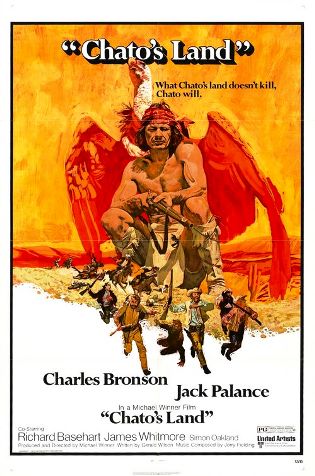
That’s the main lesson that can be taken away from Chato’s Land. In this western, Bronson plays Chato, an Apache who enters the wrong saloon and is forced to shoot a racist sheriff in self-defense. Former Confederate Captain Quincey Whitemore (Jack Palance) forms a posse to track Chato down but soon discovers that his posse is not made up of the best and brightest. Instead, most of them are sadistic racists who just want to kill Apaches. Despite Whitemore’s efforts to stop them, the posse rapes Chato’s wife and kills his best friend. Chato trades his white man’s clothes for a loin cloth and sets out for revenge.
Chato’s Land is historically significant because it was the first of many films that Charles Bronson made with Michael Winner. The most famous Bronson/Winner collaboration was Death Wish, which also featured Charles Bronson as a man who seeks revenge after his wife is raped. What is surprising about Chato’s Land is how little screen time Bronson actually has. Most the film is spent with the posse, which is full of familiar faces (Richard Jordan, Simon Oakland, Victor French, Ralph Waite, and James Whitmore all report for duty). It actually works to the film’s advantage, making Bronson even more intimidating than usual. There’s never any doubt that Chato is going to kill every member of the posse but since almost every member of the posse is loathsome, that’s not a problem.
It’s possible that Chato’s Land was meant to be an allegory for the Vietnam War, which is probably giving Michael Winner too much credit. (In an interview, the author of Death Wish, Brian Garfield, once shared an anecdote about Winner inserting a shot of three nuns into Death Wish and bragging about how the shot was meaningless but that it would fool the critics into thinking he was making a grand statement about something.) Like most of Winner’s films, Chato’s Land is good but not great. There are parts of the movie that drag and Jack Palance and Charles Bronson don’t get to share any big scenes together, which seems like a missed opportunity. Bronson, who was always underrated as an actor, gives one of his better performances as Chato. Chato does not say much but Bronson could do more with one glare than most actors could do with a monologue. In Europe, Bronson was known as Il Brutto and Chato’s Land features him at his most brutal.
(Lisa is currently in the process of cleaning out her DVR! It’s going to take a while. She recorded this 1962 literary adaptation off of FXM on January 30th!)
Hemingway’s Adventures Of A Young Man is one of those films that you just know was made specifically to win Oscars. It’s a big prestige production, complete with a historical setting, an epic scope and big, all-star cast. That most of those stars appear in relatively small roles was undoubtedly meant to evidence of the film’s importance.
“Look!” the film seems to shout at times, “This is such an important film that even Paul Newman was willing to stop by for a day’s work!”
The film is based on ten short stories by Ernest Hemingway and, loosely, A Farewell to Arms. The stories all dealt with the early life of Nick Adams, who was a literary stand-in for Hemingway. Since the Nick Adams stories were autobiographical (and, for that matter, so was A Farewell to Arms), the film can also be viewed as biopic. Richard Beymer (who, a year earlier, had starred in West Side Story and who is currently playing Ben Horne on Twin Peaks) may be playing Nick Adams but the film leaves little doubt that he was actually meant to be playing Ernest Hemingway.
The film opens with Nick hunting with his father, Dr. Harold Adams (Arthur Kennedy). He is present when his father travels to an Indian camp and helps to deliver a baby. He respects his father but Nick wants to see the world and the film follows him as he explores America, working odd jobs and meeting colorful characters along the way. Paul Newman shows up as a punch-drunk boxer and proceeds to overact to such an extent that he reminded me of Eric Roberts appearing in a Lifetime film. Nick meets rich men, poor men, and everything in between. He works as a journalist. He works as a porter. Eventually, when World War I breaks out, Nick enlists in the Italian army and the film turns into the 100th adaptation of A Farewell to Arms.
And really, I think it would have been an enjoyable film if it had been directed by someone like Otto Preminger, George Stevens, or maybe even Elia Kazan. These are directors who would have embraced both the pulpy potential of the Nick Adams stories and the soapy melodrama of the war scenes. A showman like Preminger would have had no fear of going totally and completely over the top and that’s the approach that this material needed. Instead, Hemingway’s Adventures Of A Young Man was directed, in a painfully earnest style, by Martin Ritt. Ritt tries to imitate Hemingway’s famously understated style with his understated direction but, cinematically, it’s just not very interesting. Ritt portrays everything very seriously and very literally and, in the end, his direction is more than a little dull.
Sadly, the same can be said for Richard Beymer’s performance in the lead role. Beymer comes across as being the nice guy who everyone says you should marry because he’ll be able to get a good and stable job and he’ll probably never go to jail. Two months ago, when I watched and reviewed Twin Peaks, I really loved Beymer’s performance as Ben Horne. He just seemed to be having so much fun being bad. Unfortunately, in Hemingway’s Adventures Of A Young Man, he never seemed to be having any fun at all. No wonder he temporarily put his film career on hold so that he could fully devote himself to working as a civil rights activist.
In the end, this is a movie that’s a lot more fun to look at than to actually watch. Visually, the film is frequently quite pretty in an early 1960s prestige movie so sort of way. And there are some good performances. Eli Wallach, Ricardo Montalban, Susan Strasberg, Arthur Kennedy — there’s a whole host of performers doing memorable supporting work. Unfortunately, even with all that in mind, this well-intentioned film largely falls flat.
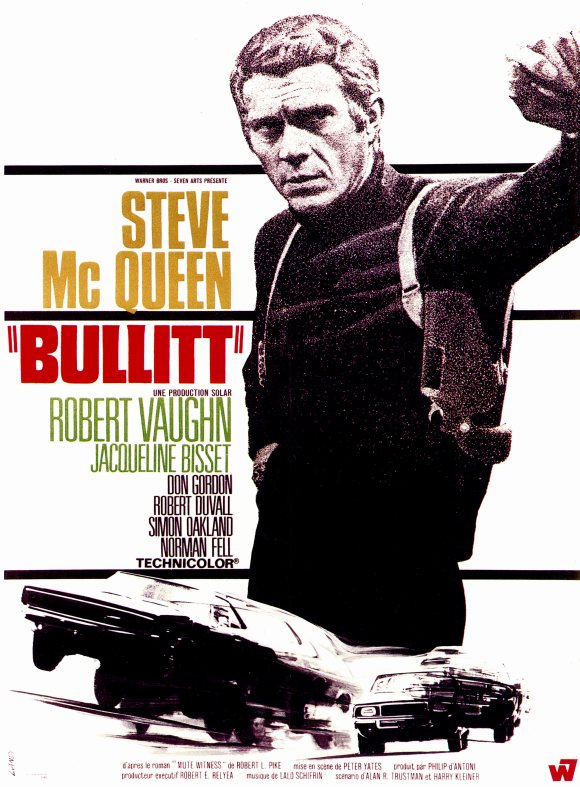
Steve McQueen was the personification of 60’s screen cool in BULLITT, a stylish action film directed by Peter Yates. It’s the first of producer Philip D’Antoni’s cop trilogy, both of which (THE FRENCH CONNECTION and THE SEVEN-UPS) I’ve previously covered. Unlike those two films, the grittiness of New York City is replaced by the California charm of San Francisco, and the City by the Bay almost becomes a character itself, especially in the groundbreaking ten minute car chase between McQueen’s Mustang and the bad guy’s Dodge Charger.
Style permeates the film from the get-go, with the snappy opening credits montage by Pablo Ferro. Then we get right into the story, as San Francisco detective Frank Bullitt is assigned to guard mob witness John Ross, scheduled to testify before a Senate Subcommitte on crime. Hot shot politician Walt Chalmers wants Bullitt because of his reputation and PR value with the papers. Things go awry when Ross…
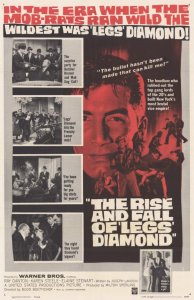
It’s the 1920s. Prohibition is the law of the land and gangsters control the streets of New York City. Jack Diamond (Ray Danton) and his tubercular brother, Eddie (Warren Oates), arrives in town. Jack and Eddie are small-time jewel thieves but Jack has ambitions to be something more. He works with his girlfriend, Alice (Karen Steele), as a dance instructor but he dreams of being the most powerful mobster in the world. His first step is to get a job working as a bodyguard for New York crime lord (and fixer of the 1919 World Series), Arnold Rothstein (Robert Lowery). Though Rothstein never trusts him, Jack works his way into his inner circle and even gets a nickname. Because he is a dancer, he is renamed “Legs” Diamond.
From the minute that he starts working with Rothstein, Legs Diamond’s cocky personality and ruthless ambition make him enemies. When he is shot three times, Legs shocks everyone by surviving and announces that he is invulnerable and cannot be killed. After Rothstein is mysteriously gunned down, Diamond goes to war against Leo “Butcher” Bremer (Jesse White, better known as the original Maytag repairman) for control of the New York underworld.
The Rise and Fall of Legs Diamond was directed by the legendary Budd Boetticher, a bullfighter-turned-director who is best known for directing a series of low-budget westerns in the 1950s. The violent and hard-boiled The Rise and Fall of Legs Diamond was Boetticher’s only gangster film and it’s a good one. The Rise and Fall of Legs Diamond is tightly-written, fast-paced, and Lucien Ballard’s black-and-white cinematography ranks with the best of film noir.
The role of Legs Diamond was originally offered to future producer Robert Evans (of The Kid Stays In The Picture fame) but when Evans turned it down, the role was given to Ray Danton. Though he is occasionally a little stiff, Danton still gives a good and tough performance as Diamond but it is still hard not to wonder what Evans would have been like in the role. The rest of the cast is full of recognizable B-movie actors, all of whom do a good job. Actress Dyan Cannon made her film debut in Legs Diamond, playing one of Diamond’s girlfriends. Meanwhile, in only his third film role, Warren Oates is memorable and sympathetic as the sickly Eddie. Though Oates does not get to do much in the film, his performance still shows why he went on to become one of the most popular and well-respected character actors of all time.
Though hardly historically accurate (in real life, Arnold Rothstein never knew Jack Diamond and Diamond received his nickname not because he was a dancer but because of the speed with which he ran away from the police), The Rise and Fall of Legs Diamond is an exciting and entertaining Depression-era gangster film.
Nearly two weeks ago, I started on something that I call Embracing the Melodrama, Part II. For the next month or so, I will be reviewing, in chronological order, 126 examples of cinematic melodrama. I started things off by reviewing the 1927 classic Sunriseand now, 24 reviews later, we’re ready to start in on one of my favorite decades, the 1960s!
And what better way to start the 60s than be taking a look at the 1961 best picture winner, West Side Story?
Being a lifelong dancer, I have to admit that I’ve lost track of how many times I’ve seen West Side Story. If you love to dance, this is one of those films that you simply have to see. Of the various musicals that have won best picture, West Side Story is arguably the best. Based on a hit Broadway show (which was itself rather famously based on William Shakespeare’s Romeo and Juliet), West Side Story was co-directed by the great choreographer Jerome Robbins and it features some of the greatest dance numbers ever filmed. If you don’t get excited while watching the Sharks and the Shark Girls arguing about America, then there’s really no hope for you. Tonight Quintet, Somewhere, A Boy Like That, Maria … even Gee, Officer Krupke, has there ever been another musical score that just leaves you wanting to sing as much as West Side Story does?
(I mean, I’ll be the first admit that I absolutely love the theme song from Santa Claus Conquers The Martians but it can’t even compare to West Side Story!)
What’s funny is that, in between viewings of the film, I always seem to forget just how good West Side Story actually is. (Fortunately, this also means that I’m pleasantly surprised every time I watch the movie.) In theory, this is an easy film to joke about. It tells the story of street gangs who are apparently just as good at dancing as they are at fighting. The all-white Jets snap their fingers and tell us that when you’re a jet, you’re the best. The Puerto Rican Sharks are moving in on the Jets’s territory. The two leaders of the gangs — Riff (Russ Tamblyn) and Bernardo (George Chakiris) — want to settle thing with a “rumble.” And it’s easy for contemporary audiences to laugh because “rumble” is such an old-fashioned way of saying things that it’s now one of those terms that’s only used when one is trying to be ironic or snarky.
(For instance, I was with some friends at the movies and the people sitting behind us kept talking. One of my friends told them to shut up. One of the loud people replied that we were the ones who need to shut up. As the insults escalated, I finally said, “Y’all — do we really have to have a rumble right now?” Unfortunately, everyone was too busy arguing to appreciate my pitch perfect delivery.)
Riff’s best friend is Tony (Richard Beymer). Tony was a co-founder of the Jets but now, he wants to move on from the gang. He meets a girl named Maria (Natalie Wood) and the two of them fall in love. However, Maria is Bernardo’s younger sister. Her best friend, Anita (Rita Moreno), is Bernardo’s girlfriend. Loving Tony, in other words, is prohibido.
And, since West Side Story is based on Romeo and Juliet, you can probably guess to what type of tragedy all of this leads.
Now, before I heap too much praise of West Side Story, I do need to admit that, in the role of Tony, Richard Beymer does not exactly radiate charisma. He’s handsome enough but you never quite buy that he was former member of the Jets. Since Tony’s singing voice was dubbed by Jimmy Bryant, you do believe everything that he sings. But otherwise, Richard Beymer comes across as being stiff and rather awkward.
And it doesn’t help, of course, that he’s acting opposite Russ Tamblyn who, in the role of Riff, is a whirlwind of unstoppable energy. Tamblyn is the one who you remember at the end of the film, followed by George Chakiris. Compared to those two, Richard Beymer’s performance is just dull.
Fortunately, there’s Maria (played by Natalie Wood with Marni Nixon doing the singing). Natalie Wood is one of my favorite of the classic Hollywood actresses. She’s certainly one of the actresses with whom I most idenitfy. With Richard Beymer sleepwalking through the role of Tony, it falls on Natalie to provide some true emotion to the film’s love story and that’s exactly what she does. Every time I see West Side Story, I want to be Natalie Wood and I want to have a best friend like Rita Moreno and I want to meet someone like Riff…
Sorry, Tony.
West Side Story is one of the best musicals ever made. If you’re not dancing and then crying and then dancing while crying as you watch West Side Story, then you’re doing it wrong.
After watching Witness For The Prosecution, I continued TCM’s 31 Days of Oscar by watching the 1966 Best Picture nominee, The Sand Pebbles.
Considering that The Sand Pebbles is close to four hours long, it’s interesting how little there is to really say about it. Taking place in 1926, The Sand Pebbles follows the crew of the USS San Pablo, a gunboat that patrols the Yangtze River in China. The San Pablo is there to protect American business interests, which are in particular danger because China is caught up in a communist revolution. For the most part, the crew of the San Pablo are portrayed as being lazy and racist. They have little interest in understanding the culture of the people around them and they use Chinese laborer to do the work on the boat.
When Jake Holman (Steve McQueen) is transferred to the San Pablo, he upsets his fellow crewmen by insisting on working in the ship’s engine room himself, the fear being that if Holman is willing to work then the rest of them will be expected to work as well. The ship’s commander, Lt. Collins (Richard Crenna), views Holman as being a threat to morale and starts to make plans to get Holman off of his boat. But, first, the boat is going to have to get out of China…
The Sand Pebbles is an episodic film and some of those episodes are more interesting than others. Typically, an episode will start out positively and then end with some sudden tragedy. For instance, Holman trains one laborer (Mako) to be a boxer and then watches as he beats the most racist crewman on the ship. However, just a few minutes later, the laborer is captured and savagely tortured by the communists and Holman is forced to perform a mercy killing.
In another subplot, Holman’s only friend, Frenchy (Richard Attenborough), marries a local prostitute (Emmanuelle Arsan, who would later write an autobiography that would serve as the basis for a very different type of film). However, in order to see his wife, Frenchy has to continually swim to shore in the middle of the night. Frenchy soon develops pneumonia and dies while his wife is dragged off and apparently executed.
And finally, Holman strikes up a romance with Shirley Eckert (Candice Bergen), an innocent missionary. However, when her arrogant and naive boss, Jameson (Larry Gates), refuses to leave the country despite the revolution, the San Pablo is ordered to rescue them. This, of course, leads to a final battle with the communists which leaves a good deal of the cast dead.
As I watched The Sand Pebbles, my main impression was that it was an extremely long movie. The film’s climatic battle was exciting and Steve McQueen (not to be confused with the director of 12 Years A Slave and Shame) gave a good performance but otherwise, the film often seemed to drag. While the movie’s theme of Americans struggling (and failing) to understand another country’s culture had a definite resonance, The Sand Pebbles did not seem to be quite sure what it truly wanted to say about it.
Let’s face it — over 500 films have been nominated for best picture. And, while a good deal of them hold up surprisingly well and are still entertaining to watch, there’s also a handful like The Sand Pebbles, ambitious films that never quite reached their potential but were probably nominated because they seemed like the type of epic film that should be nominated. Many of these films were nominated and a few even won.
However, in the case of The Sand Pebbles, a nomination would have to be enough. That year, the Oscar for Best Picture was won by A Man For All Seasons.

 Old west outlaw Frank Calder (Oliver Reed) wants to learn how to read so he and his gang ride into the nearby town and kidnap Melissa Ruger (Candice Bergen). Because he saw her reading to a group of children, Calder assumed that Melissa was a school teacher. Instead, Melissa is the wife of a brutal cattle baron and hunter named Brandt Ruger (Gene Hackman). Even after Calder learns the truth about Melissa’s identity, he keeps it a secret from his gang because he knows that they would kill her and then kill him as punishment for kidnapping the wife of a man as powerful as Brandt. Stockholm Syndrome kicks in and Melissa starts to fall in love with Calder. Meanwhile, Brandt learns that his wife has been kidnapped and, with a group of equally brutal friends, he sets out to get her back. In Brandt’s opinion, Calder has stolen his personal property. Using a powerful and newly designed rifle, Brandt kills Calder’s men one-by-one until there is a final, bloody confrontation in the desert.
 Don’t mess with Charles Bronson.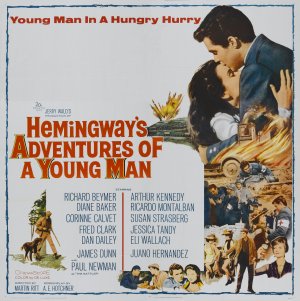


 It’s the 1920s. Prohibition is the law of the land and gangsters control the streets of New York City. Jack Diamond (Ray Danton) and his tubercular brother, Eddie (Warren Oates), arrives in town. Jack and Eddie are small-time jewel thieves but Jack has ambitions to be something more. He works with his girlfriend, Alice (Karen Steele), as a dance instructor but he dreams of being the most powerful mobster in the world. His first step is to get a job working as a bodyguard for New York crime lord (and fixer of the 1919 World Series), Arnold Rothstein (Robert Lowery). Though Rothstein never trusts him, Jack works his way into his inner circle and even gets a nickname. Because he is a dancer, he is renamed “Legs” Diamond.


 Through the Shattered Lens