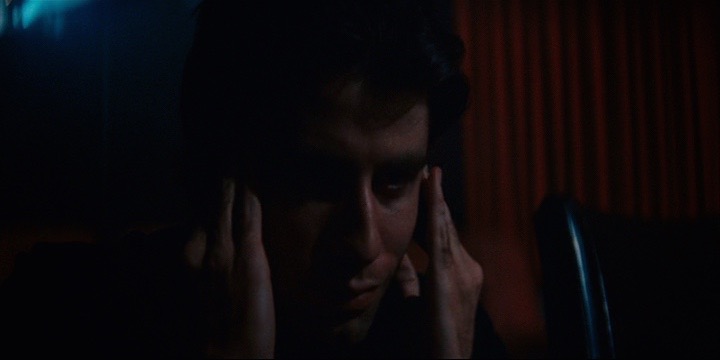
When wealthy playboy David Greenhill (Don Johnson, doing a one-note Michael Douglas impersonation) is accused of throwing his wife out of a window, there’s only one lawyer who he wants to defend him. Jennifer Haines (Rebecca De Mornay) may have just won a huge case but it is obvious that the only reason that David wants her on his team is because she’s sexy as Hell and David has an obsessive streak. Still, despite the misgivings of her boyfriend (Stephen Lang) and her mentor (Jack Warden), she takes the case, convinced that she is the only attorney smart enough to be able to get David acquitted.
It becomes very obvious that David is not only probably guilty but that he might be a serial killer as well. Not only does he start to turn up everywhere that Jennifer goes but, protected by attorney/client privilege, he starts to tell her all of his dark secrets. Jennifer finds herself trapped into defending an obviously guilty client, one who appears to be setting her up to be his next victim. Even when he fails to pay her for her services, the trial judge refuses to allow Jennifer to quit the case.
Back in the 90s, Guilty As Sin used to frequently show up on late night HBO and Cinemax. I always watched because I had a crush on Rebecca De Mornay and I bet I was not alone as far as that’s concerned. Late night cable is where Guilty As Sin belongs, which makes it strange that this weak and implausible movie was directed by Sidney Lumet. One of the legitimately great American directors, Lumet directed several classic courtroom thrillers over the course of his career. Guilty As Sin is not one of them. This is probably the most impersonal film that Lumet ever made. Other than the presence of Lumet favorite Jack Warden, there is nothing about Guilty As Sin that would lead anyone to think that it had been directed by the same man responsible for 12 Angry Men, Dog Day Afternoon, Network, or Prince of the City.
Fortunately, though Guilty As Sin was one of his Lumet’s last films as a director, it was not his final film. Released in 2007, Lumet’s final film was a crafty thriller called Before The Devil Knows Your Dead, which showed that, at the age of 83, Lumet was still one of the greats and that Guilty As Sin was just a minor bump in an otherwise brilliant career.
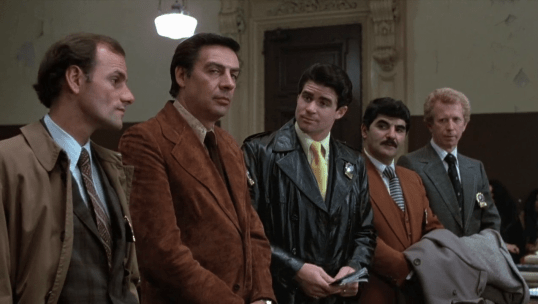
In 1970s New York City, Danny Ciello (Treat Williams) is a self-described “prince of the city.” A narcotics detective, Ciello is the youngest member of the Special Investigations Unit. Because of their constant success, the SIU is given wide latitude by their superiors at the police department. The SIU puts mobsters and drug dealers behind bars. They get results. If they sometimes cut corners or skim a little money for themselves, who cares?
It turns out that a lot of people care. When a federal prosecutor, Rick Cappalino (Norman Parker), first approaches Ciello and asks him if he knows anything about police corruption, Ciello refuses to speak to him. As Ciello puts it, “I sleep with my wife but I live with my partners.” But Ciello already has doubts. His drug addict brother calls him out on his hypocrisy. Ciello spends one harrowing night with one of his informants, a pathetic addict who Ciello keeps supplied with heroin in return for information. Ciello finally agrees to help the investigation but with one condition: he will not testify against anyone in the SIU. Before accepting Ciello’s help, Cappalino asks him one question. Has Ciello ever done anything illegal while a cop? Ciello says that he has only broken the law three times and each time, it was a minor infraction.
For the next two years, Ciello wears a wire nearly every day and helps to build cases against other cops, some of which are more corrupt than others. It turns out that being an informant is not as easy as it looks. Along with getting burned by malfunctioning wires and having to deal with incompetent backup, Ciello struggles with his own guilt. When Cappalino is assigned to another case, Ciello finds himself working with two prosecutors (Bob Balaban and James Tolkan) who are less sympathetic to him and his desire to protect the SIU. When evidence comes to light that Ciello may have lied about the extent of his own corruption, Ciello may become the investigation’s newest target.
Prince of the City is one of the best of Sidney Lumet’s many films but it is not as well-known as 12 Angry Men, Dog Day Afternoon, Network, Serpico, The Verdict, or even The Wiz. Why is it such an underrated film? As good as it is, Prince of the City is not always an easy movie to watch. It’s nearly three hours long and almost every minute is spent with Danny Ciello, who is not always likable and often seems to be on the verge of having a nervous breakdown. Treat Williams gives an intense and powerful performance but he is such a raw nerve that sometimes it is a relief when Lumet cuts away to Jerry Orbach (as one of Ciello’s partners) telling off a district attorney or to a meeting where a group of prosecutors debate where a group of prosecutors debate whether or not to charge Ciello with perjury.
Prince of the City may be about the police but there’s very little of the typical cop movie clichés. The most exciting scenes in the movie are the ones, like that scene with all the prosecutors arguing, where the characters debate what “corruption” actually means. Throughout Prince of the City, Lumet contrasts the moral ambiguity of otherwise effective cops with the self-righteous certitude of the federal prosecutors. Unlike Lumet’s other films about police corruption (Serpico, Q&A), Prince of the City doesn’t come down firmly on either side.
(Though the names have been changed, Prince of the City was based on a true story. Ciello’s biggest ally among the investigators, Rick Cappalino, was based on a young federal prosecutor named Rudy Giuliani.)
Prince of the City is dominated by Treat Williams but the entire cast is full of great New York character actors. It would not surprise me if Jerry Orbach’s performance here was in the back of someone’s mind when he was cast as Law & Order‘s Lenny Briscoe. Keep an eye out for familiar actors like Lance Henriksen, Lane Smith, Lee Richardson, Carmine Caridi, and Cynthia Nixon, all appearing in small roles.
Prince of the City is a very long movie but it needs to be. Much as David Simon would later do with The Wire, Lumet uses this police story as a way to present a sprawling portrait of New York City. In fact, if Prince of the City were made today, it probably would be a David Simon-penned miniseries for HBO.
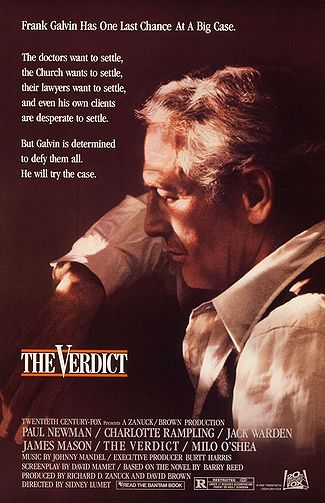
Speaking of the good, old-fashioned star power of Paul Newman, The Hustler and Butch Cassidy and the Sundance Kid were not the only films to receive an oscar nomination as the result of his charisma. There’s also The Verdict, a 1982 best picture nominee that would probably be forgotten if not for Paul Newman’s performance. However, since Paul Newman did play the lead role in The Verdict and he did give an amazing lead performance, The Verdict was nominated for best picture and, 33 years later, it ended up on TCM where I just watched it.
That’s the power of good acting.
Paul Newman plays Frank Galvin, a Boston-based attorney. At one time, Frank was a lawyer at an elite firm. But he has since fallen on hard times. Now, he’s the type of attorney who crashes funerals and hands out his card. He spends his spare time at his favorite bar, playing pinball and telling long jokes while stumbling about in a drunken haze. In many ways, Frank represents everything that people hate about personal injury attorneys but, since he’s played by Paul Newman, you know that he’s going to turn out to be a good guy.
Frank only has one friend left in the world, his former mentor Mickey (Jack Warden). Looking to help Frank out, Mickey sends Frank a medical malpractice suit. A woman at a Catholic Hospital was given an anesthetic during child birth that has led to her now being brain dead. Both the woman’s family and the Archdiocese are looking for a settlement. The family needs the money to pay for her medical care. The Archdiocese just wants the case to go away. All Frank has to do is accept whatever settlement deal is offered…
However, something has changed for Frank. He’s visited the comatose woman and, looking at her trapped in a vegetative state, he’s decided that the hospital needs to be held responsible for its mistake. He rejects the settlement and takes the case to court, looking for both justice for the victim and redemption for himself.
That’s easier said than done, of course. The Archdiocese has hired Ed Concannon (James Mason, perfectly cast), one of the best and most powerful attorneys in Boston. Ed has a huge legal team working on the case. Frank has Mickey. As well, the Judge (Milo O’Shea) makes little effort to hide his contempt for Frank.
Probably the only bright spot in Frank’s life is that he’s met a woman. Laura (Charlotte Rampling) meets him in a bar and soon, they’re lovers and Frank is confiding in her about the case. What he doesn’t suspect is that Laura herself is a spy, hired by Concannon.
It looks like all is lost but then Frank discovers that there is one nurse (Lindsay Crouse) who might be willing to tell the truth about what happened at the hospital…
In many ways, The Verdict is a predictable film. From the minute we first meet him, we know that Frank is going to be redeemed. From the minutes that we hear about the case, we know who we’re supposed to root for and who we’re supposed to hiss. Just about every courtroom cliché is present, right down to a surprise witness or two…
But no matter! The Verdict may be predictable but it works. As he proved with 12 Angry Men, Director Sidney Lumet knew how to make legal deliberations compelling and the entire film is full of small but memorable details that elevate it above its simplistic storyline. As a director, Lumet gets good performances from his cast and, as a result, this is a film where the hero is flawed and the antagonists aren’t necessarily evil. Even the Bishop of the Archdiocese of Boston (who, in most films, would have been a cardboard villain) is given a scene where he’s allowed to show some humanity.
And, of course, Paul Newman is great in the role of Frank. When we first meet Frank, he looks and sounds terrible. Indeed, it’s strange to see Paul Newman playing a character who is essentially such a loser. (Even Eddie Felson in The Hustler had an appealing swagger about him.) It’s during the scenes where Frank considers the woman in a coma that Newman starts to reveal that there’s more to Frank than what’s on the rough surface. By the end of the film, Frank may be a hero but Newman doesn’t play him as such. He’s still has that alcoholic rasp in his voice and his eyes still betray hints of insecurity and a fear that, at any minute, he’s going to screw up and mess everything up. It’s a great performance, one for which Newman received a nomination for best actor.
Speaking of star power, Bruce Willis also shows up in The Verdict. He’s an extra who appears as an observer in the courtroom. He’s sitting a few rows behind Paul Newman. (He’s also sitting beside Tobin Bell, the Jigsaw Killer from the Saw films). It’s probably easiest to spot Willis towards the end of the film, when the verdict is read. Bruce breaks out into a huge grin and almost looks like he’s about to start clapping. Bruce only gets about 10 second of screen time but he acts the Hell out of them!
Thanks to Paul Newman, The Verdict is a memorable and entertaining film. Be sure to watch it the next time it shows up on TCM.
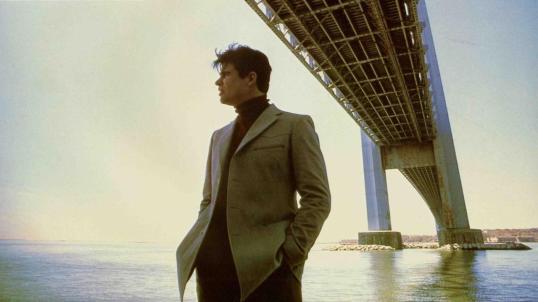
Oddly enough, right after I watched City Hall, I watched yet another 1997 film about politics and police corruption in New York. And while Night Falls on Manhattan is definitely not one of Sidney Lumet’s best films, it’s still definitely an improvement on City Hall.
Night Falls on Manhattan tells the story of what happens when two veteran detectives — Liam Casey (Ian Holm) and Joey Allegreto (James Gandolfini) — attempt to arrest drug dealer Jordan Washington (Shiek Mahmud-Bey). Liam ends up getting shot multiple times before Jordan, disguised as a police officer, flees the scene. As the cops search for Jordan, they accidentally shoot and kill one of their own.
In short, Manhattan has gone crazy and only the prompt capture and conviction of Jordan Washington will set things right.
However, the police don’t have to spend too much time searching for Jordan because, the very next day, he turns himself in. He’s accompanied by a veteran radical lawyer named Sam Vigoda (Richard Dreyfuss). Vigoda announces that yes, Jordan is a drug dealer and yes, he did shoot Liam Casey. However, Vigoda claims that Jordan has been paying off the cops and that Liam and Joey weren’t actually trying to arrest him. Instead, they were specifically looking for an excuse to execute him.
Flamboyant District Attorney Morganstern (Ron Leibman) know that his office has to convict Jordan. And luckily, he has a secret weapon. Liam’s son, Sean (Andy Garcia), just happens to be a former cop and an assistant district attorney. He assigns Sean to handle Jordan’s prosecution.
Sean, it turns out, has political ambitions of his own and, by prosecuting Jordan, he not only gets revenge for the shooting of his father but he also furthers his own career. (He also gets a girlfriend, in this case an associate of Vigoda’s who is played by Lena Olin.) When Morganstern has a heart attack, Sean suddenly finds himself being mentioned as a candidate to replace him in the upcoming election.
However, even as Sean appears to be shoo-in to be the next district attorney, he also discovers that neither Liam nor Joey were as innocent as he originally assumed..
Night Falls In Manhattan is an occasionally diverting legal and political thriller. As a director, Sidney Lumet had an obvious feel for New York culture and, as a result, the film feels authentic even when the plot occasionally veers into melodrama. As opposed to City Hall, you never doubt the plausibility of Night Falls On Manhattan. Though Andy Garcia is a bit an odd choice to play an Irish-American (and it’s particularly difficult to imagine him being, in any way, related to Ian Holm), the rest of the film is well-cast. Fans of The Sopranos will enjoy a chance to see James Gandolfini playing someone who, because he’s on the “right” side o the law, is actually more dangerous than Tony Soprano and Rob Leibman is thoroughly believable as a bullying crusader against crime.
After I watched Night Falls on Manhattan, I did some checking online and I was surprised to discover that the film is apparently not better known than it is. While it definitely uneven, Night Falls On Manhattan is an interesting look at crime, ethics, and urban politics.
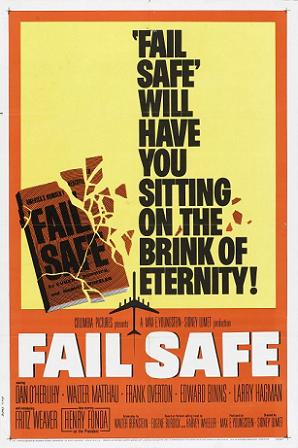
After watching Dr. Strangelove, you may find yourself asking what that film would have been like if it had treated its doomsday scenario seriously. Well, you can find out by watching yet another film from 1964, Sidney Lumet’s Fail-Safe.
What’s Fail-Safe about? Well, basically, it tells the exact same story as Dr. Strangelove, except without the humor. Once again, an American bomber is accidentally ordered to launch a nuclear attack against Russia. Again, the President (played, somewhat inevitably, by Henry Fonda) has to have an awkward conversation with the leader of Russia. Again, a sinister defense advisor (this time played by Walter Matthau) argues that the world can survive a nuclear war.
Admittedly, there is no equivalent to George C. Scott’s Buck Turgidson in Fail-Safe. However, there is a General Black (Dan O’Herilihy) who has a recurring nightmare about watching a bullfight while the sky around him glows with radiation.
Fail-Safe has the same plot as Dr. Strangelove but none of the humor. In fact, Fail-Safe has absolutely no humor at all. It’s one of the most somber films that I’ve ever seen. It has a good opening with General Black’s nightmare and an effective ending that makes excellent use of freeze frames but the middle of the film is basically just a collection of endless debates.
And I’m sure that approach made sense at the time because, after all, Fail-Safe was dealing with a serious theme, it was directed by a serious filmmaker, and it featured a bunch of serious actors. And maybe if I had never seen Dr. Strangelove, Fail-Safe would not seem like such a slow and boring movie. But I have seen Dr. Strangelove and, as a result, it’s impossible to watch Fail-Safe without wanting to hear Henry Fonda say, “You can’t fight here! This is the war room!”
Everyone already knows that the 1957 Best Picture nominee 12 Angry Men is a classic. We all know the film’s story — a teenage boy is on trial for murdering his family. 11 jurors want to convict. 1 juror doesn’t. Over the next few hours, that one juror tries to change 11 minds. Some of the jurors are prejudiced, some of them are bored, and some of them just want to go home. And, as the film reminds us, all 12 of them have a huge responsibility. You don’t need me to tell you that this is a great movie. Therefore, consider this to be less of a review and more of an appreciation of one of the best movies ever made.
1) The film is the feature debut of director Sidney Lumet. As any student of American film can tell you, Sidney Lumet was one of the most important directors in the history of cinema. After beginning his career in television, Lumet made his film directing debut with 12 Angry Men and he was rewarded with a much deserved Oscar nomination for best director.
2) The film’s story is actually a lot more complex than you might think. 12 Angry Men is such an influential film and its story has been imitated so many times that it’s easy to forget that the film’s plot is a lot more nuanced than you might think. Despite what many people seem to think, Juror Number 8 never argues that the defendant is innocent. Instead, he argues that the state has not proven its case beyond a reasonable doubt and, as a result, the defendant cannot be convicted. That’s an important lesson that is too often forgotten.
3) The movie celebrates the power of one person determined to do the right thing. Again, that’s a lesson that remains very relevant today.
4) As Juror Number Eight, Henry Fonda makes human decency believable.
5) As the angry and bullying Juror Number Three, Lee J. Cobb is the perfect antagonist.
6) As Juror Number Ten, Ed Begley makes Cobb seem almost reasonable. To be honest, the scene where Begley’s racist ranting causes all of the other jurors to stand up and turn their back on him feels a bit too theatrical. But it’s still undeniably effective. Alone among the jurors, Juror Number Ten is the only one without any hope of redemption. It’s a bit of a thankless role but Begley does what he has to do to make the character believable.
7) E.G. Marshall makes the wealthy Juror Number Four into a worthy opponent of Fonda without crossing the line into prejudice like Cobb and Begley. In many ways, Marshall’s role is almost as important as Fonda’s because Marshall’s performance reminds us that not all disagreements are the product of ignorance or anger.
8) As the Jury Foreman, Martin Balsam is the epitome of every ineffectual authority figure.
9) As Juror Number Seven, Jack Warden is hilariously sleazy.
10) As Juror Number Nine, Joseph Sweeney grows on you. The first time I saw the film I thought that Sweeney went a bit overboard but, on more recent viewings, I’ve come to appreciate Sweeney’s performance.
11) As Juror Number Twelve, Robert Webber is hilariously shallow. Juror Number Twelve is in advertising and Webber seems like he was right at home on Mad Men.
12) Though they don’t get as much of a chance to make an impression, John Fiedler, Jack Klugman, Edward Binns, and George Voskovec all do good work as the other jurors. If there’s ever been a film that proves the value of a great ensemble, it’s 12 Angry Men.
With the recent passing of director, Sidney Lumet, I decided to watch one of Lumet’s best-known films, the 1976 best picture nomineeNetwork.
Network tells the story of Howard Beale (played by Peter Finch). Howard is a veteran news anchor at a fictional television network. Because his ratings are in decline, Howard is fired. Howard reacts to this by announcing that he will commit suicide at the end of the next broadcast. Ironically, so many people tune in to see Howard kill himself that his ratings improve and Howard gets to keep his job under the watchful eyes of news director Max Shumacher (William Holden) and network executive Dianne Christiensen (Fay Dunaway).
At the same time, Max and Dianne are adulterous lovers. The course of the film’s narrative finds Max abandoning his wife (Beatrice Straight) and Dianne, who is described as a “child of the tube,” enthusiastically trying to produce an early reality television show starring a group of Marxist revolutionaries. They do this under the paranoid eyes of network president Frank Hackett (Robert Duvall) and Frank’s boss, the corrupt Arthur Jenson (Ned Beatty).
However, Howard Beale isn’t just an over-the-hill news anchor. He’s actually a seriously mentally ill man who hears voices and who starts to see himself as some sort of messiah. Eventually, this leads to a disheveled Howard giving a crazed speech in which he encourages viewers to yell, “I’m as mad as Hell and I’m not going to take it anymore!” Yes, this is the famous scene that is always used whenever some pompous media jackass wants to criticize the current state of television. Even though I think it’s one of the most overrated scenes in history, here it is:
Anyway, after this scene, Dianne starts to promote Howard as the “Mad Prophet of the Airwaves” and Max gets all outraged over how the news no longer has any integrity (bleh, Max is kinda full of himself) and eventually, Howard’s mad rantings get the attention of Arthur Jenson who has plans of his own for Howard. The whole thing eventually ends on one of those rather dark notes that’s impressive the first time you watch it but just seems more heavy-handed and clumsy with subsequent viewings.
As you might be able to tell from my review, I almost felt as if I was watching two different movies when I watched Network. For the first hour, the movie is a sharp and clever satire on the media. The characters are sharply drawn, the performance are full of nuance, and even the villainous Dianne is allowed a bit of humanity. And then, Howard gives his famous “mad as Hell” speech and the entire freaking film pretty much just falls apart as suddenly, all the characters start to act like cartoons. The film’s satire becomes so heavy-handed that you actually find yourself wanting to watch something mindless and brainless just because you know it would piss off self-righteous old Max. The actors stop acting and instead concentrate on shouting. Whatever humanity Dianne had been allowed suddenly vanishes and she just becomes yet another stereotypical “castrating bitch.” Max gets to spend a lot of time telling her why she’s worthless and it pretty much all comes down to the fact that 1) she’s under 40 and 2) she has a vagina. (Never mind the fact that Max has abandoned his wife, apparently men are allowed to be assholes.) By the time the 2nd half of the film ends, you don’t care about whatever the film’s message may have been. You’re just happy that everyone has finally shut up.
As I sat through the second half of this film, it soon became apparent to me why Aaron Sorkin has continually cited Network‘s screenwriter Paddy Chayefsky as a major influence. Chayefsky won an Oscar for writing Network and he’s constantly cited as one of the greatest screenwriters of all time but, quite frankly, his script isn’t that good. Much like Sorkin’s work, you’re aware of the screenplay not because of what the characters say but because they say so much. This is the type of film that is often wrongly called prophetic by bitter old men. This is largely because the script itself was written by a bitter old man. The only true insight one gets from this movie is the insight that the old will always view the young and the new as a threat.
And yet, even as the second half of the film collapses around us, Network still holds our attention. We’re still willing to stick around to see how all of this ends (and keep an eye out for a 17 year-old Tim Robbins who made his uncredited film debut at the end of Network). This has nothing to do with anything written by Paddy Chayefsky and everything to do with the direction of Sidney Lumet. I once read somewhere that you can’t make a good film out of a bad script. I’m not sure who said that though it has a definite William Goldman sound to it. Well, if nothing else, Network proves that this is not always the case.
To me, there is no more fitting tribute to Sidney Lumet than to say that he somehow managed to create something worthwhile out of Network.
With the recent passing of filmmaker Sidney Lumet I’ve gone through some of the films of his I’ve come to see as favorites of mine. One film which always came to the forefront whenever I spoke about Lumet as a filmmaker is his directorial film debut in 1957 with his adaptation of 12 Angry Men. Of all his films this is the one which I always go back to time and time again. Part of me is somewhat biased in regards to this film since I was part of a class reading of the original teleplay and played the role of Juror #3.
The scene in the film which I love the most has to be when Juror #8 (played with calm assurance by Henry Fonda) and Juror #3 (played with seething rage by Lee J. Cobb) finally get into it after a very long deliberation in trying to find a consensus on the guilt or innocence of the defendant in their case. I love how in this scene everything that’s right about the American jury system was being upheld by Juror #8. How the guilt or innocence of the defendant should come down to just the facts of the case and combing through all the testimony. How emotions and personal feelings and bias should never enter the equation. It is a person’s life in their hands and it is a responsibility too great to leave it to emotions to find the verdict.
This scene also shows the darker side of the American jury system in that there will be, at times, people chosen to preside as a juror in a case will come in with emotional baggage and a hidden agenda which clouds their decision making. They don’t look at the facts and testimony at hand but at what they believe to be true no matter what the facts may say otherwise. this is how the jury system becomes twisted and becomes part and parcel to the notion that justice is never truly blind but always colored by human frailties and prejudices.
Even 54 years since the films first premiered it still holds a powerful effect on me and those who sees it for the first time. It helps that you have a master filmmaker in Sidney Lumet guiding an exceptional cast of actors. One could come to the conclusion that the audience has the angel on one shoulder with Juror #8 and the devil on the other with Juror #3. All in all, a great scene that always stays with me long after the film has ended.
Sad news came across the news wire this morning as it was confirmed that one of the most esteemed filmmaker in America has passed away at the age of 86. Sidney Lumet was considered by many as one of the best filmmakers of all-time. He definitely is one of the best, if not the best, American filmmaker of all-time.
Lumet was quite prolific as a filmmaker since he began to work behind the camera starting in 1957 with the classic drama 12 Angry Men and ending with his most recent work in 2007 with Before the Devil Knows Your Dead. In between these two films he would direct another 43 films with all of them received positively by critics and audiences everywhere. He was the consummate professional and never waited for the perfect project to come along. He always went into a film project because he either liked the script or, barring being in one which didn’t have a script he liked, it had actors he wanted to work with or he wanted to test his abilities as a filmmaker with new techniques.
Sidney Lumet began his career directing Off-Broadway plays and summer stock productions. He would soon move into directing tv shows in 1950. It would be his time as a tv director where turn-arounds between episodes were so short that a director had to work quite fast that he would earn the reputation as a filmmaker who didn’t spend too much time shooting too many takes of a scene. Lumet became known as a filmmaker who would shoot one to two takes of a scene and move onto the next. Another tool he learned as a tv director that served him well once he moved into film was to rehearse for several weeks with his actors the script before starting up actual production behind the camera.
It was in 1957 when he finally moved into filmmaking with 12 Angry Men (itself previously a teleplay for a TV drama) which would catapult him into prominence in the film community. The film was well-received and still considered by many as one of the most influential films of its kind as it highlighted social injustice in a time when such themes were not considered profitable by studios and the people who ran them. This was the film which would help build the foundation of Lumet’s filmmaking-style as he would continue to use filmmaking as a way to tell the audience about social injustices not just in his preferred film location of New York, but in America and the world, in general. Some of the best films in American history were done by him during the 1970’s when he would take the chaos and public distrust of long-standing public institutions in the US and crafted three of the finest films of the 70’s and America as it was during that decade with Serpico, Dog Day Afternoon and Network.
Sidney Lumet’s legacy as a filmmaker will continue to inspire young filmmakers long after his passing. He was a man who looked at filmmaking as an artform and not just a way to entertain the audience. His films never talked down or pandered to the very general public who watched them unlike some of the filmmakers working in the industry today. His legacy as being the consummate “actor’s director” meant that one didn’t need to be dictatorial with his cast and crew to create a great piece of filmmaking. That there were other ways to make a film and do it in such a way that everyone were still able to give their best without being alienated to do so.
My very first experience when it came to Sidney Lumet had to have been watching his Cold War classic, Fail-Safe, in high school history and it was one of those films which got me looking at film as something more than a form of entertainment. Here was a film that was entertaining but also one so well-made and acted that it’s ideas and themes were not lost. It opened up my eyes to the possibility of film as a medium that could be used to teach, raise issues to debate in society and highlight both the good and the bad of the human experience.
Sidney Lumet has made such an impact not just on those who were fans of films and grow up to become players in the industry, but also those people who would work in other fields of life whether they were lawyers, judges, police officers or politicians (professionals he would use over and over in his films throughout his career). Even Supreme Court Justice SOnia Sotomayor would look at Lumet as an inspiring figure in convincing her that she made the correct choice in choosing law as the path for her professional life.
I find it one of the most fitting tribute for Sidney Lumet that his time as a filmmaker and doing what he enjoyed doing the most became inspirational for people of all color, stripe and creed. This was a man who didn’t just take from the public but gave back just as much in the end. America has truly lost one of its best artists.
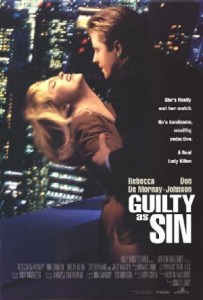 When wealthy playboy David Greenhill (Don Johnson, doing a one-note Michael Douglas impersonation) is accused of throwing his wife out of a window, there’s only one lawyer who he wants to defend him. Jennifer Haines (Rebecca De Mornay) may have just won a huge case but it is obvious that the only reason that David wants her on his team is because she’s sexy as Hell and David has an obsessive streak. Still, despite the misgivings of her boyfriend (Stephen Lang) and her mentor (Jack Warden), she takes the case, convinced that she is the only attorney smart enough to be able to get David acquitted.
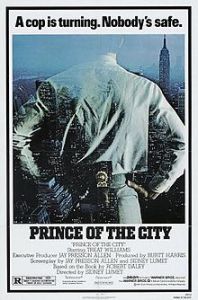 In 1970s New York City, Danny Ciello (Treat Williams) is a self-described “prince of the city.” A narcotics detective, Ciello is the youngest member of the Special Investigations Unit. Because of their constant success, the SIU is given wide latitude by their superiors at the police department. The SIU puts mobsters and drug dealers behind bars. They get results. If they sometimes cut corners or skim a little money for themselves, who cares?